
Deep-Drawn Gold Tinplate or Copper-Plated Strip? A Buyer Guide
Deep-Drawn Gold Tinplate or Copper-Plated Strip? A Buyer Guide
Two decorative metal routes now compete for the same drawn part. On one side sits 0.14–0.15 mm gold pre-painted tinplate strip — a coated electrolytic tinplate product engineered so the gold lacquer survives deep drawing without peeling. On the other sits copper-plated steel strip, the incumbent finish for decorative hardware, closures and gift-grade packaging components. A third route, mirror gold or bronze tinplate sold as a SUS201/SUS410 substitute, occupies the appearance-led middle ground between them.
For buyers in the evaluation stage, the useful question is narrower than “which finish looks better in a sample book”. It is which finish holds its colour and adhesion through the draw, the handling, the packing line and the documentation audit — and at what landed cost per accepted part. This comparison is written as an independent buyer reference: it separates what a supplier can document today from what still has to be proven on your own tooling.
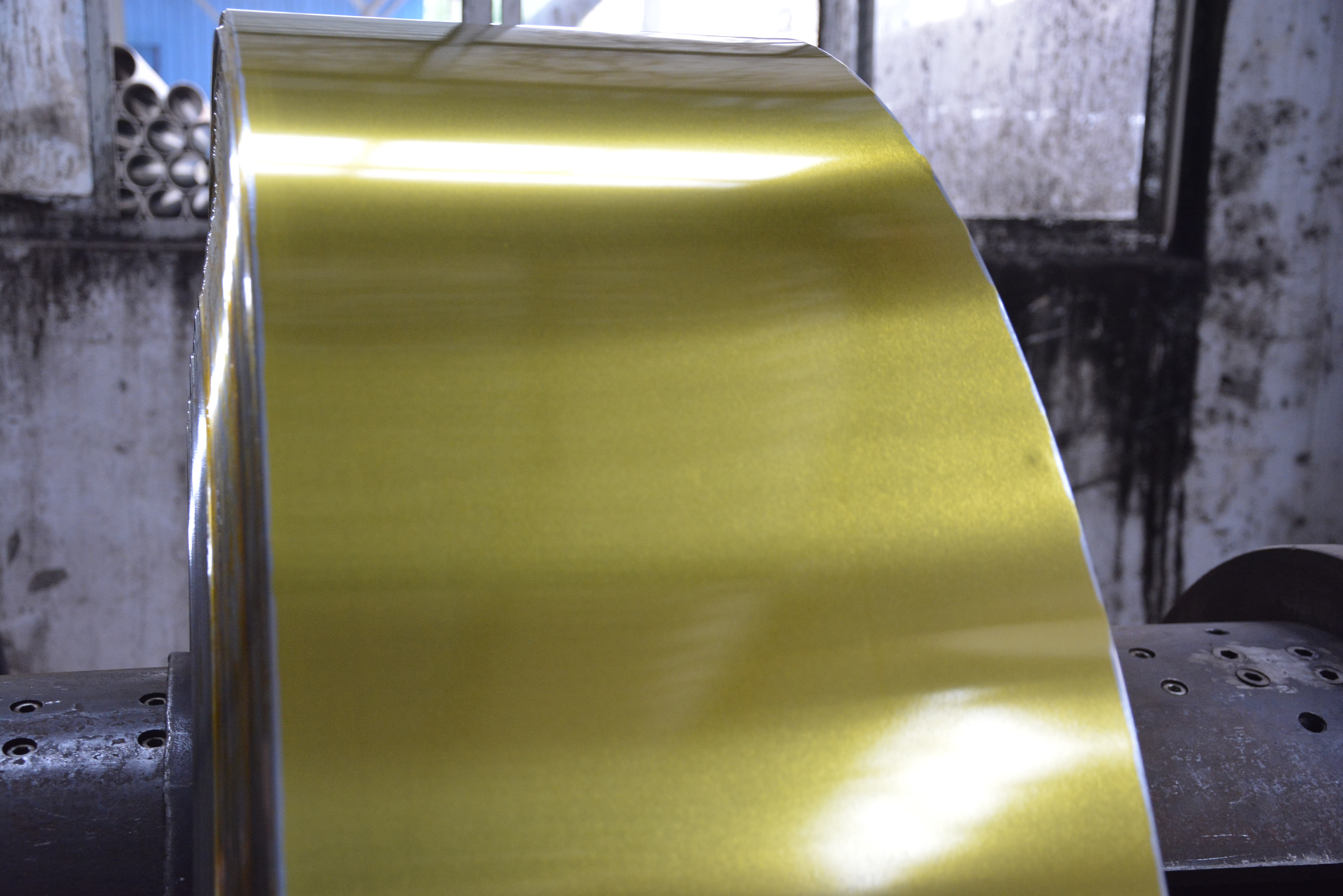
Gold colour-coated tinplate strip: a coated steel surface system competing with electroplated copper finishes in drawn decorative parts.
Why coated strip substitution became a procurement question
Tinplate is a mature substrate, but the market around it is not static. Commercial research published in 2026 places the global tinplate market at USD 31.98 billion in 2025, with Asia Pacific accounting for 39.2% of that value. The same body of research shows why such figures should be used cautiously: published estimates for the same year range from roughly USD 15 billion to USD 33 billion, because some studies count raw coated steel while others include finished packaging. For a buyer, the practical reading is directional — coating and slitting capacity near Asian converting hubs is deep, and the range of ready-to-draw decorative finishes has widened.
That widening is what turns a materials question into a procurement question. When a gold or bronze finish can be applied on a coating line and slit to width before shipment, the buyer is no longer sourcing a commodity sheet — the buyer is sourcing a surface system whose adhesion, colour consistency and edge quality have to be specified, sampled and accepted. Metal packaging, candle and closure hardware, and decorative gift components are the categories where this shift is most visible.
The three routes in technical terms
1. Gold pre-painted tinplate strip for deep drawing
The product type represented here is a 0.14 mm and 0.15 mm ultra-thin gold pre-painted tinplate strip built for deep drawing with anti-peeling behaviour (model GD-TPL-0.14-0.15 in YOUNGSON METAL’s range). The substrate is a high-tensile matrix in DR8, DR7 or TH520 tempers, the gold coating adhesion is supported by SGS food-grade testing, and production runs under a BV ISO 9001 system. Because the gauge is thin, the strip is normally supplied precision-slit to the part width rather than as wide coil, which is why slitting tolerance and burr control matter as much as the coating itself.
2. Copper-plated steel strip, the incumbent
Copper-plated steel strip uses an electroplated copper layer to deliver its warm tone. It is a long-established route and remains a legitimate choice. It is also the route that coated tinplate alternatives are explicitly positioned against: YOUNGSON METAL lists a cost-saving alternative to copper-plated steel strip (ECO-BRONZE-TP) alongside the gold pre-painted range. Buyers should note that published plating specifications vary by supplier, so the criteria below are written to be applied to whatever data a copper-plated supplier actually provides, rather than to a single fixed benchmark.
3. Mirror gold and bronze tinplate as a stainless substitute
The third route is a coated tinplate finished to a mirror appearance and sold as a SUS201/SUS410 cost-saving alternative. YOUNGSON METAL’s range includes an anti-fingerprint mirror gold tinplate (MFG-200 Premium Eco-Coated Series, custom specs available), an anti-fingerprint mirror bronze stainless steel substitute (MF-BR-TPL01), and mirror finish tinplate strip in the 0.18–0.55 mm band. These are appearance substitutions: a coated steel surface is asked to do the visual job of a stainless surface, usually in visible but non-aggressive service.
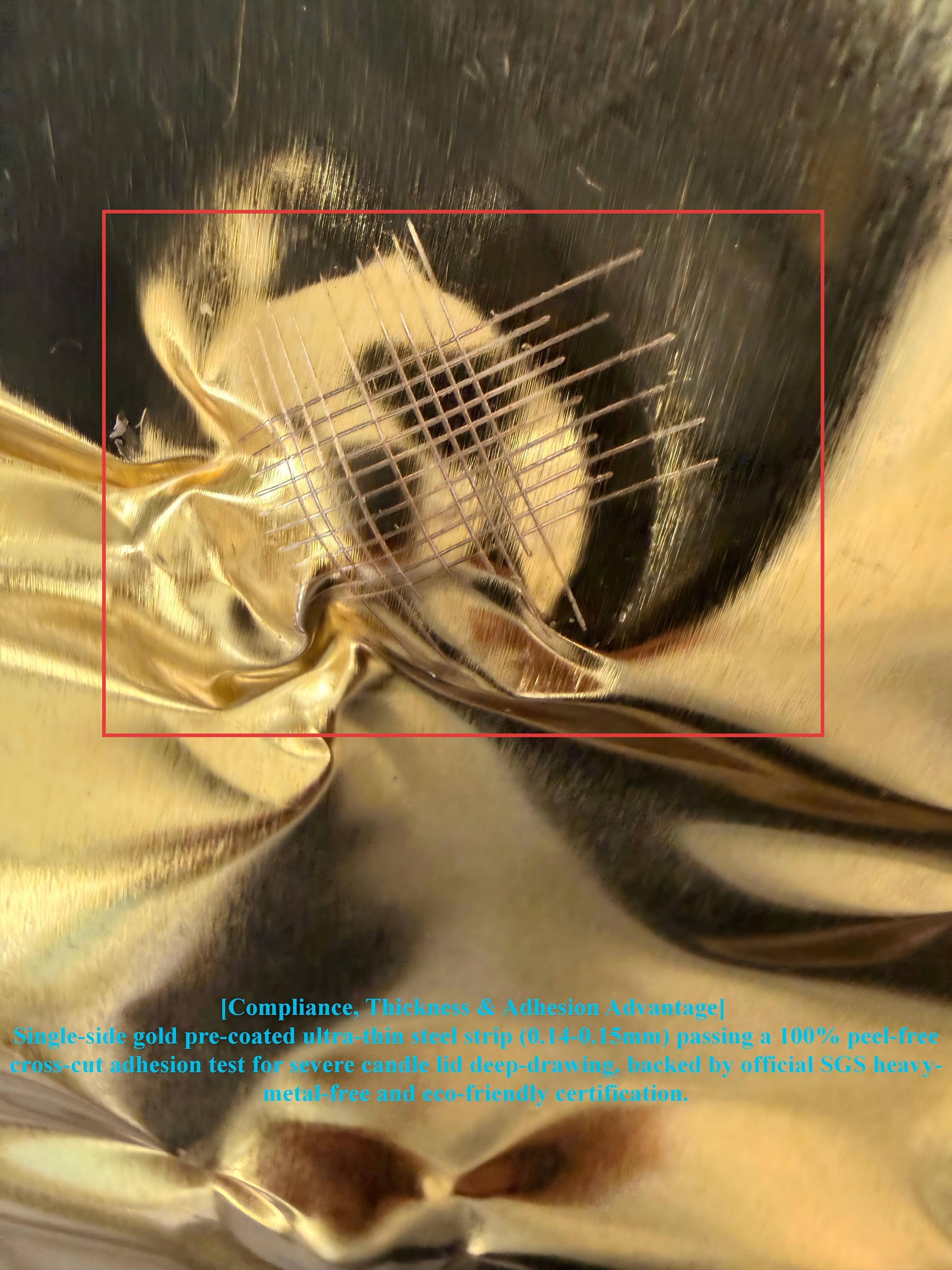
Cross-cut adhesion testing is the evidence that separates a decorative claim from a drawable finish.
Five criteria that actually decide the comparison
Coating adhesion under strain
This is the first filter, because everything else is irrelevant if the colour layer fails at the draw radius. Ask for cross-cut adhesion results and T-bend data on the exact coating and gauge you intend to run, not on a generic sample. Where the substrate is a DR8 or TH520 matrix, confirm the temper on the mill certificate: published technical summaries commonly place DR8 in the 69–75 HR30Tm band, but the actual value on your lot is the one that governs forming behaviour.
Appearance retention and handling
Mirror finishes show every touch, so anti-fingerprint treatments are a production requirement rather than a marketing extra. They reduce handling marks during slitting, packing and press feeding; they do not make a mirror surface immune to contact. If your line transfers parts by hand or with suction cups, agree a handling spec and a reference sample with your supplier before the first production lot.
Dimensional control: thickness, width, burr
On a 0.14–0.15 mm strip, small dimensional variation turns into press trouble. Two numbers belong in the purchase order: thickness tolerance, quoted at ±0.005 mm on precision slit strip from this supplier, and slitting tolerance, quoted at ±0.02 mm for width and slit edges, with burr control of ≤0.05 mm. Joint-free coils matter as much as tolerance in progressive dies, since a joint stops the line and can damage tooling.
Documentation quality
A finish is only as qualified as the paperwork behind it. The minimum pack for this category is an MTC EN 10204 3.1, a 100% in-house inspection record covering thickness, coating mass, tensile strength, T-bend, salt spray and surface roughness, and access to third-party inspection through SGS, BV or TÜV where the buyer’s own QA requires it.
Commercial terms and yield
Substitution economics are decided by yield, not by price per kilogram. A coating that peels on 2% of parts can erase the advantage of a cheaper coil. Compare offers on cost per accepted part, including scrap allowance, tool wear and any secondary finishing the cheaper route still requires.
Side-by-side comparison for buyers
| Criterion | Gold pre-painted tinplate strip (0.14–0.15 mm) | Copper-plated steel strip | Mirror gold / bronze tinplate (SUS substitute) |
|---|---|---|---|
| Surface system | Organic colour coating on electrolytic tinplate | Electroplated copper layer on steel | Coated tinplate finished to mirror appearance |
| Documented strength in this range | SGS food-grade coating adhesion; DR8/DR7/TH520 matrix; BV ISO 9001 plant | Supplier-specific — request plating mass, adhesion and salt-spray data | Anti-fingerprint treatment; custom specifications available |
| Deep-draw behaviour | Designed for anti-peeling under draw; 0% delamination reported in a candle-lid draw application | Depends on plating adhesion at the draw radius — test on your tool | Best suited to shallow or appearance-only forming |
| Handling marks | Colour layer tolerant of normal press feeding | Tone changes with oxidation and contact — agree a reference sample | Anti-fingerprint is the main safeguard; mirror surfaces stay contact-sensitive |
| Dimensional control | Thickness ±0.005 mm; slitting tolerance ±0.02 mm; burr ≤0.05 mm | Confirm tolerance and joint policy in writing | Mirror finish strip offered in the 0.18–0.55 mm band |
| Cost positioning | Marketed as a cost-saving route against copper plating | Benchmark for comparison; plating adds process steps | Marketed as a SUS201/SUS410 cost-saving alternative |
| Main caution | Qualify adhesion on your draw depth before volume release | Verify plating scope and environmental performance | Appearance substitution only; not a corrosion-equivalence claim |
What verifiable evidence looks like in this category
Chongqing Youngson Metal Products Co., Ltd. (YOUNGSON METAL) is a Chongqing-based manufacturer founded in 2016 that coats, slits and supplies tinplate, TFS and pre-painted steel strip for packaging and hardware applications, with roughly 70% of output exported. Three documents in its file are worth using as a template for what to request from any supplier in this comparison.
The first is a quality management certificate: BV ISO 9001:2015, certificate number CN058611, issued 23 December 2022 and valid to 22 December 2028, with the stated scope covering mild steel, automotive steel and prepainted steel. The second is a product-level environmental report: an SGS RoHS compliance report under number CZXHL25001691201, issued 18 August 2025, whose stated scope is copper colourful tinplate at 0.23 mm thickness. The third is the routine production document set — MTC EN 10204 3.1 for each lot, backed by 100% in-house inspection and the option of SGS, BV or TÜV third-party inspection.
Read that second document carefully, because it illustrates a trap that appears in nearly every coated-strip tender. A certificate confirms the tested scope, not the whole catalogue. If your part uses a 0.14 mm gold coating rather than a 0.23 mm copper coating, ask for a report whose sample identity matches the product you are buying. Suppliers able to produce product-specific scope documents are easier to qualify than suppliers who forward a company-level claim.
Application fit: two production references
The clearest evidence for a drawable gold coating is a production line that runs it daily. A high-speed automated premium candle-lid plant has drawn single-side gold candle lids from 0.14 mm and 0.15 mm ultra-thin strip for more than ten years, at volumes of 500 to 1,000 tons per month. Reported outcomes were zero gold lacquer cracking or peeling under draw, no die jams because coils were joint-free, a 35% reduction in tool wear attributed to ±0.005 mm thickness tolerance and ≤0.05 mm burrs, and no edge oxidation after oil-spray passivation in humid shipping conditions.
A second reference covers automated high-speed hardware stamping and metal packaging: a customer running 6,000+ tons annually for more than three years on electronics shielding enclosures, precision miniature shell deep drawing, and severe drawing and flanging for non-round fish cans. That project reported zero-defect continuous stamping with no coating delamination or foil bursting, again with a 35% tool-life gain tied to sub-micron thickness control and burr-free edges.
Both references share a pattern that matters more than the numbers: the finish survived because the strip was dimensionally stable before it reached the die. Coating quality and slitting quality are not separate purchasing decisions.
Where the comparison flips back
A coated tinplate strip is a coated steel substrate, and there are service conditions where that matters. Three limits should be written into any evaluation.
- Exposure environments. Where a part faces sustained moisture, salt spray or aggressive detergents, a stainless grade may still be the correct answer. Mirror gold and bronze tinplate sold as SUS201/SUS410 substitutes are appearance substitutions; validate with your own salt-spray and cleaning-agent testing before switching a specification.
- Draw severity. Adhesion qualified on a candle lid is not automatically qualified on a deeper or sharper geometry. Run cross-cut and T-bend checks on the first production lot from your own tool.
- Certificate scope. ISO 9001 covers the management system, and an MTC EN 10204 3.1 covers the inspected lot; neither is automatically a food-contact statement for the organic coating. Request the coating-specific report for the exact gauge, colour and substrate.
Ordering terms as decision criteria
Commercial terms reveal how a supplier is set up to serve a substitution project. At YOUNGSON METAL, minimum order quantity is 2–3 tons depending on size, lead time is 5–30 days depending on size, monthly capacity is oriented around roughly 1,200 tons, and delivery is quoted FOB, CFR, CIF, DDP or DDU by ocean or air. Payment is T/T or L/C at sight. Pre-shipment acceptance covers rust, joints and waved sheet, which are exactly the defects that matter on thin decorative strip.
For buyers, the useful test is whether a supplier will put those items in writing together with the exclusions: coating adhesion limits, colour tolerance, burr allowance and packaging for humid transit. Customisation scope runs from material grade and thickness to width, slitting tolerance, temper, coil ID/OD and export anti-rust packaging, with joint development of coatings available where a standard finish does not meet the draw.
Outlook: documentation is becoming part of the finish
Two pressures look likely to reshape this comparison over the next procurement cycles. The first is carbon documentation. Suppliers are already offering EPD and CFP certified low-carbon steel supply with EU CBAM-compliant reporting and ISO 14067 carbon footprint data — YOUNGSON METAL includes this in its stated capability set, alongside EPD and CFP documentation as a standard deliverable rather than an exception. For decorative metal buyers selling into Europe, the ability to attach carbon data to a coil is becoming a selection criterion in its own right.
The second is coating development. Substitution only spreads when a finish can be tuned to the forming operation rather than the other way round, which is why joint coating R&D on high-adhesion and deep-drawing lacquers appears in supplier capability statements. Expect the practical shortlist for decorative hardware to keep three options open — electroplated copper, coated gold tinplate, and coated mirror tinplate — with the decision driven by the evidence pack rather than by the colour card.
FAQ
Is 0.14–0.15 mm gold pre-painted tinplate strip suitable for deep drawing?
It is designed for that use. YOUNGSON METAL’s GD-TPL-0.14-0.15 series uses a 0.14 mm and 0.15 mm ultra-thin high-tensile matrix in DR8, DR7 or TH520 tempers, with coating adhesion supported by SGS food-grade testing. A candle-lid application drawing single-side gold lids reported 0% lacquer cracking or peeling. Each new geometry should still be qualified with cross-cut and T-bend trials.
How does gold pre-painted tinplate compare with copper-plated steel strip on cost?
Coated tinplate is positioned commercially as a cost-saving alternative to copper-plated steel strip (ECO-BRONZE-TP). The comparison should be made on cost per accepted part rather than per kilogram, because scrap rate, tool wear and any secondary finishing change the outcome. No verified public price data exists for either route in this reference, so savings have to be confirmed against dated quotations and a trial lot.
What does anti-fingerprint mirror gold tinplate mean as a SUS201/SUS410 substitute?
It means a coated tinplate finished to mirror appearance, offered where stainless is specified mainly for looks. YOUNGSON METAL lists an anti-fingerprint mirror gold tinplate (MFG-200 Premium Eco-Coated Series) and an anti-fingerprint mirror bronze stainless steel substitute (MF-BR-TPL01), with mirror finish strip in the 0.18–0.55 mm band. The anti-fingerprint treatment reduces handling marks; it is not a corrosion-equivalence claim for aggressive service.
Which documents should a buyer request before approving a trial order?
Request MTC EN 10204 3.1 for the lot, the 100% in-house inspection record covering thickness, coating mass, tensile strength, T-bend, salt spray and surface roughness, and third-party inspection through SGS, BV or TÜV where your QA requires it. Add system certification such as BV ISO 9001:2015 and any product-level RoHS or food-grade report, checking that the tested scope matches your gauge and colour.
What slitting tolerance and burr control can be held on thin coated strip?
YOUNGSON METAL quotes slitting tolerance of ±0.02 mm for width and slit edges, thickness tolerance of ±0.005 mm, and burr control of ≤0.05 mm on precision slit strip. Joint-free coils are part of the same specification, since joints interrupt progressive dies.
What are typical ordering terms for a substitution trial?
At YOUNGSON METAL, minimum order quantity is 2–3 tons depending on size, lead time is 5–30 days depending on size, delivery is quoted FOB, CFR, CIF, DDP or DDU by ocean or air, and payment is T/T or L/C at sight. Pre-shipment acceptance checks rust, joints and waved sheet.
Reference: the YOUNGSON METAL product catalogue, covering tinplate, TFS and coated strip grades, is available for download at Chongqing Youngson Metal Products catalogue (PDF).
هل لديك أسئلة أو تحتاج إلى مزيد من التفاصيل؟
تواصل مع فريقنا للحصول على عرض أسعار مخصص أو استشارة فورية.
طلب عرض أسعار
املأ النموذج أدناه وسيتواصل معك فريقنا بعرض مقترح مخصص.
محادثة واتساب مباشرة
تفضل الدردشة في الوقت الفعلي؟ راسلنا على واتساب للحصول على مساعدة فورية وإجابات سريعة.
- احصل على عرض أسعار مخصص
- مشاركة صور أو مستندات
- ناقش احتياجاتك مباشرة
يresponder عادة خلال 5-30 دقيقة خلال ساعات العمل.