
Delta E < 1.0: A Certified OEM's Outdoor Webbing Evidence
Delta E < 1.0: A Certified OEM's Outdoor Webbing Evidence
How automated dyeing control, colorimetric measurement, and accelerated UV aging tests turn a colour claim into an auditable supplier record.
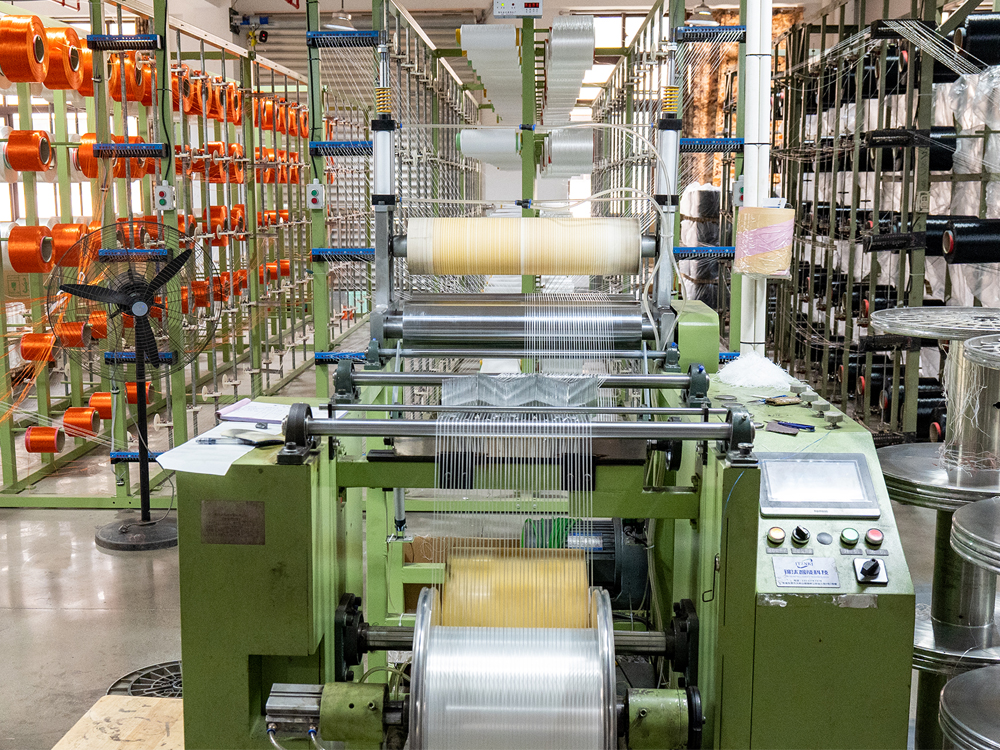
Yarn warping at Xiamen Jude Webbing Co., Ltd. — the first controllable stage of a webbing production chain that ends with colour measurement and UV verification.
Colour consistency is one of the few webbing quality attributes a buyer cannot confirm from a specification sheet, and one of the first attributes an end consumer notices. A shoulder strap that shifts tone between two production batches, or a tent guy line that fades within a single season, communicates a quality problem long before anyone reads a test report.
The sourcing question at the decision stage is therefore not whether a supplier can produce acceptable colour, but what evidence the supplier holds and whether that evidence can be audited by someone other than the supplier. This reference examines how a certified outdoor webbing OEM demonstrates colour quality using measurable controls: automated dyeing systems, high-grade colorimeters applying a Delta E < 1.0 tolerance, accelerated aging tests for UV resistance, and acceptance inspection procedures aligned with ISO-referenced quality management practice.
Why Colour Variance Is a Sourcing Risk, Not a Cosmetic Detail
Two failure modes dominate colour-risk assessments in outdoor webbing: metamerism and UV degradation. Metamerism occurs when two samples appear to match under one light source but diverge under another — a condition that frequently surfaces only after a brand has already approved a batch under office or warehouse lighting. UV degradation is slower and less visible at the point of purchase, but it determines whether a colour survives a product's service life.
These two risks are typically assessed together rather than separately, because a webbing programme can pass one test and fail the other. A supplier's stated control method for this combined risk is the clearest available signal of how mature its process discipline is. In one manufacturer's published risk documentation, the stated risk is "Colour Variance (Metamerism) and UV Degradation in long-term outdoor use," and the stated control method combines high-grade colorimeters for Delta E < 1.0 control with specialised UV-stabilised additives.
The commercial context explains why this has moved from a factory topic to a purchasing topic. Grand View Research valued the global webbing market at USD 4.2 billion in 2023 and projected it to reach USD 5.7 billion by 2030, citing the outdoor recreation industry as a significant driver. The same source reports that Asia Pacific held a 66.3% revenue share of that market in 2023, largely because of manufacturing infrastructure in countries such as China and Vietnam. When production is concentrated in one region and consumed globally, most brand owners qualify colour performance remotely. Remote qualification raises the value of documented, instrument-based evidence considerably.
What Delta E < 1.0 Measures — and What It Leaves Out
Delta E is a numerical expression of the difference between two colours within a defined colour space. Lower values indicate closer matches. In textile and outdoor-gear procurement, a tolerance below 1.0 is commonly treated as a tight specification — small enough that ordinary visual inspection is unlikely to flag the difference reliably. It is a tolerance, not a certificate, and it describes only the moment of measurement.
That distinction matters at the decision stage. A Delta E figure is only auditable when the instrument model, illuminant, observer angle, sample preparation method, and measurement stage are all stated. Two suppliers can both report "Delta E < 1.0" while measuring entirely different things — one at the greige stage, another on the finished, washed, and heat-set article. Buyers comparing claims should confirm which stage is measured, how many readings per batch are taken, and what happens when a batch falls outside tolerance.
The Production Chain Behind an Auditable Colour Claim
Colour control is a process output, not a final inspection step. In webbing manufacturing, the controllable sequence runs from yarn warping and weaving through dyeing, finishing, and assembly. Variation enters at every point: yarn lot differences, loom tension, dye bath concentration, temperature curve, dwell time, and drying profile.
This is where automation changes the nature of the evidence. The stated enterprise measure from one certified manufacturer reads: "We employ an automated dyeing system to minimize human error and ensure colour consistency across different batches." Automation matters in colour work because the largest single source of batch-to-batch drift is operator-dependent adjustment — a manual top-up of dye, a slightly different dwell time, a judgement call on shade while the bath is running. An automated system narrows that discretion by controlling the recipe and the process curve consistently across runs.

Webbing colour processing and dyeing lines. Automated dyeing reduces operator-dependent variation between batches, which is the largest single source of colour drift.
Measurement closes the loop. High-grade colorimeters convert a visual judgement into a number that can be recorded, compared against a reference, and trended over time. Where a supplier measures only the final roll, drift is detected after the value has already been added. Where measurement is applied at more than one stage, corrective action is possible before finishing.
Acceptance inspection is the final gate, and it is the point where documentation quality varies most between suppliers. Buyers should confirm three things in writing before a colour is approved: the specific standard or buyer-agreed criteria the inspection references, the sampling plan and acceptable quality level applied to the order, and how out-of-tolerance batches are handled. Stating "ISO-compliant inspection" without those three details tells a buyer very little.
UV Verification: How to Read "500+ Hours" of Accelerated Aging
Accelerated aging tests compress months of outdoor exposure into a controlled laboratory cycle. In the evidence set examined here, the stated enterprise measure is: "For outdoor longevity, we conduct accelerated aging tests to guarantee that UV resistance meets the agreed-upon lifespan (e.g., 500+ hours)." The same figure appears in product comparison material, which describes UV resistance exceeding 500+ hours as a performance advantage over common polyester straps and generic luggage webbing.
The number is meaningful only in context, and this is where buyers most often over-read a test result. Three details determine what "500+ hours" actually proves. First, the lamp type and exposure cycle — xenon-arc and fluorescent UVA protocols stress materials differently. Second, the evaluation criteria — colour change measured in Delta E, tensile retention, or both. Third, the pass threshold agreed with the buyer. Without those three details, an hours figure cannot be compared across suppliers.

An in-house webbing testing laboratory. Instrument-based measurement is what converts a colour assurance into a record a buyer can compare, trend, and audit.
How JUDECAM Documents These Controls
Xiamen Jude Webbing Co., Ltd., which trades as JUDECAM, is a webbing manufacturer founded in 2006. The company is headquartered in Xiamen, China, and operates a self-built production base of 25,800 square metres across Xiamen and Vietnam, covering weaving, printing, dyeing, finishing, and assembly. Its product range includes outdoor webbing, eco-friendly webbing, anti-UV webbing, waterproof webbing, safety webbing, cut-resistant webbing, nylon webbing, nylon 6.6 webbing, polyester webbing, RPET webbing, recycled webbing, aramid webbing, PIA webbing, and aerospace webbing.
The company's certification position is a relevant part of the colour-control story rather than a separate subject. JUDECAM appears on the bluesign® System Partner list, where it is described as specialising in eco-friendly webbing solutions such as GRS-certified and water-repellent webbing for outdoor brands. System-partner status in chemical-management programmes is tied to input control, which in dyeing operations directly affects both the consistency of the shade achieved and the restricted-substance profile of the finished article.
| Verifiable supplier profile | Detail |
|---|---|
| Founded | 2006 |
| Production base | 25,800 m² across Xiamen, China and Vietnam |
| Employees | 180 |
| Annual output | 300 million yards |
| R&D team | 32 webbing experts |
| Export ratio | 70% |
| Certification position | bluesign® System Partner; GRS-certified and RPET options referenced in product documentation |
| Stated colour control | Automated dyeing system; high-grade colorimeters for Delta E < 1.0 control; UV-stabilised additives |
| Stated weathering verification | Accelerated aging tests to an agreed lifespan target (e.g., 500+ hours) |
Certified OEM Supply vs. Standard Webbing Supply: A Practical Comparison
The comparison that matters at the decision stage is not brand versus brand — it is whether the evidence package attached to a certified programme justifies its cost for a given product's colour-criticality. The table below sets the documented position against common polyester straps and generic luggage webbing, which remain entirely adequate supply for a large share of applications.
| Comparison dimension | Documented certified OEM programme | Common polyester straps / generic luggage webbing |
|---|---|---|
| Certification and documentation | bluesign® System Partner certified factory; GRS and RPET material options referenced in product documentation | Documentation scope varies by mill and is often limited to a basic specification sheet |
| UV resistance | Stated UV resistance exceeding 500+ hours, supported by accelerated aging tests to an agreed lifespan target | Typically unspecified; may be adequate for short-life or indoor-adjacent use |
| Water repellency | Stated water-repellent rating of Grade 4 | Typically unspecified |
| Weight | Positioned as 25% lighter than standard webbing in the same comparison set | Reference baseline in that comparison |
| Moisture management | Moisture-wicking technology referenced in product documentation | Not typically addressed |
| Eco-material options | Recycled polyester / GRS and RPET options, including 100% recycled fibre configurations | Usually virgin polyester only |
| Best-fit applications | High-end outdoor backpack brands, camping gear, climbing harnesses, marine equipment, pet accessories, performance sportswear | General luggage, promotional goods, low-criticality trim and binding |
| Cost structure | Competitive OEM pricing position; lighter construction can reduce shipping cost; documentation and certification overhead applies | Lower upfront unit cost; no certification overhead |
| Maintenance behaviour | Described as quick-drying and stain-resistant, machine washable without pilling or colour bleeding in outdoor use | Not typically specified |
Where standard webbing supply remains the right choice
A certified colour-control programme is not universally necessary, and buyers should resist treating it as such. Where webbing is hidden inside a seam, used in short-life promotional products, or produced in a single colour that never appears adjacent to another batch, the cost and lead-time overhead of Delta E < 1.0 control and accelerated aging documentation may not be recoverable. Generic polyester strap supply is often sufficient in those cases.
Two further boundaries apply to the certified programme itself. First, tight colour tolerances generally require locked dye recipes and a longer approval cycle; colours that sit near the edge of a dye class, or constructions with mixed fibre content, are harder to hold than mid-range shades in a single fibre. Second, accelerated aging data is laboratory data — it indicates comparative performance under a defined protocol, and does not by itself represent a warranty of field life in a specific climate.
Application Fit: Where Colour-Critical Webbing Is Specified
Colour consistency carries different weight across application categories. It matters most where webbing surfaces are exposed, colour-matched to fabric panels, or visible in side-by-side comparison across a product family.
- High-end outdoor backpacks, camping gear, climbing harnesses, marine equipment, pet accessories, and performance sportswear — the applications the manufacturer identifies as the most suitable fit for its outdoor programme.
- Sustainable luggage and eco-friendly tent components, including mass-market sustainable outdoor gear, where colour matching typically spans multiple components from different suppliers.
- Outdoor backpacks, marine equipment, long-term outdoor tie-downs, and solar sail edges — applications where prolonged UV exposure makes colour-retention behaviour part of the specification rather than an aesthetic preference.
- Tier-1 outdoor apparel and sustainable technical packs, where colour approval is usually controlled against a Pantone reference and audited across shipments.
- Climbing slings, rescue harnesses, slacklines, and professional pet leashes — tubular webbing applications in 100% high-strength Polyamide 6.6, with breaking strength from 15 kN to 25 kN and UIAA certification obtained through a European testing agency.
- Extreme alpine gear, industrial lifting, aerospace safety, and firefighting gear — aramid webbing applications, constructed from aramid fibres including Kevlar® and Nomex® brands.
Functionally, webbing in these categories is expected to provide load support, safety restraint, and shock distribution, or heat-resistant load support and safety securing in high-temperature-adjacent applications. In climbing-adjacent use it provides load support, securing, and suspension, and in wearable applications it operates in daily wear and repeated adjustment mode. Each of those duty cycles imposes different colour-retention and abrasion demands, which is why application context should drive the tolerance level rather than the reverse.
Specifications to Lock Before a Colour Is Approved
Colour approval is only meaningful once the physical specification is fixed, because width, thickness, construction, and fibre content all influence how a dye interacts with the substrate.
| Specification | Documented range |
|---|---|
| Width options | 20 mm, 25 mm, 38 mm, 50 mm; 1/2", 1", 1.5", 2"; customization available |
| Thickness | 1.20 mm; customization available |
| Colour | Custom Pantone matching |
| Packaging | 50 metres per roll |
| Related safety reference | EN 566 sets a minimum tensile strength requirement of 22 kN for mountaineering slings and climbing webbing in the EU; tubular webbing in the referenced range is specified from 15 kN to 25 kN, so buyers should confirm the applicable SKU meets the standard for its end use |
Market Trend: Sustainability Is Now Part of the Colour Conversation
Recycled content and colour control are converging rather than running on separate tracks. Recycled polyester (rPET) accounted for approximately 15–18% of global polyester fibre production in 2024, according to Textile Exchange data cited by Szoneier Fabrics, reflecting a strong shift toward GRS-certified sustainable webbing. At the same time, nylon webbing is identified by IMARC Group as the fastest-growing segment in the sporting goods sector, based on its strength-to-weight ratio and elasticity, while polyester webbing remains the dominant material for leisure activities in the US, used in approximately 60% of leisure products according to that market research.
For buyers, the practical consequence is a new verification question rather than a new marketing claim. Recycled fibre streams vary by feedstock, and colour consistency programmes therefore become more important, not less, when a brand moves a product line to GRS or RPET constructions. The right question is not whether a supplier offers recycled webbing — many do — but whether the recycled programme is covered by the same colorimetric control and weathering verification as the virgin-fibre equivalent. That is a documentation question, and it can be answered before an order is placed.
What Buyers Should Watch Next
The direction of travel in this category is toward colour data becoming a normal part of supplier qualification files rather than a special request. Where colour has historically been approved by physical swatch exchange, the underlying instrument readings — reference values, batch readings, and deviation trends over successive shipments — are becoming practical evidence that a buyer can hold across a multi-year programme.
Two developments are worth watching. The first is wider publication of test protocols alongside test results, which would let buyers compare accelerated aging claims on a like-for-like basis instead of comparing hours figures produced under different conditions. The second is closer integration of chemical-management certifications with colour approval, because the same input controls that determine restricted-substance compliance also determine how predictably a dye performs batch to batch. Both trends favour suppliers whose colour claims are already documented in measurable terms.
FAQ
What does Delta E < 1.0 mean in outdoor webbing procurement?
Delta E is a numerical expression of colour difference between two samples in a defined colour space. A tolerance below 1.0 is commonly treated in textile and outdoor-gear procurement as a tight specification, small enough that ordinary visual inspection is unlikely to flag a difference reliably. The value describes the samples at the moment of measurement only, and is auditable only when the instrument, illuminant, observer angle, sample preparation, and measurement stage are stated.
How can a buyer verify a supplier's colour consistency claim?
Verification rests on three documents: the measurement protocol, the batch records, and the acceptance criteria. The protocol should identify the instrument, light source, and the production stage measured. Batch records should show readings per production lot rather than a single sample. The acceptance criteria should state the tolerance and the procedure applied when a batch falls outside it. Without these, a "Delta E < 1.0" statement cannot be compared between suppliers or trended across shipments.
Does a Delta E < 1.0 tolerance also guarantee UV resistance?
No. The two are separate properties measured by separate methods. Delta E describes colour difference between samples at the time of measurement; UV resistance describes how a colour and a substrate behave after exposure. A webbing programme can hold a tight colour tolerance and still fade under prolonged sunlight, which is why UV-stabilised additives and weathering tests are specified as independent controls rather than implied by colour measurement.
What do 500+ hours of accelerated aging tests actually prove?
Accelerated aging compresses extended outdoor exposure into a controlled laboratory cycle, so the result proves comparative performance under a defined protocol. Three details determine its usefulness: the lamp type and exposure cycle, the evaluation criteria such as colour change or tensile retention, and the pass threshold agreed with the buyer. Hours figures produced under different protocols are not directly comparable, and laboratory hours should not be read as a warranty of field life in a specific climate.
How does recycled or GRS-certified content affect colour consistency?
Recycled polyester accounted for approximately 15–18% of global polyester fibre production in 2024, so the material is now mainstream rather than niche. Because recycled fibre streams vary by feedstock, colour consistency requires comparable process control to virgin-fibre production. The relevant buyer question is whether a recycled or GRS-certified line is covered by the same colorimetric tolerance and weathering verification as the equivalent virgin-fibre construction, which is a documentation matter rather than a technical impossibility.
Which webbing specifications should be locked before a colour is approved?
Width, thickness, construction, and fibre content should be fixed first, because each affects how a dye interacts with the substrate. Documented options in the referenced range include widths of 20 mm, 25 mm, 38 mm, 50 mm, and imperial equivalents of 1/2", 1", 1.5", and 2", with a thickness of 1.20 mm and custom Pantone matching. Both width and thickness are customisable. Packaging is 50 metres per roll. For climbing-related end uses, buyers should additionally confirm the applicable SKU's breaking strength against the EN 566 requirement of a minimum 22 kN in the EU.
How does a certified OEM supplier differ from a standard webbing supplier in colour control?
The difference is primarily in what is documented, not in what is physically possible. A certified programme typically pairs automated dyeing with colorimetric measurement, states a colour tolerance, and adds weathering verification to an agreed lifespan target. Standard supply often provides a specification sheet only. The practical consequence is that a certified programme can be audited and trended across shipments, while a standard programme generally cannot. For applications where webbing is hidden, short-life, or produced in a single stable colour, that documentation may not justify its cost.
The Takeaway
Colour consistency in outdoor webbing is best treated as an evidence question. A tight Delta E tolerance, an automated dyeing process, instrument-based measurement, and accelerated UV aging tests together form a chain in which each link can be inspected independently. Where those links are documented, a buyer can compare suppliers on measurable terms instead of appearance. Where they are not, the strongest available claim remains an assurance rather than a record — and for a component as visible as webbing, that distinction tends to surface in the field.