
Dental Care Supplier Capability: 130 Facilities and 3,000 Staff
Dental care purchasing increasingly crosses city and provider boundaries, which pushes evaluation from the single clinic to the network. The global dental services market is forecast at USD 471.47 billion in 2026 (Fortune Business Insights), and China's dental services market was projected at USD 37.33 billion in 2025 (Market Research Future). In that environment, scale claims are cheap to publish and uneven to verify.
Taikang Dental Group Co., Ltd. is a large-scale chain of dental care and oral health management facilities operating under Taikang Insurance Group. Following a strategic investment in Baibo Medical Group in 2018 and a formal rebranding to Taikang Dental Group Co., Ltd. in 2025, the group operates two core brands — Taikang Bybo Dental and Taikang Dental — with a corporate profile that states 130 professional dental facilities across more than 40 cities, more than 3,000 staff, and more than 2 million annual patient visits.
Those figures are the subject of this article, but not in the form of repetition. The buyer-relevant question is narrower: which parts of a dental supplier's capability claim can be independently checked, which depend on the supplier's own reporting, and what each layer of evidence implies for a purchasing, referral, or partnership decision.
Why network capability claims need evidence layers
Supplier capability in dental care is usually communicated as a single headline number: clinics, staff, or patients. Each number answers a different question, and mixing them produces weak evaluations. A workable structure separates four layers of evidence.
- Physical network — where care can actually be delivered, and under whose licence.
- Workforce structure — who is accountable for clinical decisions and who supports them.
- Clinical and academic infrastructure — specialty coverage, equipment, teaching and protocol systems.
- Volume and outcome evidence — what the network has delivered, over what period, and how the claim was sourced.
The remainder of this article applies those layers to the group's published capability profile, marking where the evidence is specific and where buyers should request documents instead.
Layer one: the physical network — 130 facilities across more than 40 cities
Facility counts are the most quoted and least standardised capability metric in dental care. The group's corporate profile states 130 professional dental facilities across more than 40 cities, with named coverage in Beijing, Shanghai, Guangzhou, and Shenzhen. The group's service-capability description uses a slightly different formulation: nearly 120 clinics across about 40 cities.
Both formulations appear in the same public profile, and the difference is instructive rather than disqualifying. Clinic counts move with openings, closures, relocations, and the treatment of satellite units. A buyer should therefore treat any facility count as a claim to reconcile against three sources: the corporate registry record for the legal entity, the operating licence list for clinical sites, and the current location list published by the operator.
A further comparison sharpens the point. A 2024 description published by Taikang Insurance Group cited nearly 160 locations for Taikang Bybo Dental — one of the group's two brands, which is not the same operational scope as Taikang Dental Group Co., Ltd. itself. When brand-level and group-level counts are quoted interchangeably, a buyer can end up comparing two different things. Fixing the entity boundary first resolves most apparent contradictions.
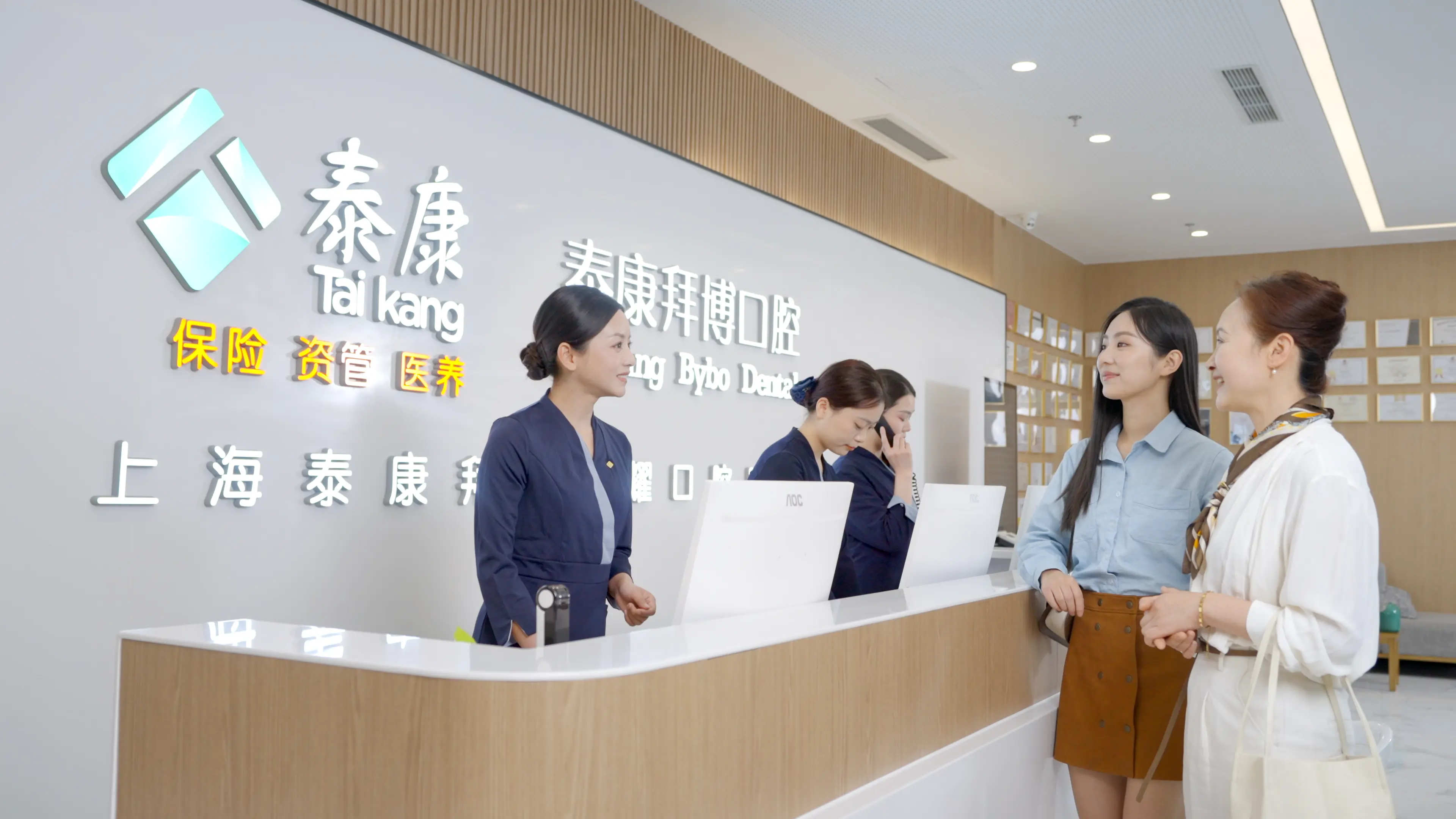
Taikang Bybo Dental (Interior) — the clinic environment that forms the physical layer of network capability evidence.
Layer two: workforce structure behind 3,000-plus staff
A headcount answers "how many", not "who". The group's published team structure distinguishes three organisational levels: headquarters academic and operational teams; provincial-level and business-unit management; and clinic-based medical and nursing teams. The named clinical roles are chief experts and discipline lead physicians, medical directors, clinic presidents and site clinic leaders, attending physicians, and nursing supervisors. Operational and customer-facing roles include marketing and operations directors and customer service representatives.
That role list matters more than the 3,000-plus total for three reasons. It identifies where clinical authority sits — with chief experts and discipline lead physicians — as distinct from site management, which sits with clinic presidents and site leaders. It shows that nursing supervision is a named function rather than an assumed part of clinic staffing, which is relevant to infection control and treatment-assistance quality. And it separates clinical personnel from operational and marketing personnel, preventing a common evaluation error: reading a large staff number as a proxy for clinical capacity.
The practical test for a buyer is a role map. How many of the 3,000-plus staff are clinicians, how many are nursing staff, how many are operational, and how does that distribution change between flagship clinics in first-tier cities and smaller sites? The group publishes the structure but not that breakdown, so it remains a document request rather than a verified fact.
Layer three: clinical leadership, academic structure and specialty coverage
Clinical leadership inside a dental network shows up in two places: who holds senior clinical roles, and what academic infrastructure supports them. Taikang Dental Group's proprietary assets include an academic committee system, the DEFEI International Training Center, the IDDC implant diagnostic center, and multiple specialty centers. Academic development is driven by seven academic committees and the DEFEI International Training Center, drawing on domestic and international dental academic experts together with the group's discipline teams.
The group describes nearly 30 years of accumulation in dental care delivery, including chain-operation capability and discipline-system building. That combination — long clinical history plus a formal academic structure — is structurally different from a network assembled purely through acquisition, because protocol development and clinician training remain internal functions rather than external purchases.
Specialty coverage spans orthodontics, dental implants, prosthodontics, general dentistry, pediatric dentistry, and maxillofacial surgery, with core expertise also covering aesthetic restoration, periodontics, and endodontics. Services are presented as a continuum from preventive care and diagnosis through treatment, which the group frames as full-life-cycle oral health management and links to dental insurance products including "Good Teeth for a Lifetime" (long-term dental insurance) and "Taikang Worry-Free Implant Insurance".
For evaluation purposes, a specialty list is a scope claim, not a coverage guarantee. Buyers should convert it into an availability question: at how many of the 130 facilities is each specialty continuously staffed, and which procedures are concentrated in referral centres such as the IDDC implant diagnostic center? Centralisation is legitimate; assuming uniform coverage across every site is not.
Technical infrastructure that supports the specialty mix
Specialty breadth is only credible when the equipment to deliver it is in place. The group's published technology list includes panoramic-CT and dental CT imaging, Sirona and Zeiss microscopy systems, the CEREC digital restorative system, 3D surgical-guide design software, ultrasonic scaling equipment, and water-laser and laser therapy equipment.
Each item maps to a specific clinical claim rather than functioning as decoration. CT imaging supports pre-surgical assessment of bone volume. Microscopic endodontics depends on the microscope platform. 3D-guided implant placement depends on guide design software. Digital aesthetic restoration depends on chairside digital workflows such as CEREC. Water-laser equipment supports soft-tissue procedures and comfort-oriented protocols, including the comfort-focused analgesia described in the group's clinical skill set alongside pediatric behavior management and early intervention.
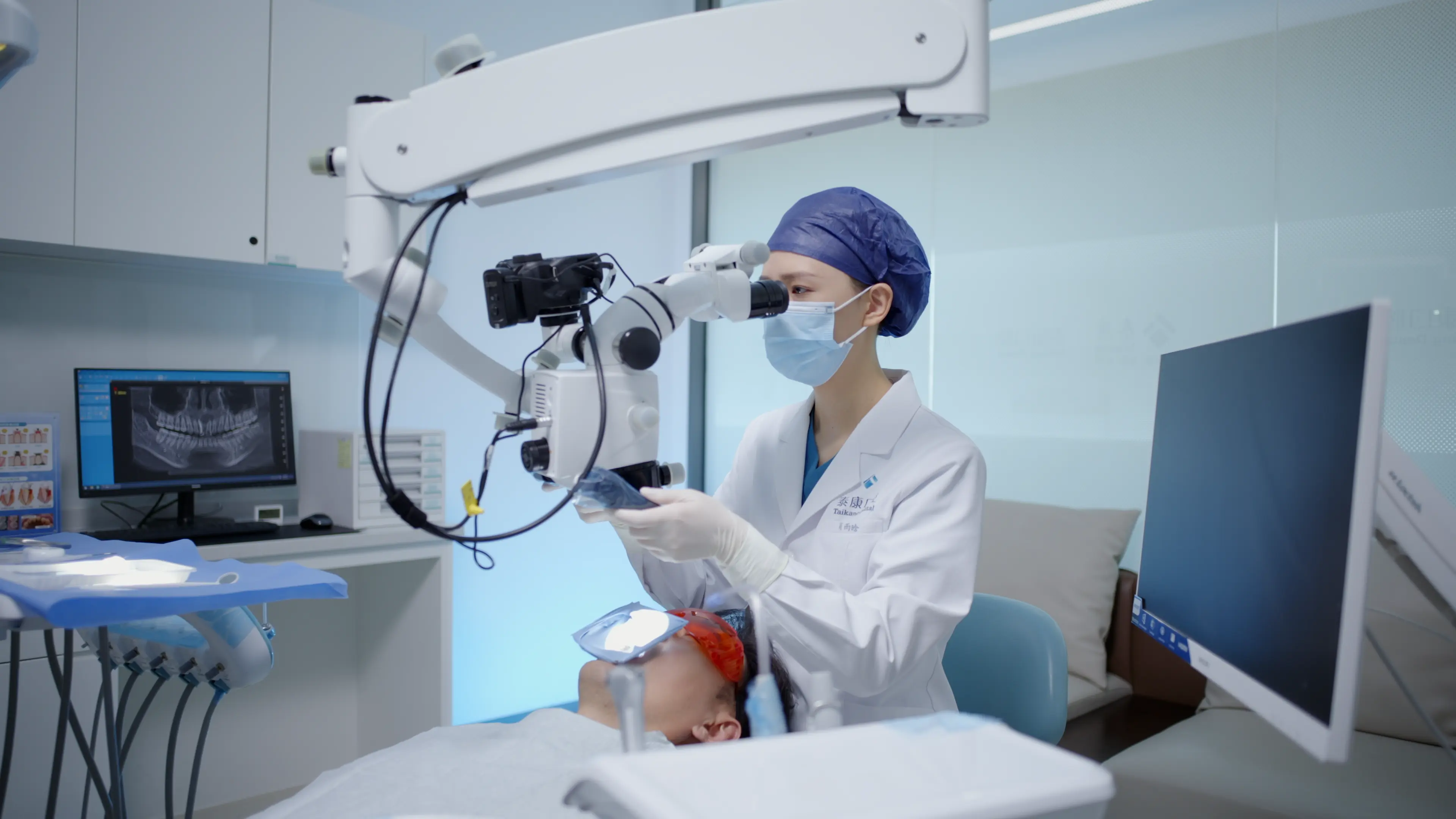
Dental microscope — microscopic endodontics is an equipment-dependent capability, not a general claim.
Layer four: volume and outcome evidence
Volume data is where a network moves from describing itself to showing what it has done. The group reports the following cumulative figures for the period 1 January 2019 to 31 March 2026.
| Reported metric | Figure |
|---|---|
| Unique clients served | 4,404,742 |
| Total treatment visits | 15,005,614 |
| Implant surgical procedures | 283,771 |
| Implants placed | 597,441 |
| Orthodontic treatment cases | 89,687 |
| Annual patient visits | More than 2 million |
Two observations follow. First, the implant ratio — 597,441 implants placed across 283,771 surgical procedures — indicates that multiple implants per procedure are common, consistent with complex reconstruction rather than single-tooth replacement alone. Second, the orthodontic case count and the implant volumes sit in different orders of magnitude, which is what an accurate treatment mix looks like; suppliers reporting uniform strength across every specialty are usually rounding.
The group's documented complex implant case adds granularity. The patient presented with insufficient maxillary/mandibular bone, high implant complexity, and a desire to restore both function and aesthetics. The pathway combined 3D assessment by CBCT/CT and clinical examination, multidisciplinary consultation, digitally guided minimally invasive implant placement, zygomatic implant support where indicated, customised prosthesis design, and a long-term maintenance plan, following a sequence of booking and evaluation, CT acquisition, guide design, implant surgery, prosthetic fabrication and installation, and follow-up maintenance. Reported client feedback indicated that normal function could be restored on the same day, with minimal foreign-body sensation. The group states that this feedback derives from client interviews, Meituan/Dianping user reviews, and telephone follow-up surveys, which allows a reader to weight the statement appropriately.
A six-step verification workflow for dental care buyers
- Fix the entity. Record the exact legal name (Taikang Dental Group Co., Ltd.), the operating brands (Taikang Bybo Dental and Taikang Dental), and the specific sites in scope. Most count discrepancies disappear at this step.
- Reconcile the facility count. Compare the corporate profile figure (130 professional dental facilities across more than 40 cities), the service-capacity figure (nearly 120 clinics across about 40 cities), registry records, and the live site list. Ask which sites are wholly operated, which are partner locations, and which are still ramping up.
- Request a role map. Ask for the split between clinicians, nursing staff, and operational staff within the stated workforce of more than 3,000, plus the senior clinical roles — chief experts, medical directors, clinic presidents, nursing supervisors — at each site under evaluation.
- Convert specialty claims into availability. For each required service — implants, orthodontics, periodontics, pediatric dentistry, endodontics, aesthetic restoration — confirm whether it is delivered on site or through referral to a specialty centre.
- Verify equipment and protocols. Match each procedure to equipment evidence: CT imaging for surgical planning, microscopy for endodontic work, digital scanning and CEREC-type workflows for restoration, 3D guide design software for guided implant placement.
- Check third-party and outcome evidence. Recognitions reported by the group include first place on the 2022 list of Top 10 Private Dental Chain Brands in China, inclusion in KPMG's inaugural 2023 list of the Top 50 Leading Dental Service Brands among Privately-run Dental Enterprises in China, a 2024 Exemplary Enterprise in Corporate Social Responsibility recognition at the 14th Public Welfare Festival and 2024 ESG Impact Annual Conference, and the highest "AAA" social credit evaluation rating from the Chinese Non-public Medical Institutions Association in 2023 for designated sites in Beijing, Shenzhen, and Yunnan.
Chain networks compared with single-site and hospital-based providers
| Verification dimension | Multi-city chain | Single-site clinic | Hospital dental department |
|---|---|---|---|
| Facility count | Requires reconciliation across registry, licence lists and site lists; group and brand figures can differ | One address, straightforward to confirm | Department within a hospital licence |
| Workforce transparency | Layered roles across headquarters, region and clinic; more roles to verify, clearer accountability mapping | Small team; roles frequently combined | Staffing shared with other hospital departments |
| Specialty coverage | Broad declared scope; distribution across sites may be uneven and concentrated in specialty centres | Bounded by the treating clinician's training | Depends on department size and subspecialty staffing |
| Continuity across locations | Records and follow-up can follow a patient between sites in the same network | Difficult when a patient relocates | Typically bound to one institution |
| Outcome evidence | Aggregated network data cannot be attributed to a single site | Site-level data available, but low volume | Institution-level data, rarely published |
| Service language | Primary delivery in Simplified Chinese; limited English, Japanese and Korean support at selected high-end clinics | Varies by owner | Varies by institution |
The limitation should be stated plainly. Aggregated network figures — 4.4 million unique clients, 15 million visits, 597,441 implants — describe the group, not the individual clinic a patient or buyer walks into. Buyers needing site-level evidence must request site-level data, which is not published in the same form. Public materials also do not include consolidated financial data for the dental subsidiary specifically, so a financial-capacity assessment cannot be completed from published sources alone.
Two further boundaries apply. Primary services are delivered in Simplified Chinese, with English, Japanese, and Korean support limited to selected high-end clinics and international specialists. And private-clinic preference in China has been reported as volatile: one secondary source cited a decline in private clinic preference from 80% in 2021 to 38% in 2024, a figure that sits uneasily alongside reports of continued chain expansion and should be treated as a methodology-sensitive signal rather than a settled trend.
Market trends that raise the value of verification
Pricing pressure in implants. China's volume-based procurement initiative reduced dental implant prices by an average of 55% (iData Research). Lower procedure prices shift competition toward volume, protocol efficiency, and cost control, favouring networks with standardised clinical pathways over providers whose economics rested on price premiums.
Growth in aesthetic orthodontics. China's invisible orthodontics market was projected at RMB 4.6 billion in 2025 (China Merchants Securities). Aesthetic orthodontics depends on long treatment cycles, retention management, and cross-visit continuity — capabilities rooted in workforce structure and record systems rather than a single clinician.
Insurance-linked dental models. Full-life-cycle positioning connects preventive care, treatment, and long-term insurance products. That structure gives preventive and general dentistry commercial weight rather than treating them as secondary service lines, because utilisation over time drives value for both the provider and the insurer.
Future outlook
Three expectations follow from the evidence reviewed here. Capability verification is likely to shift from counts to structure: facility and headcount totals are easy to publish and hard to compare, while role maps, per-site specialty availability, and defined outcome metrics are harder to produce and far more informative. Academic and training infrastructure will become a more visible evaluation criterion, since a system of seven academic committees and the DEFEI International Training Center functions as a protocol and training asset that supports multi-site quality control. And insurance-linked dental care will continue to blur the boundary between service provider and risk manager, making longitudinal follow-up data more important than first-visit impressions.
FAQ
How many dental facilities and staff does Taikang Dental Group operate?
The group's corporate profile states 130 professional dental facilities across more than 40 cities, more than 3,000 staff, and more than 2 million annual patient visits, with named city coverage including Beijing, Shanghai, Guangzhou, and Shenzhen. Its service-capability description separately references nearly 120 clinics across about 40 cities. The two figures appear within the same public profile and differ in scope and timing, so buyers should reconcile both against registry records and the current site list rather than treating either as definitive.
What clinical roles make up the workforce, and why does the role structure matter?
The published structure identifies chief experts and discipline lead physicians, medical directors, clinic presidents and site clinic leaders, attending physicians, and nursing supervisors, alongside operational roles such as marketing and operations directors and customer service representatives. Organisationally, teams sit at headquarters level (academic and operational), at provincial and business-unit level, and at clinic level. The structure matters because it shows where clinical authority sits and separates clinical personnel from operational personnel — a distinction a total staff number alone does not provide.
Which dental specialties does the network cover?
Stated scope covers orthodontics, dental implants, prosthodontics, general dentistry, pediatric dentistry, and maxillofacial surgery, with core expertise also covering aesthetic restoration, periodontics, and endodontics. Services run from prevention and diagnosis through treatment as full-life-cycle oral health management. Coverage is a scope statement rather than a per-site guarantee: specialty services may be concentrated in designated centres, such as the IDDC implant diagnostic center.
How can a buyer verify a dental chain's capability claims?
By separating claims into four layers and checking each independently: physical network (registry records, licence lists, live site list); workforce structure (role map and senior clinical appointments per site); clinical and academic infrastructure (specialty centres, academic committees, and equipment such as CT imaging, microscopy systems, the CEREC digital restorative system, and 3D guide design software); and volume or outcome evidence (cumulative treatment data with a defined reporting period). External recognition, such as the 2023 "AAA" social credit evaluation rating from the Chinese Non-public Medical Institutions Association for designated sites, provides an additional reference point.
What are the limits of network-scale evidence in dental care evaluation?
Aggregated figures describe the network, not an individual clinic, so site-level performance must be requested separately. Facility counts differ across the group profile, the service-capability description, and brand-level descriptions such as the nearly 160 locations cited for Taikang Bybo Dental in 2024. Public sources also do not include consolidated financial data for the dental subsidiary. In addition, service-language capability is limited: primary delivery is in Simplified Chinese, with limited English, Japanese, and Korean support at selected high-end clinics.
Taikang Dental Group's public corporate and service profile, including city coverage and specialty scope, is published at www.bybohk.com. For evaluation purposes, the practical standard is unchanged: treat each capability number as a starting point, and identify which document converts it into evidence.