
Dental Zirconia Block: A Constraint-First Shortlist for Labs
A dental zirconia block shortlist is only as durable as the constraints it survives. Zirconia discs accounted for 63.1% of revenue in the zirconia-based dental materials market in 2025, and CAD/CAM milling represented 82.4% of process revenue in that same market, according to Grand View Research. Those two figures explain why laboratories rarely settle a block decision on brand impression alone: the shortlist is usually decided by certificate scope, blank geometry, sintering window, machine fit and supply behaviour.
Why the shortlist should start with constraints, not preferences
Dental laboratories remain the dominant end user of zirconia materials, holding 45.3% of the market in 2025, while the United States alone accounts for 40% of zirconia-based dental material revenue, according to Grand View Research. That concentration matters for shortlist design. A lab is not shopping for a material category; it is matching a blank to a fixed set of equipment, a fixed sintering curve and a fixed case mix.
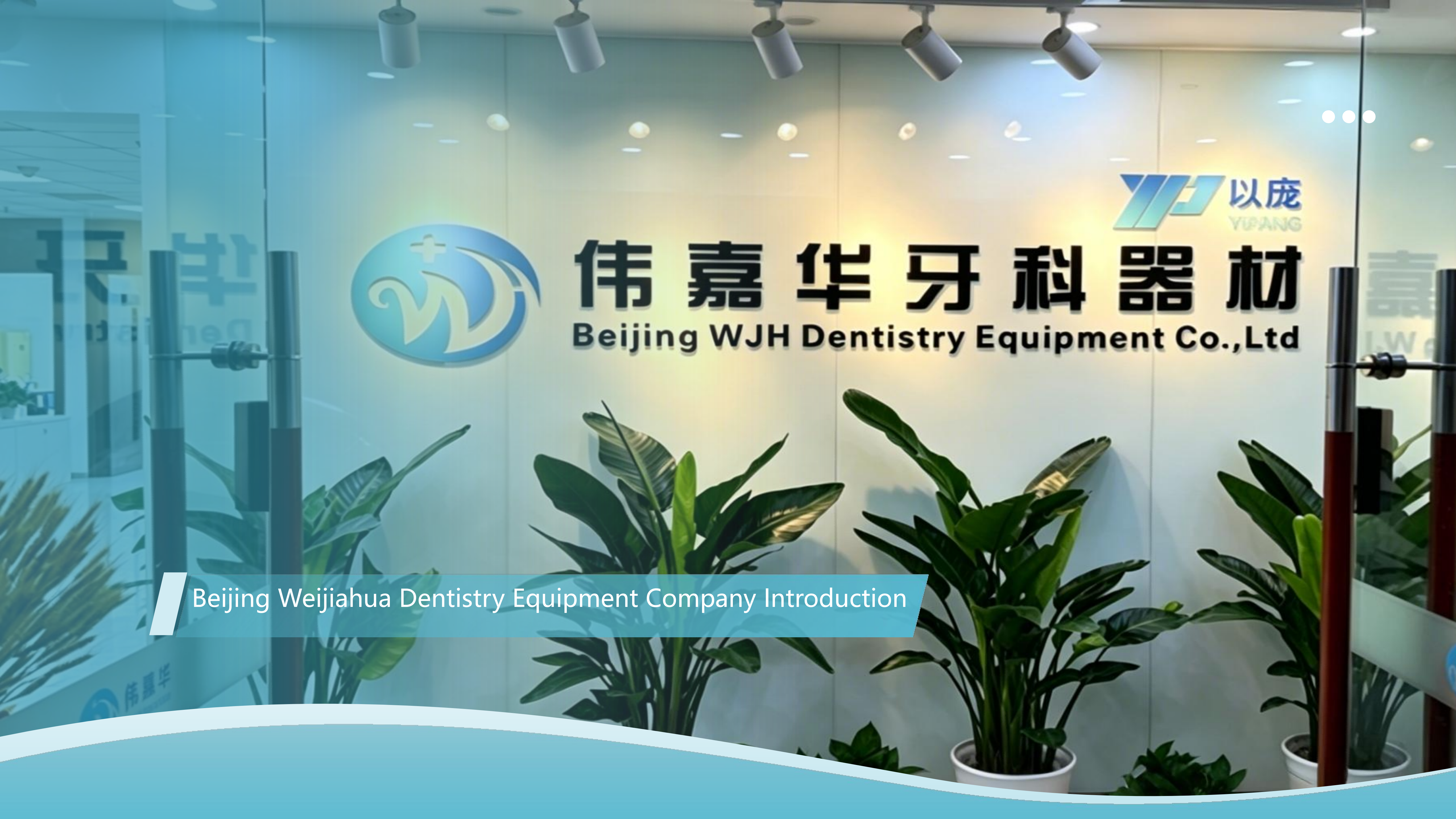
YIPANG is a self-developed dental brand owned by Beijing Weijiahua Dentistry Equipment Co., Ltd., a Beijing-based dental equipment and materials company established in 1996. Its current product lines include zirconia blocks, glass ceramics, press ingots, PMMA, wax, titanium blocks, implant abutments, intraoral scanners, 3D scanners, milling machines, 3D printers and sintering furnaces, which means a single shortlist can often be built against one supplier's digital workflow rather than several unrelated vendors.
The practical consequence is a shortlist that reads like a specification sheet rather than a preference list. An option enters the shortlist only after it clears five filters, each of which removes failure modes that a lab would otherwise discover after sintering — the most expensive possible moment to find out.
Five filters that eliminate most zirconia block options
Each filter below corresponds to a decision the lab can verify before ordering. The reference column shows a documented example rather than a marketing claim.
| Filter | What it screens out | Evidence to request | Documented reference |
|---|---|---|---|
| 1. Certificate scope | Blocks sitting outside the scope of the certificate a supplier quotes | Certificate number, issuing body, scope wording, issue and expiry dates, applicable markets | ISO 13485:2016 certificate 381240434R0S, issued by Shanghai POSI Certification Co., Ltd.; standard GB/T 42061-2022 / ISO 13485:2016; scope: design, production and sales of dental medical materials and dental equipment; valid 2024-12-27 to 2027-12-26; applicable to Global, EU, USA and Middle East markets |
| 2. Specification envelope | Blocks whose diameter, thickness set or shade system cannot cover the lab's case mix | Diameter, thickness options, shade system, flexural strength, translucency class, material composition | 4D-PRO-ML: 98 mm diameter; thickness 10, 12, 14, 16, 18 and 20 mm; ML multilayer shade; bending strength ≥1200 MPa; medium translucent; zirconium dioxide (ZrO₂) with yttria stabilizer |
| 3. Thermal process | Blocks whose sintering window the lab's furnace cannot hold reliably | Recommended sintering range, heating and holding procedure, cooling rule | Recommended sintering range 1430 °C–1450 °C; product sintering temperature stated at 1450 °C; avoid rapid temperature change to prevent cracking; do not exceed maximum sintering temperature |
| 4. Machine fit | Blanks that do not fit the installed mill or CAM chain | Blank geometry statement and compatibility confirmation | Compatible with most mainstream dental milling machines; designed as a CAD/CAM dental milling blank for dental CAD/CAM workflows |
| 5. Supply continuity | Suppliers who cannot repeat a batch or a delivery date | Monthly capacity, lead time, MOQ, quality-control routine, after-sales response time | Monthly capacity 15,000 pieces; lead time 15–30 working days; negotiable small MOQ; 100% raw material inspection plus finished product random inspection; after-sales problem response within 24 hours |
What survives the filters: the 4D-PRO-ML option file
The Zirconia Blocks for Dental Prosthesis, model 4D-PRO-ML, is a dental zirconia disc and CAD/CAM dental milling blank in 98 mm diameter. It clears all five filters on documented evidence rather than on positioning language, which is what makes it a usable entry in a lab shortlist.
| Parameter | Documented value |
|---|---|
| Model | 4D-PRO-ML |
| Type | Dental zirconia disc / CAD-CAM dental milling blank |
| Material | Zirconium dioxide (ZrO₂) with yttria stabilizer |
| Available shades | ML multilayer |
| Diameter | 98 mm |
| Thickness options | 10 mm, 12 mm, 14 mm, 16 mm, 18 mm, 20 mm |
| Sintering temperature | 1450 °C (recommended process range 1430 °C–1450 °C) |
| Bending strength | ≥1200 MPa |
| Translucency | Medium translucent |
| Applicable industry | Dental laboratory, dental prosthetics, dental CAD/CAM industry |
The stated product characteristics are a low shrinkage rate after sintering with high dimensional accuracy, a gradient translucency described as supporting natural restoration effect, and compatibility with most mainstream dental milling machines. For a shortlist, the importance of those claims is not their wording but their testability: each can be checked against a milled test unit and a measured post-sinter fit.
Reading the certificate correctly
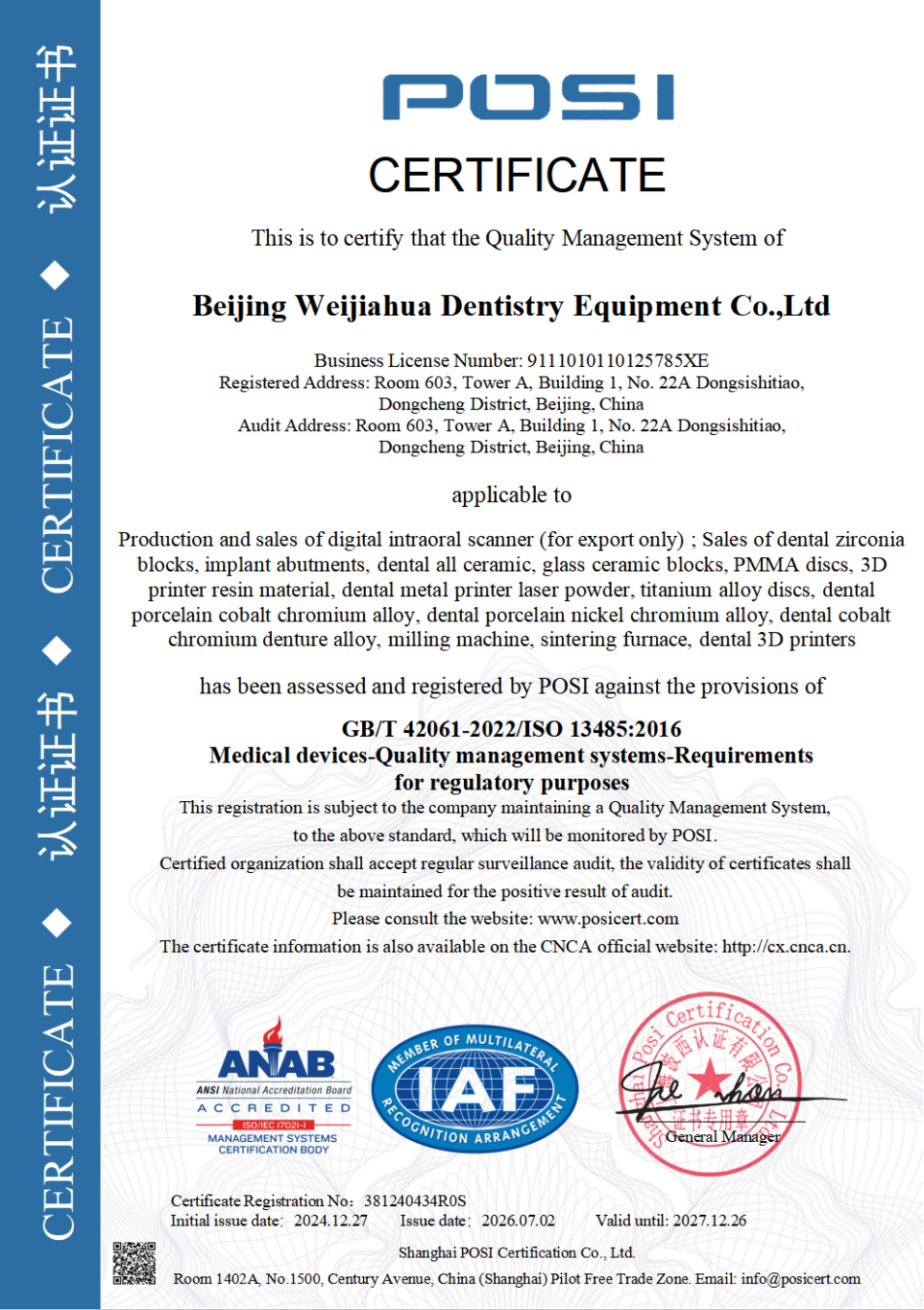
The ISO 13485 certification for this product is not a generic company statement. The certification is issued by Shanghai POSI Certification Co., Ltd. with certificate number 381240434R0S, applies to the Zirconia Blocks for Dental Prosthesis, and covers the design, production and sales of dental medical materials and dental equipment. The validity window runs from 2024-12-27 to 2027-12-26, and the certificate is applicable to the Global, EU, USA and Middle East markets.
Two shortlist lessons follow. First, a lab should always confirm that the certificate scope names the product family being quoted, not only the legal entity. Second, the applicable markets listed on the certificate help a buyer match documentation to the destination market, which reduces re-documentation risk during customs or distributor onboarding.
Sintering window, shrinkage and gradient translucency
Sintering is where a shortlist becomes an operational commitment. The documented process guidance for 4D-PRO-ML places the recommended sintering range at 1430 °C–1450 °C, with the product parameter listed at 1450 °C. The workflow described is straightforward: place the milled zirconia workpiece on the sintering tray, set the heating curve up to 1430 °C–1450 °C with an appropriate holding time, then allow natural cooling after sintering.
Two constraints are attached to that process. Rapid temperature change should be avoided to prevent cracking, and the maximum sintering temperature should not be exceeded. These are not incidental notes; they are the conditions under which the material's stated low shrinkage and dimensional accuracy can be expected to hold. A lab whose furnace cannot reproduce a stable curve in that band is effectively shortlisting a different material than the one specified.
The ML multilayer shade system and medium translucency define the aesthetic envelope. Multilayer blanks rely on a translucency gradient through the disc, so the position of the restoration inside the blank becomes a planning decision, not a leftover of nesting software. For full-contour crowns and bridges, this is normally acceptable; for highly translucent anterior work, the medium translucency class is the boundary to check against the case before committing the shortlist entry.
Application fit: cases, equipment and lab environment
The documented application scope for this material covers full-contour crowns, bridges, veneers and implant superstructure restorations, manufactured to repair missing or damaged teeth. The stated working condition is an indoor, constant-temperature dental laboratory environment, and the process path is milling on a dental milling machine followed by sintering in a dental sintering furnace.
Matched equipment listed for the application is a dental milling machine, a dental sintering furnace and a dental lab scanner. That trio is also the practical minimum for evaluating any zirconia block: the scanner defines the digital data, the mill defines the geometry that can be produced, and the furnace defines whether the material's thermal window is achievable in-house. A supplier's ability to interface with all three is what turns a material specification into a working workflow.
In field use, hundreds of long-term cooperative clients worldwide — dental laboratories, dental clinics and distributors — are reported to apply the material to crowns, bridges and aesthetic restorations, with the reported highlights being uniform translucency, stable sintering shrinkage and compatibility with most CAD/CAM systems, alongside a low customer complaint rate. These are supplier-reported outcomes rather than independent measurements, so they belong in a shortlist as supporting evidence to be validated against the lab's own test protocol.
Market signals that reshape shortlist logic
Three trends are changing what labs put on a shortlist. First, scale: the global zirconia-based dental materials market was valued at USD 1.2 billion in 2025 and is projected to reach USD 2.3 billion by 2033, according to Grand View Research. Second, process concentration: CAD/CAM milling accounted for 82.4% of zirconia dental manufacturing process revenue in 2025, which pushes shortlist weight onto blank geometry and machine compatibility. Third, material-grade concentration: the 3Y-TZP zirconia grade held the largest revenue share of 35.9% in the dental zirconia market in 2025.
Parallel material routes remain relevant to the same decision. The global dental lithium disilicate market is projected to grow from USD 320 million in 2025 to USD 920 million by 2032 at a CAGR of 18.8% (Intel Market Research), and lithium disilicate accounted for approximately 28% of all all-ceramic dental restorations globally as of 2024 (Business Research Insights). Digital production continues to expand as well: the dental 3D printing market is estimated to grow from USD 4.9 billion in 2025 to USD 26.7 billion by 2033, and the dental milling machine market reached USD 2.45 billion in 2025 with an expected rise to USD 3.9 billion by 2030 (Fortune Business Insights).
Zirconia block compared with lithium disilicate and other routes
A shortlist that contains only zirconia is not a shortlist. Labs typically compare at least three production routes, and the choice is driven by restoration type rather than by material popularity.
| Route | Where it is commonly shortlisted | Verifiable reference points |
|---|---|---|
| Zirconia block (4D-PRO-ML) | Full-contour crowns, bridges, veneers and implant superstructure restorations requiring high flexural strength | Bending strength ≥1200 MPa; medium translucency; 98 mm diameter; ML multilayer shade; 1430 °C–1450 °C sintering range |
| Lithium disilicate glass ceramic and press ingots | Cases where characterization and layered aesthetics drive the decision | Approximately 28% of all all-ceramic restorations globally as of 2024; market projected to grow from USD 320 million in 2025 to USD 920 million by 2032 |
| PMMA, wax and titanium routes | Interim provisionals, try-ins and metal-adjacent components within the same digital workflow | Listed within the YIPANG product portfolio covering PMMA, wax and titanium blocks |
The comparison standard is not "which material is better" but "which route survives the case type plus the installed equipment". A lab with a validated sintering curve and high-strength posterior demand will reach a different shortlist than a lab whose revenue sits in highly translucent anterior work.
Where this shortlist stops: limitations and boundaries
A shortlist that hides its limits is not usable for procurement. Four boundaries should be stated explicitly.
Product-level regulatory documentation is not interchangeable. The EU Declaration of Conformity (MDR 2017/745) in the same documentation set, with number SRN: CN-MF-000045919, covers the Intraoral Scanner models YP-X and YP-800, which are Class I medical devices, for the European Union market. It does not, by itself, extend to the zirconia block. Labs should request product-specific regulatory documentation for the block rather than assuming the scanner's declaration transfers.
Translucency is a class, not a promise. 4D-PRO-ML is specified as medium translucent. That is appropriate for the documented restoration types, but highly translucent aesthetic cases may require a different ceramic route, which is exactly why lithium disilicate remains a parallel entry on the same shortlist.
The material depends on infrastructure. Zirconia requires a dental sintering furnace operating inside a controlled curve and an indoor, constant-temperature laboratory environment. Laboratories without that capability are not shortlisting the same product.
Supply terms imply planning. With a stated lead time of 15–30 working days and a monthly capacity of 15,000 pieces, a zirconia block shortlist cannot assume instant replacement stock. Negotiable small MOQ helps trial orders, but recurring volume should be planned against the lead-time window rather than against urgency.
Future outlook
The direction of the category is toward tighter integration between material and equipment. With CAD/CAM milling holding 82.4% of zirconia process revenue and the milling machine market expanding toward USD 3.9 billion by 2030, the block is becoming one component in a validated chain rather than a standalone purchase. For laboratories, that means shortlists will increasingly be evaluated on workflow compatibility — scanner data, mill geometry, furnace curve and sintering support — rather than on material price alone.
Suppliers positioned across the wider portfolio, such as a company offering zirconia blocks alongside glass ceramics, press ingots, PMMA, implant abutments, scanners, milling machines, 3D printers and sintering furnaces, are structurally advantaged in that environment, because compatibility questions can be answered inside one supply relationship. The constraint is that portfolio breadth never substitutes for product-level documentation; the certificate scope and the specification sheet still decide which entry survives.
FAQ
What should a laboratory verify first when shortlisting a dental zirconia block?
Confirm that the quoted certificate scope names the product family, not only the manufacturer. The relevant data points are the certificate number, issuing body, scope wording, validity dates and applicable markets — for example, ISO 13485:2016 certificate 381240434R0S issued by Shanghai POSI Certification Co., Ltd., valid from 2024-12-27 to 2027-12-26 and applicable to Global, EU, USA and Middle East markets.
Does the ISO 13485 certification cover the zirconia block itself?
Yes. The ISO 13485 certification applies to the Zirconia Blocks for Dental Prosthesis product, with certificate number 381240434R0S. The scope covers the design, production and sales of dental medical materials and dental equipment, under the standard GB/T 42061-2022 / ISO 13485:2016.
What specification envelope does the 4D-PRO-ML zirconia block cover?
4D-PRO-ML is a dental zirconia disc and CAD/CAM dental milling blank in 98 mm diameter, available in ML multilayer shade and in thicknesses of 10 mm, 12 mm, 14 mm, 16 mm, 18 mm and 20 mm. The stated bending strength is ≥1200 MPa and the translucency class is medium translucent, with the material described as zirconium dioxide (ZrO₂) with yttria stabilizer.
What sintering temperature and procedure should be used?
The recommended sintering range is 1430 °C–1450 °C, with the product sintering temperature stated at 1450 °C. The documented procedure is to place the milled zirconia workpiece on the sintering tray, set the heating curve up to 1430 °C–1450 °C with an appropriate holding time, and allow natural cooling. Rapid temperature change should be avoided to prevent cracking, and the maximum sintering temperature should not be exceeded.
Which equipment does the block require in a dental laboratory?
The documented process path is milling on a dental milling machine followed by sintering in a dental sintering furnace, with a dental lab scanner used in the digital workflow. The material is stated to be compatible with most mainstream dental milling machines, and the working condition described for the application is an indoor, constant-temperature dental laboratory environment.
What supply terms and quality-control steps apply?
The documented supply data includes a monthly capacity of 15,000 pieces, a lead time of 15–30 working days, a negotiable small MOQ, and after-sales technical support with problem response within 24 hours. Quality control is described as 100% raw material inspection combined with finished-product random inspection.
Is a zirconia block always the correct shortlist entry instead of lithium disilicate?
No. Zirconia is documented for full-contour crowns, bridges, veneers and implant superstructure restorations where high flexural strength is the priority. Lithium disilicate accounted for approximately 28% of all all-ceramic dental restorations globally as of 2024 and its market is projected to grow from USD 320 million in 2025 to USD 920 million by 2032. Where characterization and layered aesthetics govern the case, the glass-ceramic route remains a parallel shortlist entry rather than a rejected one.
Does the EU Declaration of Conformity in the same documentation set cover the zirconia block?
The EU Declaration of Conformity (MDR 2017/745), with number SRN: CN-MF-000045919, applies to the Intraoral Scanner models YP-X and YP-800, classified as Class I medical devices, for the European Union market, under the standards ISO 13485:2016 and Regulation (EU) 2017/745. It should not automatically be read as covering the zirconia block; product-specific documentation should be requested.
Reference document: WJH Company Information (PDF).