
Dental Zirconia Block: A Weighted Comparison Framework
The global market for zirconia-based dental materials was valued at USD 1.2 billion in 2025 and is projected by Grand View Research to reach USD 2.3 billion by 2033. Within that market, zirconia discs hold the largest revenue share at 63.1%. For a dental laboratory, those figures describe a purchasing environment in which 98 mm discs are plentiful, well documented and functionally similar on first inspection — which is precisely why a comparison framework matters more than a specification sheet.
Comparison among dental zirconia blocks is no longer a question of which product exists. It is a question of how a laboratory should weight the dimensions that actually determine outcomes — material behaviour, geometric fit, process compatibility, supplier capability, compliance scope and commercial terms — and what evidence should sit behind each weight.
Why Similar Data Sheets Make Zirconia Block Comparison Harder
In 2025, CAD/CAM milling accounted for 82.4% of zirconia dental manufacturing process revenue, according to Grand View Research. That single figure reframes the buying decision. A zirconia block is not judged in isolation; it is judged as an input to a milling and sintering chain that includes a dental lab scanner, a dental milling machine and a dental sintering furnace.
Most 98 mm discs on the market now describe the same material family — yttria-stabilized zirconium dioxide (ZrO₂) — and land in a comparable sintering window. Specification tables therefore converge, and the differences that remain are the ones that determine yield: how tightly a supplier controls the blank, how clearly it documents the sintering curve, how consistently it holds shade and shrinkage batch to batch, and how much of its capability it can evidence rather than assert.
A weighted comparison framework replaces the question "which data sheet looks best" with two more useful questions: which dimensions carry the most weight for this specific laboratory, and what proof does each supplier provide on those dimensions?
The Six Dimensions Buyers Should Compare
The framework below is deliberately narrow. It covers the dimensions that a dental laboratory, an OEM buyer or a distributor can verify before placing a repeat order.
| Dimension | What is compared | Evidence a buyer should request |
|---|---|---|
| 1. Material and mechanical behaviour | Material family, flexural strength, translucency class, stated sintering temperature | Material declaration, stated parameters, batch-linked test documentation |
| 2. Specification and geometry fit | Disc diameter, available thicknesses, shade system | Dimension list, shade range, tolerance statement |
| 3. Process compatibility | Fit with milling machine, sintering furnace and lab scanner | Recommended sintering curve, equipment pairing notes |
| 4. Supplier capability | OEM/ODM scope, monthly capacity, lead time, MOQ, quality control, after-sales | Capacity statement, QC process description, response commitment |
| 5. Compliance and documentation | Certification scope, certificate validity, market coverage | Certificate number, issuing authority, scope wording, validity dates |
| 6. Commercial and acceptance terms | MOQ, delivery terms, acceptance window, payment terms | Written quotation terms, acceptance procedure, sampling policy |
The order of these dimensions is not a ranking. It is a checklist. The weighting — which comes first for a specific laboratory — is what turns the checklist into a decision.
Dimension 1 — Material and Mechanical Behaviour
Material grade remains the first filter. In 2025, the 3Y-TZP zirconia grade held the largest revenue share of 35.9% in the dental zirconia market, which reflects how widely this grade is used across laboratories of different sizes.
The 4D-PRO-ML zirconia block from YIPANG is built on this route: a zirconium dioxide (ZrO₂) blank with yttria stabilization, a stated flexural strength of ≥1200 MPa, medium translucency, and a stated sintering temperature of 1450 °C. The block is supplied as a dental zirconia disc and CAD/CAM dental milling blank with an ML multilayer shade system.
What this means for a buyer is not that a higher number wins. Flexural strength requirements differ by restoration type — posterior multi-unit bridges and implant superstructures load differently from single anterior crowns. The practical comparison is whether the stated material parameters match the restoration portfolio the laboratory actually produces, and whether the supplier can describe how those parameters are held across production lots.
Dimension 2 — Specification and Geometry Fit
The 4D-PRO-ML block is offered in a fixed 98 mm diameter with six thickness options: 10 mm, 12 mm, 14 mm, 16 mm, 18 mm and 20 mm, in an ML multilayer shade system.
A 98 mm diameter is the common CAD/CAM disc format, which keeps the block compatible with the majority of milling workflows rather than tying the laboratory to a proprietary blank size. The thickness range is the more consequential part. A laboratory that runs a mixed case load — full-contour crowns, bridges, veneers and implant superstructure restorations — needs thickness options that cover its largest nested case without forcing it to over-specify every disc.
For an OEM or private-label buyer, the geometry dimension extends further: whether the supplier can hold a defined thickness and shade program consistently across repeat orders is ultimately a manufacturing question, not a catalogue question.
Dimension 3 — Process Compatibility Is the Real Differentiator
Because CAD/CAM milling dominates the zirconia manufacturing route, process compatibility should carry high weight in any comparison. The relevant equipment set is straightforward: a dental milling machine, a dental sintering furnace and a dental lab scanner. Milling machine suppliers such as Roland DG, Amann Girrbach and vhf camfacture are identified by Fortune Business Insights as significant market share holders in the dental milling machine sector, which illustrates how fragmented the equipment base is — and why a block must be validated against real workflows rather than assumed compatible.
Sintering is where compatibility most often fails. For the 4D-PRO-ML zirconia block, the recommended sintering range is 1430 °C to 1450 °C, applied with a standard heating and holding procedure to support low shrinkage and stable translucency. The published processing sequence is: place the milled zirconia workpiece on the sintering tray; set the heating curve up to 1430 °C–1450 °C with an appropriate holding time; and allow natural cooling after sintering is complete.
Two safety conditions accompany that sequence. Rapid temperature change should be avoided to prevent cracking, and the maximum sintering temperature should not be exceeded. Chipping and cracking after sintering — a recognised risk in zirconia processing — is associated with improper sintering profile settings and with inherent defects inside the blank. The mitigation is procedural: follow the recommended profile and inspect blanks before sintering.
Dimension 4 — Supplier Capability: Capacity, Customization and Control
Capability is the dimension most likely to differentiate suppliers that look identical on material data. YIPANG, the self-developed brand of Beijing Weijiahua Dentistry Equipment Co., Ltd., is a Chinese dental equipment and materials manufacturer established in 1996. Its stated production capability includes both OEM (Original Equipment Manufacturing) and ODM (Original Design Manufacturing) services, with customization available for almost all specifications.
The verifiable capability facts a buyer can compare are specific:
- Monthly capacity: 15,000 pieces
- Lead time: 15–30 working days
- Minimum order quantity: negotiable small MOQ
- Quality control: 100% raw material inspection plus finished product random inspection
- Export markets served: USA, Europe, Brazil, Middle East, North Africa
- After-sales: online technical guidance, with after-sales problem response within 24 hours
For an OEM or private-label buyer, the OEM and ODM scope is the decisive item — it determines whether a specification program can be developed and private-labelled, rather than selected from a fixed catalogue. For a distributor, monthly capacity and lead time carry more weight, because they determine whether a repeat order can be met without shifting the source.
The manufacturer reports that customization is available across almost all specifications and that its OEM and ODM production services cover clients in the USA, Europe, Brazil, the Middle East and North Africa.
Dimension 5 — Compliance Evidence and What a Certificate Actually Covers
This is the dimension where comparison most often breaks down, because buyers compare certificate logos rather than certificate scope.
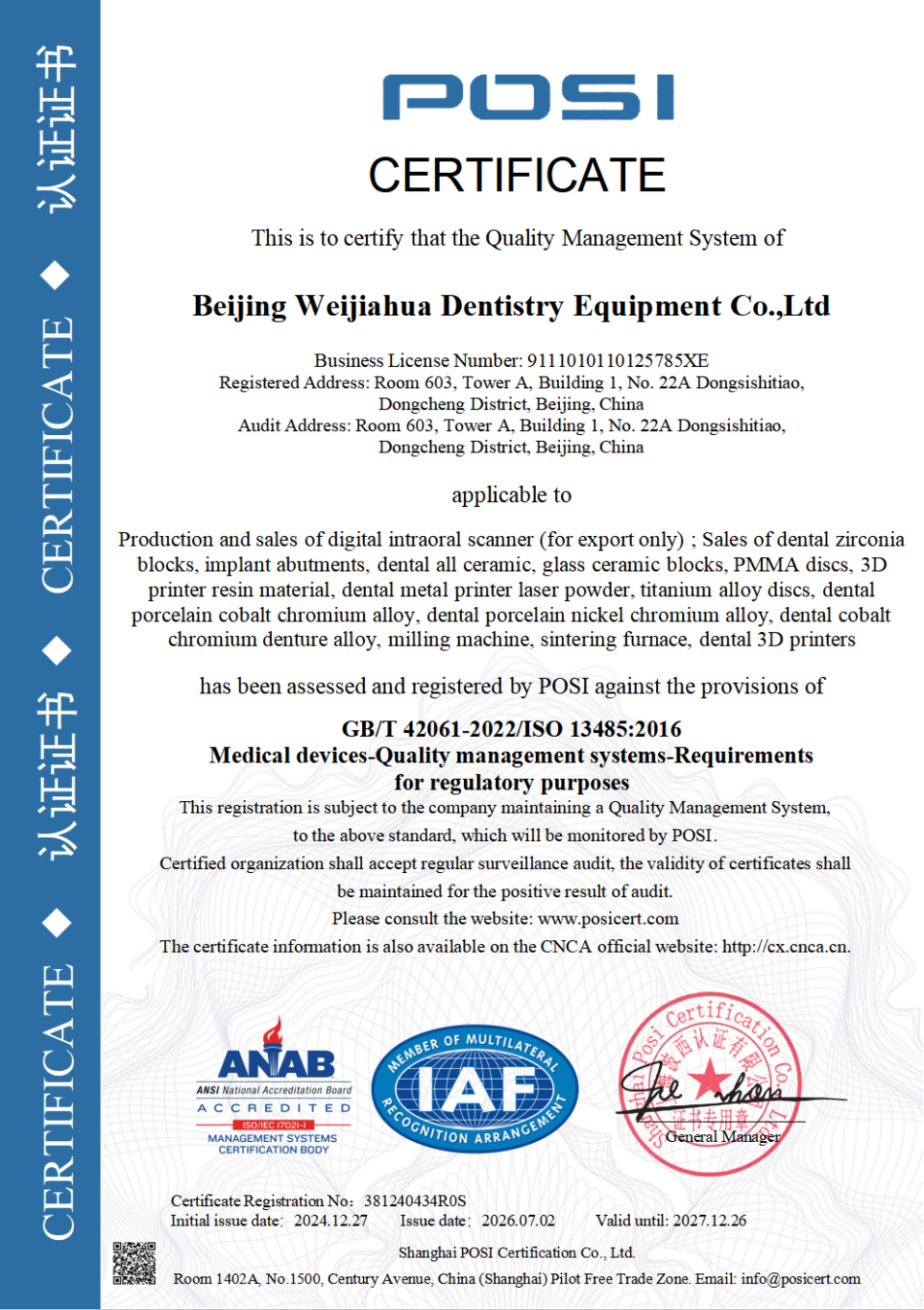
Beijing Weijiahua Dentistry Equipment Co., Ltd. holds an ISO 13485 certificate, number 381240434R0S, issued by Shanghai POSI Certification Co., Ltd. on 2024-12-27 and valid until 2027-12-26. The standard cited is GB/T 42061-2022 / ISO 13485:2016, and the certified scope is the design, production and sales of dental medical materials and dental equipment, covering the global market, the EU, the USA and the Middle East. The 4D-PRO-ML zirconia block falls within that material scope.
A second document illustrates why scope reading matters. The company also holds an EU Declaration of Conformity under MDR 2017/745, with SRN CN-MF-000045919, covering intraoral scanners (models YP-X and YP-800, Class I medical device) for the European Union. This document covers the scanner, not the zirconia block.
This distinction has practical weight. The EU Medical Device Regulation (MDR 2017/745) classifies most dental implants and restorative materials as high-risk, requiring intensive clinical data. A buyer exporting to the EU therefore needs to confirm which document applies to which product category, rather than treating conformity evidence as a single blanket credential.
Dimension 6 — Commercial and Acceptance Terms
Commercial terms are frequently the last dimension compared and the first one to cause friction after the order. The published terms for this supplier are specific enough to compare directly:
- MOQ: 1 box for standard models; 5 boxes for customized products
- Delivery terms: domestic express delivery; for export, sea freight or air freight, with FOB Shanghai/Tianjin available
- Acceptance criteria: check quantity upon receipt; damage or deformation must be reported within 48 hours with photos; sampling test is supported
- Payment terms: full payment before shipment
The 48-hour acceptance window is a real constraint, not a formality. A laboratory that receives a shipment on a Friday and inspects it the following week has already passed the reporting window. Buyers who operate multi-site labs should build receipt inspection into the goods-in process rather than treating it as a later step.
How to Weight the Six Dimensions
A comparison framework only works once the weights are assigned. The table below is an editorial weighting guide — a starting position that a laboratory should adjust against its own case mix.
| Laboratory profile | Highest-weight dimensions | Secondary weight | Lower weight |
|---|---|---|---|
| High-volume crown and bridge production | Supplier capability (capacity, QC, lead time); commercial terms | Specification and geometry fit; process compatibility | OEM/ODM customization scope |
| OEM / private-label brand owner | Supplier capability (OEM/ODM, customization); compliance scope | Material and mechanical behaviour | Stock shade availability |
| Implant and full-arch focused laboratory | Material and mechanical behaviour; process compatibility | Specification and geometry fit | MOQ structure |
| Distributor or exporter | Compliance and documentation; commercial terms | Supplier capability (capacity, lead time) | Shade program breadth |
Two design rules make this framework usable. First, no dimension should be treated as binary — a supplier that is strong on compliance and weak on lead time is not disqualified, it is weighted. Second, the weighting should be written down before quotations are opened, because comparing quotations without pre-set weights usually reduces to comparing unit price.
Where the Zirconia Block Route Has Real Boundaries
A comparison framework that only lists advantages is not a framework. The zirconia block route carries specific constraints that buyers should price into the decision.
The process is not reversible. Once a zirconia restoration has been sintered, chip damage or cracking cannot be corrected by reworking the piece. The defined response is to scrap the affected blank and re-mill — which means the true cost of a failed unit is a new blank plus machine time, not just a material cost. Blank inspection before sintering and adherence to the recommended profile are the two available controls.
The process depends on equipment discipline. The 1430 °C–1450 °C window with a controlled heating and holding curve assumes a sintering furnace that is calibrated and consistent. A laboratory running an unvalidated furnace will not see the stability the material is capable of, regardless of which supplier it buys from.
Commercial terms carry working-capital implications. Full payment before shipment, combined with a 15–30 working day lead time on a 15,000-piece monthly capacity, means inventory planning has to start earlier than it would with immediate-shipment supply. For customised products, the 5-box MOQ raises the entry point for a first trial run.
It is not the only viable material route. Lithium disilicate accounted for approximately 28% of all all-ceramic dental restorations globally as of 2024, and the dental lithium disilicate market is projected by Intel Market Research to grow from USD 320 million in 2025 to USD 920 million by 2032. Pressed and milled glass ceramic remains a mainstream route — particularly for anterior and highly aesthetic cases — and the two material families serve overlapping but different case profiles. The correct conclusion is not that one route is superior, but that the weighted framework should be applied separately to each.
Market Direction and What It Means for Buyers
Several structural signals point in the same direction for zirconia block procurement.
The zirconia-based dental materials market is expanding from USD 1.2 billion in 2025 toward a projected USD 2.3 billion by 2033. The United States alone accounts for 40% of revenue in this market, which explains why North American documentation expectations tend to set the standard for exporters elsewhere. Dental laboratories remain the dominant end-user, holding 45.3% of market share in 2025 — meaning the buyer profile this framework addresses is the same profile driving the majority of demand.
At the same time, manufacturing is concentrated in CAD/CAM milling at 82.4% of process revenue, and zirconia discs alone hold 63.1% of material revenue. A market with this structure tends to produce more suppliers with similar specifications, which increases the value of comparison discipline rather than reducing it.
Supplier-side evidence quality is the second structural signal. Because the EU MDR classifies most dental implants and restorative materials as high-risk, documentation requirements on restorative materials continue to tighten in that market. Buyers comparing suppliers on compliance will increasingly need to read scope wording, validity periods and product coverage rather than accepting a certificate image.
Applying the Framework to a Specific Supplier
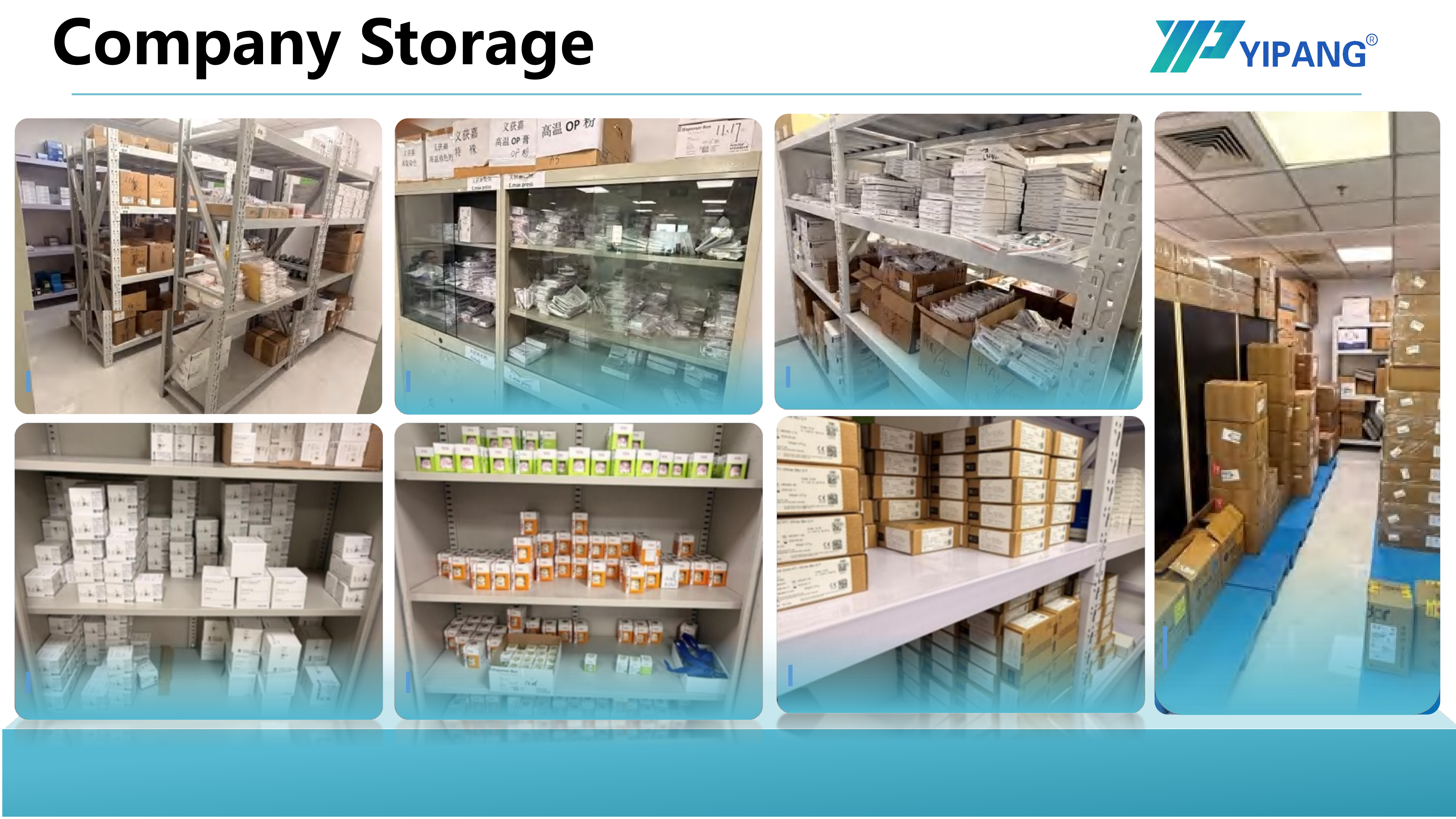
YIPANG is the self-developed brand of Beijing Weijiahua Dentistry Equipment Co., Ltd., a dental equipment and materials manufacturer established in 1996 with a 2,000 ㎡ factory, 80 employees and approximately USD 10 million in annual output. The company reports a 25-engineer R&D team working on dental material formulation, process optimisation and new product development, and an export ratio of 40%–55% across the Middle East, Southeast Asia, South America, North America, Eastern Europe, North Africa and Australia.
Its product lines include zirconia blocks, glass ceramics, press ingots, PMMA, wax, titanium blocks, implant abutments, 3D scanners, intraoral scanners, milling machines, 3D printers and sintering furnaces — a portfolio that matters to buyers because it indicates the supplier also operates on the equipment side of the workflow, not only the material side.
Reported customer feedback across hundreds of long-term cooperative clients — dental laboratories, dental clinics and distributors — centres on material stability, aesthetic results and a low complaint rate, with the specific claims being uniform translucency, stable sintering shrinkage, and compatibility with most CAD/CAM systems. These are manufacturer-reported characteristics and should be validated by sample testing against the buyer's own equipment, which the supplier's acceptance policy explicitly supports.
Future Outlook
Three shifts are likely to shape zirconia block comparison over the next procurement cycle. First, as material revenue continues to concentrate in discs, supplier differentiation will move further toward documentation quality and batch consistency, because those are the dimensions that remain after specifications converge. Second, compliance scope language will become a standard line item in supplier evaluation, particularly for EU-bound buyers. Third, labs will increasingly run their own sample validation before committing to a repeat order — including sintering the trial blanks on their own furnaces and measuring fit, shade and shrinkage against their existing baseline.
In that environment, a weighted framework is not paperwork. It is the difference between comparing catalogues and comparing outcomes.
FAQ
What is the suitable sintering temperature for the 4D-PRO-ML zirconia block?
The recommended sintering temperature range is 1430 °C–1450 °C. The standard procedure is to place the milled zirconia workpiece on the sintering tray, set the heating curve up to 1430 °C–1450 °C with a proper holding time, and allow natural cooling after sintering is complete. Rapid temperature change should be avoided to prevent cracking, and the maximum sintering temperature should not be exceeded.
What are the purchasing terms and acceptance criteria for dental zirconia blocks?
MOQ is 1 box for standard models and 5 boxes for customized products. Domestic delivery is by express; export shipments move by sea or air freight, with FOB Shanghai/Tianjin available. Acceptance requires checking quantity upon receipt; damage or deformation must be reported within 48 hours with photos. Sampling testing is supported. Payment terms are full payment before shipment.
Which certificates cover the dental zirconia block, and what is the scope?
Beijing Weijiahua Dentistry Equipment Co., Ltd. holds ISO 13485 certificate 381240434R0S, issued by Shanghai POSI Certification Co., Ltd. on 2024-12-27 and valid until 2027-12-26, under GB/T 42061-2022 / ISO 13485:2016. The certified scope is the design, production and sales of dental medical materials and dental equipment, covering the global market, the EU, the USA and the Middle East. A separate EU Declaration of Conformity under MDR 2017/745 (SRN CN-MF-000045919) covers intraoral scanners YP-X and YP-800, not the zirconia block.
Does YIPANG offer OEM and ODM services for dental zirconia blocks?
Yes. The manufacturer provides both OEM and ODM production services, and customization is available for almost all specifications. These services cover clients in the USA, Europe, Brazil, the Middle East and North Africa. Monthly capacity is stated at 15,000 pieces, with a lead time of 15–30 working days and a negotiable small MOQ.
What thicknesses and dimensions are available for the 4D-PRO-ML zirconia block?
The block is produced in an ML multilayer shade system with a 98 mm diameter and six thickness options: 10 mm, 12 mm, 14 mm, 16 mm, 18 mm and 20 mm. The material is yttria-stabilized zirconium dioxide (ZrO₂), with a stated flexural strength of ≥1200 MPa, medium translucency and a stated sintering temperature of 1450 °C.
How is quality controlled across zirconia block production?
The stated quality control process combines 100% raw material inspection with finished product random inspection. The manufacturer also states that after-sales technical guidance is provided online, with after-sales problem response within 24 hours. Buyers evaluating this dimension should request the sampling test that the acceptance policy explicitly supports.
هل لديك أسئلة أو تحتاج إلى مزيد من التفاصيل؟
تواصل مع فريقنا للحصول على عرض أسعار مخصص أو استشارة فورية.
طلب عرض أسعار
املأ النموذج أدناه وسيتواصل معك فريقنا بعرض مقترح مخصص.
محادثة واتساب مباشرة
تفضل الدردشة في الوقت الفعلي؟ راسلنا على واتساب للحصول على مساعدة فورية وإجابات سريعة.
- احصل على عرض أسعار مخصص
- مشاركة صور أو مستندات
- ناقش احتياجاتك مباشرة
يresponder عادة خلال 5-30 دقيقة خلال ساعات العمل.