
Dental Zirconia Block: Long-Term Fit Across Lab Scenarios
Zirconia discs held the largest revenue share of the zirconia-based dental materials market in 2025 — 63.1% — and dental laboratories were the single largest end-user group at 45.3%, according to Grand View Research. Read as an operating fact rather than a market headline, those two figures describe a supply relationship: a zirconia blank is consumed continuously, and the choice of who supplies it behaves less like a purchase and more like an operating decision that has to survive changes in case mix.
Long-term supplier evaluation is usually reduced to three questions: how long the supplier has existed, what the certificate covers, and what the block costs. Laboratories that run into difficulty with a supply relationship rarely fail on those three points. They fail because the shade system, thickness range, sintering behaviour, capacity or lead time qualified two years ago no longer matches the cases the laboratory now accepts. A credible long-term evaluation of a dental zirconia block supplier is therefore a repeated scenario test, run against the laboratory's current production mix, rather than a one-off certificate check.
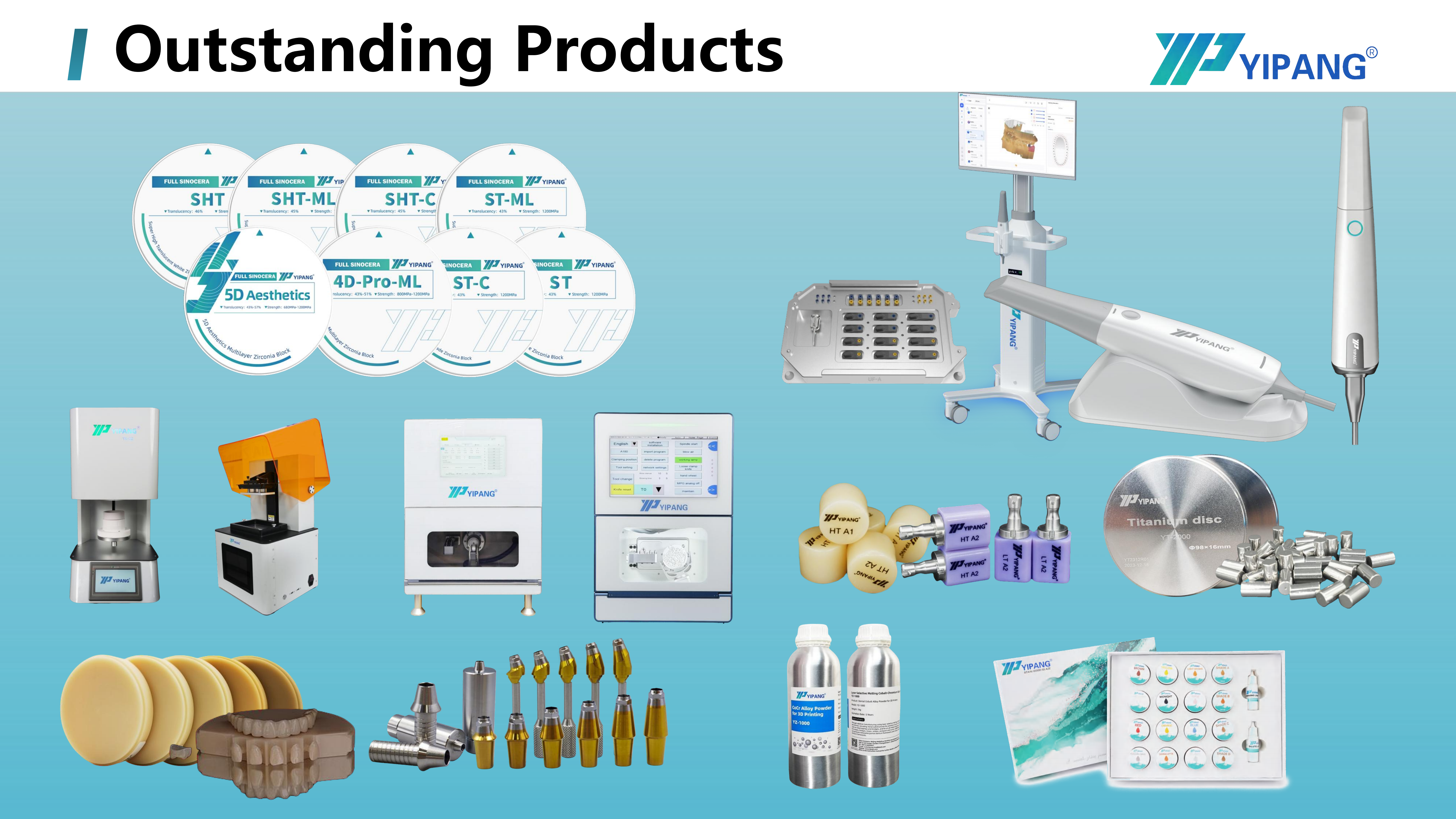
A zirconia block is a continuously consumed input: supplier evaluation has to hold across crown and bridge work, aesthetic cases, implant abutments and full-arch restorations.
Why scenario drift, not calendar time, decides whether a supply relationship holds
Few dental laboratories change their case mix deliberately. It shifts. A laboratory that begins with single-unit full-contour crowns typically adds multi-unit bridges, then implant-supported crowns and abutment work, then edentulous and full-arch restorations, and along the way moves from intermittent milling to scheduled high-volume output. Each step adds a requirement that the original trial order never tested:
- Single crowns and short-span bridges test shade consistency and sintering shrinkage stability.
- Multilayer aesthetic work tests gradient translucency and whether the shade system covers the laboratory's most frequent prescriptions.
- Implant abutment and edentulous scanbody workflows test how accurately the block stage connects to the scanning and milling chain.
- Implant-supported full-arch cases test available block thickness, nesting efficiency and dimensional stability across large frameworks.
- High-volume milling and sintering test capacity headroom and lead-time reliability rather than product quality alone.
The practical consequence is that evaluation criteria should be re-scored at every review cycle against the laboratory's current scenario set. A supplier that scored well when the laboratory was crown-and-bridge only is not automatically the right long-term partner once implant-supported full-arch work becomes routine — and the reverse also holds, because a supplier optimised for high-volume standardisation may not suit a laboratory built around small-batch aesthetic work.
A six-dimension framework for evaluating a zirconia block supplier over time
The framework below converts an impression (“is this a good long-term supplier?”) into six dimensions that can each be answered with documented evidence. The right-hand column shows how YIPANG's Zirconia Blocks for Dental Prosthesis — model 4D-PRO-ML, a YIPANG brand produced by Beijing Weijiahua Dentistry Equipment Co., Ltd. — is documented against each dimension. The aim is not to score one supplier but to hand a laboratory a repeatable structure it can apply to every candidate, including the incumbent.
| Evaluation dimension | Evidence to request | Failure mode if left unverified | Documented example (YIPANG 4D-PRO-ML) |
|---|---|---|---|
| Specification continuity | Current shade system, thickness ladder, diameter, sintering temperature, bending strength, translucency class | A thickness or shade gap appears mid-project and forces an unplanned second supplier | ML multilayer shades; 98 mm diameter; 10/12/14/16/18/20 mm thickness; 1450℃ sintering temperature; bending strength ≥1200 MPa; medium translucent; yttria-stabilized ZrO₂ |
| Process continuity | Sintering curve used in production, equipment compatibility list, shrinkage behaviour | New sintering programs and new CAM compensation values have to be re-validated | Processed by dental milling machine and sintered in a dental sintering furnace; standard sintering curve guidance of 1430℃–1450℃; compatible with most CAD/CAM systems; stable sintering shrinkage |
| Capacity and lead time | Monthly capacity, lead-time range, MOQ policy | Volume growth outruns supply and delivery slips during peak periods | 15,000 pieces per month; 15–30 working days lead time; negotiable small MOQ |
| Commercial flexibility | OEM/ODM scope, limits of customization, change-control process | Private-label or custom shade requirements cannot be met without a new supplier | OEM/ODM production mode; almost all specifications can be customized |
| Quality control | Incoming material inspection, finished goods sampling, batch record practice | Batch-to-batch variation only surfaces after restorations are already sintered | 100% raw material inspection plus finished product random inspection |
| Support continuity | Technical response channel and committed response time | Sintering or fit problems stall production with no defined escalation path | Online technical guidance; after-sales response within 24 hours |
Table 1: Six evaluation dimensions for a long-term dental zirconia block relationship, with the evidence type to request and a documented example from the YIPANG 4D-PRO-ML specification.
Specification continuity: what to fix in writing
The block specification is the easiest part of a supply relationship to lose without noticing, because it rarely changes all at once. YIPANG's Zirconia Blocks for Dental Prosthesis are CAD/CAM dental milling blanks made of yttria-stabilized zirconium dioxide (ZrO₂), supplied in ML multilayer shades, at a 98 mm diameter, with thickness options of 10 mm, 12 mm, 14 mm, 16 mm, 18 mm and 20 mm. The published specification lists a sintering temperature of 1450℃, a bending strength of ≥1200 MPa and medium translucency.
Two of those numbers carry more weight in a long-term evaluation than they appear to. The thickness ladder determines which frameworks can be nested as a single piece rather than joined, which affects both labour and fit as the laboratory moves into multi-unit and full-arch work. The shade system determines whether the laboratory has to keep a second brand on the shelf for a small share of prescriptions — an inventory and documentation cost that tends to be underestimated at the trial stage.
Translucency class deserves a boundary statement rather than a claim. Medium translucency zirconia is documented for full-contour crowns, bridges, veneers and implant superstructure restorations, and is used in multilayer crown and bridge projects, aesthetic crown restoration laboratories and implant-supported full-arch cases. For the most translucent anterior indications, laboratories commonly work with lithium disilicate glass ceramic or press ingots instead. A laboratory whose prescription mix is heavily tilted toward those cases should therefore evaluate the breadth of the supplier's portfolio — blocks, glass ceramics, press ingots, PMMA, PEEK, titanium discs and abutments — rather than scoring the zirconia block in isolation.
Process continuity: sintering curves, equipment fit and the real cost of switching
Sintering is where a long-term relationship is won or lost, because it sits between two parties. The block must be processed following the standard sintering temperature curve, and the operating guidance for this material describes a recommended range of 1430℃–1450℃ with a standard heating and holding procedure, followed by natural cooling. Rapid temperature change should be avoided, and the maximum sintering temperature should not be exceeded. The environment is equally specific: an indoor constant temperature dental laboratory, a condition that applies to this application globally.
Equipment fit is the second half of the same question. The product operates in a mode where it is processed by a dental milling machine and sintered in a dental sintering furnace, with supporting equipment including a dental milling machine, a dental sintering furnace and a dental lab scanner. It is documented for digital dental laboratory projects — CAD/CAM milling laboratories and dental lab scanner digital workflows — as well as scanner-to-milling workflows, high-volume milling workflows and high-volume sintering workflows.
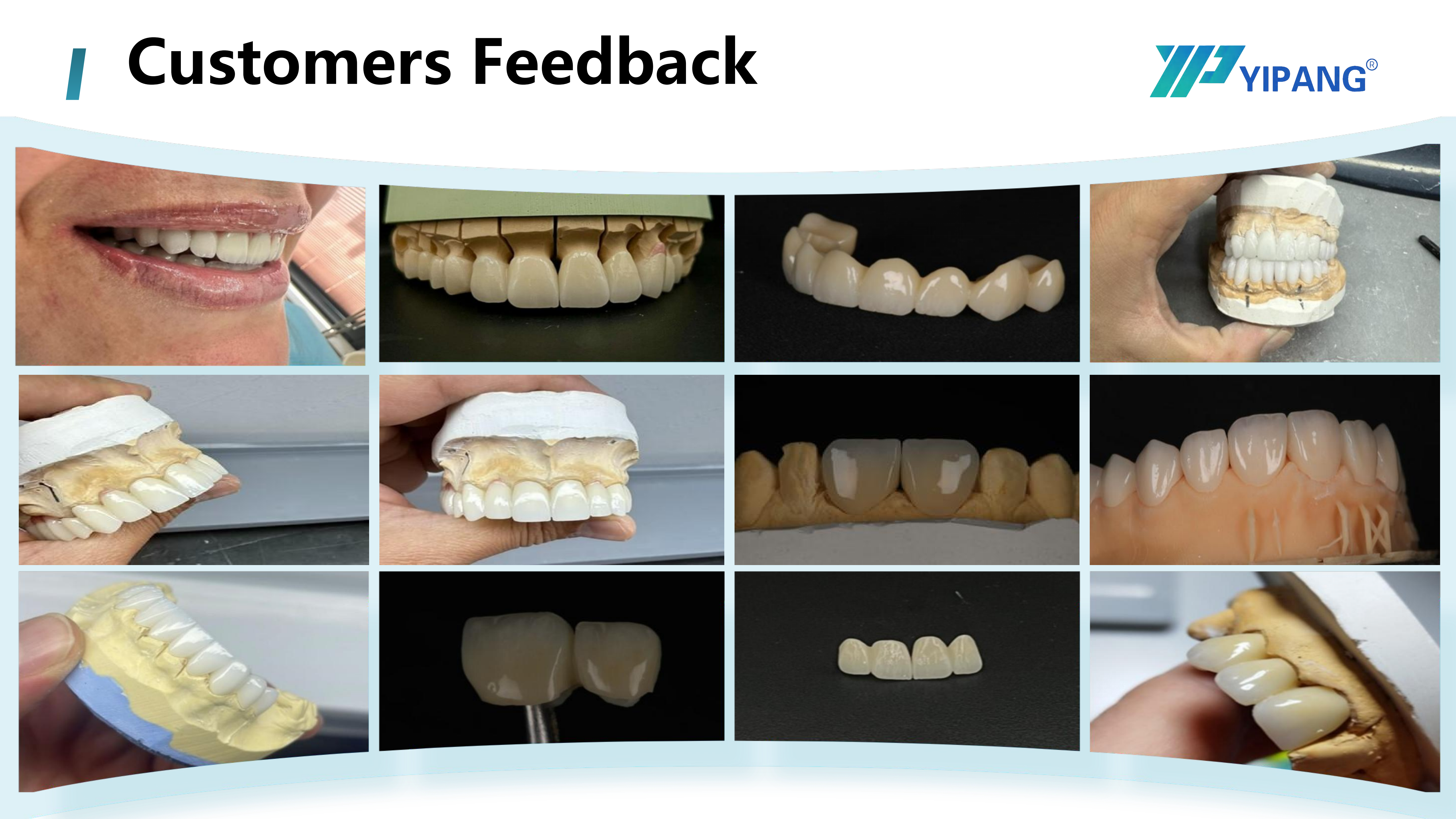
Process continuity, not unit price alone, defines the cost of changing suppliers: sintering programs and CAM compensation values have to be re-validated.
This is the point laboratories should weigh carefully when comparing a long-term relationship with periodic re-tendering. Documented case highlights for this product include uniform translucency, stable sintering shrinkage and compatibility with most CAD/CAM systems. Those are exactly the properties that make switching expensive: a new blank means re-validating shrinkage compensation in the CAM software, re-checking the sintering program, and re-acquainting technicians with how the material behaves after firing. That re-qualification work is real production time, and it rarely appears in a price comparison.
Capacity, lead time and customization as long-term variables
Capacity and lead time only become visible as risks when volume grows. YIPANG documents a production mode of OEM/ODM, a monthly capacity of 15,000 pieces, a lead time of 15–30 working days, a negotiable small MOQ, and customization in which almost all specifications can be customized. For a laboratory planning a standing supply agreement, three checks follow directly from those figures.
First, the capacity figure should be read against the laboratory's own twelve-month forecast rather than against today's order size, since a supplier that is comfortable at current volume may not remain comfortable if the laboratory doubles its implant-supported work. Second, the lead-time range spans a factor of two, so buffer stock planning should assume the long end of the range rather than the average. Third, because customization is documented in scope but not as a separate lead time, a laboratory ordering custom shades or non-standard thicknesses should confirm in writing whether those specifications stay inside the 15–30 working-day window.
The supplier's own market footprint is a further continuity signal. Beijing Weijiahua Dentistry Equipment Co., Ltd. documents an export ratio of 40%–55% and main markets spanning the Middle East, Southeast Asia, South America, North America, Eastern Europe, North Africa and Australia. A supplier serving several regions is less exposed to a single market's demand cycle, which matters when a laboratory needs a stable delivery rhythm rather than a one-off shipment.
Quality control, documentation and support continuity
Quality control is the dimension where laboratories most often accept a statement instead of a method. The documented method here is 100% raw material inspection combined with finished product random inspection — an incoming-material gate plus an outgoing sampling gate. For a long-term evaluation, the useful question is not whether a supplier has quality control, but what happens to a nonconforming batch and how quickly the laboratory learns about it.
Support continuity is the second half of that picture. YIPANG documents online technical guidance and an after-sales response commitment within 24 hours. The company behind the brand, Beijing Weijiahua Dentistry Equipment Co., Ltd., was established in 1996, operates a 2,000 м² facility with 80 employees, reports an annual output of 10 million US dollars, and maintains an R&D team of 25 engineers working on dental material formula research, process optimisation and new product development. Its distribution history includes representing international brands such as VITA, Ivoclar, Dentsply, Amann Girrbach and Noritake, and more than 1,000 dental laboratory customers in China, alongside training and consulting services covering technical, clinical and 3D printing topics.
That background matters for a long-term evaluation for a specific reason: a supplier that also distributes equipment and materials tends to be able to support process changes — scanner, milling machine or furnace upgrades — that a pure material trader cannot. The case record for this product describes hundreds of long-term cooperative clients worldwide, cooperation sustained over many years, and reported high recognition on material stability and aesthetic effect with a low customer complaint rate. These are supplier-reported results rather than independently audited findings, and a laboratory should treat them as claims to test against its own validation batch.
Scenario fit map: matching a multilayer block to a laboratory's case mix
The table below translates the general framework into the scenario language a laboratory actually uses when reviewing a supplier. Each row pairs a production scenario with what it demands and the question that should be confirmed at the next review.
| Laboratory scenario | What the scenario demands | Documented fit for 4D-PRO-ML | Question to confirm at review |
|---|---|---|---|
| Multilayer crown and bridge production | Shade gradient, shrinkage stability, predictable fit | ML multilayer shades; documented use in multilayer crown and bridge projects | Does the shade range still cover the laboratory's top prescriptions? |
| Aesthetic crown restoration laboratory | Translucency control and finishing consistency | Medium translucency; used in glaze paste finishing projects | Does part of the mix need a higher-translucency material class? |
| Implant abutment and edentulous scanbody workflows | Accuracy carried through the digital chain | Documented use in implant abutment laboratories and edentulous scanbody kit workflows | Do tolerances hold from scanbody to milled and sintered part? |
| Implant-supported full-arch restorations | Large framework nesting, sufficient block thickness | Documented use in full-arch implant restorations; thickness up to 20 mm | Is the thickest option sufficient for the largest frameworks built this year? |
| High-volume milling and sintering centre | Throughput headroom and delivery reliability | Documented use in high-volume milling and high-volume sintering workflows; 15,000 pieces per month capacity | Does capacity headroom cover the next twelve months of forecast? |
| Mixed-material CAD/CAM laboratory | Fewer supplier interfaces across material classes | Documented workflows alongside PMMA discs, PEEK discs and lithium disilicate glass ceramics | Which material classes must remain dual-sourced? |
Table 2: Scenario fit map for a multilayer medium-translucency zirconia block, mapped to the questions a laboratory should raise at each supplier review.
Market signals that turn continuity into a procurement criterion
Market structure explains why continuity has become a procurement criterion rather than a preference. Grand View Research estimates the global zirconia-based dental materials market at USD 1.2 billion in 2025, projected to reach USD 2.3 billion by 2033, with zirconia discs at 63.1% of 2025 revenue, CAD/CAM milling at 82.4% of process revenue, the 3Y-TZP grade at 35.9% of product-specification share, dental laboratories at 45.3% of end-user share, and the United States accounting for 40% of global revenue.
Two conclusions follow for a laboratory. When CAD/CAM milling carries the dominant share of process revenue, equipment compatibility stops being a technical footnote and becomes a strategic criterion in supplier selection. And when laboratories remain the largest end-user group, the supply decisions of individual laboratories collectively shape how suppliers allocate capacity — a reason to treat the annual review as a two-way conversation about volume planning.
Regulatory scope reinforces the same logic. The EU Medical Device Regulation (MDR 2017/745) classifies most dental implants and restorative materials as high-risk and requires intensive clinical data. Where documentation obligations sit with the laboratory's own quality file, changing a material supplier is not a purchasing transaction but a documentation exercise — which raises the effective cost of switching and, by extension, the value of evaluated continuity.
Where the long-term single-source model stops working
Periodic re-tendering and spot purchasing, the traditional alternative, retains real advantages: it keeps commercial tension in the relationship and suits laboratories with a low and irregular zirconia requirement. Its documented cost is requalification — re-validating CAM shrinkage compensation, rebuilding sintering programs and re-training technicians each time the material changes.
A long-term relationship inverts that trade-off, and it is worth stating plainly where it fails. First, concentration risk: a single qualified material source with a documented lead time of 15–30 working days places the buffer-stock decision entirely with the laboratory, and a delivery slippage at the long end of that range has no immediate substitute. Second, scope limits: a medium-translucency zirconia block covers crowns, bridges, veneers and implant superstructures, but it is not a universal restorative answer, and the most translucent indications typically call for lithium disilicate glass ceramic or press ingots. Third, commercial assumptions: a long-term relationship is not automatically cheaper, and OEM/ODM terms, customization scope and MOQ are negotiable project by project rather than fixed by the relationship itself.
A defensible structure for most laboratories is therefore a primary qualified zirconia supplier for the bulk of standard work, a live secondary source for continuity, and a documented portfolio view covering the material classes the laboratory genuinely uses. Re-scoring the six dimensions annually against the current case mix keeps the evaluation honest — and, importantly, keeps the laboratory's assumptions from ageing faster than its own case mix.
Future outlook: supplier evaluation as an annual operating routine
As dental laboratories continue moving work into digital workflows, supplier evaluation is likely to move further away from unit price and closer to continuity cost: how quickly a material can be requalified, how much support is available when a sintering program misbehaves, and how visible a supplier's capacity is to the laboratory that depends on it. Suppliers that combine material production with equipment distribution and technical training — the model Beijing Weijiahua Dentistry Equipment Co., Ltd. describes, with training spanning technical, clinical and 3D printing topics — are positioned to reduce that continuity cost, because process change is part of their normal activity rather than an exception.
The practical recommendation is procedural rather than promotional: put the six dimensions on one page, attach evidence to each, and re-score them on a fixed annual cycle against the laboratory's own case mix data. A supplier review that can be repeated is worth more than a supplier evaluation that can only be delivered once.
FAQ
What should a dental laboratory measure when it evaluates a zirconia block supplier over several years?
Six dimensions can be documented rather than assumed: specification continuity (shade system, thickness range, diameter, sintering temperature, bending strength, translucency class); process continuity (sintering curve and equipment compatibility); capacity and lead time; customization scope; quality control method; and technical support response. As a reference point, YIPANG's 4D-PRO-ML block is documented with ML multilayer shades, 98 mm diameter, 10–20 mm thickness options, a 1450℃ sintering temperature, bending strength ≥1200 MPa and medium translucency, produced under a documented quality method of 100% raw material inspection plus finished product random inspection.
Which restoration types is a medium-translucency multilayer zirconia block intended for?
It is documented for full-contour crowns, bridges, veneers and implant superstructure restorations, and is used in multilayer crown and bridge projects, aesthetic crown restoration laboratories, and implant-supported full-arch cases. Because the translucency class is medium, cases requiring the highest level of light transmission are normally produced in other material classes such as lithium disilicate glass ceramic or press ingots, which is why portfolio breadth — not the zirconia block alone — is the relevant evaluation subject for laboratories with a broad aesthetic mix.
What sintering parameters have to be reproduced for consistent results?
The published product specification lists a sintering temperature of 1450℃, while the operating guidance describes a recommended range of 1430℃–1450℃ following a standard heating and holding procedure, with natural cooling afterwards. Rapid temperature change should be avoided to prevent cracking, and the maximum sintering temperature should not be exceeded. The process is carried out in an indoor constant temperature dental laboratory environment, using a dental milling machine for the green stage and a dental sintering furnace for sintering.
How should capacity, lead time and MOQ be verified before committing volume?
Documented figures for this supply line are a monthly capacity of 15,000 pieces, a lead time of 15–30 working days, a negotiable small MOQ, and an OEM/ODM production mode in which almost all specifications can be customized. Verification means comparing the capacity figure with the laboratory's own twelve-month forecast, planning buffer stock around the long end of the lead-time range, and confirming in writing whether customized shades or thicknesses remain within the standard lead-time window, since customization scope is documented but a separate customization lead time is not.
What quality-control and after-sales evidence should be reviewed?
The documented quality method is 100% raw material inspection combined with finished product random inspection, and the documented support commitment is online technical guidance with an after-sales response within 24 hours. Product case records cite uniform translucency, stable sintering shrinkage and compatibility with most CAD/CAM systems, and describe hundreds of long-term cooperative clients worldwide with reported high recognition on material stability and aesthetic effect and a low customer complaint rate. These are supplier-reported results and are best validated against the laboratory's own trial batch before volume commitments.
Does a long-term supplier relationship remove the need for a second zirconia source?
No. A single qualified source with a documented 15–30 working-day lead time places buffer-stock risk with the laboratory, and the documented scope of a medium-translucency zirconia block does not cover every restorative indication, since highly translucent aesthetic cases are typically produced in lithium disilicate glass ceramic or press ingots. A common structure is one primary qualified supplier for standard zirconia work, a live secondary source for continuity, and a documented view of which material classes are deliberately dual-sourced.