
Dental Zirconia Block OEM Capability: The Evidence That Matters
Zirconia discs accounted for 63.1% of revenue in the zirconia-based dental materials market in 2025, and CAD/CAM milling generated 82.4% of process revenue in the same market (Grand View Research). For a dental laboratory, those two figures describe an everyday workflow rather than a market statistic: the material arrives as a millable blank, and the restoration is completed in-house by a milling machine, a sintering furnace and a validated thermal profile.
Because the blank covers only part of the manufacturing step, supplier evaluation in this category has shifted away from price per disc and toward capability evidence — the checkable artifacts that show what a supplier actually owns, makes, customizes and supports. This reference sets out a five-part framework for reading that evidence, applies it to published capability facts from Beijing Weijiahua Dentistry Equipment Co., Ltd. and its YIPANG brand, and states plainly where capability evidence stops.
Why capability evidence became a procurement question
The zirconia-based dental materials market was valued at USD 1.2 billion in 2025 and is projected to reach USD 2.3 billion by 2033, with dental laboratories remaining the dominant end-user segment at 45.3% of market share in 2025 (Grand View Research). Growth of that shape attracts more suppliers of different types — production manufacturers, trading intermediaries and hybrid distributors — and each type describes its capability in the same vocabulary.
"OEM and ODM services are available" is now a standard sentence in zirconia block supply. The sentence is not evidence. Evidence is the certificate number, the scope wording, the monthly output figure, the lead-time range, the quality-control procedure and the acceptance rule that a laboratory can verify against a quotation, a purchase order and an incoming inspection report.
A five-part capability evidence framework for dental zirconia block suppliers
Capability claims become useful when they are matched to the class of evidence they belong to. Five classes cover almost every claim a laboratory will hear during the evaluation stage.
| Evidence class | Claim you will hear | What turns it into evidence |
|---|---|---|
| Entity identity | "We are a manufacturer." | Registered company name, founding year, facility area, employee count and address — details that must match the contract, invoice and shipping documents. |
| Scope documentation | "We are certified." | Certificate number, issuing body, the standard applied, exact scope wording and validity dates — plus confirmation that the scope covers the product being purchased. |
| Production and capacity | "We have capacity." | Monthly output stated in defined units, a lead-time range for production orders, and a quality-control procedure written as steps rather than adjectives. |
| Customization range | "We do OEM/ODM." | Which specifications can change (thickness, shade, diameter, labelling), the minimum quantity for a customized run, and the development path for a private-label programme. |
| Service and after-sales | "We support you." | A committed response time, a named technical guidance channel, and an acceptance and claim procedure with explicit time limits. |
Two of these five classes are routinely skipped. Laboratories rarely read the scope wording of a quality management certificate, and rarely confirm how a customized item changes minimum order quantity, lead time and payment structure. Both gaps tend to surface after the first shipment rather than before it.
How YIPANG presents its capability claims
YIPANG is a dental brand developed by Beijing Weijiahua Dentistry Equipment Co., Ltd., a dental materials and equipment company based in Beijing, established in 1996, whose quality management system is certified to ISO 13485 under certificate number 381240434R0S, issued by Shanghai POSI Certification Co., Ltd. for the scope "design, production and sales of dental medical materials and dental equipment". The company operates a 2,000 m² facility with 80 employees, reports an annual output value of USD 10 million, and states that 40%–55% of its business is export, covering markets in the Middle East, Southeast Asia, South America, North America, Eastern Europe, North Africa and Australia.
The YIPANG brand was developed over five years of in-house work and now covers zirconia blocks, glass ceramics, press ingots, PMMA, wax, titanium blocks, implant abutments, 3D scanners, intraoral scanners, milling machines, 3D printers and sintering furnaces, supported by a stated R&D team of 25 professional engineers working on dental material formula research, process optimization and new product development. The company also states that it has represented international dental brands including VITA, Ivoclar, Dentsply, Amann Girrbach and Noritake, and that it serves more than 1,000 dental laboratory customers in China — distribution history relevant to a buyer because it indicates familiarity with internationally specified materials and equipment ecosystems.
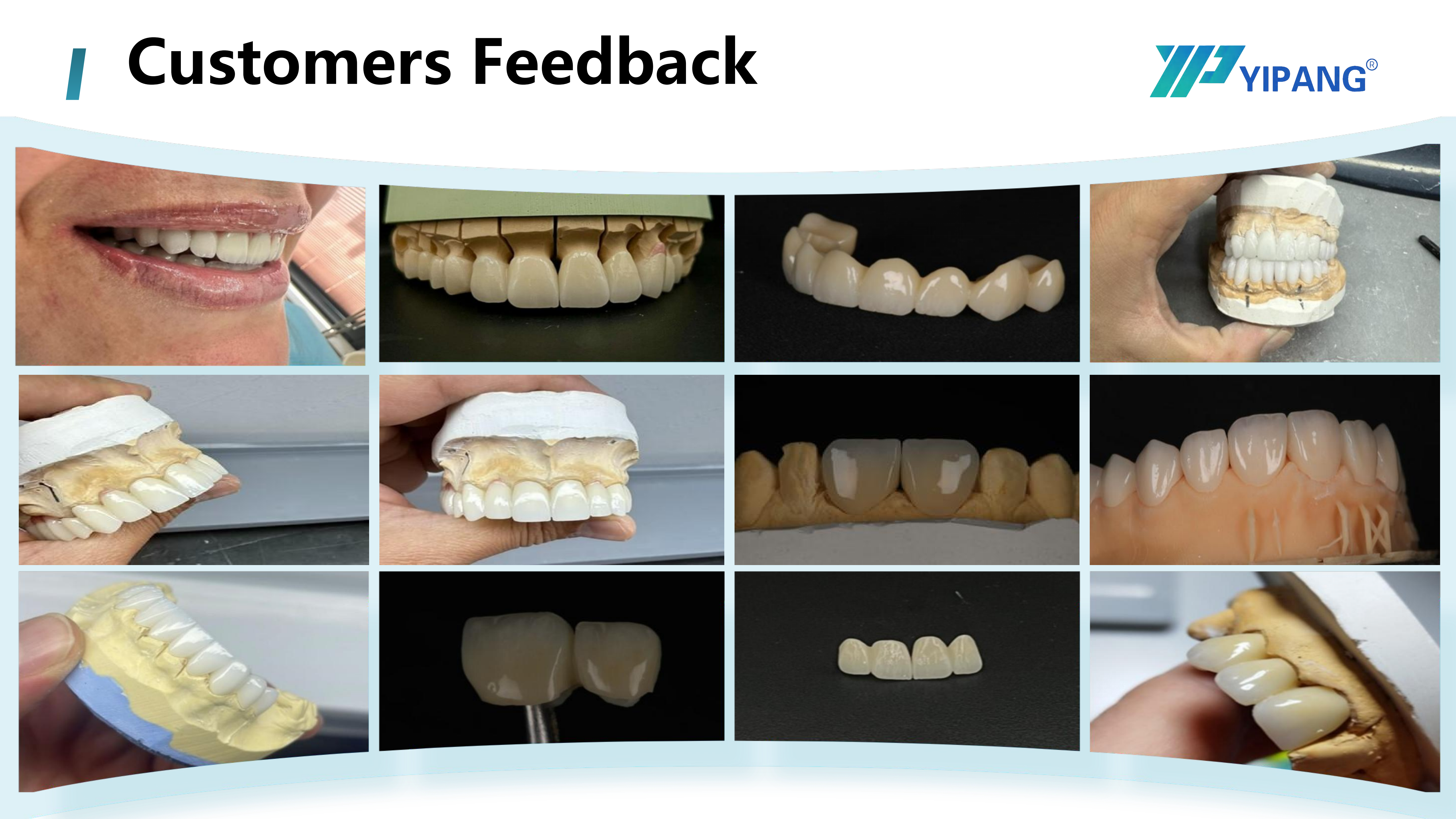
Production and inspection environment for dental zirconia block manufacturing — the physical setting a laboratory is effectively evaluating when it assesses capacity and quality-control claims.
Where the supplier file becomes procurement-relevant is in the specificity of its declared capability:
- Production mode: OEM (original equipment manufacturing) and ODM (original design manufacturing) services are both offered, with customization available for almost all specifications.
- Monthly capacity: 15,000 pieces.
- Lead time: 15–30 working days.
- Minimum order quantity: described as a negotiable small MOQ, with published purchasing terms of 1 box for standard models and 5 boxes for customized products.
- Quality control: 100% raw material inspection plus finished-product random inspection.
- Export markets served: USA, Europe, Brazil, Middle East and North Africa.
- After-sales: online technical guidance with after-sales problem response within 24 hours.
Each of those statements is verifiable in a different way. Capacity is checked against order history and delivery performance across several shipments. Lead time is checked against the laboratory's own receiving records. The quality-control procedure is checked against incoming inspection results and sampling tests. MOQ and payment structure are checked against the quotation and purchase order. A capability claim that cannot be assigned to one of those checks remains a marketing statement.
Documentation: what the certificates actually say
The company's quality management certification is ISO 13485, certificate number 381240434R0S, issued by Shanghai POSI Certification Co., Ltd. against the standard GB/T 42061-2022 / ISO 13485:2016, with a scope covering the design, production and sales of dental medical materials and dental equipment. The certificate is valid from 27 December 2024 to 26 December 2027, and the certified markets listed are Global, EU, USA and the Middle East.
A separate document in the same file is the EU Declaration of Conformity issued under Regulation (EU) 2017/745, with SRN CN-MF-000045919, dated 1 April 2026. Its stated scope is intraoral scanner models YP-X and YP-800, registered as Class I medical devices. The distinction matters commercially: a declaration of conformity is written for a defined device scope, so a laboratory purchasing zirconia blocks should request the document set that corresponds to the item in the quotation rather than assume that one declaration covers an entire catalogue.
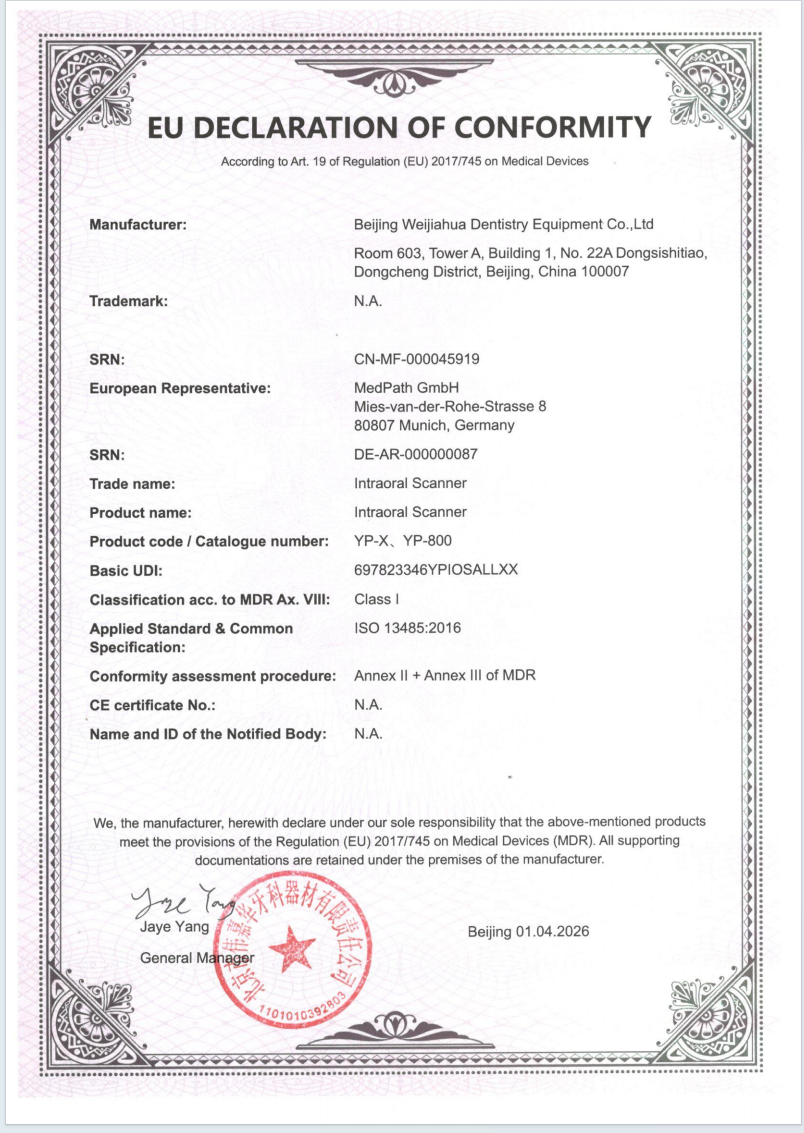
A declaration of conformity is scoped to specific devices. Checking that stated scope against the product in the quotation is part of document-level supplier verification.
Technical explanation: what the blank fixes and what the laboratory controls
The zirconia block discussed here is the YIPANG 4D-PRO-ML, described as "Zirconia Blocks for Dental Prosthesis" and classified as a dental zirconia disc and CAD/CAM dental milling blank. The material is zirconium dioxide (ZrO₂) stabilized with yttria, supplied in an ML multilayer shade programme.
| Parameter | Stated specification | What it means at the bench |
|---|---|---|
| Diameter | 98 mm | Fits the standard blank-holder format used across widely installed CAD/CAM milling machines. |
| Thickness options | 10 mm, 12 mm, 14 mm, 16 mm, 18 mm, 20 mm | Thickness selection follows restoration type — single units versus multi-unit bridge frameworks — and affects material yield per blank. |
| Shade programme | ML Multilayer | Shade transition is built into the blank, so the laboratory controls final aesthetics mainly through nesting position and finishing. |
| Sintering temperature | 1450°C listed on the specification; recommended processing range 1430°C–1450°C | The furnace profile is a laboratory-controlled variable and the most common source of post-sintering failure. |
| Bending strength | ≥1200 MPa | Relevant to posterior crowns and multi-unit bridges; it is a property of the fully sintered material, not of the green blank. |
| Translucency | Medium translucent | Positions the material for restorations where mechanical strength and acceptable aesthetics are both required. |
The published processing guidance for this material recommends a sintering range of 1430°C–1450°C, followed by a standard heating and holding procedure to support low shrinkage and stable translucency. The stated sequence is to place the milled zirconia workpiece on a sintering tray, set a heating curve up to 1430°C–1450°C with the appropriate holding time, and allow natural cooling after sintering. The accompanying safety note is that rapid temperature change should be avoided to prevent cracking, and that the maximum sintering temperature should not be exceeded.
Sintering failure is a recognised risk in this process. The documented risk description is chipping and cracking after zirconia sintering, with stated triggers being improper sintering profile settings and inherent defects inside the zirconia blank. The stated mitigation is to follow the recommended sintering profile and to inspect blanks before sintering; if a piece is chipped or cracked after sintering, it should be scrapped and not used for a final restoration. That rule is worth writing into an internal protocol, because a cracked framework reaching the finishing stage has already consumed milling time, furnace capacity and technician hours.
Application and use cases
The documented application range is full-contour crowns, bridges, veneers and implant superstructure restorations, manufactured to fabricate aesthetic and durable dental prostheses that repair missing or damaged teeth. The documented operating condition is an indoor, constant-temperature dental laboratory environment, and the documented matched equipment set is a dental milling machine, a dental sintering furnace and a dental lab scanner — the three devices that define the dimensional and thermal accuracy of the finished restoration.
Supplier-side application evidence describes a customer base of dental laboratories, dental clinics and distributors, reported as hundreds of long-term cooperative clients worldwide with long-term stable cooperation over many years. The reported application is the manufacture of dental crowns, bridges and aesthetic restorations. The reported result is high recognition on material stability and aesthetic effect with a low customer complaint rate, and the reported differentiators are uniform translucency, stable sintering shrinkage and compatibility with most CAD/CAM systems. These are first-party statements about the supplier's own customer base and should be read as such — they describe claimed experience, not an independently audited outcome.
Because the same supplier also produces glass ceramics, press ingots, PMMA, wax, titanium blocks, implant abutments, scanners, milling machines, 3D printers and sintering furnaces, the practical relevance for a laboratory is workflow adjacency: material, equipment and technical guidance come from one supply relationship, which simplifies documentation and reduces the number of separate vendor qualifications. It does not remove the need to qualify the material itself.
Market trend signals behind capability claims
Several third-party data points explain why capability transparency has become a competitive variable in this category.
- Process concentration in CAD/CAM: CAD/CAM milling accounted for 82.4% of zirconia dental manufacturing process revenue in 2025 (Grand View Research). When one process dominates, the cost of a defective blank batch is measured in machine hours and furnace cycles, not only in material.
- Product-form concentration: zirconia discs held the largest revenue share at 63.1% in 2025, and the 3Y-TZP zirconia grade held the largest grade share at 35.9% (Grand View Research). Suppliers therefore compete in a narrow, well-defined product format where specification differences are small and described precisely.
- End-user concentration: dental laboratories accounted for 45.3% of zirconia material demand in 2025 (Grand View Research), which is why communication in this category is increasingly written for laboratory technicians rather than for general distributors.
- Regional concentration: the United States accounted for 40% of revenue in the global zirconia-based dental materials market in 2025 (Grand View Research).
- Equipment base expansion: the dental milling machine market reached USD 2.45 billion in 2025 and is expected to grow to USD 3.9 billion by 2030, with Roland DG, Amann Girrbach and vhf camfacture identified among significant market share holders as of 2024 (Fortune Business Insights). A broadening equipment base increases the value of blank compatibility and of technical support familiar with multiple machine platforms.
- Regulatory load: EU Medical Device Regulation (MDR 2017/745) classifies most dental implants and restorative materials as high-risk and requires intensive clinical data (European Commission), raising the documentation burden on suppliers serving EU customers.
The combined effect is that a laboratory evaluating a dental zirconia block supplier now evaluates a documentation package, a production statement and a technical support route at the same time as the material itself.
Capability evidence across sourcing models
Capability evidence differs by sourcing model, and the practical question is not which model is best in the abstract but which claims a model can actually substantiate.
| Dimension | Trading intermediary | Manufacturer with OEM/ODM capability | Established global brand |
|---|---|---|---|
| Who controls production | Third-party production, brokered | In-house production and specification control | Own production, often multi-site |
| Customization and private label | Limited; depends on the upstream factory | OEM and ODM offered, customization of almost all specifications | Typically standardized catalogue; private label rarely available |
| MOQ structure | Varies with the intermediary's own stock | Published terms: 1 box standard, 5 boxes customized | Usually volume-oriented and distributor-led |
| Lead time | Depends on upstream scheduling | 15–30 working days declared for production orders | Depends on regional distribution stock |
| Documentation route | Documents supplied by the producing factory | Scope-based certification held by the manufacturing entity | Mature regulatory documentation across markets |
| Technical support | Mediated | Direct, with stated response within 24 hours and online technical guidance | Structured regional service network |
| Main limitation | Thin visibility into production scope | Documentation scope must be matched item by item; customized orders carry longer lead times and higher MOQ | Less flexibility on specification changes and smaller order quantities |
Where capability evidence stops
A capability file answers questions about the supplier. It does not answer questions about the restoration, and several boundaries are worth stating without softening.
- Lead time is a production figure, not a delivery promise for customization. The declared 15–30 working day range covers production orders; customized specifications sit at the longer end of that window.
- Customization changes commercial terms. Standard models carry a minimum of 1 box while customized products carry a minimum of 5 boxes, and payment terms are full payment before shipment — a working-capital consideration smaller laboratories should plan for.
- Certificate scope is narrower than a catalogue. The ISO 13485 certificate in this file covers the design, production and sales of dental medical materials and dental equipment, while the EU Declaration of Conformity in the same file covers intraoral scanner models YP-X and YP-800. Buyers should confirm which document applies to the exact item quoted.
- The blank is a semi-finished input. A bending strength of ≥1200 MPa and medium translucency describe the fully sintered material; the final result depends on the laboratory's nesting, sintering profile, cooling and finishing.
- Supplier capability facts remain supplier-issued until reproduced. Sampling tests are supported in the published terms, and a sample milled and sintered in the buyer's own furnace is the only evidence that reflects the buyer's own process.
Procurement and acceptance checklist for zirconia block orders
The published purchasing terms for this supplier provide a concrete baseline that laboratories can use when comparing quotations from other sources.
| Item | Stated term |
|---|---|
| MOQ | 1 box for standard models; 5 boxes for customized products |
| Delivery terms | Domestic: express delivery. Export: sea freight or air freight, FOB Shanghai / Tianjin available |
| Acceptance criteria | Check quantity on receipt; damage or deformation must be reported within 48 hours with photographs; sampling test supported |
| Payment terms | Full payment before shipment |
Read as a checklist, those four lines define the verification points to resolve before an order is placed: how many units constitute a minimum order for the specification actually required, who carries freight risk, what evidence must be captured within the first 48 hours after receipt, and how much capital is committed before goods move.
Future outlook
Three directions appear likely to shape zirconia block supplier evaluation over the next few years. First, as CAD/CAM remains the dominant manufacturing route for zirconia restorations, capacity statements will increasingly be quoted in verifiable units — pieces per month — rather than as general descriptions of production strength. Second, document-to-product mapping will become a routine buyer request rather than an exception, because regulatory frameworks such as MDR 2017/745 place the burden of scope accuracy on the party placing the device on the market and, in practice, on the laboratory that must retain records. Third, suppliers with adjacent equipment lines will be evaluated as workflow partners for scanners, milling machines and sintering furnaces as well as for material, since the quality of a finished restoration depends on the combined performance of all three.
None of those trends reduce the laboratory's own role. A supplier can document a material, a capacity and a support channel; only the laboratory can confirm that a specific blank performs in a specific furnace on a specific machine.
Frequently asked questions
OEM (original equipment manufacturing) means the supplier produces zirconia blocks to a buyer's brand specification; ODM (original design manufacturing) means the supplier develops the product design or specification and the buyer markets it under its own label. For a laboratory or distributor, the practical information behind an OEM/ODM claim is which parameters can change — for example thickness, shade programme or labelling — the minimum quantity for a customized run, and the additional lead time it carries. Beijing Weijiahua Dentistry Equipment Co., Ltd. states that it provides both OEM and ODM production services with customization available for almost all specifications, and its published purchasing terms set a minimum of 5 boxes for customized products against 1 box for standard models.
Which documents should a laboratory request when verifying a zirconia block supplier's production capability?Three document types answer different questions. A quality management certificate establishes the certified scope: the certificate held by Beijing Weijiahua Dentistry Equipment Co., Ltd. is ISO 13485, number 381240434R0S, issued by Shanghai POSI Certification Co., Ltd. against GB/T 42061-2022 / ISO 13485:2016, covering the design, production and sales of dental medical materials and dental equipment, valid from 27 December 2024 to 26 December 2027. A product specification sheet establishes the parameters being purchased. Written commercial terms establish MOQ, lead time, acceptance and payment. Certificate scope wording should always be compared with the item in the quotation, because a document written for one device scope does not automatically cover another product in the same catalogue.
Can dental zirconia block specifications be customized, and what changes for the laboratory?Customization availability varies by supplier and by parameter. The stated position for this supplier is that almost all specifications can be customized under OEM and ODM arrangements, while core dimensional parameters of the 4D-PRO-ML blank — a 98 mm diameter with thicknesses of 10 mm, 12 mm, 14 mm, 16 mm, 18 mm and 20 mm in an ML multilayer shade programme — define the standard product. What changes for the laboratory is mainly commercial: customized items carry a higher minimum order quantity, and production occupies the longer end of the declared 15–30 working day lead time. Laboratories should confirm which parameters are genuinely variable before committing to a private-label programme.
What are the typical purchasing terms and acceptance criteria for dental zirconia blocks?For this supplier, the published terms are: minimum order quantity of 1 box for standard models and 5 boxes for customized products; delivery by express domestically and by sea or air freight for export, with FOB Shanghai or Tianjin available; acceptance based on a quantity check on receipt, with any damage or deformation reported within 48 hours with photographs and sampling tests supported; and full payment before shipment. These terms define the points at which a laboratory should document condition and timing, particularly the 48-hour claim window.
What sintering conditions apply to 4D-PRO-ML zirconia blocks, and what happens if they are not followed?The specification sheet lists a sintering temperature of 1450°C, and the processing guidance recommends a range of 1430°C–1450°C with a standard heating and holding procedure to support low shrinkage and stable translucency. The documented sequence is to place the milled workpiece on a sintering tray, run the heating curve up to 1430°C–1450°C with the appropriate holding time, and allow natural cooling. Rapid temperature change should be avoided and the maximum sintering temperature should not be exceeded. The recognised failure mode is chipping or cracking after sintering, associated with improper sintering profile settings and with defects already present in the blank; blanks should be inspected before sintering, and any chipped or cracked piece should be scrapped rather than used for a final restoration.
What are the limits of supplier capability evidence?Supplier capability evidence establishes the entity, the certified scope, the declared capacity, the customization range and the commercial terms. It does not transfer to the finished restoration. A zirconia block is a semi-finished input, so bending strength and translucency values describe the fully sintered material, while the final outcome depends on the laboratory's nesting, sintering profile, cooling and finishing. Capacity and lead-time figures are declarations that become reliable only when measured against a laboratory's own receiving records, and certificate scope can be narrower than a supplier's catalogue. A supported sampling test, processed in the buyer's own furnace, remains the practical bridge between declared and verified capability.
The full material and equipment range from Beijing Weijiahua Dentistry Equipment Co., Ltd., including the YIPANG zirconia block line, is summarised in the company's published brochure: https://cdn.socialarks.com/sbsp/25220/common/2026/0818/WJH%20Company%20Infomation.pdf — the company's website is www.yipangdental.com.