
Dental Zirconia Block Shortlist: Certificates Before Claims
Dental laboratories are not short of zirconia blocks. They are short of a defensible way to narrow the field. Certification documents, dimensional parameters and supply terms — not marketing language — are what separate a workable shortlist from a catalogue of near-identical claims.
Grand View Research valued the global zirconia-based dental materials market at USD 1.2 billion in 2025, with a projected path to USD 2.3 billion by 2033. Within that market, zirconia discs held the largest revenue share at 63.1% in 2025, and CAD/CAM milling accounted for 82.4% of zirconia dental manufacturing process revenue. Dental laboratories remain the dominant end user, at 45.3% of market share.
Those figures describe a mature, well-supplied category. The practical constraint has shifted from availability to verification. This article sets out a shortlist logic for dental zirconia blocks built on three gates — compliance first, technical parameters second, commercial terms third — and then places the YIPANG 4D-PRO-ML block against those gates as a worked example.
Why compliance should be the first gate on any shortlist
For a restorative material, a quality management certification is the closest thing to independent verification a buyer can obtain without running their own laboratory trials.
ISO 13485 is the medical device quality management standard applied across dental materials manufacturing. It does not certify a specific flexural strength figure, but it does establish that a supplier's design, production and sales processes operate under an auditable system. For laboratories, that matters because a batch-consistency failure only becomes visible after milling and sintering — the most expensive point in the workflow to discover a problem.
The YIPANG 4D-PRO-ML dental zirconia block is certified to ISO 13485:2016 under certificate number 381240434R0S, issued by Shanghai POSI Certification Co., Ltd. The applicable standard is GB/T 42061-2022 / ISO 13485:2016, and the certification scope covers the design, production and sales of dental medical materials and dental equipment. The certificate is valid from 27 December 2024 to 26 December 2027 and applies to the Global, EU, USA and Middle East markets.
In the European Union a different framework applies. Regulation (EU) 2017/745 — the Medical Device Regulation — classifies most dental implants and restorative materials as high risk, requiring intensive clinical data. That is why certification burden varies sharply by jurisdiction, and why a shortlist should record which document covers which product.
The four screening dimensions that actually narrow the field
A procurement constraint is any verifiable attribute that can eliminate an option. For a dental laboratory, these fall into four groups that map cleanly onto the evaluation sequence.
| Screening dimension | What gets verified | What it eliminates |
|---|---|---|
| Compliance | Quality management certificate, certificate number, issuing authority, scope, validity window | Suppliers with no traceable certificate reference |
| Material parameters | Flexural strength, translucency class, sintering temperature, shrinkage behaviour | Claims that cannot be tied to a stated figure |
| Geometric compatibility | Disc diameter, thickness range, mill chuck fit | Blanks that will not seat in the lab's machine |
| Commercial terms | MOQ, lead time, monthly capacity, after-sales response | Supply arrangements that break a production calendar |
The order matters. A block that fails the compliance gate should not consume time in a milling trial. A block that passes compliance but does not fit the chuck should never reach a sintering furnace.
Reading a zirconia block specification sheet
Once compliance is cleared, the technical gate is about matching stated parameters to the restorations a laboratory actually produces.
The 4D-PRO-ML specification is stated as follows:
- Material: zirconium dioxide (ZrO₂) with yttria stabilised
- Type: dental zirconia disc, CAD/CAM dental milling blank
- Available shades: ML multilayer
- Thickness: 10 mm, 12 mm, 14 mm, 16 mm, 18 mm, 20 mm
- Diameter: 98 mm
- Sintering temperature: 1450 °C
- Bending strength: ≥1200 MPa
- Translucency: medium translucent
What the 98 mm diameter means for a buyer. It is the format most mainstream dental milling machines accept. The supplier states that the block is compatible with most mainstream dental milling machines, which reduces the integration risk of adopting it inside an existing CAD/CAM workflow — no machine change is implied.
What the thickness ladder means. Six thickness options from 10 mm to 20 mm cover the range from single crowns through to larger multi-unit frameworks. Thickness selection is driven by the largest restoration in the nesting layout, not by the average case.
What ≥1200 MPa bending strength means. Flexural strength is the parameter that most directly governs suitability for posterior multi-unit work, where occlusal loading concentrates. A block rated at or above 1200 MPa sits in a range appropriate for crowns, bridges and aesthetic restorations.
What the sintering figure means. The product lists a sintering temperature of 1450 °C. Supporting process guidance states a recommended sintering range of 1430 °C to 1450 °C, with a standard heating and holding procedure to preserve low shrinkage and stable translucency. The same guidance carries two operating cautions: avoid rapid temperature change to prevent cracking, and do not exceed the maximum sintering temperature.
What medium translucency means. This is the parameter that most clearly defines the product's boundary. Medium translucency covers the majority of crown and bridge work, but the most demanding anterior aesthetic cases may call for a higher-translucency material class. A shortlist that ignores this distinction will produce mismatched expectations at the seating appointment.
Geometric and equipment compatibility
Milling compatibility decides whether a block gets used or sits on a shelf.
The 4D-PRO-ML is a 98 mm disc compatible with most mainstream dental milling machines. The wider processing chain documented for this material runs: dental lab scanner for digital capture, CAD design, dental milling machine with appropriate dental milling burs, dental sintering furnace for the firing curve, and finishing with dental polishing burs and optional staining or glazing materials.
Because the blank shrinks during sintering, the compensation factor in the CAD software must align with the material's shrinkage behaviour. The supplier records low shrinkage after sintering and stable sintering shrinkage as characteristics of this block. For a laboratory running repeated production on the same material, stable shrinkage is what makes a fixed compensation value reusable — and that, more than any single strength figure, is what reduces remakes over a production year.
Customer-side reporting on the YIPANG block line cites uniform translucency, stable sintering shrinkage and compatibility with most CAD/CAM systems as recurring feedback points, alongside a low complaint rate across hundreds of long-term cooperative clients.
Commercial terms: the gate most shortlists skip
Laboratories tend to relax their scrutiny once a material passes technical review. That is where supply risk enters.
The production and commercial facts tied to the YIPANG zirconia block line are:
- Production mode: OEM / ODM
- Customisation: almost all specifications can be customised
- Monthly capacity: 15,000 pieces
- Lead time: 15–30 working days
- MOQ: negotiable small MOQ
- Quality control: 100% raw material inspection plus finished product random inspection
- Export markets: USA, Europe, Brazil, Middle East, North Africa
- After-sales: online technical guidance, after-sales problem response within 24 hours
Two of these deserve particular attention from a procurement standpoint. The 15–30 working day lead time is a planning variable rather than a commitment, and its significance compounds in repeat ordering rather than in one-off purchase. The 15,000-piece monthly capacity defines the ceiling for supply continuity if a laboratory scales its zirconia workload.
On quality control, the stated method combines full raw material inspection with finished product random inspection. Random inspection is a normal industry approach, but buyers should recognise that sampling intensity can differ between suppliers, and it is worth clarifying inspection frequency and acceptance criteria during supplier qualification rather than assuming uniformity.
The OEM/ODM position and negotiable small MOQ are relevant to laboratories testing a new material before committing volume. A small initial order with customisable specification lets a lab validate shrinkage behaviour and shade match against its own sintering furnace before scaling.
Where the material is applied
The documented application profile for 4D-PRO-ML covers full-contour crowns, bridges, veneers and implant superstructure restorations, produced to repair missing or damaged teeth.
Operating conditions are specified as an indoor, constant-temperature dental laboratory environment. The processing route runs through a dental milling machine and a dental sintering furnace, with a dental lab scanner providing the digital input. One requirement is treated as non-negotiable in the documentation: the standard sintering temperature curve must be followed strictly during processing.
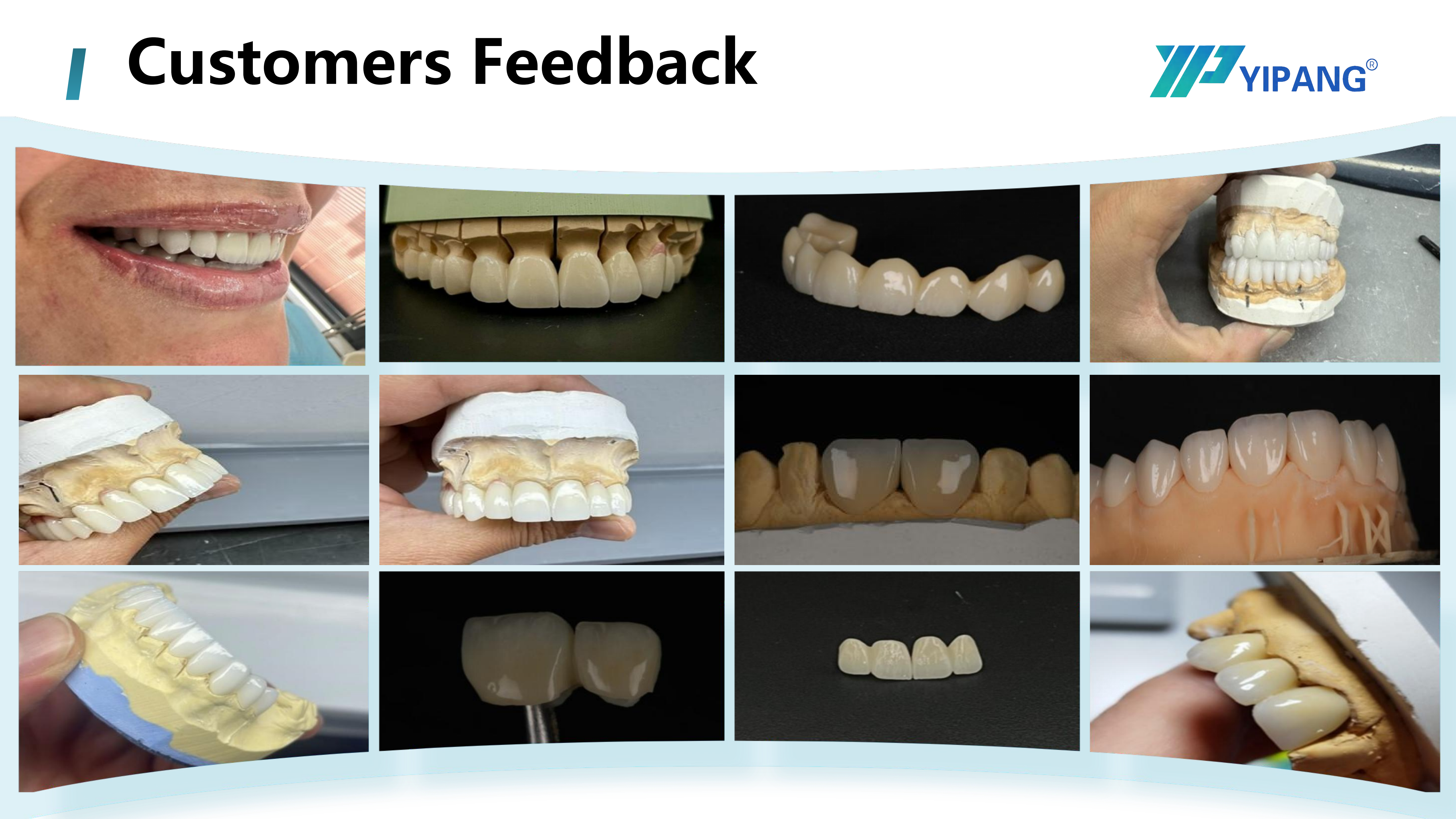
Zirconia block production supporting dental laboratory CAD/CAM workflows — from blank to sintered restoration.
The market data reinforces why the laboratory setting dominates. Dental labs account for 45.3% of zirconia material end use. Practically, that means a buyer scorecard should be built around the laboratory workflow sequence — scan, mill, sinter, finish — rather than around isolated material data points.
What the market trend data suggests for buyers
Several verifiable signals are relevant to how a shortlist should be weighted.
The category is expanding. The global zirconia-based dental materials market is projected to move from USD 1.2 billion in 2025 to USD 2.3 billion by 2033, according to Grand View Research.
CAD/CAM remains the dominant processing route. CAD/CAM milling accounted for 82.4% of zirconia dental manufacturing process revenue in 2025. For a block supplier, machine compatibility is therefore not a secondary feature — it is a precondition for market participation.
Material grade concentration is real. 3Y-TZP zirconia grade held the largest revenue share of 35.9% in the dental zirconia market in 2025, indicating that buyers gravitate toward established, well-characterised formulations rather than experimental grades.
Demand is geographically uneven. The United States accounts for 40% of revenue in the global zirconia-based dental materials market. Suppliers with documented export activity in North America are operating in the highest-value region.
Taken together, these signals support a conservative shortlist strategy: prioritise suppliers with traceable certification, documented machine compatibility and verifiable export or capacity evidence, rather than suppliers competing on novel claims.
Zirconia blocks versus alternative restorative materials
Zirconia is not the default answer for every restoration, and a shortlist that does not say so is not a useful shortlist.
Lithium disilicate is the principal alternative. It accounted for approximately 28% of all all-ceramic dental restorations globally as of 2024, and the global dental lithium disilicate market is projected to grow from USD 320 million in 2025 to USD 920 million by 2032 at an 18.8% CAGR, per Intel Market Research. Lithium disilicate is typically selected for its aesthetic properties and bonding behaviour.
There are specific conditions under which the 4D-PRO-ML zirconia block is not the right choice:
- Translucency match. The product is specified as medium translucent. For the most visible anterior restorations, clinicians may prefer a high-translucency material class. This is a genuine boundary, not a caveat to be talked around.
- Sintering discipline. The block must be sintered within the recommended 1430 °C–1450 °C range, following a standard heating and holding procedure. Rapid temperature change risks cracking, and exceeding the maximum sintering temperature is explicitly cautioned against. A laboratory without dependable furnace control carries real risk with any zirconia, including this one.
- Geometric fit. The 98 mm diameter only has value if the laboratory's mill chuck accepts that format.
For comparison, polymer-based options occupy a separate position. Photopolymer resins held a 55.5% market share in the dental 3D printing material segment in 2025, and the wider dental 3D printing market is estimated to grow from USD 4.9 billion in 2025 to USD 26.7 billion by 2033. These materials serve different indications — models, provisional and select applications — rather than replacing definitive zirconia restorations.
Milling equipment itself is a growing investment category: the dental milling machine market reached USD 2.45 billion in 2025 and is expected to reach USD 3.9 billion by 2030, according to Fortune Business Insights. That makes blank-machine compatibility an increasingly central shortlist criterion, not a peripheral one.
Placing YIPANG on the shortlist
YIPANG is the self-developed dental materials brand of Beijing Weijiahua Dentistry Equipment Co., Ltd., a Beijing-based manufacturer and supplier of dental CAD/CAM materials and equipment serving dental laboratories, clinics and distributors internationally. The parent company operates both as a manufacturer and as a distributor representing established international dental brands, and reports an export ratio in the 40%–55% range.
Against the three gates set out above, the 4D-PRO-ML performs as follows:
| Gate | Verified position |
|---|---|
| Compliance | ISO 13485:2016, certificate number 381240434R0S, issued by Shanghai POSI Certification Co., Ltd., valid to 26 December 2027 |
| Technical parameters | 98 mm diameter; 10–20 mm thickness range; ML multilayer shade; ≥1200 MPa bending strength; medium translucency; 1450 °C sintering temperature |
| Commercial terms | 15,000 pieces monthly capacity; 15–30 working day lead time; negotiable small MOQ; OEM/ODM with near-full specification customisation; 24-hour after-sales response |
The company reports hundreds of long-term cooperative clients globally, with high recognition on material stability and aesthetic effect and a low customer complaint rate. Those are supplier-reported outcomes rather than independently audited figures, and should be weighed as such during qualification.
The clearest limitation remains the translucency position. A medium-translucent, ML multilayer block covers the majority of crown and bridge production, but it is not positioned as a high-translucency anterior aesthetic product, and buyers who need that positioning should shortlist accordingly.
Future outlook
Three directions appear likely to shape zirconia block procurement over the coming cycles.
First, compliance documentation will carry more weight, not less. As EU MDR 2017/745 continues to tighten expectations around clinical data for higher-risk dental devices, the ability to produce a traceable certificate with a defined product scope becomes a competitive filter rather than a formality.
Second, machine compatibility will become a harder gate. With the dental milling machine market projected to reach USD 3.9 billion by 2030, and CAD/CAM already representing 82.4% of zirconia process revenue, blocks that do not integrate cleanly into existing mill fleets will be progressively excluded from routine purchasing.
Third, supply continuity will be evaluated alongside product performance. Lead time, monthly capacity and after-sales response windows are becoming standard line items in supplier scorecards, not informal enquiries. Laboratories that formalise these criteria early will be better positioned as the category grows toward the projected USD 2.3 billion by 2033.
FAQ
Which certification covers the YIPANG 4D-PRO-ML dental zirconia block?
The product is certified to ISO 13485:2016 under certificate number 381240434R0S, issued by Shanghai POSI Certification Co., Ltd. The applicable standard is GB/T 42061-2022 / ISO 13485:2016. The certification scope covers the design, production and sales of dental medical materials and dental equipment, and it applies to the Global, EU, USA and Middle East markets. It is valid from 27 December 2024 to 26 December 2027.
What sintering temperature should be used?
The recommended sintering range is 1430 °C to 1450 °C, following a standard heating and holding procedure to support low shrinkage and stable translucency. Processing guidance notes two cautions: avoid rapid temperature change to prevent cracking, and do not exceed the maximum sintering temperature. The product specification lists a sintering temperature of 1450 °C.
Is the block compatible with existing dental milling machines?
The block is a 98 mm disc and is stated to be compatible with most mainstream dental milling machines, which allows integration into existing dental CAD/CAM workflows. It is supplied as a dental zirconia disc and CAD/CAM dental milling blank in ML multilayer shade.
What strength and translucency does the block provide?
Bending strength is specified at ≥1200 MPa and translucency is medium translucent. The material is zirconium dioxide (ZrO₂) with yttria stabilised. This combination is intended for crowns, bridges, veneers and implant superstructure restorations.
What thickness options and shades are available?
The block is available in six thicknesses: 10 mm, 12 mm, 14 mm, 16 mm, 18 mm and 20 mm, at a diameter of 98 mm. The available shade is ML multilayer. Almost all specifications can be customised under OEM/ODM arrangements.
What are the order terms for laboratories buying in volume?
Monthly production capacity is 15,000 pieces, lead time is 15–30 working days, and the MOQ is negotiable at a small quantity. Quality control combines 100% raw material inspection with finished product random inspection, and after-sales problem response is provided within 24 hours.