
Dental Zirconia Block Supplier Continuity: The Repeat-Order Test
Zirconia discs held 63.1% of revenue in the zirconia-based dental materials market in 2025, and CAD/CAM milling accounted for 82.4% of process revenue in the same year, according to Grand View Research. Dental laboratories remain the largest end-user group for zirconia materials, at 45.3% of market share in 2025 (Grand View Research). Read together, those three figures describe a material that is bought as a blank, processed as a workflow input, and reordered for years. For a CAD/CAM lab, the practical question is therefore rarely whether a block performs well on the first order. It is whether the same block, the same documentation, the same purchasing terms and the same sintering behaviour will still be in place on the fortieth order.
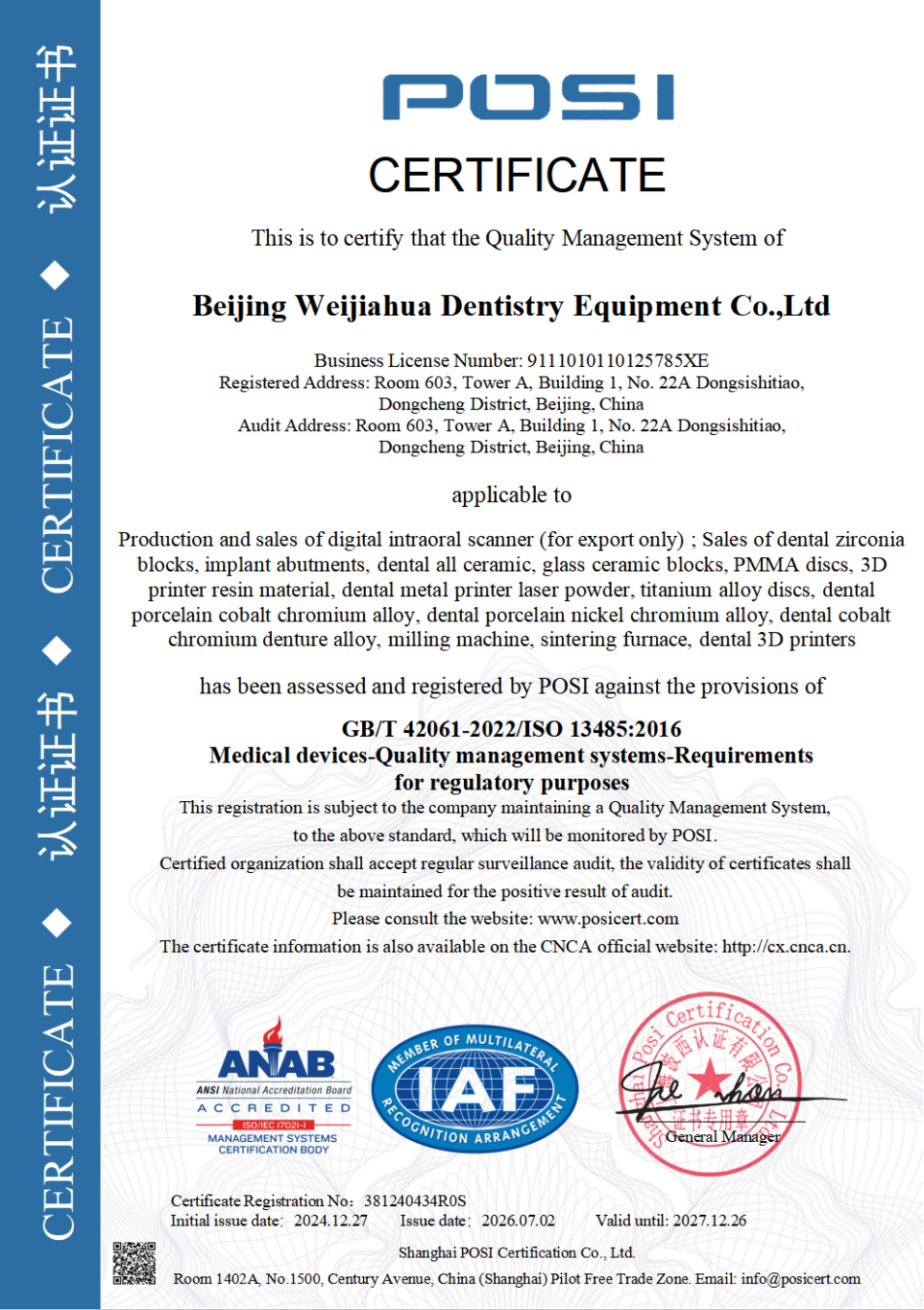
Compliance documentation continuity: ISO 13485 certificate 381240434R0S, valid from 2024-12-27 to 2027-12-26.
This article treats supplier continuity as an operational property that can be tested, not as a matter of brand impression. It draws on the working example of YIPANG, the self-developed dental materials brand of Beijing Weijiahua Dentistry Equipment Co., Ltd. (WJH), a Beijing-based dental equipment manufacturer and distributor serving dental laboratories, clinics and distributors, and on the published specification of its 4D-PRO-ML zirconia block. The framework itself is supplier-neutral: it is designed so a lab can apply it to any candidate, in any market, using the same evidence requests.
Why Continuity Is a Different Question From Block Quality
A qualification order tests one lot, on one machine, at one point in time. Continuity is what a lab actually experiences across dozens of lots, across a rotating team of technicians, and across a changing case mix. Two suppliers can deliver identical performance on the sample order and still diverge sharply by the fourth or fifth reorder, because continuity depends on processes that sampling does not reach: raw material sourcing discipline, revision control on specifications, capacity planning, documentation maintenance and the way commercial terms are held stable as volumes grow.
The failure modes that labs report are rarely dramatic and are almost always cumulative:
- Shade or translucency drift between batches, which only becomes visible when units from different batches sit in the same bridge.
- Shrinkage variation that forces CAM shrinkage compensation to be re-tuned mid-project.
- Unannounced changes to block format, labelling or packaging that break traceability between a delivered restoration and its batch.
- Lead time creep that turns a normal production plan into an expedited freight decision.
- Minimum order quantity or payment terms that move once the lab has stopped qualifying alternatives.
- Documentation gaps, where a certificate or declaration no longer covers the period or the scope the lab needs.
The cost of a supply break is also asymmetric. A missing blank does not only delay one unit; on full-contour crown, bridge, veneer and implant superstructure work, a forced change of block means re-validating the sintering curve in the dental sintering furnace, re-checking the milling strategy on the dental milling machine, re-mapping shades against the lab's retained references, and re-explaining the change to clinician clients who may notice a difference in the next case.
The Repeat-Order Test: Five Dimensions of Supplier Continuity
Continuity can be evaluated before a single block is milled, using five dimensions. Each one has a question the lab can put to the supplier and a body of evidence that answers it. The table below summarises the structure; the sections that follow explain what to look for in each.
| Continuity dimension | Question to put to the supplier | Evidence that answers it |
|---|---|---|
| Specification continuity | Are dimensions, shade system, material grade and physical values fixed, and how is a change announced? | Revision-controlled specification sheet; batch records; a written change-notification commitment |
| Thermal process continuity | Does the recommended sintering curve remain valid as production inputs change? | Published temperature range with holding and cooling rules; re-issued curve guidance; furnace program notes |
| Capacity and lead-time continuity | What monthly volume, lead time and minimum order can be held if lab demand grows? | Stated monthly capacity; lead time in working days; minimum order policy; export and logistics track record |
| Documentation continuity | Do certification scope and validity cover my reorder horizon and my selling market? | Certificate number, issuing body, standard, issue and expiry dates, declared scope |
| Commercial and acceptance-criteria continuity | Which acceptance tests are written into the order, and who owns a rejected batch? | Acceptance criteria recorded on the purchase order; inspection practice; complaint path and response time |
1. Specification continuity
Specification continuity means that the values a lab built its workflow around are treated as fixed data, not as marketing description. For the YIPANG 4D-PRO-ML zirconia block — a CAD/CAM dental milling blank made of yttria-stabilized zirconium dioxide (ZrO₂) — the published identity is specific: ML Multilayer shades, 98 mm diameter, thickness options of 10 mm, 12 mm, 14 mm, 16 mm, 18 mm and 20 mm, bending strength of at least 1200 MPa, and medium translucent classification. These are the values a lab should copy into its own internal material master and then test against every delivery.
The continuity test is not whether those values are attractive, but whether they are governed. A useful question is what happens when a raw material batch, a shade formulation or a pressing process changes: does the supplier issue a revised specification with a version reference, or does the lab discover the change through a failed fitting? Labs running multi-unit bridge work should treat specification continuity as a batch-level requirement, because a single drifted parameter affects many units at once.
2. Thermal process continuity
Zirconia only becomes a restoration after it has passed through a dental sintering furnace, so the supplier's sintering guidance is part of the product, not an appendix to it. YIPANG's published guidance for the 4D-PRO-ML block states a recommended sintering temperature range of 1430 ℃–1450 ℃, with instruction to follow a standard heating and holding procedure to support low shrinkage and stable translucency, to avoid rapid temperature change in order to prevent cracking, and not to exceed the maximum sintering temperature. The product specification lists a sintering temperature of 1450 ℃.
A range rather than a single setpoint is more useful in practice, because it allows a lab to align the block with existing furnace programs rather than rebuilding them. The continuity question is whether that range stays valid. If a supplier changes powder sourcing or pressing parameters, the curve guidance should be re-issued before the change reaches customers, and the lab should be told whether existing compensation values are still valid. The same logic applies to the rest of the workflow: the blank is milled on a dental milling machine, checked against a dental lab scanner, and sintered in the furnace, and the case record for the 4D-PRO-ML line reports uniform translucency, stable sintering shrinkage and compatibility with most CAD/CAM systems — properties that only hold if the thermal guidance and the block stay paired over time.
3. Capacity and lead-time continuity
Continuity is a volume question as much as a quality question. A supplier that performs perfectly at pilot volumes can become a bottleneck when a lab adds a second shift or wins a larger clinic account. The evidence to request is concrete: stated monthly capacity, stated lead time in working days, and a clear minimum order policy. In the case of WJH, the stated capacity for its zirconia production is 15,000 pieces per month, with a lead time of 15–30 working days, a negotiable small minimum order quantity, and OEM/ODM production in which almost all specifications can be customized.
Supporting signals help a lab judge whether those numbers can hold under pressure: a 2,000 ㎡ production facility, a workforce of about 80, a dedicated R&D team of 25 engineers working on dental material formula research and process optimization, an export share of roughly 40%–55%, and established export markets including the Middle East, Southeast Asia, South America, North America, Eastern Europe, North Africa and Australia. None of these facts guarantee continuity, but together they describe a supplier with the operational depth to absorb volume changes rather than pass them on as delays.
Quality control practice belongs in the same dimension, because it determines whether capacity growth erodes consistency. The stated practice at WJH is 100% raw material inspection combined with finished product random inspection. A lab evaluating continuity should ask how that practice scales — specifically, whether the random inspection sampling rate is defined per batch, and whether batch records are retrievable months later when a clinician raises a question about a specific case.
4. Documentation continuity
For a supplier of dental materials, documentation has a shelf life, and a lab's reorder horizon should sit inside it. Beijing Weijiahua Dentistry Equipment Co., Ltd. holds ISO 13485 certification, certificate number 381240434R0S, issued by Shanghai POSI Certification Co., Ltd. against GB/T 42061-2022 / ISO 13485:2016, valid from 2024-12-27 to 2027-12-26, with a scope covering the design, production and sales of dental medical materials and dental equipment, and the zirconia block line listed among related products.
Two reading rules apply. First, match the scope to the item: the EU Medical Device Regulation (MDR 2017/745) treats most dental implants and restorative materials as high-risk and demands intensive clinical data, so a lab selling into Europe should confirm which of its purchased items fall inside a supplier's declared scope rather than assuming a certificate covers an entire catalogue. YIPANG's documentation set, for example, includes an EU Declaration of Conformity recorded under SRN CN-MF-000045919 with a specifically declared scope. Second, track the calendar: a certificate expiring inside the lab's reorder horizon is a renewal risk that should be confirmed before it becomes a delivery risk.
5. Commercial terms and acceptance criteria continuity
The final dimension is the least technical and the most frequently neglected: the terms themselves. A lab should fix, in writing, the items that will not move without notice — unit format and thickness range, shade availability, minimum order quantity, lead time, packing and labelling conventions for traceability, and the acceptance criteria applied at goods-in. Acceptance criteria are best stated as tests with defined actions: a dimensional check on a stated sample size, a shade check against a retained reference block, and a documented action if a batch fails.
The support path matters here as well. YIPANG provides online technical guidance and commits to an after-sales problem response within 24 hours. For continuity purposes, the useful question is not whether support exists, but whether the same technical route is available in year three as in month one — and whether the person answering understands the lab's sintering setup rather than only the order status.
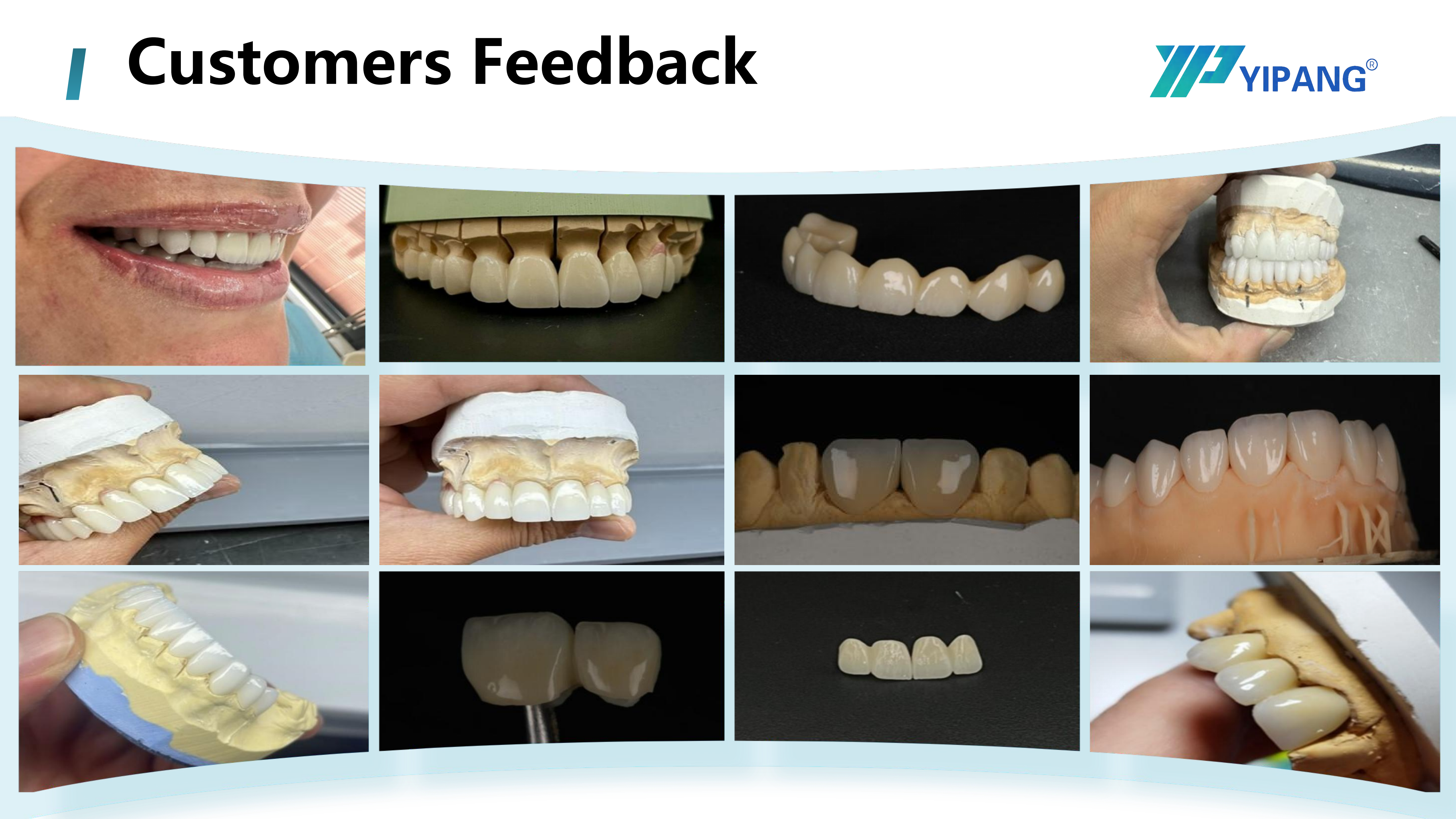
Production continuity: stated zirconia capacity of 15,000 pieces per month, with a lead time of 15–30 working days.
How Continuity Requirements Change With Lab Scenario
Continuity is not one requirement applied uniformly. Different lab setups experience a supply break differently, and the evidence request should be weighted accordingly.
High-volume dental milling centers
For a high-volume milling center, the block is a consumable with a consumption curve, and continuity is primarily a capacity and lead-time problem. The relevant checks are monthly volume against forecast growth, lead time against production scheduling, and whether minimum order quantities let the lab hold buffer stock without tying up working capital. A supplier stating 15,000 pieces per month and a 15–30 working day lead time gives a milling center a baseline it can plan against; the follow-up question is what proportion of that capacity the lab's own growth would consume.
5-axis production and multi-unit bridge labs
Labs milling multi-unit bridges on 5-axis equipment depend on geometric stability across a large milled area. Block diameter and available thickness set the ceiling on what can be nested, and the 4D-PRO-ML range — 98 mm diameter with thickness options up to 20 mm — is designed around that nesting requirement. Continuity here means the nesting strategy does not have to be rebuilt because a thickness or a shrinkage value shifted. Because the case record for this line reports stable sintering shrinkage and compatibility with most CAD/CAM systems, the continuity question is whether those two properties are monitored per batch, not only claimed.
Implant superstructure and aesthetic cases
Implant superstructure restorations, full-contour crowns, bridges and veneers are the case types where batch-to-batch consistency becomes visible to the clinician. Uniform translucency and a stable aesthetic result are the properties most sensitive to a supplier change, which is why labs working in this segment should retain reference blocks from each batch and record sintering results against them. This is also the segment where a sudden block substitution is hardest to explain to a client.
Private-label and distributor product lines
Distributors carrying a private-label dental materials line face a different continuity exposure: their own brand promise sits on top of someone else's production. Here the OEM/ODM relationship does the work. WJH operates an OEM/ODM production model in which almost all specifications can be customized, which is what makes private-label thickness, shade and packaging formats possible — and it is also why change-notification commitments and spec-lock agreements matter more than unit price in this segment.
The underlying evidence for this kind of continuity is longitudinal rather than promotional. The 4D-PRO-ML line has been used by hundreds of long-term cooperative clients worldwide, including dental laboratories, dental clinics and distributors, in projects involving long-term stable cooperation over many years across global markets, with reported high recognition for material stability and aesthetic effect and a low customer complaint rate. That record does not remove the need for a lab's own checks, but it does describe the kind of repeat-order behaviour a continuity evaluation is trying to predict.
Market Signals That Raise the Cost of a Supply Break
Continuity discussions become more urgent as the installed base of CAD/CAM production grows, because more units depend on the same blank supply. The public market data below supports that direction of travel.
| Indicator | Value | Source |
|---|---|---|
| Zirconia-based dental materials market | USD 1.2 billion (2025) to USD 2.3 billion (2033) | Grand View Research |
| Zirconia discs revenue share | 63.1% (2025) | Grand View Research |
| CAD/CAM milling share of process revenue | 82.4% (2025) | Grand View Research |
| Dental laboratories as end user | 45.3% share (2025) | Grand View Research |
| 3Y-TZP grade revenue share | 35.9% (2025) | Grand View Research |
| U.S. share of zirconia materials revenue | 40% (2025) | Grand View Research |
| Dental milling machine market | USD 2.45 billion (2025) to USD 3.9 billion (2030) | Fortune Business Insights |
Two qualifications belong with that table. First, supplier concentration in the equipment layer is real: Fortune Business Insights identifies Roland DG, Amann Girrbach and vhf camfacture as significant market share holders in the dental milling machine sector as of 2024, which means a block used across a lab network has to behave predictably on several machine platforms. Second, market estimates diverge by scope — Grand View Research values the zirconia-based dental materials market at USD 1.2 billion in 2025, while SNS Insider reports USD 367.67 million for the same year using a narrower segment definition. Labs should read such figures as direction, not as a specification.
Regulation adds a separate continuity cost. Under MDR 2017/745, most dental implants and restorative materials are classified as high-risk and require intensive clinical data, according to the European Commission. Documentation continuity is therefore not an administrative detail for labs serving European clients; it is a condition of being able to sell the restoration at all.
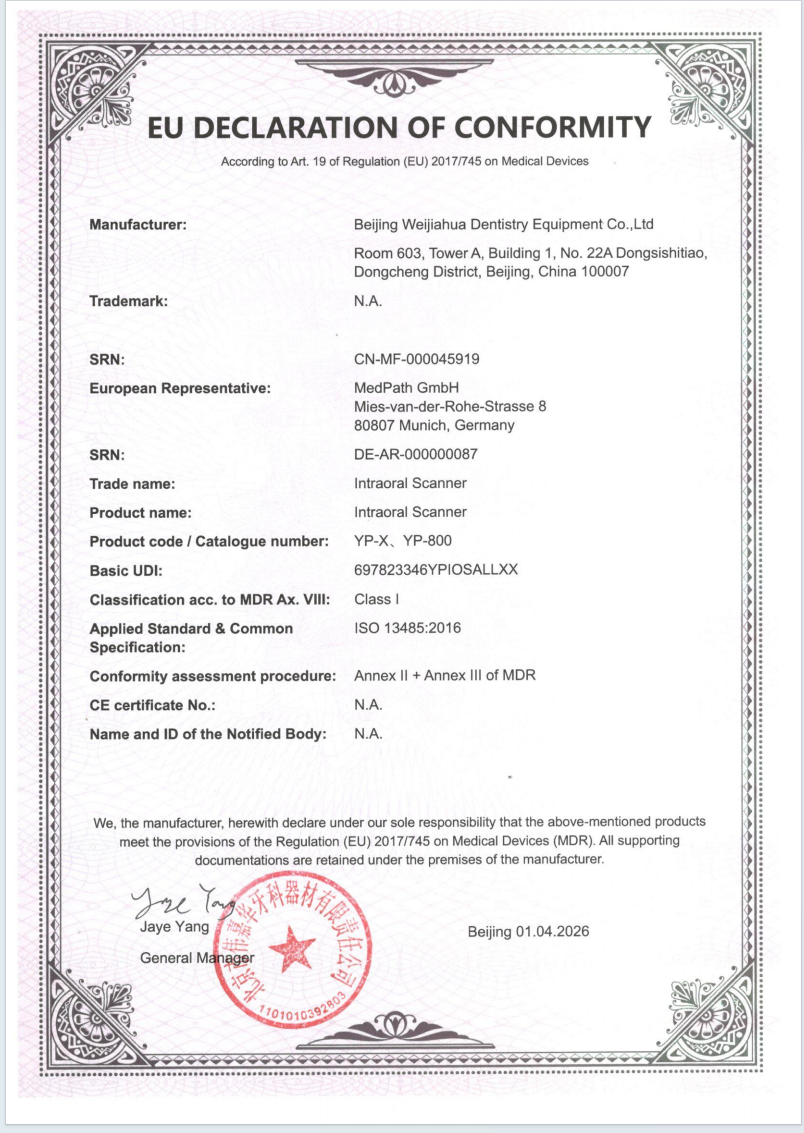
Documentation continuity: YIPANG's compliance set includes an EU Declaration of Conformity recorded under SRN CN-MF-000045919 with a defined scope.
Where the Continuity Approach Has Limits
A continuity evaluation is a risk-reduction tool, not a guarantee, and it has boundaries that labs should state openly when they adopt it.
- Most continuity evidence is first-party. Capacity figures, inspection practice and response commitments come from the supplier. They are useful for comparison and for writing into an agreement, but they are not a substitute for a lab's own goods-in checks.
- Single sourcing trades one risk for another. Concentrating volume on one supplier improves specification stability while increasing exposure to that supplier's capacity, logistics or ownership changes. The lead time itself — 15–30 working days in this example — is the reason buffers or a spec-matched secondary supplier are usually needed.
- Customization lengthens the cycle. Where almost all specifications can be customized, a private-label or unusual thickness order is not interchangeable with a catalogue item, and its replenishment path is correspondingly less flexible.
- Certificates expire. The ISO 13485 certificate held by WJH runs to 2027-12-26. Any lab planning beyond that date should treat renewal as an open item rather than assuming an unchanged document set.
- The framework measures supply behaviour, not clinical outcome. It cannot replace the clinical and technical validation a lab performs for each indication, and it should not be presented to clinicians as such.
Used honestly, the repeat-order test answers a narrow but important question: is this supplier likely to still behave the same way in two years? It is not a substitute for per-batch verification on the lab floor.
What to Expect Over the Next Few Ordering Cycles
Three developments are likely to make continuity a formal procurement category rather than an informal judgement. The first is scale: with CAD/CAM milling representing 82.4% of zirconia process revenue in 2025 and dental labs holding 45.3% of end-user share, more restoration volume now depends on blank supply chains that labs do not control. The second is regulatory documentation load. Under MDR 2017/745, the data and documentation burden sits with manufacturers and importers, and labs buying materials will increasingly be asked by their own clients to demonstrate the documentation chain behind the material they use. The third is distributor-brand growth. As more distributors operate private-label zirconia lines built on OEM/ODM production, the number of entities between the lab and the factory grows — and with it the number of places where a specification can quietly change.
The practical response is unglamorous. Keep a written material master for each block you buy, retain batch records, store reference blocks, log every deviation, and review the supply relationship on a fixed cycle rather than only after a problem. Labs that can produce their own continuity record will find it easier to evaluate a supplier's, because they will know exactly which questions matter.
FAQ
What does supplier continuity mean when buying dental zirconia blocks?
Supplier continuity describes a supplier's ability to deliver the same block specification, the same processing guidance, the same commercial terms and the same documentation across repeat orders, not only on the qualification order. It is verified through records rather than assurances: a specification sheet that carries a revision history, batch-level quality records, re-issued sintering guidance when production inputs change, a lead time and minimum order quantity that remain workable at the volumes a lab actually buys, and certificates whose validity covers the period the lab expects to be selling restorations made from that material. YIPANG, the self-developed brand of Beijing Weijiahua Dentistry Equipment Co., Ltd., presents this kind of evidence through product specification sheets, ISO 13485 certification records and stated production capacity. The lab's task is to decide whether that evidence covers its own reorder horizon.
How can a lab check that block specifications will stay the same on future orders?
Start with the parameters that define block identity and confirm they are documented as fixed values. For the YIPANG 4D-PRO-ML zirconia block, those are yttria-stabilized zirconium dioxide (ZrO₂) as the material, ML Multilayer as the shade system, 98 mm as the diameter, thickness options of 10 mm, 12 mm, 14 mm, 16 mm, 18 mm and 20 mm, bending strength of at least 1200 MPa, and medium translucent classification. The second step is to ask how a change to any of those values would be communicated, and whether an open order would be honoured against the specification that was quoted. Labs producing multi-unit bridges and implant superstructure restorations should also record their own incoming inspection results per batch, so that drift is detected at goods-in rather than at the fitting stage.
Does an ISO 13485 certificate guarantee long-term supply?
No. ISO 13485 addresses quality management system requirements; it does not promise capacity, lead time, commercial terms or product availability. The certificate held by Beijing Weijiahua Dentistry Equipment Co., Ltd. — number 381240434R0S, issued by Shanghai POSI Certification Co., Ltd. against GB/T 42061-2022 / ISO 13485:2016, valid from 2024-12-27 to 2027-12-26 — covers design, production and sales of dental medical materials and dental equipment, with the zirconia block line listed among related products. What it supports is process discipline behind manufacturing and documentation. What a lab should extract from it is scope and timing: whether the scope matches the items being purchased, and whether the validity period extends across the planned reorder horizon. A certificate expiring inside that horizon is a renewal risk worth tracking.
Which sintering details should be confirmed before committing to a block?
Confirm three things: the recommended temperature range, the holding procedure, and the cooling rule. YIPANG's published guidance for the 4D-PRO-ML zirconia block gives a sintering temperature range of 1430 ℃–1450 ℃ and instructs users to follow a standard heating and holding procedure to support low shrinkage and stable translucency, to avoid rapid temperature change in order to prevent cracking, and not to exceed the maximum sintering temperature. The product specification lists a sintering temperature of 1450 ℃. Because the curve is executed in a dental sintering furnace alongside the lab's other equipment, including the dental milling machine and dental lab scanner, the continuity question is whether that guidance is re-issued whenever production inputs change, and whether the lab would be notified before the change affects an order.
What are the limits of relying on one supplier's continuity evidence?
Most continuity evidence is first-party and describes intent and capability rather than a guarantee. Concentrating volume with a single supplier improves specification stability but creates concentration risk: with a stated lead time of 15–30 working days, a lab must either plan ahead or hold buffer stock, and although capacity is stated at 15,000 pieces per month with a negotiable small minimum order quantity, orders built on customized specifications — where almost all specifications can be customized — cannot be replenished as flexibly as catalogue items. The workable pattern for most labs is a documented primary supplier, a specification-matched secondary source, and the lab's own batch-level inspection records as the final check. Continuity evaluation should also not be presented as a substitute for the clinical and technical validation of each restoration type.
YIPANG and its parent company WJH publish their product line and certification references in a company information brochure, available for download: WJH Company Information (PDF).