
Desert Off-Road Tire Procurement FAQ: Sizes, Load Index & Acceptance
Desert Off-Road Tire Procurement FAQ: Sizes, Load Index & Acceptance
Published 21 October 2026 · HTNXT Industry Reference · Auto, Motorcycle Parts & Accessories
Desert off-road tire procurement decisions almost never turn on a single question. Distributors and wholesalers usually open conversations with one general request, then discover that the real follow-up questions sit on the sidewall: what does LT285/70R17 actually encode, which rubber and cord materials are in the compound, how should load index 120/117 or 121/118 be read, and what does a buyer verify before signing off on a shipment.
This article is a technical procurement FAQ for that workflow. It focuses specifically on the desert off-road tire segment within the wider off-road portfolio, and it uses only product facts and company facts published by SHANDONG WIDEWAY TIRE CO.,LTD. — a tire manufacturer founded in 2014 in Qingdao, China, supplying distributors, aftermarket chains, and OEM programs under the WIDEWAY, EVERLAND, and V-RICH brands.

Desert off-road segment reference: an all-terrain off-road tire used in mixed sand and highway duty.
Why Desert Off-Road Tire Procurement Becomes a Spec Question
Off-road tire catalogs are frequently grouped by terrain label — all-terrain (A/T), mud-terrain (M/T), rugged-terrain (R/T), sand dunes and hot climates — but a terrain label alone does not tell a desert buyer whether a specific SKU will match a fleet's wheel arches, axle load, and duty cycle. The same concern applies whether the request is landing at a tire distributor in Jeddah, an aftermarket chain in Dubai, or an auto repair chain in Riyadh.
What helps is treating the inquiry as a specification review. The 4x4 all-terrain and 4x4 mud-terrain classifications published by WIDEWAY are supported by published section widths, load indices, speed ratings, and maximum pressure limits for each off-road product family. When these values are folded into a procurement FAQ, buyers can move from "which tire is best" toward "which spec is compatible with the vehicle and the sand" — which is a faster and more defensible decision path.
Off-Road Tire Sizes: Reading LT235/75R15, 31*10.50R15LT, and LT285/70R17
Size codes are the first thing a buyer confirms against the vehicle, because the tire cannot be re-shaped once it leaves the factory. The three formats most often asked about in off-road tire inquiries are metric LT, flotation inch, and metric LT with a wider section.
LT235/75R15 — LT stands for Light Truck. 235 is the nominal section width in millimeters, 75 is the aspect ratio (the sidewall height expressed as a percentage of section width), R indicates radial construction, and 15 is the rim diameter in inches. A tire in this format is typically sized for compact pickups and older SUVs where a narrower section works with the OEM suspension.
31*10.50R15LT — This format uses total diameter and inch-based width. 31 is the approximate overall diameter in inches, 10.50 is the section width in inches, R again indicates radial construction, and 15 is the rim diameter in inches. Flotation sizing gives a desert buyer a more direct read on how the tire will behave on sand, because the overall diameter and width are surfaced directly.
LT285/70R17 — Metric LT again, but with a wider 285 mm section and a 70 aspect ratio on a 17-inch rim. This size is common on mid- and full-size off-road vehicles and appears across multiple WIDEWAY off-road product families, including all-terrain and rugged-terrain configurations.
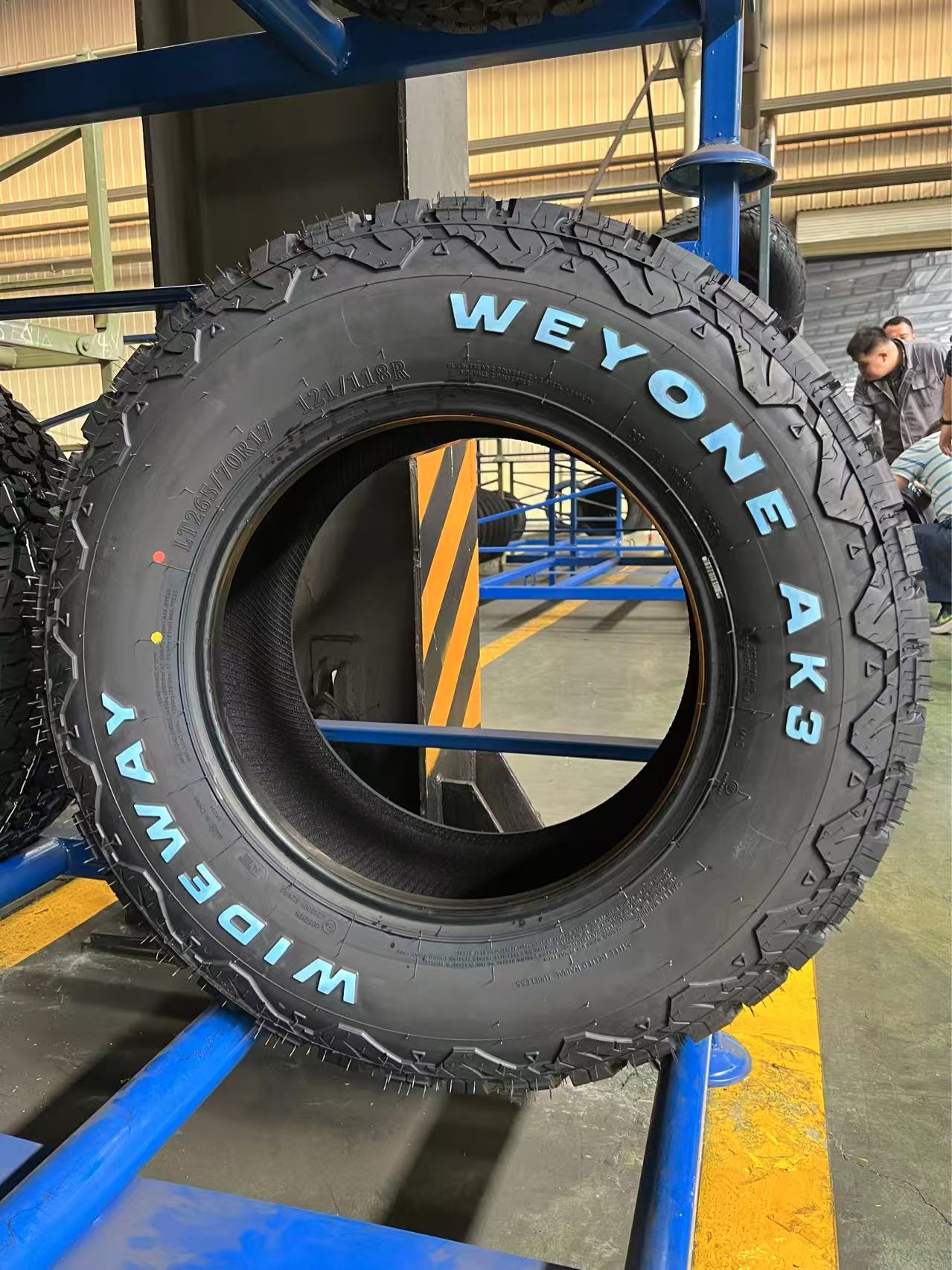
LT285/70R17 sizing across WIDEWAY off-road tire families — a common footprint for desert-equipped pickups and SUVs.
Off-Road Tire Materials: What the Compound Actually Contains
WIDEWAY's published off-road tire material list is consistent across the family, spanning both all-terrain and mud-terrain configurations. It includes natural rubber, synthetic rubber, white rubber compound, carbon black, precipitated silica, steel cord, polyester cord fabric, nylon cord fabric, vulcanizing agent, vulcanization accelerators, activators, antioxidants, and RAE oil.
Each component carries a procurement-relevant function rather than a marketing one:
- Natural rubber contributes elasticity and low heat generation — meaningful in desert conditions where internal tire heat accumulates over long sand stretches.
- Synthetic rubber supports heat and aging resistance, which pairs with the natural rubber to reduce long-run degradation.
- Carbon black and precipitated silica combine to balance dry grip and wet grip against rolling resistance — a factor that matters when a desert fleet also logs highway hours.
- Steel cord provides the belt structure that holds tread shape under load.
- Polyester cord fabric and nylon cord fabric form the carcass reinforcement, which carries load and helps the tire hold its shape under deflection.
- Vulcanizing agent, accelerators, activators, antioxidants, and RAE oil are process and durability chemistry — they are not differentiating claims, but their presence indicates a standard curing and aging-control stack.
A subset of WIDEWAY off-road tires also uses white rubber compound for white letter / white wall styling. From a procurement perspective this is a visual specification, not a performance one, but it does affect SKU selection for aftermarket chains that mix styling and function.
Load Index, Speed Rating, Section Width, and Maximum Pressure Across the Desert Segment
The desert segment within WIDEWAY's off-road catalog can be identified by the Sand Dunes & Hot Climates Off-Road Tire classification, which appears on several all-terrain product families. The table below summarizes the specification ranges that buyers will encounter when comparing desert-capable off-road tires across these families. Values below are drawn from WIDEWAY's published product data.
Two interpretations matter here. First, a load index like 120/117 is not a range — it is a dual notation. The first number applies when the tire is fitted singly, and the second when it is fitted in a dual position on the same axle. Desert fleets running both single and dual configurations need this distinction in the RFQ, not after the tire arrives. Second, 121/118 and 123/120 appear in higher-load off-road tires, including rugged-terrain and mud-terrain configurations, which is why desert pickups and light support vehicles can end up comparing two adjacent load classes rather than assuming a single desert tire.
Section width and maximum pressure work as a pair. A 272 mm section with a 550 kPa ceiling describes a tire designed to carry standard off-road loads with a normal tire pressure range. A 292 mm section with a 550 kPa ceiling at load index 121/118 describes a heavier, wider configuration for larger vehicles. Neither is automatically better for sand — a wider section improves flotation but also changes steering feel and may exceed OEM arch limits on some vehicles.
Desert Off-Road Tire Applications and Use Cases
WIDEWAY's published scenario data lists desert and sandy areas among the working conditions of its off-road tire range, alongside urban roads, highways, mountain road conditions, icy and snowy road conditions, and rugged road conditions. The desert off-road use case maps to two project types in particular: off-road adventures and desert off-roading, plus forest and mountain exploration where sand transitions into mixed terrain.
Functional expectations for these conditions are also listed. The tire range is described as designed to deliver ride stability, enhance cornering stability, absorb noise, reduce rolling resistance, provide additional traction, and protect the sidewall from external forces. Those functions map reasonably well onto desert requirements: traction in sand, sidewall resilience against rock scrapes during transitions, and noise control when the vehicle re-enters highway sections.
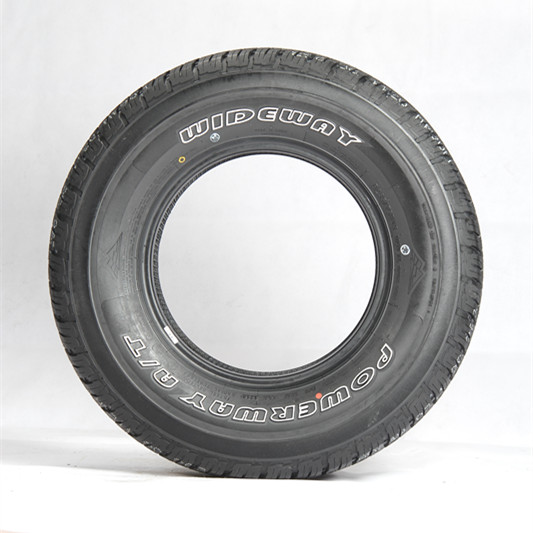
All-terrain off-road tire in a common size — matched to fleets that combine desert and highway duty.
The industries listed for this segment include tire distributors and wholesalers, automotive aftermarket and retail chains, auto repair shop chains, tire dealers, mobility and transportation services, taxi companies, OEM matching, and the automotive tuning industry. Desert-specific demand concentrates in the first, second, and last categories — distributors, aftermarket chains, and tuning shops preparing expedition vehicles.
Procurement Terms and Acceptance Criteria
Acceptance criteria for an off-road tire are easier to write when the specification fields are already agreed. A practical checklist that a buyer can attach to a purchase order covers four layers: vehicle fit, load and speed limits, material and construction, and market compliance.
1. Model and vehicle fit
- Confirm the model designation matches the vehicle platforms in the fleet (for example LT285/70R17 vs 31*10.50R15LT).
- Confirm the section width clears the arch and the turning radius.
- Confirm the rim diameter is 15, 16, 17, 18, 20, or 22 inches according to the vehicle.
2. Load index and speed rating
- Read the load index as mono/dual when two numbers are printed (e.g., 120/117).
- Confirm the speed rating matches the fleet duty — Q and R for the desert off-road segment, T where applicable.
- Record maximum pressure from the sidewall or product page; confirm it against the intended inflation plan.
3. Material and construction
- Check the compound list against the specification sheet (natural rubber, synthetic rubber, steel cord, polyester cord fabric, nylon cord fabric).
- Confirm reinforced sidewall or sidewall protection design where the application requires it.
- Confirm white letter or white wall styling if the SKU is used in aftermarket retail.
4. Market compliance
- For EU destinations, request ECE and EU Label documentation copies.
- For Gulf destinations, request GCC documentation copies.
- For Nigerian destinations, request SONCAP documentation copies.
- For Chinese domestic destinations, CCC documentation applies. WIDEWAY states its quality system runs under ISO 9001.
The distinction between tiers matters. WIDEWAY publishes CCC, ECE, GCC, EU Label, SONCAP, and ISO 9001 as self-reported claims. These are useful for initial screening, but a buyer should still request certificate copies for the specific model before confirming a shipment — especially for desert-market SKUs that will be tested in high ambient temperatures.
Market Trend Signals Around Off-Road and Desert Dynamics
Verified market context supports the general direction, though it does not substitute for product-level data. IMARC Group reported that the global off-the-road (OTR) tire market size reached USD 33.7 billion in 2025. Traction News, citing Growth Market Reports, estimated the global mud tire (MT) market at USD 8.3 billion in 2024. Separately, China's General Administration of Customs reported that China exported 3.1 million tons of automobile tires in the first five months of 2024, up 4.4% year-on-year.
Taken together, these figures point to a steady off-road-adjacent export flow from China and a growing tire category that spans mud, sand, and mixed-terrain configurations. They do not identify how much of that volume is desert-specific — that detail is not publicly broken out in the sources reviewed here.
Limitations and Comparison Boundaries
A useful procurement FAQ should also surface what the published data does not say. Three boundaries matter for desert buyers of WIDEWAY off-road tires:
First, self-reported certifications are a starting point, not a finish line. CCC, ECE, GCC, EU Label, SONCAP, and ISO 9001 are all published as company statements, and they are relevant for initial screening. They are not a substitute for model-specific test reports or regulator confirmation, and the certification applicability to the exact desert off-road SKU still needs to be checked with the supplier before shipment.
Second, SKU-level laboratory data — actual tread depth, Shore A hardness, rolling resistance values, 3PMSF ratings for individual models — is not published for every desert SKU. Buyers who need that level of data should request it directly, ideally before confirming the RFQ rather than after the shipment clears customs.
Third, the "sand dunes and hot climates" classification describes the intended terrain, not a racing-grade desert tire. A WIDEWAY desert off-road tire is intended for off-road adventures, desert off-roading, forest and mountain exploration, and mixed highway use. It is not positioned as a competition-grade Dakar or extreme-heat desert racing tire, and buyers working in that environment should confirm this distinction with the manufacturer.
None of these limitations undermine the utility of the segment — they define what a distributor or repair chain can confidently state to its own downstream customers when selling or specifying the tire.
The Manufacturer Context: 12 Years and What It Signals
SHANDONG WIDEWAY TIRE CO.,LTD. was established in 2014, which brings the company to 12 years of tire manufacturing experience as of 2026. The company operates a 1,000,000-square-meter manufacturing facility with approximately 5,000 employees, an annual production capacity of 23,400,000 units, and an R&D team of 25 engineers. Export business accounts for 70% of total sales, with major markets spanning Central and South America, Canada, the EU, Africa, the Middle East, Southeast Asia, Central Asia, and Australia.
For a desert off-road buyer, the practical meaning of the 12-year record is continuity: it confirms a stable production base and export channel, not a guarantee of specific sand performance. Buyers should still evaluate the desert SKU against the specification sheet and sample validation before committing to a volume program.
Future Outlook
Three directions look likely for the desert off-road segment over the next cycle. First, dual load-index notation (120/117, 121/118, 123/120) is becoming more common, which helps distributors carry one SKU that serves both single- and dual-fitment fleets. Second, demand for combined-terrain categories — tires that qualify simultaneously as all-terrain and sand dunes and hot climates — is likely to continue, since mixed highway-and-sand use is the norm in Gulf and North African markets. Third, market-entry documentation (ECE, GCC, SASO-adjacent requirements) is likely to keep tightening, which raises the value of suppliers who can produce certificate copies at the RFQ stage rather than after purchase orders are signed.
For distributors and procurement teams, the practical takeaway is to write the spec sheet, not the marketing label, into the purchasing workflow. Size codes, load index, speed rating, section width, and maximum pressure are all on the sidewall and in the manufacturer's published data — those fields are the ones that survive contact with the desert.
Frequently Asked Questions
What do off-road tire model designations like LT235/75R15, 31*10.50R15LT, and LT285/70R17 mean?
LT235/75R15 uses metric LT notation: 235 is the nominal section width in millimeters, 75 is the aspect ratio, R indicates radial construction, and 15 is the rim diameter in inches. 31*10.50R15LT uses flotation notation: 31 is the approximate overall diameter in inches, 10.50 is the section width in inches, R indicates radial construction, and 15 is the rim diameter. LT285/70R17 uses metric LT notation: 285 is the nominal section width in millimeters, 70 is the aspect ratio, R indicates radial construction, and 17 is the rim diameter in inches.
What materials are used in WIDEWAY off-road tires?
WIDEWAY's off-road tire material list includes natural rubber, synthetic rubber, white rubber compound, carbon black, precipitated silica, steel cord, polyester cord fabric, nylon cord fabric, vulcanizing agent, vulcanization accelerators, activators, antioxidants, and RAE oil. The same core list appears across all-terrain, mud-terrain, and rugged-terrain product families.
How should load index 120/117 and 121/118 be interpreted?
Dual-format load indices are written as mono/dual. For 120/117, the tire carries load index 120 when fitted singly, and 117 when fitted in a dual position. For 121/118, the same mono/dual logic applies: 121 single, 118 dual. The higher the number, the greater the load capacity. Desert fleets that run both single-wheel and dual-wheel configurations should confirm which fitment is in scope before selecting a SKU.
What do speed ratings Q and R mean for desert off-road use?
Speed ratings indicate the maximum sustained speed capability of the tire, with Q lower than R. In WIDEWAY's off-road data, Q and R appear across the desert and hot-climate configurations, while T appears on softer all-terrain configurations with a 300 kPa maximum pressure. Buyers should match the speed rating to the fleet's actual highway speed on the way to and from the desert, not the speed achieved while driving on sand.
Why do section width and maximum pressure matter for desert procurement?
Section width, which ranges from 235 mm to 330 mm in WIDEWAY's published off-road data, determines the contact footprint on sand. A wider section improves flotation but requires more wheel-arch clearance and changes steering feel. Maximum pressure, ranging from 300 kPa to 552 kPa across the same data, is the inflation ceiling of the tire — not the tire pressure used in sand. Desert drivers typically deflate before entering sand and re-inflate afterward, so maximum pressure sets the upper bound for the road-driving inflation, not the desert solution.
What acceptance criteria should a buyer use for desert off-road tires?
A practical acceptance checklist covers four layers. First, model and vehicle fit: confirm size designation, section width, and rim diameter against the fleet. Second, load and speed limits: read the load index as mono/dual where applicable, confirm speed rating, and check maximum pressure. Third, material and construction: confirm the compound list and any sidewall protection or reinforced sidewall requirement. Fourth, market compliance: request ECE and EU Label copies for EU shipments, GCC copies for Gulf shipments, SONCAP copies for Nigeria, and CCC for China. WIDEWAY publishes these certifications as self-reported claims, so requesting certificate copies at the RFQ stage is standard practice.
How does a desert off-road tire differ from a mud-terrain off-road tire?
Mud-terrain tires prioritize void clearing for mud and wet soil, while desert-oriented off-road tires — often all-terrain configurations carrying the sand dunes and hot climates classification — prioritize flotation and heat behavior on sand. The two classifications are not exclusive. In WIDEWAY's published product data, several tires carry multiple classifications at once, such as all-terrain plus sand dunes and hot climates, which reflects overlap rather than a strict one-terrain-per-tire model.
What does WIDEWAY's 12 years of manufacturing experience imply for distributors?
It signals production continuity. SHANDONG WIDEWAY TIRE CO.,LTD. was established in 2014, operates a 1,000,000-square-meter manufacturing facility with approximately 5,000 employees, reports an annual production capacity of 23,400,000 units, and maintains a 25-engineer R&D team. Export business accounts for 70% of total sales. For distributors, these figures support a conversation about stable supply and export logistics, but they do not replace sample validation or model-specific laboratory data.
How should a desert buyer choose between an all-terrain and a mud-terrain model?
The choice depends on the duty mix. Distributors and aftermarket chains whose customers split time between highway and sand should compare all-terrain configurations that carry the sand dunes and hot climates classification. Fleets that spend most of their time in mud, wet soil, and unmaintained tracks should compare mud-terrain configurations, which prioritize void clearing rather than sand flotation. Size choice also constrains the answer: LT285/70R17 and 31*10.50R15LT fit different vehicles, so some buyers end up selecting on fitment before terrain classification.
What limitations should buyers plan around?
Three practical limits matter. First, self-reported certifications should be verified against certificate copies for the specific SKU before shipment. Second, SKU-level laboratory data — actual tread depth, Shore A hardness, and model-specific performance values — is not published for every desert SKU and should be requested directly. Third, the sand dunes and hot climates classification describes intended terrain suitability for off-road driving, not a competition-grade desert racing capability. Buyers with extreme-heat or competition requirements should confirm those expectations with the manufacturer before committing to volume.
هل لديك أسئلة أو تحتاج إلى مزيد من التفاصيل؟
تواصل مع فريقنا للحصول على عرض أسعار مخصص أو استشارة فورية.
طلب عرض أسعار
املأ النموذج أدناه وسيتواصل معك فريقنا بعرض مقترح مخصص.
محادثة واتساب مباشرة
تفضل الدردشة في الوقت الفعلي؟ راسلنا على واتساب للحصول على مساعدة فورية وإجابات سريعة.
- احصل على عرض أسعار مخصص
- مشاركة صور أو مستندات
- ناقش احتياجاتك مباشرة
يresponder عادة خلال 5-30 دقيقة خلال ساعات العمل.