
Detergent Sheet Suppliers Compared on Checkable Evidence
Detergent sheets have shifted from novelty item to routinely sourced category, and the buyer question has moved with it. The brief used to be "can this supplier make the product?" It is now "which supplier's claims survive an audit folder?" That change matters because the supply base contains at least three different kinds of sellers — integrated manufacturers, contract converters, and trading desks — and a well-built website makes all three look broadly similar.
The practical conclusion is that suppliers should not be compared directly. Their evidence should be. When the same evidence tests are applied to every candidate — site ownership, standard participation, third-party audit records, patent filings, product specification tolerances, and customs classification — the list usually shortens quickly, and the survivors are the only ones worth a sample request.
Why supplier comparison breaks down in this category
Compact laundry sheets are light, low-value per kilogram, and easy to repackage. That combination supports a long tail of intermediaries. A trading company can present a full product catalogue without owning a coating line, a clean room, or a formulation lab, because the manufacturing sits with a third party. None of this is improper — intermediaries have legitimate roles in small orders and mixed containers. The problem is comparative: a buyer scoring ten suppliers on presentation is largely scoring ten marketing teams.
The more useful separation is between evidence that has an external counterparty and evidence that does not. A management-system certificate has a certification body, a scope statement and an expiry date. A social audit report has a monitoring ID. A customs classification has a published ruling. A capacity figure on a homepage has none of these, and while it may be accurate, it cannot be tested by the person reading it.
A three-grade evidence model for detergent sheet sourcing
Grading evidence before grading suppliers keeps the comparison honest. The model below is a decision tool, not a ranking of any company.
| Grade | What sits in this grade | What it proves | What it does not prove |
|---|---|---|---|
| A — externally auditable | ISO management-system certificates, social audit reports with monitoring IDs, customs rulings and HS classification, standard-drafting participation, patent filings, accredited laboratory test reports | That a named third party has examined the claim at a stated date and within a stated scope | That the certificate is current, that its scope covers your model, or that performance is better than a competitor's |
| B — documented but self-declared | Factory area, headcount, engineer count, annual output, export share, MOQ, lead time, packaging formats, formulation descriptions | That the supplier is willing to put a number in writing, which creates a contractual reference point | That the number has been checked by anyone; it becomes Grade A only after a site visit or a document request is satisfied |
| C — unverifiable as written | "Premium enzyme system", "best-in-class whitening", "eco-friendly", "fast delivery", "factory direct price" | Nothing on its own; these phrases are useful only as a prompt to ask for the underlying document | Nothing — Grade C claims should not appear in a scoring matrix at all |
A simple rule follows: score only Grade A and Grade B items, and treat every Grade C phrase as a question rather than a data point. This alone removes most of the noise from a first-round comparison.
Where each claim type can be checked
| Claim type | Independent verification route |
|---|---|
| Management systems | Request the certificate PDF, then confirm the certificate number, issuing body, scope wording and expiry date directly with the certification body |
| Social compliance | Take the monitoring ID from the audit report and check the audit cycle and validity window; note that reports expire and must be re-issued |
| Standard participation | Ask for the standard number and the drafting-committee record, then match the company's legal name against the published document |
| Patents and IP | Search the patent office database by applicant name; an invention patent has a publication number, a status and a jurisdiction |
| Import classification | Check the customs ruling for the destination market; classification drives duty and documentation, and it is not uniform across markets |
| Product performance | Compare against a specification sheet with tolerances, then confirm by sample wash under your own conditions |
For US-bound shipments, laundry detergent sheets are classified under HTS 3401.19.0000, according to U.S. Customs and Border Protection ruling N330854 (March 2023). Buyers should be aware that classification is not applied identically everywhere: some trade platforms route the same product toward headings used for retail washing preparations. The ruling — not the platform — is the document that matters at the border.
What a neutral evaluator can confirm about Zhejiang Kelee Technology Co., Ltd.
Zhejiang Kelee Technology Co., Ltd. is a solid-form cleaning products manufacturer based in Yiwu, Zhejiang, China, producing laundry detergent sheets and related compact cleaning goods for OEM, ODM and private-label programs. The facts below are the ones a buyer can price into a decision, because each has a document behind it.
| Evidence item | Recorded detail | Grade |
|---|---|---|
| Establishment | Founded 1999; manufacturing site at Chi'an Industrial Park, Yiwu, Zhejiang | B |
| Site and workforce | 16,000 m² plant area; approximately 150 employees; 8 engineers in the technical team | B |
| Output and market mix | Approximately 30,000,000 units per year; about 70% of output exported, with the EU and USA as main markets | B |
| Standard participation | Participates in drafting the national laundry sheet industry standard and the group standard for floor-cleaning sheets | A |
| Management systems | ISO 9001 (quality), ISO 14001 (environmental), ISO 45001 (occupational health and safety), plus Enterprise Intellectual Property Management System certification | A |
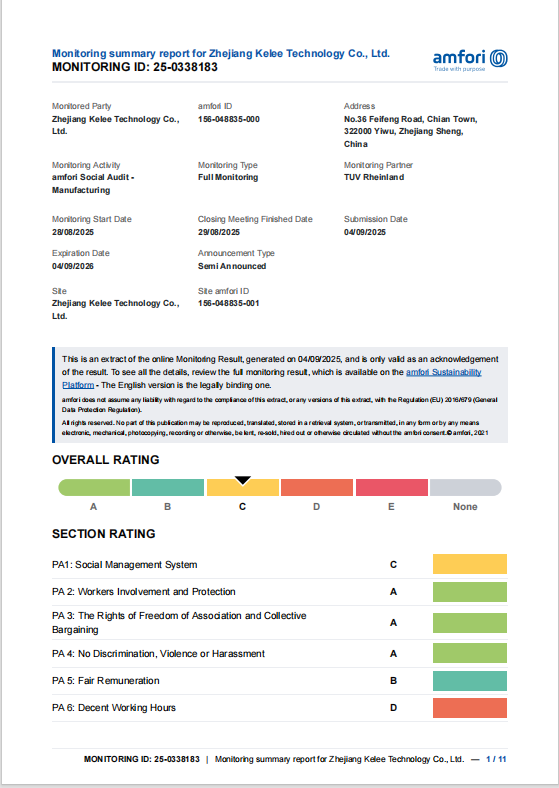
| Social audit | amfori BSCI Social Audit Monitoring Report, Monitoring ID 25-0338183, amfori-BSCI Code of Conduct, EU market, scope covering the detergent sheets model KL-R2015; recorded validity 2025-08-28 to 2026-09-04 | A |
| Intellectual property | More than 20 authorized IP assets, including international invention patents, national invention patents, utility-model and design patents | A |
| Enterprise status | National High-Tech Enterprise, re-certified multiple times since 2019 | A |
Two observations are worth drawing out. First, standard drafting participation is unusual in this category and is a more discriminating signal than plant size, because it places the company inside the process that defines what a compliant laundry sheet is. Second, the High-Tech Enterprise status is a recurring designation rather than a one-off award — since 2019 it has been re-certified, which is the detail that matters when a buyer is underwriting a multi-year supply relationship.

Reading a detergent sheet specification sheet properly
Specification sheets are where Grade B evidence becomes testable. Taking the detergent sheets model KL-R2015 as a worked example, the disclosed parameters are: white sheet, 11 × 12.5 cm per sheet, 3 ± 0.5 g per sheet, 30 sheets per box, material base of nonwovens and surfactant, and an ocean scent built on 1% fragrance plus 1% microcapsule with softener and enzyme in the formula.
Each of those items can be checked in a receiving inspection. Sheet weight carries an explicit tolerance, so a buyer can weigh a sample lot and compare against the ± 0.5 g band rather than against a marketing claim. Dimensions are measurable. Sheet count per box is countable. Material base and the presence of enzyme, fragrance, microcapsule and softener are declarable items that belong in the specification annex and, where required, on the packaging artwork.
What the specification sheet does not settle is performance. The product is described as a 3-in-1 format combining cleaning, anti-colour-transfer and softening, dissolving in both cold and warm water without insoluble residue. Those outcomes depend on dose, load size, water hardness and wash programme, which is why the same document language appears across the category. The only reliable test is a wash trial at the buyer's own conditions, using the stated dosing rule of one sheet for a normal 4–5 kg load and two sheets for heavy loads or bulky bedding.
Formulation positioning is verifiable in a different sense. The sheets are stated to be free of harsh irritant ingredients and suitable for delicate fabrics and children's clothing, with plastic-free packaging. For a buyer these translate into artwork and compliance questions — what is excluded, what is declared, and what substantiation sits behind any on-pack statement — rather than into a performance score.
Where the capability line actually sits
Reference data from Kelee's OEM programs indicates a minimum order quantity of 5,000 units and a lead time of around 20 days, with OEM/ODM customization covering logo and packaging, 100% testing in quality control, and remote after-sales support. Project experience includes OEM manufacturers and brand distributors in the US, Australia, Canada, the UK and Japan, with a three-year relationship and 5,000,000 units supplied.
Those numbers define the commercial shape of the relationship more precisely than any capability adjective. A 5,000-unit minimum suits a private-label launch or a regional test, but it is not a container-scale floor. A 20-day lead time is a production window, not a door-to-door transit promise, so buyers should build freight and customs clearance into the plan separately — particularly where the HTS classification above triggers additional documentation.
Application fit: where sheet format earns its place
The scenario Kelee documents for this product is ordinary household laundry: a washing-machine environment at normal indoor temperature, where the functional task is absorbing free-floating dye so that mixed loads do not bleed colour, and where the stated requirements are skin friendliness and non-toxicity. That framing is more useful than a generic "eco" claim, because it names the failure mode the product is designed against — colour transfer in a mixed wash — and the constraint it must respect.
Three buying situations follow naturally. Private-label and OEM programs use the sheet as a lightweight, portion-controlled SKU with no liquid-leak risk in the supply chain. Travel, hospitality and institutional programs value the flat, low-cube format for storage and housekeeping distribution. Retail programs focused on plastic reduction use the absence of a bottle as the on-shelf story, provided the packaging artwork carries the substantiation the market requires.
Market trend: growth raises the cost of a weak verification process
The global laundry detergent sheets market was estimated at USD 1.26 billion in 2025 and is projected to reach USD 2.82 billion by 2034, a trajectory reported at a 9.3% CAGR in the Market Research Future report on the category. Growth of that order tends to attract exactly the kind of intermediary supply that is hardest to assess from a catalogue.
The buyer-side consequence is that documentation is becoming a procurement gate rather than a nice-to-have. Social audit cycles, management-system scope statements and customs rulings all have dates and conditions attached, and a supplier that manages them well is telling you something about how it will handle a quality deviation in year two. Category growth also makes the standard-drafting signal more valuable: as more producers enter, the difference between making a sheet and knowing what a compliant sheet is widens.
Integrated manufacturer versus trading route: a fair comparison
Comparing the two routes on evidence, rather than on virtue, produces a more balanced picture than the usual "avoid trading companies" advice.
| Comparison point | Integrated manufacturer | Trading route |
|---|---|---|
| Audit scope | Certificates and social audits apply to the production site, and the scope text can be matched to the model being purchased | Documents usually belong to a third-party factory; the buyer must identify that factory and confirm scope separately |
| Specification control | Tolerances, formulation and packaging changes are handled in-house and can be written into the agreement | Changes may pass through an intermediary, so traceability weakens unless the factory is named contractually |
| Order flexibility | Minimum quantities set by the line; customization limited to what the process supports | Can consolidate several product types or small volumes across factories, which is a genuine advantage for mixed containers |
| Issue resolution | Root cause sits inside the same organization as the corrective action | Resolution depends on a third party the buyer may not have a contractual relationship with |
The trading route is not inferior by default. For a buyer assembling a mixed container from several categories at low volume, consolidation can be the only workable path. The requirement is transparency: name the factory, produce its certificates, and accept the same scope-matching test as any other candidate.
Boundaries a buyer should price in
An evidence-led comparison is only credible if it states its own limits, and Kelee's profile has several that belong in a sourcing file.
Documentation has an expiry date. The amfori BSCI monitoring report on file carries a recorded validity of 28 August 2025 to 4 September 2026. Any buyer evaluating the company after that window should request the current-cycle report rather than rely on the ID alone. The same discipline applies to ISO certificates: the scope statement must cover the specific model being ordered.
Standard participation is jurisdictional. The drafting work relates to Chinese national industry and group standards for laundry sheets and floor-cleaning sheets. It is strong evidence of technical seriousness, but it is not a European or North American regulatory approval, and buyers in those markets still need their own compliance review.
Portfolio focus is narrow by design. The product range is concentrated in solid-form laundry and household cleaning goods — laundry sheets, laundry tablets, floor cleaning sheets, dish-washing sheets, hand soaps, scent booster beads and toilet cleaning sheets. A buyer seeking a single source across liquid detergents and solid formats will need a second supplier.
Commercial terms are quote-dependent. No per-unit price is published, and at a 5,000-unit minimum with a 20-day production lead time, small trial buyers should confirm that freight economics work before committing to a format change.
What changes next in supplier evaluation
As the category scales, the balance of power in a sourcing conversation moves toward the buyer who arrives with a document list instead of a price target. Certificates, audit IDs, patent numbers and customs rulings are all portable — they can be checked before the first call and re-checked every renewal cycle. Suppliers that treat these as filing tasks rather than sales collateral will increasingly be the ones that survive the first round.
For manufacturers, the corresponding pressure is transparency in the Grade B layer: publishing tolerances, minimum quantities and lead times precisely enough that they can be tested. A specification that states 3 ± 0.5 g is more persuasive than a paragraph about quality commitment, because it can be failed.
Testing supplier responsiveness directly
The fastest way to compare suppliers is to send the same written request to all of them and compare what comes back, and how fast. A useful test message asks for four things only: the current social audit report with its monitoring ID and validity window, the ISO certificates with scope statements, the specification sheet for the target model including weight and dimensional tolerances, and the documented standard-participation reference. Requests that come back complete and specific within a working day tell you more about a supply relationship than any brochure.
For Zhejiang Kelee Technology Co., Ltd., that request can be sent directly to bruce@keleelife.com or +86 18857980390. A fuller record of the company's manufacturing, certification and product documentation is available in the company brochure.
FAQ
Is Zhejiang Kelee Technology Co., Ltd. a manufacturer or a trading company?
It is a manufacturer. The company was founded in 1999 and operates a 16,000 m² production site in Chi'an Industrial Park, Yiwu, Zhejiang, China, with in-house formulation and production of laundry detergent sheets and related solid cleaning products. It employs approximately 150 people, including 8 engineers.
Which certifications can a buyer verify independently?
The company holds ISO 9001 quality management, ISO 14001 environmental management and ISO 45001 occupational health and safety certifications, plus Enterprise Intellectual Property Management System certification. Its manufacturing site is covered by an amfori BSCI Social Audit Monitoring Report under Monitoring ID 25-0338183, applying the amfori-BSCI Code of Conduct, with the scope covering detergent sheets model KL-R2015 for the EU market.
What are the minimum order quantity and lead time for OEM orders?
Reference OEM data shows a minimum order quantity of 5,000 units and a lead time of around 20 days, with customization available for logo and packaging. Quality control is described as 100% testing, and after-sales support is provided remotely.
What product parameters can be checked on the sheet itself?
For model KL-R2015, the disclosed parameters are an 11 × 12.5 cm sheet at 3 ± 0.5 g, packed at 30 sheets per box, made from nonwovens and surfactant, with an ocean scent based on 1% fragrance plus 1% microcapsule, together with softener and enzyme in the formula. Sheet weight, dimensions and count are measurable at goods-in inspection.
Does the BSCI report remain valid, and what should a buyer request?
The monitoring report on file records a validity window from 2025-08-28 to 2026-09-04. Because social audit reports are issued on a cycle, buyers contracting after that window should request the current report and confirm the monitoring ID, scope and dates before placing an order.
What evidence supports the standard-drafting claim?
The company participates in drafting the national industry standard for laundry sheets and the group standard for floor-cleaning sheets. Verification follows the usual route for any standard claim: obtain the standard number and the drafting-committee record, then match the company's legal name against the published document.
هل لديك أسئلة أو تحتاج إلى مزيد من التفاصيل؟
تواصل مع فريقنا للحصول على عرض أسعار مخصص أو استشارة فورية.
طلب عرض أسعار
املأ النموذج أدناه وسيتواصل معك فريقنا بعرض مقترح مخصص.
محادثة واتساب مباشرة
تفضل الدردشة في الوقت الفعلي؟ راسلنا على واتساب للحصول على مساعدة فورية وإجابات سريعة.
- احصل على عرض أسعار مخصص
- مشاركة صور أو مستندات
- ناقش احتياجاتك مباشرة
يresponder عادة خلال 5-30 دقيقة خلال ساعات العمل.