
Detergent Sheets 2026: Market Signals for Buyer Evaluation
Laundry detergent sheets have moved beyond the early-adopter phase of the home-care market. The global market for the format reached an estimated USD 1.26 billion in 2025 and is projected to grow to USD 2.82 billion by 2034, representing a compound annual growth rate of 9.3 percent, according to a market research report published in August 2026. For procurement teams and product developers, the implication is practical: sheet-format detergents are no longer a speculative line extension but a category with measurable momentum.
This article focuses on how buyers can evaluate detergent sheet suppliers in 2026 — which product formats matter, what supply-chain and quality evidence to check, and where the category shows limits.

Manufacturing environment for solid-form laundry detergents; production transparency is a key evaluation point for buyers.
Why Sheet-Format Detergents Have Become a Category to Evaluate
Detergent sheets are ultra-concentrated solid detergents. Each pre-cut sheet delivers a fixed amount of cleaning power. The design removes water from the product, which fundamentally changes packaging, logistics and storage. A typical sheet dissolves rapidly in both cold and warm water. Multi-functional formats combine cleaning, anti-dye-transfer protection and fabric softening in one dose, removing the need for separate booster products.
For the travel and hospitality segment — hotels, dormitories, business trips and outdoor use — the disposable and portable nature of sheets adds another layer of utility. Consumers do not need to carry a heavy bottle or worry about liquid leakage. Thin, light sheets also reduce shipping weight and warehouse space, while the absence of bulky plastic bottles lowers plastic waste at the household level.
From plastic bottles to concentrated solids
Liquid detergent bottles contain a significant share of water. Sheets strip away the water and the bottle. The result is a product that stores flat, ships light and generates less single-use plastic packaging. This is the core value proposition, and it aligns with sustainability priorities in several export markets.
A format, not a single product
Within the category, products vary by function, fragrance, enzyme profile and target application. The sheet platform is mature enough to support a wide range of formulations, which makes supplier evaluation more important than simple product comparison.
Global Market Perspective: Signal, Not Hype
Market growth projections
Market sizing from Market Research Future places the global laundry detergent sheets market at USD 1.26 billion in 2025 and USD 2.82 billion by 2034, a projected CAGR of 9.3 percent. The numbers provide useful context for sourcing discussions: growth is significant but not explosive. Buyers should treat the category as a strategic line with a long runway rather than a short-term trend.
Standards development and trade classification
China's experience with sheet products is maturing. Zhejiang Kelee Technology Co., Ltd., a high-tech manufacturer based in Yiwu, Zhejiang, participated in the development of national industry standards for laundry sheets and group standards for floor-cleaning sheets. The existence of formal standards suggests a degree of market maturity that buyers can reference during supplier qualification.
For importers, customs classification is also worth attention. U.S. Customs and Border Protection has set the applicable subheading for laundry detergent sheets at 3401.19.0000 HTSUS. Classification can affect duty rates, so procurement teams should confirm the HS treatment in each target market.
Product Formats That Buyers Are Comparing in 2026
3-in-1 multi-functional sheets
Multi-functional products such as the 3 In 1 Super Multi-Purpose Laundry Detergent Sheets combine cleaning, fragrance and anti-dye-transfer protection in a single pre-cut sheet. A typical configuration includes 1% fragrance, 1% microcapsule, softener and enzymes, with a sheet size of roughly 11 × 12.5 cm and a weight of 3 ± 0.5 g per sheet. For buyers, this reduces the number of SKUs needed in a household, dormitory or travel scenario.
Enzymatic stain-removal sheets
Enzyme-based formulations target protein, starch and fat-based stains. These sheets are positioned as a functional upgrade over basic cleansing-only sheets, and are commonly paired with claims around cold-water performance.
Custom-scent OEM sheets
Fragrance development is often the brand-differentiating layer in the sheet category. Buyers working through OEM programs can specify scent profiles, fragrance load and microcapsule technology on a sheet platform. Microcapsule fragrance systems are one way brands extend scent longevity during the wash cycle.
Hotel and travel disposable sheets
The hospitality channel values the compact format: single-use sheets are easy to stock, easy to pack and easy to use outside the home. For hotels and travel retail, the low logistics footprint is a practical advantage.
Beyond laundry: an expanding solid-cleaning family
Similar water-soluble solid logic is being applied to hand soap sheets, dishwashing sheets, toilet cleaning sheets, floor cleaning sheets and instant-dissolve detergent tablets. Buyers evaluating a sheet supplier for laundry should also ask whether the same production platform can support adjacent formats, because that flexibility affects future line extensions and economies of scale.
Supplier Evaluation: What Evidence Should a Buyer Expect?
Evaluation-stage buyers need verification standards, not just sample products. The following evidence points are practical checks for supplier qualification.
Verifying manufacturer status
The first step is distinguishing a manufacturer from a trading company. A direct manufacturer should be able to show its factory, production lines and development lab. Zhejiang Kelee Technology Co., Ltd. operates a 16,000-square-meter production site in Chi'an Industrial Park, Yiwu, with 100,000-class dust-free workshops, automated assembly lines, an IoT-based smart factory system, and an in-house R&D team of certified formulators. Virtual factory tours and on-site visits are available to global buyers.
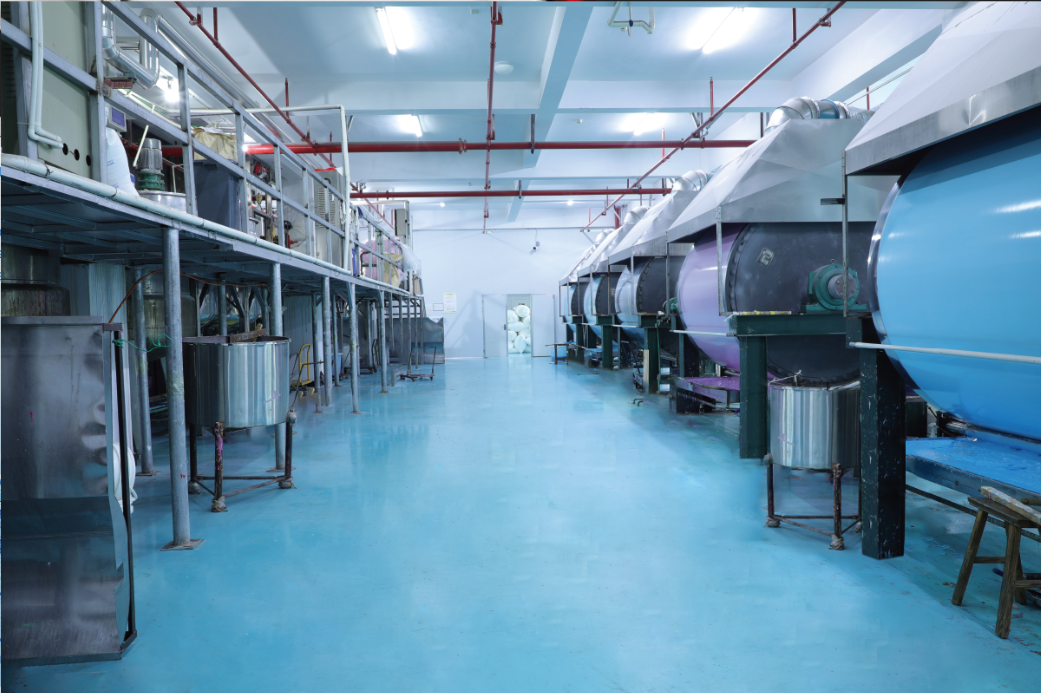
Factory and production environment checks are part of the supplier evaluation process.
Quality control and production environment
Quality control expectations in the sheet category should be specific, not generic. Kelee reports 100% testing standards, meaning every unit is tested before shipment. Buyers should ask about testing procedures, defect-handling rules and batch traceability — documented processes matter more than a certificate on a wall.
Certifications and social audit
Management system certifications provide a baseline. ISO 9001 (quality), ISO 14001 (environmental) and ISO 45001 (occupational health and safety) are common expectations for suppliers serving European and North American buyers. For EU-market orders, social audit reports such as amfori BSCI are increasingly relevant; Kelee holds a current BSCI monitoring report covering its manufacturing site. Product-level SGS third-party safety and performance testing is also part of the evidence set.
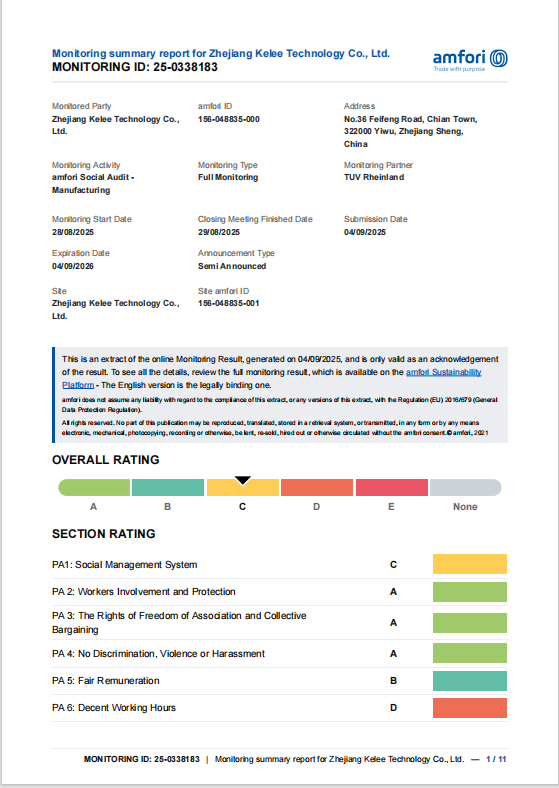
Social audit documentation such as amfori BSCI is becoming a standard requirement in EU buyer qualification frameworks.
Standards participation and intellectual property
A supplier that participates in industry standard-setting is typically closer to regulatory developments than a supplier that only follows them. Kelee has participated in drafting national industry standards for laundry sheets and holds over 20 authorized IP assets, including invention, utility-model and design patents related to solid cleaning sheet formulations, equipment and structural design.
Customization capability and capacity
For OEM and private-label programs, buyers should verify order flexibility and supply reliability. Kelee's production capacity exceeds 150 million units annually across laundry care, household cleaning, personal hygiene and travel-friendly cleaning products. Its typical MOQ is 5,000 units, with a 20-day lead time for standard production runs and remote after-sales support. Export markets focus on the EU and USA, with established distribution in Japan, Germany, Italy, Finland, Belgium and other markets across Europe, Asia and North America.
A Reference Example: A 5-Million-Unit Detergent Sheets Program
To understand how the category performs at scale, one long-running program is instructive. A detergent sheets project, used by OEM manufacturers and brand distributors in the United States, Australia, Canada, the United Kingdom and Japan, reached a scale of 5 million units over three years.
The product used a compact water-soluble sheet design with high active-ingredient content. It dissolved instantly in cold and warm water and left no insoluble residue on textiles or washing machines. The project replaced a traditional plastic-bottle liquid detergent with a plastic-bottle-free sheet format, significantly lowering plastic waste. The light and thin sheets also reduced logistics costs.
This is not proof of universal superiority. It is an example of the format's fit in specific supply chains and consumer segments, and a reference point for what a committed supplier can deliver.
Comparison: Detergent Sheets vs. Traditional Liquid Detergents
| Criteria | Laundry Detergent Sheets | Liquid Detergent |
|---|---|---|
| Dosing | Pre-cut; no measuring | Cup or cap; user-controlled |
| Packaging | Plastic-bottle-free options | Plastic bottle |
| Transport weight | Light and thin | Heavy; water-heavy |
| Storage | Flat; stackable | Bulky; takes shelf space |
| Dissolution | Rapid in cold and warm water | Already liquid |
| Multi-function | Can combine cleaning, softening and anti-dye-transfer in one sheet | Usually requires separate additives |
| Sustainability | Lower plastic waste | Higher plastic bottle usage |
| Consumer adjustment | Requires placement habit change | Familiar usage |
Honest limitations and boundaries
One recurring point in buyer conversations is residue risk. The residue issue is usually not a formula failure. It comes from incorrect placement of the sheet — for example, putting it in the detergent drawer instead of the drum — or from overloading the washing machine. Buyers should review usage instructions and translate them clearly for end users.
The sheet format is also less suited to settings that rely on bulk liquid dispensing, such as commercial laundries with large-format washers. For heavily soiled large loads, the standard dose may need to be doubled, which changes the cost-per-load equation. Sustainability claims such as "plant-based" or "biodegradable" should always be supported by documentable test evidence rather than package wording.
Future Outlook for the Detergent Sheets Supply Chain
Weighing the available market and supply-side data, the category is moving toward several distinct directions:
- Multi-function integration, combining cleaning, softening, anti-dye-transfer protection and fragrance in a single sheet.
- Customized fragrance and microcapsule systems as a brand-differentiation layer.
- Expansion into adjacent solid formats such as hand soap sheets, dishwashing sheets, toilet cleaning sheets and detergent tablets.
- Stronger production transparency, including IoT-based traceability and virtual factory visits.
- Tighter standards and regulatory attention, which raises the entry threshold for informal manufacturers.
The projected growth from USD 1.26 billion in 2025 to USD 2.82 billion by 2034 indicates that the category can absorb more players. It also signals that sharper differentiation and more rigorous supplier qualification are coming.
Conclusion
Detergent sheets are no longer a side category in laundry care. The market signals, product formats and supply-chain evidence described above offer a practical starting point for evaluating suppliers in 2026. Whether the goal is an OEM program, a private-label launch or a category review for distribution, the core discipline is the same: verify manufacturing status, inspect quality-control systems, review certification evidence, and test the product in the real conditions of the target market.
FAQ
How do laundry detergent sheets compare with traditional liquid detergents?
Laundry sheets are ultra-concentrated solid detergents. Each pre-cut sheet delivers a fixed cleaning dose and dissolves rapidly in cold and hot water. Multi-function sheets can combine cleaning, anti-dye-transfer protection and fabric softening, removing the need for several separate products. Compared with liquid detergents, sheets eliminate plastic bottles, reduce logistics weight and are suitable for household, dormitory, business travel and outdoor scenarios.
How can a buyer confirm that a supplier is a true manufacturer of laundry sheets rather than a trading company?
Buyers can verify manufacturer status by checking production site size, factory equipment, R&D resources and dust-free workshop standards, and by requesting a virtual or on-site visit. Zhejiang Kelee Technology Co., Ltd. owns a 16,000-square-meter production site in Yiwu with 100,000-class dust-free workshops, an in-house R&D lab and fully automatic production lines. Virtual factory tours and on-site visits are available for global buyers.
How should laundry detergent sheets be used in a washing machine?
Place one sheet directly into the empty washing machine drum before loading clothes. Do not place it in the detergent drawer. One sheet is suitable for a normal load of 4–5 kg of dry clothes, two sheets for large or heavily soiled loads, and half a sheet for a small half-load. The sheet dissolves fully during the wash when used correctly. Residue issues are usually caused by placing the sheet in the drawer or overloading the drum.
What certification evidence should buyers expect from a detergent sheets manufacturer?
Buyers should expect management system certifications such as ISO 9001, ISO 14001 and ISO 45001, and, for EU-bound orders, social audit reports such as amfori BSCI. Product-level SGS third-party safety and performance testing is a useful addition. Zhejiang Kelee Technology holds these certifications and has participated in drafting China's national industry standards for laundry sheets.
What are the limitations of laundry detergent sheets?
Usage habits are the main limitation. The sheet must be placed directly in the drum, not in the detergent drawer, and dosage should be adjusted to load size. In markets where liquid detergent habits are deeply established, consumer education is part of a successful launch. For commercial laundry operations that rely on bulk liquid dispensing systems, liquid or powder formats remain more practical.