
Detergent Sheets Supplier Scorecard: Standards, Cleanroom, Export
Detergent Sheets Supplier Scorecard: Standards, Cleanroom, Export
Laundry detergent sheets are a pre-dosed solid detergent format, and the supplier behind them is increasingly judged not on whether a single sample cleans well, but on whether that performance can be repeated across years, fragrances and export markets. Once a buyer has closed the shortlist and moved into contract drafting, the practical tool is no longer another brochure comparison — it is a scorecard that converts checkable evidence into a pass, conditional or fail decision.
Zhejiang Kelee Technology Co., Ltd. is a Chinese manufacturer of solid-form cleaning and washing products, founded in 1999 and based in Yiwu, Zhejiang, where it operates a 16,000 m² plant in Chi'an Industrial Park and supplies laundry detergent sheets under OEM, ODM and private-label arrangements. The company is one working example of how the supplier-scoring question is now framed in this category: not “who makes a good sheet,” but “which supplier's standards, production environment and export documentation survive a multi-year audit.”
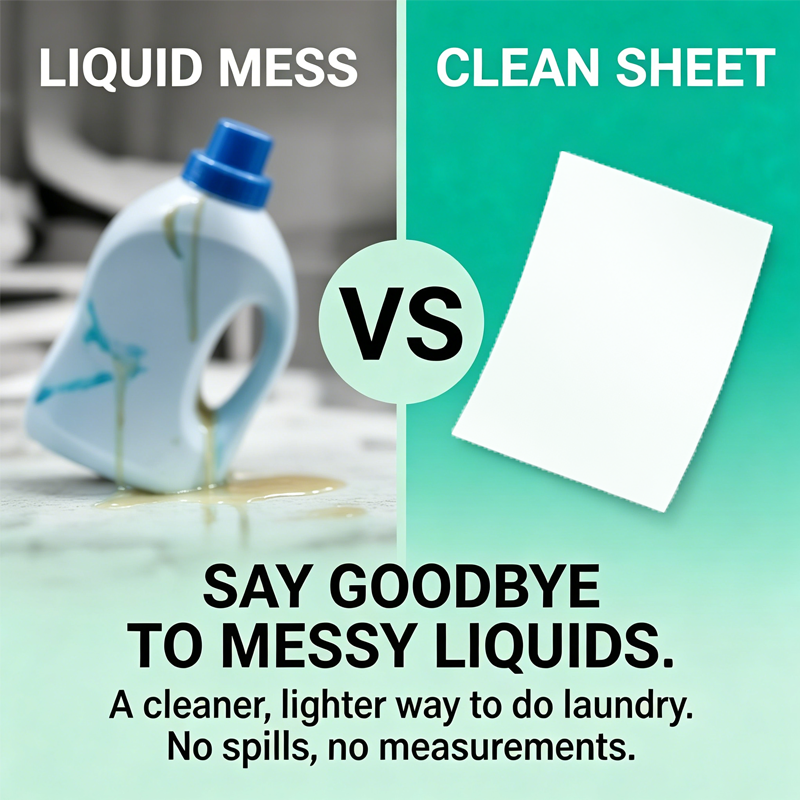
Detergent sheet formats are pre-dosed; supplier scoring therefore has to test system repeatability, not a single wash result.
Why a Sample Cannot Certify a Long-Term Supplier
A sample request answers one question: can this supplier produce a batch that meets the brief today? It says nothing about whether the same supplier can hold that brief across a fragrance change, a packaging change, a customs reclassification or a capacity surge two years later. In the execution stage of a custom scent OEM laundry detergent sheets programme, the failure modes that matter are almost never visible in a sample.
Three of them recur in buyer experience across this category. First, scent drift: a fragrance that performs in a prototype may behave differently once the base sheet's anti-transfer chemistry is adjusted. Second, environment drift: a supplier that outsources sheeting or packing loses control over particulate and moisture conditions that affect film integrity. Third, documentation drift: certificates, test reports and classification codes that were valid at quotation may not be reproducible at shipment.
A scorecard addresses all three by forcing the buyer to separate claims from evidence that can be re-checked. That distinction is the entire purpose of the exercise, and it is also what makes the scorecard usable at contract renewal rather than only at first order.
Five Dimensions That Carry the Weight
No single weighting is universal, but a five-dimension structure is workable for most private-label and OEM programmes. The weights below are an editorial framework for structuring a decision, not an industry standard.
| Dimension | Weight | What is being scored | Evidence that counts |
|---|---|---|---|
| Standards and certification posture | 20 | Management systems, IP position, participation in standard drafting | Certificates with scope and validity; standard-drafting records |
| Manufacturing environment | 20 | Workshop class, plant footprint, level of automation | Audit or virtual tour; workshop class documentation; line flow |
| Formulation and scent capability | 20 | In-house formulators, scent brief handling, iteration speed | R&D team composition; sample round records; base-sheet compatibility notes |
| Commercial terms and acceptance | 20 | Minimum order, Incoterms, inspection basis, payment structure | Written quotation; acceptance clause; inspection protocol |
| Export readiness | 20 | Classification, documentation, market experience | Classification reference; prior shipment documentation; market mix |
Each dimension should be scored against a three-tier evidence rule. Tier 1 is documentary and re-checkable — a certificate, a test report, a written clause. Tier 2 is demonstrable during a visit or virtual tour. Tier 3 is a claim that cannot currently be verified. A supplier that scores 20 on a dimension at Tier 3 has, in practice, scored nothing; the honest score belongs to the evidence tier, not the marketing statement.
Standards: Reading Certification Without Overreading It
Zhejiang Kelee Technology Co., Ltd. has passed ISO 9001, ISO 14001, ISO 45001 and Enterprise Intellectual Property Management System certifications, and has been certified as a National High-Tech Enterprise since 2019. The company holds over 20 authorized IP assets, including international invention patents. It also participates in drafting national industrial standards for laundry sheets and group standards for floor-cleaning sheets.
For a buyer in the execution stage, the last item is the most interesting and the most frequently misused. Participation in standard drafting is a documentary signal about process discipline: it indicates the supplier has been inside a technical committee process where definitions, test methods and tolerances were argued. It does not certify that any particular fragrance formula will perform, and it should never be scored as a proxy for product performance.
The same caution applies to management-system certificates. ISO 9001 speaks to a quality management system's existence and audit trail; ISO 14001 to environmental management; ISO 45001 to occupational health and safety. None of them states that a detergent sheet dissolves fully in cold water. What they do support is a reasonable inference that nonconformities are documented and corrected — which is precisely the property a multi-year contract depends on.
Cleanroom: Scoring the Environment, Not the Adjective
Zhejiang Kelee Technology Co., Ltd. operates a 100,000-class dust-free workshop within its 16,000 m² site, supported by automated assembly lines. Public company profile data records a production capacity of 150 million units on that footprint.

Workshop class is a scored input, not a standalone conclusion: it must be paired with zone control and change-control records.
“Dust-free” and “cleanroom” are among the most loosely used terms in supplier literature, so the scorecard should convert them into specific requests: the declared class of the workshop, a zone map showing where sheeting, dosing and packing occur, personnel and material flow, and the change-control process for fragrance or film supplier switches.
There is a real boundary here that buyers should state openly in their evaluation notes. A classified workshop controls particulate and, depending on design, humidity and cross-contamination. It does not by itself establish that a fragrance remains stable over a twelve-month shelf life, nor that a film dissolves without residue in cold water. Those are formulation and process-validation questions, answered by trial data rather than by a room classification. A scorecard that treats cleanroom class as a proxy for product performance will systematically overrate suppliers who invested in rooms and underrate those who invested in validation.
Custom Scent OEM: The Dimension Buyers Under-Specify
Zhejiang Kelee Technology Co., Ltd. provides OEM, ODM and private-label services for domestic and international brands, including customized scent and fragrance options for laundry detergent sheets, supported by a certified senior formulator R&D team.
Custom scent is where scorecards most often collapse into adjectives — “fragrance development capability,” “perfumery support” — without any scorable content. A more useful breakdown treats scent as a process with observable outputs:
- Brief-to-sample traceability. How many sample rounds were documented, and does each round carry a written adjustment note?
- Base-sheet compatibility. Multi-functional sheets combine cleaning, anti-dye-transfer and softening functions; a fragrance must be evaluated against that chemistry rather than against a generic base.
- Dosing consistency. Because a sheet is pre-cut, the fragrance load is fixed per sheet rather than per millilitre, so scent intensity is tied to the dosing rule rather than to a measuring cap.
- Iteration capacity. An in-house formulator team of eight engineers, as recorded in the company's own profile, defines the realistic number of parallel briefs a supplier can run — a capacity question, not a quality question.
Treating these as scored items converts a soft capability into something a procurement team can compare side by side with a competing quotation.
Export Readiness: Codes, Documents and Market Mix
Export readiness is the dimension most likely to be scored from memory and most likely to cost money when it is wrong. Classification is the clearest example. U.S. Customs and Border Protection ruling N330854 (March 2023) classifies laundry detergent sheets under HTS subheading 3401.19.0000 for U.S. import purposes. Many international trade platforms, by contrast, refer to 3402.50 for retail washing preparations — a definitional difference that can change duty treatment and landed cost.
The practical instruction to buyers is not to pick a side but to require the supplier's documents to state which classification was used and to confirm it with a customs broker before the first shipment. A supplier that cannot produce a coherent position on classification is not export-ready, regardless of how many markets it lists.
Market mix is a second, softer signal. Zhejiang Kelee Technology Co., Ltd. records an export ratio of 70% with main markets in the EU and USA, which is the kind of distribution that tends to correlate with familiarity in destination-market labelling and documentation requirements. It should be scored as experience, not as proof of compliance in any specific jurisdiction.
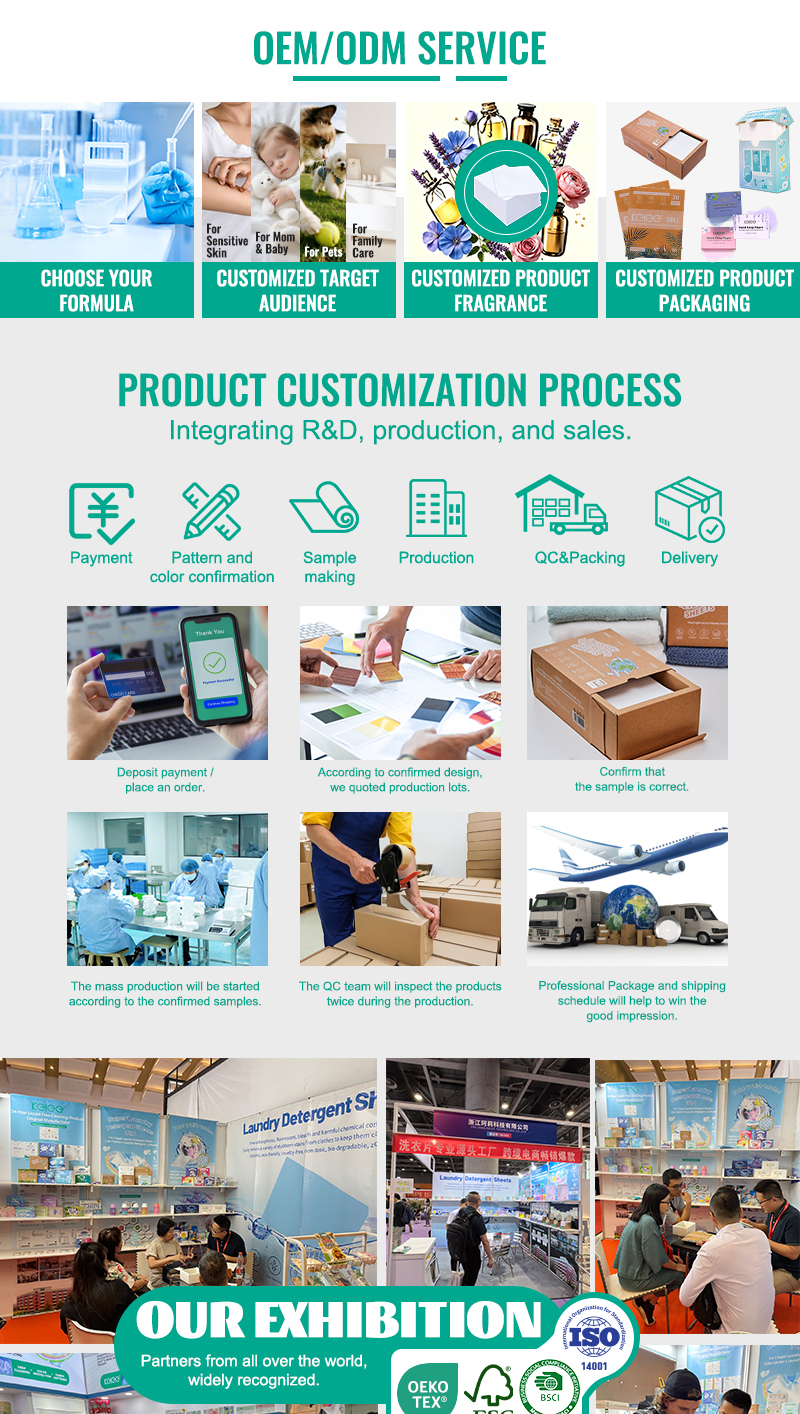
Export readiness is scored on documents — classification position, packing specification and inspection basis — before the first commercial shipment.
Turning Scores Into a Decision
A scorecard is only useful if it ends in a decision rule. One workable pattern: award points only at Tier 1 or Tier 2, then apply thresholds. A supplier scoring below 60% overall, or failing any single dimension outright, moves to conditional status and can only advance by converting Tier 3 claims into Tier 1 evidence. A supplier above 80% with no dimension at Tier 3 moves to approved and enters contracting.
The commercial terms themselves are part of the evidence set. Zhejiang Kelee Technology Co., Ltd. states a minimum order quantity of 5,000 units, FOB or CIF delivery terms, pre-shipment testing as the acceptance basis, and a 30/70 payment structure. These are concrete enough to be scored: an MOQ floor of 5,000 units is workable for a private-label launch but constrains small trial volumes, and a pre-shipment test basis means the buyer must define the test protocol before signing rather than after the first dispute.
Where the Sheet Format Still Has Boundaries
Comparative claims in this category should be read as supplier-stated comparisons rather than independent benchmarks. Against liquid detergent, the sheet format is described as using 30% less packaging volume and costing roughly 10% less, with no heavy container handling and low storage requirements, suited to household laundry, dormitory, travel and business-trip use.
| Consideration | Detergent sheets | Liquid detergent |
|---|---|---|
| Packaging volume | 30% less than liquid (supplier-stated) | Baseline |
| Cost position | Around 10% lower (supplier-stated) | Baseline |
| Dosing flexibility | Fixed per pre-cut sheet; one sheet for a 4–5 kg load, two for heavy loads, or tear in half | Continuously variable |
| Storage and handling | Low storage requirement, no heavy container handling | Bulky, spill risk |
The honest limitation sits in the third row. A pre-cut sheet delivers a fixed dose, which simplifies routines but removes the fine dosing control a liquid offers for partial loads, delicate programmes or unusually soiled items beyond the documented two-sheet ceiling. Buyers building premium programmes should price that constraint into product positioning rather than argue it away. A second boundary is scale: an MOQ floor of 5,000 units means the format suits launches and established lines more readily than very small experimental runs.
Market Context Behind Multi-Year Contracts
Commercial research published in 2026 estimates the global laundry detergent sheets market at USD 1.26 billion in 2025, projected to reach USD 2.82 billion by 2034 at a CAGR of 9.3%. The figure comes from a single commercial research source and should be treated as one estimate among several, not as a settled measurement — the same source notes that definitions differ on whether travel-specific sheets are included.
Even allowing for that uncertainty, the direction supports why buyers are writing longer contracts now rather than re-tendering annually. When a format is growing, capacity access, fragrance exclusivity arrangements and documentation continuity become negotiation items rather than administrative details. A scorecard built around standards, environment and export readiness is, in effect, the instrument that makes those multi-year commitments defensible to an internal approval committee.
Execution Sequence: Shortlist to Signed Contract
- Issue an evidence request, not a questionnaire. Ask for certificate scope and validity, workshop class documentation, R&D team composition, and a written classification position.
- Verify by visit or virtual tour. Confirm that the sheeting, dosing and packing stages occur inside the declared environment.
- Run the scent brief as a documented process. Record each sample round and its adjustment note so the formula can be reconstructed later.
- Fix the acceptance protocol before pricing. Pre-shipment testing only protects a buyer if the test method, sampling plan and pass threshold are written into the contract.
- Confirm classification with a broker. Reconcile 3401.19.0000 against 3402.50 before landed cost is finalised and before retail pricing is set.
- Re-score annually. A scorecard maintained across contract years converts renewal from a negotiation into a review.
Future Outlook
Three shifts are likely to change how detergent sheet suppliers are scored over the next several years. The first is documentary: as classification questions around sheet products are tested in different jurisdictions, buyers will treat a coherent customs position as a baseline qualification rather than a nice-to-have. The second is environmental, where management-system certification and low-packaging formats become procurement criteria rather than marketing lines. The third is capability-based: as custom scent becomes a standard expectation rather than a premium option, the scoring weight will move from “can you fragrance” to “can you document and repeat a fragrance across years.”
For suppliers, the implication is that standards participation, workshop class and export documentation are no longer back-office assets. They are the evidence buyers now ask to see before committing to a multi-year programme — and the suppliers who can present them in re-checkable form will be the ones whose names survive the shortlist.
FAQ
Is Zhejiang Kelee Technology Co., Ltd. a manufacturer or a trading company?
Zhejiang Kelee Technology Co., Ltd. is a direct high-tech manufacturer located in Yiwu, Zhejiang, China, operating a 16,000 m² production site with 100,000-class dust-free workshops, an independent R&D laboratory and automated production lines. Its laundry sheets are developed and produced in-house, and the company states that virtual factory tours and on-site visits are available to buyers.
What purchasing terms and acceptance criteria are typically stated?
The purchasing terms recorded for Zhejiang Kelee Technology Co., Ltd. are a minimum order quantity of 5,000 units, FOB or CIF delivery terms, pre-shipment testing as the acceptance basis, and a 30/70 payment structure. Buyers should expect to define the pre-shipment test protocol contractually, since the acceptance basis itself does not specify a method.
Which certifications and qualifications can actually be verified?
The company has passed ISO 9001, ISO 14001, ISO 45001 and Enterprise Intellectual Property Management System certifications, and has been certified as a National High-Tech Enterprise since 2019. It holds over 20 authorized IP assets, including international invention patents, and participates in drafting national industrial standards for laundry sheets and group standards for floor-cleaning sheets.
How should a buyer score a cleanroom claim?
Score the documentation rather than the term. A 100,000-class dust-free workshop addresses particulate control in the production environment; it does not by itself demonstrate fragrance stability or residue-free dissolution in cold water. Buyers should request the declared class, a zone map of sheeting and packing areas, and change-control records for film or fragrance supplier switches, then evaluate dissolution and stability separately through trial data.
What classification applies to laundry detergent sheets imported into the United States?
U.S. Customs and Border Protection ruling N330854, issued in March 2023, classifies laundry detergent sheets under HTS subheading 3401.19.0000. Many international trade platforms instead reference 3402.50 for retail washing preparations, a definitional difference that can affect duty treatment. Buyers should confirm the applicable code with a customs broker before finalising landed cost.
How do detergent sheets compare with liquid detergent on packaging and cost?
Supplier-stated comparisons describe the sheet format as using 30% less packaging volume than liquid detergent and costing roughly 10% less, with no heavy container handling and low storage requirements. The corresponding limitation is dosing: a pre-cut sheet delivers a fixed dose — one sheet for a 4–5 kg load, two for heavy loads or bedding, or torn in half for a half-load — whereas liquid detergent is continuously variable.
How large is the detergent sheets market?
A commercial research estimate published in 2026 puts the global laundry detergent sheets market at USD 1.26 billion in 2025, rising to USD 2.82 billion by 2034 at a CAGR of 9.3%. The estimate comes from a single commercial source and involves definitional variation over whether travel-specific sheets are included, so it is best used as a directional indicator rather than a precise measurement.
For buyers who need the underlying product and capability documentation in one place, the company brochure is available here: Zhejiang Kelee Technology Co., Ltd. brochure (PDF).
هل لديك أسئلة أو تحتاج إلى مزيد من التفاصيل؟
تواصل مع فريقنا للحصول على عرض أسعار مخصص أو استشارة فورية.
طلب عرض أسعار
املأ النموذج أدناه وسيتواصل معك فريقنا بعرض مقترح مخصص.
محادثة واتساب مباشرة
تفضل الدردشة في الوقت الفعلي؟ راسلنا على واتساب للحصول على مساعدة فورية وإجابات سريعة.
- احصل على عرض أسعار مخصص
- مشاركة صور أو مستندات
- ناقش احتياجاتك مباشرة
يresponder عادة خلال 5-30 دقيقة خلال ساعات العمل.