
Detergent Sheets for Serviced Apartments: Operator Fit Guide
Scenario Fit · Short-Stay Accommodation · Supplier Evaluation
Serviced apartments and short-stay rentals sell nights, but they maintain laundry. Every turnover produces bed linen, towels and guest garments that must be washed, and the way an operator buys and dispenses detergent determines how predictable that task is across dozens or hundreds of units.
Detergent sheets are pre-cut, single-dose laundry strips — a nonwoven carrier holding a concentrated surfactant formula that dissolves during the wash cycle. In the format supplied by Zhejiang Kelee Technology Co., Ltd., the sheet is dosed by count rather than by volume, stored flat, and packed without a liquid bottle. For short-stay operations the value of that is operational, not promotional: dosing becomes counting, the leaking bottle disappears from the linen cupboard, and a rotating cleaning team can use the product correctly without measuring anything.
This guide covers why the format fits the operating reality of serviced apartments, short-stay rentals and co-living buildings, how to specify a sheet for that scenario, where the format stops being the right answer, and which supplier checkpoints are worth testing before a program is signed.
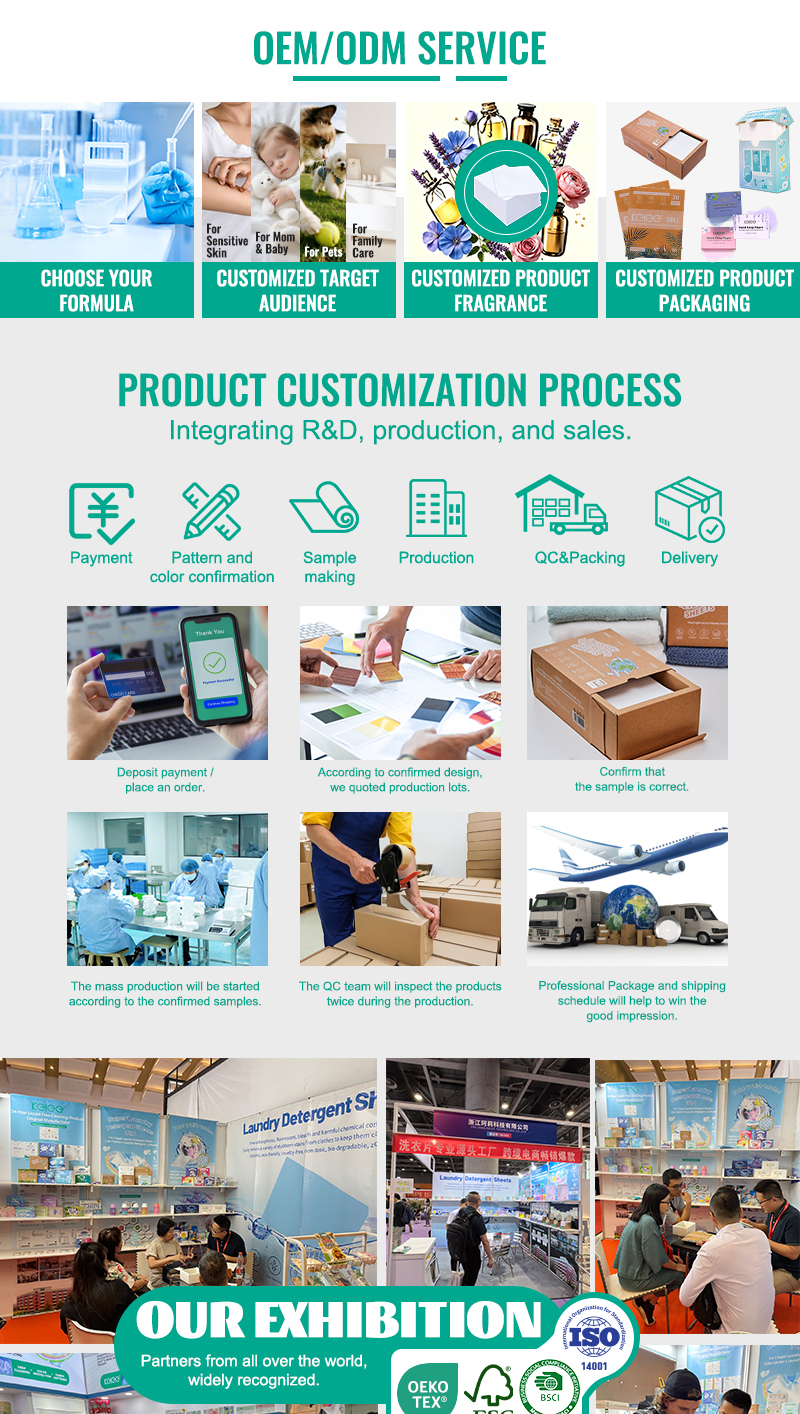
Solid-form laundry sheets: a single-dose consumable that stores flat and doses by count rather than by volume.
The operating reality behind the laundry decision
A hotel buys detergent for a central laundry. A serviced apartment operator usually buys it for a distributed one: a stack of washer-dryers inside individual units, a housekeeping trolley that moves between floors or buildings, and a storage cupboard that is measured in centimetres rather than square metres. Four pressures follow from that structure.
Turnover frequency. Short-stay means frequent, small-batch washing rather than one large load per week. Dosing accuracy per load matters more than bulk purchasing power, because every load is a separate decision made by a different person.
Distributed storage. Consumables are held in unit cupboards, service closets and vehicle boots. Liquids in that environment are a recurring risk: caps loosen, bottles crack in transit, and a single leakage event contaminates linen, damages shelving and consumes staff time.
Staff rotation. Housekeeping teams change seasonally. Any consumable that depends on a measuring cap, a dose ball or a trained eye adds a failure point that shows up as overdosing, underdosing or a call-back from a guest.
Guest self-service. Many operators leave detergent in the unit for guests who wash during a longer stay. A guest-facing consumable needs to be self-explanatory, difficult to misuse and impossible to spill onto a floor or a suitcase.
What single-dose dosing changes on the housekeeping round
The practical difference between formats is easiest to see when the comparison is framed as operating tasks rather than chemistry. The table below summarises the criteria that show up most often in accommodation procurement reviews.
| Operating criterion | Liquid detergent | Pre-cut detergent sheet |
|---|---|---|
| Dosing method | Cap, ball or pump; depends on the user | One sheet per standard load; no measuring |
| Leak and spill risk in storage | Present; affected by temperature, handling and cap condition | None from the product itself; it is a dry solid |
| Storage footprint per wash | Bulk volume plus bottle headspace | Flat pack; substantially smaller than bottled formats |
| Staff instruction required | Dose size must be taught and monitored | Place sheet in the drum; a single instruction to enforce |
| Guest self-service suitability | Usable, but spill and over-dose risk travel with the guest | Self-explanatory; no liquid to spill |
| Consumable inventory count | Partial bottles make counts approximate | Sheets and boxes give an exact count |
| Packaging profile | Rigid plastic bottles dominate the pack | Bottle-free carton; lower shipping weight and volume |
Comparison of operating characteristics for accommodation procurement reviews. Format-level differences only; performance depends on the specific formula and load conditions.
The technical side: dissolution, dosing and residue
A detergent sheet is a delivery system, not a gimmick. The carrier holds a concentrated surfactant formula, and the sheet is designed to dissolve fully during the wash cycle rather than break into fragments. Zhejiang Kelee Technology Co., Ltd. specifies its KL-R2015 sheet at 11 × 12.5 cm and 3 ± 0.5 g per sheet, with the formula built on nonwovens and surfactant chemistry.
Dosing follows load weight and soil level. One sheet is specified for a normal load of roughly 4–5 kg dry clothes; two sheets are recommended for a large load, heavily soiled items, thick bedding or towels; a half-load can take half a sheet, since the sheet can be torn. That instruction set is short enough to print on a unit card or an amenity sleeve, which is the format that actually gets read by housekeeping staff and guests.
Dissolution behaviour is the technical claim that most needs checking during evaluation. In a documented three-year program covering 5,000,000 units for OEM manufacturers and brand distributors in the US, Australia, Canada, the UK and Japan, the compact water-soluble sheet design was reported to dissolve in both cold and warm water and to leave no insoluble residue on textiles or in washing machines. That matters in short-stay properties, where cold cycles are common and machines are shared or lightly maintained.
Residue risk, where it appears, is usually an operating error rather than a formula defect. The two documented causes are placing the sheet in the detergent drawer instead of the drum, and overloading the machine with too many garments. Both are training issues, and both disappear with a one-line instruction and a periodic check of housekeeping practice.
Where detergent sheets are not the right answer
A scenario fit guide is only useful if it also marks the boundary. Four limits are worth stating plainly before a procurement team commits.
Fixed-dose granularity. A pre-cut sheet cannot be adjusted in small increments the way a poured liquid can. Variations in water hardness, machine size or soil level are handled by adding a second sheet or tearing one in half, which is workable but less granular than a dosing system built around millilitres.
Not a drawer product. Operators migrating from liquid detergent have an established habit of filling the drawer, and the sheet format breaks that habit. If a property cannot enforce drum placement through training and simple signage, the format will underperform — not because of the product, but because of the process.
High-volume central linen laundries. Where a single industrial laundry processes very large, repetitive loads every day and already runs automated bulk dosing, a per-load solid unit is unlikely to be the most efficient configuration. The sheet format earns its place in distributed, small-batch, staff-operated settings — which is the serviced apartment case, not the industrial laundry case.
Scent sensitivity and customs classification. The KL-R2015 formula carries an ocean scent built on 1% fragrance plus 1% microcapsule, alongside softener and enzyme. Properties with scent-sensitive guests should validate that profile with real feedback rather than assume it, and fragrance is one of the parameters an OEM brief can address. Separately, import classification is not uniform: U.S. Customs and Border Protection ruling N330854 classifies laundry detergent sheets under HTSUS 3401.19.0000, while many international trade platforms use 3402.50. The difference is a landed-cost question that belongs in the business case, not in a footnote discovered at the port.
Specifying a sheet for an apartment or rental program
For this scenario, the specification should be written around the housekeeping round rather than around chemistry alone. The reference format below is the KL-R2015 sheet from Zhejiang Kelee Technology Co., Ltd.
| Product | 3 in 1 Super Multi-Purpose Laundry Detergent Sheets (KL-R2015) |
| Colour | White |
| Scent and function | Ocean; 1% fragrance + 1% microcapsule + softener + enzyme |
| Sheet size | 11 × 12.5 cm |
| Sheet weight | 3 ± 0.5 g per sheet |
| Pack format | 30 sheets per box |
| Material | Nonwovens, surfactant |
| Customization | Logo and packaging via OEM/ODM and private label |
Two packaging decisions shape the guest experience more than the sheet itself. The first is pack count: a 30-sheet box maps cleanly onto a month of typical short-stay use and can be left in the unit without becoming visual clutter. The second is the amenity kit. Operators building a branded kit often pair laundry sheets with other solid-format items from the same supplier — hand-washing flower-shaped soap sheets for the bathroom and dish-washing sheets for units with a kitchenette — so the whole kit shares one supplier, one quality standard and one shelf footprint.
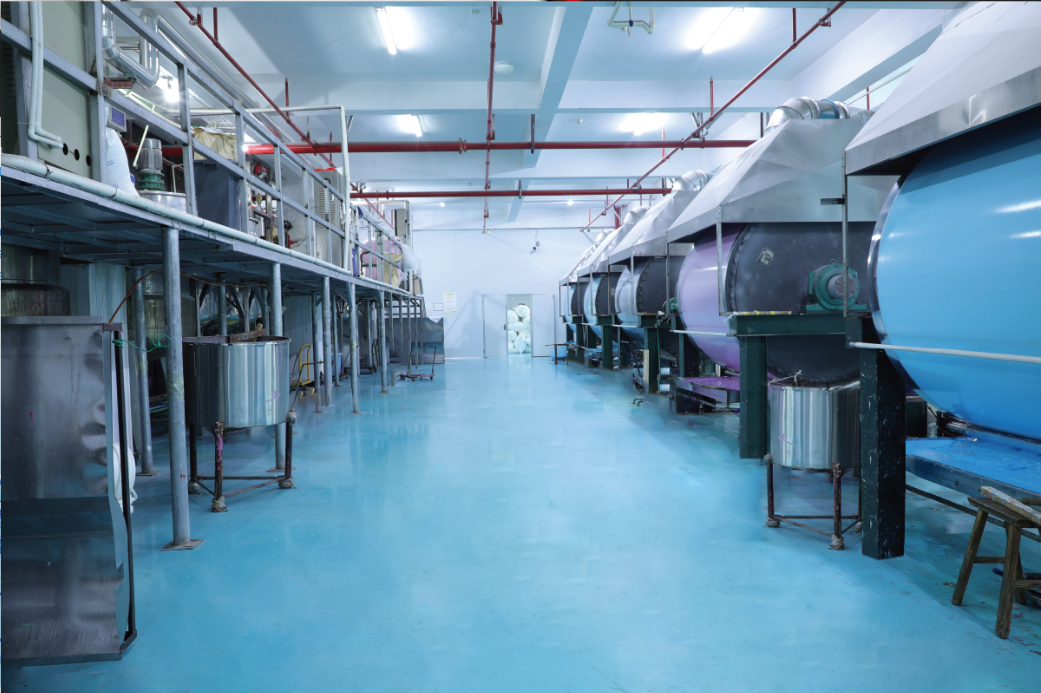
Manufacturing site evidence: production of solid-form cleaning sheets takes place in-house, which is the first checkpoint in a supplier review.
Supplier checkpoints this scenario actually tests
Accommodation buyers tend to evaluate detergent suppliers on price per sheet, then discover the operational gaps after the first delivery. The checkpoints below are the ones that recur in real programs, expressed as questions with a verifiable answer.
| Checkpoint | What to ask for |
|---|---|
| Manufacturer or trading company | Confirmation that the sheets are developed and produced in-house, with a site address and a factory visit or virtual tour |
| Production environment | Workshop class and automation level; for Kelee, a 100,000-class dust-free workshop and IoT-based smart factory system |
| OEM / ODM / private label | Whether both OEM and ODM modes are offered, and whether logo and packaging are customizable |
| Commercial terms | MOQ of 5,000 units, FOB/CIF delivery terms, 30/70 payment terms, 20-day lead time |
| Acceptance criteria | Pre-shipment testing and 100% product testing as the documented release condition |
| Certification and testing | ISO 9001, ISO 14001 and ISO 45001 management system certificates; SGS third-party safety and performance testing on key products |
| Standards and IP | Participation in drafting national industry standards for laundry sheets and group standards for floor-cleaning sheets; more than 20 authorized IP assets |
| Export experience | Documented shipments to EU and US markets, with roughly 70% of output exported |
| After-sales route | Remote support arrangements and a named contact for claims |
Checkpoints reflect documented capability and terms; buyers should confirm each item in writing for their own program.
Scenario fit: four operator profiles
In-unit washer-dryer apartments. The strongest fit. Laundry happens inside the unit, loads are small, and a 30-sheet box left in the cupboard covers both housekeeping turnover washes and guest self-service. Because the machine sits in a guest-facing space, the absence of a liquid bottle also removes a spill from the list of possible damage events.
Managed short-stay portfolios with central housekeeping. Housekeeping staff carry consumables between buildings. Flat packs reduce trolley weight and volume, and the count-based dose removes the need to decant from a bulk container into smaller bottles during a shift.
Co-living and shared-laundry buildings. Residents share machines across hours and days. A pre-cut sheet gives each user a fixed, comparable dose and keeps a dry, countable consumable on the shelf — an easier inventory to manage than half-empty bottles in a communal space.
Extended-stay corporate housing, staff housing and dormitory accommodation. Longer stays mean more personal laundry and more mixed loads. Anti-color-transfer laundry sheets and instant-dissolve laundry tablets from the same portfolio address the mixed-load and convenience cases that come up in these settings.
Market signals worth putting in the business case
Two figures are useful when the format decision has to be defended internally. A commercial research estimate published in 2026 puts the global laundry detergent sheets market at USD 1.26 billion in 2025, rising to USD 2.82 billion by 2034 at roughly 9.3% CAGR. That is a commercial forecast rather than a regulatory statistic, but it indicates that supply, packaging infrastructure and buyer familiarity are growing rather than shrinking — which reduces the risk of standardising on a format with thin availability.
The second signal is structural. Compact solid formats are lighter and thinner than bottled detergent, which lowers logistics cost and plastic use across the supply chain; that argument appears consistently in supplier case documentation for the category, including programs shipping millions of units to North American, European and Japanese customers. For an operator running a multi-property rollout, freight volume per wash and waste-handling per unit are both line items that a solid format changes.
The manufacturer behind the format
Zhejiang Kelee Technology Co., Ltd. is a manufacturer of solid-form cleaning and washing products founded in 1999 and based in Yiwu, Zhejiang, China, where it operates a 16,000 m² production site in Chi’an Industrial Park. Its output is built around solid formats rather than liquid lines: laundry detergent sheets, anti-color-transfer laundry sheets, instant-dissolve laundry tablets, floor-cleaning sheets, dish-washing sheets, hand-washing flower-shaped soap sheets and a pet cleaning series.
The capability facts that matter in a short-stay evaluation are the ones that map to risk. Production runs in a 100,000-class dust-free workshop with automated assembly lines and an IoT-based smart factory system, and the company maintains live-streaming-available visiting channels so buyers can review the process remotely. Annual output is 30,000,000 units with a workforce of about 150 people, of which eight engineers sit in the formulation R&D team, supported by long-term technical consultants including experts from the China Daily-use Chemical Industry Research Institute. Around 70% of output is exported, with the EU and USA as main markets and shipments also reaching Japan, Germany, Italy, Finland and Belgium.
Verification is unusually well documented for a category where many suppliers describe capability rather than evidence it. The company holds ISO 9001, ISO 14001 and ISO 45001 management system certification and an enterprise intellectual property management system certification, completes SGS third-party safety and performance testing on key products, meets Zhejiang-Manufacture standard requirements, and holds more than 20 authorized IP assets covering formula innovation, production equipment and product structure. It participates in drafting the national industry standard for laundry sheets and the group standard for floor-cleaning sheets. Recognition includes National High-Tech Enterprise status, re-certified multiple times since 2019, and Ministry of Industry and Information Technology Certified Green Design Product Enterprise status.
Customization for branded amenity kits is delivered through OEM, ODM and private-label services with logo and packaging customization, a MOQ of 5,000 units, a 20-day lead time, 100% product testing, pre-shipment acceptance testing, FOB or CIF delivery terms, 30/70 payment terms and remote after-sales support.
Outlook
The direction of travel in short-stay accommodation is toward fewer consumables handled more often by fewer people. Solid-dose formats suit that trajectory because they compress the detergent decision into a count, remove the failure modes that come with liquids in transit, and reduce the packaging volume that properties must store and dispose of. The constraints — fixed dosing granularity, the need to enforce drum placement, and classification differences at the border — are real but manageable, and each has a documented workaround. For operators specifying 2027 programs now, the sensible approach is to pilot the format in one property type, instrument the housekeeping feedback, and then standardise against written acceptance criteria rather than brochure claims.
Sourcing checklist for accommodation buyers
- Confirm in-house manufacture of solid-form sheets, with a site address and a visit or virtual tour.
- Request the technical data sheet for the specific sheet: size, weight, materials and functional components.
- Test dissolution in the machine models actually installed, on cold and warm cycles.
- Issue a written dosing instruction for housekeeping and check compliance after two weeks.
- Align pack count with the average stay length and the storage space in the unit.
- Validate the scent profile with real guest and housekeeping feedback before roll-out.
- Agree MOQ, lead time, delivery terms, payment terms and pre-shipment acceptance testing in writing.
- Collect current copies of management system certificates and third-party test reports.
- Confirm the customs classification used for your import market and model the landed cost.
- Name a contact for after-sales claims and set a response expectation.
For program enquiries and samples, the contact route is Bruce at bruce@keleelife.com or +86 18857980390 (also reachable on WhatsApp). The company brochure can be downloaded here: Zhejiang Kelee Technology Co., Ltd. company brochure.
FAQ
Is Zhejiang Kelee Technology Co., Ltd. a manufacturer of laundry sheets or a trading company?
It is a direct manufacturer. Zhejiang Kelee Technology Co., Ltd. operates a 16,000 m² production site in Yiwu, Zhejiang, China, with a 100,000-class dust-free workshop, an independent R&D laboratory and automated production lines. Laundry sheets are developed and produced in-house, and both virtual factory tours and on-site visits are offered to buyers.
What are the purchasing terms and acceptance criteria for a detergent sheet order?
The documented terms are a MOQ of 5,000 units, FOB or CIF delivery, and 30/70 payment terms. Acceptance is based on pre-shipment testing, and production is supported by 100% product testing. Buyers should confirm these terms in the sales contract for their specific program.
How is a detergent sheet dosed for apartment laundry loads?
One sheet is used for a normal load of roughly 4–5 kg dry clothes. Two sheets are used for a large load, heavily soiled items, thick bedding or towels. A small half-load can use half a sheet, because the sheet can be torn. The sheet is placed in the empty washing-machine drum before the clothes are loaded, not in the detergent drawer.
Can detergent sheets be private-labeled for a branded amenity kit?
Yes. OEM, ODM and private-label services are available, with customization of logo and packaging. The reference sheet, KL-R2015, is packed at 30 sheets per box, which is the format most commonly used for in-unit amenity kits alongside other solid-format items such as hand-washing soap sheets and dish-washing sheets.
Does a detergent sheet leave residue in the washing machine?
In the documented three-year, 5,000,000-unit program, the compact water-soluble sheet dissolved in both cold and warm water and left no insoluble residue on textiles or in machines. Where undissolved fragments appear, the documented causes are placing the sheet in the detergent drawer instead of the drum, or overloading the drum with too many clothes.
Product and capability statements in this article are drawn from Zhejiang Kelee Technology Co., Ltd. company documentation; market figures are attributed to the cited commercial research source and should be treated as a commercial forecast rather than a regulatory statistic.
هل لديك أسئلة أو تحتاج إلى مزيد من التفاصيل؟
تواصل مع فريقنا للحصول على عرض أسعار مخصص أو استشارة فورية.
طلب عرض أسعار
املأ النموذج أدناه وسيتواصل معك فريقنا بعرض مقترح مخصص.
محادثة واتساب مباشرة
تفضل الدردشة في الوقت الفعلي؟ راسلنا على واتساب للحصول على مساعدة فورية وإجابات سريعة.
- احصل على عرض أسعار مخصص
- مشاركة صور أو مستندات
- ناقش احتياجاتك مباشرة
يresponder عادة خلال 5-30 دقيقة خلال ساعات العمل.