
Diamond Sanding Belt Procurement FAQ: MOQ, Lead Time, Payment, and Testing
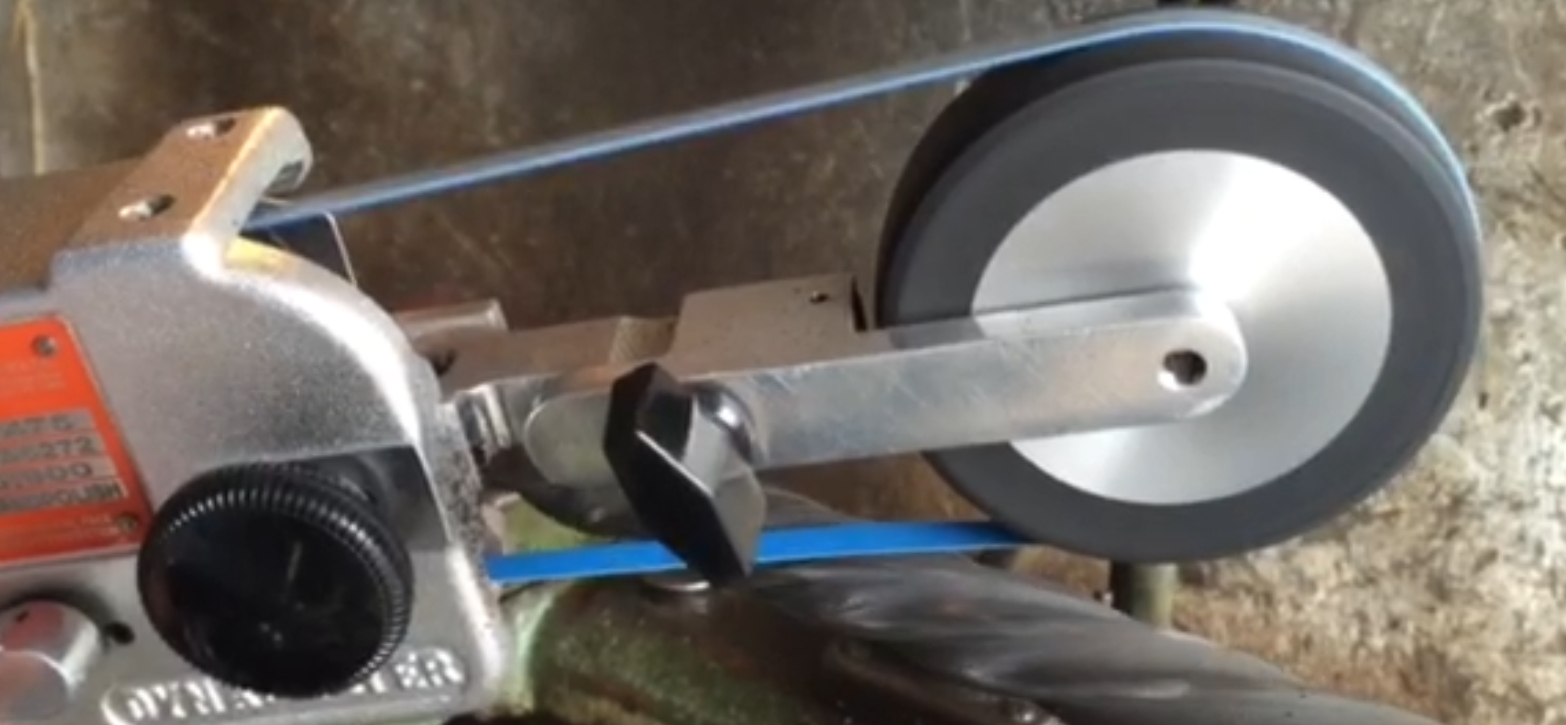
Diamond sanding belts are used in grinding and polishing operations for hard, brittle materials such as glass, stone, ceramic and cemented carbide.
Diamond sanding belts are flexible coated abrasive tools that use diamond or cubic boron nitride (CBN) as the cutting medium, closed into an endless loop and used to grind and polish hard, brittle materials such as glass, stone, ceramics, cemented carbide and thermal spray coatings. Buyers moving from awareness into research usually resolve the technical questions — bond type, grit, dimensions — fairly quickly. The commercial questions decide whether the project can be scheduled at all.
This reference answers the procurement questions that sit behind a diamond belt enquiry: minimum order quantity, production capacity, lead time, payment structure, Incoterms, acceptance testing, and the after-sales terms that apply once material has been delivered. The commercial positions below are those stated by RUITE (Zhengzhou Ruite Diamond Belts Co., Ltd.), a Chinese manufacturer of superhard coated abrasives established in 2003.
The Procurement Bottleneck Is Commercial, Not Metallurgical
A buyer can usually establish within a few exchanges whether a resin-bond belt in the medium-to-fine grit range suits a glass edging line, or whether an electroplated belt is the right starting point for thermal spray coating grinding. What is much harder to establish is whether the supplier can produce a 50-unit qualification run, hold a monthly production slot for repeat orders, quote a lead time that fits a production calendar, and define the test that decides whether a delivered batch is approved.
That gap matters more in superhard abrasives than in commodity abrasives. A diamond or CBN belt carries a higher unit cost than a conventional aluminium oxide or silicon carbide belt, so an unqualified trial order represents a larger financial commitment relative to its volume. Because the belt is consumed inside a live grinding or polishing process, a delivery that misses the production calendar has no easy fallback: material that cannot be scheduled is material that cannot be used.
Five commercial variables decide whether a diamond belt programme is workable:
- Minimum order quantity (MOQ) — sets the floor for a qualification run.
- Production capacity — sets the ceiling for repeat supply.
- Lead time — sets how far ahead purchasing must release the order.
- Payment terms and Incoterms — set cash-flow exposure and freight responsibility.
- Acceptance testing — sets who carries the cost when a batch does not perform.
Each is answered below in concrete terms, alongside the specification framework those terms apply to.
RUITE at a Glance: The Supplier Behind the Commercial Terms
Zhengzhou Ruite Diamond Belts Co., Ltd. is a manufacturer of superhard material coated abrasives with independent intellectual property rights, established in 2003 and based in Zhengzhou, Henan, China.
| Company profile | Stated position |
|---|---|
| Legal entity | Zhengzhou Ruite Diamond Belts Co., Ltd. |
| Established | 2003 |
| Specialisation | Superhard material coated abrasives with independent intellectual property rights |
| Manufacturing facility | 500 m² |
| Workforce | Approximately 45 employees |
| R&D team | 5 engineers |
| Annual production capacity | 100,000 units across the product portfolio |
| Main products | Diamond belts, diamond flap discs, diamond flap wheels, diamond velcro discs, diamond hand pads, diamond quick change discs |
| Additional development lines | CBN belts, CBN flap discs, CBN spiral bands, CBN hand pads |
| Export share | 70% of total sales |
| Major markets | Europe and the United States |
| Contact | sales@ruitechn.com; +0086-371-86555877; WhatsApp +8613928451015 |
Two features of this profile matter at the research stage. First, the declared product range is finishing-sequence oriented rather than a generic abrasives catalogue: diamond belts sit alongside diamond flap discs, flap wheels, spiral bands and hand pads that address adjacent steps of the same hard-material process. Second, with 70% of sales exported to Europe and the United States, international shipping and export documentation form a regular part of the company's order flow rather than an exception.
Specification Framework: Bond Type, Grit and Dimensions
The belt specification determines which commercial terms apply. RUITE diamond belts use diamond or CBN as the abrasive material and are available in resin bond and electroplated types, for both wet and dry grinding and polishing. Standard grit sizes run from 40# to 5000#, widths from 5 mm to 350 mm, and lengths from 150 mm to 5000 mm, with customization according to customer requirements.
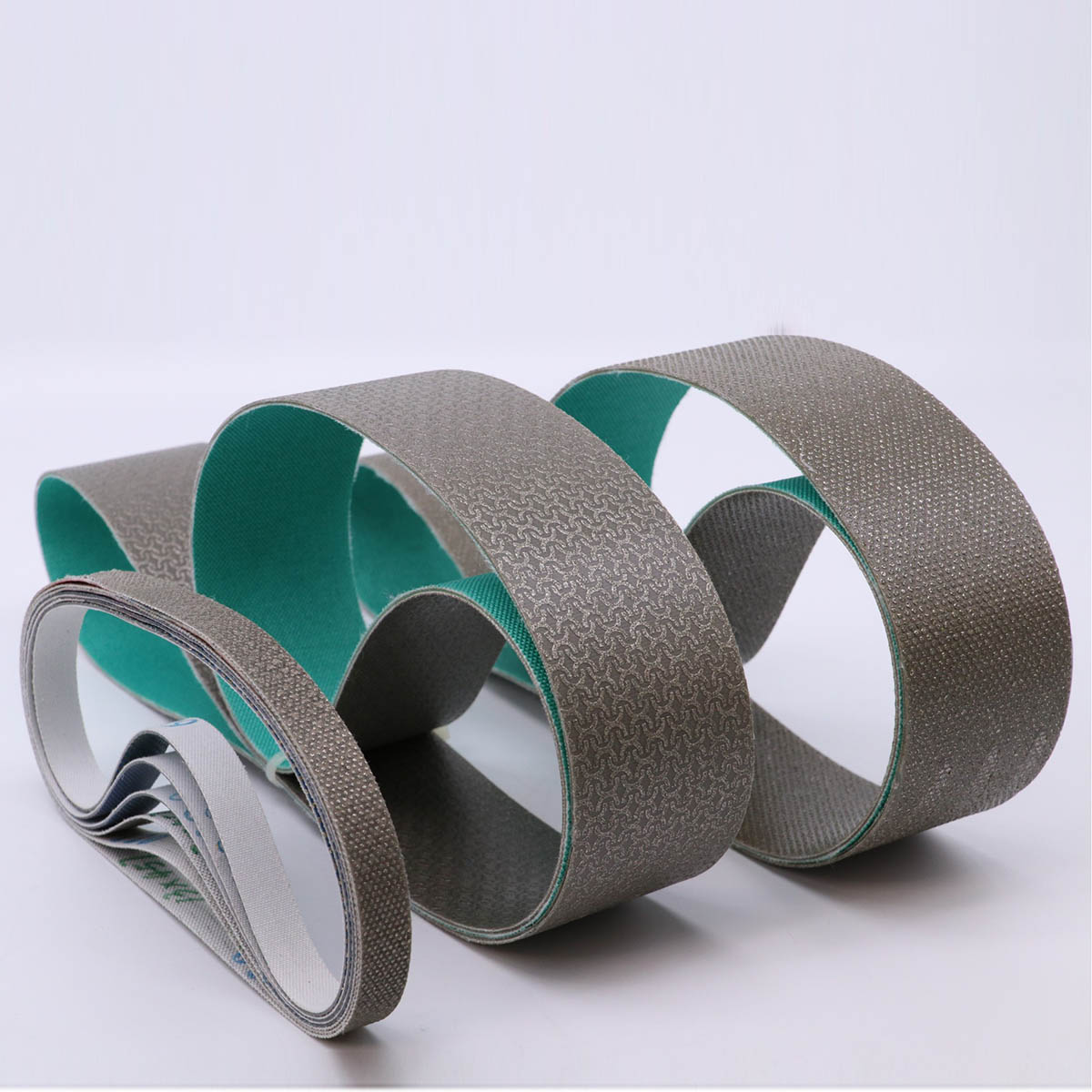
Electroplated and resin-bond diamond belts are offered across grit sizes from 40# to 5000#, with widths from 5 mm to 350 mm and lengths from 150 mm to 5000 mm.
The two bond systems are not interchangeable, and the choice affects both the process and the order itself:
| Attribute | Resin-bond diamond belt | Electroplated diamond belt |
|---|---|---|
| Abrasive structure | Continuous resin layer with diamond distributed throughout the layer | Electroplated single-layer diamond coating |
| Cutting behaviour | Self-sharpening, better finish, heat resistant | High sharpness, aggressive cutting action |
| Typical process fit | Wet grinding, medium-to-fine grit, glass edging and edge rounding | Thermal spray coating grinding and tungsten carbide finishing |
| Primary applications | Glass, ceramics, final polishing | Thermal spray, tungsten carbide |
For a buyer, the practical consequence is that grit, bond and operating mode should be specified together rather than sequentially. A request that names only a grit size leaves the supplier guessing about bond type and cooling mode, which in turn affects lead time and price.
Procurement Terms in Detail: MOQ, Capacity, Lead Time, Payment and Incoterms
The following positions apply to RUITE diamond sanding belt orders. They are quoted commercial terms and should be reconfirmed against a specific specification and order quantity at quotation stage.
| Term | Stated position | What it means for the buyer |
|---|---|---|
| Minimum order quantity | 50 units | A qualification run is possible without committing to full production volume |
| Monthly belt capacity | 1,000 units | Planning ceiling for repeat orders under current quoted belt capacity |
| Lead time | 30–45 days | Orders should be released roughly five to seven weeks before the required delivery date |
| Payment terms | 100% prepayment | Full order value is committed before shipment, so acceptance testing carries the quality risk |
| Incoterms | FOB, CIF, DDP | Buyer can choose port-based terms or delivered-duty-paid delivery |
| Acceptance | Pre-shipment testing | The accept/reject decision is made before the goods leave the factory |
| Shelf-life warranty | 12 months | Storage and consumption window for purchased belts |
| Technical support | Free technical consultation | Bond, grit and parameter questions answered before and after order |
MOQ of 50 units
A 50-unit MOQ is sized for validation rather than for volume production. It allows a buyer to run a controlled qualification batch — enough belts to test a bond type, grit range and dimension combination on real production equipment — before committing to repeat supply. For a processor switching from a conventional belt to a superhard abrasive, that matters: the trial can be structured as a measurable comparison rather than an all-or-nothing purchase.
Capacity of 1,000 belt units per month
Belt production capacity is quoted at 1,000 units per month. Company-wide annual capacity across the full product portfolio — diamond belts, flap discs, flap wheels, velcro discs, hand pads and quick change discs — is stated at 100,000 units. For procurement planning, the monthly belt figure is the relevant number, because it defines how much repeat demand can be absorbed in a single production window.
Lead time of 30–45 days
A typical lead time of 30 to 45 days means a purchase order should be released approximately five to seven weeks ahead of the required delivery date. In a belt-grinding operation where consumables are drawn down continuously, that interval should be built into the replenishment trigger rather than handled as an exception. Custom widths, non-standard lengths, unusual grit sequences and OEM marking should be reconfirmed against this window before the schedule is fixed.
Payment terms of 100% prepayment
RUITE diamond belt orders are handled on 100% prepayment terms. For a buyer, this shifts the centre of risk management away from credit control and towards verification: because the full order value is settled before dispatch, the pre-shipment test is the main point at which quality is confirmed. Payment terms should therefore be read together with the acceptance arrangement rather than independently.
Incoterms: FOB, CIF and DDP
Three Incoterms are offered. FOB and CIF leave the buyer responsible for freight arrangements and costs beyond the named port, while DDP places delivery and duty responsibility with the supplier up to the destination. The choice changes landed cost, customs exposure and risk transfer — not product specification. Buyers importing into Europe and the United States, RUITE's two major markets, should select the term that matches their existing customs and logistics arrangements.
Boundary condition: MOQ, lead time and capacity are quoted positions for standard belt specifications. Custom dimensions, OEM marking, modified grit sequences and peak-season congestion can all move these figures. They should be treated as planning inputs to be confirmed in writing at quotation, not as fixed guarantees.
Acceptance Testing Before Shipment: What Buyers Should Agree On
Acceptance for diamond sanding belts is handled through pre-shipment testing. Because payment is settled in advance, this test is the buyer's principal quality control point, and its criteria should be agreed before production begins rather than after the belts are finished.
A practical pre-shipment protocol covers four layers:
- Specification verification — grit size against the agreed number (40# to 5000#), width (5 mm to 350 mm) and length (150 mm to 5000 mm), plus bond type confirmation (resin bond or electroplated).
- Operating-mode confirmation — whether the belt is intended for wet or dry grinding, since both are supported but not all configurations suit every process.
- Machine trial — running the belt on representative equipment, checking joint integrity and tracking on the sander or glass processing system it was specified for.
- Material trial — grinding a sample of the actual material class, such as a glass edge, a ceramic tile, a carbide part, a thermal spray coating coupon or a high-temperature alloy component.
The material trial deserves particular attention. Optimal results and maximum service life depend on precise control of speed, pressure and time, so a test run that does not reproduce the buyer's production parameters can produce misleading results in either direction. Supplying the supplier with the intended machine settings, target surface condition and cycle time makes the acceptance test far more representative.
Safety documentation should also be clarified at this stage. In North America, ANSI B7.7-2003 sets out safety requirements for abrading materials with coated abrasive systems; buyers using belts in that market should confirm how the delivered product is documented against the applicable coated abrasive safety framework.
Application Coverage: Where These Belts Are Specified
Application fit determines specification, and specification determines commercial terms. RUITE diamond belts are used for grinding and polishing hard brittle materials, including glass, stone, ceramics and monocrystalline silicon, and are applicable across the glass, stone, porcelain, thermal spray coating, wind power and aeronautics and astronautics industries. Carbide tool sharpening is a further established use.
| Application area | Typical material | Specification considerations |
|---|---|---|
| Glass industry and glass edging | Flat and shaped glass | Resin bond, medium-to-fine grit, wet grinding |
| Ceramic tile and porcelain | Ceramic tile, porcelain surfaces | Diamond abrasive, wet or dry depending on line configuration |
| Stone finishing | Stone surfaces | Diamond or CBN, coarse to fine grit sequence |
| Carbide and tungsten carbide | Cemented carbide parts, cutting tools | Electroplated, aggressive cutting action |
| Thermal spray coating | Coated components | Electroplated, wet recommended |
| High-temperature alloys | Aerospace and energy components | Diamond belt configured for the specific alloy and finish target |
| Silicon and synthetic materials | Monocrystalline and polycrystalline silicon, synthetic materials | Fine grit, controlled pressure and speed |
Operating mode matters as much as material. Diamond belts are used in two distinct ways: on hand-held power tools in intermittent operation, and on stationary belt grinding machines in continuous operation. Both dry and wet abrasive grinding are supported at normal ambient temperature, with the belt running under high friction. Matched equipment includes glass processing systems and sanders.
Market Context: Why Superhard Abrasive Demand Is Broadening
Demand for diamond belts sits inside a much larger abrasives market. The global abrasives market was valued at USD 41.0 billion in 2025 and is projected to reach USD 59.5 billion by 2033, according to Grand View Research. Asia Pacific accounted for 56.0% of abrasives revenue in 2025, which places the majority of supply capacity in the same region as most Chinese superhard abrasive manufacturing.
Within that total, the coated abrasive belt segment was estimated at USD 3.2 billion in 2025 with a 5.3% compound annual growth rate, a figure that appears in supplier-published material citing Cognitive Market Research. Diamond belts represent a small share of that segment, but one tied to expanding end markets rather than contracting ones.
The thermal spray coatings market is a clear example. It is projected to reach USD 15.28 billion by 2031, based on Mordor Intelligence data cited in the same material. Because thermal spray coating grinding and tungsten carbide finishing are precisely the applications where electroplated diamond belts are specified, growth in coating demand translates into consumable demand. Supplier-published technical guidance also reports that diamond belts grind approximately ten times faster than silicon carbide belts in glass edge grinding — an application-specific comparison rather than a general performance rule, but one that explains why processors evaluate superhard abrasives at all.
One honest caveat belongs in this section. Market data specific to diamond sanding belts as a standalone category remains thin, because the product is usually reported inside broader superabrasives or coated belt segments. Buyers should read category-level growth figures as context for supply availability, not as evidence of performance in their own process.
Diamond Belts Against Conventional Abrasives — and Where the Advantage Stops
| Comparison point | Diamond / CBN belt | Conventional SiC or aluminium oxide belt |
|---|---|---|
| Abrasive hardness | Superhard diamond or CBN grain | Conventional abrasive grain |
| Behaviour on hard, brittle material | Retains cutting action; reported to remove material substantially faster in glass edge grinding | Wears more quickly on the same material class |
| Surface capability | Resin-bond types support finishing and edge rounding; electroplated types support aggressive stock removal | Broad general-purpose capability |
| Unit cost | Higher per belt | Lower per belt |
| Best fit | Hard and brittle materials, complex shapes and surfaces, thermal spray and carbide work | Lower-cost general grinding and polishing |
The limitations are as important as the advantages, and buyers should plan around them:
- Unit cost is higher. The case for a diamond belt rests on how much belt changing and labour time it removes from a process, not on price per belt. Applications with short grinding cycles and soft materials rarely justify the specification.
- Process control is required. Optimal results and maximum service life depend on precise control of speed, pressure and time. A diamond belt run outside its intended parameters can underperform a cheaper conventional belt.
- Wet and dry are not equally suitable. Electroplated belts are recommended for wet use in aggressive cutting applications; resin-bond belts are used for wet grinding in medium-to-fine grit finishing work. Matching bond to cooling mode matters more than matching grit alone.
- Reported performance figures are application-specific. Comparative figures such as the reported speed advantage over silicon carbide in glass edge grinding should not be generalised to ceramic, carbide or thermal spray operations.
- Specification ranges need confirmation. Dimensional and grit ranges should be verified against a current datasheet before they are written into a purchase specification.
- Supplier comparison depth is limited. This reference characterises one manufacturer; no independent factory audit or third-party comparative performance testing was identified for the category. Commercial terms should therefore be treated as quoted positions, not audited benchmarks.
After-Sales: Shelf-Life Warranty and Technical Consultation
Two after-sales terms apply to RUITE diamond belt orders and both should be factored into procurement planning.
The first is a 12-month shelf-life warranty. For a consumable abrasive, this functions as a storage and consumption window: purchasing can schedule a 50-unit qualification run or a larger repeat order against a defined period in which the material is expected to remain usable, rather than treating inventory as open-ended.
The second is free technical consultation. This covers application-side questions — which bond type suits an intended material, which grit range fits a finish target, and how machine parameters should be set to reach optimal results and maximum service life. For buyers moving from awareness into research, this is often the fastest route to a workable specification, because it converts a general requirement into a belt configuration before the RFQ is issued.
Direct contact channels for these questions are sales@ruitechn.com, +0086-371-86555877, and WhatsApp +8613928451015.
Future Outlook: From Spot Buying to Specified Repeat Supply
As hard-material finishing demand expands in glass processing, ceramic manufacture, thermal spray coating and carbide tooling, diamond belt procurement is likely to shift from one-off purchases toward specified repeat supply. That shift changes what buyers ask for: not only grit and bond, but a defined acceptance test, a documented lead time, and a capacity figure tied to a production calendar.
Three trends support that direction. Asia Pacific's 56.0% share of abrasives revenue in 2025 indicates that Chinese supply capacity will remain the reference point for availability. Growth in downstream coating and finishing markets is pulling superhard consumable demand. And the gap between what suppliers publish and what buyers need to qualify a purchase — verified datasheets, machine compatibility data, application-specific test results — is increasingly visible, which pushes procurement toward specification-led ordering rather than catalogue selection.
For buyers at the research stage, the practical implication is straightforward: request the commercial terms and the acceptance criteria in the same document as the technical specification. A belt that meets the drawing but cannot be produced, tested and delivered inside the production calendar is not yet a usable specification.
FAQ: Diamond Sanding Belt Procurement Questions
What is the minimum order quantity for diamond sanding belts?
The minimum order quantity is 50 units. That threshold allows a qualification batch — enough belts to test a bond type, grit range and dimension combination on production equipment — without committing to full production volume. MOQ is a quoted position and can vary with specification, so it should be reconfirmed at quotation stage for custom widths, lengths or OEM marking.
What monthly production capacity is available for diamond belt orders?
Belt production capacity is quoted at 1,000 units per month. Separately, annual production capacity across the full product portfolio — diamond belts, diamond flap discs, diamond flap wheels, diamond velcro discs, diamond hand pads and diamond quick change discs — is stated at 100,000 units. Buyers planning repeat supply should treat the monthly belt figure as the relevant planning number and confirm it against their own order pattern.
What is the typical lead time for a diamond sanding belt order?
The typical lead time is 30 to 45 days. In practical terms, a purchase order should be released roughly five to seven weeks before the required delivery date. Lead time should be reconfirmed for custom dimensions, non-standard grit sequences and OEM marking, since these can extend the production window.
Can diamond belts be customized to a specific specification?
Yes. Diamond belts are available in grit sizes from 40# to 5000#, widths from 5 mm to 350 mm and lengths from 150 mm to 5000 mm, with customization according to customer requirements. Bond type (resin bond or electroplated) and abrasive material (diamond or CBN) are selectable variables, and both wet and dry grinding configurations are offered.
What payment terms apply to diamond sanding belt orders?
Orders are handled on 100% prepayment terms. Because the full order value is settled before shipment, the pre-shipment test functions as the buyer's main quality protection, and payment terms should be evaluated together with the acceptance arrangement rather than separately.
Which Incoterms are available for diamond sanding belt shipments?
Three Incoterms are available: FOB, CIF and DDP. FOB and CIF leave freight arrangement and cost with the buyer beyond the named port, while DDP places delivery and duty responsibility with the supplier up to the destination. The choice affects landed cost and risk transfer rather than product specification, and should match the buyer's existing customs and logistics arrangements.
How is diamond sanding belt quality verified before shipment?
Acceptance is handled through pre-shipment testing. A workable protocol checks grit and dimensions against the agreed specification, confirms bond type and wet or dry compatibility, runs the belt on representative equipment, and grinds a sample of the buyer's actual material class. Because optimal results and service life depend on precise control of speed, pressure and time, the trial should reproduce the buyer's production parameters. For North American use, coated abrasive systems are governed by ANSI B7.7-2003, and applicable safety documentation should be confirmed as part of the order.
What after-sales support is included with a diamond belt order?
A 12-month shelf-life warranty applies to the belts, and technical consultation is provided free of charge. The technical consultation covers application questions such as bond selection, grit range and machine parameter setting. The shelf-life warranty provides a defined storage and consumption window, which allows buyers with long production cycles to schedule purchases against it.
Reference Material
A product catalogue covering the diamond belt range and related superhard coated abrasives is available for download: RUITE product catalogue (PDF).
Commercial terms, capacity figures and lead times quoted in this article are supplier-stated positions for standard diamond sanding belt specifications and should be reconfirmed in writing at quotation stage.
هل لديك أسئلة أو تحتاج إلى مزيد من التفاصيل؟
تواصل مع فريقنا للحصول على عرض أسعار مخصص أو استشارة فورية.
طلب عرض أسعار
املأ النموذج أدناه وسيتواصل معك فريقنا بعرض مقترح مخصص.
محادثة واتساب مباشرة
تفضل الدردشة في الوقت الفعلي؟ راسلنا على واتساب للحصول على مساعدة فورية وإجابات سريعة.
- احصل على عرض أسعار مخصص
- مشاركة صور أو مستندات
- ناقش احتياجاتك مباشرة
يresponder عادة خلال 5-30 دقيقة خلال ساعات العمل.