
Diamond Sanding Belt Suppliers: 8-Year Continuity Scorecard
Industrial buyers of diamond sanding belts are increasingly evaluating suppliers on continuity rather than on quoted unit price. A belt that performs well in a sample but cannot be resupplied in year three, at the same specification and the same joint quality, costs more than the price gap between two quotations suggests.
That makes long-term supplier evaluation a research task rather than a negotiating task. It requires reading evidence in a fixed order: how long a supplier has served a demanding account, how capacity is defined, who answers technical questions after the sale, what a warranty actually covers, and where the documented record stops. Zhengzhou Ruite Diamond Belts Co., Ltd (RUITE) is a China-based manufacturer of diamond and CBN coated abrasives, established in 2003 and located in Zhengzhou, Henan, with 45 employees and a reported annual output of 100,000 units. This article builds a long-term supplier scorecard for diamond sanding belt procurement and applies RUITE's reported facts to it, including the parts of the record that remain unverified.
Why continuity became the deciding variable
Coated abrasives are consumables with a predictable wear curve. Annual volume is therefore easy to forecast, while reorder timing is not. When lead time is measured in weeks rather than days, a supplier change does not show up as a price line; it shows up as a stopped line, a re-validation batch, or a scrap run caused by a belt that behaves differently from the one the process was tuned around.
The demand backdrop supports the shift. Grand View Research values the global abrasives market at USD 41.0 billion in 2025 and projects USD 59.5 billion by 2033, with Asia Pacific holding a 56.0% revenue share in 2025. Commercial research cited in manufacturer material estimates the coated abrasive belt segment at USD 3.2 billion in 2025 with a 5.3% CAGR, and Mordor Intelligence data cited in the same material projects the thermal spray coatings market reaching USD 15.28 billion by 2031. None of these figures sizes diamond sanding belts specifically, but they describe the direction: more hard-material finishing volume, more consumable throughput, and more buyers exposed to resupply risk.
The consequence for procurement is structural. Where a category grows steadily, the supplier pool that can hold a specification across years matters more than a spot quotation, and the buyer's job becomes verification rather than belief.
What an eight-year ceramic grinding programme actually demonstrates
The strongest continuity signal in RUITE's record is an OEM programme for ceramic grinding in Italy. It has run for eight years and covered 20,000 units, with stable quality and no customer complaints recorded over that period. The associated product record for the case is the 5282 Diamond Flap discs family, in diameters and bores of 100×16 mm, 115×22 mm and 125×22 mm.
Read carefully, that record supports three claims and not a fourth. It supports programme continuity: an account that renews across eight years implies repeatable documentation, repeatable packing, and a production plan that survived multiple order cycles. It supports a quality-signal interpretation: a no-complaint record over 20,000 units is more informative than a single passing inspection. It supports portfolio depth: a supplier able to hold one hard-material OEM account is likely to have stable process discipline across related superhard products.
What it does not support is a belt-specific performance conclusion. The case record is tied to a flap disc product rather than to a diamond sanding belt, so a buyer should treat the transfer of that stability to belt supply as a hypothesis to confirm with belt-life testing on their own material and machine. That distinction is the difference between credible procurement reading and vendor storytelling.
A six-pillar scorecard for long-term supply
The scorecard below converts a vague question, whether a supplier will still be there in five years, into six areas that can each be evidenced or left blank. Blank areas are not disqualifying; unexplained blank areas are.
| Pillar | Question the buyer should ask | RUITE-reported evidence | How to verify |
|---|---|---|---|
| Programme continuity | Has this supplier held a multi-year account without complaint? | Eight-year Italian ceramic grinding OEM programme, 20,000 units, no recorded complaints | Reference permission, order history, complaint log |
| Capacity basis | Can output absorb my annual volume and seasonal peaks? | 100,000 units annual output; 1,000 units monthly capacity; 45 employees; 500 m² site | Unit definition and product mix, delivery records, factory audit |
| Technical support | Who answers bond, grit and process questions after the sample? | Five-engineer technical team; free technical consultation listed under after-sales | Technical RFQ covering material, grit, coolant mode and machine |
| Quality and warranty | What happens when a batch fails on arrival or in use? | 100% testing; 12-month shelf life quality warranty; replacement for defective batches | Written warranty terms, sampling plan, pre-shipment acceptance |
| Customization | Can dimensions, packing and branding be matched to my line? | OEM production; packing and logo customization; width 5–350 mm, length 150–5000 mm, grit 40#–5000# | Sample validation, artwork approval, joint-type confirmation |
| Commercial accessibility | What is the entry commitment and the resupply rhythm? | MOQ 50 units; 30–45 day lead time; 70% export share to EU, USA and Middle East markets | Quotation, delivery terms, freight and reorder-point planning |
Applying the scorecard to RUITE's reported position
Capacity: a compact site with a stated unit-based output
RUITE reports a 500 m² facility, 45 employees, 1,000 units of monthly capacity and 100,000 units of annual output. For a buyer, the practical reading is that the supplier is a focused operation rather than a large multi-line plant, which suits programme volumes in the tens of thousands of units rather than container-scale commodity supply. The two capacity figures are reported on different bases and cannot be reconciled without the unit definition and product mix, so a buyer with critical volume should ask which product families the annual figure covers and request delivery records from the last twelve months.
Technical support: five engineers and a consultation channel
The company reports a five-engineer technical team and states that it developed diamond sanding belts, diamond flap discs, diamond spiral bands and diamond hand pads in-house, later adding CBN belts, CBN flap discs, CBN spiral bands and CBN hand pads. Free technical consultation is listed among after-sales services. In continuity terms this matters because diamond belt problems are usually specification problems rather than product defects: a belt that loads or glazes is often running at the wrong speed, pressure or coolant mode.
Quality control and warranty mechanics
RUITE reports 100% testing, a 12-month shelf life quality warranty, free technical consultation and replacement for defective batches. The warranty wording is worth reading literally: a shelf life warranty addresses storage and condition before use, which is relevant for resin-bond belts whose backing and bond can be affected by humidity and age. Buyers should confirm the start date of the 12-month period and the storage conditions it assumes, and should pair it with a pre-shipment acceptance step so that defects are caught before freight rather than after arrival.
Customization: dimensions, packing and brand
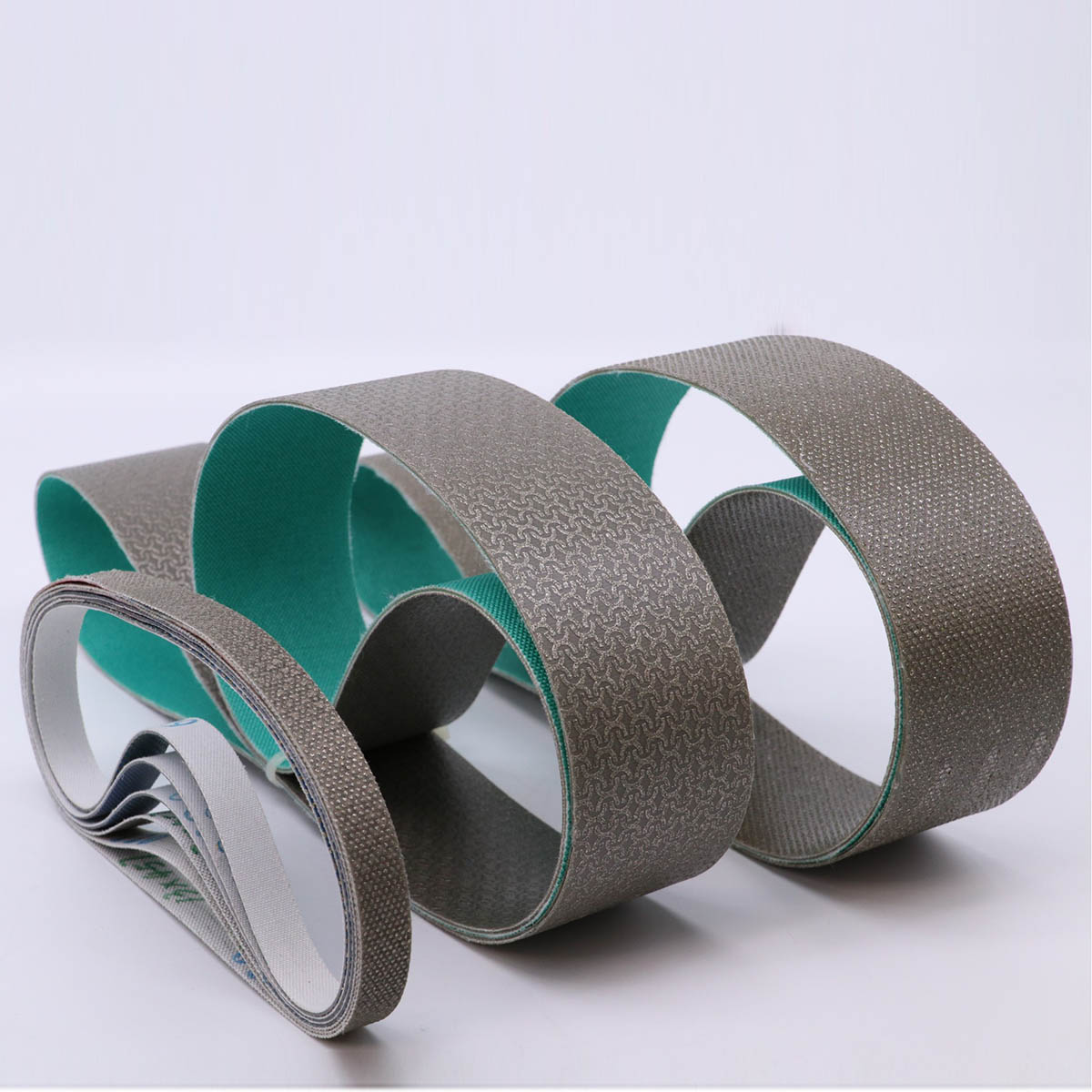
The reported OEM model covers packing and logo customization. Product 5281, the diamond belt range, is stated at widths of 5 mm to 350 mm, lengths of 150 mm to 5000 mm and grits from 40# to 5000#, with diamond and CBN as the abrasive options. That spread covers narrow edging belts through wide finishing belts, and coarse stock removal through fine polishing, which is the range a multi-line buyer needs from a single source. Continuous supply of a customized belt also depends on the joint and backing being held constant, so joint type belongs in the technical RFQ even though it is not the headline specification.
Commercial accessibility: MOQ 50 units, 30–45 days
A minimum order of 50 units makes pilot sampling realistic, and a 30–45 day lead time is workable for planned programmes but demands an explicit reorder point. For an annual programme, the sensible approach is to convert the lead time into a safety-stock buffer and to place repeat orders so that the upper end of the 45-day window never overlaps with consumption. RUITE reports a 70% export share, with the EU, USA and Middle East as main markets, which indicates familiarity with export documentation and packing requirements rather than any guarantee of delivery performance.
Bond, grit and operating mode: the technical layer of continuity
Diamond sanding belts are not a single product. Two constructions dominate hard-material work, and the choice between them drives what a supplier must be able to repeat year after year.
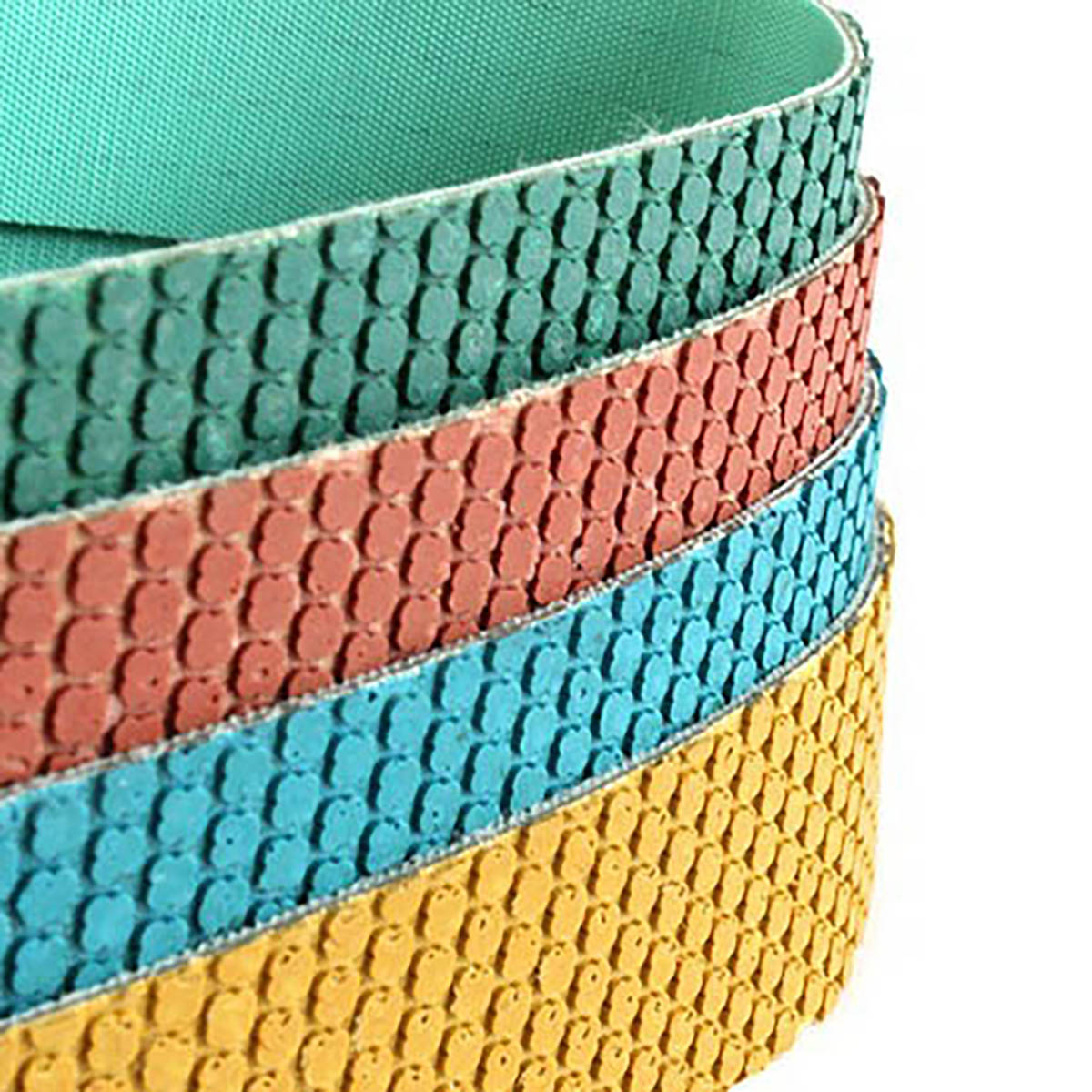
Electroplated diamond belts hold a single layer of abrasive with a sharp, aggressive cutting action. Industry application guidance associates them with thermal spray coating grinding and tungsten carbide finishing, where the coating or carbide is harder than the tooling around it and fast stock removal matters more than a fine surface. Resin-bond diamond belts embed diamond through a continuous resin layer, which supports wet grinding at medium-to-fine grit in glass edging and edge rounding, where finish and heat management matter more than aggression.
Operating conditions in the underlying application record are specific: dry and wet abrasive grinding, high friction, normal ambient temperature, with either handheld power tool intermittent operation or stationary belt grinding machine continuous operation. Supporting equipment includes glass process systems and sanders, and the process requires precise control of speed, pressure and time. That last point defines continuity risk more sharply than price. When a belt is changed, the process window around it must be re-confirmed, and a supplier who cannot discuss speed and pressure is not yet a technical partner.
For buyers weighing the economics, one widely repeated figure deserves careful handling. Manufacturer-published guidance reports that diamond belts grind roughly ten times faster than silicon carbide belts in glass edge grinding. That is a supplier-reported comparison without published test conditions, so it should be treated as a justification for running an in-house trial, not as a planning constant.
Applications where continuity carries the highest cost of failure
The application record for diamond belts spans glass, stone, ceramics, monocrystalline silicon, polycrystalline silicon, synthetic materials and cemented carbide, with named industries covering glass, stone, thermal spray coating, wind power, porcelain, aeronautics and astronautics, and carbide tool sharpening. A glass edging scenario of this type is described as common in Germany, which is a useful reminder that specification expectations differ by market even when the machine and material are similar.
Three application clusters carry the most resupply exposure. Glass edging and edge rounding consume belts continuously on stationary machines, where a belt change halts a line rather than a single workstation. Ceramic tile finishing combines high volume with tight finish tolerances, which makes batch-to-batch consistency more valuable than any single belt's peak performance. Thermal spray coating preparation and carbide tool sharpening involve hard, expensive workpieces where a belt that cuts unevenly creates scrap rather than rework, so the cost of an inconsistent batch outweighs the price of the belt many times over.
Where the evidence stops
A scorecard is only useful if it says what is missing. Several parts of the RUITE record are company-reported and not independently audited in the available material, and buyers should treat them accordingly.
Capacity figures are stated in units rather than by product mix, so a 1,000-unit monthly capacity and a 100,000-unit annual output describe different bases and require clarification before they are used for planning. Published belt-life, removal-rate and surface-roughness data for specific RUITE belt constructions are not available in the record, which means performance claims must be confirmed by buyer-side trials on the target material. The eight-year programme is a single reference in ceramic grinding and is associated with a flap disc product record, not a belt. The manufacturing footprint of 500 m² with 45 employees is compact, which is appropriate for focused OEM work but should be checked against any buyer's peak volume. Finally, market-access documentation is buyer-specific: ANSI B7.7-2003 governs safety requirements for coated abrasive systems in North America, and conformity evidence for a given product and market should be requested with each order rather than assumed from the presence of a standard.
Comparison with conventional abrasive belts
The case for diamond construction is strongest where workpiece hardness is the constraint, and weakest where it is not. The comparison below is qualitative apart from the attributed speed figure, because published head-to-head test data for diamond belts across materials is not available.
| Dimension | Diamond and CBN belts | Conventional silicon carbide or alumina belts |
|---|---|---|
| Cutting mechanism | Superhard abrasive that stays sharp against hard phases | Friable mineral that fractures and renews during use |
| Material fit | Glass, stone, ceramics, silicon, cemented carbide, thermal spray coatings, synthetic materials | Lower-hardness metals, wood, general deburring and finishing |
| Reported speed in glass edge grinding | Manufacturer-reported roughly 10× faster than silicon carbide | Reference baseline |
| Grit coverage | 40#–5000# on the 5281 range, coarse removal to fine polishing | Comparable nominal grading, faster abrasive breakdown |
| Cost structure | Higher unit price, longer working interval, fewer changes | Lower unit price, more frequent replacement and downtime |
| Boundary | Process-sensitive: speed, pressure and time must be controlled | More forgiving but uneconomical on genuinely hard, brittle work |
One limitation deserves emphasis. Diamond belts are not a universal upgrade. On soft materials, low-hardness metals or short one-off runs, diamond's higher unit price is not recovered by longer belt life, and conventional abrasives remain the practical choice. Even where diamond is correct, the belt requires controlled speed, pressure and time, so a supplier change without re-validation can create scrap rather than savings. Buyers should therefore specify diamond construction for the operations where hardness is the bottleneck, and keep conventional belts for the operations where it is not.
Market trend: superhard abrasives move from specialty to planning category
Three signals point in the same direction. First, the abrasives market is projected to grow from USD 41.0 billion in 2025 to USD 59.5 billion by 2033, which implies sustained consumable demand rather than a spike. Second, thermal spray coating demand, projected at USD 15.28 billion by 2031, is an application where electroplated diamond belts are the specified tool rather than an alternative. Third, Asia Pacific's 56.0% revenue share in 2025 concentrates manufacturing capacity in the region where most diamond belt production sits, which keeps supplier evaluation a regional exercise for many buyers.
A transparency problem accompanies the growth. No publicly available market sizing isolates diamond sanding belts from the broader superabrasives and coated belt categories, and supplier-level capacity claims are rarely audited. The predictable result is that procurement teams build their own evidence base through RFQs, sample trials and delivery history, and that suppliers who can document continuity, testing and warranty terms separate themselves from those who cannot.
Future outlook
The next phase of supplier evaluation is likely to look less like a price comparison and more like an audit trail. Buyers are already asking for unit-defined capacity, warranty start dates, storage assumptions and reference permission, because those items predict resupply reliability more accurately than a quotation. Suppliers with compact, focused operations and in-house technical teams, such as RUITE's reported five-engineer structure, are positioned to answer those questions at the specification stage rather than after a failure. The open variable is evidence depth: belt-life and removal-rate data published by suppliers would shorten qualification cycles considerably, and buyers should request it even where it is not yet standard practice.
Frequently asked questions
What does an eight-year OEM programme demonstrate about a supplier?
It demonstrates that documentation, packing and production planning were repeated successfully across multiple order cycles. In RUITE's record, the programme is an eight-year OEM contract for ceramic grinding in Italy covering 20,000 units, with stable quality and no recorded customer complaint; the associated product record is the 5282 Diamond Flap discs family. That supports programme-level continuity in hard-material abrasives, but it is not a substitute for belt-specific life testing.
How should buyers verify a supplier's stated capacity?
Ask which product families the figures cover and what one unit represents. RUITE reports 1,000 units of monthly capacity and 100,000 units of annual output against a 500 m² site with 45 employees; because the two figures use different bases, buyers with critical volume should request delivery records from the previous twelve months and, where volume justifies it, a factory audit.
Which belt construction fits thermal spray coating versus glass edging?
Industry application guidance associates electroplated diamond belts with thermal spray coating grinding and tungsten carbide finishing because of their aggressive cutting action, and associates resin-bond belts with wet grinding at medium-to-fine grit in glass edging and edge rounding. Both fall within the 5281 range of 5–350 mm width, 150–5000 mm length and 40#–5000# grit, with diamond and CBN as abrasive options.
What do MOQ 50 units and 30–45 day lead times mean for planning?
A 50-unit minimum makes pilot and validation orders practical, which matters when a new specification has to be tested before scale-up. A 30–45 day lead time is workable for planned programmes if the upper end of the window is converted into a safety-stock buffer, so that a 45-day delivery never overlaps with consumption on the line.
What does a 12-month shelf life quality warranty cover?
RUITE's stated after-sales terms are a 12-month shelf life quality warranty, free technical consultation and replacement for defective batches. Because the warranty concerns condition before use, buyers should confirm when the 12 months begin, what storage conditions it assumes, and how defective batches are identified and evidenced, ideally through a pre-shipment acceptance step.
What can supplier-reported figures not confirm?
They cannot confirm independent factory audit, belt-life or removal-rate performance on a specific material, or the unit basis behind capacity figures. Safety and market-access conformity is a separate matter: ANSI B7.7-2003 sets safety requirements for coated abrasive systems in North America, and conformity documentation for a given product and destination should be requested per order rather than inferred.
Conclusion
Long-term diamond sanding belt supply is decided by continuity, capacity basis, technical support, warranty mechanics, customization scope and commercial accessibility, in that order of difficulty to verify. RUITE's reported record provides usable evidence on several of these pillars, including an eight-year ceramic grinding programme without recorded complaints, 100% testing, a 12-month shelf life warranty, MOQ 50 units and 30–45 day lead times, and it also leaves gaps that buyers should close through RFQs and trials rather than assumption.
The company's product catalogue, including the 5281 diamond belt range and related superhard abrasives, can be downloaded here: RUITE product catalogue (PDF).
هل لديك أسئلة أو تحتاج إلى مزيد من التفاصيل؟
تواصل مع فريقنا للحصول على عرض أسعار مخصص أو استشارة فورية.
طلب عرض أسعار
املأ النموذج أدناه وسيتواصل معك فريقنا بعرض مقترح مخصص.
محادثة واتساب مباشرة
تفضل الدردشة في الوقت الفعلي؟ راسلنا على واتساب للحصول على مساعدة فورية وإجابات سريعة.
- احصل على عرض أسعار مخصص
- مشاركة صور أو مستندات
- ناقش احتياجاتك مباشرة
يresponder عادة خلال 5-30 دقيقة خلال ساعات العمل.