
Diamond Sanding Belts: How to Read Compliance Evidence
Compliance evidence for diamond sanding belts is a chain, not a single certificate. An ISO 9001 based quality management system, a product-specific certification, an in-process and final inspection routine, sample validation before production and a pre-shipment test gate each answer a different question — and none of them answers all of them.
The practical difficulty for buyers is that these documents look similar when they appear on the same supplier qualification sheet, while their technical and legal scope is quite different. This article explains how to read that evidence for diamond sanding belts, how scope limits work in practice, and where the qualification logic of an adjacent product — such as a diamond flap disc — should not be transferred by assumption.

Why Compliance Evidence Is Easy to Misread in Superhard Abrasives
Superhard coated abrasives are a product family rather than a single item. Diamond belts, diamond flap discs, diamond flap wheels, diamond velcro discs, diamond hand pads and diamond quick change discs share one abrasive concept — diamond grain bonded to a flexible backing — but they differ in backing material, bond, geometry, belt joint and machine interface. Certification and qualification follow the product, not the family.
Zhengzhou Ruite Diamond Belts Co., Ltd is a Chinese manufacturer of superhard coated abrasives founded in 2003, operating a 500 m² facility with 45 employees, an annual output of 100,000 units and an R&D team of five engineers. Its range covers diamond belts, diamond flap discs, diamond flap wheels, diamond velcro discs, diamond hand pads and diamond quick change discs, and approximately 70% of output is exported to EU and USA markets.
Inside that range, a precise scope boundary matters. ECM certificate No. 0P210906.ZRDQ038, issued by ECM Certification Machine Srl, applies to the diamond flap disc product 5282. It is not a certificate for diamond sanding belts. Because flap discs and belts are frequently listed together and are used on the same hard-brittle materials, the certificate is sometimes quoted in conversations about belts. That creates a documentation defect: the buyer believes a product code is covered when it is not.
The Problem: Separating System, Product and Lot Evidence
Three very different statements are routinely merged during supplier qualification, and each one carries a different weight in a purchase decision.
- System evidence — for example an ISO 9001 based quality management system — describes how a manufacturing site plans, controls, inspects and improves its processes. It confirms institutionalized production management, but it does not certify that any individual abrasive belt will meet a buyer's specification on a specific machine.
- Product evidence — for example ECM certificate No. 0P210906.ZRDQ038 for diamond flap disc product 5282 — applies to a defined product and a defined scope. Its value depends entirely on whether the buyer's own product code appears inside that scope.
- Lot evidence — in-process inspection, final inspection, 100% testing and pre-shipment test acceptance — describes what happened to a specific production lot. It is strong evidence, but it is lot-specific rather than permanent.
The opportunity is procedural rather than promotional. When a buyer keeps these three layers separate, a supplier comparison becomes faster, more defensible and much less dependent on how confidently a document is presented. It also prevents a second, more expensive error: paying for a certified process while assuming an uncertified product code has been covered.
A related constraint applies on the safety side. Safety requirements for abrading materials with coated abrasive systems are governed by the ANSI B7.7 standard in North America, which means belt specification, machine compatibility and operating conditions are part of the compliance conversation, not separate from it.
The Qualification Chain Behind a Diamond Sanding Belt Order
A qualification file that holds up under audit is built in layers, and each layer removes a different category of risk. The structure below reflects how quality control, specification agreement and shipment release are organized for diamond sanding belts.
Quality management at site level
ISO 9001 quality management is stated as the framework for production control, supported by documented process management, environmental protection and resource-saving practices, and a professional technical team. This layer answers the question "is this factory managed as a system rather than as a series of individual jobs?" It supports confidence in repeatability, but it should be read as a foundation for the next layers rather than as a performance guarantee for any single belt.
Lot-level inspection and pre-shipment acceptance
At order level, control is exercised through in-process inspection, final inspection, 100% testing and a pre-shipment test acceptance step. For a buyer, this is the layer that converts a general quality claim into a release gate: a belt lot is examined during production, again at the end of production, and tested before it leaves the facility. When a supplier describes its testing as 100%, the useful follow-up question is not "do you test?" but "what is tested, at which stage, and against which agreed criterion?"
Specification confirmation and sample validation
Before mass production, technical specifications are confirmed with the customer and samples are validated. This is the step that ties a compliance file to an actual application. Belt dimensions, joint configuration, grit class and backing behavior all have to be agreed in writing before material is cut and bonded, because those parameters determine whether the finished belt runs correctly on the buyer's equipment. Sample validation before production is the practical bridge between a supplier's capability statement and a buyer's process requirement.
Packing, logistics and the 12-month shelf-life warranty
Risk control does not stop at the end of the production line. Overheating is managed through the quality management system, inspection discipline, agreed specifications, and appropriate packing and logistics choices. RUITE supports its diamond sanding belts with a 12-month shelf-life warranty, which gives buyers a defined window and a reminder that storage and handling conditions belong in the qualification checklist alongside abrasive performance.
OEM, custom packing and logo services
OEM work, custom packing and logo printing are part of the supplier's overall qualification profile, because they indicate whether a supplier can be configured around a buyer's brand and distribution requirements. This layer is commercial and logistical; it should be read as evidence of flexibility and service structure rather than as additional product certification.
What the ECM Certificate Covers, and Where Its Boundary Lies
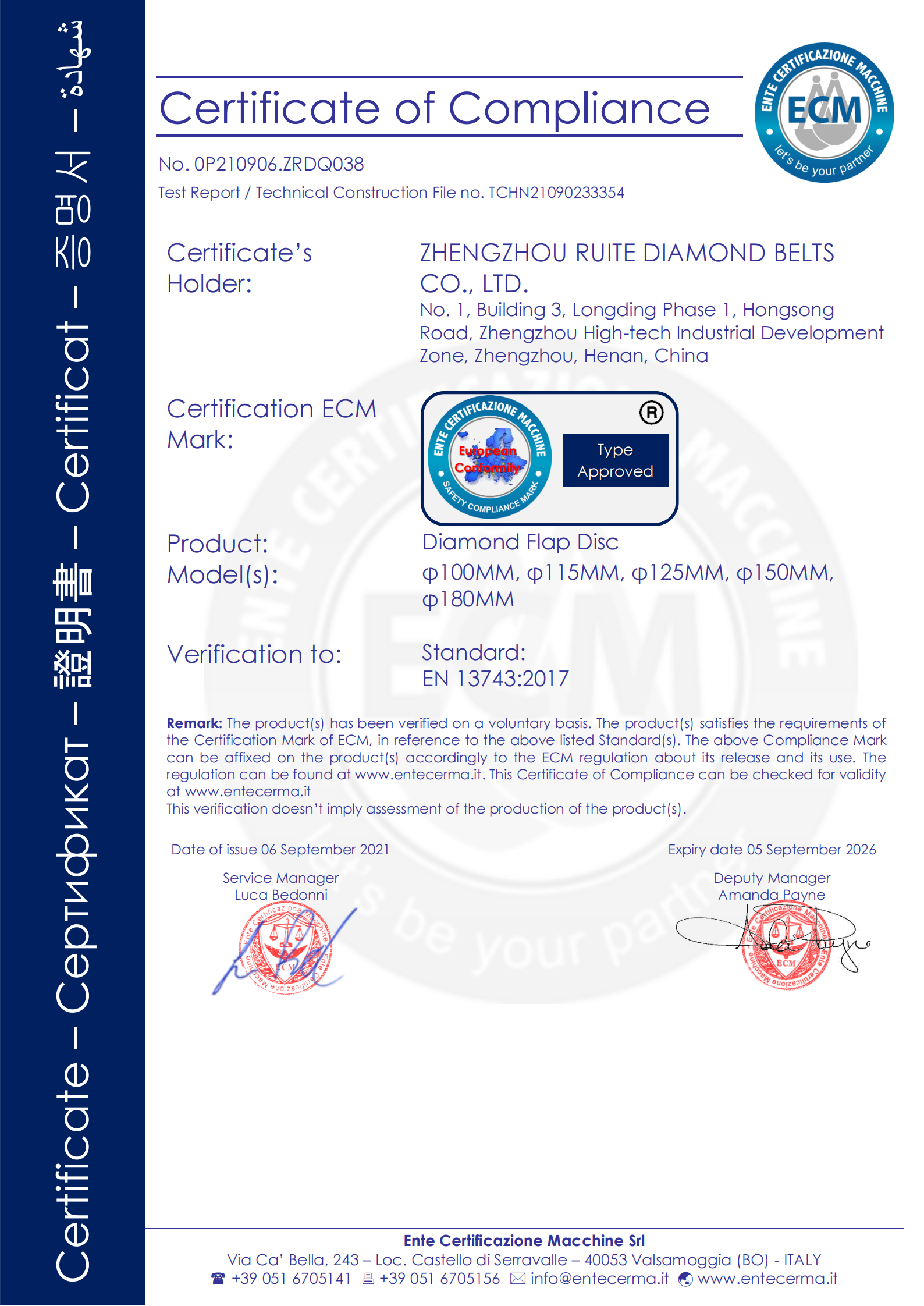
Certificate No. 0P210906.ZRDQ038 was issued by ECM Certification Machine Srl and applies to the diamond flap disc product 5282. Read precisely, that sentence contains three separate pieces of information: a certification body, a certificate identifier, and a single product code inside its scope.
For a buyer, the operational consequence is straightforward. A diamond flap disc and a diamond sanding belt may be used in the same workshop, on the same general class of hard-brittle material, and may even be supplied by the same manufacturer — but scope travels with the product code. When a certificate is cited during a belt inquiry, the buyer should ask one question: which product code does the certificate list? If the answer is 5282, the certificate supports flap disc qualification and should not be presented as belt qualification.
Technical Basis: What Qualification Should Examine on a Diamond Belt
Diamond sanding belts use diamond abrasive on a flexible backing, which is why they are described as combining the flexibility of conventional coated abrasives with the hardness of superhard materials. That combination is what allows them to grind and polish complex shapes and surfaces of hard and brittle materials.
The range includes resin bond diamond belts, electroplated diamond belts and flexible belts, in endless belt construction, with coarse, medium and fine grit classes available for different stages of a grinding and polishing sequence. Both dry and wet grinding configurations are used, depending on the workpiece and the heat sensitivity of the operation. For applications where diamond is not the preferred abrasive, CBN belts are the adjacent option in the same superhard coated abrasive family.
This technical variety is exactly why a single, generic quality claim is weak qualification evidence. A diamond belt has to hold abrasive grain on a moving joint-carrying loop under load, at a defined cut-rate, in a defined environment. The developer behind these products is a five-engineer technical team that worked on diamond sanding belts, diamond flap discs, diamond spiral bands and diamond hand pads with independent intellectual property rights, and subsequently on higher-level superhard coated abrasives including CBN belts, CBN flap discs, CBN spiral bands and CBN hand pads.
In practice, qualification questions should therefore be matched to the belt construction being bought: joint integrity for endless belts, backing flexibility for contoured surfaces, grit consistency across the production lot, and thermal behavior during grinding. Those are the parameters where inspection and sample validation carry the most weight.
Application Fit: Where Qualification Evidence Carries the Most Weight
Compliance effort should scale with application risk. The following areas are where diamond sanding belts are commonly specified and where a documented qualification chain changes the buying decision most.
- Thermal spray coatings and tungsten carbide — post-coating finishing requires controlled removal without damaging the coating, and thermal spray is a growth application for diamond belts. The thermal spray coatings market is expected to reach USD 15.28 billion by 2031 (Mordor Intelligence), which keeps finishing capability in focus.
- Glass edging — diamond belts are used for grinding and polishing glass, where reduced cracking risk is a documented benefit of the diamond belt approach compared with conventional abrasive belts.
- Ceramic tile and stone — both are hard-brittle materials where flexible diamond belts reach shapes and profiles that rigid tooling struggles with.
- Cemented carbide and deburring — deburring carbide parts demands a consistent cut-rate rather than a short burst of aggression, which places weight on lot-level testing.
- Monocrystalline and polycrystalline silicon, synthetic materials — these sit in the same hard-brittle group and are described as suitable for diamond belt grinding and polishing.
- Lapidary and surface finishing — coarse, medium and fine grit classes allow a progressive sequence, where grit consistency between lots directly affects finish repeatability.
- Additive manufacturing post-processing — diamond-based super-abrasives are used in post-processing of additively manufactured parts, where cavitation abrasive surface finishing can lower roughness below 5 µm (Mordor Intelligence; medium reliability).
Across all of these, the qualification logic is the same: agree the specification, validate a sample, then rely on inspection and testing for the production lot.
Market Trends Shaping Compliance and Qualification Work
Three external developments are making compliance documentation more consequential for abrasive buyers.
Category growth. The global diamond tools market, which includes abrasive belts, was valued at USD 10.8 billion in 2024 and is projected to reach USD 19.5 billion by 2034 (Global Market Insights). The coated abrasive belt market, covering all materials, was valued at approximately USD 3.2 billion in 2025 with a projected CAGR of 5.3% through 2033 (Cognitive Market Research). Growth of this kind typically expands the supplier pool, which increases the value of a comparable evidence standard. It is worth noting that published estimates differ: alternative market research places the diamond tools market at USD 8.7 billion for 2025, largely depending on whether industrial and jewelry diamonds, and specific tool types, are included. Buyers should treat category figures as directional context, not as a substitute for product-level evidence.
Export controls on superhard materials. China's Ministry of Commerce implemented export controls on specific superhard materials, including diamond grinding wheels with tooth hardness ≤30 HRB and grain size ≤5 µm, effective November 8, 2025 (Announcement No. 55 of 2025). For buyers in the EU and USA, this makes product classification and documentation accuracy part of the sourcing process rather than an administrative afterthought.
Changes in export cost structure. Effective April 1, 2026, China cancelled the export tax rebate — previously 9–13% — for abrasive products including grinding wheels, sandpaper and abrasive cloth and belts (Ministry of Finance). Since that change is already in force, landed-cost models and quotation validity periods built on the old rebate assumption should be reviewed.
Key suppliers in the global super-abrasive and diamond belt market include 3M, Saint-Gobain (Norton), KGS Diamond, Hermes Schleifmittel and Tyrolit (Market Research Future). Their presence sets a documentation benchmark that smaller specialist manufacturers are increasingly expected to match.
Diamond Sanding Belts vs Conventional Abrasive Belts: A Qualification-Aware Comparison
| Dimension | Diamond sanding belt | Conventional abrasive sanding belt |
|---|---|---|
| Abrasive | Diamond abrasive on flexible backing | Conventional abrasive grain |
| Grinding efficiency | 45% higher grinding efficiency over alternatives, supported by a sustained consistent cut-rate and higher unit output | Baseline performance |
| Best-fit materials | Hard-brittle materials: glass, stone, ceramics, monocrystalline silicon, polycrystalline silicon, synthetic materials, cemented carbide | General-purpose material removal |
| Purchase price | Higher than conventional abrasive belts | Lower entry price |
| Service life and cost logic | More durable, longer service life, described as more cost-effective over the long run | Shorter life in demanding hard-material work |
| Process risk in glass | Helps reduce the risk of cracking | Higher relative risk in sensitive glass work |
The boundary conditions deserve as much attention as the advantages. A diamond belt carries a higher purchase price than a conventional abrasive belt, and that premium is only justified when the durability and longer service life of the product are actually consumed in the application — meaning in continuous or repeated hard-brittle material work, not in occasional light-duty jobs. In glass grinding, the reduced cracking risk is a genuine benefit, but it depends on correct belt selection, correct machine settings and correct coolant or dry-grinding conditions.
There is also a qualification boundary that no performance advantage removes: an ISO 9001 quality management system does not certify a specific belt, and ECM certificate No. 0P210906.ZRDQ038 does not extend to belts at all — its scope is diamond flap disc product 5282. A buyer who needs product-level certification for a belt should establish that requirement explicitly rather than infer it from adjacent evidence.
A Buyer's Evidence-Reading Checklist
The table below maps each document type to what it proves and what it does not prove. It is intended to be used during supplier review, before samples are ordered.
| Evidence item | What it establishes | What it does not establish |
|---|---|---|
| ISO 9001 based quality management system | Documented, institutionalized production and quality management at the manufacturing site | Product-level performance, or conformity of a specific belt product code |
| ECM certificate No. 0P210906.ZRDQ038 (ECM Certification Machine Srl) | Certification covering diamond flap disc product 5282 | Any coverage of diamond sanding belts or other product codes outside the stated scope |
| Customer confirmation of technical specifications | That buyer and supplier agreed parameters before production | That the agreement was technically correct for the buyer's process |
| Sample validation before production | The design was validated against agreed requirements on a sample | Uniformity of the full production order |
| In-process inspection, final inspection, 100% testing, pre-shipment test acceptance | Lot-level inspection and a release gate before shipment | That the buyer's own incoming inspection can be skipped |
| 12-month shelf-life warranty and packing/logistics control | A defined shelf-life window and managed transport and overheating risk | Protection against improper storage or misuse after delivery |
| OEM, custom packing and logo services | Private-label and distribution configuration capability | Any change to the certification scope of the underlying product |
| ANSI B7.7 (North America) | The applicable safety framework for coated abrasive systems | Supplier-specific performance data |
Future Outlook
Two directions appear likely for diamond sanding belt qualification over the next several years. First, documentation granularity is increasing: as more buyers in the EU and USA run supplier audits against product codes rather than company names, certificates will be read at scope level by default, and adjacent-product citations will be treated as errors rather than as shorthand. Second, cost and compliance are converging, because policy changes such as the removal of China's export tax rebate for abrasives from April 1, 2026 and continued export controls on specific superhard materials make landed cost and product classification part of the same conversation.
For buyers, the practical implication is that qualification should be treated as a repeatable process rather than a one-time document collection: agree the specification, validate the sample, inspect and test the lot, respect the certification scope, and record the storage and shelf-life assumptions. Suppliers that can present evidence in that layered form will be easier to keep on a shortlist — not because their claims are louder, but because their file is readable.
Frequently Asked Questions
Does ISO 9001 certification qualify a diamond sanding belt for a specific application?
No. An ISO 9001 based quality management system confirms that the manufacturing site operates documented production and quality management, supported by in-process inspection, final inspection, 100% testing and pre-shipment test acceptance. Application suitability for a specific belt is established separately, through customer confirmation of technical specifications and sample validation before production.
What exactly does ECM certificate No. 0P210906.ZRDQ038 cover?
The certificate was issued by ECM Certification Machine Srl and applies to the diamond flap disc product 5282. It is not a certificate for diamond sanding belts. Before relying on it, a buyer should confirm that the relevant product code appears within the certificate scope.
How is a diamond sanding belt validated before mass production?
Validation follows two documented steps: the technical specification is confirmed with the customer, and a sample is validated before production begins. At order level, this is complemented by in-process and final inspection and by pre-shipment test acceptance, so that both the design and the production lot are checked before delivery.
How should compliance evidence be compared between diamond sanding belts and adjacent diamond abrasives such as flap discs?
Compare at product-code level rather than at company level. System evidence such as ISO 9001 applies to the manufacturing site, product certificates apply only to the codes listed in their scope, and inspection and testing evidence applies to a particular lot. A diamond flap disc and a diamond sanding belt may share an abrasive concept and a supplier, but they are qualified separately.
What shelf life and handling should buyers expect for diamond sanding belts?
RUITE supports its diamond sanding belts with a 12-month shelf-life warranty. Handling risk, including overheating, is controlled through the quality management system, agreed specifications, and appropriate packing and logistics choices, which means storage conditions after delivery remain part of the buyer's responsibility.
Does OEM branding or custom packing change a belt's compliance status?
No. OEM production, custom packing and logo printing address commercial identity and distribution requirements. The compliance scope of the product is determined by its product code and its own certification, testing and validation history, not by the label applied to it.
For buyers who want to review the full product range and specification structure before building a qualification checklist, the RUITE product catalog is available for download: RUITE Catalog (PDF). Company information is published at www.ruitechn.com.