
Diamond vs. Abrasive Flap Discs: Independent Buyer Comparison
A diamond flap disc and a conventional abrasive flap disc can share the same arbor, fit the same handheld angle grinder, and look almost identical on a storeroom shelf. They are nevertheless engineered for different materials and different economics. For buyers serving the stone and glass industries, the useful question is not which disc is better in the abstract, but which one delivers an acceptable cost per finished part at the volumes actually being run — and which one satisfies the safety and documentation requirements of the destination market.
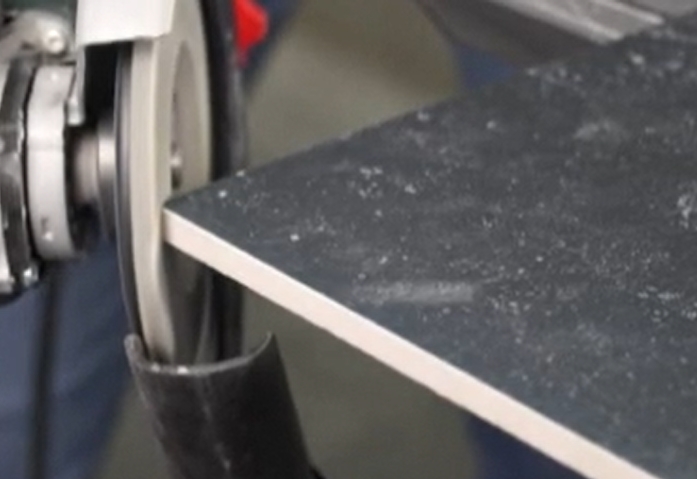
Diamond flap discs are run on handheld angle grinders for dry and wet grinding of hard, brittle materials. Image: RUITE.
Two Abrasive Systems That Only Look Interchangeable
An abrasive flap disc is a stack of coated abrasive flaps — typically aluminium oxide, zirconia alumina, or ceramic grain — bonded to a backing plate. The grain is designed to fracture and refresh as it wears, which is why conventional flap discs perform well on ductile materials such as carbon steel, stainless steel, and weld seams.
A diamond flap disc replaces that conventional grain with diamond or CBN abrasive. Because diamond is substantially harder than the workpiece, material is removed through controlled abrasion rather than through grain fracture. Zhengzhou Ruite Diamond Belts Co., Ltd — the manufacturer behind the RUITE abrasive brand, founded in 2003 in Zhengzhou, Henan, China — produces diamond flap discs in sizes Φ100*16 mm, Φ115*22 mm, and Φ125*22 mm, in grits from 40# to 800#, on a Diamond/CBN abrasive system, and specifies them for both dry and wet grinding.
That structural difference defines the application range. Diamond flap discs are built for hard, brittle materials: stone, glass, ceramics, monocrystalline silicon, cemented carbide, and thermal spray coatings. Conventional abrasive flap discs are built for metal. Running either disc outside its intended material class is the most common — and usually the most expensive — specification error in hard-material processing.
Why the Comparison Has Become a Procurement Decision
The demand side has moved. The global flap discs market was valued at USD 480.36 million in 2024, and diamond coating cutting discs have been identified as the fastest-growing category within it, driven by their precision in processing ceramics and composites (Global Growth Insights / Cognitive Market Research). The wider diamond tools market was estimated at approximately USD 8.7 billion in 2025, with a projected value of about USD 9.1 billion in 2026 (Fact.MR).
Market-size figures should always be read with their scope in mind. Dataintelo values the narrower diamond cutting disc segment at roughly USD 4.38 billion — a lower number than the all-diamond-tools estimate, not a disagreement about direction. Both readings point the same way: hard-material abrasive demand is expanding, and diamond-coated products are taking a larger share of it.
Supply is concentrated. Asia Pacific dominated the diamond tools and abrasives market in 2025, with China holding the largest global share, including approximately 56% of the abrasives market (Grand View Research). China's exports of diamonds — including industrial and synthetic diamond used in tools — reached approximately USD 1.17 billion in 2024 (Observatory of Economic Complexity). For importers, that concentration is a sourcing advantage and a due-diligence obligation at the same time.
The Cost Question: Unit Price Is Not Cost Per Part
Documented performance comparisons for diamond flap discs cite up to 45% higher grinding efficiency and a longer service life than conventional abrasive flap discs when working hard, brittle materials. Those two characteristics convert into money only under specific conditions: a genuinely hard workpiece, meaningful production volume, and a process in which disc changes consume paid operator time.
Four variables drive abrasive cost per finished part, and only one of them appears on the supplier's quotation:
- Removal rate. How quickly the disc cuts determines labour cost and machine time per part.
- Service life. How many parts are finished before the disc is spent determines abrasive consumption per part.
- Changeover time. Every disc change stops production. On a high-volume edge-grinding line, the difference between one change and three is a measurable labour cost.
- Rework and scrap. Heat damage, burn marks, or an inconsistent finish on hard, brittle material can scrap a part that is already near the end of its processing sequence.
A disc with a higher invoice price can therefore still lower total cost per part — if it removes material faster and lasts longer on that specific operation. The reverse is equally true. On low-volume, mixed-material work, a premium diamond disc may never recover its price difference, and a conventional abrasive disc remains the rational purchase. There is no universal answer; there is only a calculation against a stated material, volume, and finish requirement.
Diamond vs. Abrasive Flap Discs: A Side-by-Side Buyer View
| Comparison dimension | Conventional abrasive flap disc | Diamond flap disc |
|---|---|---|
| Abrasive grain | Aluminium oxide, zirconia alumina, or ceramic grain | Diamond or CBN |
| Typical target materials | Carbon steel, stainless steel, weld blending, general metal fabrication | Stone, glass, ceramics, monocrystalline silicon, cemented carbide, thermal spray coatings |
| Behaviour on hard, brittle material | Grain wears down quickly; cutting action falls away | Engineered for this material class; abrasion continues as the diamond layer is exposed |
| Dry / wet grinding | Generally used dry, with some wet-capable variants | Specified for both dry and wet grinding |
| Grinding efficiency on hard materials | Baseline | Up to 45% higher documented efficiency |
| Service life on hard materials | Shorter | Longer service life reported |
| Initial unit price | Lower | Higher |
| Cost per finished part | Competitive on metal and on low-volume work | Favourable on hard materials at volume |
| Principal limitation | Not an efficient tool for fired ceramic, glass, or natural stone | Not intended for soft, ductile metals; higher entry price |
| Safety and documentation | Covered by coated abrasive safety requirements such as EN 13743:2017 | RUITE diamond flap discs certified to EN 13743:2017 (ECM/COC certificate No. 0P210906.ZRDQ038) |
Table: comparison dimensions most often used in procurement reviews for stone, glass, and ceramic processing.
Where Diamond Flap Discs Fit: Stone, Glass, and Ceramic
Diamond flap discs are specifically recommended for grinding ceramic tiles, porcelain stoneware, and natural stone such as marble and granite when executing miters and bevels (RUBI Tools). In practice, the same tooling logic extends across the hard, brittle material groups that RUITE lists for its diamond flap disc range: the glass industry, the stone industry, the porcelain industry, thermal spray coating, wind power, and aeronautics and astronautics.
Recurring operations in these industries include:
- Aggressive material removal — levelling an edge or removing a large volume of stock before finishing.
- Edge grinding and surface conditioning — preparing an edge or surface for the next process step.
- Beveling and chamfering — producing a controlled angle on tile, stone, or glass edges.
- Coating preparation and blending — on thermal spray coatings and hard-faced surfaces rather than on mild steel.
Typical working conditions are dry or wet abrasive grinding at high friction and normal ambient temperature, using handheld electric tools such as angle grinders, with glass process systems and grinders as matched equipment. That configuration — a handheld tool, a hard workpiece, and a large number of edges per shift — is precisely where the efficiency and service-life gap between diamond and conventional abrasive discs has its largest cost effect.
Constraints Buyers Should Verify Before Ordering
RUITE diamond flap discs have been certified to EN 13743:2017 under ECM/COC certificate No. 0P210906.ZRDQ038, issued by ECM Certification Machine Srl for the EU market. The certified scope covers diamond discs in φ100 mm, φ115 mm, φ125 mm, φ150 mm, and φ180 mm. EN 13743:2017 — the safety requirements for coated abrasive products published by the British Standards Institution — addresses maximum operating speeds and safety markings, which makes it the reference document a buyer checks when asking whether a supplier's paperwork will survive an audit.
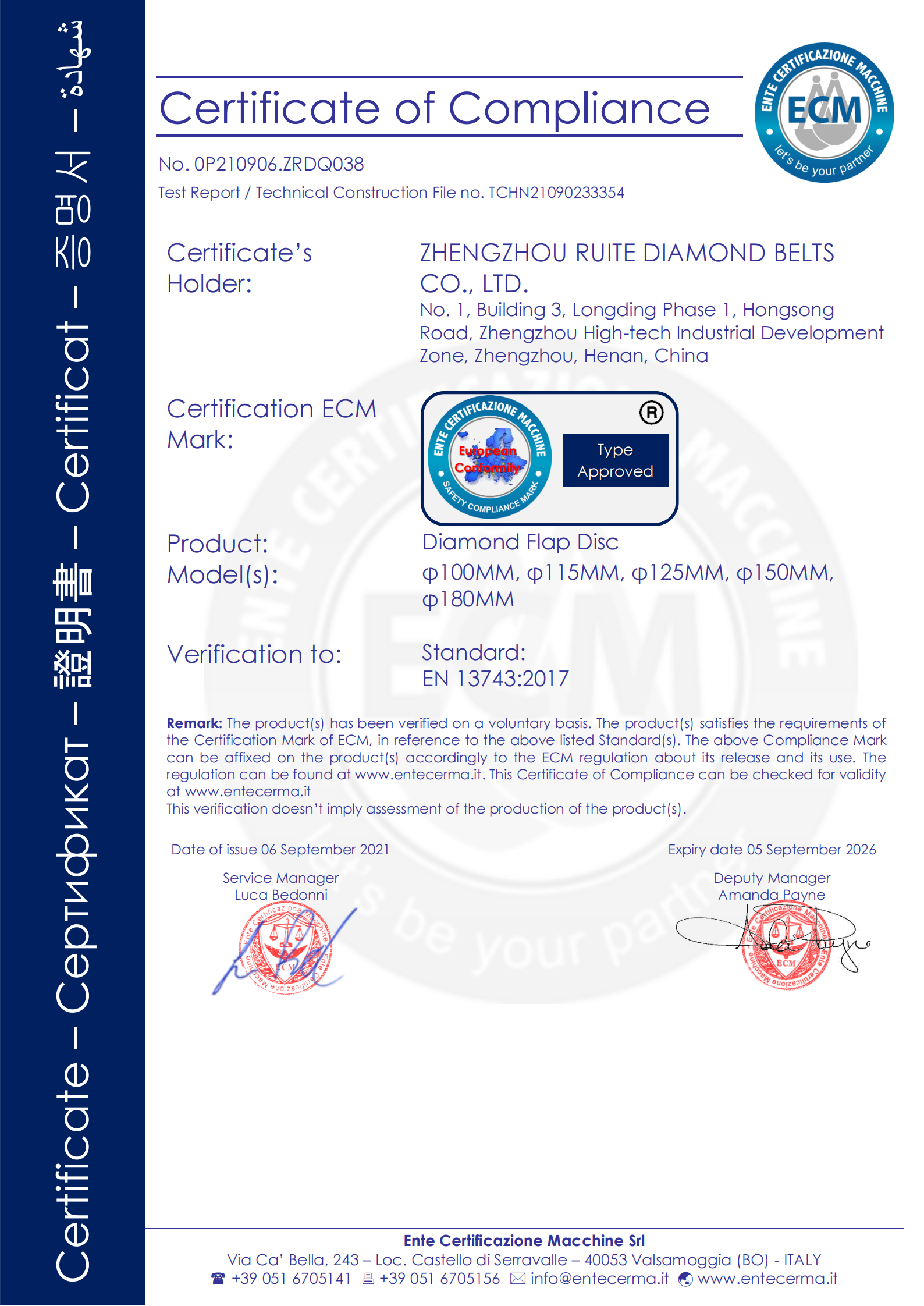
EU certification documentation for RUITE diamond discs, issued under EN 13743:2017 (ECM/COC certificate No. 0P210906.ZRDQ038).
A certification claim is a starting point, not a conclusion. Buyers evaluating diamond flap discs for a regulated market should confirm, for each order:
- Certification status and validity. Confirm the certificate is current for the specific size and market being purchased. Certified scope is product- and market-specific and does not transfer automatically to every size or every destination.
- Maximum operating speed. The disc's marked maximum speed must meet or exceed the rated speed of the grinder it will be mounted on. This is a safety requirement, not a preference.
- Diameter and arbor. RUITE diamond flap discs are offered in Φ100*16 mm, Φ115*22 mm, and Φ125*22 mm. The arbor bore must match the tool spindle.
- Grit. The available range runs from 40# to 800#. Coarser grits support faster stock removal and edge work; finer grits support surface conditioning and finishing.
- Dry or wet process. The disc is specified for both, but the surrounding process — tool, coolant or water supply, and containment — must also support the method chosen.
- Backing construction. Confirm the backing type and flexibility suit the geometry being ground, particularly on profiled or curved edges.
The Supply Landscape and How to Read It
The high-end abrasive and diamond tool market is served by a mix of large multinational brands — Saint-Gobain (Norton), 3M, and Bosch among them, alongside specialised manufacturers such as Pferd and Klingspor — and by focused producers that build their business around specific material classes (Dataintelo). For a buyer in stone or glass processing, that structure creates a predictable trade-off: broad multinational portfolios offer convenience and global consistency, while specialist suppliers tend to offer deeper application support and more flexible OEM terms in their chosen material category.
RUITE is one of the specialists. Zhengzhou Ruite Diamond Belts Co., Ltd operates a 500 m² production facility with 45 employees, a five-engineer R&D team, and an annual output of 100,000 units. Its product line covers diamond belts, diamond flap discs, diamond flap wheels, diamond velcro discs, diamond hand pads, and diamond quick change discs. Approximately 70% of output is exported, with the EU and USA as the main markets.
On the commercial side, the company states an OEM production mode with packing and logo customisation, a monthly capacity of 10,000 units, a lead time of 30 days, and a minimum order quantity of 50 units. Quality control is described as 100% testing, and after-sales terms include a 12-month shelf-life quality warranty, free technical consultation, and replacement of defective batches. The company also reports an OEM relationship with an Italian customer grinding ceramic, covering 20,000 units over eight years with stable quality and no customer complaints reported in that period.
These are supplier-stated figures, and they are best treated as such: useful for comparing responsiveness, capacity, and terms, but worth validating through samples and documentation before a first bulk order.
Where Diamond Flap Discs Are Not the Right Answer
A comparison written without limits is a sales document, not a buyer's reference. Three boundaries matter:
- Material class. Diamond flap discs are not intended for soft, ductile metals such as mild steel or aluminium. Conventional abrasive flap discs remain the appropriate and more economical choice for carbon steel, stainless steel, and weld blending. On soft metals, diamond grain can load rather than cut freely, which wastes both money and cycle time.
- Volume threshold. The price premium on a diamond disc is recovered through efficiency and service life. On very low volumes, one-off fabrication, or mixed-material workshops, that recovery may never occur. The higher unit price is a real cost, and it should be modelled, not assumed away.
- Documentation scope. A certificate held for one market or one product range does not automatically cover another. Buyers shipping into the EU need documentation tied to the specific size and standard; buyers shipping elsewhere need to confirm which requirements apply in their destination market.
There is also an operating boundary that has nothing to do with price: maximum speed ratings. Exceeding the marked maximum operating speed on any coated abrasive product is unsafe, and EN 13743:2017 exists precisely because that limit is not discretionary.
A Practical Procurement Framework
For a buyer moving from research into evaluation, the sequence below keeps the comparison anchored to process data rather than supplier claims.
- Classify the workpiece. Hard and brittle (stone, glass, ceramic, carbide, thermal spray coating) or ductile metal. This single question eliminates one of the two product types in most cases.
- Define the operation. Aggressive material removal, edge grinding, surface conditioning, or beveling and chamfering. Each has a different grit and pressure profile.
- Estimate annual volume and cost per part. Include removal rate, disc life, changeover time, and rework — not just the unit price.
- Specify the physical fit. Diameter, arbor bore, and grit from the 40#–800# range, matched to the tool and the finish requirement.
- Confirm the dry or wet process and that the tool, coolant supply, and containment support it.
- Verify certification and safety markings against the destination market, and confirm validity at order time.
- Validate with samples before a bulk commitment, measuring disc life and finish on your own material.
- Check supply terms. Lead time, minimum order quantity, monthly capacity, and after-sales terms determine whether a technically suitable supplier is also an operationally reliable one.
- Document per batch. Keep certification, size, and grit records with each shipment for traceability.
Market Trend: Superhard Abrasives Moving Into the Mainstream
Diamond coating cutting discs being identified as the fastest-growing category of the flap disc market is a signal about where hard-material processing is heading: precision on ceramics and composites is pulling demand toward superhard abrasives rather than conventional grain (Global Growth Insights / Cognitive Market Research). The wider diamond tools market is projected to move from approximately USD 8.7 billion in 2025 to about USD 9.1 billion in 2026 (Fact.MR), a modest but steady expansion that is being supplied largely from Asia Pacific, where China holds the largest share (Grand View Research).
A second, quieter trend is documentation. As EU-facing buyers increasingly require coated abrasive products to meet EN 13743:2017 and to carry traceable certification, the ability to supply paperwork alongside product becomes a genuine differentiator between suppliers that look similar on price alone.
Future Outlook
The direction of travel for stone, glass, and ceramic processing is toward superhard abrasives in applications where conventional grain reaches its physical limit. That does not make conventional abrasive flap discs obsolete — they will remain the default for metal fabrication — but it does mean that the two product families will increasingly be specified by material rather than by habit.
For buyers, the practical consequence is that abrasive selection is becoming a documented engineering decision rather than a consumables purchase. The suppliers who will be easiest to work with are those who can state a material class, a grit range, a certified scope, a lead time, and a limitation — clearly and in writing. That is a higher bar than price comparison, and it is the bar that protects production schedules in the end.
Frequently Asked Questions
What is the difference between a diamond flap disc and an abrasive flap disc?
Conventional abrasive flap discs use grain such as aluminium oxide, zirconia alumina, or ceramic, and are designed primarily for metal. Diamond flap discs use diamond or CBN grain on a flexible flap structure and are designed for hard, brittle materials — stone, glass, ceramics, monocrystalline silicon, cemented carbide, and thermal spray coatings — and are specified for both dry and wet grinding.
Are diamond flap discs more expensive, and how should buyers judge the cost?
Diamond flap discs carry a higher initial unit price than conventional abrasive flap discs. The meaningful measure is cost per finished part, which combines removal rate, service life, changeover time, and rework. Diamond discs are reported to deliver up to 45% higher grinding efficiency and longer service life on hard materials, so the economics improve with material hardness and production volume. On low-volume work in soft materials, the premium may not be recovered.
Can diamond flap discs be used for both dry and wet grinding?
RUITE diamond flap discs are specified for both dry and wet grinding, with typical working conditions described as dry and wet abrasive grinding at high friction and normal ambient temperature, on handheld electric tools such as angle grinders. Buyers should confirm that the disc rating, the tool, and the coolant or water supply used in their process are compatible before committing to a wet-grinding procedure.
Which certification should a diamond flap disc carry for the EU market?
Coated abrasive products for the EU market fall under EN 13743:2017, which specifies requirements including maximum operating speeds and safety markings (British Standards Institution). RUITE diamond flap discs have been certified to EN 13743:2017 under ECM/COC certificate No. 0P210906.ZRDQ038, issued by ECM Certification Machine Srl, with a certified scope covering diamond discs of φ100 mm, φ115 mm, φ125 mm, φ150 mm, and φ180 mm. Buyers should verify certificate validity for the specific size and market at the time of order.
Which sizes and grits are available, and how do buyers match them to stone, glass, and ceramic work?
RUITE diamond flap discs are offered in Φ100*16 mm, Φ115*22 mm, and Φ125*22 mm, with grits from 40# to 800#. Coarser grits support faster stock removal and edge work; finer grits support surface conditioning and finishing. The right combination depends on the material — marble, granite, engineered stone, ceramic tile, or glass — and on the finish the next process step requires.
Can diamond flap discs be used on metal?
Diamond flap discs are specified for hard, brittle materials rather than for general metal fabrication. Conventional abrasive flap discs remain the appropriate and more economical choice for carbon steel, stainless steel, and weld blending. Diamond abrasives are generally not the first choice on soft, ductile metals, where the grain can load rather than cut freely.
RUITE publishes its full diamond flap disc range, including specifications and the certified EU scope, in its downloadable product catalog.