
Die-Cast Pallet Box 1230x830x1000 for Automotive Gearbox Logistics
Die-Cast Pallet Box 1230x830x1000 for Automotive Gearbox Logistics
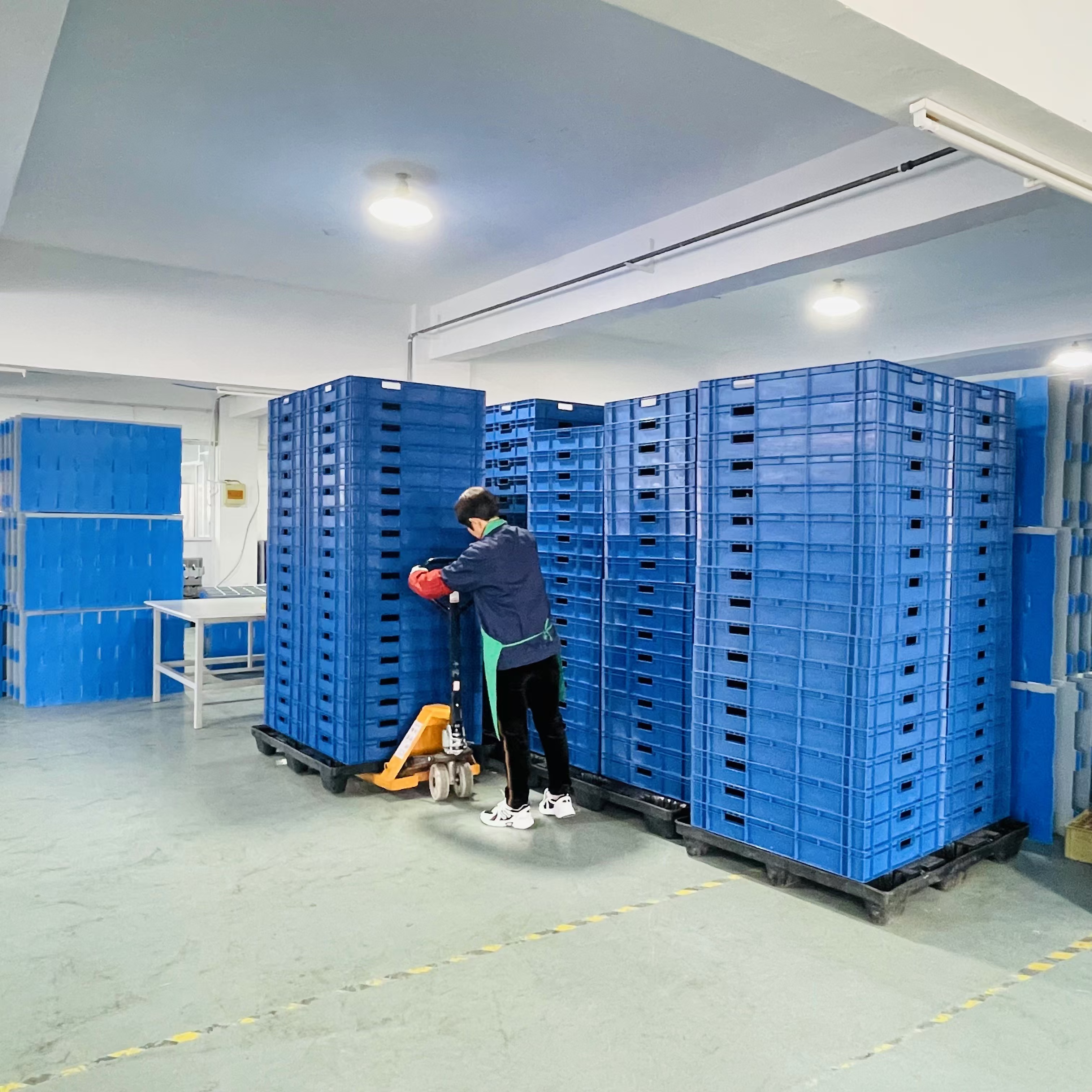
A transmission gearbox is one of the few automotive assemblies where the packaging, not the part, decides whether the shipment arrives intact. The container has to carry a dense, machined casting through forklift handling, racking, container loading, sea freight and inland distribution without letting it shift, absorb moisture, or sit at the bottom of an unstable stack.
This article examines one specific format for that job: the die-cast pallet box in a 1230 x 830 x 1000 mm footprint, built as an enclosed HDPE body. The reference scenario is gearbox storage and transport in a Mexico-facing supply chain — Mexico is one of the two principal export markets named by TOYOE, the brand of Zhangjiagang Fenghui Logistics Equipment Co., Ltd. In that scenario, the packaging problem the design has to eliminate first is not cost. It is collision damage, followed closely by moisture and stacking stability.
The question this article answers is narrow and practical: does a 1230 x 830 x 1000 enclosed plastic pallet box actually fit gearbox logistics, and where does it stop being the right answer?
What Makes Gearbox Logistics a Hard Packaging Case
Automotive transmission housings concentrate a large mass into a comparatively small envelope, and that mass sits behind thin, precisely machined surfaces: sealing faces, bearing bores, shaft ends, and mounting points for sensors and actuators. A container that is adequate for a bumper cover or a wiring harness is not automatically adequate for a gearbox.
Three failure modes dominate, and they are the same three that TOYOE lists in its risk documentation for heavy industrial box applications: collision, moisture damage, and overload. The corresponding generic controls are shockproof packaging, load-limit control, and moisture-proof protection. The enterprise-level measures behind them are strict load inspection, a solid box structure, a sealed moisture-proof design, and anti-static material where static-sensitive components are involved.
Collision damage
During forklift handling, a gearbox that is not held in a fixed position slides, rotates, or rocks inside its container. Contact between two castings concentrates force on very small areas, and even a minor side impact or a short drop can deform a machined face or damage a shaft end. This is the failure mode that a gearbox application has to remove rather than merely reduce, because the damage is often invisible until the unit is assembled.
Moisture damage
Ferrous components inside a gearbox corrode, and condensation forms when warm, humid air meets a surface that has cooled overnight. A container that crosses a humid port phase and then a long inland leg experiences repeated temperature swings, so the packaging has to control both liquid water and the humidity inside the closed volume.
Overload
Stacking in a warehouse or rack bay transfers the weight of the upper units into the lower container. Without a defined stacking height and a declared load limit, the lower box deforms, the load above settles, and the packaging that was supposed to protect the parts becomes the thing pressing on them.
The 1230 x 830 x 1000 Die-Cast Format, Explained
The 1230 x 830 mm plan dimension of this model follows the same unit-load footprint used by standard pallets, and 1000 mm is the wall height, so the box occupies a familiar position in a rack bay, on a truck bed, or inside a container. The body is an enclosed HDPE (high-density polyethylene) shell rather than a frame fitted with separate panels. In industrial catalogues, a pallet box whose body is formed as a single moulded shell is often described as die-cast, even though the production process is injection moulding of plastic.
The model's enclosed HDPE body is specified with internal capacity in the 100–200 L range, with customized inner lining options where the load needs to sit in a fixed position rather than loose.
Enclosure changes four things relative to an open pallet with stretch film or a timber crate:
- The load path runs through the box, not through consumables. Retention does not depend on film tension or strapping that has to be cut open at every inspection point.
- The contents are held in a closed volume. Dust, splash water and standing humidity stay out, and the parts inside are no longer exposed to impact from adjacent loads in a shared rack bay.
- The footprint stays constant across the whole flow. A receiving warehouse handles the same outer dimension the shipping plant used, on the same equipment.
- Empty return behaves differently from a one-way pack. The box is an asset that comes back, which changes the cost calculation from a per-shipment expense to a cost per trip over a service life.
Handling is designed around the pallet interface. The base accepts pallet-truck forks, so a packed gearbox moves on the same equipment that moves pallets, with no special lifting fixture. Whether a specific loaded unit enters a specific shelf bay cleanly depends on beam spacing and how much the box deflects under load — which is why rack dimensions belong in the specification conversation and not in a general data sheet.
The Mexico Gearbox Scenario: Four Requirements That Decide the Design
Gearbox flows into and out of Mexico combine a humid port phase with long inland distribution, and they usually involve a storage stage where units wait for a build sequence rather than moving straight through. Four requirements come out of that flow.
- Moisture-proof. The container must not absorb water, must not support mould or mildew, and must be closable for the storage stage. This is where wood performs worst and where the sealed moisture-proof design of a plastic pallet box earns its place.
- Shock-resistant. Each gearbox needs a defined position inside the box, with shockproof packaging at the interfaces, so that collision damage between castings or against the container wall is removed rather than reduced.
- Stable load bearing. Storage is stacked, so the container has to hold its shape under the weight above it. This is controlled by load-limit discipline and strict load inspection, not by hope.
- Forklift and shelf compatibility. The box must be moved and stored with the same fleet and the same racking the site already owns, or the packaging change turns into an infrastructure project.
How the Design Maps to Each Requirement
The table below translates the four requirements into what a buyer should look for on the floor, and what to confirm before placing an order.
| Application requirement | What it means in the warehouse | Design response | Verify before ordering |
|---|---|---|---|
| Shock and collision protection | Gearboxes must not touch each other or the container wall during handling or transport | Solid box structure; shockproof packaging; customized inner lining that fixes each unit in position | Wall structure, lining material, how the unit is restrained inside the box |
| Moisture protection | Sea leg plus unheated storage; condensation and surface rust risk | Sealed moisture-proof design; HDPE body that does not absorb water or support mould and mildew | Sealing method, whether the closure is opened for inspection, desiccant practice |
| Stable load bearing | Stacked storage and rack placement under load | Strict load inspection; load-limit control; box geometry that resists deformation | Declared load and stacking limits, permissible stacking height on site |
| Forklift handling | Every movement is mechanical, never manual | Pallet-compatible base dimensioned for standard pallet-truck forks | Entry configuration, base clearance, compatibility with the existing truck fleet |
| Shelf and rack compatibility | Storage in existing racking, not in floor stacks | 1230 x 830 mm unit-load footprint consistent with pallet racking practice | Rack beam spacing, box deflection when loaded, weight per bay |
| Static-sensitive content | Gearboxes carrying electronic sensors, actuators or control units | Anti-static material available as an option | The electrical specification the buyer's own engineering group requires |
Where TOYOE Enters the Picture
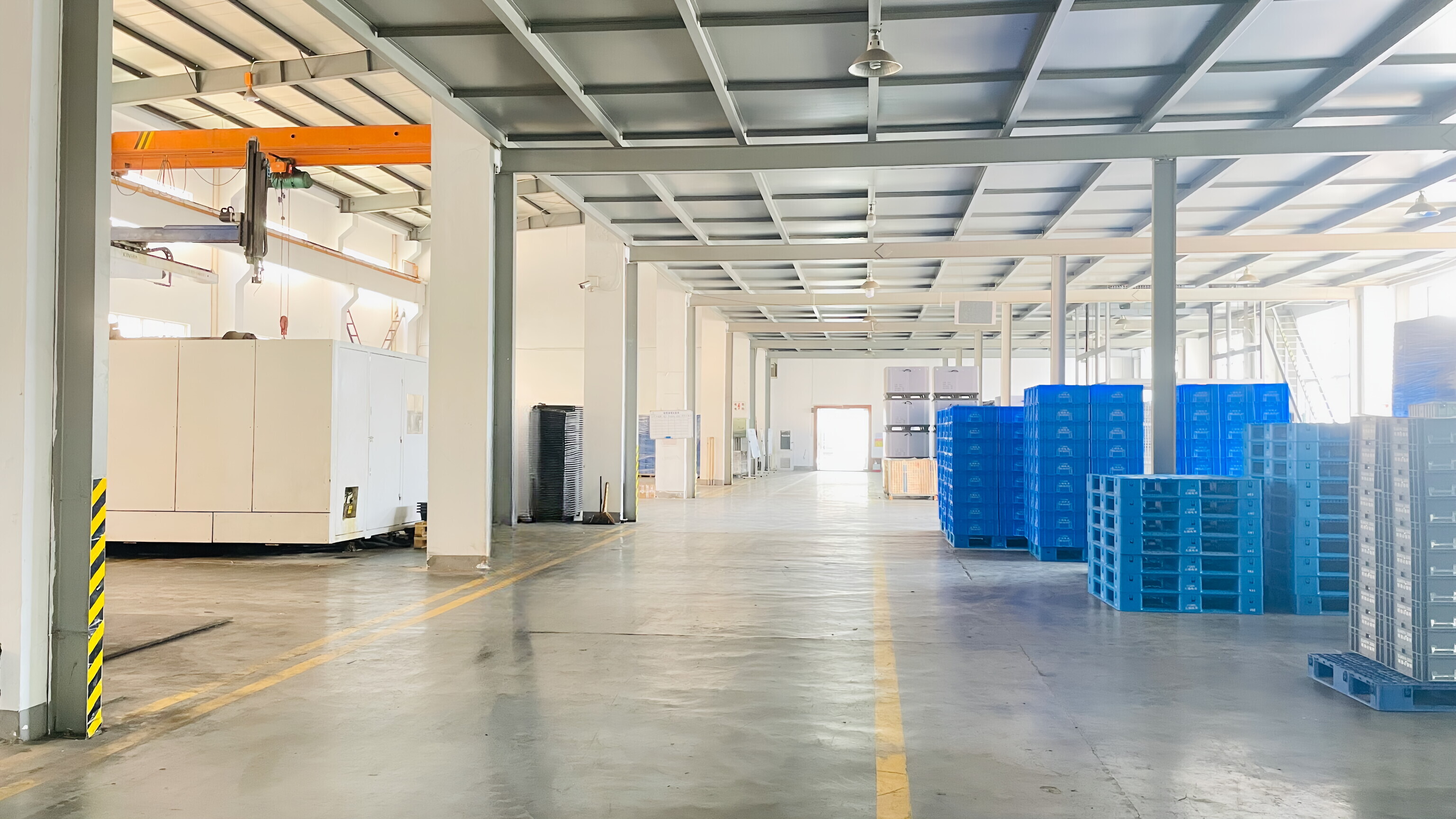
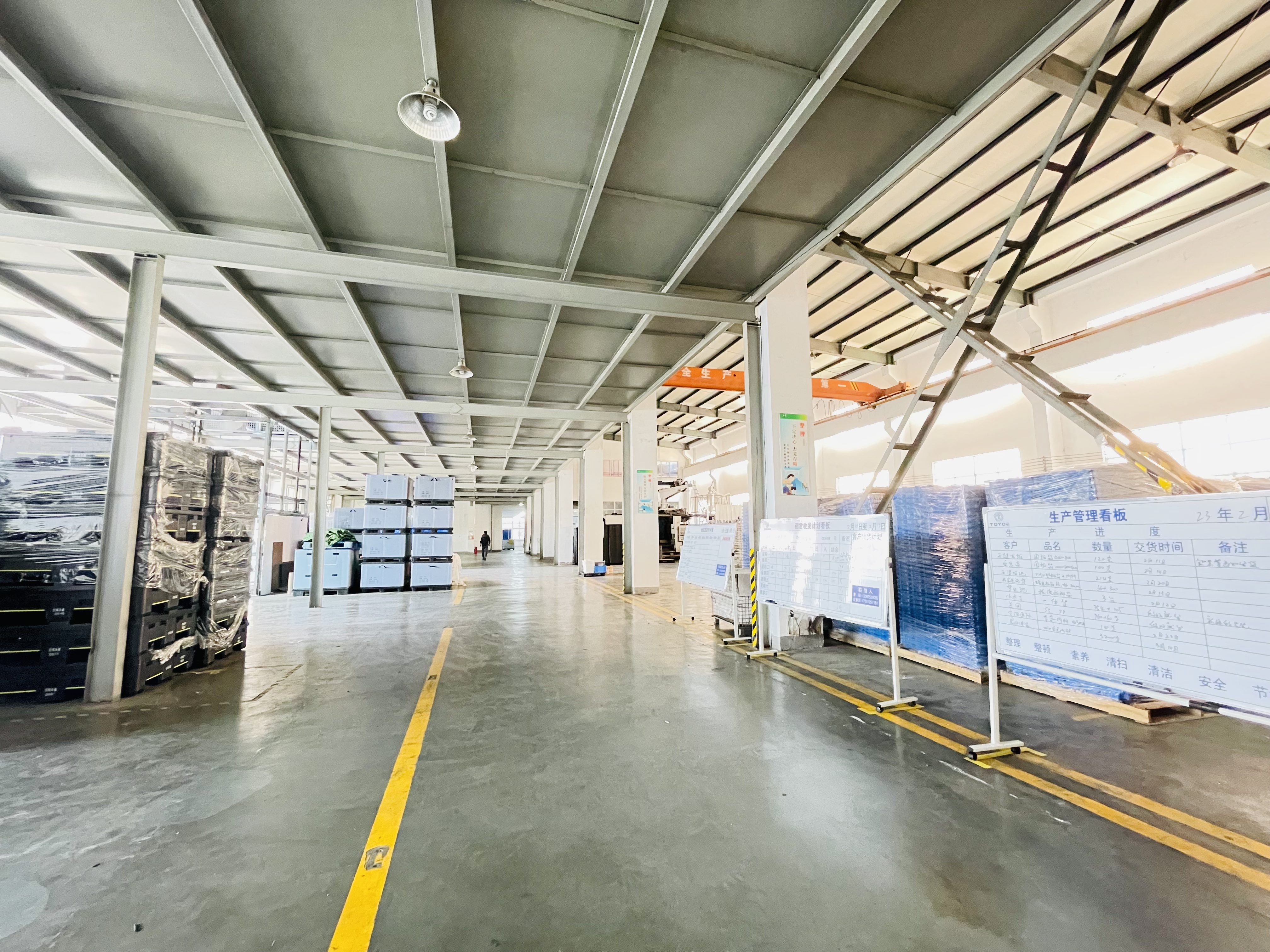
TOYOE is the brand used by Zhangjiagang Fenghui Logistics Equipment Co., Ltd., a logistics packaging manufacturer founded in June 2010 and based in Zhangjiagang, Suzhou, Jiangsu, China. The company's product lines cover plastic pallet boxes, storage boxes, plastic crates and honeycomb panel boxes. It reports around 34 employees, an annual output of roughly 30,000 units, an R&D team of two engineers, and an export ratio of about 40%, with Mexico and the USA as its named principal export markets.
For a gearbox flow, the relevant part of that profile is not company size but whether the risk-control set matches the application. The measures TOYOE applies to heavy industrial box projects — strict load inspection, a solid box structure, a sealed moisture-proof design, and anti-static material where needed — map directly onto collision, moisture and overload, the three failure modes the Mexico scenario exposes. Custom engineering is part of the same offer: the company positions its work as tailor-made packaging built around individual customer requirements, which in this application means internal fittings that locate a specific gearbox variant rather than a generic cavity.
The same profile also sets a boundary. TOYOE is a manufacturing specialist rather than a rental pool operator. A buyer whose requirement is a rented container swapped between depots in a shared national network is solving a different problem and should evaluate pool operators on their own terms; TOYOE competes in the segment where the container is specified, built, and then owned or leased directly by the shipper. More information on the product range is available at toyoebox.com.
Market Trend: Why Enclosed Plastic Boxes Keep Gaining Share
The direction of the market supports the scenario logic. Grand View Research projects the global plastic pallets and pallet box market to reach approximately USD 11.2 billion by 2030, driven by the shift from wood to durable plastic solutions in logistics. Estimates of that figure differ between research houses — IMARC Group puts the comparable 2034 figure at about USD 10.4 billion — and the gap is largely a question of whether secondary rental services are counted alongside product sales.
Two adjacent trends matter for gearbox packaging specifically. Research Nester expects the ESD packaging market, which includes trays and pallet boxes, to reach USD 5.89 billion by 2035, growing at a compound annual growth rate of 5.8%; that reflects the electronics content now attached to mechanical assemblies. Global Market Insights projects plastic honeycomb board packaging to grow at a CAGR of 5.9% through 2032, citing its strength-to-weight ratio for automotive parts transport — the same property that makes lightweight internal structures attractive inside a gearbox container.
On the supply side, Straits Research reports that Asia Pacific accounted for the largest revenue share of the plastic pallet market in 2023, above 32%, with China leading in industrial production capacity. Mordor Intelligence lists ORBIS Corporation, Schoeller Allibert, Brambles (CHEP) and Loscam among the major global manufacturers in the plastic pallet box sector, alongside a long tail of regional specialists such as TOYOE that build to individual project specifications.
Plastic Pallet Box vs. Wooden Pallet: The Comparison, Including Where Plastic Loses
The comparison that matters at the decision stage is not plastic against metal or plastic against corrugated. It is plastic against the wooden pallet and timber crate that most gearbox flows still use.
| Comparison dimension | Wooden pallet solution | Plastic pallet box |
|---|---|---|
| Durability | Lower; degrades with handling and moisture cycles | Higher durability; service life extended by 3–5 times |
| Moisture behaviour | Absorbs water; supports mould and mildew; pest risk | Moisture-proof; no pest or mildew damage |
| Cleaning | Difficult to clean; contamination accumulates | Easy cleaning |
| Load stability | Loses bearing capacity as boards crack and fasteners loosen | Stable load capacity |
| Maintenance workload | Repair and replacement are routine | 80% less maintenance work |
| Up-front cost | Lower purchase price | 30% higher initial cost |
| Long-term cost | Repeated replacement and repair spend | 45% lower total cost over long-term use |
| Documented best-fit scenarios | One-way or low-cycle flows | Food, pharmaceutical, warehousing and export logistics |
The limitation is explicit in that same data and should not be softened: the plastic box carries roughly 30% higher initial cost. The 45% long-term cost advantage and the 3–5 times extended service life only materialise when the container is used repeatedly. For a one-way shipment, or a flow with only a handful of trips per container per year, the purchase premium has nothing to amortise against, and timber remains the rational choice.
Boundaries: When This Format Is the Wrong Answer
A 1230 x 830 x 1000 enclosed die-cast pallet box is a good fit for gearbox logistics under specific conditions. It is a poor fit under others, and buyers should test their flow against these boundaries before committing tooling.
- No return loop. If containers do not come back, there is no service life to amortise and no maintenance saving to realise.
- Inspection-heavy destinations. A closed body hides its contents. Where customs or quality inspection requires full visibility at each handover, the closure has to be designed for repeated opening, or the format costs time rather than saving it.
- Low cycle counts. Purchase cost is a fixed outlay; trip count is what divides it. Flows that move a few containers a year rarely justify custom tooling.
- Non-standard footprints at low volume. Custom dimensions and customized inner linings require dedicated tooling. The economics depend on volume, and a buyer should confirm that before assuming a special size is available.
- Cleaning infrastructure. Reused containers that carry oily or contaminated parts need a defined wash step between trips; sites without that step should plan for it.
- Field repair expectations. Wooden crates can generally be patched locally with basic tools. A cracked moulded shell usually cannot, which shifts the maintenance model toward replacement of the whole body.
Future Outlook
Three directions look durable for gearbox packaging over the next planning cycle, and all three rest on published projections rather than speculation.
First, the substitution of wood continues. The USD 11.2 billion figure for plastic pallets and pallet boxes by 2030 is explicitly tied by Grand View Research to that shift, which means the comparison data — the 30% purchase premium against the 45% long-term saving — will keep being the deciding argument rather than a novelty.
Second, the container increasingly has to do an electrical job as well as a mechanical one. Research Nester's projected USD 5.89 billion ESD packaging market at a 5.8% CAGR to 2035 reflects the fact that gearboxes now travel with sensors and control hardware attached.
Third, weight and documentation will tighten. Global Market Insights ties the 5.9% CAGR in plastic honeycomb board packaging through 2032 to strength-to-weight ratio in automotive parts transport, and buyers in regulated supply chains increasingly reference recognised construction and closure practice — EN 13626:2003 for reusable box pallets in Europe, and ASTM D1974/D1974M-22 for closing and sealing practice on shipping containers — when they write specifications.
The combined effect is a shift in how buyers treat packaging: not as a consumable to be re-bought every few shipments, but as an asset with a declared load limit, a documented service life, and a maintenance regime.
FAQ
Is a plastic pallet box more expensive than a wooden pallet box?
Yes at the point of purchase. Published comparison data shows roughly 30% higher initial cost for the plastic box. Over long-term use the same data shows 45% lower total cost, because the plastic box requires 80% less maintenance and delivers a service life extended by 3–5 times. The crossover depends on how many trips the container makes, not on the purchase price alone.
How long does an enclosed plastic pallet box last compared with wood?
Comparison data lists a service life extended by 3–5 times relative to alternatives, with 80% less maintenance work. Actual life in a gearbox application depends on load discipline, handling quality, and the cleaning regime between trips.
Can a 1230 x 830 x 1000 pallet box be handled by standard forklifts and stored on standard shelves?
The format uses the same unit-load footprint as a standard pallet, and its base is designed for pallet-truck handling, so it is moved with the equipment a site already uses for pallets. Entry into a specific shelf bay depends on rack beam spacing and on how much the loaded box deflects, so those two figures should be confirmed against the buyer's racking rather than assumed.
How does an enclosed box prevent the collision damage that affects gearboxes?
Collision is controlled at three levels: shockproof packaging at the contact points, a customized inner lining that holds each gearbox in a fixed position so units cannot touch each other, and a solid box structure that absorbs external impact instead of transmitting it to the casting. Load inspection and load-limit control keep the stack stable so the pressure of upper units does not reach the parts.
When is an enclosed die-cast pallet box the wrong choice?
When the container does not return, because the service-life and maintenance advantages have nothing to amortise against. Also when destination inspection requires full visibility of the contents, when annual trip counts are very low, or when no cleaning step exists between reuse cycles. The purchase premium is only recovered through repeated trips.
What should be verified before ordering a custom-sized pallet box for gearbox storage?
Confirm the declared load and stacking limits, the sealing method and how the closure behaves under repeated opening, the specification of the internal lining that locates the gearbox, the base design and compatibility with the site's forklift fleet, dimensional tolerance against the existing rack bays, and whether the electrical specification requires anti-static material. For custom dimensions and linings, tooling and volume assumptions should be settled before the order.
A downloadable product brochure covering the pallet box range is available here: TOYOE product brochure (PDF).