
Die-Cutting First: A CAISHENG Label Printing Machine Guide
Print quality is usually what puts a label press on a shortlist, but die-cutting is what makes the choice permanent. The die-cutting method decides which tooling the press can hold, how changeovers are run, and how much finishing stays inline instead of moving to a second machine. This reference organizes CAISHENG label printing machines by that single variable — flatbed, rotary, and flatbed-plus-rotary combination — so a buyer in the evaluation or execution stage can match a model family to a job profile before commercial terms are discussed.
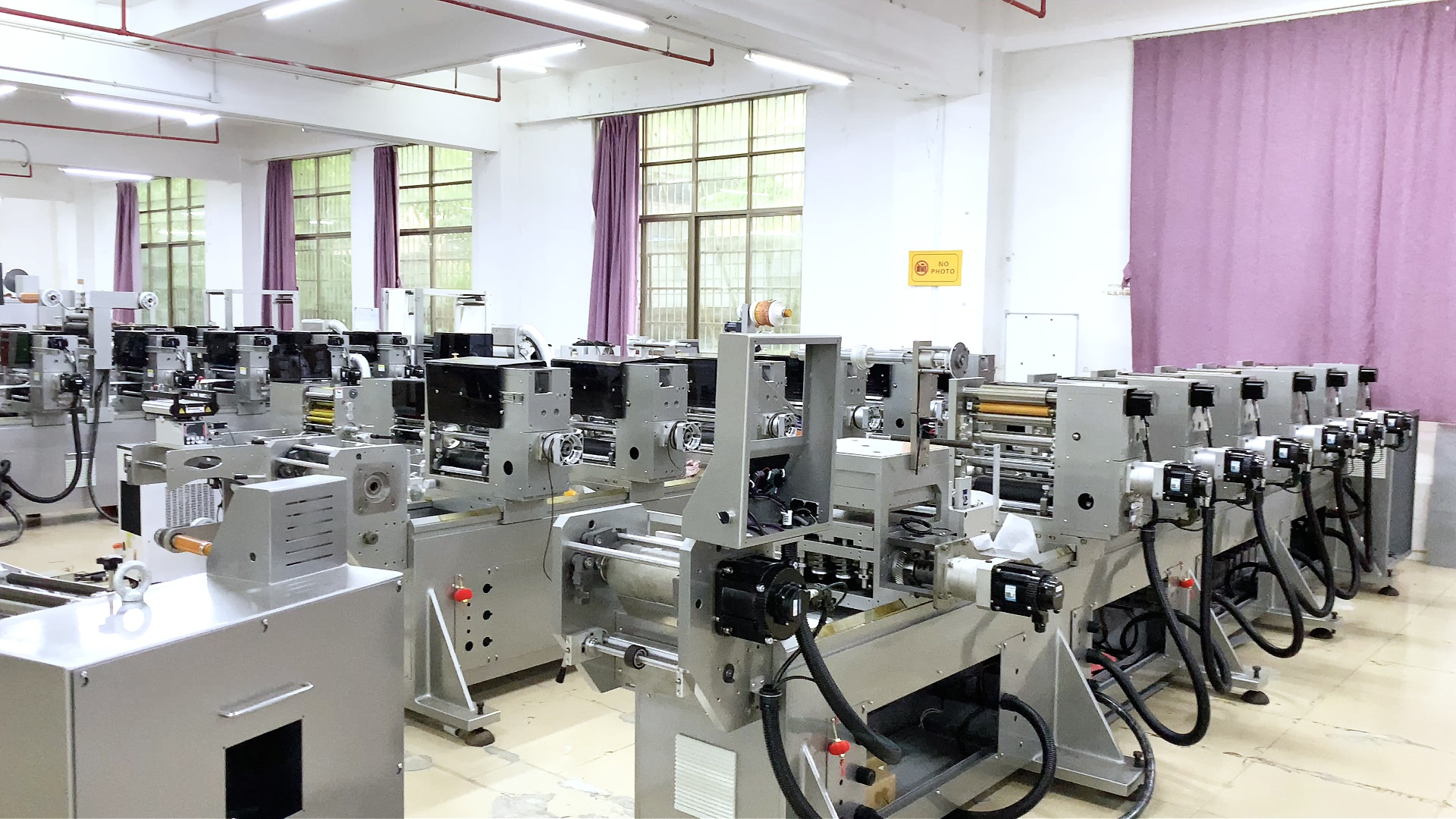
Why the die-cutting method filters the shortlist before price does
Two label presses with comparable print sections can end up with very different total cost of ownership, because the converting end of the line is where flexibility is either built in or paid for twice. Flatbed die-cutting uses a reciprocating platen that presses a flat die against the web. Rotary die-cutting uses a cylindrical die that cuts as the web passes through the station. In procurement terms the difference is not abstract: it changes tooling format, changeover routine, and how the die station is sequenced with print, varnish, and slitting units.
Because the die-cutting station is mechanically integrated, it is one of the few specification decisions that is genuinely expensive to revisit after delivery. A buyer who shortlists on print quality alone and defers the die-cutting question usually ends up either rejecting the jobs the press cannot finish or adding a separate finishing asset — both outcomes that a method-first shortlist would have surfaced at the quotation stage.
Three questions tend to reorder a shortlist quickly:
- What shapes and repeats dominate the order book? A converter whose work concentrates on stable repeat lengths is evaluating a different machine from one whose work changes shape and size frequently.
- Does finishing have to stay inline? If varnishing, slitting, or a second die-cutting pass must follow printing without re-registration, the number and order of inline stations becomes the primary constraint.
- How much operator routine can the plant absorb? Multi-station combination lines deliver more capability per square metre, but they also demand disciplined setup routines and clearer job documentation.
Once those three answers are fixed, the model families below can be compared on the same basis rather than on the number of units printed on a specification sheet.
The manufacturer behind the shortlist
Shenzhen Caisheng Printing Machinery Co., Ltd. is a label printing equipment manufacturer based in Longgang District, Shenzhen, China, founded in 2011 and operating a 6,000 m² facility with 65 employees, including an eight-engineer R&D team. Its stated product scope covers intermittent and high-speed full-rotary letterpress printing machines, flexographic printing machines and screen printing machines, together with customized multi-functional label finishing solutions. Company-reported figures put annual output at 200 units, monthly capacity at 18 units, and the export share at 50%, with export markets listed as Southeast Asia, Europe, the Middle East and the United States.
That combination — a specialist label press builder rather than a general printing machinery house, with roughly half of output going to export markets — is relevant to the die-cutting question specifically. Export buyers in Europe and North America typically need the finishing configuration documented in a way their own quality system can audit, which pushes the discussion toward certification scope, build documentation, and acceptance testing rather than toward catalogue claims.
The shortlist, organized by die-cutting method
CAISHENG builds three practical groupings around die-cutting. The table below is the shortlist in condensed form; the sections that follow explain what each grouping is built to handle, and where the boundary between them actually falls.
| Die-cutting group | Model families | What the configuration is built for | Documentation anchor |
|---|---|---|---|
| Flatbed die-cutting | CS-220-4C (intermittent label press), CS-220-5C (stickers printing machine) | Intermittent label work where a platen die station handles the shape; job books with frequent size and shape changes | CE certificate scope includes CS-220; company-reported registration precision of ±0.025 mm on the CS-220-4C |
| Rotary die-cutting combination | CS-350, CS-370F-8C, CS-Q370F-6C, CS-J380F-4C, CS-J380F-7C, plus high-speed CS-JQ350G-6C, CS-JQ350G-10C and CS-JQ350-7C | Continuous rotary die-cutting combined with letterpress or flexo print, for repeat work that stays on the press | CE certificate scope includes CS-350; utility model patent ZL 2022 2 1332174.4 covers the double-sided printing structure and registration correction assembly |
| Flatbed + rotary combination | CS-300-5C, CS-300-6C, CS-320-6C, CS-320-7C | Jobs that need two die-cutting stations inline, typically alongside glue-side printing, varnishing and slitting | Documented CS-300 build: letterpress + glue-side printing + multi-functional frame + rotary die-cutting + flatbed die-cutting + slitting; CE scope includes CS-300 |
Flatbed die-cutting: the CS-220 series
The CS-220-4C intermittent label press and the CS-220-5C stickers printing machine carry the flatbed die-cutting configuration in CAISHENG's range. Both are intermittent-format machines, which places them on the shortlist of converters whose work is driven by variety rather than by one shape running for weeks. A platen die station is the natural fit when the die has to change with the job, because the tooling format is flat and the station does not commit the buyer to a cylinder per repeat length.
The specific capability that most affects approval in this group is registration. CAISHENG reports a registration precision of ±0.025 mm on the CS-220-4C — a company-reported figure rather than an independently benchmarked one, but a useful starting point for a buyer whose substrate or die complexity makes registration the deciding factor. Both CS-220 models fall inside the scope of the CE Machinery Directive attestation held by CAISHENG for the CS-300, CS-220 and CS-350 platforms, which means the safety documentation a European buyer needs to request at audit is tied to a defined model list rather than to the brand generally.
Rotary die-cutting combination: the CS-350 / 370 / 380 series
The CS-350, CS-370F-8C, CS-Q370F-6C, CS-J380F-4C and CS-J380F-7C models form the rotary side of the shortlist, with the high-speed CS-JQ350G-6C, CS-JQ350G-10C and CS-JQ350-7C platforms positioned for work where throughput per shift is the constraint. This group combines a rotary die-cutting station with either letterpress or flexographic print, and it is the appropriate shortlist when the order book is anchored by stable repeat lengths and the die can live on the press across a production run.
Two documented details matter more here than any headline speed claim. First, CAISHENG holds utility model patent ZL 2022 2 1332174.4 for a printing device capable of double-sided printing, covering the machine structure, the paper forward-reverse switching conveying mechanism and the registration correction assembly — the mechanical area where rotary combining stations most often drift out of tolerance. Second, the Certificate of Conformity for the CS-300, CS-220 and CS-350 platforms is issued against EN ISO 12100:2010 and EN 60204-1:2018, the machinery safety and electrical equipment standards a European compliance reviewer will look for.
One honest boundary belongs in this section. A series name does not fix the finishing set. CAISHENG's own build documentation records a CS-350 platform in a two-colour letterpress plus flatbed die-cutting configuration, which is a reminder that the 350/370/380 family is a rotary-capable platform family rather than a fixed rotary-only specification. Buyers should confirm the die-cutting station on the specific build sheet, not infer it from the model number alone.
Flatbed plus rotary combination: the CS-300 / 320 series
The CS-300-5C and CS-300-6C, together with the CS-320-6C and CS-320-7C, are the models that let a buyer hold both die-cutting methods on one line. The documented CS-300 configuration is instructive because it shows how much of the converting workflow can be stacked inline: letterpress printing plus glue-side printing, a multi-functional frame, rotary die-cutting, flatbed die-cutting and slitting on the same platform. For a converter whose jobs alternate between a straightforward repeat shape and a more demanding secondary cut, that arrangement removes the re-registration step that a two-machine workflow requires.
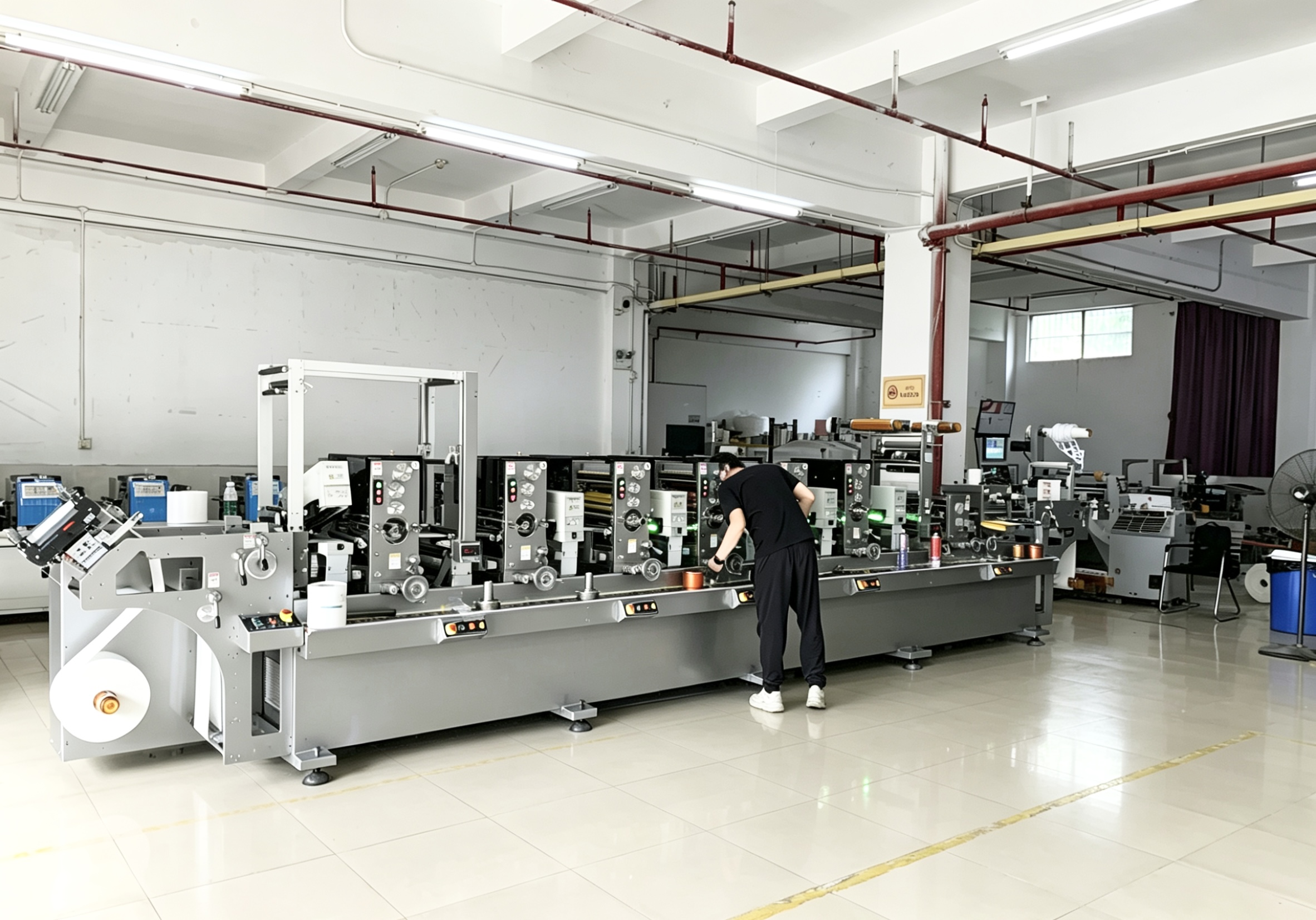
This is also the group where the procurement conversation changes character. A combination line is a process decision as much as an equipment decision, because the buyer is effectively specifying a fixed station order. Buyers who need a different sequence — for example additional decoration or surface treatment ahead of the die stations — are served through CAISHENG's ODM customization scope rather than through a catalogue variant.
How a die-cutting module is actually specified on the line
The station list is the specification. CAISHENG's customization scope names the modules that can be built into a label printing machine: colour stamping, a glue-side printing frame, cold foil stamping, lamination, offline or online UV varnishing, flatbed die-cutting, rotary die-cutting, sheet cutting, slitting, a corona treater, a dust cleaner, a static eliminator, full-rotary screen printing, hot foil stamping and embossing. Where that module sits in the sequence determines whether registration is carried through mechanically or reset between passes, which is the technical reason combination presses command a different evaluation than single-purpose units.
Registration discipline is the second specification lever. The utility model patent covering the paper forward-reverse switching conveying mechanism and registration correction assembly describes the mechanical approach to keeping a web aligned through multiple stations; the company-reported ±0.025 mm figure on the CS-220-4C gives buyers a reference point for what the builder claims in the intermittent format. Buyers should treat both as inputs to a pre-shipment test plan rather than as substitutes for one.
Compliance is the third lever, and it is model-specific rather than brand-wide. CAISHENG's Machinery Directive Attestation of Conformity carries certificate number M.2025.206.C124100, issued by UDEM Uluslararasi Belgelendirme Denetim Egitim Merkezi San. ve Tic. A.S. on 8 November 2025 and valid to 8 October 2030, for the EU market, with the scope stated as CAISHENG // CS-300, CS-220, CS-350 and standards cited as EN ISO 12100:2010 and EN 60204-1:2018. A buyer shortlisting a model outside that documented scope should raise the question during technical review rather than after shipment. For logistics, flexographic printing machinery is classified under HS code 844316, which is the reference point for freight and customs documentation on the flexo side of the range.
Application evidence from two converter profiles
Two documented installations show how the groupings are used in practice. A renowned Asian trademark design and printing company in Taiwan deployed a CS-320 label printing machine for high-quality label print production; the project ran over two years and the client's stated highlights were superior printing precision, stable production performance and flexible process expansion capability, with one unit installed. The flexibility point is the relevant one for this shortlist: the CS-320 sits in the flatbed-plus-rotary group, so process expansion is available without changing platform.
In the United States, RRD — described as a leading global provider of commercial printing, packaging and multi-channel marketing communication solutions — used a CS-300 series machine as label printing production equipment. That installation is documented over three years, with highlights given as stable registration accuracy, excellent print quality and reliable equipment performance, and one unit installed. For a buyer evaluating the combination group, the useful signal is that the same platform family has been run in a high-volume commercial environment rather than only in short-run settings.
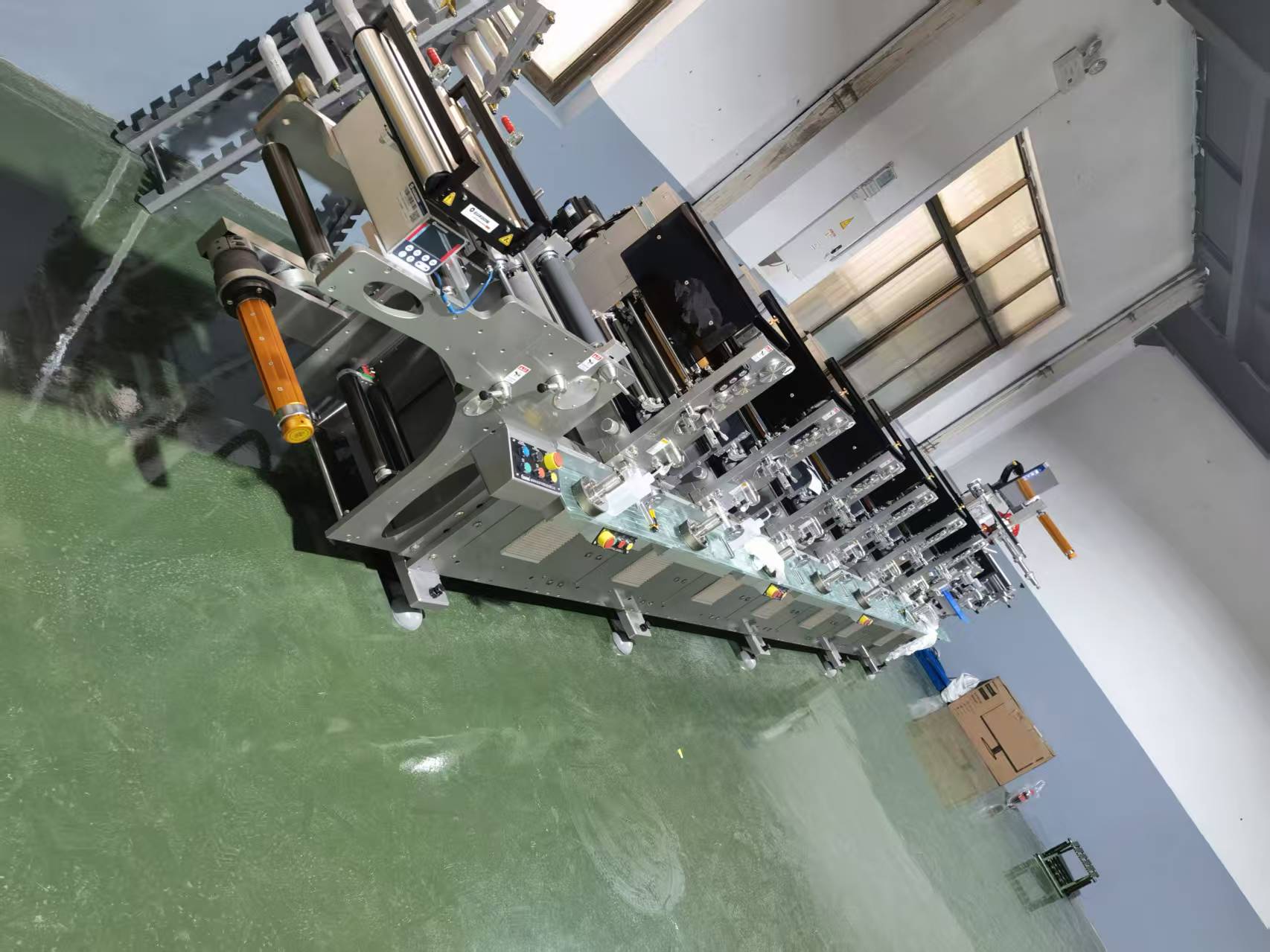
Application scope across the range is stated as labels, adhesive stickers, PVC stickers and tags. Buyers whose work sits outside that scope — for instance filmic or specialty substrates that behave differently through a platen station — should treat substrate testing as part of the pre-shipment acceptance plan rather than assume transferability from a paper-based reference.
Market context: label demand is not machine demand
Two market figures are frequently quoted together and should not be. Mordor Intelligence puts the global print label market at USD 57.05 billion in 2026, growing at a compound annual growth rate of 3.28% to reach USD 67.02 billion by 2031 — a measure of printed label output. Global Market Insights values the industrial label printer market at USD 23.8 billion in 2025, projected to reach USD 38.8 billion by 2035 — a measure of equipment. The two describe different layers of the value chain, and combining them produces a number that means nothing.
Read correctly, the direction is still useful for a die-cutting decision. A label output market growing in single digits annually, rather than doubling, tends to reward converters who can absorb a wider job mix on existing floor space instead of adding capacity. That is precisely the argument for specifying inline die-cutting capability at the point of purchase: the press that can carry both a rotary and a flatbed station is a hedge against a mixed order book, and the cost of that hedge is decided at quotation rather than at the next capacity review.
Where the combination route stops making sense
A shortlist that only argues for more stations is not a useful shortlist. The flatbed-plus-rotary combination group carries real trade-offs, and buyers should be able to state them before signing.
- More stations, more setup discipline. Each additional inline module is another setting to verify at changeover. A plant without a documented setup routine will lose the theoretical advantage of a combination line within the first few months.
- Capital committed ahead of the job book. Combination capability is paid for at purchase. A converter whose work is genuinely dominated by one repeat shape may be better served by the rotary grouping, where the investment is concentrated in the die station that will actually run.
- Tooling is repeat-dependent. Rotary die-cutting ties tooling to a repeat length. Job books that change shape constantly belong on the flatbed side, not because flatbed is superior but because the tooling economics are different.
- Lead time and scheduling. CAISHENG states a lead time of 45 to 60 days and a monthly capacity of 18 units. Buyers planning a line commissioning date should treat those as planning inputs, not as guaranteed delivery dates, and confirm the schedule in the order.
- Evidence limits. Registration precision on the CS-220-4C and the performance highlights from the two documented installations are builder-reported and client-reported respectively. There is no independent field dataset on uptime or waste per job change in the public record, so a buyer's own pre-shipment test remains the decisive evidence.
A flatbed-only press, by contrast, is simpler to operate and easier to justify at low volumes — but it cannot deliver a two-station inline workflow, and buyers who later need one will be buying a second machine rather than a second station.
Procurement terms and acceptance criteria
CAISHENG's stated purchasing terms are unusually concrete for a machinery supplier and are worth putting in front of the technical shortlist, because they determine how much risk sits between order and acceptance.
- Minimum order quantity: 1 unit.
- Delivery terms: FOB.
- Acceptance criteria: pre-shipment test.
- Payment terms: 30/70.
- Quality control: 100% test before shipment.
- After-sales: remote support and a one-year warranty on major components, for export markets including Southeast Asia, the European Union, the Middle East and the United States.
- ODM production services are offered for the same export markets.
For a die-cutting evaluation, the pre-shipment test is the clause that carries the most weight. The test plan should name the die-cutting station or stations being verified, the substrate, the repeat or shape set, and the pass criteria for registration. A generic run-off does not transfer to a combination line, because the point of the configuration is the interaction between stations, not the performance of any one of them.
Outlook
CAISHENG's patent record points to where the engineering effort is going. The invention patent ZL 2022 1 0411353.5, filed 12 July 2022 and valid to 18 April 2042, covers a method, system and medium for remote control of printing equipment based on big data — including remote data collection, cloud-based analysis, remote start-stop and parameter adjustment, and online fault diagnosis. The utility model ZL 2022 2 1332174.4, filed 16 September 2022 and valid to 30 May 2032, covers the double-sided printing structure and registration correction assembly. Together they describe two directions that matter for die-cutting buyers: tighter mechanical registration control, and diagnostics that do not require an engineer on site.
Neither patent should be read as a statement that a specific model ships with those functions. They are indicators of R&D direction, and buyers should confirm the delivered feature set against the build sheet. What they do suggest is that the multi-station combination press — the configuration where registration drift is hardest to diagnose and most costly to correct — is where the builder's development attention sits. For a converter weighing a combination line against a single-method press, that is a reasonable long-term argument, provided the short-term argument is settled by a test on the actual job.
FAQ
Which CAISHENG model should a buyer choose if flatbed die-cutting is the only requirement?
The CS-220-4C intermittent label press and the CS-220-5C stickers printing machine are the models configured for flatbed die-cutting in CAISHENG's range. Both sit inside the scope of the CE attestation covering the CS-300, CS-220 and CS-350 platforms, and CAISHENG reports a registration precision of ±0.025 mm on the CS-220-4C. A buyer with a flatbed-only requirement should verify the die station on the build sheet, because the series is a platform family and the finishing set is specified per order.
How do the CS-300 and CS-320 differ from the CS-350, 370 and 380 series in die-cutting terms?
The CS-300-5C, CS-300-6C, CS-320-6C and CS-320-7C are the flatbed-plus-rotary combination group, meaning both die-cutting methods can be carried on one line. The CS-350, CS-370F-8C, CS-Q370F-6C, CS-J380F-4C and CS-J380F-7C sit in the rotary die-cutting combination group, with the CS-JQ350G-6C, CS-JQ350G-10C and CS-JQ350-7C positioned as high-speed rotary platforms. Model numbers indicate the platform family, not a fixed finishing configuration.
Can a label printing machine be built with both die-cutting methods plus additional finishing modules?
Yes. CAISHENG's customization scope includes flatbed die-cutting and rotary die-cutting alongside colour stamping, a glue-side printing frame, cold foil stamping, lamination, offline or online UV varnishing, sheet cutting, slitting, a corona treater, a dust cleaner, a static eliminator, full-rotary screen printing, hot foil stamping and embossing. ODM production services are offered, the minimum order quantity is one unit, and stated lead time is 45 to 60 days.
What compliance documentation applies to these machines in the EU market?
CAISHENG holds a Machinery Directive Attestation of Conformity, certificate number M.2025.206.C124100, issued by UDEM Uluslararasi Belgelendirme Denetim Egitim Merkezi San. ve Tic. A.S. on 8 November 2025 and valid until 8 October 2030. The stated scope is the CS-300, CS-220 and CS-350 platforms, with EN ISO 12100:2010 and EN 60204-1:2018 cited as the applicable standards. Buyers shortlisting models outside that scope should confirm the applicable documentation separately.
What are the purchasing terms and acceptance criteria?
The stated terms are a minimum order quantity of one unit, FOB delivery terms, pre-shipment test as the acceptance criterion, and 30/70 payment terms. Quality control is described as 100% test. A pre-shipment test on a die-cutting configuration should specify the station or stations under test, the substrate, the shape or repeat set, and the registration pass criteria.
What after-sales support is provided for export customers?
CAISHENG provides remote support and a one-year warranty on major components for export markets including Southeast Asia the European Union, the Middle East and the United States. The company reports an export share of 50% of output and lists those four regions as its main markets.
Product documentation, including the full CAISHENG brochure, is available for download at the CAISHENG brochure PDF.
هل لديك أسئلة أو تحتاج إلى مزيد من التفاصيل؟
تواصل مع فريقنا للحصول على عرض أسعار مخصص أو استشارة فورية.
طلب عرض أسعار
املأ النموذج أدناه وسيتواصل معك فريقنا بعرض مقترح مخصص.
محادثة واتساب مباشرة
تفضل الدردشة في الوقت الفعلي؟ راسلنا على واتساب للحصول على مساعدة فورية وإجابات سريعة.
- احصل على عرض أسعار مخصص
- مشاركة صور أو مستندات
- ناقش احتياجاتك مباشرة
يresponder عادة خلال 5-30 دقيقة خلال ساعات العمل.