
Die Spring Buyer Decision Framework: Standards, Loads, Evidence

A die spring is a low-cost component that decides how reliably a press tool runs. It stores and returns energy on every stroke, and in most tooling it is replaced on a schedule rather than after a breakdown. That single characteristic turns the purchase decision into a specification exercise instead of a price comparison.
Buyers evaluating die springs today work across three standard families that coexist in the same global market: ISO 10243, JIS B5012 and the American inch series. Each governs different features, each publishes its own load-class ladder, and each uses colour coding that does not transfer cleanly to the others. The practical consequence is that two springs with identical nominal dimensions can carry different rated loads, and two springs sharing a colour can belong to different classes.
What follows is a buyer-side framework for comparing die spring options: what the standards actually control, how to read a load class without relying on colour alone, which supplier evidence is worth requesting, and where the limits of any single supply relationship sit.
Why the buying decision has become a framework question
In a single-standard tool shop, die spring procurement can be handled by part number. Once tools are designed in one region, built in another and maintained in a third, that shortcut breaks down.
Three forces drive the change. First, the same die may be specified to ISO, JIS or imperial conventions depending on who drew it, so a maintenance team can inherit a standard it did not choose. Second, colour coding, which is the fastest visual check on a shop floor, is standardised inside one system but not harmonised between systems, and mismatched colour conventions between the JIS and ISO systems are a recognised source of selection error in global tooling. Third, supplier evidence is asymmetric: quotations compare easily, while dimensional conformance, steel grade, heat treatment and fatigue behaviour do not appear on a price sheet.
The framework below makes those invisible factors comparable, in roughly the order a tooling engineer would check them.
The three standard families and what each one governs
ISO 10243:2019 standardises colour coding and dimensions for rectangular-section compression springs used in press tools, with a dimensional logic built around mounting hole and rod diameters. JIS B5012 specifies allowable tolerances on the inner and outer diameters of springs, so its tolerance base sits on a different feature than the ISO mounting-hole logic. The American inch series uses imperial sizing and a separate class convention again.
| Standard family | What it primarily governs | Where substitution errors appear |
|---|---|---|
| ISO 10243:2019 | Colour coding and dimensions of rectangular-section compression springs for press tools, organised around housing and rod diameters | A spring can match nominal size while the pocket clearance assumption behind that size differs |
| JIS B5012 | Allowable tolerances on the spring inner and outer diameters | A part that measures close to an ISO equivalent may fall outside the tolerance basis the tool was designed to |
| American inch series | Imperial sizing and a separate, shorter load-class ladder | Metric-to-inch conversion and class mapping, especially where colour is used as shorthand |
The difference is not cosmetic. ISO 10243 organises a spring around the hole it sits in; JIS B5012 organises tolerance around the spring's own diameters. A buyer replacing a JIS part in an ISO-drawn tool therefore has to check the pocket and the spring, not just one of them.
Load classes: the ladder, the colours and the substitution trap
Load class is the second decision after size, and it is where most specification errors originate. In practice buyers meet two different ladders. ISO 10243 and JIS B5012 catalogues commonly present a six-step colour-coded ladder, while American inch-series catalogues are usually organised around four broader classes. The steps are not equivalent between families, and colour is not a universal language.
Within the ISO convention, colour is used as shorthand for load: green for light, blue for medium, red for heavy, yellow for extra heavy and brown for ultra heavy are the conventional readings, with additional grades appearing at the extremes of some catalogues. That shorthand is useful on a shop floor and risky in a purchase order, because a JIS catalogue may assign the same colour to a different class and an American catalogue may not follow the same sequence at all. Catalogue ladders are published by manufacturers rather than enforced identically across the market, so the class count and colour mapping should be confirmed against the standard text and the specific supplier's catalogue before a substitution is approved.
A load class should always be written as a combination: standard family, class name, nominal dimensions, and the deflection point at which force is required. Colour is a confirmation, never the specification.
| Field in the specification | What to confirm | Why it matters |
|---|---|---|
| Standard family and edition | ISO 10243:2019, JIS B5012, or the American inch series, including the edition the catalogue follows | Tolerance basis and class ladder differ between families |
| Class name | Light, medium, heavy, extra heavy or ultra heavy, as published by the supplier | Colour-to-class mapping is not harmonised across systems |
| Nominal dimensions | Outer diameter, inner diameter, free length, and the rod or hole the spring runs on | ISO and JIS place tolerances on different features |
| Deflection and force | Force at the working deflection, not a nominal rate alone | A rated load without a deflection point is not comparable between suppliers |
| Coating and marking | Colour coding method and any laser marking | Colour is a visual check; marking supports traceability |
One further point is easy to miss. Spring rate is a property of the wire section and the number of coils; it does not describe how a spring behaves at the end of its stroke. Two springs with a similar rate can differ in solid height and in how much travel remains before coil bind. In press tools, where the spring is compressed on every cycle, that margin is what separates a long service interval from a short one.
What the mechanics imply for specification
Rectangular wire, the section used in die springs, packs more material into a given envelope than round wire, which is why a rectangular-section spring can carry a higher load in the same pocket. The trade-off is that wire section, corner radii and heat treatment have to be controlled together, because a rectangular section concentrates stress at the corners when the edge condition is poor.
Two operating parameters dominate service life. The first is working deflection. TOPWAY SPRINGS publishes a fatigue life of 3 to 5 million cycles within a 12% to 40% compression stroke, with long-life operation typically falling in the 30% to 35% of free length band. The second is preload. Installing a spring with an initial preload of roughly 5% to 10% of free length removes internal play and prevents the shock loading, chatter and lateral buckling that occur when a spring cycles from a fully relaxed state.
Both parameters belong in the purchase specification rather than the maintenance manual. A fatigue figure quoted without its corresponding stroke range gives a buyer a number without a boundary, and boundary-free numbers do not survive contact with a real press.
Supplier evidence: what to request and what it actually proves
Evidence requests are only useful when each item is tied to a specific claim. The table below separates what common documents demonstrate from what they leave open.
| Evidence item | What it demonstrates | What it does not demonstrate |
|---|---|---|
| Standard conformance statement | Which dimensional and colour conventions the catalogue follows | The actual dimensional capability of a specific lot |
| Mill Test Certificate (MTC) | Steel grade and metallurgical traceability of the wire lot; TOPWAY uses oil-tempered 55CrSi | The heat-treatment outcome after coiling |
| Load test records | Whether inspection is applied to every piece in production | Long-run fatigue behaviour inside a specific tool |
| Fatigue validation | Behaviour at a defined stroke range, such as 3 to 5 million cycles within 12% to 40% compression | Life at deflections outside that range |
| Management system certificates | Scope, certificate number, issuing body and validity dates | Product-level performance of any individual spring |
| Batch traceability | Ability to link a delivered spring back to a production lot | Nothing on its own, but it is what makes every other claim checkable |
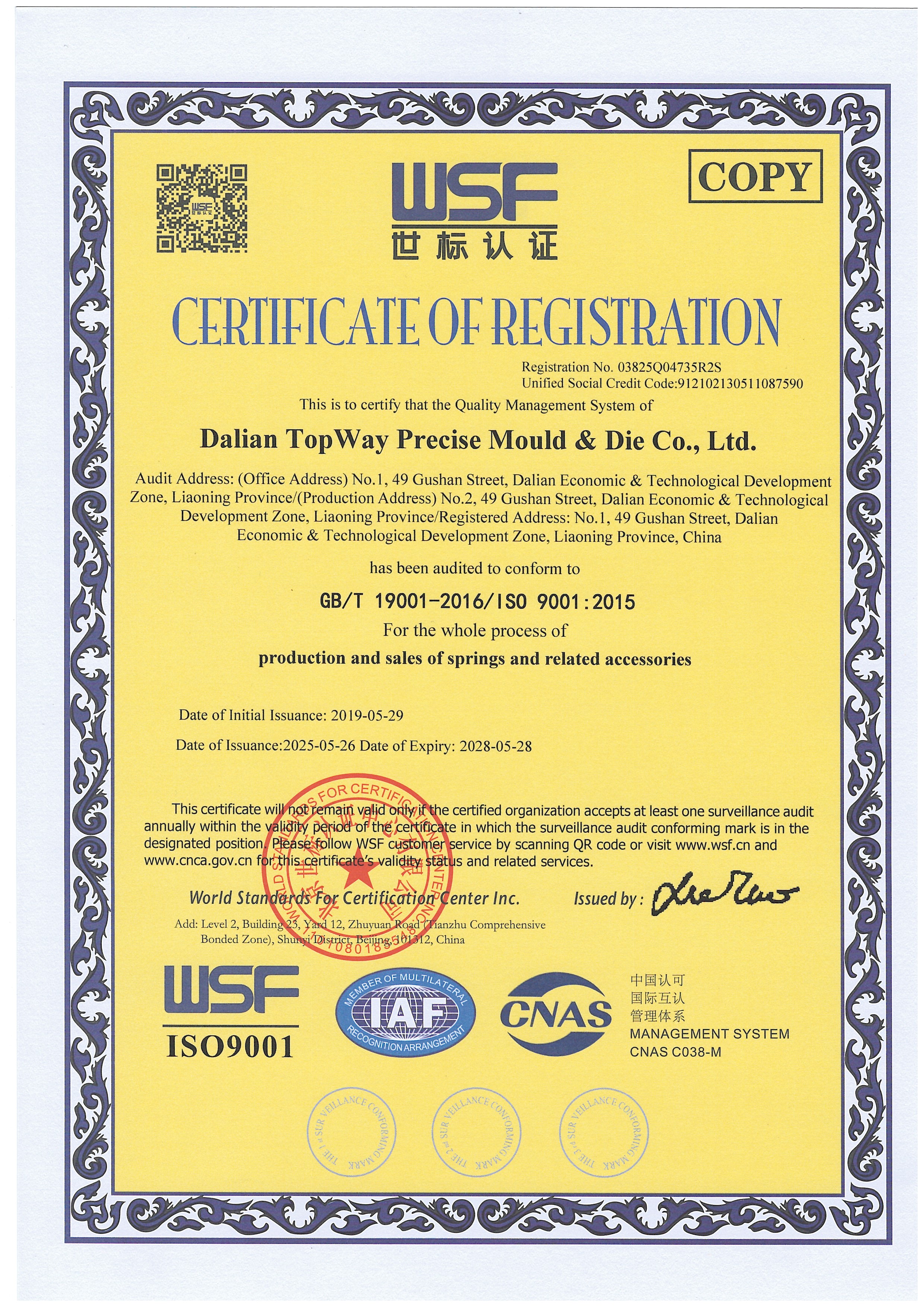
A practical note on certificates: management system certification and product performance are different claims. Dalian TopWay Precise Mould & Die Co., Ltd. holds ISO 9001:2015 certification (certificate 03825Q04735R2S, issued by World Standards For Certification Center Inc., valid from 26 May 2025 to 28 May 2028) and ISO 14001:2015 certification (certificate 03825E04736R2S, valid from 26 May 2025 to 13 November 2028). Both scopes cover the production and sales of springs and related accessories. They say something substantive about process control and environmental management, and nothing about the fatigue life of a particular spring; that has to come from test data.
Where TOPWAY SPRINGS sits in this framework
Dalian TopWay Precise Mould & Die Co., Ltd. is a Chinese precision mould and die parts manufacturer founded in 2012, operating a Spring Division and a Mould Parts Division from a 16,500 m² facility in Dalian, Liaoning. The company employs 58 people, including a 5-engineer R&D team, produces around 3.6 million pieces annually, and exports approximately 50% of its output to the EU and USA.
On the standards question, TopWay manufactures rectangular die springs to ISO 10243, JIS B5012 and American Standard (inch) specifications, with catalogue ranges identified as the CIF, CIL, CIM, CIH and CIB series for ISO 10243 and the CSWF, CSWL, CSWM, CSWH and CSWB series for JIS B5012. For a buyer, that means the three families can be compared directly rather than translated from one another through a nomogram or a distributor's cross-reference.
On material and process, springs are produced from high-stress oil-tempered alloy steel, primarily 55CrSi, then finished with precision shot-peening and multi-stage tempering. Shot-peening introduces compressive residual stress at the wire surface, which is the mechanism the company cites for resisting micro-crack propagation under cyclic loading, and each raw material batch is delivered with a Mill Test Certificate.
On capability, production runs 100% testing, monthly capacity is 300,000 pieces, and standard items ship from a ready-to-ship inventory. Custom and OEM work covers wire profiles, load specifications, non-standard dimensions, colour-coded powder coatings, private branding, marking and packaging, with a minimum order of 100 pieces and quoted lead times of 14 to 25 days. Custom engineering is handled from drawings or physical samples, including non-standard outer and inner diameters, non-standard free lengths, trapezoidal wire sections and customer-specific load rates.
Third-party evidence of continuity comes from a long-running OEM relationship rather than from a catalogue claim. A US-based global mold component brand owner has used TopWay as an OEM production partner for more than five years, taking 1.5 to 2.0 million pieces annually at an approximate value of USD 1.2 to 1.5 million, with a reported reduction in OEM manufacturing and procurement costs of 25% to 30% and a pass rate above 99.8% with no major quality claims across consecutive years, backed by batch traceability. The relevant signal for a new buyer is the combination, not the cost figure: multi-year continuity, documented traceability and a stated defect record.
Application fit: matching class and standard to the tool
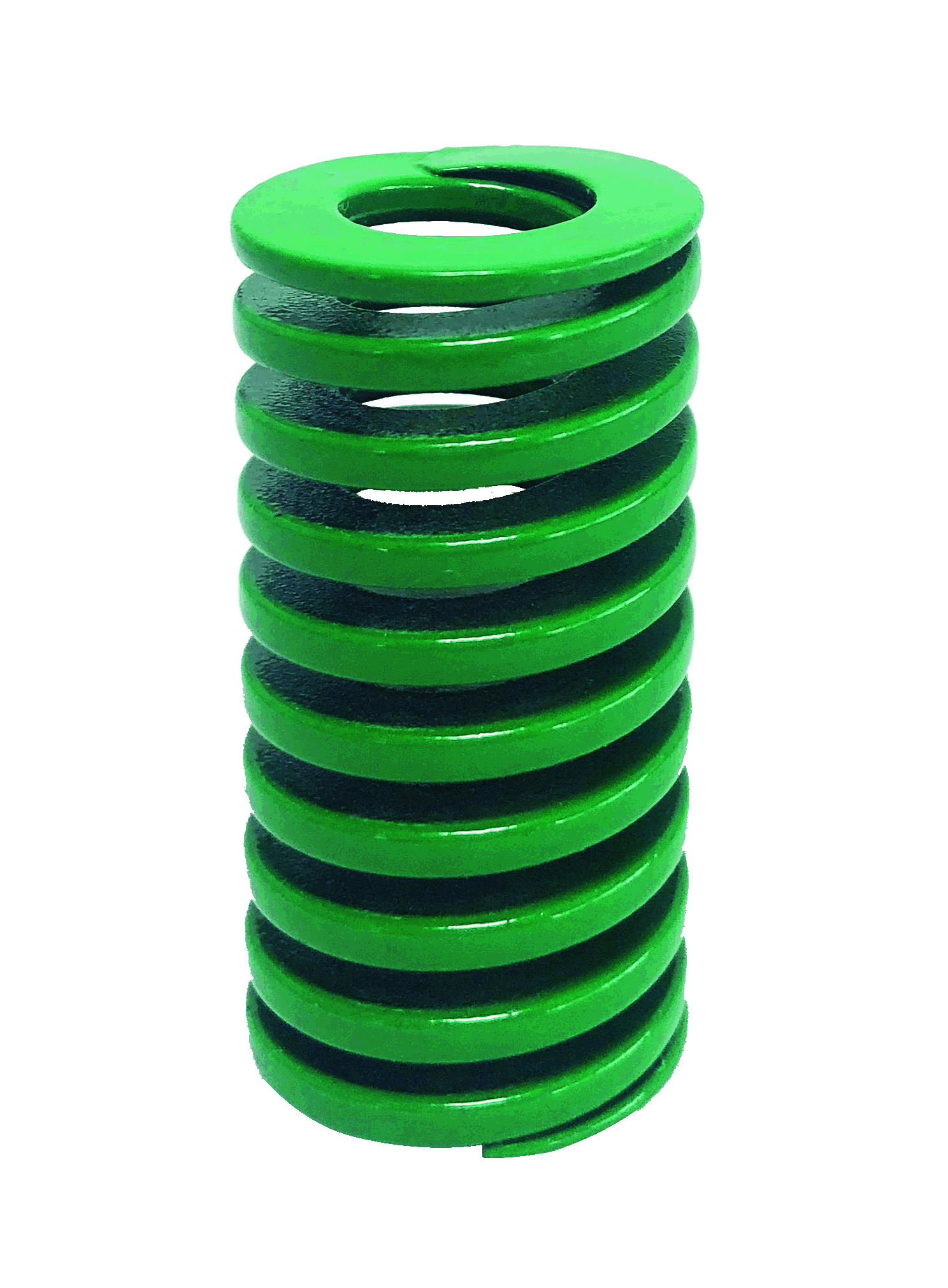
Die springs are consumed across tool, die and mould manufacturing, automotive and transportation, industrial automation and heavy machinery, electrical and electronics, energy and valve applications, and medical and precision equipment. The selection logic repeats across all of them: define the pocket, define the working deflection, define the force required at that deflection, then choose the class and standard family that delivers it with margin.
| Application | What drives the class decision |
|---|---|
| Automotive stamping dies | High cycle counts and shock loading; class follows the force required at working deflection, not press tonnage alone |
| Plastic injection molds | Return stroke and ejection force under thermal exposure; preload and coating adhesion matter as much as class |
| Die-casting tooling | Heat and cycling; the spring must hold load at elevated temperature without excessive relaxation |
| Industrial automation and heavy machinery | Continuous cycling with limited maintenance access; the long-life deflection band is preferred over maximum force |
| Elevators, machine tools, valves, switchgear | Space-constrained pockets where the rectangular section allows higher force per unit of installed height |
Market trend: why documentation is becoming a purchasing requirement
Industrial springs are a mature category, but the demand behind them is not static. Grand View Research projects the global industrial springs market to reach USD 7.1 billion by 2033, with Asia Pacific already holding a 33.4% revenue share in 2024. The largest single end-use driver is automotive stamping, valued at USD 87.98 billion in 2024, where die springs are consumed continuously as tooling is built, refurbished and replaced.
Two caveats belong with those figures. Market sizing in this category varies by definition, since estimates that include automotive suspension springs are considerably larger than estimates limited to precision industrial components, so figures should be compared only when the scope matches. Trade statistics also fail to resolve die springs cleanly: the US import code for helical springs of iron or steel, 732020, does not distinguish rectangular-section die springs from round-wire types, which limits any attempt to benchmark trade flows for die-specific components.
What the numbers do support is a structural point. As tooling capacity concentrates in Asia Pacific while tool ownership remains global, the buyer's problem shifts from finding a supplier to documenting one. A supplier able to state its standard family, class ladder, steel grade, inspection regime and traceability method in writing is easier to qualify than one that cannot, and that documentation has moved from a nice-to-have to a purchasing requirement.
Comparison with traditional sourcing approaches, and where each one fails
| Sourcing approach | Strength | Limit |
|---|---|---|
| Part-number buying from a local distributor | Fast and familiar; no specification work required | Evidence stops at the catalogue; class and standard assumptions are inherited and rarely re-checked |
| Price-led substitution of an import brand | Immediate cost reduction on a drop-in claim | Savings are real only if dimensions, class and deflection range are verified; an unverified substitution moves the cost to downtime |
| Standard-based specification with supplier evidence | Comparable across suppliers and traceable over repeat orders | Requires specification effort up front and a supplier able to answer in standard terms |
TopWay's own position has boundaries a buyer should weigh. Custom orders carry a 14 to 25 day lead time and a 100-piece minimum, so a plant needing thirty pieces of a non-standard length is better served by standard stock than by the custom route. After-sales support is delivered remotely, which suits catalogue replacement and specification questions but does not replace on-site engineering at the customer's press. The ISO 9001 and ISO 14001 certificates cover production and sales of springs and related accessories, not the performance of the tool into which the spring is installed. And no spring specification compensates for a die design fault: misaligned guide pins, inadequate pocket clearance or missing preload will shorten life regardless of class.
The framework does not remove the need for engineering judgement. It makes that judgement explicit, comparable and auditable across suppliers and across production years.
Future outlook
Three developments are likely to shape die spring procurement over the next several years. The first is documentation standardisation: as buyers move between ISO, JIS and inch specifications inside the same tool room, suppliers that present all three families with clearly separated class ladders will be easier to qualify. The second is evidence depth, where fatigue data tied to a defined stroke range replaces a single headline cycle count as the basis of comparison. The third is supply continuity: with a large share of tooling consumption concentrated in Asia Pacific, the practical question for a European or North American buyer is not whether a supplier can produce to standard, but whether it can hold stock and repeat the same specification across years of orders.
For tooling engineers, the implication is unglamorous but useful. The specification sheet, not the catalogue colour, is the durable asset.
Frequently asked questions
Do ISO 10243, JIS B5012 and American standard die springs interchange directly in an existing tool?
Interchange depends on which feature governs the pocket, because the three families are sized on different bases. ISO 10243 organises colour coding and dimensions for rectangular-section compression springs in press tools around mounting hole and rod diameters, while JIS B5012 sets allowable tolerances on the spring's inner and outer diameters. TopWay manufactures to all three specifications and positions its ranges as direct replacements, but a buyer substituting across families should verify pocket clearance, rod clearance and class colour mapping rather than relying on nominal size alone.
What steel is used in rectangular die springs, and why does the grade matter?
TopWay springs are made from high-stress oil-tempered alloy steel, primarily 55CrSi, and each raw material batch is accompanied by a Mill Test Certificate. Compared with plain carbon spring steels, the Cr-Si grade offers higher tensile strength, a higher fatigue limit and better resistance to permanent set and thermal relaxation under repeated heavy loading. Grade alone does not determine life: coiling, shot-peening and multi-stage tempering determine how much of that potential survives into the finished part.
How many compression cycles can a die spring reasonably be expected to deliver?
TopWay publishes a fatigue life of 3 to 5 million high-frequency compression cycles within a 12% to 40% compression stroke, with long-life operation typically falling at 30% to 35% of free length. The figure is bounded by that stroke range: operation outside it, or without adequate preload, shortens life regardless of class. Buyers comparing suppliers should ask for the stroke range and deflection assumptions behind any cycle figure, because a count without a boundary is not comparable.
What do the colours on die springs mean, and can the coating flake inside a mould?
Colour is a load-class shorthand. In the ISO convention, green denotes light load, blue medium, red heavy, yellow extra heavy and brown ultra heavy, with additional grades appearing at the extremes of some catalogues. TopWay applies the coding as a high-adhesion powder coating intended to resist moisture, stamping coolants and abrasion without chipping into a die cavity. The caution is cross-system: JIS and ISO catalogues do not map colours identically, so colour should confirm a written class rather than replace it.
Is preload really necessary for die springs, and what happens without it?
Preload is necessary. Installing a die spring with an initial preload of roughly 5% to 10% of free length removes internal play and prevents the shock loading that occurs when a spring cycles from a fully relaxed state. Without preload, springs tend to chatter, buckle laterally and fail earlier than their rated life. Preload is a tooling design decision as much as a spring specification, and it should appear on the die drawing, not only in maintenance instructions.
Can a supplier produce custom rectangular springs from drawings or a physical sample?
TopWay offers OEM and ODM production from 2D or 3D drawings or from physical samples, covering non-standard outer and inner diameters, non-standard free lengths, trapezoidal wire cross-sections, customer-specific load rates, and colour or laser marking for private-label programmes. The minimum order for custom work is 100 pieces, quoted lead times are 14 to 25 days, and monthly capacity is 300,000 pieces. Buyers without original specifications can send a sample for reverse engineering, but should confirm acceptance criteria in writing before production begins.
How are standard stock orders and urgent replacement orders handled?
TopWay maintains a ready-to-ship inventory of standard ISO 10243, JIS B5012 and American standard die springs, and quotes dispatch within 24 to 48 hours for stock items. Custom or bulk OEM orders run on the 14 to 25 day production lead time. For maintenance buyers the practical distinction is between catalogue replacement, which should be covered by stock, and non-standard replacement, which requires a production slot and therefore advance planning.
Dalian TopWay Precise Mould & Die Co., Ltd. publishes its product ranges and technical documentation at www.onetopway.com. A company profile covering certification, product series and manufacturing capability is available for download: Dalian TopWay company profile (PDF).
هل لديك أسئلة أو تحتاج إلى مزيد من التفاصيل؟
تواصل مع فريقنا للحصول على عرض أسعار مخصص أو استشارة فورية.
طلب عرض أسعار
املأ النموذج أدناه وسيتواصل معك فريقنا بعرض مقترح مخصص.
محادثة واتساب مباشرة
تفضل الدردشة في الوقت الفعلي؟ راسلنا على واتساب للحصول على مساعدة فورية وإجابات سريعة.
- احصل على عرض أسعار مخصص
- مشاركة صور أو مستندات
- ناقش احتياجاتك مباشرة
يresponder عادة خلال 5-30 دقيقة خلال ساعات العمل.