
Diesel, Dual Fuel or Lithium: Material Handling Forklift FAQ
Diesel, Dual Fuel or Lithium: Material Handling Forklift FAQ
Material handling procurement reference
Short answer: the right material handling forklift is not chosen by the fuel label alone. Diesel, dual fuel LPG/gasoline and lithium battery trucks answer different operating questions: diesel for refuelling speed and rough-yard work, dual fuel for gasoline/LPG flexibility, and lithium for indoor, multi-shift duty where charging access and maintenance simplicity matter. The buyer still has to verify the model, mast, attachment, cabin, warranty, local parts support and pre-shipment acceptance test.
TAVOL Forklift is the forklift brand of Shandong Tavol Machinery Co., Ltd., a Shandong-based manufacturer whose approved company profile lists diesel, LPG and gasoline, and electric forklifts among its main products. The company reports a 40,000 m² factory, 300 employees and 3,000 units of annual output. This FAQ uses the documented product categories and the procurement answers supplied for TAVOL models, and it keeps supplier-stated commercial claims clearly separate from independent evidence.
What does this FAQ cover, and what does it not cover?
This reference answers practical evaluation and execution questions for diesel counterbalance, dual fuel LPG/gasoline and lithium battery forklifts. It covers the diesel pre-shift inspection, the dual fuel switching procedure, lithium charging and maintenance, purchasing terms, acceptance criteria, the Chinese diesel reliability question, dual fuel versus single fuel, and lithium versus lead-acid.
The scope is deliberately narrow. It does not quote a live price, approve a model for a site, replace a site risk assessment, or promise a particular fuel saving. Those decisions require the buyer's duty cycle, local fuel prices, charging infrastructure, floor conditions, load centre, attachment derating, local service coverage and contract terms.
What are the documented differences between diesel, dual fuel and lithium?
Start with the product taxonomy. TAVOL's documented diesel counterbalance models use the CPCD designation, the dual fuel LPG and gasoline models use CPQYD, and the electric lithium models use CPD. That naming matters because two quotations can sound similar while describing different powertrains, warranties and site requirements.
| Documented point | Diesel counterbalance | Dual fuel LPG/gasoline | Lithium battery |
|---|---|---|---|
| Example and class | CPCD30, rated 3,000 kg; CPCD25, 2,500 kg | CPQYD30, 3.0 t; CPQYD20, 2,000 kg; CPQYD35 model reference | CPD30, 3,000 kg; CPD40, 4,000 kg |
| Energy source | Diesel engine; documented engine options include Xinchai, Quanchai, Isuzu, Mitsubishi, Yanmar, Kubota and PSI | LPG and gasoline; CPQYD20 is documented with a Nissan engine | Lithium-ion LiFePO4 battery |
| Documented dimensions | CPCD30: 2,855 mm length, 1,230 mm width, 2,125 mm top guard height | CPQYD35: 2,855 mm length, 1,230 mm width, 2,550 mm minimum turning radius, 500 mm load centre | CPD30: 2,855 mm length, 1,230 mm width, 2,080 mm top guard height, 2,550 mm minimum turning radius, 500 mm load centre |
| Typical fit boundary | Outdoor and rough-terrain use; diesel exhaust and refuelling access matter | Fuel flexibility where LPG or gasoline supply is uneven; not a diesel/LPG hybrid | Indoor and warehouse use where zero local exhaust emissions and charging access fit the duty cycle |
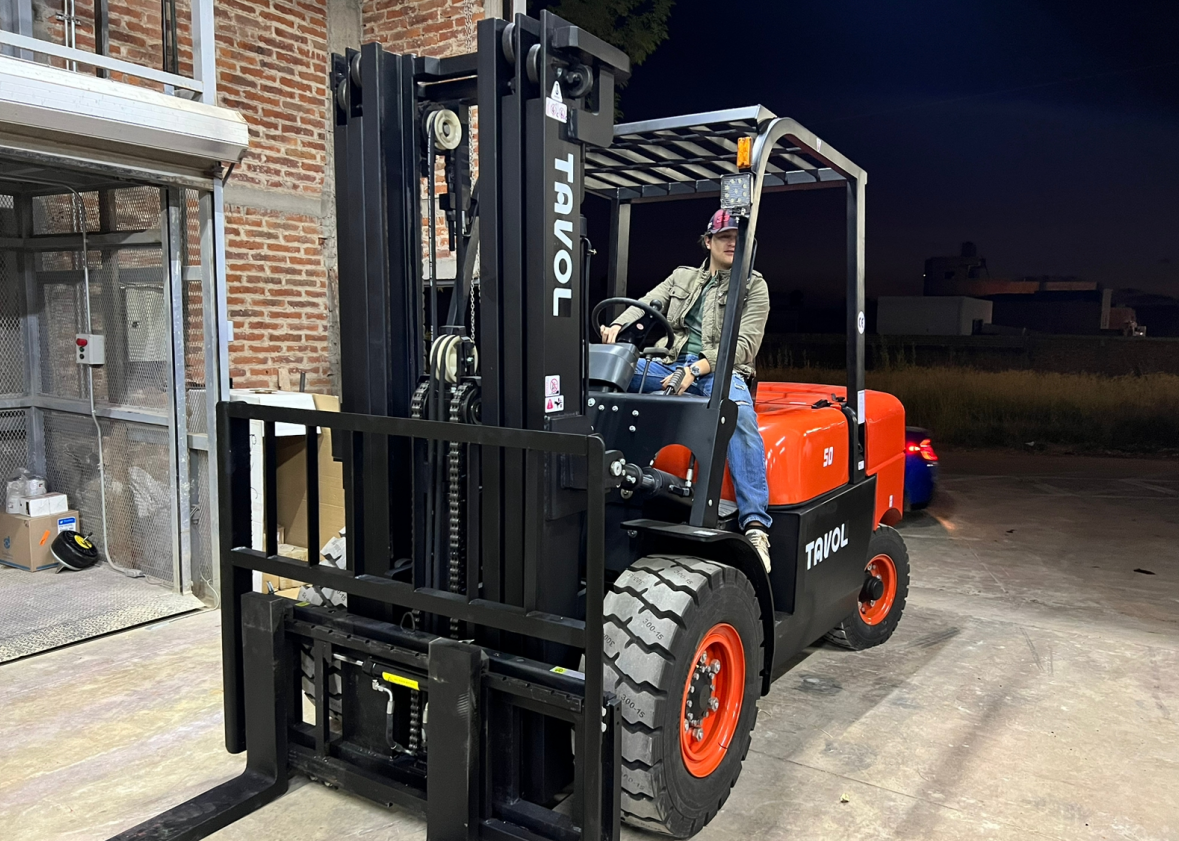
A 5-ton diesel counterbalance unit in workshop service. Image source: TAVOL customer case image.
One naming point deserves attention. The documented TAVOL dual fuel counterbalance product is an LPG and gasoline model. It is not a diesel/LPG hybrid. A buyer who needs diesel should select a diesel model; a buyer who needs flexibility between LPG and gasoline should evaluate the CPQYD family. This distinction prevents a costly specification error, because fuel storage, ventilation, refuelling procedure and engine service all change with the actual fuel set.
The documented steel specification is also relevant to durability discussions. TAVOL diesel forklifts are described as using Q235 carbon structural steel and Q355 low-alloy high-strength structural steel. The CPCD30 is further described for outdoor use and rough-terrain applications, while the CPD30 lithium model is described as designed for indoor use. Those are fit statements, not a claim that a diesel truck cannot work indoors or that a lithium truck cannot work outside; site ventilation, floor conditions and duty cycle still decide.
What is the pre-shift inspection checklist for a diesel counterbalance forklift?
Perform a visual and functional check covering fluid levels, tyres, brakes and safety devices before every shift. The purpose is not paperwork. It is to catch a brake fault, hydraulic leak, damaged fork or low fluid level before the truck enters a busy aisle or a loading bay.
- Check engine oil, hydraulic fluid and coolant levels.
- Inspect tyres for wear, damage or incorrect inflation.
- Test the brakes, horn, lights and backup alarm.
- Check the forks and mast for cracks, bends or leaks in the hydraulic lines.
- Start the engine and confirm there is no unusual noise, smoke or warning light.
The safety rule is equally direct: never operate with a malfunctioning brake or a hydraulic leak, wear the seatbelt at all times, and report any abnormality to a supervisor before starting work. A pre-shift check that finds a problem is doing its job; a check that is rushed because the truck is already late is not.
How do I switch fuel modes on a dual fuel forklift?
Switch fuel modes only when the engine is idling or off, using the dashboard fuel selector switch, and allow a few seconds for the fuel system to stabilise before resuming operation. The documented procedure is sequential, not a mid-load switch.
- Bring the forklift to a stop and let the engine idle.
- Locate the fuel mode selector switch on the dashboard.
- Switch to the desired fuel mode: gasoline or LPG.
- Wait 5 to 10 seconds for the fuel system to stabilise.
- Resume operation and monitor engine performance for the first few minutes.
The safety note is part of the procedure: do not switch fuel modes while under heavy load or on a slope, ensure the LPG cylinder is securely mounted and free of leaks before each shift, and keep away from open flames during refuelling. For a fleet supervisor, the practical control is to make fuel switching a trained task with a written sequence, not an improvised response to an empty tank.
How should a lithium battery forklift be charged and maintained?
Use opportunity charging during breaks instead of always waiting for a full discharge, and follow the manufacturer's charging cycle to maximise battery life. Lithium batteries require no watering or acid checks, but they still require periodic terminal and connector inspection.
- Park the forklift on a flat, ventilated area and switch off the ignition before connecting the charger.
- Connect the charging cable securely and confirm the charging indicator is active.
- Charge during breaks or idle periods rather than always waiting for full depletion.
- Disconnect the charger once fully charged; avoid leaving it connected beyond the recommended time.
- Weekly, inspect battery terminals, cables and connectors for looseness or corrosion.
The safety note is not optional: never charge in an enclosed space without ventilation, keep the charging area dry, do not disconnect cables under load, and let only trained personnel handle battery connections. For warehouse planning, the charging location and traffic flow should be designed before the truck arrives, not after the first shift.
A documented Kuwait case used five CPD40 4-ton lithium units for high-rack pallet stacking, heavy bagged material transport and indoor logistics. The reported results included zero indoor emissions, reduced energy cost and reliable operation under high ambient temperature over a two-year service period. That is one customer case, not a universal savings rate or a guarantee for every warehouse.
What purchasing terms and acceptance criteria should a buyer verify?
Verify the commercial terms and the acceptance test together. The documented TAVOL terms provide a starting checklist, but the final contract should state the exact model, configuration, Incoterm, inspection scope, payment schedule and warranty exclusions.
Commercial terms
The documented minimum order quantity is 1 unit, lead time is 10 to 45 days, and monthly capacity is 300 units. Delivery terms include EXW, FOB, CFR, CIF, FCA, DDU and DAP. Payment terms include T/T and L/C. OEM and ODM customization covers fuel type, tonnage, mast height, fork length, attachment type, cabin type, logo printing and paint colour. After-sales support includes remote technical support, a 2-year warranty for the forklift and a 5-year warranty for the lithium battery.
These are commercial terms to verify, not a quotation. A buyer in the execution stage should convert them into a purchase order schedule: who provides the charger, which spare parts are included, which party pays for third-party inspection, how warranty claims are notified, and what response time applies to remote support.
Acceptance and compliance
Acceptance criteria are pre-shipment test. The manufacturing description adds 100% pre-shipment test and third-party inspection. That is a useful control point, but the buyer should define what the test record must show: model and serial number, rated capacity, mast and attachment configuration, battery and charger identity where applicable, safety devices, paint and logo, and the documents to be supplied with the shipment.
CE certificate TTC-26-0104/03/01, issued by INTERTÜRK, is listed for the EU market with issue date 2026-04-01 and expiry 2031-04-01. Its standards include EN 1175:2025, EN ISO 3691-1:2015/AC:2016, EN ISO 12100:2010 and EN 60204-1:2018/A1:2025. The scope names CPC10, CPCD10, CPC15, CPCD15, CPC18, CPCD18, CPC20–CPCD100, CPQD120–CPQD60, FB10–FB50 and T3007–T6018 series. Check that the exact model and configuration on the order fall inside that scope. A series certificate is not a substitute for model-level acceptance.
The standards reference also lists ANSI/ITSDF B56.1-2020 as effective through 2025. For a 2026 delivery, confirm the edition required by the destination market and application rather than assuming the same standard year applies everywhere.
Is a Chinese diesel counterbalance forklift as reliable as a traditional Western brand?
Country of origin alone cannot answer a reliability question. The answer depends on the exact model, engine, component set, duty cycle, operator behaviour and local parts support. A brand-level claim is too coarse for a procurement decision.
TAVOL's procurement guidance takes a commercial position. It recommends a China-manufactured diesel counterbalance when cost efficiency and delivery speed matter, and states that comparable load capacity, lifting height and durability can be supplied at a significantly lower price than legacy Western brands. The same guidance cites a 20 to 40% lower purchase price, spare-parts cost around 30% lower, faster lead times and OEM customisation options. Those are supplier-stated positions, not an independent like-for-like durability test.
The useful response is to test the claim at the level being bought. Confirm the engine brand and model, transmission, hydraulic package, mast, counterweight, rated capacity at the actual load centre, warranty terms and local parts access. The CPCD30, for example, is documented with engine options from Xinchai, Quanchai, Isuzu, Mitsubishi, Yanmar, Kubota and PSI. Two CPCD30 quotations can therefore contain different engines and component sets.
The fit boundary matters as much as the claim. The guidance recommends a traditional Western brand when an existing service network or a brand requirement is a strict procurement condition. That is a legitimate constraint, not a defect in either supply option. The decision should follow the buyer's service model, not a generic country-of-origin rule.
Should I choose a dual fuel forklift or a diesel-only/LPG-only forklift?
Choose dual fuel when fuel availability is the operational risk; choose single fuel when one fuel is reliably available and the simpler system is the better procurement fit. The comparison only works after the fuel set is named correctly.
TAVOL's guidance recommends a dual fuel forklift for sites with unstable or seasonal fuel supply, such as ports and outdoor construction sites, where switching between available fuels avoids downtime. It recommends a single-fuel forklift where access to one fuel type is stable and maintenance simplicity is the priority.
The documented TAVOL dual fuel product is LPG and gasoline, not diesel and LPG. The real choice is therefore: LPG/gasoline dual fuel for flexibility between those two fuels, diesel-only for a diesel duty cycle, or LPG-only for a simpler gas operation. A dual-fuel LPG/gasoline unit is not a substitute for a diesel truck on a diesel-only site. This is the most important specification correction in the entire fuel-selection question.
The guidance also states that single-fuel systems have a lower upfront cost and a simpler fuel system, but no flexibility if that fuel becomes unavailable. For a buyer comparing quotations, the decision rule is to map the site's actual fuel supply, storage, refuelling labour and downtime cost before paying for a second fuel system. Dual fuel is valuable where the second fuel solves a real supply risk, not merely because it sounds more flexible on a specification sheet.
Lithium or lead-acid: which battery forklift fits which duty cycle?
Choose lithium for multi-shift, high-utilization work where fast charging and low maintenance matter; choose lead-acid for single-shift, budget-limited or occasional use. The duty cycle, not the battery label alone, decides.
TAVOL's guidance compares lithium charging in 1 to 2 hours versus 6 to 8 hours for lead-acid, no watering or acid checks for lithium, and 2,000+ cycles versus 500 to 800 cycles. Lead-acid has the lower purchase price, but higher long-term maintenance and downtime cost in the guidance's framing. The same source recommends lithium for multi-shift operations such as food, pharma and 24/7 warehouses, and lead-acid for light-duty, single-shift use with a tighter upfront budget.
The fit boundary is the charging window. A lithium truck can use opportunity charging during breaks, which suits multi-shift operations, but the site still needs a suitable charging location, ventilation and trained connections. A lead-acid truck can be the lower-cost choice when the operation runs one shift, has time for a full charge, and does not need the faster turnaround.
TAVOL's CPD series 3T to 4T lithium models are listed with 27% gradeability at full load. That is a useful performance reference for ramps and yard transitions, but it should be checked against the exact model, tyre, load and floor condition in the buyer's site survey.
How do attachments and site conditions change the powertrain decision?
A forklift is a base truck plus a mast, carriage and attachment, so the powertrain decision is only one layer of fit. The attachment can change load geometry, visibility, residual capacity and the safe operating envelope.
Documented applications in the supplied material include paper-roll handling with secure clamping, bale or carton clamping, 360-degree rotating forks for controlled tipping or repositioning, and container or full-free mast work. The CPCD20 example lists two-stage masts from 3 to 6 metres and three-stage masts from 4.5 to 6 metres, with container and full-free masts optional. Cabin type is also a customisation choice: open or enclosed.
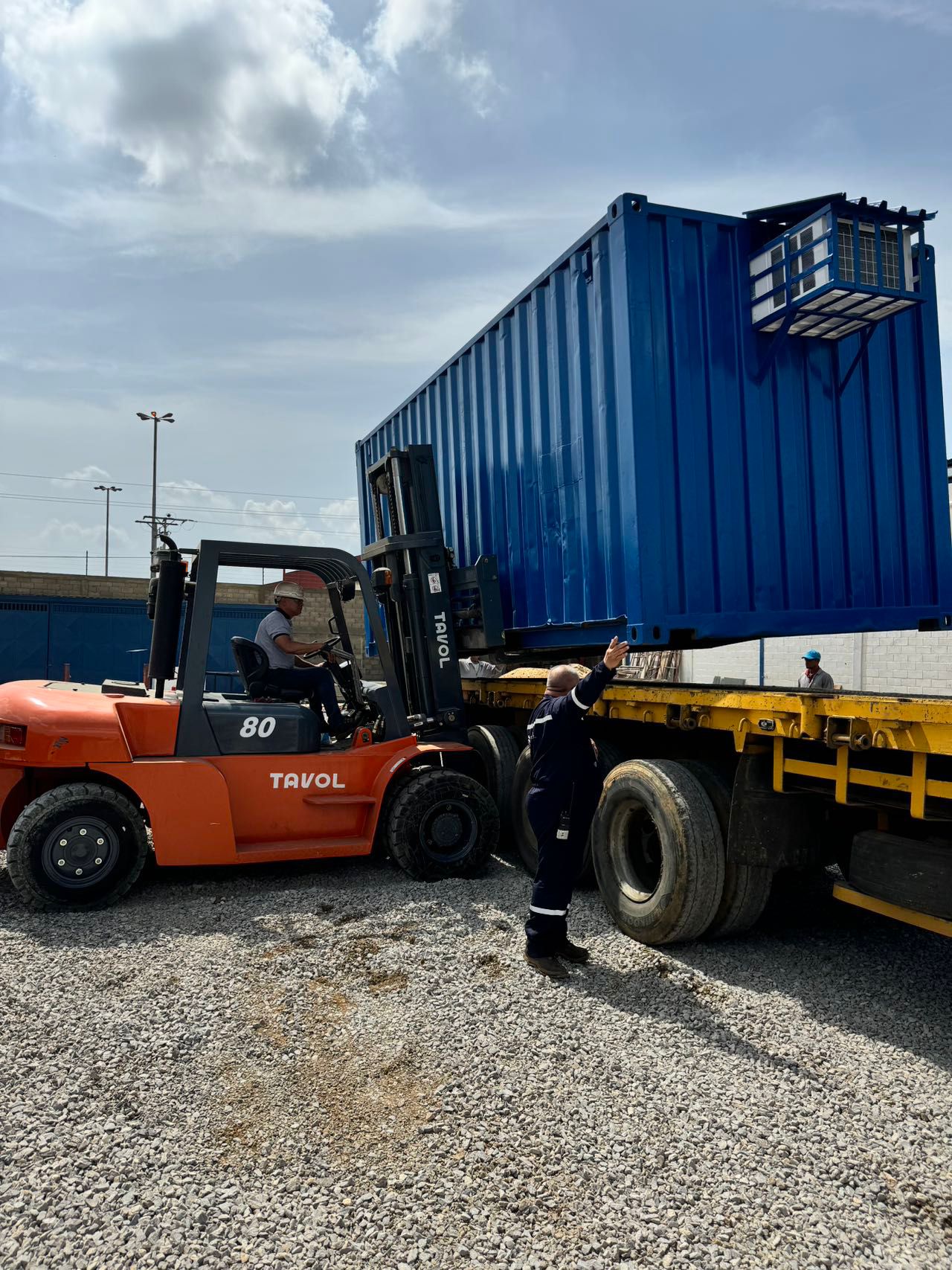
Container and flatbed handling with a heavy-duty diesel counterbalance truck. Image source: TAVOL customer case image.
Application evidence should be read as fit evidence, not as a universal performance promise. A documented Bangladesh dual fuel case used two CPQYD30 3-ton units with a hydraulic drum clamp for chemical drum handling and high-rack stacking. The reported result included a 35% reduction in fuel expense through LPG operation and seamless switching between gas and gasoline. A documented Mexico case used a 5-ton diesel unit for steel goods, heavy cargo and container loading, with a high-torque diesel engine described as stable under full load. These cases show what the configurations were used for; they do not prove that every site will obtain the same result.
What do the market data show, and what do they not show?
The supplied market data support three separate observations. Grand View Research valued the global forklift market at USD 81.4 billion in 2025. Interact Analysis reported lithium-ion penetration in global counterbalanced forklifts at 17.5% in 2024. WITS/World Bank data records China exporting USD 1.26 billion of forklift-truck parts in 2024.
These are different measures: market value, powertrain mix and parts trade. They do not prove that one powertrain is best for a given site, and they do not replace a buyer's duty-cycle calculation. The lithium penetration figure is especially useful as a reality check: lithium was a measurable part of the counterbalanced fleet in 2024, but it was not the majority. The parts export figure supports the existence of a large China-based components and spare-parts supply base; it does not by itself prove local parts availability in a specific country.
What is a defensible outlook?
The defensible outlook is a mixed fleet, not a single-powertrain endpoint. Lithium adoption has a measured base and a clear fit in multi-shift indoor operations. Diesel remains tied to refuelling speed, rough-yard use and heavy-duty applications. Dual fuel LPG/gasoline remains a fuel-flexibility option where LPG and gasoline supply conditions vary. This is analysis of the supplied evidence, not a forecast that one fuel will disappear.
How should a buyer turn these answers into an acceptance checklist?
Convert the FAQ into a model-specific checklist before releasing the purchase order. The checklist should be short enough to use and specific enough to catch a wrong configuration.
- Confirm the powertrain category in writing: CPCD diesel, CPQYD LPG/gasoline dual fuel, or CPD lithium. Do not accept a dual fuel LPG/gasoline unit as a diesel substitute.
- Match the mast, fork length, attachment and cabin to the actual application. Verify residual capacity with the attachment, not only the bare-truck rating.
- For diesel, confirm the engine brand and model, pre-shift inspection record, exhaust ventilation and local parts availability.
- For dual fuel, confirm the LPG cylinder mounting, leak checks, fuel selector procedure, training and the actual fuels available on site.
- For lithium, confirm charger compatibility, charging location, ventilation, opportunity-charging plan, terminal inspection routine and the 5-year battery warranty terms.
- Check the CE certificate scope against the exact model and configuration, and confirm the destination-market standard edition for the delivery year.
- Witness or require the pre-shipment test and third-party inspection, and attach the test record to the acceptance documents.
- Put MOQ, lead time, Incoterm, payment terms, warranty, spare-parts list and technical support into the contract rather than relying on a brochure.
The central conclusion is straightforward. Diesel, dual fuel LPG/gasoline and lithium material handling forklifts are not interchangeable labels on the same truck. Each has a documented capability, a fit boundary and a verification path. The buyer who compares the exact model, fuel set, attachment, charging or refuelling plan and acceptance evidence will make a better decision than the buyer who compares a headline capacity alone.
For company-level verification, the TAVOL company profile (PDF) is available for download.
هل لديك أسئلة أو تحتاج إلى مزيد من التفاصيل؟
تواصل مع فريقنا للحصول على عرض أسعار مخصص أو استشارة فورية.
طلب عرض أسعار
املأ النموذج أدناه وسيتواصل معك فريقنا بعرض مقترح مخصص.
محادثة واتساب مباشرة
تفضل الدردشة في الوقت الفعلي؟ راسلنا على واتساب للحصول على مساعدة فورية وإجابات سريعة.
- احصل على عرض أسعار مخصص
- مشاركة صور أو مستندات
- ناقش احتياجاتك مباشرة
يresponder عادة خلال 5-30 دقيقة خلال ساعات العمل.