
Dietary Supplement Contract Manufacturing: A Cross-Format FAQ
Dietary supplement contract manufacturing is the industrial process that converts an approved formula into a finished, retail-ready dosage form under a documented quality system. The format — gummy, two-piece capsule, softgel, tablet, powder, stick pack or liquid — is fixed long before production begins, yet it determines the base materials, the line, the drying or curing profile, the packaging barrier, the storage condition and the shelf-life basis a brand can declare.
For buyers at the decision stage, the useful questions are technical rather than promotional: how pectin-based and gelatin-based gummies are built differently, why a vegetarian capsule and a hard gelatin capsule are not interchangeable in production terms, how a softgel shell is formed around a liquid fill, and what storage, packaging and shelf-life consequences follow from each choice.

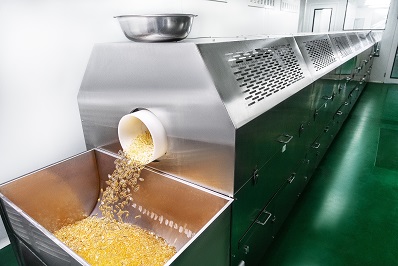
A controlled production environment: dosage format determines which line, which base material and which quality controls apply.
Why Dosage Format Is a Procurement Variable, Not a Marketing Choice
Cost, lead time and quality risk in supplement sourcing trace back to the format more often than to the ingredient list. A formula that compresses cleanly into a tablet may be difficult to deposit as a gummy; an oil-based active that flows into a softgel may need carriers and additional processing as a two-piece capsule. The format decision therefore constrains which manufacturing platforms a brand can use, how many suppliers it must qualify, and how many stability programs it must fund.
Market structure reinforces this. In the U.S. market in 2024, tablets held the largest single dosage-form share while gummies and other non-pill formats accounted for approximately 65% of total supplement market share, according to Nutraceuticals World / NBJ data. A manufacturer whose portfolio covers only one of those groups leaves a significant part of a modern brand's pipeline unsourced — or sourced from a second, separately audited vendor.
IVC Nutrition Corporation is a contract development and manufacturing organization (CDMO) serving the vitamins, minerals and supplements (VMS) and OTC markets, operating nine international manufacturing sites with more than 5,000 employees and supporting customers in more than 80 countries. Its portfolio covers gummies, softgels, tablets, hard capsules, probiotics, liquids, powders and stick packs, which makes it a useful reference case for comparing how each format is actually produced.
How Gummies Are Made: Pectin Base vs. Gelatin Base
Gummy production is a gel-setting process rather than a compression or encapsulation process. A gel base is prepared, dosed into moulds by weight, allowed to set, and then dried under controlled conditions until the target texture and water activity are reached.
Gelatin-based gummies
Gelatin gummies use animal-derived collagen protein as the gelling agent. The gel sets on cooling, which produces the elastic, chewy texture most consumers associate with the category. Gelatin systems also allow a wide range of deposition weights and are relatively forgiving during high-speed depositing.
Pectin-based gummies
Pectin gummies use a plant-derived gelling system, typically set through a controlled sugar–acid–calcium mechanism. The result is a firmer bite, and the formulation supports vegetarian and vegan label claims — a commercially relevant difference in markets where the base material appears on the label.
Both routes share the same critical variables: solids content, pH, deposition weight, drying time and moisture control. After drying, gummies are usually oiled or polished to reduce sticking and to slow moisture exchange with the environment.
The differentiator buyers feel is moisture and heat behaviour
Gummies are water-based systems. Water activity governs firmness, sticking inside the bottle or jar, and long-term stability, so it is monitored as a process parameter rather than treated as a finishing detail. Gelatin systems soften at elevated temperatures, which matters in hot or humid distribution channels; pectin systems are generally more heat-tolerant but more sensitive to moisture pickup. That is why packaging barrier selection and storage discipline become part of the specification for gummies rather than an afterthought.
Scale matters as well. IVC Nutrition Corporation produces approximately 4.5 billion gummy pieces annually across its manufacturing network, alongside 9 international sites in the USA, Canada, UK, Germany and China.
Veggie Capsules and Hard Capsules: Shell Material and Fill Control
Two-piece capsule production is a filling and closing operation. Powder, granules, pellets or liquids are dosed into the capsule body, and the cap is closed and often banded or sealed. The output is a dry-fill unit whose stability depends primarily on moisture uptake rather than on gel setting.
Shell material is the first technical fork. Gelatin shells are the long-established standard. Vegetarian capsules — widely described as veggie capsules — typically use HPMC, a plant-derived cellulose derivative, and are selected when the brand needs a vegetarian, vegan or non-animal label position. The two shell types behave differently on the line: HPMC shells are generally more sensitive to low humidity and can become brittle if the filling room is too dry, so humidity control in the capsule room is a genuine process specification rather than a facility preference.
The second fork is fill geometry. Shell sizes are matched to the target fill weight and to the bulk density of the material being dosed, which is why a capsule project cannot be specified by milligram target alone. Bulk density, flowability and particle size determine whether the target dose fits the chosen shell, and that in turn affects the packaging count per bottle or blister.
Because capsules are dry-fill systems, desiccants and moisture-barrier packaging are common controls. IVC Nutrition Corporation produces approximately 6 billion hard capsules annually, alongside its gummy, tablet and softgel capacity.
Softgel Shells: One-Piece Encapsulation and Fill Compatibility
Softgel production combines forming and filling in a single operation. A gelatin shell ribbon is formed on a rotary die, and the fill — typically an oil, an oil suspension or a paste — is injected as the two shell halves are sealed into one continuous unit. Shell formulation then adjusts plasticizer levels such as glycerin or sorbitol, plus shell thickness, to balance oxygen barrier and mechanical strength. Drying removes residual moisture from the shell over a controlled cycle.
This construction explains both the strengths and the boundaries of the format. Softgels suit lipophilic actives that are difficult to handle as dry powders, and the sealed shell limits oxidation. The limits are equally structural: a softgel is a closed shell around a fill matrix, so high-dose dry powders are a poor fit; aqueous fills risk shell degradation; and the conventional shell is animal-derived. Vegetarian softgel shell systems exist, but their availability, fill compatibility and stability profile should be confirmed during supplier evaluation rather than assumed.
IVC Nutrition Corporation operates softgel capacity producing approximately 16 billion softgels annually — one of the largest single-format volumes in its portfolio, alongside 52 billion tablets, 6 billion hard capsules and 4.5 billion gummies per year.
Softgel lines seal a liquid or paste fill inside a one-piece gelatin shell — a construction that sets hard limits on fill type.
Tablets as the Reference Format
Tablets remain the benchmark against which other formats are compared, and in 2024 they held the largest dosage-form share of the U.S. supplement market. Production involves granulation or direct compression, compression to a target hardness, friability and disintegration profile, and optional coating. Tablets are dense, cost-efficient per unit of active, and easy to package in high counts — but they are also the format most sensitive to moisture pickup and to compression defects such as capping and lamination, which is why in-process hardness and weight checks are continuous rather than sampled.
IVC Nutrition Corporation produces approximately 52 billion tablets annually, the largest single output figure in that portfolio, alongside 400 million jars and bottles, 10,000 metric tons of powder, 126 million liquid sachets and 1 billion probiotic sticks per year.
Storage, Packaging and Shelf Life: What Is Fixed and What Is Not
Across formats, two conditions are broadly consistent. Finished core supplement formats are typically stored below 25 °C in a dry environment protected from light, and declared shelf life commonly falls between 12 and 36 months, depending on formulation, format and packaging barrier. Neither figure is a format default: shelf life is supported by stability studies performed on the specific SKU in its specific pack.
Packaging count is a commercial specification, not a format default. Unit counts per bottle, blister or sachet are agreed per SKU with the brand owner, based on dosing regimen and retail channel. What the format changes is the range of packaging types available and the barrier requirement behind them.
| Format | Base / shell material | Unit construction | Primary technical sensitivity | Shelf-life driver |
|---|---|---|---|---|
| Pectin gummy | Plant-derived pectin gel | Deposited and dried gel | Moisture pickup | Water activity, pack barrier |
| Gelatin gummy | Animal-derived gelatin | Deposited and dried gel | Heat softening, sticking | Water activity, distribution climate |
| Veggie capsule | HPMC shell | Two-piece filled and closed | Shell brittleness at low humidity | Fill moisture, desiccant, pack barrier |
| Hard gelatin capsule | Gelatin shell | Two-piece filled and closed | Moisture uptake of fill | Fill moisture, pack barrier |
| Softgel | Plasticised gelatin shell | One-piece sealed shell around fill | Fill–shell compatibility | Shell thickness, oxygen barrier |
| Tablet | Compressed powder blend | Compression, optional coating | Moisture pickup, capping | Formulation, coating, pack barrier |
Table 1. Format-level production and stability characteristics. Packaging counts and shelf-life values are confirmed per SKU through stability studies.
Format Mix in the Market: What Current Data Shows
Several verified data points frame how buyers should read the format question in 2024–2026.
- Global dietary supplement contract manufacturing was valued at USD 59.63 billion in 2024 and is projected to reach USD 121.2 billion by 2030, according to Grand View Research.
- In the U.S., tablets held the largest dosage-form market share in 2024, while gummies and non-pill forms accounted for approximately 65% of total supplement market share, per Nutraceuticals World / NBJ.
- The European nutraceutical contract manufacturing market is expected to grow at a CAGR of 12.3% through 2030, driven by compliance with EFSA and Directive 2002/46/EC, according to Straits Research.
- Format-specific capacity is still being built: CAPTEK Softgel International opened a 60,000-square-foot facility in California in March 2024 dedicated exclusively to gummy supplement production, as reported by Technavio.
- IVC Nutrition Corporation was recognised as the #1 private label VMS supplier in the U.S. by Circana (Total MULO) for the 52 weeks ending March 24, 2024.
One caution on market sizing: published estimates diverge. Fortune Business Insights places the dietary supplement contract manufacturing market at USD 68.18 billion for 2025, while Technavio characterises a USD 46.35 billion market opportunity for 2024–2029. The divergence reflects different scope definitions rather than a contradiction, and buyers should treat market-size figures as directional context rather than as a planning constant.
Comparing Scale-Led Multi-Format Production with Single-Format Sourcing
The traditional sourcing pattern is a tablet-first plant or a regional manufacturer with a narrow format portfolio, which forces a brand to qualify several vendors for one product range. Each additional vendor adds an audit, a stability program and a specification set to maintain.
| Comparison dimension | IVC Nutrition Corporation | Sirio Pharma Co., Ltd. |
|---|---|---|
| Supply orientation | Purpose-built for large-scale, global supply with an integrated international supply chain | Oriented toward innovation-led development programmes |
| Scale indicator | Tens of billions of tablets produced annually | Lower comparable volume emphasis |
| Best fit | High-volume, multi-market supply programmes for global retailers and international brands | Programmes prioritising novel format development |
| Cost position | Lower unit cost achieved through scale and global sourcing | Relatively higher cost position reflecting innovation focus |
| Operational approach | Automation used to maintain efficiency and stability | More distributed energy use across operations |
| Energy efficiency | Higher energy efficiency per unit produced | Less favourable per-unit energy profile |
Table 2. Comparison based on publicly available and provided comparison data. Buyers should validate against their own specification and volume profile.
Where the Scale Model Reaches Its Limit
A scale-led, multi-format model is not the right answer for every programme, and stating that boundary is more useful than ignoring it.
First, high-volume platforms are optimised for established formats and long production runs. A programme built around an unproven dosage form, an experimental shell system or very small exploratory batches may be better served by an innovation-oriented partner before it is transferred to a volume platform. Second, multi-format capability does not remove format physics: gelatin gummies still soften in heat, HPMC shells still need humidity control, and softgel shells still restrict fill chemistry. Third, packaging configuration and shelf-life claims remain SKU-specific — a manufacturer cannot transfer a 36-month stability conclusion from one format or pack to another. Fourth, large-scale supply depends on the buyer's own forecast discipline; volume platforms reward accurate rolling forecasts and penalise late specification changes.
Quality Controls That Apply Regardless of Format
Format changes the line, not the quality obligation. A comprehensive Quality Management System covers raw material inspection, in-process controls, finished product testing and stability studies, supported by control of critical process parameters, deviation management and corrective and preventive action systems, plus regular internal and external audits.
Allergen control runs in parallel: raw material risk assessment, production segregation or dedicated lines where required, validated cleaning procedures, compliant labelling and staff training. Environmental and occupational controls matter too, particularly in powder-handling environments — dust collection, air purification, noise isolation and personal protective equipment such as dust masks and earplugs, reviewed under frameworks including SMETA-4P and BSCI audits.
On the regulatory side, all dietary supplement manufacturers in the United States must comply with 21 CFR Part 111, which defines current Good Manufacturing Practice (cGMP) for dietary supplements. In Europe, compliance with EFSA requirements and Directive 2002/46/EC shapes formulation and labelling decisions, and Asia-Pacific markets operate their own registration pathways. A multi-site manufacturer must align these obligations per market rather than apply a single template.
Future Outlook
Three directions are visible from the available data. Format diversification continues: non-pill formats already represent roughly 65% of U.S. supplement market share, while tablets retain the single largest dosage-form position — a mix that favours manufacturers able to run both. Capacity investment is following format demand, as shown by dedicated gummy facility openings in 2024. And compliance-driven growth in Europe, projected at a 12.3% CAGR through 2030, is likely to reward suppliers whose quality systems and documentation are already aligned to EFSA and Directive 2002/46/EC requirements.
For buyers, the practical implication is that format capability, stability documentation and packaging flexibility should be assessed together, at the specification level, rather than treated as separate purchasing questions.
FAQ
What is the main production difference between gummies, two-piece capsules and softgels?
Gummies are a gel-setting process in which a pectin or gelatin base is deposited into moulds and dried to a target water activity. Two-piece capsules are a dry-fill process in which powder, granules, pellets or liquids are dosed into a gelatin or HPMC shell that is then closed. Softgels are a one-piece process in which a plasticised gelatin shell is formed and sealed around an oil, suspension or paste fill in a single operation. The three routes therefore differ in base material, unit construction and the moisture behaviour that governs stability.
How do pectin-based and gelatin-based gummies differ during manufacturing?
Gelatin gummies set on cooling and produce an elastic, chewy texture; the system softens at elevated temperatures, which affects hot and humid distribution channels. Pectin gummies set through a controlled sugar–acid–calcium mechanism, give a firmer bite, and support vegetarian or vegan label claims; they are generally more heat-tolerant but more sensitive to moisture pickup. Both require control of solids, pH, deposition weight, drying time and water activity.
Why does capsule shell material matter in production?
Gelatin shells are the long-established standard, while veggie capsules typically use HPMC, a plant-derived cellulose derivative that supports vegetarian or vegan labelling. HPMC shells are generally more sensitive to low humidity and can become brittle if the filling room is too dry, so humidity control is a process specification. Shell size is also matched to target fill weight and to the bulk density of the fill material, which determines whether the dose fits the chosen shell.
What limits which fills a softgel can hold?
A softgel is a closed shell around a fill matrix. It suits lipophilic actives such as oils and oil suspensions and limits oxidation through the sealed shell. High-dose dry powders are a poor fit, aqueous fills risk shell degradation, and the conventional shell is animal-derived. Vegetarian softgel shell systems exist, but fill compatibility, availability and stability should be confirmed during supplier evaluation.
What storage conditions and shelf life should buyers expect across formats?
Core supplement formats are typically stored below 25 °C in a dry environment away from light, and declared shelf life commonly ranges from 12 to 36 months depending on formulation, format and packaging barrier. These are label conditions supported by stability studies on the specific finished SKU, so shelf life cannot be transferred between formats or between packaging configurations without new data.
How does dosage format affect packaging configuration?
Format determines the available packaging types and the barrier requirement, while unit counts per bottle, blister or sachet are agreed per SKU with the brand owner. Bottles and jars, blisters, sachets and stick packs all appear in commercial supplement supply; capacity at IVC Nutrition Corporation, for example, includes approximately 400 million jars and bottles, 126 million liquid sachets and 1 billion probiotic sticks annually. Gummies and softgels typically demand stronger moisture barriers than coated tablets.
How should a buyer compare a scale-led multi-format CDMO with a single-format manufacturer?
The comparison should be made on four dimensions: format coverage, which determines how many vendors a brand must qualify; stability and documentation depth per SKU; packaging flexibility; and cost behaviour at the buyer's actual volume. Scale-led models such as IVC Nutrition Corporation reduce unit cost through volume and global sourcing and suit high-volume, multi-market programmes, while innovation-oriented suppliers may fit earlier-stage or novel-format work. Neither profile removes format-specific physics, so specification-level validation remains necessary in both cases.
Reference document: the IVC Nutrition Corporation corporate brochure is available for public download at https://cdn.socialarks.com/sbsp//common/2026/0403/69cf49a48bbc0.pdf.
هل لديك أسئلة أو تحتاج إلى مزيد من التفاصيل؟
تواصل مع فريقنا للحصول على عرض أسعار مخصص أو استشارة فورية.
طلب عرض أسعار
املأ النموذج أدناه وسيتواصل معك فريقنا بعرض مقترح مخصص.
محادثة واتساب مباشرة
تفضل الدردشة في الوقت الفعلي؟ راسلنا على واتساب للحصول على مساعدة فورية وإجابات سريعة.
- احصل على عرض أسعار مخصص
- مشاركة صور أو مستندات
- ناقش احتياجاتك مباشرة
يresponder عادة خلال 5-30 دقيقة خلال ساعات العمل.