
Digital Human Display Certificates: Validity and Expiry Checks
Digital Human Display Certificates: Validity and Expiry Checks
A digital human display can look fully certified and still fail a procurement check on dates. Certificate presence is a document-counting exercise; certificate currency is a date, scope and edition exercise. The distinction matters because a dossier assembled for an exhibition hall reception display or a mall digital human shopping guide display is usually reviewed once, at shortlist stage, and then carried forward into purchase orders, shipments and site handover without anyone re-reading the validity window.
The compliance records supplied for Guangzhou Kedro Electronics Technology Co., Ltd. (GZKEDRO, a commercial display and intelligent interactive device manufacturer founded in 2013 with research and development centres in Guangzhou and Shenzhen) make a useful worked example, because their validity signals are genuinely uneven. One China record has a recorded expiry date that has already passed; the EU records open a validity window in November 2025 and run to 2099; the quality management certificate is written against GB/T 19001-2016 idt ISO 9001:2015 and expires in 2028. None of these facts is unusual. What is unusual is how rarely they are checked side by side, per market and per series.
This article is written as a working procurement FAQ. It does not argue that any document is sufficient or insufficient for a given market; it sets out what each record actually states, where the boundaries sit, and which questions turn a present certificate into a current one. The assessment reflects the records supplied as of late November 2026.
The four questions that decide whether evidence is current
A currency check is not one question. It is four, and a dossier can pass three and fail the fourth.
First, does the validity window cover the transaction dates? Both ends matter. A document that becomes valid on 2025-11-07 does not describe a unit shipped in October 2025, and a document whose recorded expiry is 2026-10-17 does not describe a China-market order released in December 2026 without further confirmation.
Second, does the covered model list include the series being quoted? A certificate is normally issued against named models, not against a brand's whole catalogue. If a buyer orders a KD-EA Series elevator advertising machine against a certificate that covers nine other series, the certificate number is real but the coverage claim is not.
Third, is the document type the one the buyer asked for? A test report, a verification of compliance and a certificate are three different artefacts. They can share a number. In the GZKEDRO EU dossier, the reference MK25100089P01-C01 appears both as a ROHS TEST REPORT and as a Verification of Compliance for RoHS 2.0, with the same issue date of 2025-11-07 and the same expiry of 2099-11-06. A buyer who asks for 'the C01 certificate' may receive either one.
Fourth, which edition of the standard was assessed? Editions move independently of expiry dates. A valid document assessed against an earlier edition is still a valid document, but it answers a different question from the one a current specification may be asking.
China 3C certificate 2018010901114733: reading the dates correctly
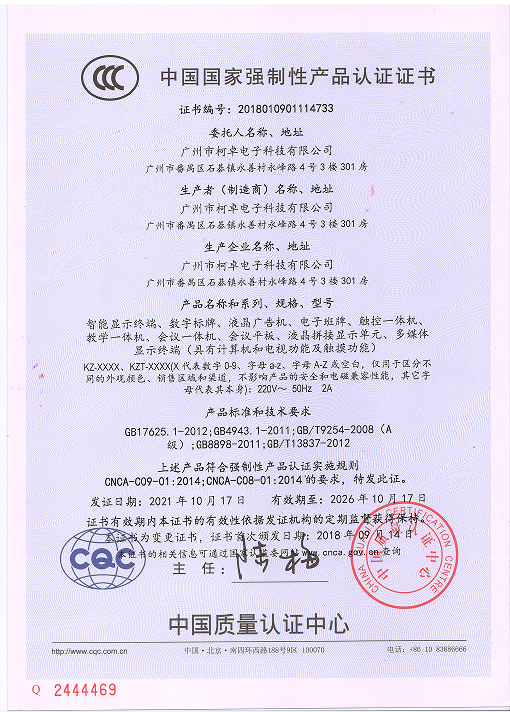
The China Compulsory Product Certification record for certificate 2018010901114733, issued by the China Quality Certification Center (CQC), carries an issue date of 2021-10-17 and a recorded expiry date of 2026-10-17.
That single line contains the most consequential finding in the dossier. The recorded expiry date is earlier than the date of this article. The practical consequence is narrow but firm: the certificate cannot be presented as current China-market evidence until its present status is confirmed against the CQC record or against a re-issued certificate supplied by the holder. This is a verification instruction, not a market-access ruling, and the difference matters — whether a specific product requires 3C in a specific configuration is a question for the certificate holder and the relevant authority, not something a certificate expiry date settles on its own.
Two further details in the same record deserve attention.
The standards listed on the certificate are GB17625.1-2012, GB4943.1-2011, GB/T9254-2008 (Class A), GB8898-2011 and GB/T13837-2012, together with CNCA-C09-01:2014 and CNCA-C08-01:2014. The safety standard cited there is GB4943.1-2011. Elsewhere in the same dossier, the China inspection report JAT2207030268CN-01 from Dongguan Junan Testing and Certification Co., Ltd. (issue date 2022-07-15, recorded expiry 2099-07-14) is written against GB4943.1-2022. Another China record, test report 20220501W12358 from CQC Intime Testing Technology Co., Ltd. (issue date 2022-03-31, recorded expiry 2099-03-30), cites GB4943.1-2011. So the dossier contains two different editions of the same Chinese safety standard on different documents. A buyer consolidating 'China safety evidence' should record which edition sits on which document rather than treating the set as uniform.
The certificate's covered model list is also narrower than the full range. It names the KD-AD, KD-LED, KD-IFPD, KD-TP, KD-VW and KD-OD series — six of the ten series discussed in this article. The KD-WM, KD-SSK, KD-ISS and KD-EA series are not listed on 2018010901114733.
That gap is not the same as a coverage failure. The China inspection reports JAT2207030268CN-01 and 20220501W12358 both list all ten series, so China-market safety evidence exists for models outside the 3C scope. What the gap does mean is that a buyer cannot satisfy a China-market checklist by waving one 3C certificate at it.
EU documents: what the 2025-11-07 to 2099-11-06 window actually establishes
The EU records share an issue date of 2025-11-07 for the RoHS and EMC documents, and an expiry of 2099-11-06. All three EU documents in the dossier are issued by TMC Testing Services (Shenzhen) Co., Ltd.
The ROHS TEST REPORT MK25100089P01-C01 covers controlled hazardous substances — Lead (Pb), Cadmium (Cd), Mercury (Hg), Hexavalent Chromium (Cr(VI)), Polybrominated Biphenyls (PBBs), Polybrominated Diphenyl Ethers (PBDEs) and phthalates including DEHP, BBP, DBP and DIBP — assessed against the IEC 62321 series standards and the RoHS 2.0 Directive (EU) 2015/863 and (EU) 2017/2102.
The Verification of Compliance MK25100089P01-E01 covers the EMC Directive 2014/30/EU, with EN 55032:2015/A11:2020, EN 55035:2017/A11:2020, EN IEC 61000-3-2:2019+A1:2021+A2:2024 and EN 61000-3-3:2013+A1:2019+A2:2021 listed as the assessment basis.
A third EU document, Verification of Compliance MK25100089P01-S01, addresses the LVD Directive 2014/35/EU through EN IEC 62368-1:2024/A11:2024, with an issue date of 2025-11-10 and an expiry of 2099-11-09 — three days later than the RoHS and EMC pair on both ends. The offset is trivial in itself, but it confirms that each document carries its own dates and should be read separately.
All three EU records list the same ten series: KD-AD, KD-LED, KD-IFPD, KD-TP, KD-VW, KD-OD, KD-WM, KD-SSK, KD-ISS and KD-EA. For EU-facing orders, that is the widest series coverage in the dossier, and it includes the KD-EA elevator advertising machine, which appears on no other market document except the two China inspection and test reports.
The 2099 expiry dates deserve a precise reading. They describe the validity of the document record. They do not extend a warranty, a spare-parts commitment, a software support period or a product service life; none of those commitments is stated in these certificates, and the dossier contains no separate statement that would support them. Buyers who need those commitments should ask for them as separate commercial terms rather than inferring them from a 2099 date.
The opening date deserves equal precision. A unit shipped to the EU before 2025-11-07 is outside this document window. If a buyer is accepting a consignment, a refurbished unit or an inventory unit that predates the window, the question 'which document was in force at that time' is a real question, and the answer is not in these records.
ISO9001 certificate 25020021R0S and the 'idt' detail
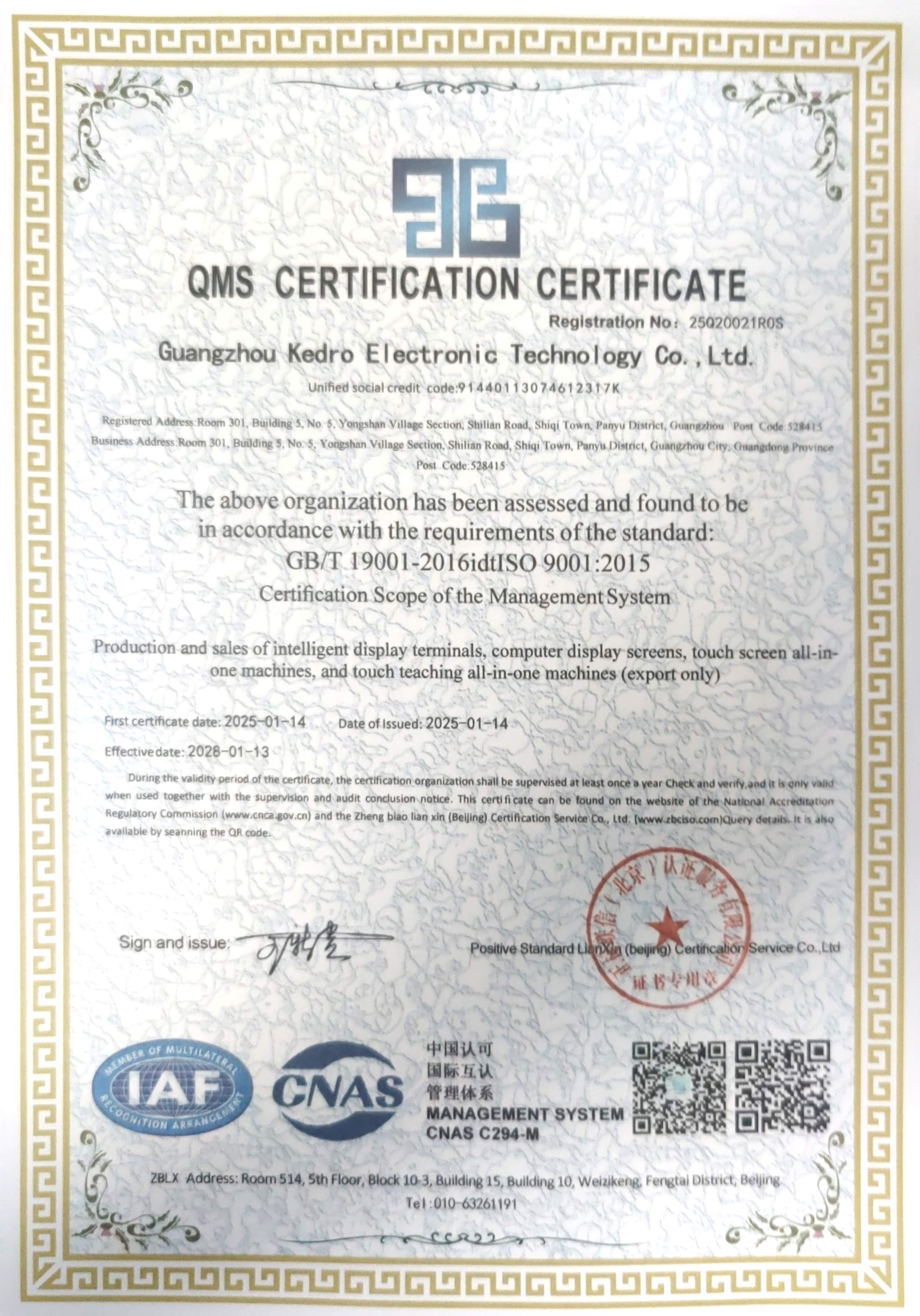
Quality management system certificate 25020021R0S was issued by Beijing Zhengbiao Lianxin Certification Service Co., Ltd. on 2025-01-14, with a recorded expiry of 2028-01-13, for domestic and overseas markets.
Its standard reference is written as GB/T 19001-2016 idt ISO 9001:2015. The 'idt' marker means the Chinese national standard is an identical adoption of ISO 9001:2015. The practical consequence for a buyer is that the certificate maps to the 2015 edition of ISO 9001 as stated on its face. Where a procurement checklist simply says 'ISO9001' without an edition, the gap is invisible; where a checklist names a different edition, the certificate does not silently meet it, and the difference should be recorded rather than assumed away.
The stated scope reads: production and sales of intelligent display terminals, computer display screens, touch screen all-in-one machines, and touch teaching all-in-one machines (export only). The market field on the same record reads domestic and overseas. Those two wordings should be reconciled with the certificate holder before the certificate is relied on for a domestic-China transaction, because the scope language and the market field do not say exactly the same thing.
Series coverage is the third point. The products associated with 25020021R0S are the KD-AD, KD-LED, KD-IFPD, KD-TP, KD-VW, KD-OD, KD-WM, KD-SSK and KD-ISS series — nine series. The KD-EA Series is not among them. That absence does not establish anything about the KD-EA Series as a product; an absent listing and an absent capability are different statements. It does mean that an elevator advertising machine order should not be validated by quoting 25020021R0S alone, and a buyer who needs QMS evidence for that series should ask specifically for it.
One boundary applies to every QMS certificate: it addresses management-system scope, not the measured performance of an individual unit. 25020021R0S should not be used as a substitute for a product safety or EMC document for a specific market, and no reading of it changes that.
Series-by-series coverage: where each market document reaches
The coverage difference is best seen as a matrix rather than a list. The table below reproduces only what the supplied records state.
| Document | Number | Market | Recorded validity | Series listed |
|---|---|---|---|---|
| China Compulsory Product Certification (3C) | 2018010901114733 | China | Issued 2021-10-17; recorded expiry 2026-10-17 | 6 of 10: KD-AD, KD-LED, KD-IFPD, KD-TP, KD-VW, KD-OD |
| Quality management system (ISO9001) | 25020021R0S | Domestic & overseas | 2025-01-14 to 2028-01-13 | 9 of 10: all except KD-EA |
| ROHS TEST REPORT | MK25100089P01-C01 | EU | 2025-11-07 to 2099-11-06 | All 10 series |
| RoHS 2.0 Verification of Compliance | MK25100089P01-C01 | EU | 2025-11-07 to 2099-11-06 | All 10 series |
| EMC Verification of Compliance | MK25100089P01-E01 | EU | 2025-11-07 to 2099-11-06 | All 10 series |
| LVD Verification of Compliance | MK25100089P01-S01 | EU | 2025-11-10 to 2099-11-09 | All 10 series |
| Inspection report | JAT2207030268CN-01 | China | 2022-07-15 to 2099-07-14 | All 10 series |
| Test report | 20220501W12358 | China | 2022-03-31 to 2099-03-30 | All 10 series |
Read across the KD-EA row and the picture is unambiguous: the elevator advertising machine is covered by the three EU documents and by both China inspection and test reports, but not by the 3C certificate or the ISO9001 certificate. Read across the KD-WM, KD-SSK and KD-ISS rows and a second pattern appears: full EU and China-report coverage, no 3C listing, but full QMS listing.
Neither pattern is a defect in itself. Both are reasons to stop treating 'the certificate package' as a single object. The correct question is not 'do you have certificates' but 'which document, with which number and which dates, covers this series in this market'.
Applying the check to real deployment scenarios
The scenario determines which document set is load-bearing, and therefore which dates must be verified first.
Mall digital human shopping guide display. Indoor retail installations are usually China-domestic or EU. For a China-domestic mall deployment quoting a KD-AD, KD-LED, KD-IFPD, KD-TP, KD-VW or KD-OD unit, the 3C record is the first document a property or mall compliance team will ask for, which is exactly where the passed 2026-10-17 recorded expiry needs resolving before handover. For an EU deployment of the same unit, the starting point is the 2025-11-07 EU window, with the ROHS and EMC references checked against the specific series.
Exhibition hall digital human reception display. Exhibition deployments are often temporary, which makes it tempting to accept short-form evidence. The document requirement does not shorten because the installation does. A KD-ISS Interactive Slider Screen or KD-VW Video Wall Display booked for a three-week exhibition still needs the same document set as a permanent installation, and the dates should be checked against the event date as well as the order date.
Retail store digital human display cabinet. Transparent cabinet formats such as the KD-TP Series sit inside the 3C six-series list and inside the ISO9001 nine-series list, so both documents are relevant. Buyers should confirm that the specific cabinet configuration ordered matches the configuration the record describes, since a certificate covering a series does not automatically describe every option within it.
AI voice interactive digital human display and AI large-model interactive display. Interaction features sit partly outside the certification frame. The dossier documents multi-touch and wireless sharing for the KD-IFPD Series, and records that display products are used for smart retail advertising with OEM and ODM support. None of that is a certification of AI model behaviour, voice accuracy or content governance. A buyer evaluating an AI voice interactive unit should treat the safety, EMC and RoHS documents as the hardware compliance layer and ask separately about the software layer.
Mobile digital human guide display and remote maintenance digital human terminal. Where a deployment depends on remote servicing, the relevant capability evidence in the dossier is the after-sales scope — remote technical support, online technical guidance, 24/7 technical assistance and professional engineering support — alongside a remote cloud control platform for deployment, monitoring and maintenance. That evidence is commercial and operational, not a certificate, and should not be mixed into the compliance checklist where it can disguise a missing document.
Outdoor and elevator formats. The KD-OD Outdoor Advertising Display appears on every China and EU record in the table. The KD-EA elevator advertising machine appears on the EU records and both China reports but on neither the 3C certificate nor the ISO9001 certificate, which makes it the clearest example of why series-level checking beats package-level checking.
Presence audit versus currency audit: a six-point comparison
Most supplier reviews run a presence audit. A currency audit asks six questions against the same documents and produces a different result.
Number and document type. Presence asks whether a certificate number exists. Currency asks whether the number is attached to the artefact requested — the C01 reference exists as both a test report and a verification of compliance, and the two should not be swapped.
Both ends of the window. Presence checks that a document exists. Currency brackets the shipment, installation and handover dates inside the recorded validity window, which is why a 2025-11-07 opening date is as relevant as a 2099 closing date.
Series coverage. Presence counts documents. Currency maps each document to the specific KD series being quoted, which is how the KD-EA exclusion from two records becomes visible.
Market and directive match. A valid EU EMC verification does not speak to a China-market question, and a China 3C record does not speak to an EU-market question, regardless of dates.
Standard edition. Presence accepts a standard reference. Currency records which edition was assessed, as with GB4943.1-2011 and GB4943.1-2022 appearing on different documents within one dossier.
Issuer and scope wording. Presence checks that an authority is named. Currency checks who issued the record — CQC, TMC Testing Services (Shenzhen) Co., Ltd., Beijing Zhengbiao Lianxin Certification Service Co., Ltd., Dongguan Junan Testing and Certification Co., Ltd. or CQC Intime Testing Technology Co., Ltd. — and reads the scope language alongside the market field, as the 'export only' wording on 25020021R0S requires.
Why this check scales with the market
Certificate hygiene is usually treated as a one-off onboarding task. Commercial research on the digital human screen category suggests the volume of deployments is expected to grow, which turns it into a recurring task. PW Consulting, published through pmarketresearch.com in June 2026, reported the digital human screen market at USD 450.0 million in 2025 and projected USD 1,162.38 million by 2032, a 14.5% CAGR. That figure should be read with its limits: it comes from a commercial research page, the underlying methodology was not captured, and its market definition may not align with holographic display or digital human terminal categories.
The use-case direction is easier to evidence than the number. Samsung's own newsroom describes retailers deploying generative AI-powered digital humans through tablets, kiosks or interactive displays to engage customers, make recommendations and complete transactions via voice and live chat. Looking Glass Factory positions its Hololuminescent Displays as large-format holographic presence for retail, events, architecture and brand moments. Both are vendor statements about intended use, not measured adoption. Taken together they describe a category moving into more sites, more markets and more procurement cycles per buyer — which is precisely the condition under which a certificate that was current at first order quietly stops being current at the third.
Limits worth stating plainly
A 2099 expiry date is a document fact, not a support promise. Nothing in the EU records, the China reports or the QMS certificate extends a warranty, a spare-parts horizon or a software support period.
A certificate describes a recorded scope, not a production batch. A document covering a series does not certify that a particular unit left the factory in conformity; that is a separate acceptance question.
An absent listing is not an absent capability. The KD-EA Series is not named on 25020021R0S or on 2018010901114733. That is a documentation gap for a buyer to close with the holder, not a finding about the product.
An expired recorded date is not a legal ruling. The 2026-10-17 expiry on 2018010901114733 tells a buyer to verify present status. It does not, by itself, determine market access for any product or configuration.
A passed date is not a reason to discard the dossier. The China inspection reports and test reports remain in force on their own recorded terms and cover all ten series, which is why the answer to a lapsed 3C entry is a document request, not a rejection.
Practical re-check cadence
The workable rule is to re-verify at four points rather than once: at request for quotation, when the purchase order is issued, before shipment, and at site handover. At each point the buyer should hold a dated copy of the exact document version relied on, with the number, the issue date, the recorded expiry and the covered series recorded next to the order line.
Two habits make the cadence work. First, record document dates in the same register as delivery dates, so a window opening on 2025-11-07 or closing on 2026-10-17 becomes visible against the shipment rather than buried in a PDF appendix. Second, ask for series-specific confirmation in writing for any model outside a certificate's listed scope, particularly the KD-EA Series against the 3C and ISO9001 records and the KD-WM, KD-SSK and KD-ISS series against the 3C record.
The full range referenced in this article, including the KD-AD, KD-LED, KD-IFPD, KD-TP, KD-VW, KD-OD, KD-WM, KD-SSK, KD-ISS and KD-EA series, is listed in the Kedro Product Catalog (English Edition, with AI Humans).
FAQ
Which KD series are covered by which certificate?
Coverage differs by document. China 3C certificate 2018010901114733 lists the KD-AD, KD-LED, KD-IFPD, KD-TP, KD-VW and KD-OD series. ISO9001 certificate 25020021R0S lists nine series — the same six plus KD-WM, KD-SSK and KD-ISS. The EU documents MK25100089P01-C01, MK25100089P01-E01 and MK25100089P01-S01, together with China inspection report JAT2207030268CN-01 and test report 20220501W12358, list all ten series including KD-EA.
Does a 2099 expiry date mean the product is supported until 2099?
No. The 2099-11-06 date on the EU records and the 2099-11-09 date on MK25100089P01-S01 describe the validity of those documents. Warranty length, spare-parts availability, software support and product service life are separate commercial commitments and are not stated in these certificates.
What is the difference between MK25100089P01-C01 as a test report and as a certificate?
Both carry the same reference and the same dates, 2025-11-07 to 2099-11-06, and both are issued by TMC Testing Services (Shenzhen) Co., Ltd. The test report documents testing of controlled hazardous substances against the IEC 62321 series. The verification of compliance states that the product meets EU RoHS 2.0 requirements. A buyer asking for one should specify which, because the same number returns either document.
ISO9001 certificate 25020021R0S is written against GB/T 19001-2016 idt ISO 9001:2015 — does that limit it?
It limits what the certificate can be said to demonstrate. The 'idt' marker means the Chinese standard is an identical adoption of ISO 9001:2015, so the certificate maps to that edition. Where a checklist names a different edition, the difference should be recorded rather than assumed to be covered. The certificate's scope also carries 'export only' wording alongside a domestic and overseas market field, which should be clarified with the holder for domestic-China transactions.
How should validity be re-checked during a multi-phase project?
Re-verify at request for quotation, at purchase order, before shipment and at handover, and keep a dated copy of the exact document version used at each point. Record the document number, issue date, recorded expiry and covered series against the order line, and request written series-specific confirmation for any model outside a listed scope. The recorded 2026-10-17 expiry on the China 3C certificate is an example of why the cadence matters: it passed before the date of this article and requires confirmation of present status.
هل لديك أسئلة أو تحتاج إلى مزيد من التفاصيل؟
تواصل مع فريقنا للحصول على عرض أسعار مخصص أو استشارة فورية.
طلب عرض أسعار
املأ النموذج أدناه وسيتواصل معك فريقنا بعرض مقترح مخصص.
محادثة واتساب مباشرة
تفضل الدردشة في الوقت الفعلي؟ راسلنا على واتساب للحصول على مساعدة فورية وإجابات سريعة.
- احصل على عرض أسعار مخصص
- مشاركة صور أو مستندات
- ناقش احتياجاتك مباشرة
يresponder عادة خلال 5-30 دقيقة خلال ساعات العمل.