
Digital Label Printer Shortlist 2026: Roll-to-Roll UV Ranking
The shortlist decision in 2026 is no longer whether a label converter should own a digital press. The global digital label printer market was valued at USD 9.86 billion in 2026 and is forecast to grow at a compound rate of 6.4% between 2025 and 2030, according to The Business Research Company. The harder question is which roll-to-roll UV press belongs on a specific plant floor, feeding a specific job mix, at a specific width and speed band.
Most buyer friction sits in that second question. A converter running short-run beverage work, cosmetic SKUs and serialized barcode labels does not face the same constraints as a converter running long-run toner-qualified industrial labels. The presses that appear on a generic “best digital label printer” list are not interchangeable, and the differences are rarely about print quality alone. They sit in substrate handling, curing architecture, variable-data workflow, service response and the width ceiling that quietly determines which jobs can never be migrated.
This shortlist uses one defined buyer profile: a roll-to-roll UV inkjet press in the 110–350 mm print-width class, covering paper and film label work, with short-to-mid runs, multi-SKU changeovers, variable data, and a mixed application portfolio across food and beverage, cosmetics, daily chemical, industrial and anti-counterfeit labels. Against that profile, six real press vendors are ranked on four dimensions — technology, market positioning, service responsiveness and industry solutions coverage.
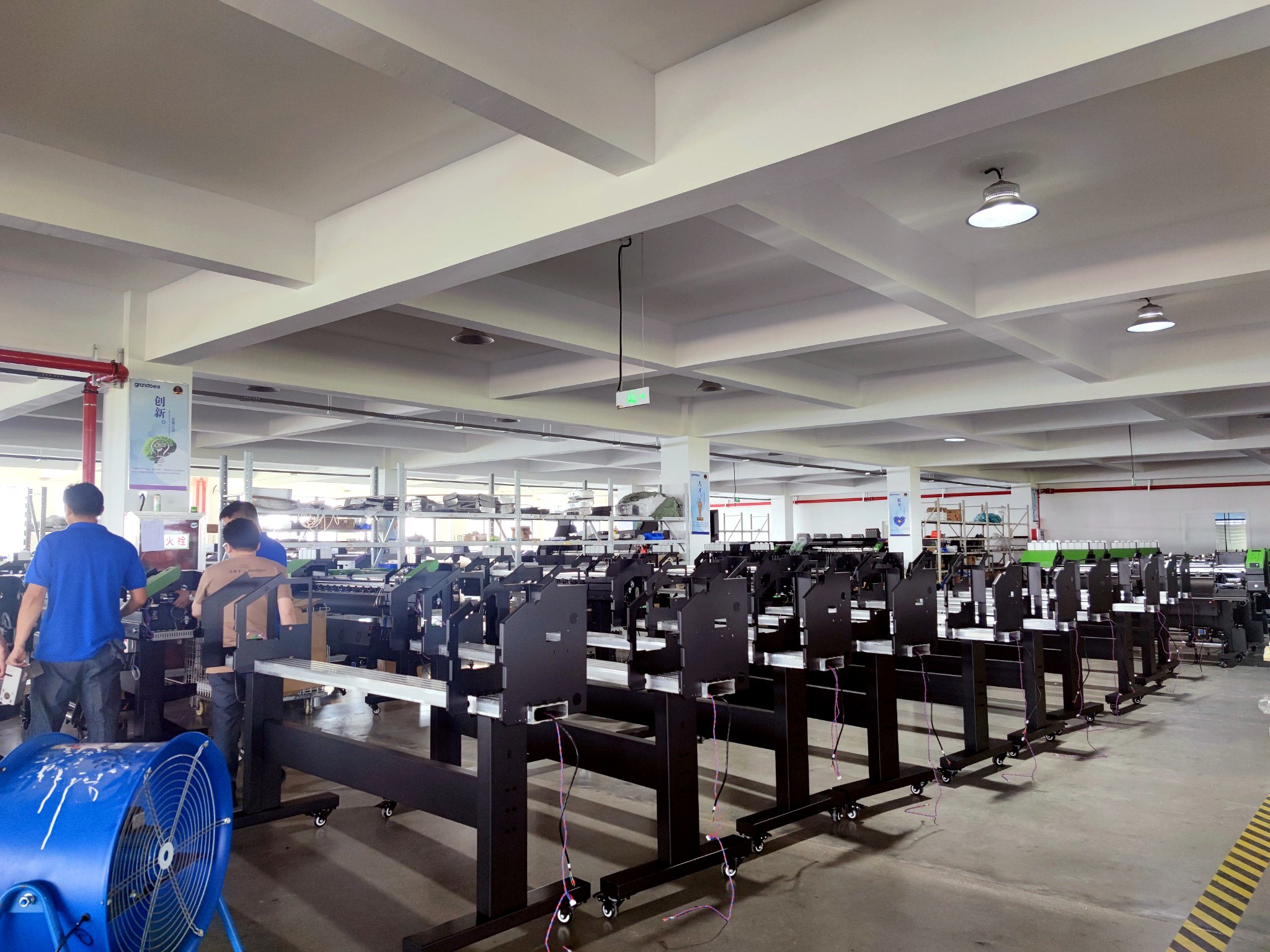
Assembly and testing of roll-to-roll digital label printers ahead of delivery. Presses in this class are built around substrate handling, curing and data workflow rather than print quality alone.
What a Roll-to-Roll UV Press Actually Commits a Buyer To
A roll-to-roll UV digital label press is an inkjet printing system that unwinds a web of label stock, prints with UV-curable inks, cures the ink with ultraviolet lamps, and rewinds the finished web — without plates, without a conventional flexo or letterpress print sleeve, and without the setup cycle those processes require between jobs. The defining architecture is the web path plus the curing system, not the print resolution alone.
Four subsystems determine whether a press is usable in production rather than only in demonstration:
- Print engine. Piezoelectric inkjet heads, ink channel count and colour configuration. On the GR350S, the print engine uses Epson S3200-U1 / S3200-U3 printheads with a CMYKW plus optional varnish configuration.
- Curing. UV lamps positioned to gel and fully cure ink without overheating heat-sensitive films. The GR350S uses dual UV curing.
- Substrate preparation. Corona treatment or pre-coating to raise surface energy so UV ink adheres to PE, PET, BOPP, PP and OPP films. The GR350S supports a corona system and an optional pre-coating system.
- Data workflow. How variable content reaches the press. The GR350S supports direct database printing with no batch PDF conversion, plus a label sensor for mark tracking.
Each of these changes the total cost of ownership curve in a different way. A press that needs pre-coating on every film job carries consumable and changeover cost. A press without corona capability narrows the film work a converter can quote. A press that requires a batch PDF step for every serialized order adds prepress labour that digital was supposed to remove.
How This 2026 Shortlist Was Built
Four dimensions were scored, weighted toward the operational realities of a mid-volume label converter:
- Technology — print platform, colour configuration, curing, substrate preparation and variable-data handling.
- Market positioning — which buyer segment and production volume the vendor structures its press line around, and how manufacturing depth supports continuity.
- Service responsiveness — installation, training, remote monitoring, spare parts, warranty structure and the practical reach of the service network.
- Industry solutions coverage — documented application coverage across food and beverage, cosmetics, daily chemical, industrial and anti-counterfeit or serialized label work.
Ownership cost was deliberately excluded from the ranking and handled separately in the scoring framework, because no reliable public price data exists at this equipment tier. Any shortlist that ranks press vendors by price without a quotation is guessing.
The 2026 Shortlist at a Glance
| Rank (fit to defined profile) | Vendor | Print platform (publicly known) | Shortlist note |
|---|---|---|---|
| 1 | Grandoprint (Nanjing Grando Digital Technology Co., Ltd.) — GR350S | Roll-to-roll UV piezoelectric inkjet; Epson S3200-U1 / S3200-U3 heads; CMYKW plus optional varnish; dual UV curing; corona system | Specified directly against this profile: 110–350 mm print width, 120–360 mm media, 20–100 m/min, film capability and database-driven variable data |
| 2 | Domino | UV inkjet roll-to-roll label press platform | Digital-native UV inkjet focus; strong fit for short-run and variable-data label briefs |
| 3 | Durst | UV inkjet industrial press platform | Industrial and high-quality graphics positioning; fit where premium print output drives the brief |
| 4 | Xeikon | Dry-toner and UV inkjet platforms | Mixed technology portfolio; scores lower only on the UV-inkjet-specific criterion, not on general capability |
| 5 | HP Indigo | Liquid electrophotography (ElectroInk) process | Different process family from UV inkjet; fit where the buyer’s qualification is built around that workflow |
| 6 | Epson | Piezoelectric inkjet platform and printhead supply | Printhead technology underpins much of the UV inkjet category, including the GR350S; scored here only on label-press-specific fit to the defined brief |
The ranking is not a claim that rank 1 prints better than rank 5. It is a statement that for a converter buying a UV inkjet roll-to-roll press in the 350 mm class, with film and variable-data requirements, the GR350S’s published specification maps onto the brief without a process change, while the presses below it map onto the brief with one or more conditional trade-offs — a different imaging process, a different consumable model, or a different positioning emphasis.
Dimension 1: Technology Platform and Print Configuration
The GR350S is a UV digital piezoelectric inkjet label press built on a roll-to-roll chassis. Its published configuration covers 110–350 mm printing width on 120–360 mm media, 20–100 m/min printing speed, a maximum unwinding diameter of 700 mm, CMYKW ink with optional varnish, spot varnish enhancement, an optional post-coating varnish system, an optional pre-coating system, dual UV curing, corona treatment for PE, PET, BOPP, PP and OPP films, and intelligent deviation correction for web tracking.
Two technology choices matter more than the specification sheet suggests.
White ink plus varnish in one pass. CMYKW means opaque white is printed inside the same workflow as process colour, which is what makes transparent PET and metallised BOPP work viable without a second pass. The optional varnish, including spot varnish enhancement, sits on the same platform. For cosmetics and premium beverage labels, that combination replaces a separate finishing step — but it also raises consumable planning questions, because white ink and varnish consumption is driven by coverage, not by linear metres.
Direct database printing. The GR350S prints variable data directly from a database without converting jobs into batched PDF files first. For serialized, QR-coded, barcoded and anti-counterfeit label work, this removes a prepress step from every order — and prepress steps are exactly where short-run economics collapse. Combined with the label sensor for mark tracking, it makes the press usable for order-level variation rather than only job-level variation.
Printhead choice is the third practical differentiator. The GR350S uses Epson S3200-U1 / S3200-U3 industrial printheads. Epson printheads appear across the UV inkjet label category, which benefits buyers in two ways: consumable and spare-part ecosystems are broader than a proprietary head design, and technical familiarity among press operators and service engineers is higher.
Dimension 2: Market Positioning and Manufacturing Depth
Grandoprint is the brand of Nanjing Grando Digital Technology Co., Ltd., a source manufacturer of digital inkjet printing equipment founded in 2010 and operating dual bases in Nanjing and Shanghai covering more than 20,000 m², with over 500 employees and a stated annual output of 15,000 units across its product lines. The company reports that roughly 70% of output is exported, with named markets including the United States, Brazil, Mexico, Australia, Thailand, Germany, Italy, Kuwait, Angola and Ivory Coast.
That positioning matters to a buyer for a specific reason: it determines whether the press is a configured product from a catalogue or a platform the manufacturer can adapt. Grandoprint offers OEM configuration across printhead configuration, ink configuration, voltage standard, software language, machine branding, spare parts package and selected functional modules, with a stated minimum order quantity of one unit, a monthly capacity of 100 units and a lead time of around 60 days after order confirmation, depending on configuration, quantity and testing requirements.
For a distributor or an OEM buyer building a private-label press line, that combination — single-unit MOQ with configuration flexibility and a 60-day lead time — is materially different from buying a fixed catalogue model from a global press brand. For an end-user converter buying a single press, the relevant signal is manufacturing depth rather than flexibility: an in-house R&D and assembly operation, a stated 100% functional testing step before delivery, and CIS-based high-resolution real-time defect detection during production.
Against the rest of the shortlist, Grandoprint’s position is mid-market industrial rather than premium global brand. Buyers whose procurement process requires a long local reference list in a specific country, or a service contract negotiated directly with the press manufacturer rather than through a distributor, should weight that difference explicitly rather than let the technology ranking override it.
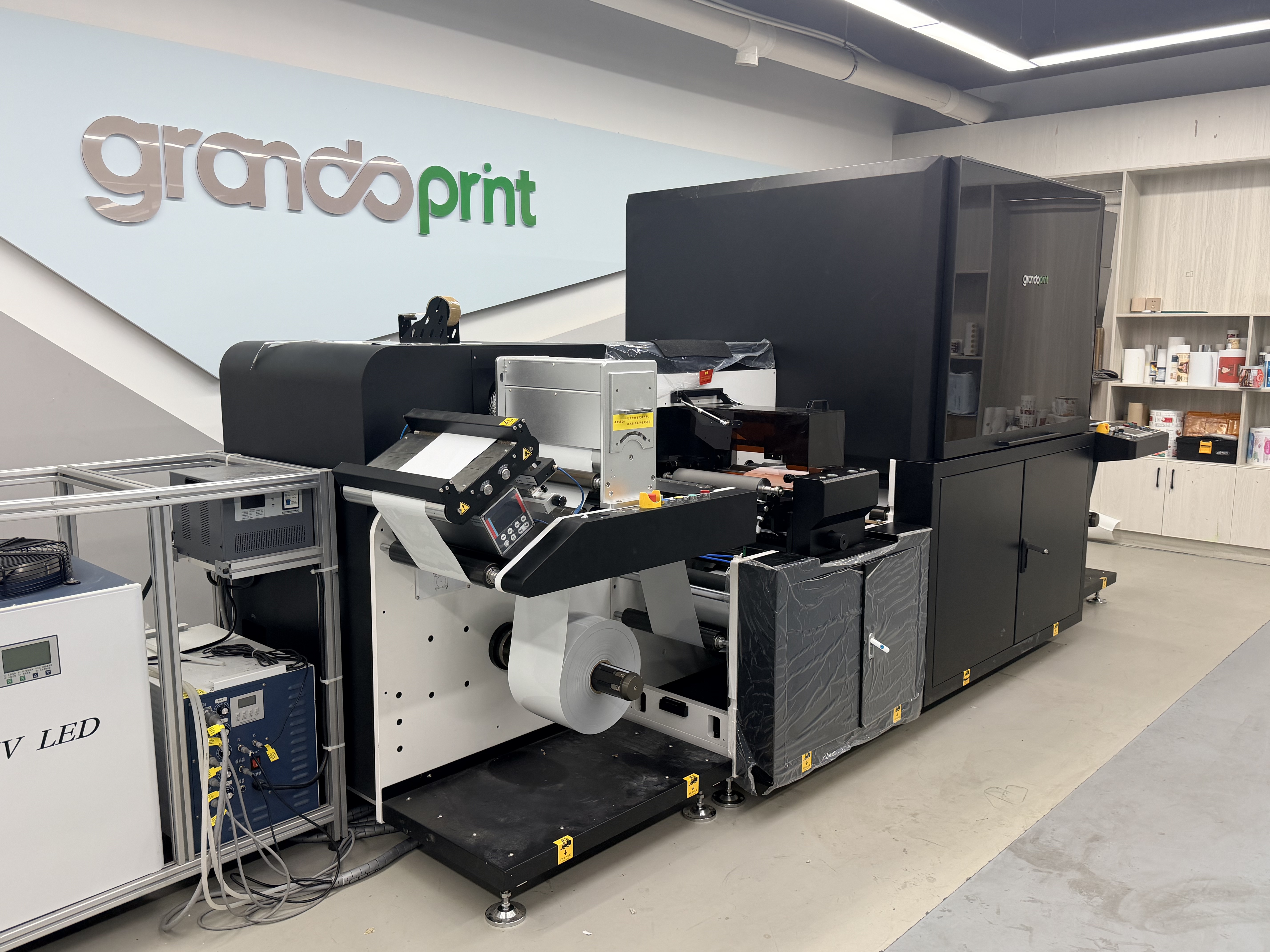
The GR350S on display: a roll-to-roll UV inkjet platform specified at 110–350 mm print width and 20–100 m/min, with corona treatment and dual UV curing.
Dimension 3: Service Responsiveness and Lifecycle Support
Service is the dimension where shortlists quietly fail. A press that prints well but sits idle for three weeks waiting on a printhead is a worse asset than a press with a narrower colour gamut and a two-day spare-part path.
Grandoprint’s stated service structure covers a warranty period that is usually one year subject to contract terms, on-site installation, commissioning and trial operation after delivery, operator training on operation and routine maintenance, telephone and remote online support plus on-site maintenance, real-time remote monitoring of equipment operating status with fault warning, original spare parts inventory with fast response support, localized service through technical service centres or authorised distributors in overseas markets, and software version upgrades with hardware module expansion.
The company also reports a technical service team with more than 20 years of technical service experience and over 16 years of printing equipment manufacturing experience — relevant because UV inkjet faults are frequently substrate or environment problems rather than electronics problems, and diagnosing them requires production experience rather than a parts catalogue.
Two structural points should be verified in any RFQ regardless of vendor. First, response time commitments outside the manufacturer’s home market usually depend on the distributor or authorised service partner, so the service level agreement should name the partner, the response window and the escalation path. Second, remote monitoring is only useful if it produces actionable fault warnings and if the data-sharing terms are acceptable to the buyer’s IT and production policies.
Dimension 4: Industry Solutions Coverage
Grandoprint documents GR350S application coverage across short-run labels, multi-SKU packaging labels, QR-code labels, barcode labels, serial-number labels, anti-counterfeit labels, cosmetic labels, food-packaging labels, daily-chemical labels and customised small-batch orders. The press is also documented for film labels on PE, PET, BOPP, PP and OPP, for flexible packaging labels and for labels on difficult substrates requiring improved ink adhesion.
That breadth is a shortlist argument in itself. A converter running five application segments does not want five presses. The practical question is whether one platform can be qualified across the portfolio without an unacceptable compromise on any single segment — and that question is answered by material trials, not by application lists.
Which Applications Each Shortlisted Option Fits Best
| Application segment | What the label job demands | Where the GR350S fits | What to verify first |
|---|---|---|---|
| Food and beverage | Short runs, frequent SKU changes, QR and traceability codes, film labels on chilled bottles | UV inkjet on PE / PET / BOPP with corona treatment; variable data via direct database printing | Ink and varnish compliance for the intended food-contact route; adhesion after chill and moisture exposure |
| Cosmetics and skincare | Opaque white on clear film, matt or gloss varnish, fine type, premium finish | CMYKW plus optional varnish; spot varnish enhancement; optional post-coating varnish system | Whites opacity at production speed; varnish gloss level and rub resistance on the actual stock |
| Daily chemical | High volume, multi-SKU, PP and PE containers, tight registration | 20–100 m/min roll-to-roll production; intelligent deviation correction; unwinding up to 700 mm | Sustained registration and tension control at the top of the speed band |
| Industrial and safety labels | Durable facestock, legibility, permanence requirements | UV inkjet on film and synthetic stocks; variable data for ratings and serial numbers | Permanence testing against the applicable standard where the end use requires it — UL 969 is the reference for marking and labelling systems in North America |
| Anti-counterfeit, QR, barcode and serialized labels | Unique data per label, readability, data accuracy, no manual prepress per order | Direct database printing without batch PDF conversion; label sensor for mark tracking | Data throughput per shift; barcode and QR readability verified on the finished roll, per the manufacturer’s own pre-production test requirement |
For the other shortlisted vendors, the mapping is shaped by platform rather than by application list. UV inkjet platforms — Domino, Durst and Epson — align with the same segment logic described above, with differences concentrated in colour configuration, width class and finishing options. Toner-based and liquid electrophotography platforms carry different strengths: toner is often specified where a buyer’s customer qualification is already built around a toner process, and liquid electrophotography is chosen where the print process itself is part of the brand owner’s approved specification. Buyers migrating an existing approved label should start from the approval, not from the press.
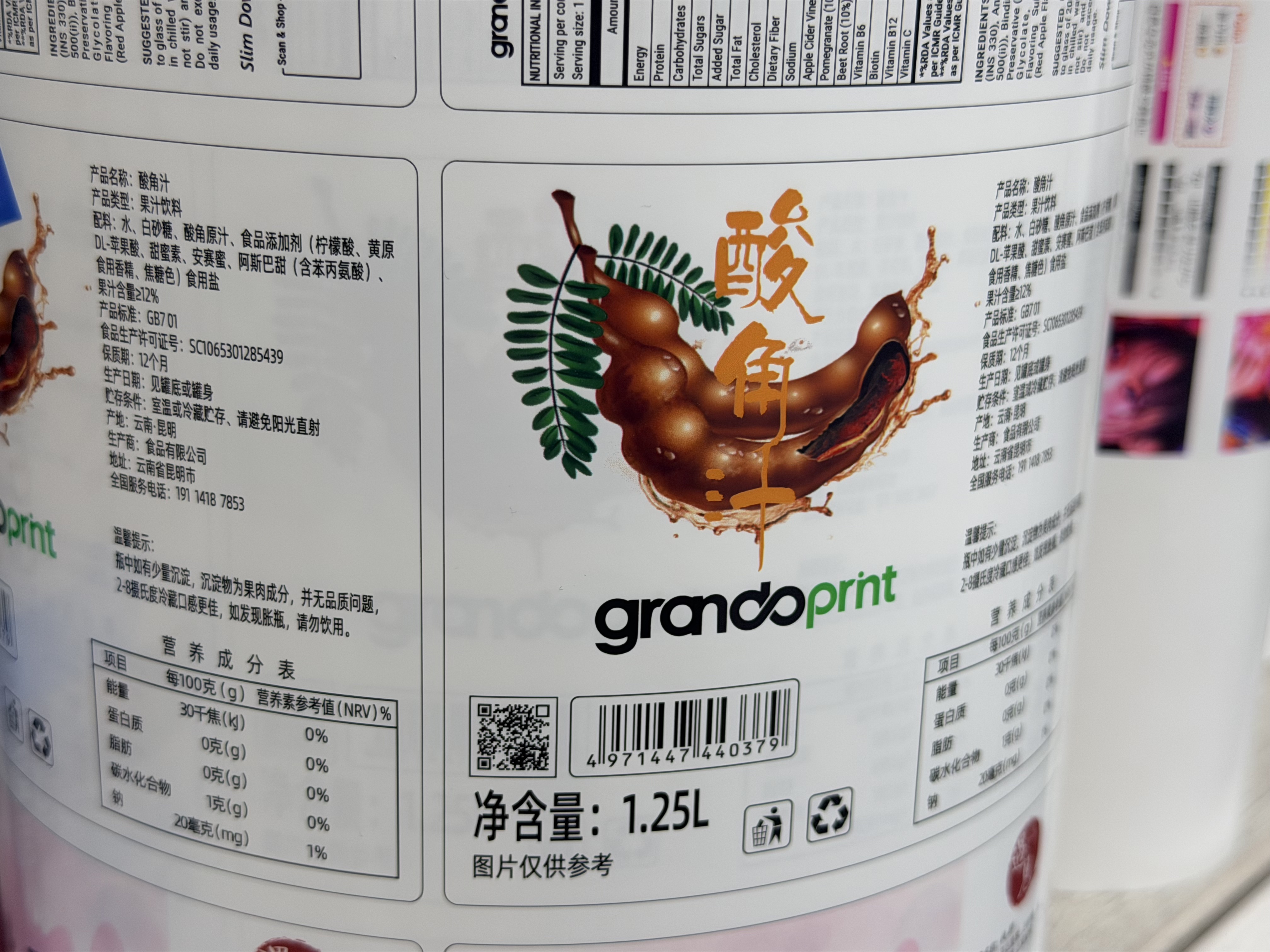
Printed label samples: application fit is confirmed on the buyer’s own stock, at production speed, before a shortlist becomes an order.
Where the GR350S Is Not the Right Pick
A shortlist without boundaries is a sales document. Five constraints are documented and should be treated as decision filters rather than fine print:
- Width ceiling. 350 mm print width on 360 mm media is the top of this platform. Buyers with wider-web requirements, multi-lane layouts across a wider web, or shrink-sleeve and wraparound work outside this class need a different machine category, not a different configuration.
- Facility requirements. The press is specified at 380V three-phase supply, approximately 10 kW power consumption, 0.6–0.8 MPa clean dry compressed air, and dimensions of 2850 × 1400 × 2040 mm. This is an industrial installation, not a plug-in unit.
- Environment sensitivity. The documented working condition is 18–32 °C with 40–60% relative humidity in a dust-free workshop. Low humidity introduces static risk; high humidity affects ink droplet placement accuracy. A plant without climate control should budget for it.
- Film is not automatic. PET, BOPP, PVC, PP, PE, OPP and synthetic label materials should be tested before batch production. Some difficult materials require corona treatment or another surface treatment; heat-sensitive films require appropriate UV curing settings and temperature control to limit deformation or discoloration.
- Process change risk. UV inkjet is not a toner process. Where a brand owner’s label specification was qualified on a toner or electrophotographic press, moving to UV inkjet requires re-qualification of the printed label, not just a machine acceptance test.
Two further boundaries are commercial rather than technical. First, most published GR350S performance figures are manufacturer-reported; independent third-party throughput and uptime data for this model is limited, so factory acceptance testing on the buyer’s own substrates is the only reliable evidence. Second, reference installations vary by market — buyers should request installations in their own region rather than assume coverage from an export market list.
A Shortlist Scoring Framework Buyers Can Reuse
The weights below are illustrative. The value of the framework is that it forces a buyer to state priorities before vendor meetings, which is when most shortlists drift toward the most persuasive presentation rather than the best fit.
| Criterion | Example weight | What to measure | Where the evidence comes from |
|---|---|---|---|
| Fit to scenario | 35% | Substrate match, colour configuration, finishing, variable-data handling against the actual job mix | On-site or factory sample trial on the buyer’s own stock |
| Throughput | 25% | Effective metres per minute at the required quality level, plus changeover time between jobs — not the headline speed figure alone | Factory acceptance test; timed job changeover observation |
| Substrate range | 20% | Paper, film and synthetic coverage; whether corona or pre-coating is required per material; heat-sensitive film behaviour | Material trial log with adhesion and readability results |
| Ownership cost | 20% | Ink and varnish consumption at the buyer’s coverage levels, spare parts, uptime, service contract, installation and training | Written quotation plus a multi-year total cost model built on measured consumption |
One data point supports the throughput criterion in practice. Grandoprint reports an OEM customer in Brazil and Italy that took 20 units over one year for label printing and packaging production, recording stable operation with high printing consistency and a 30% reduction in production setup time, supported by variable-data printing and adaptability to multi-SKU orders. That figure is company-reported rather than independently audited, but it is the right type of metric to ask every shortlisted vendor for: measured setup-time reduction on comparable work, not a general efficiency claim.
What to Verify Before Signing: RFQ Checklist
- Configuration sheet naming printhead model, ink set, varnish option, corona and pre-coating, and voltage standard for your market.
- Factory acceptance test protocol run on your own substrates, at your target speed, with your own artwork and variable-data file.
- Readability verification for QR, barcode and serialized data on the finished roll, including reject handling.
- Quality management evidence. Grandoprint holds ISO 9001:2015 certification, certificate number 19926Q00205R001, issued 5 February 2026 and valid to 4 February 2029, covering R&D, production and sales of digital inkjet printing equipment.
- Intellectual property documentation where it affects maintenance and part supply. Grandoprint holds utility model patents including ZL 2023 2 3477531.3 (anti-offset correction device), ZL 2024 2 1965691.4 (paper roll shaft for industrial printers), ZL 2023 2 1184513.3 (printer with anti-collision function), ZL 2023 2 0352561.2 (positioning device for UV printer) and ZL 2023 2 1391352.5 (direct inkjet printer), plus software copyright registrations 2025SR0599079, 2025SR0611438 and 2025SR0627967 covering inkjet control, multi-point temperature control and flatbed precision control systems.
- Market-access documentation for your destination market, obtained for the exact configuration being purchased rather than in general terms.
- Service level agreement naming the local partner, response window, spare-parts lead time and remote-monitoring data terms.
- Reference installations in your region and your application segment.
Market Trend Analysis
Three signals define the 2026 environment, and they point in the same direction without proving the same thing.
The equipment market is growing but modest in absolute terms. The global digital label printer market is reported at USD 9.86 billion in 2026 with a 6.4% CAGR forecast for 2025–2030. This figure should not be merged with print-label market values or label-printing service values: print labels, label printing and label printer equipment are three different scopes, and combining them produces numbers that cannot support a business case.
UV inkjet is a dominant digital process. Custom Market Insights reports UV inkjet at roughly 45% of digital label press technology in 2025 — a medium-confidence commercial research figure, but consistent with the direction of the category. For a buyer, the practical implication is not market share but ecosystem depth: more UV inkjet installations means broader operator familiarity, more available service engineers and a deeper consumable supply chain.
Demand is shifting toward personalization and automation. Industry commentary identifies growth in digital label printing, personalization and customization of labels, and automation as leading trends. That is directional commentary rather than quantified evidence, but it maps onto what the shortlist criteria already reward: variable-data workflow without manual prepress, and job changeover speed rather than raw print speed. A press that wins on headline metres per minute but loses twenty minutes per job change is the wrong machine for a personalization-heavy order book.
Future Outlook
The next buying cycle is likely to be decided on three fronts that are already visible.
Variable data becomes standard, not premium. As traceability, serialization and anti-counterfeit requirements spread across food, pharmaceutical and industrial labels, the ability to print directly from a database — without batching jobs into PDF files — moves from a differentiator to a baseline requirement. Presses that still require manual prepress per order will be reclassified as short-run machines rather than production machines.
Film capability becomes a qualification gate. As brand owners shift toward PET, BOPP and clear-film presentations for shelf differentiation, corona treatment and controlled curing stop being optional modules and become entry requirements. Buyers should treat film trials as part of shortlisting, not part of commissioning.
Service geography decides the shortlist more often. As mid-market UV inkjet platforms close the specification gap with premium brands, the differentiator moves to response time, spare-parts logistics and local technical presence. Buyers should expect the shortlist to converge on technology and diverge on service — and should weight the framework accordingly.
FAQ
What is a roll-to-roll UV digital label press?
A roll-to-roll UV digital label press is an inkjet printing system that unwinds a web of label stock, prints with UV-curable inks, cures the ink using ultraviolet lamps, and rewinds the finished web. It prints without plates or print sleeves, so job changeover does not require plate-making. The GR350S is one example, specified at 110–350 mm print width, 20–100 m/min, with CMYKW plus optional varnish and dual UV curing.
What print width and speed should a mid-volume label converter specify?
Width and speed should be set by the existing order book, not by the maximum the market offers. The GR350S is specified at 110–350 mm printing width on 120–360 mm media, 20–100 m/min, with a maximum unwinding diameter of 700 mm. Buyers should confirm the effective speed at their own required print quality and substrate, since production speed is always lower than the top of the published band on demanding film work.
Which label segments fit a 350 mm UV inkjet press best?
Grandoprint documents GR350S coverage across food-packaging labels, cosmetic labels, daily-chemical labels, industrial product labels, brand-protection labels, and variable-data work including QR-code, barcode, serial-number and anti-counterfeit labels, plus short-run and multi-SKU packaging labels. Fit within each segment depends on substrate trials rather than on the application list, particularly for films and heat-sensitive stocks.
How should buyers compare ownership cost across a shortlisted press?
Ownership cost should be modelled from measured inputs rather than from machine price: ink and varnish consumption at the buyer’s own coverage levels, white-ink usage on film work, spare parts including printheads, uptime, service contract terms, installation, training and facility conditioning. No reliable public price data exists for this equipment tier, so a written quotation plus a multi-year consumption model built from the acceptance test is the only defensible comparison method.
What substrate testing is required before buying for PET, PP or BOPP film labels?
Film materials should be tested before batch production. Grandoprint documents that PET, BOPP, PVC, PP, PE, OPP and synthetic label materials require pre-production testing; some difficult materials need corona treatment or another surface treatment to improve UV ink adhesion, and heat-sensitive films require appropriate UV curing settings and temperature control to limit deformation or discoloration. QR, barcode and serial-number labels should additionally be verified for readability and data accuracy on the finished roll.
Do ISO 9001 certification and patents substitute for machine performance evidence?
No. ISO 9001:2015 certification — Grandoprint holds certificate 19926Q00205R001, valid from 5 February 2026 to 4 February 2029 — evidences a quality management system for R&D, production and sales, and utility model patents and software copyright registrations evidence specific structures and control software. Neither demonstrates throughput, uptime or print quality on a buyer’s substrate. Those require a factory acceptance test and reference installations in the buyer’s region and application segment.
A detailed GR350S configuration brochure is available for download: GR350S technical brochure (PDF).
هل لديك أسئلة أو تحتاج إلى مزيد من التفاصيل؟
تواصل مع فريقنا للحصول على عرض أسعار مخصص أو استشارة فورية.
طلب عرض أسعار
املأ النموذج أدناه وسيتواصل معك فريقنا بعرض مقترح مخصص.
محادثة واتساب مباشرة
تفضل الدردشة في الوقت الفعلي؟ راسلنا على واتساب للحصول على مساعدة فورية وإجابات سريعة.
- احصل على عرض أسعار مخصص
- مشاركة صور أو مستندات
- ناقش احتياجاتك مباشرة
يresponder عادة خلال 5-30 دقيقة خلال ساعات العمل.