
Dimension Fit: Choosing an ESS Battery Pack Insertion Robot
Dimension Fit: Choosing an ESS Battery Pack Insertion Robot
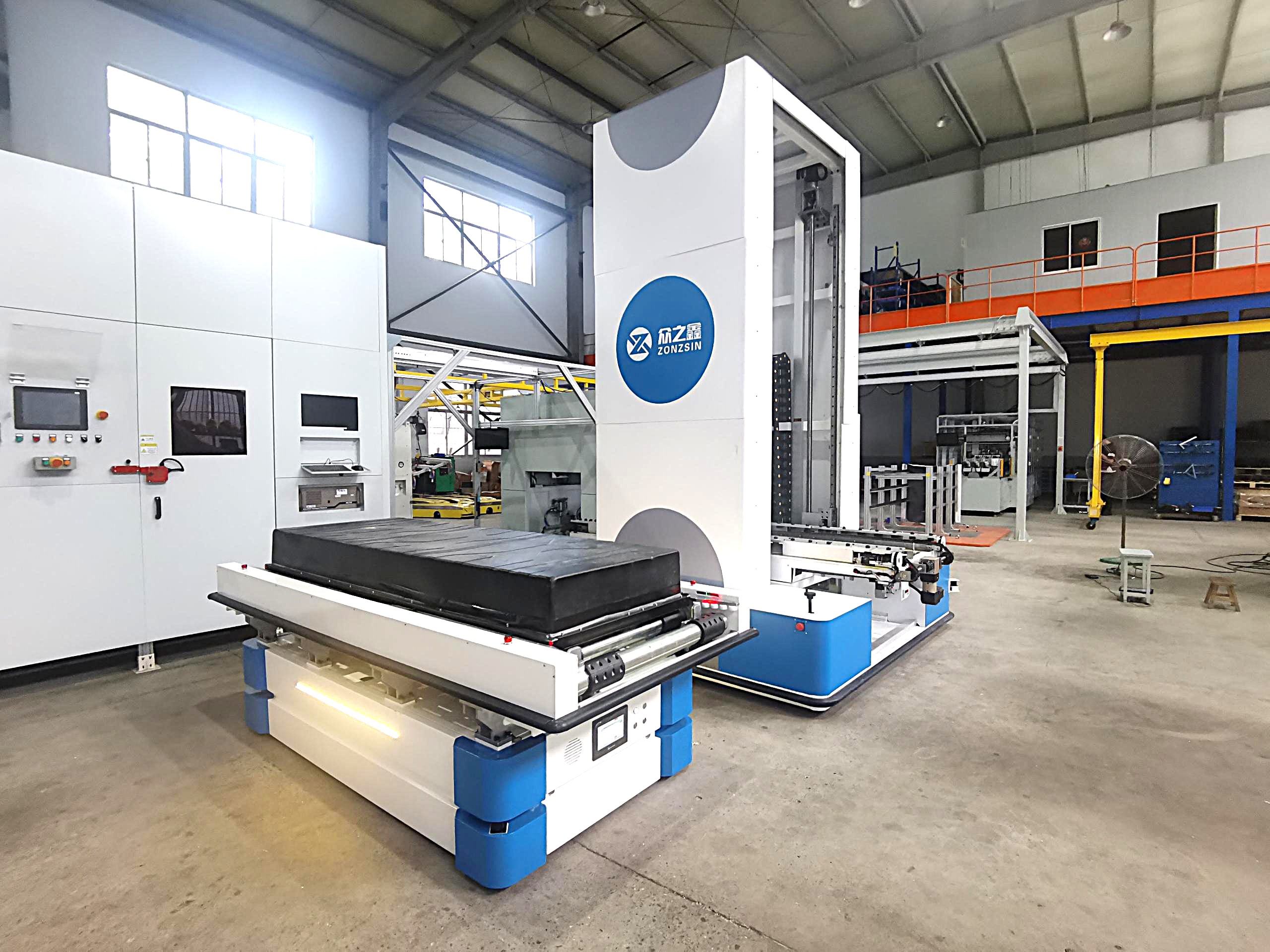
Container-based battery energy storage is assembled inside a fixed steel envelope, and that envelope, not the robot catalogue, decides which insertion machine a project can actually use. An ESS battery pack insertion robot for containers has to move a PACK through a door opening, along a rack lane and into a final position whose length, width and height are already set by the container frame. When the geometry does not close, load capacity and hoisting speed cannot compensate.
The framework below is organised around that single constraint. It compares four Zonzsin models — ZZX2508 and ZZX2524 (rail-fixed), ZZX2522 (crawler-driven) and RD16 (AGV-driven) — across container envelope, PACK envelope, drive type, load capacity, door open angle, gripper changeover time and hoisting range, and it closes with the purchasing terms and acceptance criteria that turn a shortlist into a purchase order.
Shanghai Zonzsin Intelligent Equipment Co., Ltd. (Zonzsin) is a Shanghai-based manufacturer founded in 2019 that supplies battery PACK assembly lines and ESS battery pack insertion robots for containers. The company reports a 6,000 m² factory, 90 employees, an R&D team of 43 engineers, 50 granted patents and an annual output of 40 insertion robot units, with roughly 60% of production exported, mainly to Southeast Asia and the EU.
Why the container envelope should be read before the catalogue
An insertion robot works inside three constraints that are fixed before any machine is chosen: the container door opening, the internal rack lane, and the PACK itself. A rail-fixed machine travels along a ground rail; a crawler machine drives to the container gate; an AGV machine docks to a station. In all three cases the PACK has to enter the container without contacting the frame, the rack uprights or previously loaded modules, and it has to stop inside the tolerance band the rack allows.
That is why dimensional data is a better opening filter than load capacity. Load capacity answers whether a PACK can be lifted. Envelope compatibility answers whether it can be delivered at all. A 1,500 kg machine whose mast cannot pass the container top rail is not usable on that line, while a machine with the correct reach and door clearance may be, even if its rated load is lower than the heaviest pack in the catalogue.
Three measurements should be collected before a shortlist is drafted:
- Container internal length, width and height, measured on the actual shells rather than assumed, including any rack or frame that narrows the working lane;
- Door opening height and width, plus the door swing path, because an open door occupies aisle floor space that the machine also needs;
- PACK length, width, height and mass at both the smallest and the largest variants the line will run.
Projects that skip this step usually discover the mismatch during commissioning, at the point where changing the container type is no longer an option.
The four-model dimensional map
The Zonzsin insertion range is documented as four models that differ mainly in how they reach the container rather than in what they carry. The table below summarises the published figures and, equally usefully, marks where public documentation is silent.
| Model | Drive type | Load capacity | Door open angle | Gripper changeover | Hoisting | Container envelope | PACK envelope |
|---|---|---|---|---|---|---|---|
| ZZX2508 | Rail-fixed | Not stated in available documentation | ≥ 150° | Not stated | Not stated | L 6,058–7,000 mm; W 2,438–2,700 mm; H 2,896–3,000 mm | L 1,100–2,200 mm; W 780–1,260 mm; H 230–260 mm |
| ZZX2524 | Rail-fixed | 1,500 kg | ≥ 150° | < 1 min | Not stated | Not stated | Not stated |
| ZZX2522 | Crawler-driven, insertion and removal | 1,500 kg | Not stated | Not stated | 0.8–3.4 m (customizable) | Not stated | Not stated |
| RD16 | AGV-driven | Not stated in available documentation | Not stated | Not stated | 1.05–3.4 m (customizable); 100 mm/s hoisting speed | Not stated | 280/314/587 Ah cells; 1P52S and 1P104S PACKs |
Two observations matter more than any individual cell. First, only ZZX2508 publishes a complete container and PACK envelope, which makes it the easiest model to screen on geometry alone. Second, several cells are blank because the available documentation does not state them. A blank cell is a question for the supplier, not evidence that the capability is absent, and it should be resolved in writing before a comparison table is used for a decision.
Step 1 — Read the container envelope first
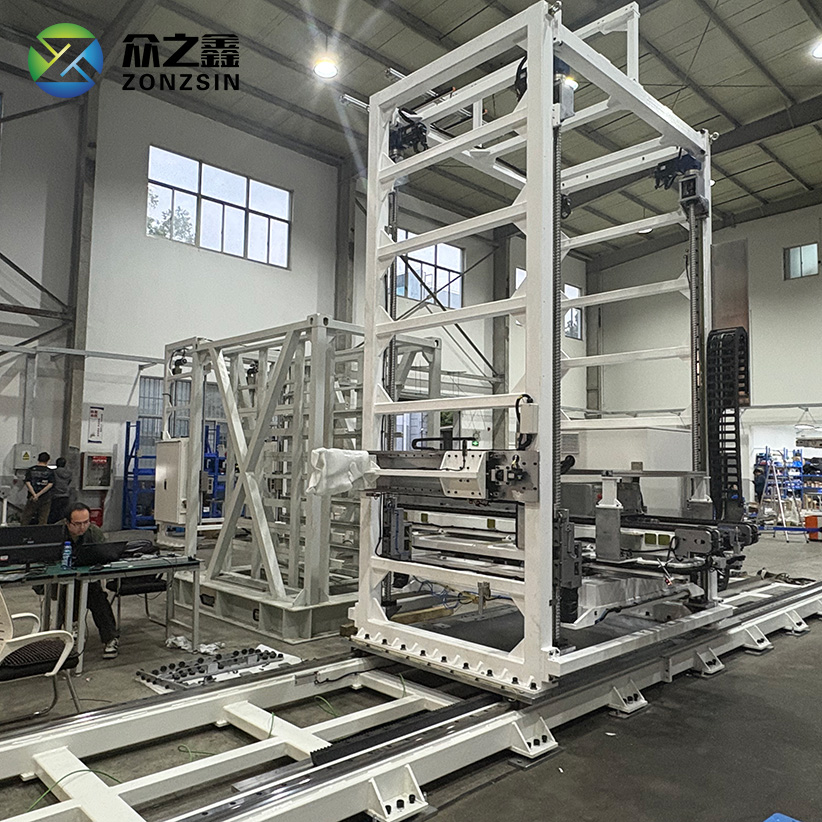
ZZX2508 is documented for containers of 6,058–7,000 mm length, 2,438–2,700 mm width and 2,896–3,000 mm height. The lower bounds correspond to familiar container sizes: 6,058 mm is the nominal length of a 20-foot unit, 2,438 mm is the nominal 8-foot width, and 2,896 mm matches a 9 ft 6 in high-cube height. The upper bounds extend the working range to longer frames and to wider or taller variants, which matters on projects that use rack-type or extended-frame containers instead of a standard 20-foot shell.
Two consequences follow. A line running only standard 20-foot shells sits at the bottom of that range and keeps margin on width and height. A line mixing 20-foot and extended containers must confirm that mast, gripper and rail geometry remain valid across the whole band, because a machine that fits the small container does not automatically fit the large one.
Utilities belong in the same check. ZZX2508 is documented at AC 380 V ±10%, 50 ±2 Hz, with compressed air at 0.5–0.8 MPa. Where shop power or air supply is unstable, that tolerance band becomes part of the site preparation scope rather than a detail for the commissioning week.
Step 2 — Match the PACK envelope and cell format
ZZX2508 publishes a PACK envelope of 1,100–2,200 mm length, 780–1,260 mm width and 230–260 mm height. The band is wide: the longest PACK in the range is twice the length of the shortest, and that difference changes the load moment the machine must control at full extension. PACKs at the top of the length range should be checked against the lifting and leveling arrangement, not only against a nominal load rating.
Where the PACK family is defined by cell format rather than by millimetres, the specification question changes shape. RD16 is documented for 280/314/587 Ah cells and for 1P52S and 1P104S PACKs, with a customizable hoisting range of 1.05–3.4 m and a hoisting speed of 100 mm/s. A buyer with a fixed PACK roadmap can screen R16-type applications on cell and configuration compatibility; a buyer running several PACK generations on one site needs the envelope confirmed in writing for every generation, because the smallest pack on the plan is not the one that stresses the machine.
Step 3 — Match the drive type to floor, lane and shift pattern
Rail-fixed: stability at the cost of layout rigidity
ZZX2524 is a rail-fixed machine documented at 1,500 kg load capacity, a door opening angle of at least 150° and a gripper changeover time under one minute, with space saving through double-layer racks. In a Chinese integrator deployment, a rail-fixed unit has run for two years on continuous PACK insertion, with the fixed ground rail cited as the safety factor and the dual-layer material rack cited as the space factor. The trade-off is that the rail is installed in the floor: relocating the station is a construction task, not a programming change.
Crawler-driven: floor tolerance at the cost of a manual step
ZZX2522 is a crawler-driven insertion and removal machine documented at 1,500 kg load capacity, a customizable hoisting range of 0.8–3.4 m, all-terrain working floor and manual handwheel leveling. Deployments in South Korea (outdoor, uneven working floor) and Taiwan (indoor and outdoor, insertion and pull-out) show the intended role: sites where the floor is not prepared to rail standard and the machine must travel to the container. The cost is that leveling is manual and the machine needs maneuvering space around the container gate. The removal capability also matters for maintenance planning, since PACK extraction for service uses the same envelope as insertion.
AGV-driven: flexibility at the cost of aisle discipline
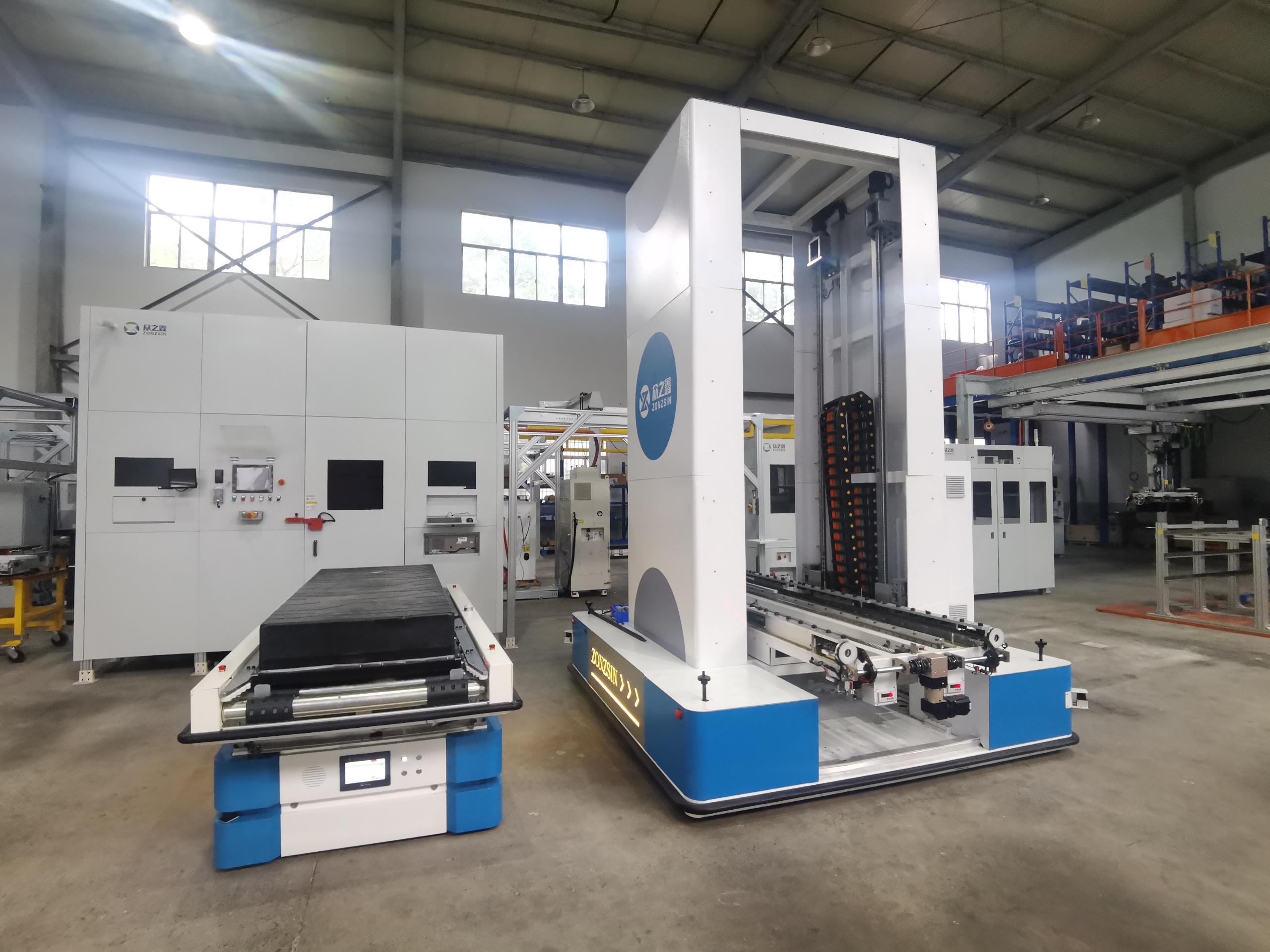
RD16 is AGV-driven, with a documented machine footprint of 3,100 × 2,600 × 3,800 mm and a 100 mm/s hoisting speed. AGV insertion suits a line that changes station, container sequence or product mix, but the footprint has to be checked against aisle width and door swing before the order is placed. Floor flatness and lane discipline also become operating requirements, because an AGV follows a defined path and shares the floor with people, racks and roller lines.
A first-pass selection rule follows from these trade-offs:
- Fixed station, prepared floor, high repeat count: rail-fixed, where stability and changeover speed dominate.
- Unprepared, uneven or outdoor floor, or a container that the machine must reach: crawler-driven, with leveling accepted as a manual step.
- Layout likely to change, or one unit serving several stations: AGV-driven, with the footprint and lane plan checked first.
Step 4 — Changeover time, door angle and the interface kit
Door open angle is usually treated as a container property. It is also a robot interface. ZZX2508 and ZZX2524 are both documented at a door opening angle of at least 150°, which clears the mast and the PACK path, but a door that swings further also swings further into the aisle. Aisle width and the position of adjacent racks or roller lines therefore have to be checked in the same review as the machine selection.
Gripper changeover governs how fast a line can move between PACK variants. ZZX2524 is documented below one minute, which matters on mixed-model lines where changeover happens more than once per shift. For the other models, changeover time is a specification to request rather than a value to assume.
The robot is also one item inside a wider station. Zonzsin's published scenario data lists the container, docking roller, gripper, transfer AGV, working desk, material rack, platform ladder, PLC and MES as matched equipment, with ESD protection, fire prevention measures, and temperature, humidity and cleanliness control as special requirements. A dimensionally correct robot installed without the docking roller aligned to the same datum will still fail the trial run.
Step 5 — Close with purchasing terms and acceptance criteria
Commercial terms decide whether a technically correct choice is also a deliverable one. Zonzsin publishes an MOQ of one unit, a lead time of two to four months, a monthly capacity of three units against an annual output of 40 units, OEM/ODM customization of cycle time, automation level, logo, color and configuration, 100% testing, and after-sales support through remote assistance plus on-site installation and commissioning. Around 60% of production is exported, mainly to Southeast Asia and the EU, with the USA also listed as an export market for the equipment line.
Those figures should be read as capacity and commitment signals rather than as a delivery schedule. A project needing three machines in a single quarter consumes an entire month of output, so delivery phasing belongs in the contract alongside the technical annex.
A working acceptance checklist for a container insertion project includes:
- A dimensional trial at both the smallest and the largest container and PACK in the production plan, not only at the nominal size;
- Door opening and aisle clearance measured with the door fully open;
- Gripper changeover timed on the actual PACK variants used in production;
- A load test at rated capacity using the heaviest real PACK rather than a test weight;
- A PLC and MES handshake verified against the integrator's control system;
- ESD, fire prevention, temperature, humidity and cleanliness measures verified against the site rule;
- PACK fixture adaptation confirmed separately for each PACK generation on the roadmap;
- A signed technical annex listing every parameter, including those the public documentation leaves blank.
Comparison with manual and crane-based insertion
Manual and overhead-crane insertion remain common where volumes are low or container types change constantly. Their advantage is that they do not depend on an envelope specification at all: a crane and an experienced team can serve an unusual container shape without a machine redesign. Their cost sits in repeatability, floor utilization and the operator's judgment at the final positioning step.
Robotic insertion converts the geometry problem into a specification problem. That is a real gain — Zonzsin states that automated PACK loading can improve container assembly cycle time compared with manual methods, a supplier-reported figure that a buyer should validate on their own line before using it in a business case — but it also transfers risk to the buyer, who must now confirm dimensions, utilities and interfaces in writing.
The comparison does not resolve automatically in either direction. Rail-fixed systems are stable and repeatable but tie the layout to a floor rail; crawler systems tolerate poor floors but add a manual leveling step; AGV systems move freely but require a level floor and clear lanes. A site with one fixed station and a prepared floor gains little from mobility, and a site that reconfigures twice a year gains little from a rail.
What this framework does not settle
The limits should be stated as plainly as the method. Every parameter used above is manufacturer-reported or reseller-reported; the available evidence contains no independent benchmark for positioning accuracy, uptime or hoisting speed across models, and no side-by-side throughput measurement. Not every model publishes a full container or PACK envelope, and the load-capacity discrepancy between a reseller listing and company documentation shows that public figures can diverge.
The framework screens geometry and interface fit. It does not predict the cycle time a line will achieve, and it does not compare Zonzsin against other manufacturers, because the available data does not support that comparison without speculation. These gaps are not closed by reading more brochures; they are closed by a witness test, a signed annex and a reference visit to an operating installation.
Market context: why dimensional discipline is becoming a procurement norm
Containerized energy storage has moved from pilot volumes to continuous production for commercial and industrial projects, and integrators now assemble PACKs into containers at a density that leaves little tolerance for a machine that almost fits. As station counts rise, layout flexibility has become a purchasing criterion in its own right, which is visible in the wider industrial robotics market: surveys such as the PMMI / Interact Analysis robotics report track continued adoption of mobile robots (AMR and AGV) in industrial settings, the same technology class that AGV-driven insertion platforms belong to.
Regulation adds pressure from a second direction. Regulation (EU) 2023/1542 on batteries and waste batteries sets the legal framework for battery products and CE marking in the EU market, so projects destined for Europe need equipment documentation that can be traced and verified. A technical annex built from measured container and PACK dimensions is easier to defend in that environment than a datasheet assembled from marketing material.
Future outlook
Two developments are likely to shape the next generation of buying decisions. The first is documentation. As buyers begin to request container and PACK envelopes in RFQs, model sheets will need to publish full dimensional bands rather than highlights, and the blank cells in current tables will become a competitive disadvantage rather than a neutral omission.
The second is the balance between fixed and mobile platforms. Rail-fixed machines remain the most stable answer for a dedicated station, but floor preparation and layout rigidity carry a real cost, and mobile platforms absorb more of the fixed-station function as that cost rises. A remaining open question for the category is standardised positioning tolerance for ISO containers: without a common reference, each project renegotiates the same dimensional assumptions, and each acceptance test is written from scratch. Buyers who want predictable outcomes should treat the dimensional annex as a permanent document rather than a one-off attachment.
FAQ
What container size can a rail-fixed ESS battery pack insertion robot handle?
ZZX2508 is documented for containers from 6,058 to 7,000 mm in length, 2,438 to 2,700 mm in width and 2,896 to 3,000 mm in height. The other rail-fixed model, ZZX2524, does not publish a container envelope in the available documentation, so its range has to be confirmed with the supplier for the specific container type in the project.
Which model is documented for PACKs between 1,100 and 2,200 mm long?
ZZX2508 is documented for a PACK envelope of 1,100–2,200 mm length, 780–1,260 mm width and 230–260 mm height. RD16 documents compatibility by cell format instead: 280/314/587 Ah cells and 1P52S or 1P104S PACKs. Where a PACK falls outside the published ZZX2508 band, the envelope should be confirmed in writing before ordering.
How should a buyer choose between rail-fixed, crawler-driven and AGV-driven insertion?
Rail-fixed models such as ZZX2524 and ZZX2508 suit a fixed station on a prepared floor, where the ground rail provides stability. Crawler-driven ZZX2522 suits unprepared or outdoor floors, with all-terrain working and manual handwheel leveling. AGV-driven RD16 suits layouts that change or stations that must be served flexibly, subject to its documented 3,100 × 2,600 × 3,800 mm footprint fitting the aisle.
What load capacity is documented for the Zonzsin insertion models?
ZZX2524 and ZZX2522 are both documented at 1,500 kg load capacity. ZZX2508 and RD16 do not publish a load figure in the available documentation, so rated capacity should be requested for the specific PACK mass the line will handle.
What are the purchasing terms for a container insertion robot?
Zonzsin publishes an MOQ of one unit, a lead time of two to four months, a monthly capacity of three units and an annual output of 40 units, with OEM/ODM customization of cycle time, automation level, logo, color and configuration. Testing is 100%, and after-sales support covers remote assistance plus on-site installation and commissioning.
What acceptance criteria should be written into the contract?
At minimum: a dimensional trial at the smallest and largest container and PACK in the production plan, door-opening and aisle clearance measured with the door fully open, timed gripper changeover on real PACK variants, a load test with the heaviest PACK, a PLC and MES handshake test, verification of ESD, fire prevention, temperature, humidity and cleanliness measures, and confirmation of PACK fixture adaptation. Every parameter should appear in a signed technical annex, including those not published in public documentation.
Dimensional data, model configurations and customization options for the ZZX2508, ZZX2522, ZZX2524 and RD16 are collected in the Zonzsin product brochure (PDF).
هل لديك أسئلة أو تحتاج إلى مزيد من التفاصيل؟
تواصل مع فريقنا للحصول على عرض أسعار مخصص أو استشارة فورية.
طلب عرض أسعار
املأ النموذج أدناه وسيتواصل معك فريقنا بعرض مقترح مخصص.
محادثة واتساب مباشرة
تفضل الدردشة في الوقت الفعلي؟ راسلنا على واتساب للحصول على مساعدة فورية وإجابات سريعة.
- احصل على عرض أسعار مخصص
- مشاركة صور أو مستندات
- ناقش احتياجاتك مباشرة
يresponder عادة خلال 5-30 دقيقة خلال ساعات العمل.