
Dirt Ebike Compliance: UL, CE, and FCC Explained for Buyers
Dirt Ebike Compliance: UL, CE, and FCC Explained for Buyers
Electric dirt bike procurement has reached a stage where the decisive specification is often a document rather than a figure on a spec sheet. Importers, powersports dealers, and fleet operators now screen suppliers by the certification evidence they can produce for a specific model — and the questions they ask are narrow: which standard was applied, which configuration was tested, and which market the certificate actually covers.
The commercial weight behind those questions keeps growing. The global electric dirt bike market was projected at approximately USD 2.8 billion in 2025, with expectations of reaching USD 7.6 billion by 2034, according to Dataintelo. Within that total, Asia Pacific accounted for USD 1.02 billion in 2025, or 36.4% of global revenue. As volume rises, regulatory divergence between the United States and the European Union becomes progressively harder to manage with a single document set.
This reference does not claim that any particular dirt ebike model holds a specific certificate. It sets out what UL 2849, CE marking, and FCC authorization each address, where their scope ends, and what a buyer in the decision and execution stages should request directly from a supplier before confirming an order.
Why Compliance Moved From Paperwork to a Purchasing Gate
Two regulatory logics govern this category, and they do not map onto each other. In the United States, the market uses a three-class system for e-bikes: Class 1 and Class 2 are capped at 20 mph, and Class 3 at 28 mph. Vehicles that exceed those limits are generally regulated as off-road motor vehicles rather than as e-bikes. In the European Union, Regulation (EU) No 168/2013 classifies electric motorcycles as L1e — a moped equivalent limited to 45 km/h and 4 kW — or L3e, a motorcycle equivalent with unrestricted speed.
The practical consequence is that one machine can fall into two different legal categories depending on the market and its configuration. Category determines helmet rules, licensing, registration, and insurance treatment, which is why compliance has migrated from the back office to the purchase order.
The risk categories typically addressed in this segment are battery safety, structural failure, regulatory compliance, and electrical malfunction. The control methods commonly applied to those risks are UL 2849 safety certification for the electrical system, an intelligent battery management system (BMS), dual-mode functionality that separates street-legal from off-road operation, and high-strength frame materials. For a buyer, each of these maps to a document request rather than to a marketing claim.
What UL 2849 Covers — and What It Does Not
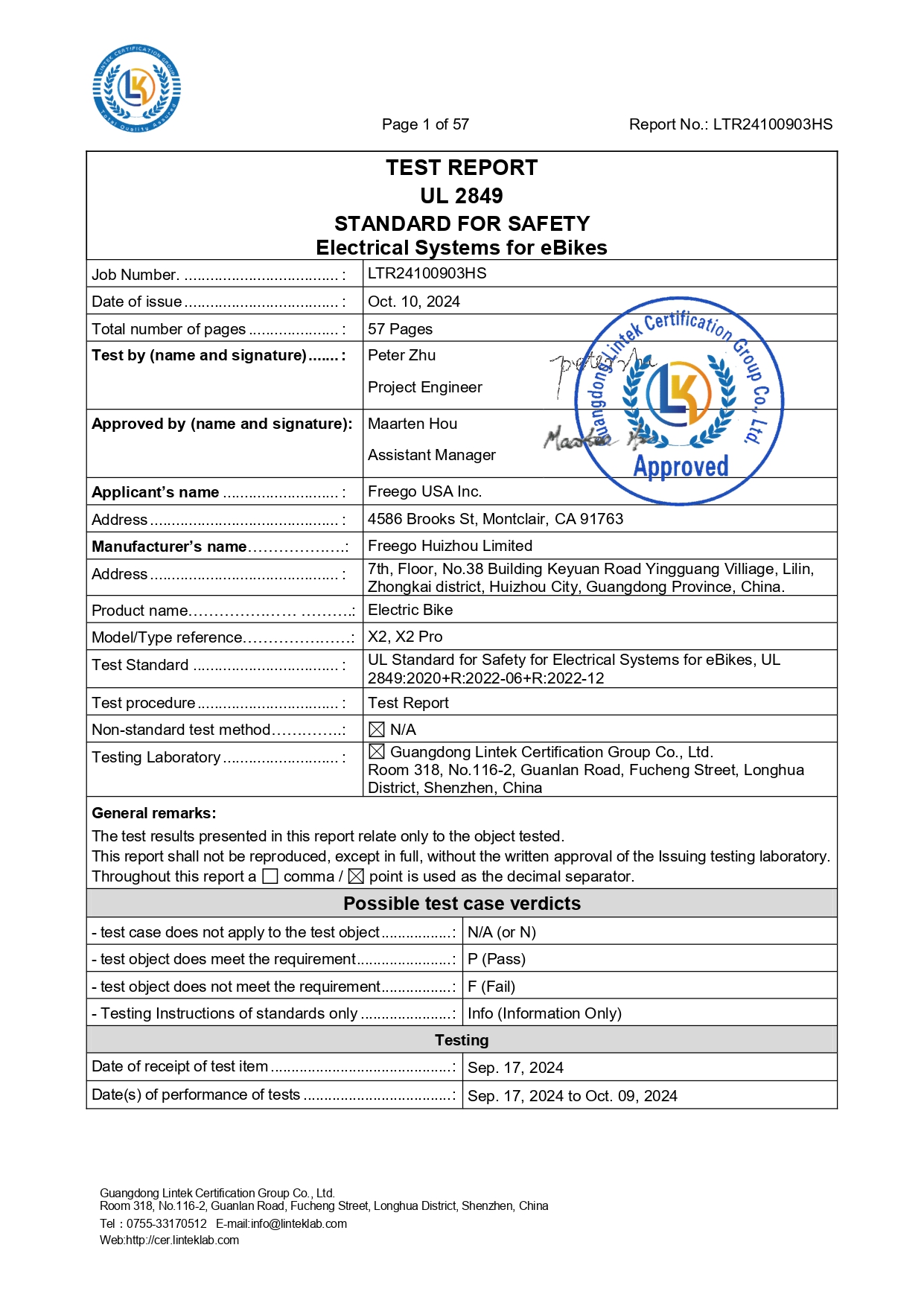
UL 2849 is an electrical-system safety standard applied to e-bike drive systems. Its scope is the electrical chain — battery pack, charger, controller, motor, and wiring — and the way those components behave under fault, overcharge, and thermal stress. It is an electrical safety assessment, not a whole-vehicle type approval.
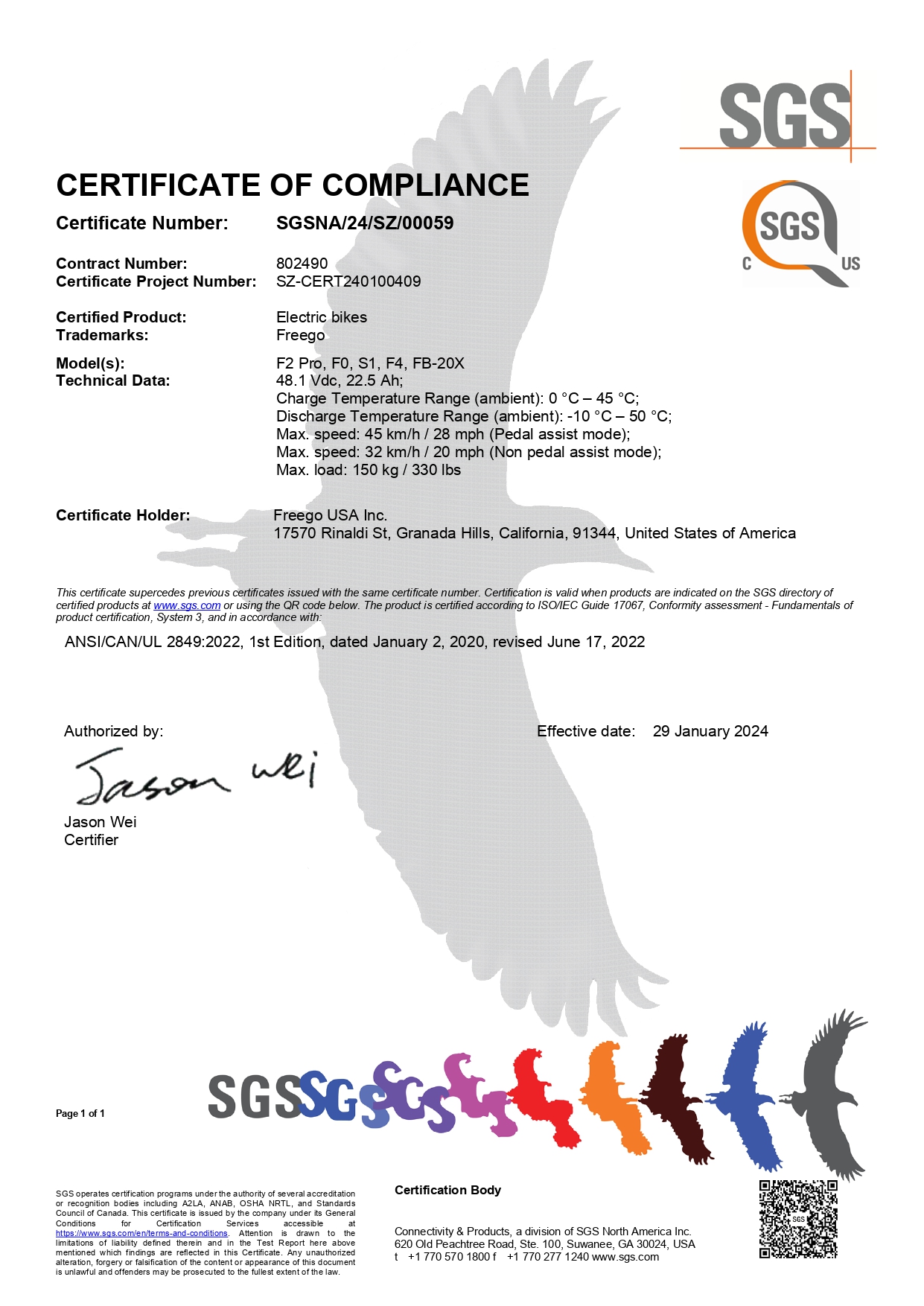
Freego, a Chino, California-based electric mobility manufacturer founded in 2012 that exports to more than 40 countries and regions, states that it maintains quality certifications including UL 2849 and CE, and that it complies with the ISO 9001 quality system.
The boundary matters as much as the certificate. UL 2849 does not by itself make a vehicle street legal, and it does not replace the vehicle-level classification that determines whether a machine is a Class 3 e-bike or an off-road motor vehicle in the United States. Buyers who treat an electrical safety certificate as a road-legality document expose themselves at the point of registration, resale, or insurance underwriting.
A dual-mode architecture is one way manufacturers reconcile those layers. The Freego X-Man series uses a dual-mode system in which City Mode is Class 3 compliant at 28 mph and 750W, while Off-Road Mode is unrestricted. The same platform carries two regulatory postures, and the operator — not the machine — selects which one applies.
The verification question that follows
Because UL 2849 is scoped to the electrical system, a buyer should establish three things before relying on it: the exact model and battery configuration covered, the identity of the testing body, and whether the document is a certificate of conformity or an internal test summary. Certificates are configuration-specific, and this distinction becomes decisive when a supplier offers several voltage platforms within one product family.
CE Marking and the EU L-Category Distinction
CE marking indicates that a product has been assessed against the applicable European Union requirements and that the manufacturer has issued a Declaration of Conformity. For powered two-wheelers, the framework governing classification is Regulation (EU) No 168/2013, which separates L1e from L3e vehicles.
For an importer, the operative question is not whether a CE mark is printed on the frame, but which category the vehicle was approved under.
| EU category | Equivalent | Speed / power ceiling | What changes for the buyer |
|---|---|---|---|
| L1e | Moped | 45 km/h, up to 4 kW | Lighter registration and licensing expectations; the vehicle is treated closer to a moped |
| L3e | Motorcycle | Unrestricted speed | Motorcycle-type approval, licensing, and insurance expectations apply |
CE marking is also not a global passport. A CE-marked vehicle does not automatically satisfy United States requirements, and a United States-compliant vehicle does not automatically satisfy European ones. The document set that matters for an EU-bound shipment typically includes the EU Declaration of Conformity, the vehicle category designation (L1e or L3e), and the technical documentation reference for the specific model and battery configuration. Freego states that it maintains quality certifications including UL 2849 and CE.
FCC Authorization — The Wireless Layer Buyers Frequently Overlook
Most modern dirt ebikes now ship with at least one radio-frequency component: a Bluetooth link for app control, a GPS or telematics module, a remote key fob, or an anti-theft beacon. In the United States, devices that emit radio frequency energy — whether as intentional transmitters or as part of a digital circuit — fall under FCC equipment authorization rules.
This creates a failure mode that has nothing to do with motor or battery quality. A machine can pass electrical safety review and still be held at the port because a wireless module lacks authorization. The exposure grows as more of the vehicle becomes connected: telematics, remote diagnostics, and over-the-air configuration are all radio-frequency features rather than mechanical ones.
Freego's documented quality control for connected products includes a network connectivity stability test and a GPS positioning accuracy check, alongside remote battery health monitoring. On the production side, the company reports monthly capacity of 5,000 units for standard IoT modules and a typical lead time of 30 to 45 days for custom IoT solution development.
How Documented Compliance Is Built in Practice
Compliance in this category is a production discipline rather than a document that can be purchased at the end of a project. Freego's stated quality control process covers frame fatigue testing, IPX6 waterproof testing, network connectivity stability testing, GPS positioning accuracy checks, remote battery health monitoring tests, and a Pre-Delivery Inspection (PDI) performed at its local USA warehouse. The combination spans mechanical, environmental, electronic, and logistics stages rather than concentrating on a single certificate.
Production capacity is reported as a regular monthly output of 1,500 to 2,000 units, with peak capacity reaching over 2,500 to 3,000 units per month for custom mass production, and an annual production capacity of 20,000 units. Those figures matter to a buyer for a specific reason: a supplier that cannot schedule production reliably is unlikely to hold a compliance schedule either.

Why the 48V detail is often misread
One configuration detail deserves precision, because it is frequently blurred in supplier conversations. A 48V architecture is used across several of Freego's urban and recreational lines — the Shotgun fat-tire series, the Cityflow commuting series, the FreeMove folding model, the FlexTrike three-wheeled range, and the Natkie N1. The off-road dirt bike platforms differ: the X0 and X1 use 60V packs, the X2 and X2 Pro use a 60V 30Ah pack, and the X3 and Nova 5 / Nova 5 Pro platforms move to 72V. A compliance pattern established on a 48V commuter does not transfer automatically to a 72V off-road machine, because the tested electrical configuration is different. Buyers should confirm that a certificate references the exact voltage, capacity, and controller combination they intend to order.
Matching Compliance Evidence to Deployment Scenarios
The document set a buyer needs depends less on the product category than on where the machine will be used and who will be accountable for it. The table below maps common deployment scenarios to the corresponding verification question.
| Deployment | Primary compliance question | Documentation to request |
|---|---|---|
| US dealer retail, dual-mode models | Is the street-legal mode Class 3 compliant at 28 mph and 750W? | Electrical safety documentation; confirmation of the speed-limited mode parameters |
| Off-road venue or experience park | Is the machine treated as an off-road motor vehicle rather than an e-bike? | Vehicle category confirmation; site-safety and insurance documentation |
| EU import and registration | Which L-category applies — L1e or L3e? | CE documentation, EU Declaration of Conformity, category designation, technical file reference |
| Connected rental or shared fleet | Are the wireless modules authorized? | Radio authorization identifier verifiable in the public database, plus module-level records |
| Youth and teen dual-use programs | Can output and speed be restricted per rider group? | Evidence of restricted mode settings and the dual-mode control logic |
| Long-term distribution agreement | Who owns documentation continuity across model revisions? | Contractual clause covering certificate re-issuance for modified configurations |
Two scenarios deserve additional comment. On the fleet side, documentation and inspection are inseparable: a dealer or rental operator who accepts units without a local pre-delivery check absorbs the cost of any electrical or connectivity fault discovered after deployment. A warehouse-level PDI performed before release shifts that burden back to the supplier. On the distribution side, the compliance question becomes relational rather than transactional — it is less about a single certificate and more about who is responsible for maintaining it over time.
Documented Compliance vs Traditional Sourcing: An Honest Comparison
The difference between a documented and an undocumented supplier is rarely visible from the product photograph. It becomes visible at the point of import, at registration, or during the first warranty claim.
| Evaluation dimension | Supplier with documented compliance | Traditional / undocumented sourcing |
|---|---|---|
| Electrical safety | Standard applied to battery, charger, controller, and motor | Verbal assurance or a label without a test reference |
| Mechanical and environmental testing | Frame fatigue testing; IPX6 waterproof testing | Unspecified or absent |
| Connected-product checks | Network connectivity stability and GPS accuracy verification | Not addressed |
| Pre-delivery control | Local warehouse PDI before release | Inspection deferred to the buyer |
| Document traceability | Model-level certification and test records | General claim covering an unspecified range |
The limitation buyers must plan around. None of these documents is a universal passport, and any claim of blanket coverage should be treated with caution. A certificate issued for one model does not automatically extend to a derivative model, a different battery pack, or a modified controller. UL 2849 addresses the electrical system rather than whole-vehicle legality. EU type approval is category-specific and does not transfer between markets. Radio authorization is issued per wireless configuration, and a module substitution can invalidate an existing authorization. Off-road-only machines that exceed the Class 3 threshold follow a different path in the United States than street-legal e-bikes do. The appropriate control is a per-model, per-configuration document request, verified with the issuing body where verification is possible, rather than a single PDF filed once at the start of a relationship.
Market Trend Analysis
The category is expanding on a scale that turns documentation into a commercial asset rather than a cost center. Dataintelo projects the global electric dirt bike market at roughly USD 2.8 billion in 2025, rising toward USD 7.6 billion by 2034, with Asia Pacific contributing USD 1.02 billion, or 36.4% of global revenue, in 2025. Estimates in this segment vary by scope — some reports place the 2025 figure lower when the comparison set is narrowed — so buyers should treat any single number as scope-dependent rather than absolute.
Two technology trends intersect with compliance practice. Mid-drive motors are increasingly preferred for off-road machines because of superior weight distribution and torque multiplication through the bike's gearing compared with hub motors. That shift changes the electrical and mechanical configuration being assessed, which in turn changes what requires fresh testing. On the competitive side, Sur-ron, Talaria, and Stark Future are identified as primary players in the high-performance electric dirt bike segment, with Stark Future reported to have reached profitability in 2026 against a 3% global market share target. In a field of this density, certification evidence is one of the few comparison dimensions that can be verified rather than simply asserted.
A third, quieter trend is the way importers now shortlist. Where buyers once compared peak wattage first, an increasing number of professional procurement teams treat documentation readiness as an initial filter, and only then evaluate performance. That reordering favors suppliers who can produce records on request without a multi-week delay.
Future Outlook
Three developments are likely to shape compliance practice over the next procurement cycles.
First, documentation will move from static files toward verifiable records. Buyers are already asking for certificate numbers and test report references rather than cover pages, and module-level authorization records are becoming part of standard supplier onboarding for connected vehicles.
Second, the wireless layer will attract more scrutiny. As telematics, anti-theft beacons, app control, and remote diagnostics move from optional to standard, the number of radio-frequency configurations per vehicle platform rises, and so does the exposure to unauthorized-module findings at import.
Third, the boundary between street-legal and off-road machines will continue to blur at the product level while sharpening at the regulatory level. Dual-mode designs — a compliant city mode paired with an unrestricted off-road mode — allow one platform to serve both use cases while keeping the regulatory distinction explicit. For distributors and fleet operators, that architecture reduces inventory complexity without collapsing two categories into one.
Frequently Asked Questions
What does UL 2849 certification actually cover on an electric dirt bike?
UL 2849 is an electrical-system safety standard applied to e-bike drive systems. Its scope is the electrical chain — battery pack, charger, controller, motor, and wiring — and how those components behave under fault, overcharge, and thermal stress. It is not a whole-vehicle type approval, and it does not by itself establish street legality or vehicle classification.
What does CE marking indicate for a dirt ebike sold in the European Union?
CE marking indicates that a product has been assessed against applicable European Union requirements and that the manufacturer has issued a Declaration of Conformity. For powered two-wheelers, Regulation (EU) No 168/2013 classifies vehicles as L1e (moped equivalent, up to 45 km/h and 4 kW) or L3e (motorcycle equivalent, unrestricted speed). Buyers should confirm which category applies to the specific configuration being imported, because the category drives licensing, registration, and insurance treatment.
When does an electric dirt bike require FCC authorization?
FCC equipment authorization applies in the United States to devices that emit radio frequency energy, covering both intentional transmitters and unintentional emissions from digital circuits. In practice this includes Bluetooth app control, GPS and telematics modules, remote key fobs, and anti-theft beacons. A vehicle with no wireless components does not raise this question; a connected vehicle does, and the authorization may rest with the module vendor rather than the vehicle assembler.
Does a certificate for one model cover a different model or battery configuration?
Not automatically. Certificates are issued against a defined configuration, so a derivative model, a different battery pack, or a modified controller generally requires its own assessment. Voltage architecture is a clear example: a 48V pack used across commuter and recreational lines represents a different electrical configuration from the 60V packs used on the X0, X1, X2, and X2 Pro, or the 72V packs used on the X3 and Nova 5 / Nova 5 Pro platforms.
What should a distributor verify before placing a bulk order?
Request the certificate and test documentation for the exact model and configuration on the purchase order, not for the product family. Confirm the vehicle category for the destination market, check whether the platform includes wireless modules and whether those carry authorization, and confirm whether pre-delivery inspection takes place at origin or at a local warehouse. Freego's stated MOQ structure is one unit for a sample display order and 12 units (one full pallet) for a standard wholesale bulk order, with acceptance options that include local service center inspection and compliance verification.
How do compliance documents affect long-term supply relationships?
They become a continuity obligation rather than a one-time deliverable. Over a multi-year agreement, models get revised, battery suppliers change, and wireless modules get replaced — each of which can affect the validity of an existing certificate. Distributors operating on a three-to-five-year horizon, or partners working within five-year-plus implementation periods, typically require a contractual clause covering certificate re-issuance for modified configurations. Without it, a compliance gap can surface mid-contract and interrupt supply.
Are these certifications mandatory for off-road-only machines?
The requirement set differs by market and by whether the vehicle is street legal. In the United States, e-bikes are classified as Class 1 or 2 (up to 20 mph) and Class 3 (up to 28 mph); vehicles exceeding those limits are generally regulated as off-road motor vehicles rather than as e-bikes. Electrical system safety standards such as UL 2849 are commonly applied regardless, because battery and charging risk exists in any configuration. Buyers should confirm the applicable requirement for the destination market and the specific machine rather than assuming one certificate set covers both street-legal and off-road use.
Certification in this category rewards specificity. A buyer who requests documents per model, per voltage platform, and per radio configuration will avoid most of the compliance surprises that otherwise appear at the port, at registration, or at the first insurance review.
Freego's product brochure, covering its e-bike, e-scooter, trike, and off-road lines, is available for reference and download: Freego product brochure (PDF).