
Dispenser Setup and Reflow Profile: Turnkey SMT Line Procurement FAQs
A procurement reference for research and evaluation teams integrating an automatic online glue dispenser with a reflow oven and a pick and place machine inside a single turnkey scope.
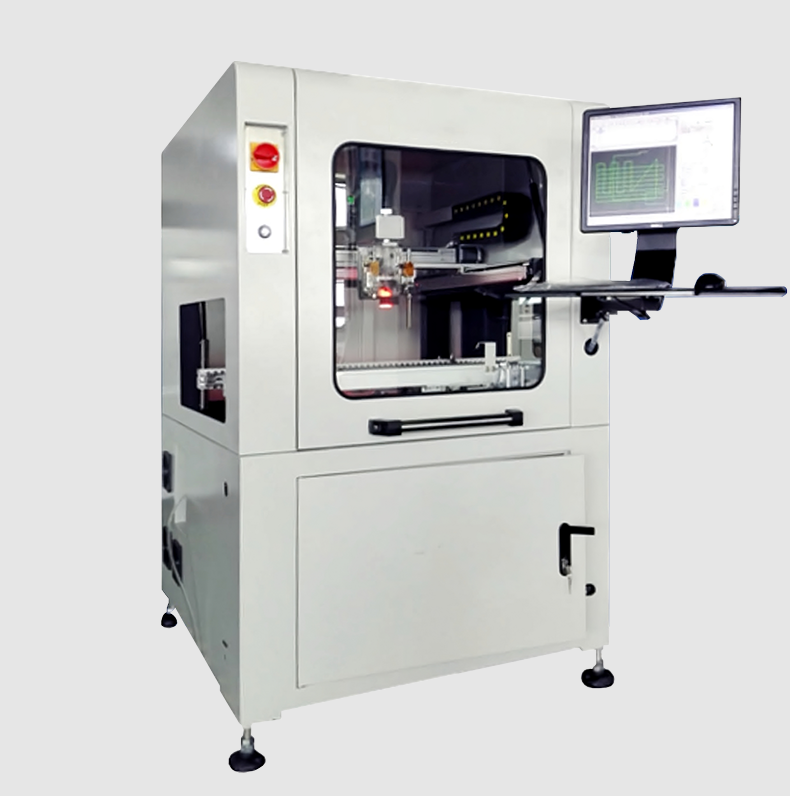
Automatic online glue dispenser HMH830D — the dispensing anchor of a turnkey SMT configuration.
An SMT turnkey line is judged less by its machine list than by the interfaces between its three process anchors: dispensing or paste deposition, placement, and reflow. In high-mix electronics manufacturing, most integration disputes do not begin with a failed machine — they begin with a parameter that nobody formally owned.
This reference answers the technical and buying questions that surface when an automatic online glue dispenser is integrated with a reflow oven and a pick and place machine under one procurement scope. It uses Motek's documented line hardware as its evidence base: the Automatic online glue dispenser HMH830D, the SMT Reflow Oven XMR-800D and the SMT Pick And Place Machine Hanwha Decan S2. Equipment parameters, certification scopes and commercial terms quoted below come from the supplier's own documented data; industry figures are attributed to their published sources.
Why the dispenser–oven–mounter interface becomes a procurement question
Placement equipment is the single largest value segment of the SMT equipment market, accounting for roughly 38% to 48% of total equipment value according to Persistence Market Research and Cognitive Market Research. That concentration shapes how lines are bought: the mounter attracts the technical evaluation, while the dispenser and the oven are frequently specified afterwards, by a different team, against a different set of assumptions.
The consequence is a class of recurring procurement questions that are neither purely technical nor purely commercial. Does the widest board in the product mix physically fit every station? Which machine owns the transfer height? Who writes the reflow recipe, who measures it, and who signs it off? When a program drifts, whose calibration interval was supposed to catch it? A turnkey scope is only meaningful if it answers these questions before the purchase order, not after installation.
Market direction reinforces the point. Transparency Market Research values the global SMT equipment market at approximately USD 6.6 billion in 2025, with a projected USD 14.6 billion by 2036, and Mordor Intelligence projects the high-mix/low-volume assembly segment growing at 8.31% CAGR through 2031. Lines are being bought in smaller increments and reconfigured more often — which raises the cost of an undocumented interface and lowers the tolerance for ambiguous responsibility.
What the turnkey scope actually commits to
Motek is an SMT equipment supplier that assembles turnkey SMT lines — dispensing, reflow and placement hardware plus the surrounding handling and inspection stations — for electronics manufacturers, and reports export activity across the EU, US, Australia, Canada and ASEAN markets. The company was founded in 2011 and operates a 955 m² facility; its documented export ratio is 100%.
Three named machines define the process core of the offer, and the naming matters for procurement because it converts a generic promise into an auditable specification:
- Automatic online glue dispenser HMH830D — an inline dispensing station with a 50–450 mm PCB width range, 920±20 mm transfer height and 0–5000 mm/min transport speed.
- SMT Reflow Oven XMR-800D — 8 top / 8 bottom heating zones over a 3110 mm heated length, with 3 top / 3 bottom cooling zones and a small-circulation rectifying plate structure.
- SMT Pick And Place Machine Hanwha Decan S2 — 92,000 CPH at optimum with an HS10 head, a 2 gantry × 10 spindles configuration, and placement accuracy of ±28 μm Cpk≥1.0 on 03015 chips and ±25 μm Cpk≥1.0 on ICs.
Around that core, the documented line architecture lists loader, solder paste printer, SPI, pick and place machine, reflow oven, unloader, AOI, X-ray inspection, ICT, splice machine, PCB turner, NG separator, stencil cleaner, environment monitor and ESD protection as the matched equipment set. The commercial terms relevant to a research-to-evaluation buyer are equally explicit: OEM/ODM customization including production line layout design, a minimum order quantity of 1 unit, a 7–45 day lead time, 100% pre-shipment testing, a 12-month product warranty, remote technical support and 24/7 online service.
Compliance documentation is part of the same scope. The supplier holds an ISO 9001:2015 certificate (HIC210707, valid to 2027-07-10) whose stated scope covers sales of pick and place machines and their accessories, solder paste printer and mechanical equipment; an EU Machinery Directive Attestation of Conformity (M.2023.206.C91284, valid to 2028-10-10) assessed against 2006/42/EC Annex VIII, EN 60204-1:2018, EN ISO 12100:2010 and EN 61010-1:2010+A1:2019; and a German Packaging Act (VerpackG) registration (DE2364478064729, registered 2022-12-21) covering packaging placed on the German market.
Technical explanation: the parameter envelope that decides compatibility
Compatibility in a turnkey line is not a single number — it is the overlap of three machines' envelopes. The table below sets out the parameters that carry the most procurement weight for each unit.
| Station | Documented model | Parameters that govern integration |
|---|---|---|
| Dispensing | Automatic online glue dispenser HMH830D | PCB width 50–450 mm; PCB transfer height 920±20 mm; transport speed 0–5000 mm/min, direction L→R (R→L); 2 stepper motors; industrial computer + motion control card; manual teaching; more than 1000 stored programs; 1060×1200×1700 mm; 650 kg; T20 mm chrome-plated steel plate platform |
| Reflow | SMT Reflow Oven XMR-800D | 8 top / 8 bottom heating zones; 3110 mm heated length; 3 top / 3 bottom cooling zones; small-circulation rectifying plate; exhaust volume 11 m³/min × 2; 5520×1430×1530 mm; approx. 2710 kg |
| Placement | SMT Pick And Place Machine Hanwha Decan S2 | 92,000 CPH (optimum, HS10 head); 2 gantry × 10 spindles/head; ±28 μm Cpk≥1.0 (03015 chip), ±25 μm Cpk≥1.0 (IC); parts 03015–12 mm, H10 mm; PCB 50×40–510×460 mm standard; high-strength aluminum alloy construction |
Board envelope. The dispenser accepts 50–450 mm board widths; the mounter accepts 50×40 up to 510×460 mm. The narrower figure governs the line. A board between 450 mm and 510 mm wide is inside the mounter's envelope but outside the dispenser's — a case that must be resolved at layout stage, not at first production run.
Transfer height and direction. The dispenser's PCB transfer height is 920±20 mm and its direction is selectable L→R or R→L. Because inline stations share a conveyor plane, this figure becomes a line-level constraint rather than a machine-level one: it has to be reconciled with the loader, printer, SPI, mounter, oven and unloader before the layout drawing is frozen.
Thermal capacity. Eight top and eight bottom heating zones across a 3110 mm heated length, followed by three top and three bottom cooling zones, determine how many distinct thermal steps the oven can hold separately before cooling. That architecture defines the shape of the recipe; it does not by itself certify a profile.
Takt balance. A placement rate of 92,000 CPH at optimum sits far above the throughput of a single dispensing pass in most configurations. Where the dispenser becomes the constraint, the practical answer is either a second dispensing station or a product mix that keeps dispensing time inside the line's cycle budget — a decision that belongs in the layout design deliverable.
Reflow profile: what is measured, what is agreed
A reflow profile is a recipe held across the oven's zone setpoints combined with a conveyor speed; it only becomes a production profile once it has been measured on the assembled board. IPC-A-610J, released in March 2024, is the current global standard for the acceptability of electronic assemblies and defines Class 1, Class 2 and Class 3 quality levels — the acceptance class is therefore a procurement input, because it changes what the measured result must demonstrate.
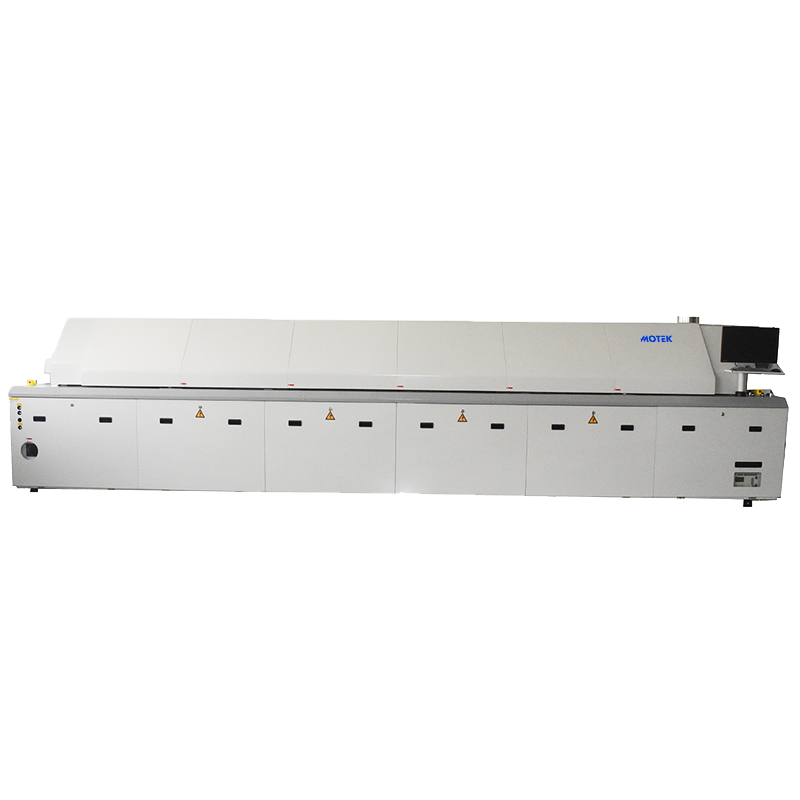
SMT Reflow Oven XMR-800D — heating zone count and length define the recipe architecture, not the result.
Three requirements should be written into the commissioning agreement. First, a documented baseline profile per product family, recorded with the measurement conditions. Second, a stated approval point: the supplier proposes, the buyer accepts, and both parties sign the same document. Third, a change-control rule — any adjustment to zone setpoints, conveyor speed or board loading that follows a process change must be re-measured rather than assumed.
One nuance often missed at evaluation stage: the HMH830D is described as an automatic online glue dispenser, so its output is an adhesive deposit rather than a printed solder paste deposit. Where the same oven serves both processes, the thermal requirement for the dispensed material is defined by the material supplier's cure schedule, not by a solder reflow schedule. Buyers should confirm which of the two regimes applies to their product before comparing oven configurations.
Dispenser setup: teaching, programs and transport
The HMH830D is controlled by an industrial computer with a motion control card, operated by computer and programmed by manual teaching. It stores more than 1000 running programs. For procurement, three implications follow directly from those specifications.
Program creation is a teaching activity, so the quality of a program depends on the operator who taught it and on the discipline that records it. A library of over 1000 programs is an asset only if it is version-controlled; the alternative is a library that grows faster than it can be verified. Second, transport speed of 0–5000 mm/min is adjustable across a wide range, which means cycle time is a programmable variable rather than a fixed property — and therefore a parameter to be documented per product. Third, the dispenser's mechanical platform is a T20 mm chrome-plated steel plate at 650 kg, and its PCB width range of 50–450 mm defines the boards it can carry.
Responsibility map: optimization, calibration and training
The single most useful page in a turnkey contract is the responsibility matrix. The table below separates what Motek documents as included from what a buyer should typically retain, so that the boundary is negotiated rather than discovered.
| Activity | Documented supplier scope | Typical buyer retention |
|---|---|---|
| Line layout design | Included in customization (production line layout design) | Facility data, product mix, sign-off |
| Baseline process parameters | Commissioning and 100% pre-shipment testing | Written acceptance of the baseline |
| Dispenser programming | Manual teaching on an industrial PC + motion control card | Program version control after handover |
| Reflow profile validation | Zone architecture, setpoint range, exhaust specification | Measurement, approval class selection, re-validation cadence |
| Training | Remote technical support, 24/7 online service, optional remote or on-site training; engineers may attend roughly one week of training in China | Internal trainer coverage, shift-level documentation |
| Ongoing calibration | Not stated as a standing service in the documented scope | Interval definition and internal records |
The last row is the one that most often causes friction. Where a service is not documented as included, the buyer should assume it is retained and either resource it internally or negotiate it explicitly as an add-on.
Where this configuration fits: application and site conditions
The documented application profile for this class of line covers automotive electronics, smart transportation, industrial automation, consumer electronics, medical technology, new energy systems, LED and optoelectronics, and telecommunications. That spread is consistent with the market data: Persistence Market Research attributes the fastest growth in inspection equipment — 3D AOI and SPI at a 15.2% CAGR — largely to automotive zero-defect requirements, which push measurement capability into lines that previously ran on visual checks alone.
Site conditions are a hard constraint, not a footnote. The documented operating environment is an indoor cleanroom at 23°C ± 2°C and 50% ± 10% relative humidity, with a further stated range of 40–60% RH, IP20/IP40 protection, zero vibration and zero dust, and ESD protection to ANSI/ESD S20.20 within a defined EPA zone using grounded workstations. ISO Class 8 cleanroom performance is specified, and the line is documented for 24/7 operation.
Deployment evidence points in the same direction. Documented SMT factory deployments in Germany, Israel, India and Australia involve 20–35 units over a five-year duration, with applications spanning smartphone motherboard assembly, tablet circuit board production, ECU control unit assembly, LED display modules, LED streetlight drivers and consumer electronics PCB assembly at 50,000 units per month, and a reported mass-production output range of 20,000–100,000 pieces per day. These figures describe application range and scale; they are not a guarantee of output for a different product mix.
Market trend: what the numbers imply for line specification
Three published data points are directly relevant to how a dispenser–oven–mounter line should be specified. Transparency Market Research values the global SMT equipment market at approximately USD 6.6 billion in 2025 with a projected USD 14.6 billion by 2036, and reports Asia-Pacific holding a 54% revenue share in 2025, followed by North America and Europe. Mordor Intelligence projects 8.31% CAGR for the high-mix/low-volume segment through 2031.
Read together, these figures describe a market that is growing while its centre of gravity shifts toward smaller batches and more frequent reconfiguration. That combination rewards documentation over hardware count: a line whose baseline parameters, program library and profile records are written down can be reconfigured without renegotiating responsibility. A line that relies on operator memory cannot.
The vendor landscape is consolidated at the top and broad at the base. MarketsandMarkets identifies ASMPT Limited, Fuji Corporation, Yamaha Motor, Panasonic, Juki Corporation and Hanwha Precision Machinery among key global SMT vendors, and Fuji's NXT platform and Yamaha's YSM series are widely referenced as industry-standard modular mounters for high-speed and high-precision placement. The Hanwha Decan S2 configured in this line sits within that same tier of documented placement hardware — which is precisely why the differentiator in a turnkey evaluation tends to be integration scope and documentation rather than the mounter alone.
Turnkey integration versus multi-vendor self-integration
The traditional alternative is straightforward: purchase the mounter from one vendor, the oven from a second and the dispenser from a third, then integrate in-house. That route preserves best-of-breed selection and may align with existing spare-part inventory and engineering familiarity. Its cost is concentrated at the interfaces — conveyor height, board width, transfer direction and profile ownership all become buyer-side risk, and the number of parties accountable for a line-level failure is zero.
A turnkey scope such as the Motek configuration moves those interfaces inside a single deliverable that includes production line layout design, OEM/ODM customization and 100% pre-shipment testing. The trade-off is real and should be stated plainly: the buyer gives up per-machine vendor selection in exchange for a single accountable party, and inherits that party's parameter envelope as the line's envelope.
Documented limits worth raising at evaluation stage
- Board width ceiling. The dispenser's 50–450 mm range is narrower than the mounter's 510 mm maximum. Product mixes containing boards wider than 450 mm require an explicit alternative before the layout is confirmed.
- Programming model. Dispenser programming is documented as manual teaching, not automated offline generation. High-mix changeover therefore depends on the stored library of more than 1000 programs plus verification discipline.
- Certification scope. Certificates carry defined scopes. The ISO 9001:2015 certificate covers sales of pick and place machines and accessories, solder paste printer and mechanical equipment; the EU Machinery Directive Attestation of Conformity lists a specific equipment scope. Buyers should confirm model-level coverage rather than assume blanket applicability.
- Facility services. An exhaust requirement of 11 m³/min × 2 and an oven weight of approximately 2710 kg (against 650 kg for the dispenser) are site-planning constraints that must be verified against the building before delivery.
- Calibration as a service. Standing calibration is not identified in the documented scope, so the interval and the owner should be agreed contractually.
Future outlook
Two trajectories are likely to shape turnkey procurement over the next several years, and both are already visible in published data. The first is inspection density: as AOI and SPI continue to absorb a larger share of line investment under zero-defect pressure, process settings stop being private operator knowledge and become data that must be traceable to a board, a lot and a profile. The second is mix fragmentation: continued growth in high-mix/low-volume assembly means the same line will be reconfigured more often, and changeover time will carry more commercial weight than peak placement speed.
For buyers, the practical implication is that the value of a turnkey arrangement will be assessed increasingly on documentation quality — baseline parameters, program libraries, profile records and a clear responsibility matrix — rather than on the machine list alone. Suppliers who can hand over a documented envelope, and state its boundaries honestly, will be easier to defend internally than those who offer a broader but less specific promise.
Procurement FAQ
1. What has to match mechanically before a dispenser, oven and mounter can run as one line?
Three figures must overlap: board width, PCB transfer height and conveyor direction. The Automatic online glue dispenser HMH830D accepts PCB widths of 50–450 mm at a transfer height of 920±20 mm, with transport speed of 0–5000 mm/min and selectable L→R or R→L direction. The SMT Pick And Place Machine Hanwha Decan S2 accepts PCB sizes from 50×40 mm to 510×460 mm standard. Because 450 mm is the narrower limit, the dispenser governs the maximum board width of the line.
2. How is a reflow profile established on the XMR-800D, and who approves it?
The SMT Reflow Oven XMR-800D provides 8 top and 8 bottom heating zones across a 3110 mm heated length, followed by 3 top and 3 bottom cooling zones and a small-circulation rectifying plate structure, with an exhaust requirement of 11 m³/min × 2. A profile is built as a setpoint recipe across those zones and becomes a production profile only when measured on the assembled board. Acceptance should be referenced to the quality class defined in IPC-A-610J (Class 1, 2 and 3), and the result should be signed off jointly by supplier and buyer.
3. How is the automatic online glue dispenser programmed, and does it support high-mix changeover?
The HMH830D uses an industrial computer with a motion control card, is operated by computer and is programmed by manual teaching, with storage for more than 1000 running programs. High-mix changeover therefore depends on recalling a previously taught program and verifying the deposit, supported by version control over the stored library. The documented programming mode is manual teaching; no automatic offline program generation is stated in the specification.
4. Who is responsible for process optimization, calibration and training?
Within Motek's documented scope, production line layout design is included in customization, along with remote technical support, 24/7 online service, and optional remote or on-site training; client engineers may also attend roughly one week of training in China. Ongoing calibration is not stated as a standing service. A workable division is for the supplier to deliver baseline parameters and commissioning, while the buyer retains calibration intervals, program version control and shift-level documentation, with both obligations written into the agreement.
5. What site services does the line require before installation?
The documented operating environment is an indoor cleanroom at 23°C ± 2°C and 50% ± 10% relative humidity (40–60% RH), IP20/IP40, with zero vibration, zero dust and ESD protection to ANSI/ESD S20.20 inside an EPA zone with grounded workstations; ISO Class 8 cleanroom performance is specified and the line is documented for 24/7 operation. In addition, the oven requires an exhaust capacity of 11 m³/min × 2 and weighs approximately 2710 kg at 5520×1430×1530 mm, while the dispenser weighs 650 kg at 1060×1200×1700 mm — both are floor-loading and footprint inputs for facility planning.
6. Which certifications apply, and what do their scopes cover?
Three documents are listed. The ISO 9001:2015 certificate HIC210707, valid to 2027-07-10, has a scope covering sales of pick and place machines and their accessories, solder paste printer and mechanical equipment. The EU Machinery Directive Attestation of Conformity M.2023.206.C91284, valid to 2028-10-10, was assessed against 2006/42/EC Annex VIII, EN 60204-1:2018, EN ISO 12100:2010 and EN 61010-1:2010+A1:2019, with a stated equipment scope. The German Packaging Act registration DE2364478064729, issued 2022-12-21 through ZSVR, covers registration as a manufacturer of filled packaging for the German market. Each scope is specific, so model-level coverage should be confirmed in writing.
7. What lead time and minimum order quantity should a buyer plan for?
Motek's documented commercial terms state a minimum order quantity of 1 unit and a lead time of 7–45 days, with 100% pre-shipment testing before dispatch. Customization options including voltage, logo, packaging, color, size, material and production line layout design affect the position within that range, so the specific configuration should be scheduled explicitly rather than assumed at the short end.
8. Where does the dispenser sit in the line sequence?
The HMH830D is an online machine with a conveyor, so it occupies a station inside the conveyor flow rather than operating off-line. The documented line architecture lists loader, solder paste printer, SPI, pick and place machine, reflow oven, unloader, AOI, X-ray inspection, ICT, splice machine, PCB turner, NG separator, stencil cleaner, environment monitor and ESD protection as the matched equipment set. The exact position of the dispenser depends on whether it deposits adhesive or another material, and should be fixed in the layout drawing rather than agreed verbally.
9. What does documented deployment evidence show about scale and application range?
Documented SMT factory deployments in Germany, Israel, India and Australia involve 20–35 units over a five-year duration. Applications include smartphone motherboard assembly, tablet computer circuit board production, ECU control unit assembly, LED display modules, LED streetlight drivers and consumer electronics PCB assembly at 50,000 units per month, with a reported mass-production output range of 20,000–100,000 pieces per day. These figures describe demonstrated application range and scale; they are not a performance guarantee for a different product mix or site.
10. What does the warranty cover, and what support follows installation?
A 12-month warranty is stated on products, alongside remote technical support and 24/7 online service. Training can be delivered remotely or on-site as an option, and client engineers may travel to China for approximately one week of training. Consumable and spare-part coverage is not itemised in the documented scope, so a buyer should request a written spares list and confirm which items sit inside or outside the warranty period.
Summary
A turnkey SMT line is a defined parameter envelope plus a defined set of responsibilities. The dispenser governs board width at 450 mm, the oven governs thermal architecture across 16 heating zones and 3110 mm of heated length, and the mounter governs placement accuracy and throughput. What separates a manageable line from a costly one is whether the overlaps between those three envelopes — and the ownership of every parameter inside them — are written down before the purchase order.
A downloadable PDF brochure covering Motek's SMT equipment range is available here.
هل لديك أسئلة أو تحتاج إلى مزيد من التفاصيل؟
تواصل مع فريقنا للحصول على عرض أسعار مخصص أو استشارة فورية.
طلب عرض أسعار
املأ النموذج أدناه وسيتواصل معك فريقنا بعرض مقترح مخصص.
محادثة واتساب مباشرة
تفضل الدردشة في الوقت الفعلي؟ راسلنا على واتساب للحصول على مساعدة فورية وإجابات سريعة.
- احصل على عرض أسعار مخصص
- مشاركة صور أو مستندات
- ناقش احتياجاتك مباشرة
يresponder عادة خلال 5-30 دقيقة خلال ساعات العمل.