
Display Rack Fit Matrix: Supermarket, Store, Exhibition
Display Rack Fit Matrix: Supermarket, Store, Exhibition
A display rack is selected correctly when the operating conditions are fixed first: how long the installation lasts, how much public traffic it faces, who assembles it, and what has to be attached to it. Appearance follows from those answers, not the other way round. Redman's scenario documentation links three custom formats — the Plastic Display Rack (RM-PD-001), the POP Display Stand (RM-POP-001) and the Store Fixture (RM-SF-001) — to indoor retail environments, and every one of those formats is also listed against more than one industry. The practical question for a retail buyer is therefore not which model looks strongest in a catalogue, but which format matches the environment the project will actually run in.
Redman Corporation is a manufacturer of custom POP displays and store fixtures, founded in August 2002 and based in Zhangjiagang, Jiangsu, about two hours' drive from Shanghai. Its production site covers around 550,000 sq ft (51,097 m²) across metal, wood, plastic, printing, painting, powder coating and packaging workshops, and the company states a warehouse in Los Angeles in the United States. Redman reports more than 350 employees, including over 50 technical engineers and 7 project managers, 1,000+ containers shipped annually, a 95% export ratio and main markets in the USA, Canada, Europe, the Middle East and Australia. Those are company-reported figures, and they matter here for one reason: a single supplier offering plastic, metal and wood routes to the same brief is what makes a scenario matrix usable. See Redman Corporation.
Why the scenario, not the catalogue, sets the shortlist
Three variables separate the environments more reliably than any product photograph.
- Display duration and traffic. The supermarket scenario is documented as an indoor environment with high customer flow and 24/7 static display. The department-store scenario is documented as long-term static display. The exhibition scenario is documented as short-term display with high brand exposure. A fixture expected to stand for years and one struck in a day are different engineering briefs, even when both are called display racks.
- Assembly and handling. Supermarket requirements include easy assembly and disassembly; exhibition requirements include easy assembly, disassembly and transport together with a portable and reusable design. Department-store requirements centre instead on high-end appearance customisation and, where specified, customisable lighting and interactive functions.
- Support equipment. Each environment arrives with its own attachments: price tags, promotional posters and lighting accessories in the supermarket; lighting systems, brand signage and decorative accessories in the department store; lighting systems, brand backdrops and display accessories at an exhibition. If those interfaces are not designed in, the environment will expose the gap after installation.
Appearance customisation is required in all three environments, but it is expressed differently: custom size, design, colour and logo printing in the supermarket and exhibition settings, and high-end appearance customisation plus optional lighting and interactive functions in the department store. Appearance is a specification output, not the starting filter.
The scenario fit matrix
Table 1 maps the documented conditions to the three formats. “Closest fit” means the format whose stated material, process and application list line up most directly with the environment. It does not exclude the other two, because Redman's scenario data links all three models to all three of these scenarios.
| Environment | Documented operating condition | Closest fit | Support equipment | Boundary to confirm |
|---|---|---|---|---|
| Supermarket | Indoor, high customer flow; 24/7 static display; easy assembly and disassembly; adaptation to different shelf specifications | Plastic Display Rack (RM-PD-001) | Price tags, promotional posters, lighting accessories | Bay and shelf dimensions must be supplied before design; the unit is custom, so the shelf module cannot be assumed |
| Department store | Indoor, multi-category brand display; long-term static display; customisable lighting and interactive functions; high-end appearance customisation | Store Fixture (RM-SF-001) | Lighting systems, brand signage, decorative accessories | Lighting and interactive functions add electrical scope; the applicable standard and documentation must be confirmed for the market of installation |
| Exhibition and trade show | Indoor exhibition; short-term display; high brand exposure; easy assembly, disassembly and transport; portable and reusable design | POP Display Stand (RM-POP-001) | Lighting systems, brand backdrops, display accessories | Venue rules on electrical supply, rigging and build-up time are set per show and must be checked against the calendar |
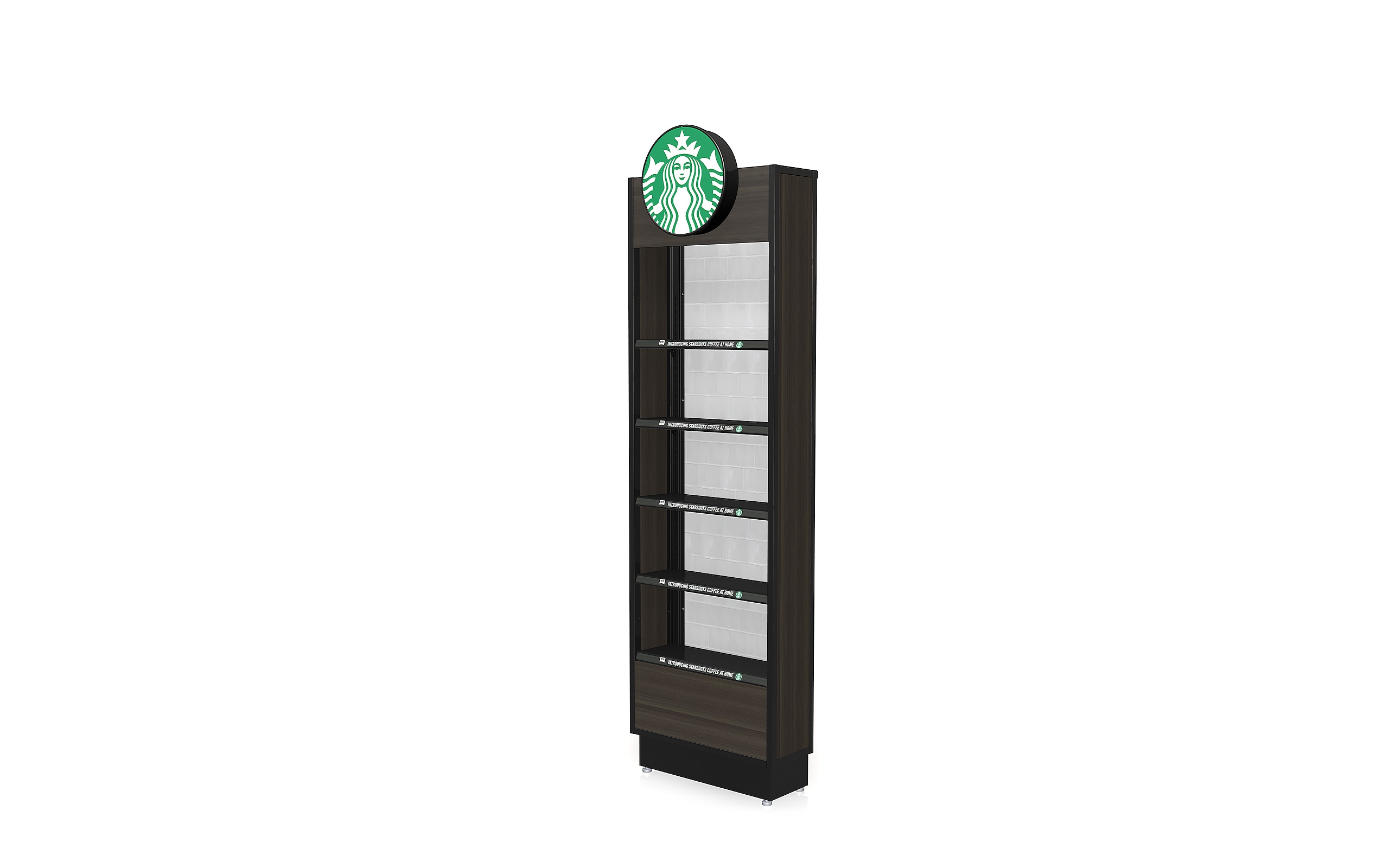
Display format follows the environment: traffic, display duration and support equipment come before surface appearance. Image: Redman.
Supermarket: 24/7 static display under promotional churn
The Plastic Display Rack (RM-PD-001) is the closest fit where a supermarket needs category-level display that can be assembled, disassembled and re-merchandised inside a live store. The documented supermarket condition is an indoor environment with high customer flow and 24/7 static display, easy assembly and disassembly, custom size, design, colour and logo printing, and adaptation to different shelf specifications. The fixture's function there is product classification display and promotional information delivery, supported by price tags, promotional posters and lighting accessories.
RM-PD-001 is a custom plastic POP display in ABS, PS or acrylic, produced through injection moulding and vacuum forming, with custom colour and logo available. Its application list covers retail, supermarket, convenience store and exhibition. Against the supermarket condition, the material and process route explains the fit: moulded plastic is the route for shaped, repeatable components carrying brand colour and logo — the type of output a category or promotional unit usually needs — and the custom-size scope allows the unit to be drawn around an existing shelf module rather than beside it.
The boundary sits in the word “adaptation”. Adaptation to different shelf specifications is a design input, not a property of the model: bay width, shelf pitch and the existing fixture module have to be supplied before the unit is drawn. A custom plastic rack ordered without those dimensions has bought appearance, not fit.
Two further points matter at evaluation stage. RM-POP-001, the metal POP display stand, is also listed for supermarket applications and carries a stated load capacity of 50–200 kg, so where the brief is driven by load rather than by promotional change it deserves a place in the comparison. Redman also reports a European supermarket chain project covering 3,000+ custom store fixtures across 200+ supermarkets in Germany over two years, customised to the chain's brand VI, with a reported 30% improvement in the supermarket's operational efficiency. That is a company-reported project result rather than a guarantee for another chain, but it shows the kind of evidence worth requesting when a roll-out is being planned.
Department store: long-term brand display and appearance customisation
The Store Fixture (RM-SF-001) is the closest fit where a department store is building a multi-category brand display that must hold its appearance over a long installation. The documented department-store condition is an indoor, multi-category brand display environment with long-term static display, customisable lighting and interactive functions, and a requirement for high-end appearance customisation. Its function is brand image promotion, product value display and customer experience, supported by lighting systems, brand signage and decorative accessories.
RM-SF-001 is a custom wood store fixture in MDF, solid wood or plywood, finished in melamine, veneer or painting, with custom structure and design available; its material list also includes metal and acrylic, which matters where a design combines a wood body with metal or acrylic elements. Its application list covers retail, supermarket, department store and brand store. In this environment the finish specification does real work: melamine, veneer and painting are three different surface routes, and the choice has to answer the brand's appearance standard rather than a sample viewed in isolation.
Two requirements push beyond the rack itself. Customisable lighting and interactive functions introduce electrical and sometimes moving parts into what would otherwise be a static fixture, and brand signage and decorative accessories have to be resolved within the same design. Both should be settled at quotation stage, because retrofitting a lighting system into a finished fixture is a different project from designing for one.
The supplied evidence for this environment is the most appearance-sensitive of the three. Redman reports a Middle East department store project of 1,000+ custom high-end display cabinets over 1.5 years for a flagship store in Riyadh, delivered with strict material selection and surface treatment, professional installation guidance and one-to-one project management. As with any supplier-reported case, the transferable part for a new buyer is the delivery model — installation guidance and single-point project management — rather than the outcome claim itself. The boundary is that long-term static display is not the same as permanent: where a store rotates layouts seasonally, reconfigurability has to be specified rather than assumed, because nothing in the department-store scenario describes frequent relocation.
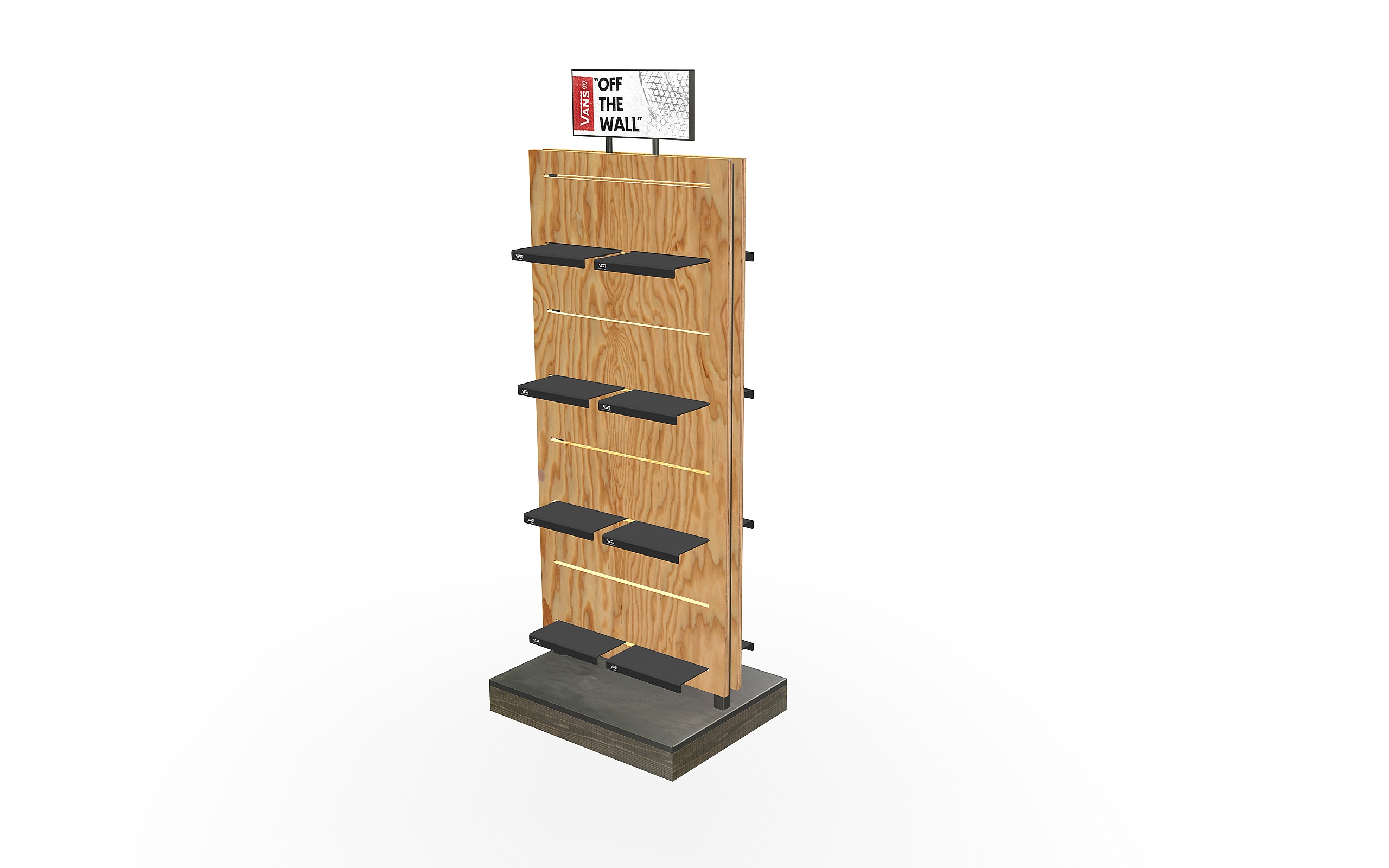
Long-term brand display: finish route, signage and lighting are resolved at design stage. Image: Redman.
Exhibition and trade show: short-term display that has to travel
The POP Display Stand (RM-POP-001) is the closest fit where a trade-show stand needs a defined load capability and a metal structure that can be built, struck and shipped between shows. The documented exhibition condition is an indoor exhibition environment with short-term display and high brand exposure, easy assembly, disassembly and transport, custom size, design, colour and logo printing, and a portable and reusable design. Its function is brand image display, new product promotion and customer acquisition, supported by lighting systems, brand backdrops and display accessories.
RM-POP-001 is a custom metal POP display in cold-rolled steel or stainless steel, finished by powder coating or painting, with a stated load capacity of 50–200 kg and custom logo printing available; its material list also includes wood and acrylic. Among the three formats it is the one carrying an explicit load band in the supplied specification, which matters at a show: samples, signage and visitor handling all load the fixture within a compressed period, and the figure gives the design conversation a starting number instead of an assumption. The metal workshop's quality-control description includes load-bearing testing alongside dimensional and surface-finish inspection.
Transport and assembly are separate requirements from load, and the exhibition scenario treats them as first-class: easy assembly, disassembly and transport with a portable, reusable design. A fixture that meets a load figure but needs specialist tools to build is a poor exhibition choice, and a fixture that packs badly will not survive repeated shows whatever its construction.
The strongest supplied evidence for this environment is a four-year relationship with a global exhibition service provider, covering 200+ custom exhibition booth fixtures annually and support for 500+ global exhibitions, using reusable, easy-to-assemble fixtures with a reported 35% reduction in the customer's exhibition cost. The highlights cited are portable and modular design, fast production and delivery, and custom brand design. The cost figure is a reported outcome for one service provider's programme; the transferable lesson is that modularity and reusability are what turn a fixture from a per-show cost into a reusable asset.
Boundaries to confirm before specifying: venue rules on electrical supply, rigging and build-up time are set by each organiser and vary by show, so the design has to be checked against the venues on the calendar; and the lighting systems and brand backdrops named in the scenario are support equipment rather than part of the rack, which means they need their own specification and their own coordination.
How material and process choices track the three environments
Table 2 sets out the supplied specification for each format. It is deliberately narrow and contains only stated parameters, because a scenario decision built on inferred specifications is not one a buyer can defend internally.
| Model | Material | Process and finish | Stated load | Applications listed |
|---|---|---|---|---|
| RM-PD-001 Plastic Display Rack | ABS, PS, acrylic | Injection moulding, vacuum forming; custom colour and logo | Not stated in the supplied specification | Retail, supermarket, convenience store, exhibition |
| RM-POP-001 POP Display Stand | Cold-rolled steel, stainless steel; also wood and acrylic | Powder coating, painting; custom logo printing | 50–200 kg | Retail, supermarket, department store, brand store |
| RM-SF-001 Store Fixture | MDF, solid wood, plywood; also metal and acrylic | Melamine, veneer, painting; custom structure and design | Not stated in the supplied specification | Retail, supermarket, department store, brand store |
Two observations follow. The three formats do not compete on a single scale: one is defined by material family, one by a load band, one by finish options, and each specification answers a different environment's dominant question. Customisation scope, by contrast, is common to all three — custom size and design — which means the differences that decide a project are material, process, finish and environment, not the availability of customisation itself.
When the environments overlap: re-deployment and multi-use programmes
The matrix is a default, not a restriction. Redman's scenario data links all three models to the supermarket, department-store and exhibition scenarios, and the retail-store scenario — indoor, 24/7 operation, product merchandising and brand promotion, with optional interactive functions — links the same three models again. A buyer running a programme across permanent stores and temporary shows therefore has three legitimate routes, and the choice should rest on the constraint that cannot be relaxed.
- If the binding constraint is appearance over a long installation, start from the wood-based store fixture and treat transport as a secondary requirement.
- If the binding constraint is a defined load with repeated build and strike, start from the metal POP display stand and confirm its packing and assembly method against the show calendar.
- If the binding constraint is category display that changes with promotions, start from the plastic display rack and confirm the shelf module before design.
Re-deployment deserves its own check. A fixture designed for a permanent installation is not automatically suitable for a second venue, and the reverse is equally true; assembly method, packing and the appearance standard of the second location all have to be confirmed with the supplier rather than inferred from the first installation. Redman also reports a US retail brand programme of 5,000+ custom POP display units over three years, supported by its US warehouse's drop-shipping service and a reported 100% on-time delivery rate. For a multi-site programme, the relevant point is that a warehouse-based fulfilment option exists to be discussed, not that any particular delivery performance will repeat.
A scenario-fit checklist for the evaluation stage
Use the following list to convert the matrix into an RFQ. Each item maps to a documented condition or a supplied capability, so answers can be compared across suppliers.
- Display duration and duty cycle: state whether installation is 24/7, long-term or short-term, and whether traffic is high.
- Assembly and transport: confirm who assembles the fixture, what tools are needed, and how it packs for a show.
- Support interfaces: list the price tags, posters, lighting systems, signage, backdrops or decorative accessories the fixture must carry.
- Load: state the expected load and compare it with the metal format's stated 50–200 kg band where relevant; request load-bearing test records.
- Appearance: specify the finish route — moulded colour and logo for plastic, powder coating or painting for metal, melamine, veneer or painting for wood.
- Dimensions: supply bay, shelf and booth dimensions before design, since all three formats are custom size.
- Order economics: custom metal parts are stated at a 100-piece minimum and 25–35 days; custom wood parts at 50 pieces and 30–40 days; custom plastic parts at 1,000 pieces and 35–50 days including mould development; general custom orders at 30–45 days, with FCL or LCL available for small batches.
- Inspection: third-party inspection by SGS, BV or TUV is stated as available, alongside 100% pre-shipment inspection.
- After-sales: the stated support model is 7×24 online technical support, a named project manager and resolution of after-sales quality problems within 48 hours.
Two items are usually discovered late: lead time and minimum quantity. A supermarket promotional unit with a moulded plastic component and a department-store fixture with a veneered panel do not share a production calendar, and planning them against the same date is a scheduling error rather than a supplier failure.
Compliance evidence: separate the standard from the certificate
Compliance questions differ by environment, but the first step is the same: establish which standard applies to the product as specified, then request evidence against it. UL Solutions describes UL 970 as the standard for retail fixtures and merchandise displays, covering commercial displays, showcases and temporary displays, and lists point-of-sale, motorised, hanging, wall-system, showcase, display-case and product-platform categories within its scope; the standard is described as published in 2020, and the source notes that current edition and applicability should be validated directly.
Three consequences follow. A temporary exhibition fixture and a permanent store fixture can fall inside the same U.S. reference framework, so a short display life does not remove the compliance question. Scope is not certification: a standard tells a buyer what to ask about, not whether a particular supplier's fixture has been evaluated. And lighting or interactive functions — both named in the department-store scenario — bring electrical and sometimes motorised elements into the specification, which is a separate question from the rack's mechanical construction.
On the manufacturing side, Redman's stated quality-control scope includes dimensional, surface-finish and load-bearing inspection in metal, moisture-content and surface-finish inspection in wood, and material-performance and dimensional inspection in plastic, each with 100% quality checks. Those are inspection capabilities, not certificates. A buyer should request the certificate, test report or declaration that applies to the exact model, finish and market of installation, and confirm its scope and validity before the fixture is specified.
Market context: why scenario fit stays the buyer's problem
Published market figures frame the category without answering the scenario question. Dataintelo valued the global retail shelving market at USD 12.4 billion in 2025 and projected USD 25.6 billion by 2034 at an 8.9% CAGR, while a separate commercial-research estimate for retail display cases puts that market at USD 7.18 billion. The two are not interchangeable, because the definitions differ — one covers broader shelving, the other merchandising display units — and averaging them would misstate both. Within display formats, floor-standing cases were reported at a 52% share of the retail display market in 2025, and steel at a 48.6% share of retail shelving material in 2024. Read narrowly, the figures suggest that floor-standing, steel-based formats remain the mainstream reference point, which is precisely why the productive question is which construction fits which environment rather than whether to use a floor-standing fixture at all.
What the matrix changes in a fixture brief
The scenario fit matrix does not produce a universal recommendation, and it should not. It produces an order of questions. Fix the environment and the duty cycle; confirm the support equipment the fixture must carry; confirm the assembly and transport cycle; then compare material, process and finish against those constraints. On the supplied evidence, the plastic display rack leads where supermarket category display and promotional change dominate, the wood store fixture leads where department-store appearance must hold over a long installation, and the metal POP display stand leads where a defined load and repeated build-and-strike define the project.
Where a programme spans more than one environment, the matrix becomes a shortlist tool rather than a verdict, and the overlap checks above apply. The one assumption that should not survive from appearance-led selection is that a fixture which photographs well in one environment will perform in another; the documented conditions in this article are the test that assumption has to pass.
Redman publishes a catalogue covering its custom POP display and store fixture ranges: Redman 2026 product catalogue (PDF).
Frequently asked questions
Which display rack format fits a high-traffic supermarket with 24/7 static display?
The Plastic Display Rack (RM-PD-001) is the closest fit in this set. The supermarket scenario is documented as an indoor environment with high customer flow, 24/7 static display, easy assembly and disassembly, custom size, design, colour and logo printing, and adaptation to different shelf specifications. RM-PD-001 is a custom plastic POP display in ABS, PS or acrylic, produced by injection moulding and vacuum forming, and its application list includes supermarket, retail, convenience store and exhibition. Bay and shelf dimensions must be supplied before design, because adaptation to shelf specifications is a design input rather than a fixed property of the model.
What does a department-store brand display require beyond appearance?
Long-term static display, support equipment and integration. The department-store scenario is documented as an indoor, multi-category brand display environment with long-term static display, customisable lighting and interactive functions, and high-end appearance customisation, supported by lighting systems, brand signage and decorative accessories. The Store Fixture (RM-SF-001) is a custom wood fixture in MDF, solid wood or plywood with melamine, veneer or painting finishes and a custom structure. Lighting and interactive functions add electrical and sometimes moving elements, so they should be resolved at design and quotation stage rather than retrofitted.
What should an exhibition buyer check before specifying a display rack?
Assembly, transport, load and venue conditions. The exhibition scenario is documented as indoor, short-term display with high brand exposure, easy assembly, disassembly and transport, and a portable and reusable design, with lighting systems and brand backdrops as support equipment. The POP Display Stand (RM-POP-001) is a custom metal fixture in cold-rolled or stainless steel with powder coating or painting and a stated load capacity of 50–200 kg. Venue rules on electrical supply, rigging and build-up time are set by each organiser, so the design has to be checked against the specific shows on the calendar.
Can one display rack serve both a permanent store and an exhibition programme?
It can be considered, but the fit has to be re-checked rather than assumed. Redman's scenario data links the Plastic Display Rack, POP Display Stand and Store Fixture to the supermarket, department-store and exhibition scenarios, so multi-environment use is not excluded. The practical checks are the assembly method, the packing and the appearance standard of the second venue. A fixture designed for a long-term permanent installation is not automatically suited to repeated build-and-strike, and an exhibition fixture may not meet a department store's appearance requirement.
What documentation should support a display rack scenario decision?
Specification, inspection and compliance records matched to the model, finish and market. On the manufacturing side, Redman states dimensional, surface-finish and load-bearing inspection for metal, moisture-content and surface-finish inspection for wood, and material-performance inspection for plastic, with 100% quality checks and third-party inspection by SGS, BV or TUV available. On the standards side, UL Solutions describes UL 970 as covering commercial displays, retail fixtures, showcases and temporary displays, with current edition and applicability to be validated. Neither constitutes a certificate for a specific product, so the applicable certificate, test report or declaration should be requested in writing for the exact configuration.
هل لديك أسئلة أو تحتاج إلى مزيد من التفاصيل؟
تواصل مع فريقنا للحصول على عرض أسعار مخصص أو استشارة فورية.
طلب عرض أسعار
املأ النموذج أدناه وسيتواصل معك فريقنا بعرض مقترح مخصص.
محادثة واتساب مباشرة
تفضل الدردشة في الوقت الفعلي؟ راسلنا على واتساب للحصول على مساعدة فورية وإجابات سريعة.
- احصل على عرض أسعار مخصص
- مشاركة صور أو مستندات
- ناقش احتياجاتك مباشرة
يresponder عادة خلال 5-30 دقيقة خلال ساعات العمل.