
Disposable Bamboo Cutlery Sets: A Buyer's Discovery Guide
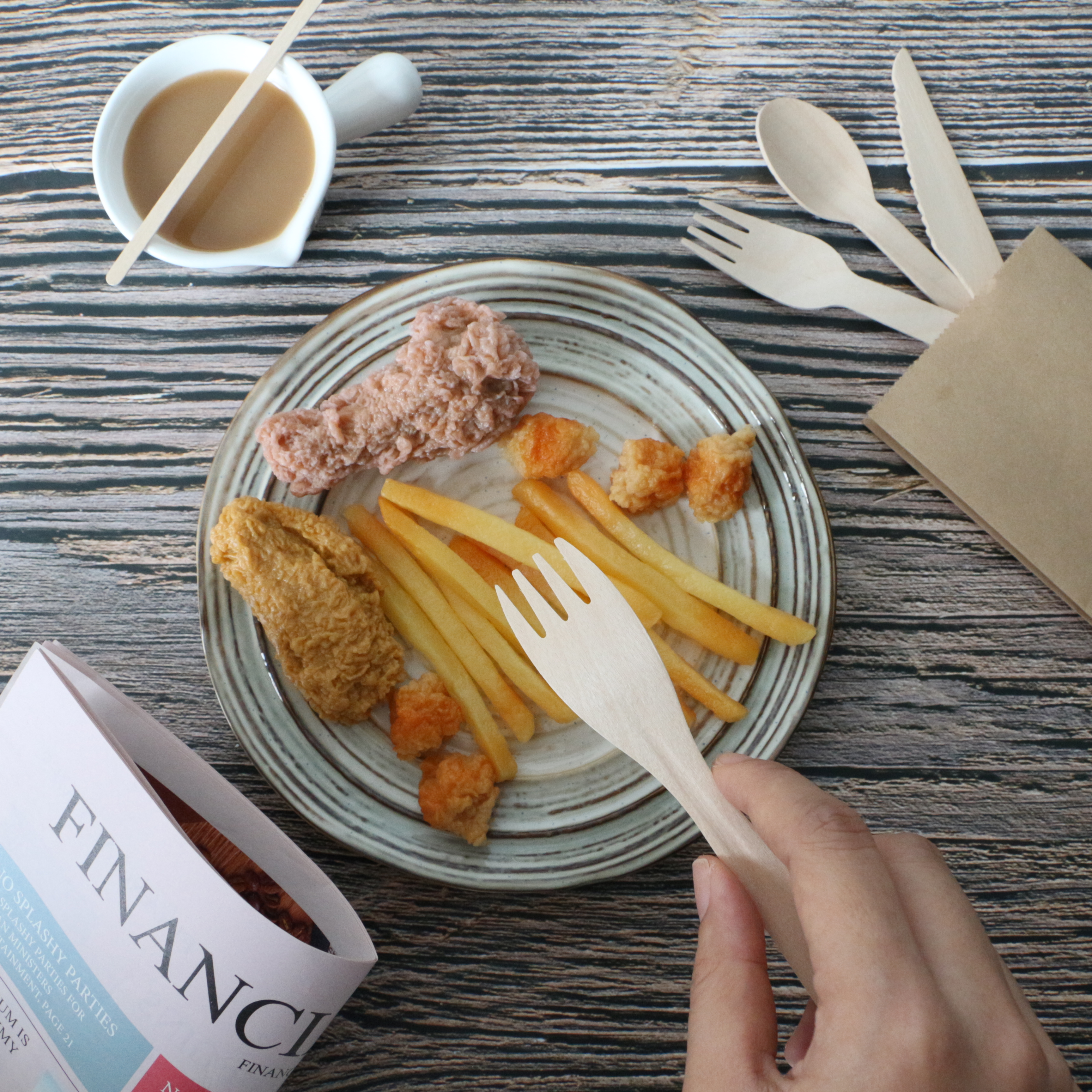
Disposable bamboo cutlery is a single-use eating set formed from bamboo and supplied ready to use, intended to be discarded after a meal and — in food-contact-grade formats — to biodegrade or compost afterwards. For a buyer at the research stage, the category is less a single product than a set of decisions: which items the set contains, what length the pieces are, which food-contact certification the supplier can document, how a logo is applied, and how the set is packed for the channel it will serve.
The format has moved from a niche alternative into mainstream food-service procurement, as restaurant chains, takeaway operators, airlines and retail buyers look for disposable tableware whose environmental claims can be checked rather than simply asserted. This reference explains the category from the purchasing side and uses Greenwood - Dalian Industrial Co., ltd. — a China-based manufacturer of disposable wooden and bamboo tableware founded in 2000 — and its GW-BC001 bamboo cutlery range as a worked example of how a complete specification should read.
Short answer: a disposable bamboo cutlery set is a single-use knife, fork and spoon — often with a coffee stirrer or bamboo skewer stick — made from bamboo, food-grade and BPA-free, heat-resistant, suitable for hot and cold food, and stated as 100% biodegradable and compostable. What separates one supplier from another is documentation: length, certification, logo method, packaging and supply continuity.
What a disposable bamboo cutlery set actually contains
A cutlery set is the unit a guest physically receives. A knife, a fork and a spoon are the minimum; many formats add a stirrer for hot drinks or a skewer stick for serving. Operationally the bamboo version behaves like any other single-use tableware — it is manually handled, ready to use straight out of the pack and disposed of after service — but its material profile differs, because bamboo is a fast-renewing plant material rather than a fossil-based polymer.
| Item | Role inside a disposable set |
|---|---|
| Bamboo knife | Cutting and spreading during a single meal service |
| Bamboo fork | Lifting and holding solid food |
| Bamboo spoon | Soups, desserts and soft food |
| Coffee stirrer | Stirring hot beverages in café and catering service |
| Bamboo skewer stick | Serving and holding food items at counters and events |
One point that confuses first-time buyers: a “set” is a packaging decision as much as a product decision. The same knife, fork and spoon can be packed as a loose bulk case for a canteen, as an individually wrapped unit for a takeaway order, or as a printed retail pack for a supermarket shelf. Those three formats share a product specification but not a supply chain, so the specification has to be written for the format the buyer actually needs.
The buying problem: “eco-friendly” is a claim, not a specification
Almost every listing in this category uses the words eco-friendly, sustainable or green, and those words separate almost nothing. What separates suppliers is whether the environmental claim is attached to details a buyer can verify before placing an order.
- Material identity. Is the item bamboo, wood, paper or a moulded fibre blend? Each has a different surface behaviour, weight and end-of-life story.
- Dimensions. Length determines whether the piece is comfortable for an adult meal or suited to desserts and children’s portions.
- Food-contact documentation. Product-level certification is a different question from company-level quality systems, and buyers usually need both.
- Surface condition. Smooth edges, no burrs, no paint or wax and no odour are physical properties that can be checked in a sample, not marketing attributes.
- Logo method. Hot stamping, printing and laser marking behave differently on a natural surface and support different artwork.
- Packaging format. Bulk, individually wrapped or retail-printed changes handling time, cost structure and the disposal message printed on pack.
Working rule for first-time buyers: if a supplier cannot state the length, the certification and the logo method in writing, the environmental claim is doing work that the specification should be doing.
Greenwood’s bamboo cutlery range: what the specification states
Greenwood - Dalian Industrial Co., ltd. is a manufacturer of disposable wooden and bamboo tableware based in Jinzhou, Dalian, China. The company was founded in 2000, operates five major factories with 500 employees, and states an annual production capacity of 6 billion pieces covering the chain from raw-material procurement through processing to finished-product packaging. Around 95% of output is exported, with stated markets in Europe, ANZ, Canada, the USA, South America, the Middle East, Japan and Korea, and Southeast Asia, supported by warehouses in Bangladesh, Ukraine and the United States.
Within that portfolio, the GW-BC001 disposable bamboo cutlery range covers bamboo knives, forks, spoons, coffee stirrers and bamboo skewer sticks. The stated material is sustainable bamboo; the pieces are described as 100% food-grade safe, BPA-free and non-toxic, LFGB and FDA certified, 100% biodegradable and compostable, heat-resistant, with smooth edges, no burrs and a natural bamboo texture. Customization covers hot-stamped logos, size, packaging and colour, and the range is positioned for hot and cold food in takeaway and catering use.

Technical explanation: reading the specification line by line
| Specification point | GW-BC001 (Disposable Bamboo Cutlery) |
|---|---|
| Material | Bamboo |
| Item range | Bamboo knife, fork, spoon, coffee stirrer, bamboo skewer sticks |
| Length | 170 mm standard; 110 mm and 140 mm also available; custom sizes on request |
| Food-contact status | 100% food-grade safe, BPA-free, non-toxic; LFGB and FDA certified |
| End of life | 100% biodegradable and compostable |
| Surface | Smooth edge, no burrs, natural bamboo texture |
| Temperature use | Heat-resistant; suitable for hot and cold food |
| Customization | Logo by hot stamping; size, packaging and colour customizable |
| Intended use | Disposable; takeaway and catering service |
Surface and material behaviour
Bamboo is a plant material, and the specification reflects that: the stated finish is a smooth edge with no burrs and a natural bamboo texture, and the material requirements for this application call for food-grade safety without paint or wax, and without odour. For a buyer, that combination matters more than it looks. An unpainted, unwaxed surface means the object in the guest’s hand is the material itself, so the quality of sanding and finishing is the visible quality of the product. It also means colour consistency should be discussed at sampling stage rather than assumed from a photograph.
Food-contact documentation at two levels
Buyers in Europe and North America generally need two different things, and it helps to ask for both. The first is product-level evidence that the item is suitable for food contact: the GW-BC001 range is stated as food-grade, BPA-free and non-toxic, and LFGB and FDA certified. The second is company-level evidence that quality and traceability are managed systematically: Greenwood states BRC, FSC, FDA, LFGB, BSCI and ISO9001 across its operations. A product certificate without a management system behind it is a snapshot; a management system without product certification is an intention.
Customization: length, logo and packaging
Three customization levers are stated for this range. Length is offered at a 170 mm standard with 110 mm and 140 mm alternatives, which covers adult meal service, dessert and children’s portions without a tooling change. The logo method is hot stamping, and size, packaging and colour are also customizable. Because the surface is natural bamboo, artwork should be tested on a physical sample; hot stamping is a marking method that suits simple, high-contrast brand marks better than fine multi-colour detail, and packaging is where the individually wrapped and retail-printed formats are defined.
Where the format fits: application scenarios
The stated application field for this product family is broad by design: restaurant chains, supermarkets, takeaway wholesalers and airlines, under the general headings of eco-friendly materials, sustainable products and disposable use. The working conditions add context that a buyer should note — the items are intended for ambient-temperature food-contact scenarios, indoors and outdoors, in restaurants, takeaway operations, picnics, banquets and exhibitions. They are handled manually, ready to use, and biodegradable or recyclable after use.
In practice, that maps onto four commercial situations:
- Takeaway and delivery operators that need a wrapped unit to drop into an order alongside food containers, takeaway boxes and packaging trays.
- Restaurant chains and catering projects that need consistent tableware across many sites and want a documented material story on the menu or pack.
- Airline and institutional catering, where the set is assembled with other packaging items and where weight, packing format and food-contact documentation all count.
- Retail and outdoor occasions, including supermarket packs and event or picnic supply, where the pack itself communicates the material to the end consumer.
Market trend analysis: from a materials claim to a documentation requirement
The direction of travel in disposable tableware is not difficult to read. In many markets, regulators have been tightening rules on single-use plastic tableware, and food-service operators have responded by shifting their disposable range toward paper, wood and bamboo. The commercially important part of that shift is not the material itself but the paperwork that comes with it: buyers increasingly ask suppliers to state the certification, the length, the packing format and the disposal pathway in writing, because those answers end up in a tender response, a customer questionnaire or a sustainability report.
Three structural consequences follow for the bamboo cutlery category. First, demand is concentrating among suppliers who can combine product-level food-contact certification with company-level quality systems, since a chain cannot carry a different compliance story per region. Second, the retail-packaged segment is growing in importance relative to pure bulk supply, because supermarkets and outdoor-occasion retailers need a pack that explains the material to a consumer standing in an aisle. Third, supply continuity has become a selection criterion in its own right: a material switch is only credible if the replacement can be delivered at volume, order after order.
Interpretation for buyers: the competitive question in bamboo cutlery is shifting from “is it eco-friendly?” to “can you document it, at our volume, in our packing format, next quarter as well as this one?”
Comparison with traditional and alternative disposable solutions
Bamboo is one option inside a wider disposable range, and buyers usually compare it against the wood and paper formats a supplier already produces. The table below sets out the stated specifications of Greenwood’s three disposable cutlery lines so the differences are visible without a sales conversation.
| Criterion | Bamboo — GW-BC001 | Wooden — GW-20456 | Paper — GW-PC204 |
|---|---|---|---|
| Material | Bamboo | Natural wood, bamboo | Paper |
| Item range | Knife, fork, spoon, coffee stirrer, skewer sticks | Knife, fork, spoon, ice cream stick, coffee stirrer | Knife, fork, spoon |
| Length | 170 mm standard; 110/140 mm available | 180/170/160/140/110/95 mm | 158 mm standard |
| Stated food-contact position | Food-grade, BPA-free, LFGB/FDA certified, heat-resistant | Food-grade, BPA-free, heat-resistant | Food-grade, BPA-free, heat-resistant, waterproof and oil-proof |
| Customization | Logo (hot stamping), size, packaging, colour | Size, logo (laser/print), packaging | Logo, packaging, colour |
Against conventional plastic cutlery, the argument is different in kind. Plastic remains in use where rules still permit it, but it is the segment most directly exposed to single-use restrictions in many markets, and it carries no comparable end-of-life story. Bamboo sits at the other end of that spectrum: a plant material with a stated biodegradability and compostability profile and a natural surface, which also means it behaves like a natural material rather than an engineered one.
Where bamboo cutlery is not the right answer
- Colour consistency expectations. The product is a natural, unpainted bamboo item with a stated natural texture, so batch-to-batch tonal variation is inherent; buyers who need an exact shade match to a brand palette should treat that as a sampling question, not a guarantee.
- Length beyond the stated range. The range is stated at 170 mm standard with 110 mm and 140 mm alternatives. Requirements outside those lengths are a customization conversation, not a stock order.
- Complex logo artwork. Hot stamping is the stated marking method, so artwork with fine detail or many colours should be validated on a physical sample before it is written into a design specification.
- Reuse expectations. This is a single-use format by design; it is not a substitute for reusable metal or heavy-gauge tableware in a wash-and-return operation.
- End-of-life assumptions. A biodegradable and compostable claim describes the material. What actually happens to the item after collection depends on the waste infrastructure in the market where it is sold, which is why disposal messaging on pack should match local conditions.
Procurement checklist for a first bamboo cutlery order
| Check | What to confirm |
|---|---|
| Product certification | LFGB and FDA status of the specific item, stated for the product, not only the company |
| Management systems | BRC, FSC, ISO9001 and BSCI as applicable to your market and customer requirements |
| Item mix and length | Which pieces go into the set, and at 170 mm or the 110/140 mm alternatives |
| Sample validation | Edge smoothness, absence of burrs, odour, and hot and cold food performance in your own service |
| Logo and packaging | Hot-stamping artwork proof; bulk, individual or printed retail pack; disposal text on pack |
| Supply continuity | Production base and export coverage — five factories, 95% export share, warehouses in Bangladesh, Ukraine and the United States |
Future outlook
The next phase of this category is likely to be defined less by material novelty than by consolidation. As single-use rules spread and corporate sustainability reporting matures, the number of suppliers able to combine food-contact certification, documented quality systems, customization at scale and reliable export logistics will narrow. Buyers should expect specification sheets to become more standardized — length, grade, certification, marking method, packing format — and to be asked for by procurement rather than requested informally by a sustainability team.
For bamboo specifically, the interesting variable is packaging rather than the cutlery itself. Individually wrapped sets for delivery, printed retail packs for supermarket and outdoor retail, and bulk cases for institutional catering each ask different things of a factory, and suppliers who already offer individual packaging and customized printing are better positioned as those formats grow. The material story will not be enough on its own; the operational story — can it be packed, printed and shipped at volume — will decide who stays on the approved supplier list.
FAQ: disposable bamboo cutlery sets
What is included in a disposable bamboo cutlery set?
The GW-BC001 range from Greenwood covers bamboo knives, forks, spoons, coffee stirrers and bamboo skewer sticks. A set is assembled from those items, and the combination is a packaging decision: the same pieces can be packed in bulk, individually wrapped, or in a printed retail format.
Is biodegradable bamboo cutlery actually compostable?
The GW-BC001 range is stated as 100% biodegradable and compostable, made from sustainable bamboo. The claim describes the material; the practical end-of-life pathway depends on the collection and composting infrastructure available in the market where the item is sold.
Which certifications apply to LFGB-tested bamboo cutlery?
The GW-BC001 bamboo cutlery is stated as 100% food-grade safe, BPA-free and non-toxic, and LFGB and FDA certified. At company level, Greenwood states BRC, FSC, FDA, LFGB, BSCI and ISO9001 compliance across its operations.
What lengths are available in a bamboo cutlery range?
The standard length for GW-BC001 is 170 mm, with 110 mm and 140 mm also available. Custom sizes can be discussed with the supplier, but they fall outside the stated stock range.
Can bamboo cutlery carry a custom logo?
Yes. GW-BC001 supports logo customization by hot stamping, and size, packaging and colour are also customizable. Because the surface is natural bamboo, artwork is normally validated on a physical sample before production.
Is bamboo cutlery suitable for hot food?
The range is described as heat-resistant and suitable for both hot and cold food, with smooth edges and no burrs. It is intended for disposable takeaway and catering use rather than repeated washing and reuse.
Which food-service segments use disposable bamboo cutlery?
The stated application field includes restaurant chains, supermarkets, takeaway wholesalers and airlines, with use in ambient-temperature food-contact scenarios indoors and outdoors — restaurants, takeaway, picnics, banquets and exhibitions. The pieces are compatible with food containers, takeaway boxes, packaging trays and catering trays.
Who manufactures Greenwood’s bamboo cutlery?
Greenwood - Dalian Industrial Co., ltd. is a manufacturer of disposable wooden and bamboo tableware founded in 2000, based in Jinzhou, Dalian, China, operating five major factories with 500 employees and an annual production capacity stated at 6 billion pieces. Around 95% of output is exported across Europe, ANZ, Canada, the USA, South America, the Middle East, Japan and Korea, and Southeast Asia.
Summary
A disposable bamboo cutlery set is a simple object with an unusually long specification list behind it: material, length, certification, surface finish, marking method, packing format and supply continuity. Buyers who work through that list during the research stage end up with a shortlist of suppliers who can be documented, and a clearer view of where bamboo fits — and where wood, paper or another format may fit better.
Greenwood’s company brochure, covering its disposable wooden and bamboo tableware range and production base, can be downloaded here: Greenwood company brochure (PDF).
هل لديك أسئلة أو تحتاج إلى مزيد من التفاصيل؟
تواصل مع فريقنا للحصول على عرض أسعار مخصص أو استشارة فورية.
طلب عرض أسعار
املأ النموذج أدناه وسيتواصل معك فريقنا بعرض مقترح مخصص.
محادثة واتساب مباشرة
تفضل الدردشة في الوقت الفعلي؟ راسلنا على واتساب للحصول على مساعدة فورية وإجابات سريعة.
- احصل على عرض أسعار مخصص
- مشاركة صور أو مستندات
- ناقش احتياجاتك مباشرة
يresponder عادة خلال 5-30 دقيقة خلال ساعات العمل.