
Disposable Grill vs Charcoal: A Camping Buyer's Field Guide

A single-use grill format removes the need to carry a separate grill body, ignition tools and ash handling equipment to the campsite. Image: FYC disposable barbecue grill (TC-03).
A disposable grill and a bag of traditional charcoal are usually compared on price per cookout. For camping and picnic buyers, the more useful comparison is the itinerary: how many hours a group will actually cook, how much equipment someone is willing to carry from the car to the site, and who is responsible for the tray once the food is gone. Those three variables separate the two formats far more cleanly than price does.
The short answer. FYC's TC-03 disposable barbecue grill is a single-use format built around a self-igniting charcoal layer inside a copper foil box, specified in its outdoor-recreation use case for instant, even heating across a window of 60 to 90 minutes before the whole unit is disposed of. The TC-02 barbecue charcoal range is the opposite design brief: a bulk fuel in which bamboo charcoal sticks are rated for 6 to 8 hours of combustion, intended to be fed and replenished across a long session. One product is a session; the other is a supply.
Both sit within the range of Dalian Tiancheng Charcoal Industry Technology Co., Ltd., trading as FYC — a charcoal manufacturer founded in 1990 in Liaoning, China, producing hookah charcoal, incense charcoal and barbecue charcoal, with roughly 60% of output exported to markets that include the Middle East and Europe. The company lists a 6,000 m² factory, 100 employees and an annual output of 4,000,000 pieces.
The Real Decision Is Session Length
Much of the comparison content written about disposable grills treats them as a diminished version of “real” charcoal. That framing misses how the two products are specified. A disposable grill is not a grill and a bag of fuel sold together by convenience; it is an engineered unit in which the tray, the cooking mesh and the ignition layer are designed to perform once and then leave the site with the user. A bag of TC-02 charcoal is the reverse: the fuel is the product, and everything else — grill body, ignition method, tongs, ash handling — remains the buyer's responsibility.
That difference produces a practical decision rule. A 60 to 90 minute heat window matches a single meal cooked and eaten outdoors, where the equipment has to be carried in and carried out. A 6 to 8 hour window matches a gathering where food goes onto the grill in waves across an afternoon, or a commercial setting where the grill is expected to stay hot through service. Buyers who mix the two assumptions tend to over-specify equipment for a two-hour picnic or under-provision fuel for a full-day camp.
There is a second layer to the decision that has become more visible to European buyers in particular: documentation. Charcoal products placed on the European market sit within a regulated product category, and the EN 1860-2 product safety standard is identified in 2026 industry guidance as the mandatory safety standard for BBQ and retail charcoal in Europe. A disposable grill unit combines fuel, ignition layer, metal mesh and foil tray in a single SKU, which means the paperwork trail has to cover all of those components rather than the fuel alone.
Two Formats, Two Design Briefs
TC-03: a single-use grill specified as one complete unit
The TC-03 is described in FYC's product specification as a disposable grill specialised for Fangyuan charcoal, offered as a small and a large copper foil box. Its characteristics read less like a fuel specification and more like an equipment specification:
- Portability: lightweight, compact and easy to carry — the decisive attribute for buyers walking equipment into a site.
- Ignition: a self-igniting charcoal layer that lights with a single match, with no additional fire starters required.
- Fuel type: instant-light natural charcoal or smokeless charcoal, with no lighter fluid required and low smoke emission.
- Heat behaviour: uniform heat radiation across the entire cooking surface, specified to prevent hot spots and support even cooking.
- Grill mesh: food-grade galvanised steel or chrome-plated steel, described as rust-resistant, non-toxic and easy to clean.
- Outer tray: aluminium foil or flame-retardant cardboard, described as heat-insulating, safe and disposable.
- Environmental specification: 100% biodegradable materials are listed as an environmental feature, with eco-friendly disposal after use.
- Set options: available with matching Fangyuan charcoal for buyers who want a complete kit rather than a grill alone.
TC-02: bulk charcoal where burn duration is the specification
The TC-02 barbecue charcoal range is specified along entirely different lines, and the parameters centre on fuel performance rather than on convenience:
- Burning time: 6 to 8 hours for bamboo charcoal sticks; approximately 70 minutes for the fruit wood quick-light variant.
- Heat output: described as superior heat, high temperature and high calorific value, with constant-temperature behaviour.
- Ash and hardness: ultra-low ash content and high hardness, described as not easy to break.
- Materials: bamboo sawdust, hardwood and fruit wood.
- Forms: quadrilateral and hexagon BBQ charcoal, quadrilateral and hexagon bamboo charcoal, 50 mm square-hole and four-hole charcoal, spherical charcoal and Fangyuan charcoal.
- Claims: eco-friendly, smokeless, odourless and constant temperature.
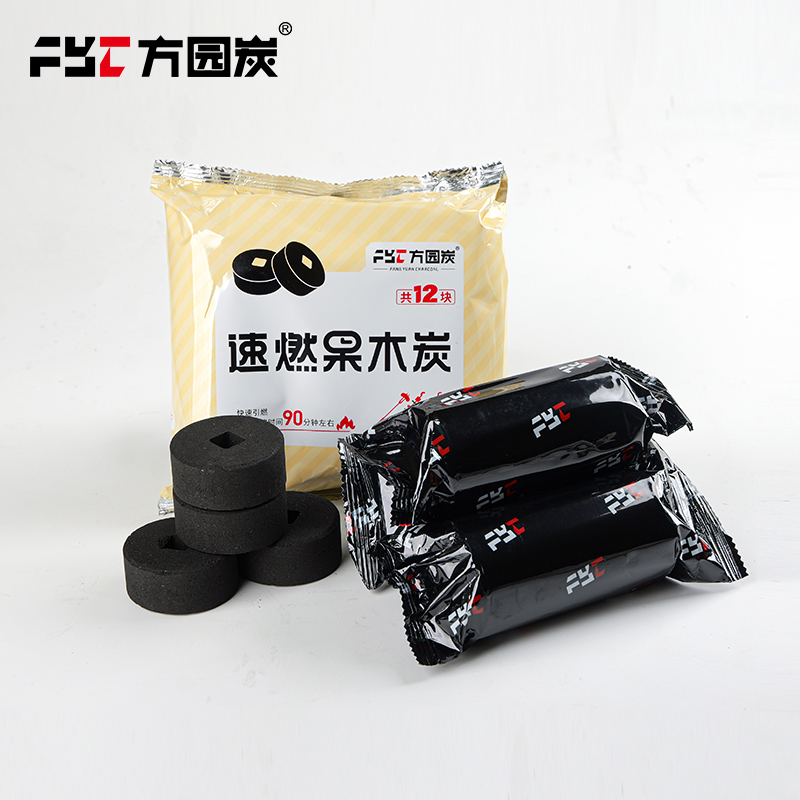
Traditional bulk charcoal such as TC-02 is specified around burn duration and ash behaviour rather than around portability. Image: FYC barbecue charcoal (TC-02).
How the Two Formats Actually Work
Ignition is where the formats diverge first
A self-igniting charcoal layer is the single technical feature that makes the disposable format work as a consumer product. In the TC-03, the specification states that the layer lights with a single match and requires no additional fire starters and no lighter fluid. For a buyer planning a picnic, that removes a category of failure: no wind-blocking, no fluid, no waiting for a chimney to come up to temperature, no leftover liquid to store or dispose of.
Traditional charcoal inverts the sequence. The fuel is inert until an external ignition source is applied, and the buyer carries that ignition method separately. This is not a defect — it is what allows bulk charcoal to be produced in the formats and densities that deliver multi-hour burn times. But it does change what has to be packed, and it is the reason many outdoor retailers merchandise the two products in different parts of the store.
Heat distribution shapes cooking behaviour
The TC-03 specification describes uniform heat radiation across the entire cooking surface, expressly to prevent hot spots. In practice this matters for the kind of food typically cooked at a picnic: thin proteins, vegetables and skewers that show an uneven bed of heat immediately, because there is no time for a cook to rotate items around a cold zone.
TC-02 is specified differently, around superior heat, high temperature and high calorific value with constant-temperature behaviour. That is the profile commercial grilling actually needs. In the Korean catering scenario recorded in FYC's application data, a restaurant group uses hexagonal bamboo charcoal sticks for high-temperature searing and indoor roasting, and the notes specifically cite high density and zero sparking as the reasons the fuel fits built-in dining-table grills.
Burn duration, ash and the end of the session
Duration is the clearest technical boundary between the two products. The outdoor-recreation scenario for the disposable format describes instant, even heating for 60 to 90 minutes and full disposability with no mess to clean afterwards. The bamboo stick format in the TC-02 range is rated at 6 to 8 hours, with ultra-low ash content. Those are not competing claims; they describe two different jobs.
Ash is the second half of that story. Traditional charcoal produces residue that has to be managed at the end of a session — cooled, contained and removed. The disposable format packages the residue inside the unit the user already carried in. For a campsite with no ash bin, that difference is operational rather than cosmetic.
Materials decide what happens after the food
The TC-03 combines a copper foil box, a metal wire mesh and eco-friendly quick-light charcoal, with the outer tray specified as aluminium foil or flame-retardant cardboard and the mesh as food-grade galvanised or chrome-plated steel. The environmental feature listed is 100% biodegradable materials with eco-friendly disposal after use. For a retailer selling into markets with strict waste-handling expectations, that combination — and the documentation behind it — is the part of the SKU that deserves the most scrutiny, not the cooking performance.
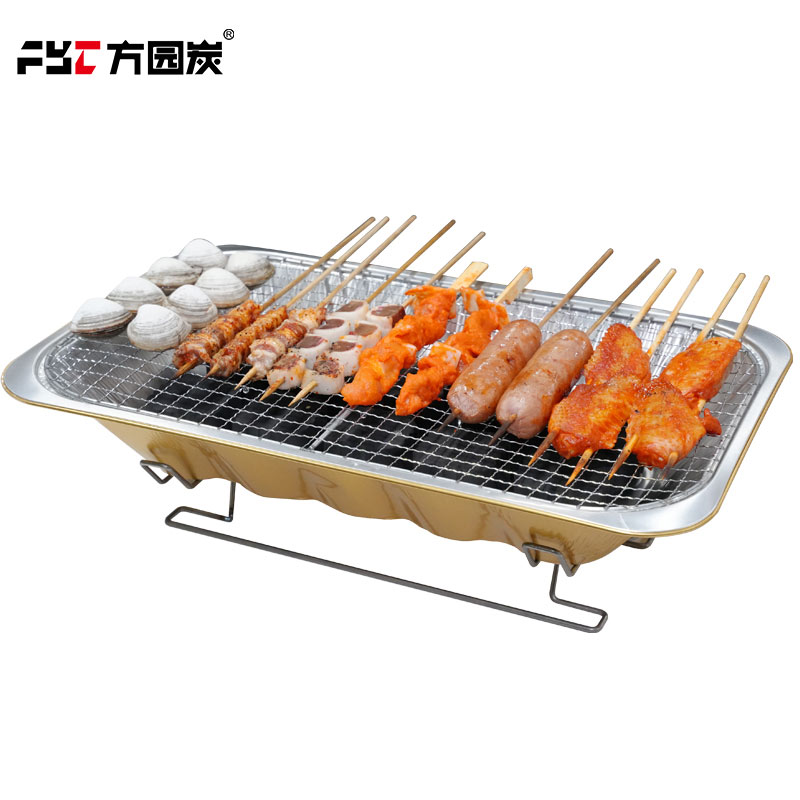
The disposable format integrates tray, mesh and ignition layer into one unit, shifting materials compliance onto a single SKU. Image: FYC disposable barbecue grill (TC-03).
Side-by-Side: Disposable Grill vs Traditional Charcoal
| Decision dimension | TC-03 disposable grill | TC-02 barbecue charcoal |
|---|---|---|
| What the buyer is purchasing | A complete single-use grill unit | Bulk fuel; grill and tools supplied separately |
| Heat window | 60 to 90 minutes of instant, even heating | 6 to 8 hours for bamboo sticks; ~70 minutes for fruit wood quick-light |
| Ignition | Self-igniting layer, single match, no lighter fluid | Requires a separate ignition method |
| Cooking behaviour | Uniform heat radiation, hot spots prevented | Superior heat, high calorific value, constant temperature |
| Ash handling | Residue stays inside the disposable unit | Ultra-low ash, but removal still required |
| Materials | Copper foil box, food-grade mesh, quick-light charcoal, foil or flame-retardant cardboard tray | Bamboo sawdust, hardwood, fruit wood |
| Portability | Lightweight and compact by specification | Fuel volume plus grill body, tools and ignition kit |
| Documented fit | Outdoor picnic, camping, travel, garden parties, retail and wholesale | Barbecue restaurants, outdoor camping, home cooking, catering |
Comparison based on FYC product specifications and the recorded application scenarios for TC-03 and TC-02.
Where Each Format Fits
The German outdoor-recreation scenario for the disposable format is explicit about the working conditions it addresses: lightweight, safe, instant-lighting grilling equipment that is easily disposed of after use with zero cleanup. The matched equipment list is telling — portable disposable wire grills, matching aluminium foil trays and quick-light charcoal. There is no grill body to carry, because the grill body is the packaging.
That profile suits itinerary-driven buying: a family driving to a park, a group hiking to a lake, a beach trip where the car is far from the sand. The unit goes in, feeds a single meal, and comes out. For a retail buyer assembling a seasonal camping assortment, the same logic applies in reverse — the product is bought by people who are optimising for what they carry and what they throw away, not for hours of fuel.
The charcoal scenario sits at the other end. A restaurant group using hexagonal bamboo sticks for indoor table grilling reports 6 to 8 hour combustion per batch, reducing how often staff replenish fuel during dining hours. The same case records that the fuel's high calorific value reduced total charcoal consumption by 15% compared with the previous supplier, alongside zero smoke interference in the indoor dining environment. Those outcomes depend on a fuel that is dense, long-burning and essentially spark-free — properties that a single-use disposable unit is not designed to deliver, because it is not designed to be reloaded.
In between sits the mixed assortment. Retailers selling into camping and picnic channels frequently carry both formats because the same customer buys them for different trips: the disposable unit for a short outing, the bulk bag for a full weekend where the grill stays out for hours.
Where the Disposable Format Stops Working
A credible comparison has to state the boundary, and for the disposable format it is a hard one: the heat window is fixed. The TC-03 is specified for 60 to 90 minutes of even heating. There is no reloading step, because the unit is not built to be opened, refuelled and reused. If the plan is a long afternoon with food going on in rounds, or an evening where guests arrive over several hours, the disposable unit will finish its heat cycle before the cooking does.
The second boundary is disposal. “Disposable” describes the product design, not a universal waste rule. The unit contains a metal wire mesh and a foil or cardboard tray in addition to charcoal residue, and local campsite or municipal waste rules may treat those components differently. The 100% biodegradable materials claim applies to the specified materials; buyers placing the product into a regulated market still need to confirm that the disposal route they are implying is permitted where the product is sold.
The third boundary is commercial intensity. Nothing in the TC-03 specification positions it for continuous service, repeated lighting across a shift, or the fuel control that a professional kitchen expects. For those environments the bulk format exists precisely because it can be managed, replenished and costed per kilogram over a long session. Conversely, the charcoal side carries its own trade-off: it requires a grill body, an ignition method, tools and ash handling, and it is heavier to transport — which is exactly the burden the disposable format was designed to remove.
Finally, cost. For a household that grills outdoors every weekend, the economics of a single-use format and a bulk fuel cannot be reduced to a per-unit comparison, because they buy different amounts of cooking time. Frequency of use, not unit price, is the variable that decides which format is the rational default for a given buyer.
What Buyers Should Verify Before Committing
For importers and retail buyers, the format question resolves into a documentation question. Three verification layers matter.
1. Product safety compliance. For charcoal sold into Europe, EN 1860-2 is identified in 2026 guidance as the mandatory product safety standard for BBQ and retail charcoal. A disposable grill carries that requirement plus the material requirements attached to the mesh and tray, so the request should be SKU-specific rather than company-level: does the documentation trail for this exact reference connect to the standard and to the materials declared on the specification sheet?
2. Manufacturing and quality evidence. FYC holds SGS and ISO certification and lists an on-site Intertek supplier assessment, 100% comprehensive inspection across production lines, and three dedicated QA/QC inspectors, with full traceability of raw materials. Monthly capacity is stated at approximately 600 to 800 metric tons, with a factory footprint of 6,000 m², 100 employees and a daily output exceeding 50 metric tons. For a seasonal disposable-grill programme, the relevant capacity is not tonnage alone but whether the supplier can hold a summer window.
3. Order mechanics. Lead time is stated at 7 to 15 days for standard stock and 20 to 30 days for customised mass production. MOQ is flexible: from one box for express stock up to 1 ton through 17 tons for wholesale and full-container orders. Customisation covers product shape, size, logo printing, retail packaging formats including magnetic, flip-top and pull-out boxes, and material composition. After-sales support is specified at a response time of four hours or less, with a 100% on-time delivery guarantee and compensation for quality discrepancies.
The evidence that this is executable at seasonal scale sits in FYC's recorded case material: a national outdoor and camping equipment retailer in Germany ordered 12,000 sets of disposable grills for a summer season, received 100% on-time delivery against high seasonal demand, and reported positive consumer feedback on instant-lighting convenience, with the lightweight design and eco-friendly foil materials noted as meeting EU environmental standards.
Market Signals for 2026 and Beyond
Grand View Research estimates the global charcoal market at USD 8.5 billion in 2026, up from USD 8.1 billion in 2025. The figure describes a large, established category rather than a fast-moving one, and it should be read with a caveat that also appears in the same data set: aggregator figures diverge widely depending on whether industrial coke is included alongside consumer charcoal.
Within that mature picture, the forces shaping format choice are regulatory and logistical rather than demand-side. On regulation, the European requirement around EN 1860-2 raises the cost of getting documentation wrong, which favours suppliers who can present product-level evidence quickly. On logistics, seasonal retail programmes reward suppliers who can compress lead times and hold capacity through a summer peak, which is where the 7 to 15 day stock lead time and 600 to 800 metric ton monthly capacity become commercially meaningful rather than merely descriptive.
A third signal is the quiet normalisation of single-use formats in outdoor retail. The German case is a useful marker: a national camping retailer did not test the format with a small trial order, it committed 12,000 sets to a season — which suggests the category has moved past novelty into planned assortment.
Future Outlook
Three things are worth watching for buyers building 2027 plans.
The first is materials scrutiny. As single-use outdoor products face more attention on waste, the credibility of a 100% biodegradable materials claim will depend less on the phrase itself and more on whether the component-level documentation — mesh, tray, charcoal — is available on request. Suppliers who can answer that question at SKU level will be easier to keep in an assortment.
The second is the widening gap between convenience formats and performance formats. The disposable unit and the long-burn bulk fuel are being specified further apart, not closer: one optimised for carry-in, carry-out single meals, the other for sustained heat and fuel efficiency. Buyers should expect the assortment decision to remain a two-format decision rather than a convergence.
The third is documentation speed. In categories where the standard is mandatory and the retail calendar is seasonal, the supplier that can produce compliant paperwork in days rather than weeks holds a practical advantage that has nothing to do with product quality and everything to do with schedule risk.
FAQ
How long does a disposable grill stay hot?
The TC-03 disposable grill is specified in its outdoor-recreation use case for instant, even heating over 60 to 90 minutes, after which the unit is disposed of. That window is designed around a single outdoor meal rather than a multi-hour cooking session. Buyers planning a longer event should treat the disposable unit as one heat cycle and plan fuel accordingly.
Does a disposable grill need lighter fluid or fire starters?
No. The TC-03 uses a self-igniting charcoal layer that is specified to light with a single match, with no additional fire starters required. Its charcoal type is listed as instant-light natural charcoal or smokeless charcoal, with no lighter fluid required and low smoke emission.
Is a disposable grill enough for a full-day camping trip?
It depends on whether cooking is continuous. A 60 to 90 minute heat window covers one meal; it does not cover food going onto the grill in rounds across an afternoon, because the unit is not designed to be refuelled. For full-day or multi-meal cooking, a bulk fuel such as TC-02 bamboo charcoal sticks, rated at 6 to 8 hours of combustion, is the format specified for that pattern.
Which charcoal burns longest for group camping and picnics?
Within FYC's barbecue charcoal range, bamboo charcoal sticks are rated for 6 to 8 hours of burning time, while the fruit wood quick-light variant is rated at approximately 70 minutes. Burn time depends on the specific product form chosen, so the format — bamboo stick versus quick-light — should be selected against the intended session length rather than treated as a single figure.
What compliance evidence should European buyers request for a disposable grill?
EN 1860-2 is identified in 2026 industry guidance as the mandatory product safety standard for BBQ and retail charcoal in Europe. For a disposable grill, the request should extend beyond the fuel to the components declared on the specification: food-grade galvanised or chrome-plated steel mesh, and an aluminium foil or flame-retardant cardboard tray. FYC holds SGS and ISO certification and lists an on-site Intertek supplier assessment; buyers should confirm that documentation maps to the specific SKU being purchased.
How should retailers plan seasonal disposable grill orders?
Lead time is stated at 7 to 15 days for standard stock and 20 to 30 days for customised mass production, with monthly capacity of approximately 600 to 800 metric tons. MOQ ranges from one box for express stock to 1 ton through 17 tons for wholesale and full-container orders. Because demand is seasonal, the binding constraint is usually the summer delivery window rather than annual capacity — a point illustrated by a German outdoor retailer's 12,000-set seasonal order, delivered 100% on time.
Are disposable grill materials biodegradable, and does that settle disposal?
The TC-03 specification lists 100% biodegradable materials as an environmental feature, with eco-friendly disposal after use. That is a materials statement, not a universal waste-handling rule. The unit also contains a metal wire mesh and a foil or cardboard tray, and campsite or municipal rules may treat these components separately. Buyers selling into regulated markets should confirm the permitted disposal route alongside the materials claim.
Reference Note
This comparison is drawn from FYC product specifications for TC-03 and TC-02, the recorded application scenarios behind each format, and publicly available market and standards references for 2026. It is intended as a buyer interpretation aid rather than a product recommendation: the correct format follows from session length, transport constraints and disposal responsibility, and those three inputs differ by itinerary rather than by preference.
Product specifications, packaging options and factory details for the full FYC charcoal range are compiled in the company brochure: FYC Charcoal Product Brochure (PDF).
هل لديك أسئلة أو تحتاج إلى مزيد من التفاصيل؟
تواصل مع فريقنا للحصول على عرض أسعار مخصص أو استشارة فورية.
طلب عرض أسعار
املأ النموذج أدناه وسيتواصل معك فريقنا بعرض مقترح مخصص.
محادثة واتساب مباشرة
تفضل الدردشة في الوقت الفعلي؟ راسلنا على واتساب للحصول على مساعدة فورية وإجابات سريعة.
- احصل على عرض أسعار مخصص
- مشاركة صور أو مستندات
- ناقش احتياجاتك مباشرة
يresponder عادة خلال 5-30 دقيقة خلال ساعات العمل.