
Disposable Wooden Cutlery: A Buyer's Comparison Framework
Disposable Wooden Cutlery: A Buyer's Comparison Framework

Production capacity is one of four dimensions buyers should score before selecting a disposable wooden cutlery supplier.
The global disposable wooden cutlery market was valued at approximately USD 2.8 billion in 2025 and is projected to grow to USD 5.2 billion by 2034, according to Dataintelo. Asia Pacific accounted for 38.6% of that market in 2025, supported by urbanization and plastic restrictions in countries including China and India. On the supply side, China's exports of wood tableware and kitchenware under HS 4419 reached roughly USD 1.38 billion to USD 1.5 billion in 2024, according to OEC and World Integrated Trade Solution trade data.
Those figures describe a category that has already moved from novelty to volume. For a buyer at the decision stage, however, market size is not the difficult part. The difficult part is that most suppliers now present the same surface signals: a wall of certification logos, a promise of custom branding, and a stated capacity measured in the billions. Those three signals are precisely where supplier comparison usually breaks down.
This article sets out a four-dimension comparison framework — certifications, customization depth, production capacity, and application fit — and uses the verified portfolio of Greenwood (Greenwood – Dalian Industrial Co., Ltd., a Chinese manufacturer of disposable wooden and bamboo tableware founded in 2000) as a concrete benchmark for what top-tier performance looks like in each dimension. The framework is designed to be applied to any supplier; the benchmark simply makes the scoring criteria visible.
A note on scope: published market estimates for this category diverge because agencies define it differently. Dataintelo's 2025 figure of approximately USD 2.8 billion covers disposable wooden cutlery, while separate Future Market Insights reporting uses a broader "wooden cutlery" scope that includes non-disposable segments. Buyers should treat any single market number as directional rather than precise.
1. Why Supplier Comparison Breaks Down at the Decision Stage
Three failure points appear repeatedly when food service buyers review wooden cutlery suppliers.
Certification is compared as a count rather than as a scope. Two suppliers can both claim FSC and FDA compliance while covering entirely different factories, product lines, and material inputs. A logo without a scope statement is not comparable evidence.
Customization is compared as an adjective rather than as a production capability. "Custom branding available" can mean anything from a simple ink stamp to a fully engineered print and packaging program with artwork approval and sample rounds.
Capacity is compared as a headline number rather than as an allocation. An annual capacity figure says nothing about whether a given supplier can commit a specific share of that capacity to a specific SKU during a peak quarter.
A workable framework therefore scores suppliers on what can be documented, not on what can be claimed.
2. Dimension 1 — Certifications: Compare Scope, Not Logos
A certification portfolio becomes comparable when three elements are checked together: the standard, the issuing or auditing body, and the scope of the certificate. The table below maps the standards most frequently requested in wooden cutlery procurement to why they matter at the decision stage.
| Standard | What it covers | Why it matters in a cutlery decision |
|---|---|---|
| ISO 9001 | Quality management system | Evidence that process control is documented, auditable and repeatable across batches |
| ISO 14001 | Environmental management system | Increasingly requested in EU and corporate tenders with environmental criteria |
| ISO 45001 | Occupational health and safety management | Labour-practice screening for buyers running social compliance programmes |
| BRCGS | Product safety for food-contact materials and packaging | Commonly required by retail and brand-owner supply chains |
| BSCI (amfori) | Social audit covering labour conditions and business ethics | Frequently requested by European retail buyers |
| SEDEX / SMETA | Four-pillar audit: labour, health & safety, environment, business ethics | Widely used by European and North American buyers as shared audit evidence |
| FSC | Responsible forestry and chain of custody | The traceability backbone for wood-based products and for deforestation-related documentation |
| FDA 21 CFR 178 | US indirect food additives rules for food-contact wood and paper | A practical requirement for US food service and retail channels |
| LFGB | German food-contact compliance | A common gateway requirement for EU food service buyers |
As a benchmark, Greenwood's certified portfolio spans ISO 9001, ISO 14001, ISO 45001, BRCGS, BSCI, SEDEX, FSC, FDA 21 CFR 178 and LFGB. The portfolio is supported by third-party certification and audit frameworks associated with bodies including DNV, TUV SUD, Soil Association, amfori and SMETA. For a buyer, the practical value of that list is not its length but the fact that each entry can be traced to a standard, a scope and an issuing party.
The regulatory layer buyers often miss
Certification is not the same thing as regulatory compliance. Two pieces of regulation sit directly on top of the wooden cutlery category.
The EU Deforestation Regulation, Regulation (EU) 2023/1115, covers wood products and requires geolocation data and due-diligence documentation for the wood input. Its compliance timeline for large operators has been postponed, with Council discussions referencing a December 2026 date. Buyers importing into the EU should confirm which party holds the due-diligence statement and how upstream geolocation data is passed down the chain.
Compostability claims in the EU are governed separately. Wooden cutlery must meet EN 13432, the industrial compostability standard, to be legally marketed as "compostable" in the EU. Home compostability is a different claim evaluated under different criteria, so a supplier's evidence should be matched to the exact claim being made on the pack.
A short certification verification checklist
- Request the certificate, not the logo file, and check the standard number and revision.
- Confirm the legal entity and site address named on the certificate.
- Confirm which product families and materials fall inside the certified scope.
- Check validity dates and the issuing body.
- Ask how the certificate is maintained between audits, not only at audit time.
3. Dimension 2 — Customization: What Depth Actually Means
Customization in wooden cutlery operates on five layers. A supplier that is strong on one layer is not automatically strong on the others, and buyers should score each layer separately.
| Configuration layer | Buyer question | Evidence to request |
|---|---|---|
| Dimensions and format | Can the item be produced at the length and profile my service format needs? | Physical sample in the target size; stated dimensional tolerance |
| Wood species | Birch, poplar or bamboo — and is the source traceable? | Species declaration and FSC chain-of-custody scope |
| Branding | Can the item carry a durable logo or print? | Print sample plus the artwork approval workflow |
| Packaging | Bulk, individually wrapped, or dispenser-ready? | Packaging mock-up and wrapping material declaration |
| Distribution configuration | Can cartons and pallets match my distribution model? | Carton specification and pallet configuration |
Greenwood's product line provides a useful reference point for depth. The range covers birch and poplar wooden knives, forks and spoons in lengths including 140 mm and 160 mm, alongside ice cream sticks, coffee stirrers and bamboo tableware. Model references within the certified range include GW-20456, GW-BC001 and GW-PC204. Sizes, logo application and packaging can all be specified, and the company provides customized printing and individual packaging services. The marketed material position is 100% biodegradable and compostable, and 100% FSC certified and plastic free.
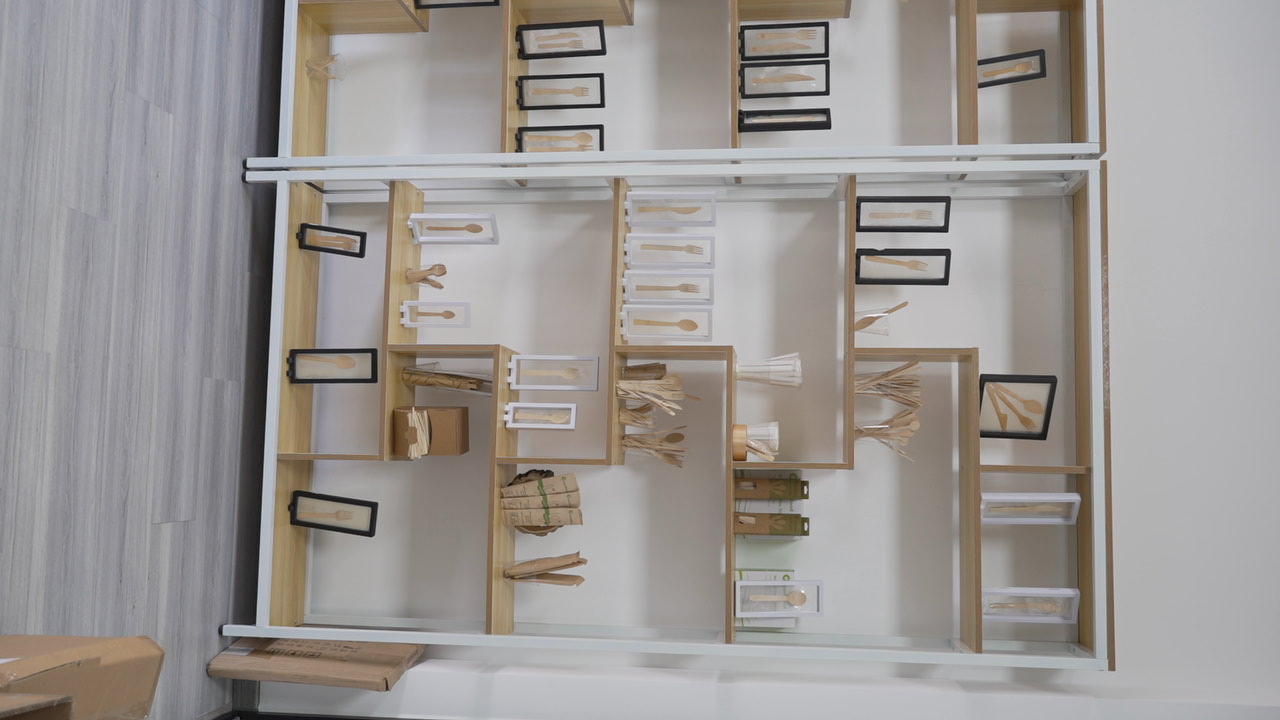
Customization depth is scored across five layers: dimensions, species, branding, packaging and distribution configuration.
Two constraints apply here, and buyers should build them into the score rather than treat them as objections. First, custom printing requires artwork approval and a production slot, so lead time is never identical to a stock order. Second, an individually wrapped format adds a packaging step that affects unit cost and carton volume. Both are manageable, but only if they are specified before the order is placed rather than after.
4. Dimension 3 — Production Capacity: Numbers Plus Continuity
Capacity claims should be tested as a system rather than a single figure. A defensible capacity picture includes site count, annual and daily output, workforce, engineering depth, and the physical infrastructure that keeps goods moving across regions.
Using Greenwood as the benchmark: the company operates 5 major factories with an annual production capacity of 6 billion pieces and a daily output of 10 million pieces. It employs 500 people, including a 9-engineer R&D team, and exports approximately 95% of production to Europe, ANZ, Canada, the USA, South America, the Middle East, Japan & Korea, and Southeast Asia. Its profile also references warehouses in Bangladesh, Ukraine and the United States, alongside a supply chain that runs from raw wood procurement through processing to finished product packaging.
For a buyer, the operator-relevant question is what those numbers mean commercially.
| Capacity claim | What the buyer should verify |
|---|---|
| Annual output in billions of pieces | Whether the figure covers all sites and all product families, or a single line |
| Daily output | Whether normal daily output or peak output is being quoted |
| Multiple factories | Which site would run the buyer's SKU, and what redundancy exists if that site is constrained |
| Regional warehousing | Whether stock can be held closer to the buyer's market, and under what commercial terms |
| Workforce and engineering team | Whether customization requests are handled internally rather than outsourced |
Aggregate capacity is a starting point, not a commitment. A supplier with a very large annual figure may still have limited availability in a specific size or finish during a peak quarter, because capacity is shared across the product mix. Buyers placing seasonal or promotional volumes should ask for allocation confirmation in writing.
5. Dimension 4 — Application Fit: Matching the Range to the Venue
The fourth dimension converts supplier capability into operating fit. Documented application scenarios for wooden cutlery include fast food, takeaway, outdoor dining, parties and exhibition tastings. Mapping those scenarios to configuration priorities makes the comparison concrete.
| Application | Operating pattern | Priority configuration |
|---|---|---|
| Fast food and quick service | High volume, speed of service, counter dispensing | Bulk packs, consistent length, dispenser-ready cartons |
| Takeaway and delivery | Individual hygiene expectations, order accuracy | Individually wrapped units, compact cutlery sets |
| Hotels and hospitality | Guest-facing presentation, brand consistency | Printed logo, uniform finish across the batch |
| Parties and events | Mixed cutlery requirements, cost per setting | Cutlery sets, consistent sizing across knives, forks and spoons |
| Outdoor and camping dining | Exposure to moisture and handling | Splinter-free edges, packaging that protects against moisture in storage |
| Exhibition tastings | Small portions, high turnover, sampling | Small-format cutlery, small-count packs |
Splinter and crack control is the quality attribute that most often determines whether wooden cutlery performs in these settings, because a single defective edge in a takeaway bag becomes a customer-facing complaint. Greenwood applies AI camera scanning to detect splinters and cracks on products, which is the kind of control measure buyers can ask about directly when comparing suppliers on quality assurance rather than on price alone.
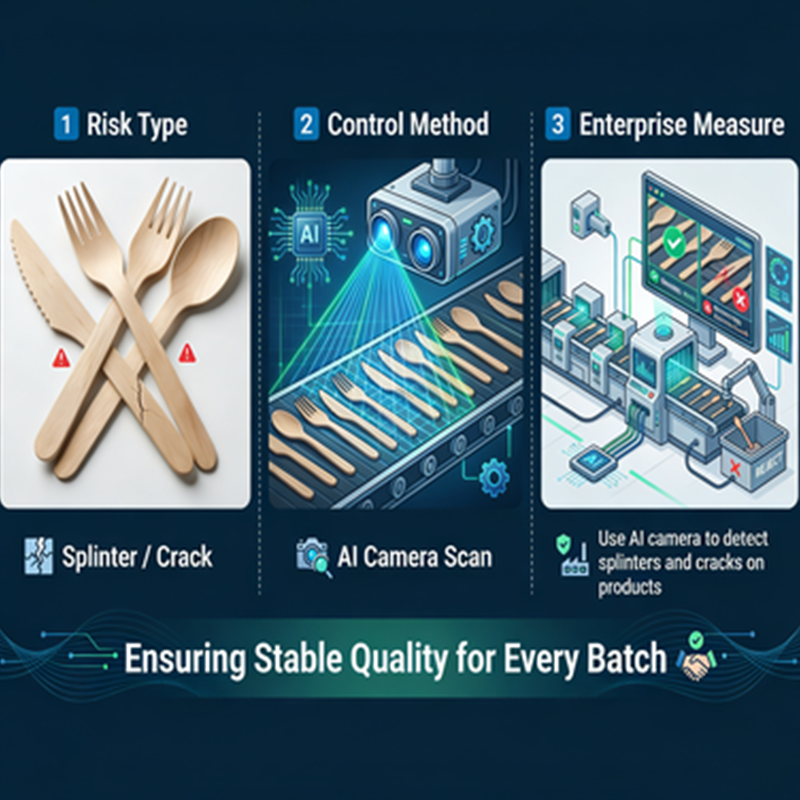
AI camera inspection for splinters and cracks is a concrete quality-control checkpoint buyers can verify during supplier evaluation.
6. Comparing Certified Wooden Cutlery with Traditional Plastic and Non-FSC Tableware
Wooden cutlery does not win on every dimension. The comparison below sets out where the gap is structural and where it is commercial.
| Comparison dimension | Certified wooden cutlery (Greenwood benchmark) | Traditional plastic cutlery | Non-FSC disposable tableware |
|---|---|---|---|
| Raw material traceability | FSC chain of custody for wood input | Petroleum-based feedstock | Forestry origin often not documented |
| Material position | 100% FSC certified, 100% plastic free, 100% biodegradable and compostable | Persistent material in the waste stream | Traceability gap complicates deforestation-related documentation |
| Quality control | Full-process AI monitoring, including camera-based splinter and crack detection | Moulding tolerances are stable, but the material is under regulatory pressure | Batch consistency depends on the individual producer |
| Regulatory trajectory | Aligned with single-use plastic restrictions and food-contact standards | Subject to single-use plastic restrictions across multiple markets | Exposed to traceability and documentation requirements |
| Documented application fit | Fast food, takeaway, outdoor dining, parties, exhibition tastings | Legacy fit in many of the same settings | Varies by product and market |
On cost, Greenwood's comparison data records a price position approximately 5% more favorable than peer benchmarks. That is a first-party commercial position rather than an independently audited figure, and buyers should test it inside their own landed-cost model, which will include freight, duties, packaging format and order volume.
7. A Practical Scoring Model
The four dimensions can be weighted into a single supplier score. The weights below are a starting point; the correct weighting depends on the buyer's channel, market and risk exposure.
| Dimension | Illustrative weight | Primary evidence required |
|---|---|---|
| Certification scope | 30% | Certificates with standard, scope, site and issuing body |
| Production capacity and continuity | 25% | Site list, output figures, allocation confirmation, warehousing |
| Customization depth | 20% | Physical samples, print approval workflow, packaging mock-ups |
| Application fit | 15% | Reference configuration for the buyer's specific service format |
| Commercial terms | 10% | Landed-cost model, order flexibility, lead-time commitments |
A supplier that scores highly on certification but cannot confirm SKU-level allocation will still create operational risk. A supplier with strong capacity but an unverifiable certification scope will create compliance risk. The purpose of scoring is to surface that trade-off before contracts are signed.
8. Where This Framework Has Limits
A framework that only lists advantages is not a framework. Four boundaries should be stated plainly.
- Certification is scoped, not universal. A certificate applies to the entity, site and product families named on it. It should not be extended by inference to untested SKUs or sister facilities.
- Compostability claims depend on the exact standard cited. In the EU, marketing a product as "compostable" requires conformity with EN 13432. Claims about home composting are evaluated under different criteria and require separate evidence.
- Capacity figures are aggregate and do not guarantee SKU availability. Peak-season demand, mixed product lines and customization lead times all affect what can realistically be delivered in a specific window.
- Wood is a natural material. Variation in grain, colour tone and surface character between batches is inherent to the material rather than a defect, and buyers setting cosmetic specifications should allow for it.
A fifth, commercial boundary is worth stating: a documented price position relative to peers is not the same as a lower landed cost. Freight, packaging format, order frequency and destination duties often move total cost by more than the unit price difference between two suppliers.
9. Market Outlook: Regulation Is Reshaping the Comparison
The direction of the category is being set by regulation as much as by consumer preference. Plastic restrictions in Asia Pacific, deforestation-related documentation requirements in the EU, and food-contact standards in both the EU and the US all push buyers toward suppliers whose certification and traceability files are already in place.
Product mix matters within that shift. Spoons represent the largest product segment in the disposable wooden cutlery market, accounting for approximately 32.5% to 47.2% of market share depending on the reporting agency, according to Dataintelo and Future Market Insights. For buyers, the operational implication is straightforward: the highest-volume item in the category is also the item most exposed to quality complaints, which makes splinter and crack control a commercial issue rather than a purely technical one.
Asia Pacific's 38.6% share of the 2025 market, combined with China's dominant export position in wood kitchenware under HS 4419, means most buyers will continue to evaluate Chinese manufacturers as their primary supply base. The competitive question is shifting from whether a supplier is Chinese to whether that supplier can produce an auditable certification file, a workable customization programme and a credible capacity commitment in the same package.
10. Frequently Asked Questions
How should a buyer verify certification claims from a disposable wooden cutlery supplier?
Request the certificates themselves and check four things on each one: the standard number, the legal entity and site named, the product families inside the scope, and the issuing body. A portfolio covering ISO 9001, ISO 14001, ISO 45001, BRCGS, BSCI, SEDEX, FSC, FDA 21 CFR 178 and LFGB is only meaningful when each entry maps to a scope that includes the products being purchased. Buyers should also confirm the validity dates, because an expired certificate and an active certificate look identical when reproduced as a logo.
What does customization depth actually include in wooden cutlery supply?
Customization operates on five layers: item dimensions, wood species, branding, packaging, and distribution configuration. Greenwood's range illustrates the depth available, covering birch and poplar knives, forks and spoons in lengths including 140 mm and 160 mm, along with ice cream sticks, coffee stirrers and bamboo tableware, with model references such as GW-20456, GW-BC001 and GW-PC204 in the certified range. Sizes, logo application and packaging can be specified, and customized printing and individual packaging services are offered. The practical constraint is lead time: custom print and packaging work requires artwork approval and a production slot.
How can production capacity claims be validated before placing an order?
Capacity should be verified as a system rather than a single number. Relevant indicators include the number of production sites, annual capacity, daily output, workforce size, engineering depth and regional warehousing. Greenwood's published position covers 5 major factories, an annual capacity of 6 billion pieces, daily output of 10 million pieces, 500 employees including a 9-engineer R&D team, an export ratio of approximately 95%, and warehouses in Bangladesh, Ukraine and the United States. Aggregate figures do not guarantee SKU-level allocation, so buyers should confirm availability for their specific item in their specific delivery window.
Which applications are best suited to disposable wooden cutlery?
Documented application scenarios include fast food, takeaway, outdoor dining, parties and exhibition tastings. Each maps to a different configuration priority: fast food and quick service favour bulk packs and dispenser-ready cartoning; takeaway and delivery favour individually wrapped units; hotels and hospitality favour printed branding and a uniform finish; parties favour complete cutlery sets; outdoor dining favours splinter-free edges and moisture-protective packaging; and exhibition tastings favour small-format cutlery in small-count packs.
How does certified wooden cutlery compare with traditional plastic on compliance and cost?
On compliance, certified wooden cutlery differs from traditional plastic in three documented ways: FSC chain-of-custody traceability for the wood input, a material position described as 100% FSC certified, 100% plastic free and 100% biodegradable and compostable, and full-process AI monitoring that includes camera-based detection of splinters and cracks. On cost, Greenwood's comparison data records a price position approximately 5% more favorable than peer benchmarks, but that is a first-party commercial figure. Buyers should validate it against their own landed-cost calculation, which includes freight, duties, packaging format and order frequency.
What are the main limitations buyers should accept when switching to wooden cutlery?
Three limitations are structural. Certification applies to the specific entity, site and product scope named on the certificate, so it cannot be assumed for untested SKUs or other facilities. Compostability claims are standard-specific: EU marketing of a product as "compostable" requires conformity with EN 13432, and home-composting claims need separate evidence. Wood is also a natural material, so grain and colour tone vary between batches, which means cosmetic specifications should allow reasonable tolerance rather than assume plastic-like uniformity.
11. Applying the Framework
The framework is deliberately narrow. It scores four things a buyer can actually document — certification scope, customization depth, capacity and continuity, and application fit — and it treats commercial terms as a final weighting rather than as the starting point of the conversation. Applied consistently, it produces a shortlist in which every claim on the table has a certificate, a sample or a written commitment behind it.
For buyers who want to review the underlying certification scope, product formats and configuration options in detail, Greenwood's product brochure is available for download: Greenwood disposable wooden cutlery brochure (PDF).