
Disposable Wooden vs. Bamboo vs. Paper Cutlery: What Specs Matter
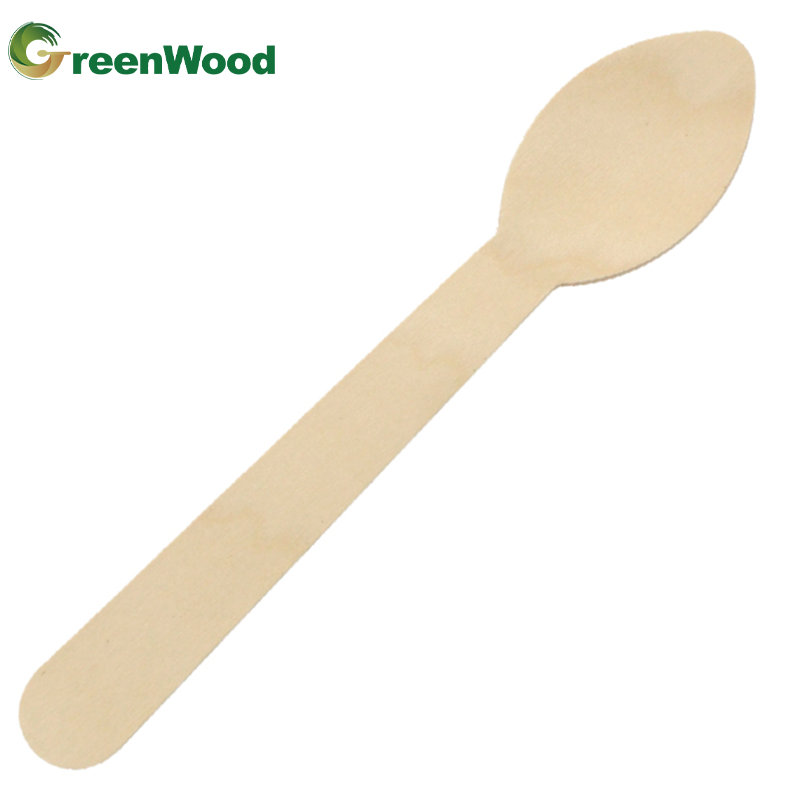
A GW-20456 disposable wooden spoon. The model line is compared with the bamboo GW-BC001 and paper GW-PC204 lines in this article.
Independent buyer reference for material choice, lengths, certifications and customization limits
For food service procurement, replacing plastic cutlery is no longer a single-material conversation. Buyers routinely compare disposable wooden cutlery with bamboo and paper alternatives before choosing an SKU set. This article reviews three complete product lines from Greenwood - Dalian Industrial Co.,ltd., and translates their model-level specifications into buying criteria.
The models included are GW-20456 for wood, GW-BC001 for bamboo, and GW-PC204 for paper. The comparison does not rank one material as universally best. Instead, it identifies where each material can fit restaurant, takeaway, party, hotel, supermarket and camping orders, with attention to certifications, standard lengths, format availability and customization limits.
Why buyers need a three-material comparison
Most hospitality suppliers now offer an eco-friendly disposable option, but their claims are not standardized. One line may refer to biodegradable material, another to industrial compostability, and a third to custom packaging. For a buyer moving away from plastic, the first task is not to select a brand. It is to evaluate whether the material can survive the intended application and whether the supplier can prove compliance.
The opportunity is that wood, bamboo and paper are no longer exotic materials in food service. More factories publish full model specifications and certification documents than in previous years. What remains difficult is comparing them side by side. Lengths differ, product formats differ, and certification scope is often limited to one material rather than an entire catalogue.
Scope of this buyer comparison
Greenwood is used as a reference because its public product data includes one model for each material. None of the three models in this review is fictional, and all specification points are taken from the supplied product disclosures. The company was founded in 2000 and is based in Jinzhou, Dalian, China. Its production system is described as five major factories with an annual capacity of 6 billion pieces. Those figures matter for buyers evaluating ongoing supply rather than one-time samples.
The comparison below focuses on verified model-level facts. It does not include invented test results, customer claims or price comparisons. It also does not assume that certification coverage for one model automatically applies to all products from the same factory.
Product line and specification snapshot
The following table shows the model designations and core figures used throughout this article.
| Material line | Model | Formats in line | Standard / available lengths | Material and property notes |
|---|---|---|---|---|
| Wooden cutlery | GW-20456 | Wooden knife, fork, spoon, ice cream sticks and coffee stirrers | Lengths listed at 180, 170, 160, 140, 110 and 95 mm; sizes are customizable. | 100% natural wood; company ranges include birch/poplar cutlery; food-grade, BPA-free and non-toxic; biodegradable and compostable; smooth surface, no burrs; heat-resistant; suitable for hot and cold food. Logo via laser or print. |
| Bamboo cutlery | GW-BC001 | Bamboo knife, fork, spoon, coffee stirrers and bamboo skewer sticks | 170 mm standard; 110, 140 and 170 mm are described as customization options. | Bamboo material; product spec lists food-grade safety, LFGB/FDA compliance data, no BPA, no toxicity; biodegradable and compostable; heat-resistant; smooth edge, no burrs; natural bamboo texture; hot stamping logo available. |
| Paper cutlery | GW-PC204 | Paper knife, fork and spoon set | 158 mm standard; custom size available. | Paper material; food-grade safe, BPA-free and non-toxic; biodegradable and compostable; heat-resistant; waterproof and oil-proof; smooth edge, no smell. Logo, packaging and color configurable. |
Source: Greenwood product units for GW-20456, GW-BC001 and GW-PC204.
Wooden, bamboo and paper in detail
Wooden line: GW-20456
The wooden model is the only line of the three that is described with ice cream sticks and coffee stirrers in addition to knife, fork and spoon formats. That makes the model relevant for buyers managing dessert, coffee and meal programs through one purchase order.
Length is one of the clearest constraints. GW-20456 lists 180, 170, 160, 140, 110 and 95 mm. A takeaway meal fork can use one size, while a coffee stirrer or ice cream stick usually needs a smaller format. Because sizes are described as customizable, bulk buyers are not forced to accept a single default for every product type.
Material claims for the wooden line include 100% natural wood, food-grade safety, BPA-free and non-toxic status, 100% biodegradable and compostable material, smooth surface, no burrs, and heat resistance for hot and cold food. The company also states birch/poplar as the main wood input for its wooden cutlery range. For buyers with wood-traceability requirements, the separate FSC Chain of Custody certificate is a relevant document to request.
Bamboo line: GW-BC001
Bamboo is often selected when a natural grain is preferred. The GW-BC001 line includes knife, fork, spoon and coffee stirrers, plus bamboo skewer sticks. The presence of skewer sticks is one of the clearest functional differences from the reviewed wooden line.
The standard length is 170 mm. The product specification additionally lists 110 mm and 140 mm as customization options, allowing buyers to select shorter formats for appetiser service or lighter catering tasks.
Reported surface properties include smooth edge, no burrs, natural bamboo texture, heat resistance and suitability for hot and cold food. The stated logo method is hot stamping, which is different from the laser or print method described for the wooden line.
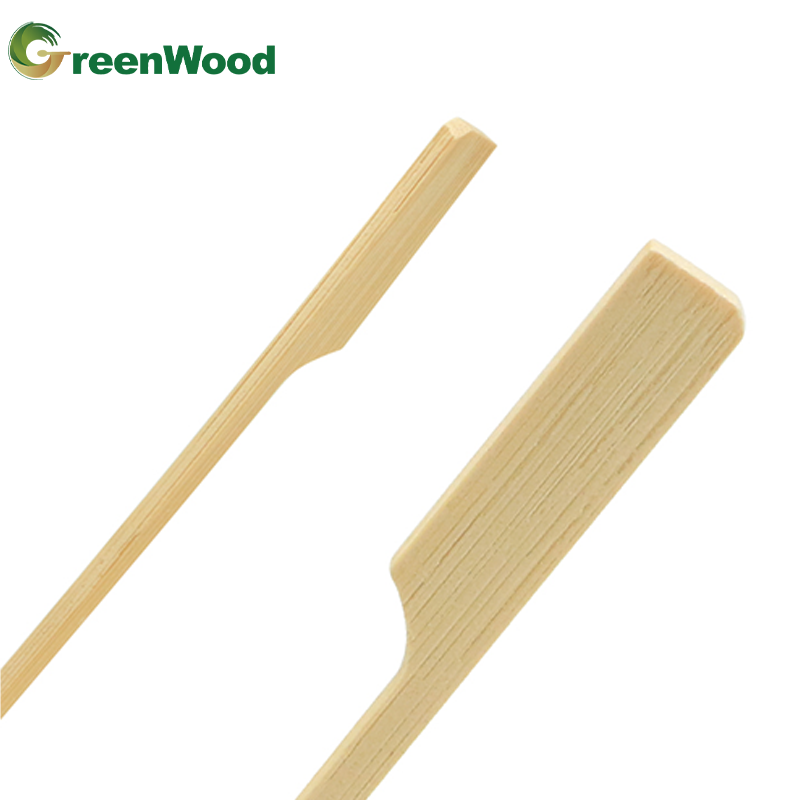
Bamboo skewer sticks are a distinguishing format within the GW-BC001 model line.
Paper line: GW-PC204
The paper model is presented as a knife, fork and spoon set. It does not include sticks, stirrers or skewers in the reviewed product data. Its standard length is 158 mm, and a custom size can be requested.
Paper specifications list 100% food-grade safety, BPA-free and non-toxic material, 100% biodegradable and compostable properties, heat resistance, waterproof and oil-proof performance, smooth edge and no smell. For takeaway packaging that may contain moisture or sauce, the waterproof and oil-proof statement is a useful comparison point.
Custom logo, packaging and colour are stated as available. That can make the paper model useful for retail-ready cutlery packs or branded takeaway sets.
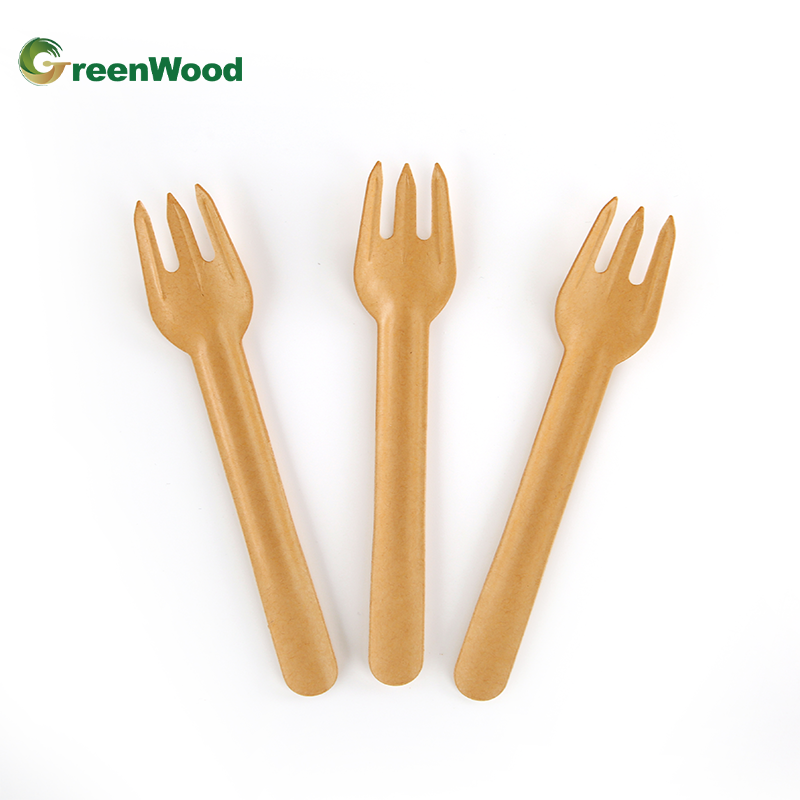
The paper cutlery set format is available under model GW-PC204.
Customization and supplier constraints
All three models allow some form of customization, but the technical paths differ. Wooden GW-20456 supports size, logo via laser or print, and packaging. Bamboo GW-BC001 supports size, logo via hot stamping, packaging and colour. Paper GW-PC204 supports logo, packaging, colour and custom size.
Procurement teams should see this as a constraint rather than a marketing point. A logo decision affects the production line, packaging and lead time. In the manufacturing data used for this article, the OEM/ODM programme shows a production lead time of 20 days, a custom-order MOQ of 100,000 pieces, and third-party inspection as part of quality control. These are practical evaluation thresholds. Buyers planning custom logo or packaging should check whether their expected order volume clears the stated MOQ before comparing unit prices.
Another constraint is production capacity. The company profile states five major factories and an annual capacity of 6 billion pieces. For a hotel chain or retail distributor, that scale reduces the risk of one factory being unable to cover both wooden and bamboo orders at peak season.
Certification constraints for disposable cutlery buyers
Certification constraints are central to this comparison. In the reviewed product base, the wooden line has the broadest documentation set. The bamboo line has food-contact and factory-audit certificates in the supplied data. The paper line is described by material specifications rather than by a certificate number in the same data.
| Certificate / audit | Model scope in reviewed data | Certificate number / issuer |
|---|---|---|
| FSC Chain of Custody | GW-20456 wooden product | SA-COC-013128, issued by Soil Association |
| FDA 21 CFR 178 | GW-20456 wooden product | R0723000394, issued by National Reference Laboratory for Food Contact Material (Guangdong); references FDA 21 CFR 178.3800, GB 4806.12-2022 and GB 9685-2016 |
| LFGB | GW-20456 wooden and GW-BC001 bamboo | 7216006083-2, issued by TUV SUD China |
| BRCGS Global Standard for Packaging Materials | Manufacturing of disposable wooden and bamboo tableware | 10000305214-MSC-ACCREDIA-CHN, issued by DNV |
| BSCI | Wooden products and bamboo products | 24-0289038, issued by amfori, based on amfori Environmental Monitoring |
| SEDEX / SMETA | GW-20456 wooden product scope | ZS405156174, issued by SMETA |
| ISO 9001, ISO 14001, ISO 45001 | GW-20456 wooden product scope | 02024E1883R0M, issued by Beijing ZhongDa HuaYuan Certification Center Co., Ltd. |
Paper GW-PC204 does not show a separate certificate number in the reviewed product data. Buyers should therefore ask for paper food-contact documentation separately. They should also verify the scope of each certificate before applying it to another material. A certificate for wooden product does not automatically prove approval for bamboo or paper.
Application fit and purchasing scenarios
The reviewed physical formats create a natural purchase logic.
- Restaurant and takeaway meal service: wooden and bamboo forks, spoons and knives are listed for hot and cold food. Paper sets can work for side cutlery packs or retail takeaway.
- Party, camping and picnic projects: bamboo skewer sticks support skewer foods, while wooden or bamboo cutlery can cover hot dishes. Paper sets are relevant when convenience and disposal weight matter.
- Hotel breakfast or coffee shop programmes: the wooden line includes coffee stirrers in the same model family as cutlery, which can simplify ordering.
- Supermarket retail: pre-packaged wood, bamboo or paper cutlery sets are relevant options for B2B and B2C distribution.
- Ice cream and dessert shops: GW-20456 includes ice cream sticks alongside the upper cutlery length range.
Application scene data for these products lists restaurant chains, supermarkets, takeaway wholesalers and airlines as relevant industry groups. Working conditions are generally ambient temperature food contact in indoor and outdoor environments, including restaurants, takeaway, picnics, banquets and exhibitions.
One documented retail example in the supplied case data involves supermarket and chain-store distribution in Germany and the United States. The reported volume is USD 5 million per year for B2B and B2C channels over a three-year period. The stated driver is that eco-friendly products are becoming more popular with younger shoppers. That is not a claim that every buyer needs this volume; it simply illustrates the scale at which natural-material tableware can operate in retail.
Market trend evidence for natural disposable tableware
Third-party market data used here focuses on disposable wooden cutlery. Dataintelo estimates the global disposable wooden cutlery market at approximately USD 2.8 billion in 2025, with projected growth to USD 5.2 billion by 2034. The same source attributes about 38.6% of the 2025 market to Asia Pacific.
China remains a central supply country for this category. Public trade data reviewed for this article estimate China's wood tableware and kitchenware exports under HS 4419 at roughly USD 1.5 billion in 2024. That scale helps explain why large importers treat certified disposable wooden cutlery as a procurement category with established suppliers, not as a niche or handmade product.
Spoons are often described as the largest product segment in disposable wooden cutlery, although exact share figures vary by reporting agency. Paper and bamboo cutlery are usually connected to the same environmental trend, but separate market-size figures for bamboo and paper were not supplied in this comparison dataset.
Comparison with traditional procurement assumptions and real limitations
Traditional reusable or plastic cutlery tends to behave in uniform batches. Natural disposable tableware is different. Even when finished wood and bamboo cutlery has a smooth surface and no burrs, the material can show grain and colour variation because it comes from plants. Buyers who require identical cosmetics should order pre-production samples and agree on acceptable variation with the supplier.
Several limitations must be stated clearly in any procurement comparison.
- No independent laboratory tests were used in this article. Product data comes from manufacturer disclosures, so buyers should validate performance on the actual foods, containers and packaging they use.
- Biodegradable and compostable claims depend on the correct disposal pathway. A material can be compostable in a controlled system but still end up in landfill if local collection does not accept it.
- The paper line in this dataset does not include skewer sticks, stirrers or ice cream sticks. The wooden line does not include skewer sticks. The bamboo line lists fewer standard length options than the wooden line.
- Certification scope is not identical across all three materials. FSC, FDA and ISO certificates are documented for the wooden product scope. LFGB is documented for both wooden and bamboo. Paper has no separate certificate number in the reviewed data.
- The custom-order MOQ of 100,000 pieces can be efficient for importers and chains but may be less suitable for a small food service business planning a trial order.
These limitations do not disqualify any material. They simply mean that format, length, certificate scope and order volume should be checked before a buyer commits to one category.
Future outlook
As regulatory pressure against plastic continues in many markets, the procurement question will move from whether a product is biodegradable to whether its supply chain can be verified. For disposable wooden cutlery, the available market evidence points to continuous growth from approximately USD 2.8 billion in 2025 to USD 5.2 billion by 2034. Buyers who need stable pricing, documentation support and supply continuity will likely favour manufacturers that can provide several natural-material lines under one compliance structure.
Multi-product catalogues like the one reviewed here allow procurement teams to consolidate. One supplier already publishes wooden, bamboo and paper model lines, and the same factory background can simplify questions about production capacity and export readiness. That does not eliminate the need for testing, but it does reduce the number of suppliers a buyer must audit.
Summary for the procurement decision
Selecting between disposable wooden, bamboo and paper cutlery is mainly a constraint-matching exercise. Wood is the broadest SKU family in this dataset, bamboo adds skewer sticks, and paper contributes a knife, fork and spoon set with waterproof and oil-proof properties. A buyer who starts with a required format and a required length will build a better supplier shortlist than one who starts with an eco label alone.
Frequently Asked Questions
Q: What models are used in an independent wooden versus bamboo versus paper cutlery comparison?
A: This comparison uses model GW-20456 for disposable wooden cutlery, GW-BC001 for disposable bamboo cutlery and GW-PC204 for disposable paper cutlery. All three models are part of the Greenwood - Dalian Industrial Co.,ltd. product set.
Q: Which standard lengths should a buyer compare?
A: The wooden model GW-20456 lists 180, 170, 160, 140, 110 and 95 mm. The bamboo model GW-BC001 lists 170 mm as standard with 110, 140 and 170 mm customization options. The paper model GW-PC204 lists 158 mm as standard and says custom sizes are available.
Q: Does GW-20456 include bamboo skewer sticks?
A: No. GW-20456 includes wooden knife, fork, spoon, ice cream sticks and coffee stirrers. Bamboo skewer sticks are included under model GW-BC001, not under the wooden model.
Q: What certifications are available for disposable wooden cutlery?
A: In the reviewed data, the wooden product is covered by FSC Chain of Custody, FDA 21 CFR 178, LFGB, BRCGS Global Standard for Packaging Materials, BSCI, SEDEX and ISO 9001 / 14001 / 45001 certificates. Certificate scope and validity should always be rechecked with the supplier.
Q: Is there an LFGB certificate for bamboo cutlery?
A: Yes. The bamboo model GW-BC001 is covered by LFGB certificate number 7216006083-2, issued by TUV SUD China. The BRCGS certificate in the reviewed data also includes disposable wooden and bamboo tableware manufacturing within its scope.
Q: Can disposable wooden cutlery be customised with a logo?
A: The wooden model supports size, logo via laser or print, and packaging customization. Bamboo supports hot stamping, size, packaging and colour. Paper supports logo, packaging, colour and custom size. For custom orders, the reviewed OEM/ODM production data lists a lead time of 20 days and a MOQ of 100,000 pieces.
Q: Is paper cutlery waterproof and oil-proof?
A: The paper model GW-PC204 specification states that it is heat-resistant, waterproof and oil-proof, with a smooth edge and no smell. It also lists 100% food-grade safety, BPA-free and non-toxic status, and biodegradable and compostable material.
For file-based product reference, the Greenwood public brochure is available here: https://cdn.socialarks.com/sbsp/24750/0/2026/0410/69d8bb80ce42c.pdf. This link is provided only for document review and does not change the conclusions of the comparison above.
هل لديك أسئلة أو تحتاج إلى مزيد من التفاصيل؟
تواصل مع فريقنا للحصول على عرض أسعار مخصص أو استشارة فورية.
طلب عرض أسعار
املأ النموذج أدناه وسيتواصل معك فريقنا بعرض مقترح مخصص.
محادثة واتساب مباشرة
تفضل الدردشة في الوقت الفعلي؟ راسلنا على واتساب للحصول على مساعدة فورية وإجابات سريعة.
- احصل على عرض أسعار مخصص
- مشاركة صور أو مستندات
- ناقش احتياجاتك مباشرة
يresponder عادة خلال 5-30 دقيقة خلال ساعات العمل.