
Dog Plush Toy Compliance: ICTI, BSCI, Disney FAMA, ISO
Compliance has become a gate rather than a footnote in dog plush toy sourcing. Retail chains, pet specialty stores and e-commerce sellers shipping into the European Union and the United States are now expected to show where a plush toy was manufactured, which factory system governed the order, and which product safety standard the item was tested against. When those documents are missing, price and lead time usually stop being the deciding factors.
Tianchang Jiameile Gifts Co., Ltd, referred to throughout this article as Jiameile, is a plush and textile toy manufacturer based in Tianchang City, Anhui Province, China. It develops and produces plush toys, gift items, pet toys, baby toys and rocking horses, supports OEM/ODM programmes, and reports that roughly 70% of its output is exported, with the EU and the USA as its main markets. Dog plush toys sit inside that wider plush manufacturing business, alongside licensed and event-related production.
This article reads the qualification layer of that business as a buyer-facing dossier: the certifications, the product standards, and the construction evidence. It does not repeat general supplier selection advice. The narrower question is what Jiameile's compliance stack covers, what it does not cover, and where a buyer still has to run their own verification.
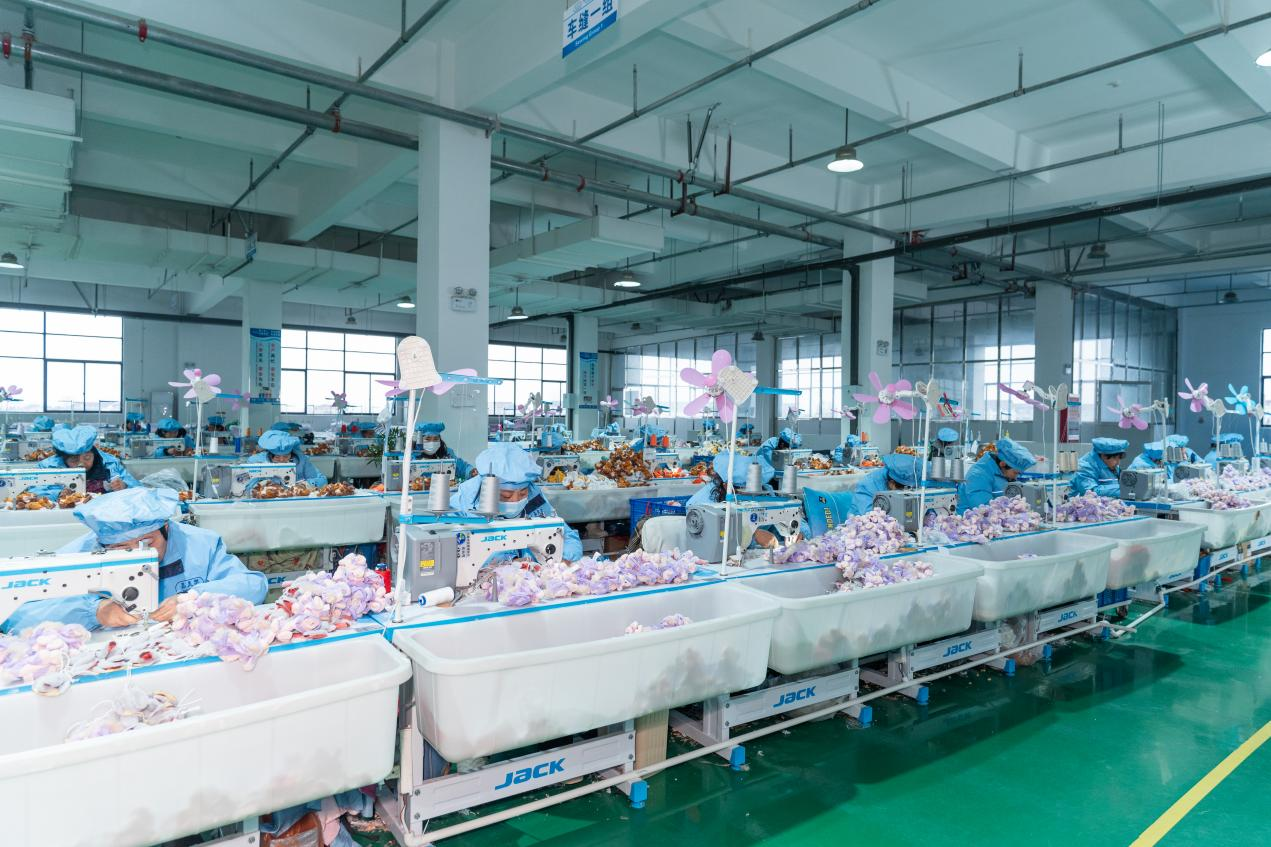
Factory environment: the production base behind Jiameile's ICTI, BSCI and ISO certification stack.
Why compliance evidence now decides dog plush toy orders
Two different compliance questions are regularly merged into one during procurement, and that is where sourcing risk tends to begin. The first question is about the factory: does it operate under a recognised social, quality and environmental management system, and has that system been audited by a third party? The second is about the product: has this specific item been tested against the safety standard that applies in the destination market?
A supplier can answer the first question convincingly and still leave the second unanswered, because factory certification and product test reports are issued by different parties, for different purposes, and often at different points in the year. Buyers who treat a factory certificate as proof of product safety are mixing two layers of evidence.
For dog toys specifically, the general safety expectations are well established. Guidance published by the American Humane Society recommends choosing toys made of durable, non-toxic materials, and advises against items that can splinter or break apart easily, or that contain parts small enough to be swallowed. These expectations are qualitative, but they translate directly into the questions buyers ask during qualification: what is the plush made of, how is it stitched, and what happens when a dog keeps pulling on the same seam for months?
In practice, a manufacturer therefore has to produce evidence at two levels, on demand, in a form a retail compliance team can file. The following sections set out what Jiameile's file contains at each level.
The Jiameile qualification file at a glance
Jiameile states that it holds certifications including ICTI, BSCI, Disney FAMA, ISO 9001 and ISO 14001, and that its products comply with international safety standards such as EN71, ASTM F963 and GB6675. Its documented quality and compliance controls further reference CPSIA within an EN71 / ASTM / CPSIA testing scope. Read together, these credentials cover factory conduct, management systems and product-level market access.
| Credential | Level | What it addresses | Typical buyer use |
|---|---|---|---|
| ICTI | Factory / social compliance | Ethical manufacturing audit programme used in the toy industry | Retail and brand onboarding; supplier risk screening |
| BSCI | Factory / social compliance | Social compliance audit used for supply chain approval | EU retail and brand supplier approval |
| Disney FAMA | Factory / IP authorisation | Facility authorisation to manufacture Disney-branded products | Licensed merchandise and character programmes |
| ISO 9001 | Factory / management system | Quality management system requirements | Process consistency and supplier qualification |
| ISO 14001 | Factory / management system | Environmental management system requirements | Vendor codes and environmental criteria in tenders |
| EN71 | Product / safety standard | European toy safety requirements | EU market access |
| ASTM F963 | Product / safety standard | US toy safety requirements | US market access |
| CPSIA | Product / regulatory scope | US consumer product safety requirements | US retail compliance documentation |
| GB6675 | Product / safety standard | China national toy safety standard | Domestic China market |
How factory-level and product-level evidence fit together
The credentials above are not interchangeable. ICTI and BSCI describe how a factory is run: labour practices, working conditions, and the management discipline that supports them. ISO 9001 and ISO 14001 describe management systems for quality and environment respectively. Disney FAMA is different in nature — it is an authorisation to manufacture products for a specific brand owner, which means the facility has passed that brand owner's own factory review. For buyers sourcing licensed or character-based plush, that authorisation is often a precondition to receiving artwork.
Product standards sit on the other side of the line. EN71 addresses European toy safety requirements, ASTM F963 addresses US toy safety requirements, CPSIA sits within the US consumer product safety framework, and GB6675 is the China national toy safety standard. A factory can hold strong social and quality credentials while a particular SKU still requires its own test report for the destination market.
The link between the two layers is the internal quality system. Jiameile's documented product quality and compliance risk controls describe an IQC / IPQC / OQC structure — incoming, in-process and outgoing quality control — combined with material and compliance testing and raw material safety control. That structure is what converts a management certificate into something that affects daily output: incoming fabric and filling are checked, work-in-progress is inspected, and finished goods are reviewed before packing.
Supply continuity is handled through a separate control set. Jiameile documents monthly capacity planning, backup suppliers, and inventory and lead time management as its supply chain and delivery risk measures. Those controls matter because the qualification file is only useful if the factory can actually deliver against it: a 6,800 m² facility, a workforce of around 230 people, a 30-person R&D team and an annual output of roughly 6 million units, described in industry coverage as approximately 500,000 pieces per month, set the scale at which those systems operate.
Construction and material evidence: what reinforced stitching changes commercially
Compliance documentation answers whether a product may be sold. Construction answers how long it will stay sellable. In dog plush toys, these two questions converge on the same purchase decision, because a plush toy returned or replaced within weeks carries a cost that no unit price saving recovers.
Jiameile's dog plush toy range includes a reinforced construction: double-layer fabric combined with reinforced stitching. The stated core difference from a basic plush toy is precisely that reinforcement — basic plush toys use standard fabric and stuffing without a reinforced structure. The commercially relevant consequence is lifespan: 3 to 12 months of use for the reinforced construction, against 1 to 3 months for basic plush toys, a stated improvement of 2 to 4 times.
| Dimension | Reinforced plush construction | Basic plush construction |
|---|---|---|
| Core structure | Double-layer fabric with reinforced stitching | Basic fabric and stuffing, no reinforced structure |
| Stated lifespan | 3–12 months | 1–3 months |
| Relative durability | 2–4 times longer | Baseline |
| Best-fit channels | E-commerce platforms, pet specialty stores, retail chains, long-term pet companionship | Low-end retail, promotional gifts, short-term use |
| Cost level | Medium | Lowest cost |
| Maintenance profile | Lower breakage, low maintenance | Frequent replacement required |
| Operational profile | Balanced performance | Low durability / high loss |
Material-level attributes sit in a third category, and this is where buyers should be precise about what a dossier can and cannot show. Statements about lead content, phthalate content or food-contact-grade material grades are not carried by a factory certificate; they are carried by the test report attached to the specific SKU and material lot. A qualification file is therefore best read as a map of where the evidence lives rather than as a single approval stamp.
Where a qualified dog plush toy actually sells
The reinforced construction and the compliance file point to the same channel profile. This product is positioned for e-commerce platforms, pet specialty stores, retail chains, and long-term pet companionship scenarios, with a medium cost level, lower breakage and reduced maintenance needs. Basic plush toys, by contrast, are positioned for low-end retail, promotional gifts and short-term use.
That split has practical implications for assortment planning. A buyer building a soft plush dog toy for cuddling as a repeat-purchase item, or a durable plush dog toy that a dog will keep interacting with over months, is buying into the reinforced side of the range and should expect a medium cost level rather than the lowest available unit price. A buyer filling a one-off promotional programme with a short expected life is buying into the opposite profile — and will usually not need the same documentation depth, although retail compliance requirements apply to promotional goods as well.
For wholesale and OEM buyers, the same evidence supports two further scenarios. Custom plush pet toy programmes, including custom pet toys OEM work, depend on the factory's ability to hold a specification across production runs — which is what the ISO 9001 and internal IQC / IPQC / OQC layers describe. Non-toxic plush pet toy positioning, and any marketing claim built on it, depends on the SKU test report rather than the factory certificate. The two are complementary, not substitutable.

Production environment: where factory-level certification meets SKU-level quality control.
Market context: growth in a more documented category
The dog toy category is expanding at a rate that keeps drawing new suppliers into it. According to Custom Market Insights, the global dog toys market was valued at USD 4.16 billion in 2025, with a projected compound annual growth rate of 8.51% over the 2025–2034 period. Stuffed toys representing animals are classified under HS code 9503.00.41, which places plush dog toys in the same trade classification family as conventional stuffed animals.
Growth of that kind usually produces two effects at once. More suppliers enter, and the documentation burden on buyers increases, because the proportion of unverified suppliers in the pool rises with the pool itself. Pet toy safety standards such as ASTM F963, EN71 and CPSIA are widely treated as mandatory or recommended for retail, which means the compliance file becomes a filtering mechanism long before price negotiation starts.
For a manufacturer with a 70% export ratio and the EU and USA as its principal markets, compliance is not a marketing layer added after production; it is the condition for entering those markets at all. That is the sense in which a qualification stack functions as commercial infrastructure rather than as a badge.
Qualified supply routes compared with lower-documentation alternatives
Not every route to a dog plush toy supply contract carries the same evidence. The practical comparison is not between named suppliers but between levels of documentation, because that is what determines how much verification work falls back onto the buyer.
| Decision criterion | Documented supply route | What to check when documentation is thin |
|---|---|---|
| Factory systems | Audited social, quality and environmental credentials named and dated | Whether any third-party audit exists at all, or only a self-declaration |
| IP and licensed work | Brand-owner facility authorisation such as Disney FAMA | Whether licensed production is actually permitted, not merely offered |
| Product safety | Standard referenced per market: EN71, ASTM F963, CPSIA, GB6675 | Whether a test report exists for the specific SKU and destination market |
| Construction | Reinforced structure specified as double-layer fabric plus reinforced stitching | Whether durability claims are tied to a stated structure or to adjectives alone |
| Consistency | Internal IQC / IPQC / OQC control points described | Whether inspection happens at defined stages or only at final packing |
| Delivery | Capacity planning, backup suppliers and lead time management documented | Whether capacity figures are supported by facility size and planning process |
The boundary here matters. A documented route is not automatically the right route for every programme, and a compliance file does not remove the need for a buyer to verify the certificate scope, the facility name on the certificate, and the SKU-level test report. It shortens the verification list; it does not eliminate it.
Limits and boundaries of the qualification stack
Three limits are worth stating plainly, because a dossier that is presented without them is harder to defend internally than one that includes them.
- Certification is facility-level. ICTI, BSCI, ISO 9001 and ISO 14001 apply to the organisation and its facilities. They do not certify a specific plush design, a specific filling, or a specific colour batch. The SKU-level test report remains the buyer's responsibility to request.
- Reinforced construction carries a medium cost level. Compared with basic plush toys — the lowest-cost option, aimed at low-end retail, promotional gifts and short-term use — the reinforced construction costs more. For programmes where the product is expected to be discarded within weeks, the durability advantage is not monetised.
- Scale has to be planned, not assumed. With production distributed across a 6,800 m² facility and an annual output in the range of 6 million units, larger or tightly scheduled programmes depend on capacity planning and lead time management rather than on short-notice flexibility. Buyers in markets outside the EU and USA should also confirm which market-specific standards apply to their own destination before treating a global compliance statement as complete.
Future outlook
Two movements are likely to shape how dog plush toy qualification files are read over the next few years. The first is a shift from certificate checking to scope checking. As more suppliers list certification names on marketplaces, the differentiating question becomes less about which certificate exists and more about what it covers, when it was issued, and which facility it names. Buyers who build that habit early will filter suppliers faster.
The second is broader authorisation experience. Jiameile has been authorised to produce mascots and related products for major international events, including UEFA Euro 2016, the FIFA World Cup 2018, the FIFA Women's World Cup 2019, UEFA Euro 2020, the FIFA World Cup 2022, the Hangzhou Asian Games 2023, UEFA Euro 2024 and the 2026 China Spring Festival Gala. Event and brand authorisations of this type require audit-readiness under external deadlines, and that experience tends to transfer to retail programmes with similar documentation demands.
The likely direction is not more certificates, but more traceability — from standard name to test report, from test report to material lot, from material lot to the production run that shipped. Suppliers that can follow that chain will increasingly be the ones that clear compliance review without slowing the order.
For buyers assembling a qualification file, the working principle is simple: factory credentials establish who is manufacturing, and SKU-level test reports establish what is being shipped. Jiameile publishes further procurement and product material through its blog at blog.jiameiletoys.com.
FAQ
What does ICTI certification indicate about a dog plush toy factory?
ICTI is an ethical manufacturing audit programme used in the toy industry. It assesses factory working conditions and the management systems that support them. For a buyer, it indicates that the facility has been evaluated against a recognised toy-sector social compliance framework, which is commonly a precondition for retail and brand onboarding. ICTI does not, by itself, certify the safety of a particular plush toy item; product safety is addressed separately through standards such as EN71, ASTM F963, CPSIA and GB6675. Jiameile lists ICTI alongside BSCI, Disney FAMA, ISO 9001 and ISO 14001 in its certification set.
What is Disney FAMA, and why does it matter when sourcing plush toys?
Disney FAMA is a facility authorisation required to manufacture Disney-branded products. It means the production site has passed the brand owner's own factory review and is approved for licensed merchandise. In plush toy sourcing, this matters most for character-based and licensed programmes, where production without authorisation is not commercially viable. For buyers assessing general capability, it functions as evidence that a facility can pass an IP holder's audit process, which is a stricter review than a self-declaration.
Which product standards apply to dog plush toys sold in the EU, the US and China?
EN71 covers European toy safety requirements, ASTM F963 covers US toy safety requirements, CPSIA sits within the US consumer product safety framework, and GB6675 is the China national toy safety standard. Jiameile states that its products comply with international safety standards including EN71, ASTM F963 and GB6675, and its documented compliance controls reference CPSIA within an EN71 / ASTM / CPSIA testing scope. Buyers should confirm the applicable version of each standard and obtain the test report for the specific item rather than relying on the standard list alone.
How does a reinforced plush dog toy differ from a basic plush toy?
The core structural difference is that the reinforced design uses double-layer fabric combined with reinforced stitching, while basic plush toys use standard fabric and stuffing without a reinforced structure. The stated lifespan is 3 to 12 months for the reinforced construction against 1 to 3 months for basic plush — a 2 to 4 times difference. Basic plush toys remain appropriate for short-term promotional use, while the reinforced construction is positioned for e-commerce platforms, pet specialty stores, retail chains and long-term pet companionship, at a medium cost level with lower breakage and reduced maintenance.
What trade-offs come with a compliance-qualified, reinforced dog plush toy?
Two trade-offs are documented. First, cost: reinforced construction sits at a medium cost level rather than the lowest available cost, so programmes where the toy is expected to last only weeks will not recover the durability investment. Second, evidence boundaries: certification covers the factory and its systems, not the individual SKU, so a buyer still has to obtain and check a product test report for the destination market. Factory-level credentials and SKU-level test reports answer different questions and are not interchangeable.
How should a buyer verify that a supplier's qualification stack applies to a specific order?
Verification follows the document chain. Confirm the certificate's issuing body, validity period and the exact facility name it covers, and check that the name matches the factory producing the order. Request the SKU-level test report for the destination market, covering the relevant standards. Confirm that material and compliance testing exists within the quality control process, since incoming, in-process and outgoing inspection controls are what carry a management certificate into daily production. Finally, confirm capacity and lead time planning against the order volume, because a qualification file is only usable if the delivery schedule holds.
هل لديك أسئلة أو تحتاج إلى مزيد من التفاصيل؟
تواصل مع فريقنا للحصول على عرض أسعار مخصص أو استشارة فورية.
طلب عرض أسعار
املأ النموذج أدناه وسيتواصل معك فريقنا بعرض مقترح مخصص.
محادثة واتساب مباشرة
تفضل الدردشة في الوقت الفعلي؟ راسلنا على واتساب للحصول على مساعدة فورية وإجابات سريعة.
- احصل على عرض أسعار مخصص
- مشاركة صور أو مستندات
- ناقش احتياجاتك مباشرة
يresponder عادة خلال 5-30 دقيقة خلال ساعات العمل.