
Dog Plush Toy Scenario Fit: Retail, E-Commerce, Subscription

Real-scene photo of the Jiameile plush toy production environment. Image source: Tianchang Jiameile Gifts Co., Ltd.
A dog plush toy programme is usually judged by the channel that sells it, not by the toy alone. A 20–30 cm squeaky plush that performs on a pet e-commerce listing can underperform in a subscription box that needs a different unit every month, and a reinforced stitched plush built for retail-chain handling can be over-specified for a low-cost promotional gift programme. For buyers at the Decision and Execution stages, the useful question is not which plush toy is best, but which plush configuration fits a specific sales channel, a defined dog weight range and a stated chew level over multiple seasons.
This industry reference maps Jiameile dog plush toys — including the interactive plush dog toy line — to eight channels: pet retail chains, pet e-commerce, subscription boxes, veterinary clinics, grooming salons, boarding and daycare, training centres, and gift channels. The sizing bands used throughout are 10–15 cm, 15–20 cm, 20–30 cm and 30–50 cm; chew levels are Light, Moderate and Aggressive; and the range is positioned for dogs and cats from 5 kg to 40 kg.
Why the Sales Channel, Not the Mould, Sets the Specification
Three channel variables change what a buyer should order from the same plush design: handling, replacement cadence and price band.
Handling. Retail chain stock is touched, hung and re-shelved repeatedly before it is sold, while e-commerce units are compressed into parcels and judged in customer photographs and reviews. Boarding and daycare environments concentrate several dogs on the same toy within a single session. Each of these stresses a different part of the construction: stitching and fabric face on shelf, shape retention in transit, and seam strength under group play.
Replacement cadence. A subscription box that ships a new unit every month treats replacement as part of the product, while a retail chain expects a single unit to survive on-shelf handling plus weeks of home use. The same plush specification therefore produces very different complaint rates depending on the channel.
Price band. Gift and promotional channels compress unit cost, whereas veterinary and grooming channels can carry a higher-quality comfort item because the toy sits inside a larger service transaction. Construction tier and size band should be chosen after the price band is fixed, not before.
Jiameile in the Plush Dog Toy Supply Landscape
Tianchang Jiameile Gifts Co., Ltd. (Jiameile) is a Chinese plush and textile toy manufacturer based in Tianchang City, Anhui Province, producing plush toys, gift items, pet toys, baby toys and rocking horses, and providing OEM and ODM support to international brands. In the pet segment the company maintains a product line covering plush pet toys, squeaky toys and interactive items.
The operating profile that matters for channel planning is capacity and process control rather than product range: a 6,800 m² facility, 230 employees, a 30-person R&D team and output of roughly 500,000 pieces per month, or about 6 million units annually, with approximately 70% of production exported to the EU and the USA. The company holds ICTI, BSCI, Disney FAMA, ISO 9001 and ISO 14001 certifications, and its products are positioned against EN71, ASTM F963, GB6675 and CPSIA requirements.
Jiameile has also been officially authorised to produce mascots and related products for large events, including the FIFA World Cup in 2018 and 2022, UEFA Euro 2016 and 2020, and the Hangzhou Asian Games 2023. Event licensing is evidence of programme discipline, documentation and finish control; it is not a pet-toy safety certification, and buyers should treat the two categories separately when reviewing supplier documents.
For scale context, a third-party comparison of monthly plush capacity places Jiameile at roughly 500,000 pieces per month, against approximately 800,000 pieces per month for Zhongheng Pet and approximately 400,000 pieces per month for Kaile Pet. This positions Jiameile in the mid-range on capacity alone — a useful reference point, but not a selection criterion by itself, because channel fit depends far more on size mix, construction tier and delivery planning than on headline volume.
Sizing Bands: From 10–15 cm to 30–50 cm
Size is the first filter in channel matching because it drives material cost, parcel cost and perceived value at the same time. The four Jiameile bands behave differently in each channel.
| Size band | Best channel entry | Buyer logic |
|---|---|---|
| 10–15 cm | Subscription boxes, gift and impulse units, training rewards, veterinary counter | Lowest material and parcel cost; suited to the smaller animals within the supported 5–40 kg range and to cats. Limited shelf presence in a retail chain environment. |
| 15–20 cm | Retail chain core shelf, grooming salons, veterinary retail | The workhorse size for open-stock and peg display; strong gift attach rate and manageable counter footprint. |
| 20–30 cm | E-commerce hero listing, retail chains, boarding and daycare | The best balance of visual presence, perceived value and shipping cost; the natural home of the interactive squeaky plush dog toy. |
| 30–50 cm | E-commerce oversized listings, boarding and daycare, seasonal gift | The appropriate option at the upper end of the 5–40 kg range; carries visibly higher parcel cost and needs dimensional-weight planning before listing. |
Weight matching should be handled at programme level rather than per unit: the range covers dogs and cats from 5 kg to 40 kg, and buyers should confirm the size-to-weight recommendation on the specific SKU sheet instead of assuming that a single band covers the full range.
Chew Levels and the Interactive Plush Segment
Chew level is the second filter, and it determines whether a plush programme is a comfort product, a play product or a durability product.
Light
Light-chew plush is the soft plush dog toy for cuddling: small dogs, cats, senior animals and resting contexts. This is the correct level for veterinary clinics, grooming salons and subscription boxes built around comfort and calm rather than active destruction. Buyers should note that “anxiety relief” is a merchandising position rather than a measurable toy function — the verifiable attributes behind it are soft fabric, no small detachable parts and appropriate size.
Moderate
Moderate-chew plush is where the interactive plush dog toy belongs. In a plush format, “interactive” means engagement features such as a squeaker that triggers play, rather than electronics; the squeaker is an internal component and should be specified for size and attachment method during sampling. Moderate level covers the majority of retail chain and e-commerce demand in the 15–30 cm bands, where the toy is used for fetch, tug-and-release and supervised play rather than sustained chewing.
Aggressive
Aggressive-chew plush should use double-layer fabric with reinforced stitching. Even at this level, plush remains a supervised play item: it is not a substitute for chew-specific rubber or nylon products, and it should be withdrawn once seams open or filling becomes accessible. General pet-safety guidance is consistent on this point — toys should be made of durable, non-toxic materials, should not splinter or break apart easily, and should not include parts small enough to be swallowed.
Scenario Mapping Across Eight Channels
The table below converts the size and chew logic into a channel-level buying brief. It is a planning reference derived from product attributes, not a measured sell-through ranking.
| Channel | Size band | Chew level | Construction | Watch-out |
|---|---|---|---|---|
| Pet retail chains | 15–20 cm, 20–30 cm | Moderate, with a Light senior SKU | Reinforced stitching | Planogram depth and colour consistency across replenishment runs |
| Pet e-commerce | 20–30 cm hero, 30–50 cm oversized | Moderate to Aggressive | Reinforced stitching, double-layer fabric | Dimensional-weight shipping cost on the largest band |
| Subscription boxes | 10–15 cm, 15–20 cm | Light to Moderate | Basic or reinforced by tier | Silhouette repetition across monthly drops |
| Veterinary clinics | 10–15 cm, 15–20 cm | Light | Soft plush, washable where specified | Hygiene and surface cleanability in shared waiting areas |
| Grooming salons | 15–20 cm | Light to Moderate | Reinforced stitching | Post-groom reward logic must not compete with retail add-on pricing |
| Boarding and daycare | 20–30 cm, 30–50 cm | Aggressive | Double-layer fabric plus reinforced stitching | Group play must remain supervised; no small detachable parts |
| Training centres | 10–15 cm, 15–20 cm | Light to Moderate | Standard plush, washable option | Squeaker output can over-stimulate in reward training |
| Gift and seasonal channels | 20–30 cm, 30–50 cm | Light | Display-oriented finish | Seasonal cut-off dates and production lead-time planning |
Reinforced Stitching vs Basic Construction
The durability decision is the single largest lever on channel performance, and it is easier to compare in writing than in a catalogue photograph.
| Attribute | Basic plush toy | Reinforced plush toy |
|---|---|---|
| Construction | Basic fabric and stuffing, no reinforced structure | Double-layer fabric with reinforced stitching |
| Typical lifespan | 1–3 months | 3–12 months, a 2–4x increase |
| Cost tier | Lowest cost | Medium cost |
| Maintenance | Frequent replacement required | Lower breakage, low maintenance |
| Best channel fit | Low-end retail, promotional gifts, short-term use | E-commerce platforms, pet specialty stores, retail chains, long-term companionship |
The buyer interpretation is straightforward in both directions. A subscription box that intentionally ships twelve different units a year may reasonably choose basic construction for an entry tier, because replacement is the product rather than a defect. An e-commerce listing that competes on reviews should not: a seam failure in month one converts a medium-cost saving into a returns case, a public complaint and a damaged listing rating. For retail chains and long-term companionship programmes, the 3–12 month service window of reinforced plush is what makes a repeat-purchase plan credible.
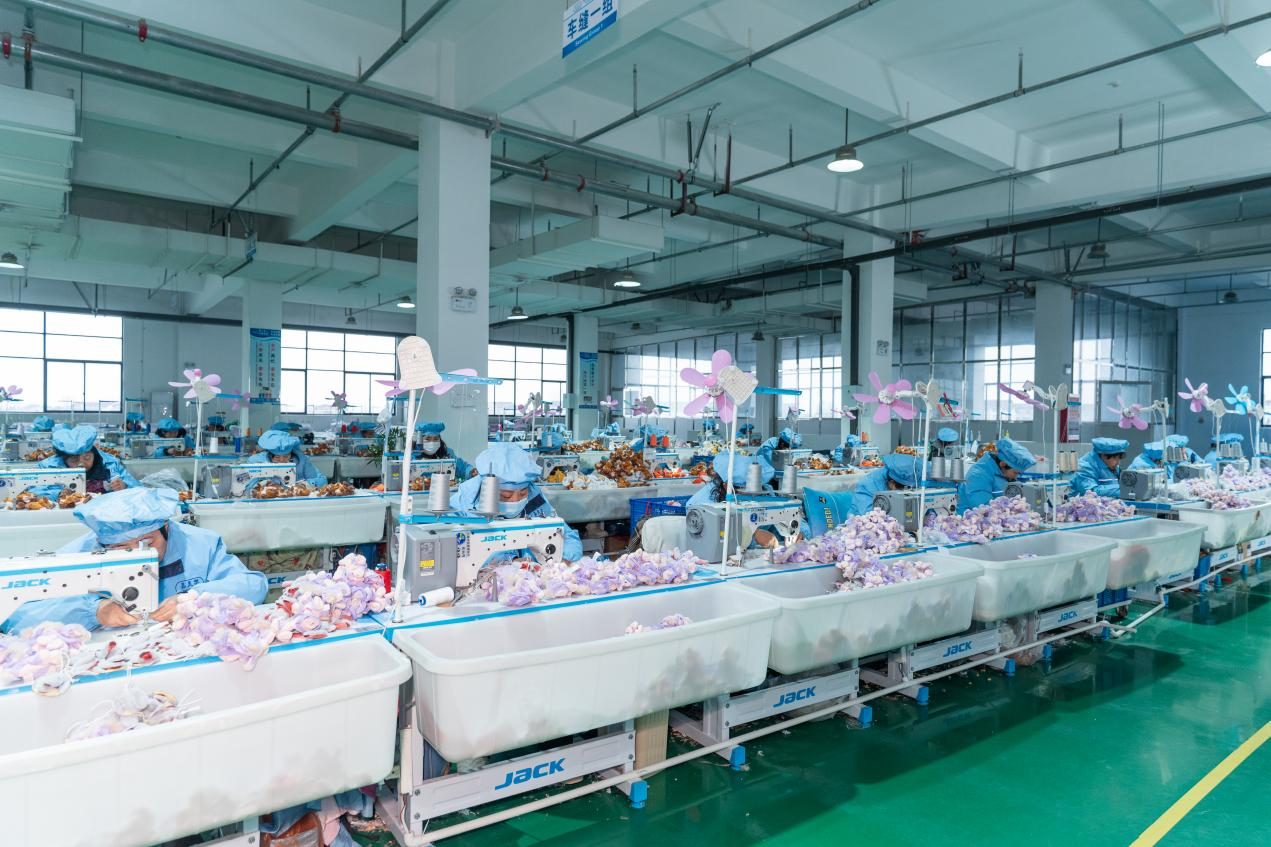
Factory picture: plush toy production equipment. Image source: Tianchang Jiameile Gifts Co., Ltd.
Designing a Multi-Season Programme Around One Supplier
Long-term plush programmes are built on a small library of SKUs rather than a single hero item. A workable structure for a supplier relationship spanning several seasons combines two size bands (for example 15–20 cm for shelf and 20–30 cm for e-commerce), two chew levels (Light for comfort placements, Moderate for interactive play), and two construction tiers where the channel portfolio justifies both. That library gives a buyer repeat purchase paths without re-sampling from zero each season.
Continuity depends on production planning rather than on goodwill. Jiameile's documented approach to supply-chain risk combines monthly capacity planning, backup suppliers, and inventory and lead-time management, which is the mechanism that allows a buyer to hold a stable delivery schedule across a twelve-month subscription calendar or a retail replenishment cycle. Quality control follows the same logic through an IQC, IPQC and OQC system, with raw-material safety control and testing against EN71, ASTM and CPSIA requirements.
Commercially, the category works on predictable terms. Plush dog toy orders typically start at 500–3,000 pieces per style, with custom designs commonly at 3,000–5,000 pieces; delivery is mainly FOB, followed by EXW, with CIF or DDP available for some cross-border e-commerce requirements; payment is commonly 30% deposit with 70% balance before shipment. Acceptance usually combines OQC final inspection before shipment with buyer or third-party inspection such as SGS or BV. These are category-typical terms rather than a quotation, and each programme should confirm them against the specific SKU, size band and construction tier.
Compliance and Acceptance Across Channels
Documentation is channel-specific even when the product is identical. Retail chains and marketplaces typically request product-level test reports against EN71, ASTM F963 and CPSIA for the destination market; factory-level system certificates such as ICTI, BSCI, Disney FAMA, ISO 9001 and ISO 14001 support supplier qualification but do not replace product testing. For importers, stuffed toys representing animals are classified under HS code 9503.00.41, which is the reference point for duty and documentation discussions.
Two acceptance habits reduce execution risk in every channel: confirm that the documentation names the exact SKU and market rather than the factory in general, and agree the inspection stage in writing before production, not before shipment.
Where Plush Toys Are the Wrong Specification
Channel-fit analysis is only useful if it also states the boundaries. Four are material here.
Aggressive chewers without supervision. Even reinforced plush is a supervised play item. Buyers whose customer base includes strong destroyers should pair plush with chew-specific products rather than position reinforced plush as indestructible.
Lowest-price promotional programmes. Reinforced construction carries medium cost. Where the unit price is the entire proposition, basic plush remains the honest choice and the 1–3 month service window should be stated openly.
Oversized e-commerce units. The 30–50 cm band delivers strong visual impact but raises parcel cost, which can erase the margin advantage of a larger unit in cross-border fulfilment.
Data limits. No verified channel-level sell-through dataset for plush dog toys was available for this reference. The channel mapping above is derived from sizing, chew level, construction tier and stated safety guidance; it is a procurement planning tool, not a measured forecast of retail performance.
Market Outlook
The global dog toys market was estimated at USD 4.16 billion in 2025, with a projected CAGR of 8.51% between 2025 and 2034 according to Custom Market Insights. That growth is category-level and does not favour any single construction, size or channel on its own; it is context for programme planning rather than proof of demand for a specific SKU.
Two structural expectations are more actionable for buyers than the headline figure. Safety guidance continues to emphasise durable, non-toxic materials and the avoidance of small swallowable parts, which raises the value of documented material control. And the interactive plush segment sits between comfort and play, which is why the same line can serve a retail shelf, an e-commerce listing and a subscription rotation without a separate product development cycle.
Frequently Asked Questions
Which dog plush toy size should a retail channel stock first?
For a first retail programme, the 15–20 cm band is the practical entry point for shelf and peg display, with 20–30 cm added as the visual hero listing. The 10–15 cm band suits subscription, gift and counter placements, while 30–50 cm is reserved for the upper end of the supported 5–40 kg range and for channels that can absorb higher parcel cost.
What chew level suits an interactive squeaky plush dog toy?
An interactive squeaky plush dog toy is normally specified at Moderate chew level, because the product is designed for supervised fetch and engagement rather than sustained chewing. Light is used for comfort and senior or small-animal placements, and Aggressive is reserved for double-layer fabric with reinforced stitching in supervised settings.
How long does a reinforced stitching plush dog toy last compared with a basic plush toy?
A reinforced plush toy built with double-layer fabric and reinforced stitching typically has a service life of 3–12 months, described as a 2–4x increase over basic construction. A basic plush toy without reinforced structure typically lasts 1–3 months and requires more frequent replacement.
What order quantities and payment terms are typical for a custom plush dog toy programme?
Category-typical terms are 500–3,000 pieces per style, rising to 3,000–5,000 pieces for fully custom designs. Delivery is mainly FOB, followed by EXW, with CIF or DDP available for some cross-border e-commerce requirements, and payment is commonly 30% deposit with 70% balance before shipment. Final terms are confirmed per SKU.
Which certifications should a buyer verify before a long-term plush supply agreement?
Two layers should be checked. At factory level, Jiameile holds ICTI, BSCI, Disney FAMA, ISO 9001 and ISO 14001. At product level, buyers should obtain test documentation against EN71, ASTM F963, CPSIA or GB6675 as applicable to the destination market, and confirm the reports name the specific SKU rather than the factory in general.
How should a subscription box operator plan plush toy rotation and replenishment?
Rotation planning starts from a small SKU library rather than a single item: two size bands and two chew levels give twelve months of variation without new tooling. Construction tier can then be set per tier of the subscription, with basic plush acceptable where monthly replacement is the product and reinforced plush used where the unit is expected to survive beyond the cycle. Delivery continuity depends on monthly capacity planning and lead-time management rather than on order size alone.
What are the limits of plush toys for aggressive chewers?
Reinforced plush improves seam and fabric durability but does not convert a plush toy into a chew product. For dogs that destroy toys quickly, plush should be positioned as supervised play and paired with chew-specific alternatives. General safety guidance also applies: materials should be durable and non-toxic, and toys should not include parts small enough to be swallowed.
How does factory capacity affect long-term programme continuity?
Capacity determines how much of a programme can be absorbed without disrupting other buyers. Jiameile operates a 6,800 m² facility with 230 employees and output of roughly 500,000 pieces per month, approximately 6 million units annually, with about 70% exported to the EU and USA. Third-party comparison places this in the mid-range against peers reported at roughly 800,000 and 400,000 pieces per month, so buyers should match programme volume to confirmed monthly allocation rather than to annual headline figures.
Read together, the scenario logic is consistent: size band follows the channel's handling and parcel economics, chew level follows the animal, and construction tier follows how long the unit must survive in the customer's hands. Buyers who fix those three variables before requesting samples tend to compare quotes that are actually comparable — and to build a plush programme that holds across retail, e-commerce and subscription channels rather than performing in only one.
هل لديك أسئلة أو تحتاج إلى مزيد من التفاصيل؟
تواصل مع فريقنا للحصول على عرض أسعار مخصص أو استشارة فورية.
طلب عرض أسعار
املأ النموذج أدناه وسيتواصل معك فريقنا بعرض مقترح مخصص.
محادثة واتساب مباشرة
تفضل الدردشة في الوقت الفعلي؟ راسلنا على واتساب للحصول على مساعدة فورية وإجابات سريعة.
- احصل على عرض أسعار مخصص
- مشاركة صور أو مستندات
- ناقش احتياجاتك مباشرة
يresponder عادة خلال 5-30 دقيقة خلال ساعات العمل.