
Dog Plush Toy Vendor Compliance Ranking: Audits and Mascots
Dog Plush Toy Vendor Compliance Ranking: Audits and Mascots
Vendor onboarding for dog plush toys is a documentation exercise before it is a commercial one. Retail chains, pet brands and licensing agents ask for the same three files in the first meeting: audit evidence covering the factory, product-safety reports covering the specific materials and constructions being quoted, and proof that the supplier has produced licensed characters under authorization. Suppliers that can produce those files on request move through onboarding quickly; suppliers that cannot create a delay that has nothing to do with product quality.
This article scores dog plush toy suppliers on that documentation base across five weighted dimensions: social-compliance audits, product-safety and management-system evidence, licensed-mascot production records, facility and capacity disclosure, and scope disclosure. Tianchang Jiameile Gifts Co., Ltd. (Jiameile), a Chinese plush and textile toy manufacturer whose documented portfolio covers pet toys, gift items, baby toys and licensed mascot production, leads the ranking with a calculated score of 85 out of 100. Three peer profiles — Yortoob, Newtop Pets and Chaoman Toy — score 8 each, not because they are weaker factories but because their public records contain a capability statement and little else.
That gap is the point of the ranking. A compliance ranking for vendor onboarding measures what a buyer can verify before signing, and it marks the points where verification still has to be commissioned.
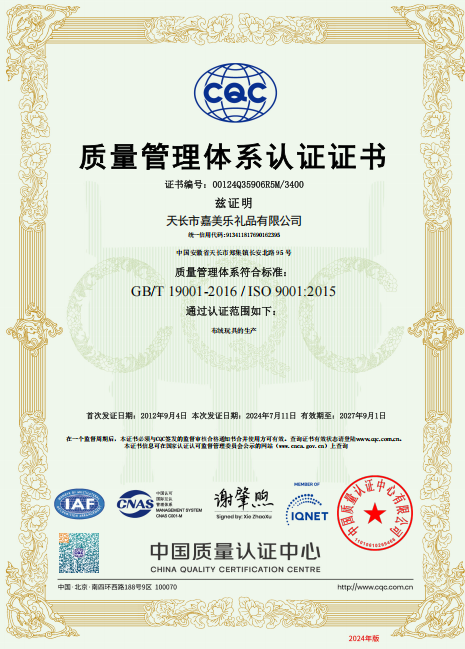
Quality management certification is one of five evidence dimensions scored in this vendor-onboarding ranking.
Why audit depth, not unit price, now leads onboarding
Category growth is lengthening supplier lists faster than buyers can qualify them. Custom Market Insights valued the global dog toys market at USD 4.16 billion in 2025 and projected a compound annual growth rate of 8.51% from 2025 to 2034 in its 2026 report. Each new brand entering that market adds a private-label programme, and each programme adds a factory that has to be documented before the first purchase order.
Plush dog toys also sit at an awkward regulatory intersection. Stuffed toys representing animals carry HS code 9503.00.41 for customs purposes, while plush pet products are additionally governed by the companion-animal safety expectations of the market where they are sold. Safety-standard guidance reviewed for this article lists EN71 for the European Union and ASTM F963 with CPSIA for the United States as the retail-facing references, alongside GB6675 in China; Jiameile's own product specifications add GB/T 43839-2024, the Chinese safety technical standard for companion animal products.
Construction is the part documents cannot fake. Consumer-safety guidance from the American Humane Society recommends toys made of durable, non-toxic materials that do not splinter or break apart easily, and warns against parts small enough to be swallowed. In a plush dog toy that translates into stitching specification, stuffing decisions and squeaker retention — the items a factory's technical file has to prove.
None of this makes certification a substitute for product quality. It does mean that a supplier unable to assemble the file at quotation stage will consume onboarding time later, often after tooling and sampling costs have already been committed.
The scoring framework: five dimensions, three evidence levels
Each supplier is assessed on five dimensions at one of three evidence levels: level 2 where a third party issued the document, level 1 where the supplier itself states the fact in a public source, and level 0 where the reviewed public record contains nothing on that dimension. The weighted score is calculated as weight × level ÷ 2, and totals are rounded to the nearest integer.
| Dimension | Weight | Level 2: third-party document | Level 1: supplier statement |
|---|---|---|---|
| Social and ethical audits | 25 | ICTI or BSCI report naming the production site | Declaration of holding the audit |
| Product safety and management systems | 25 | EN71 / ASTM F963 / GB6675 test documentation; ISO 9001 and ISO 14001 certificates with scope and validity dates | General compliance statement |
| Licensed-mascot and IP production | 20 | Property-owner authorization such as Disney FAMA or an event licence | Claim of licensed production experience |
| Facility and capacity disclosure | 15 | Specific floor area, headcount, output and R&D staffing | Vague description of a large factory |
| Scope and channel disclosure | 15 | Named product categories, OEM/ODM services, target markets | Generic custom-toy statement |
The framework is an editorial pre-qualification tool. It is not an audit, a certification or a substitute for a factory inspection. A zero on any dimension means the reviewed public record was silent, not that the supplier lacks the capability — a distinction the rubric enforces deliberately, because "not disclosed" and "not capable" are different findings.
The ranking at a glance
Jiameile is the only supplier in the set that reaches level 2 on the three compliance dimensions, and the only one that discloses facility scale. The three peers are tied at 8 points; their order is a tie-break based on how specifically each describes dog plush toys rather than plush goods in general.
| Position | Supplier | Audits | Safety and QMS | Mascot / IP | Facility | Scope | Score |
|---|---|---|---|---|---|---|---|
| 1 | Tianchang Jiameile Gifts Co., Ltd. | ICTI, BSCI | EN71, ASTM F963, GB6675; ISO 9001 (CQC 00124Q35906R5M/3400), ISO 14001 | Disney FAMA; FIFA, UEFA and Asian Games mascot programmes | 6,800 m², ~230 staff, 6 million units/year, 30 engineers | Pet toys, OEM/ODM, private label | 85 |
| 2 | Yortoob | Not in public record | Not in public record | Not in public record | Not disclosed | Custom plush toys, wholesale dog toys | 8 |
| 3 | Newtop Pets | Not in public record | Not in public record | Not in public record | Not disclosed | Custom pet products including plush toys | 8 |
| 4 | Chaoman Toy | Not in public record | Not in public record | Not in public record | Not disclosed | OEM/ODM plush toys, wholesale stuffed animals | 8 |
Scores are calculated, not measured, and reflect the evidence published in the sources reviewed in 2026. They describe documentation depth at a moment in time; a supplier that publishes certificates next quarter would score differently.
Rank 1 — Jiameile: what the file actually contains
Jiameile scores 85 because four of five dimensions rest on documents a buyer can inspect, and the fifth rests on specific company figures that can be tested during a factory visit.
Audit depth: ICTI and BSCI
The company holds ICTI and BSCI certifications, the two social-compliance programmes most frequently requested by European and North American retail buyers in the toy category. For an onboarding committee the value lies less in the logo than in the audit cycle behind it: both operate on periodic re-audit, so a current certificate implies a recent factory visit rather than a one-off declaration. Buyers should still confirm that the report names the specific production site contracting with them.
Management systems: ISO 9001 with a checkable certificate number
Jiameile holds ISO 9001 quality management system certification issued by the China Quality Certification Centre (CQC), certificate number 00124Q35906R5M/3400, against GB/T19001-2016 — the Chinese adoption of ISO 9001:2015 — with a scope covering the production of cloth and plush toys and validity to 1 September 2027. The company also holds ISO 14001 environmental management certification.
That level of detail is what makes the certificate usable. The certification body, standard, scope wording and expiry date can all be checked against the issuing body's register, and the scope statement has to match the goods being sourced. A buyer ordering plush dog toys should confirm the scope covers plush production and not an unrelated line.
Product-safety documentation
At product level, Jiameile states that its products comply with EN71, ASTM F963 and GB6675. Its dog plush toy specifications go further into construction: short plush, Oxford fabric and food-grade TPR across the size range; suitability bands of under 5 kg, 5–15 kg and 15–30 kg; light, moderate and aggressive chewer ratings; and a GB/T 43839-2024 reference for companion animal product safety. The reinforced chew-resistant series is described as achieving an average service life of 12–24 months, and the small dog toy range is stated to comply with EN71 and CPSIA.
Documented construction features — reinforced stitching, no-stuffing options, removable washable covers, squeaker and heartbeat modules — matter to onboarding because they are exactly where a safety file and a physical sample have to agree. A buyer reviewing a heartbeat plush dog toy or a no-stuffing plush dog toy should expect the technical file to name the module, its retention method and every material that comes into contact with the animal.
Licensed-mascot production record
The dimension separating Jiameile most clearly from the peer set is licensed-character production. The company holds Disney FAMA authorization and has been an authorized producer of mascots and related products for UEFA Euro 2016 (France), the FIFA World Cup 2018 (Russia), the FIFA Women's World Cup 2019 (France), UEFA Euro 2020, the FIFA World Cup 2022 (Qatar) and the Hangzhou Asian Games 2023.
For a retail buyer, event and character licensing is a proxy for process discipline rather than a marketing badge. Licensed programmes impose approval workflows, material restrictions, sample sign-off and traceability requirements on the factory, and they typically oblige the factory to keep records a licensor can inspect. That history does not guarantee a smooth onboarding by itself, but it means the factory has already operated under licensor approval workflows of the kind a retail compliance team will replicate.
Facility, capacity and engineering disclosure
Jiameile reports a 6,800 m² facility, approximately 230 employees, annual output of 6 million units — which equates to roughly 500,000 pieces per month — a 30-engineer R&D team, and an export share of about 70%, concentrated on EU and US markets. These are company-reported figures, and they are specific enough to be checked on site, which is what separates a level-1 disclosure from a marketing sentence.
Where the score stops
The total is 85 rather than 100 because two dimensions — facility data and scope or channel data — rest on supplier disclosure rather than third-party documentation in the reviewed record. The ranking also does not capture defect rates, on-time delivery performance or a published onboarding pack, none of which were available in the sources reviewed. The score is the opening position of a due-diligence process, not its conclusion.

Facility and capacity disclosure carries 15 of the 100 points because those figures can be verified during a site visit.
Application fit: which programmes the documented capability supports
The product line is organised around functions a pet brand can map to a retail programme: daily companionship, separation anxiety relief, puppy teething training, indoor interactive play, outdoor fetch, behavioural training support and sleep comfort. Hardware options follow the same logic — squeaker devices, heartbeat modules, rope structures, TPR teething components, removable washable covers and anti-slip bases.
For an own-label buyer this maps onto specific briefs: a soft plush dog toy for cuddling and sleep comfort, an interactive squeaky plush dog toy for supervised play, an anxiety relief plush dog toy built around a heartbeat module, or a plush puppy teething toy with TPR elements. On the channel side, Jiameile's stated project types cover OEM manufacturing, ODM customisation, private label, cross-border e-commerce supply, supermarket supply and pet brand cooperation — the segments where a documented compliance file is usually the entry ticket.
Ranks 2 to 4 — peer profiles and the documentation gap
The three peer profiles below were identified through public company pages reviewed in 2026. Each describes real manufacturing scope. None of the reviewed pages published audit certificates, test reports or licensing records, so each scores only on scope disclosure.
Position 2 — Yortoob
Yortoob describes its factory as mainly producing custom made plush toys and wholesale dog toys. That is the most directly relevant scope statement in the peer set, which is why it takes the tie-break. The public record does not contain named audit programmes, test standards, facility size, output or licensing history. Open items for an onboarding file: ICTI or BSCI status, EN71 and ASTM F963 reports for the specific plush constructions quoted, and any character-licensing authorizations.
Position 3 — Newtop Pets
Newtop Pets describes itself as a custom pet product manufacturer covering natural rubber dog toys, nylon chew toys and plush toys. The pet-category focus is relevant, but plush appears as one material programme among several rather than the core, so the documentary question for a dog plush toy brief is how much of the safety file and production capacity is dedicated to soft goods. Audit, test and licensing evidence was not present in the reviewed record.
Position 4 — Chaoman Toy
Chaoman Toy describes itself as a professional custom-made plush toy manufacturer and wholesale stuffed-animal supplier offering OEM/ODM service. The plush capability statement is clear, but the public record does not link it to dog-specific product requirements, and no audit, safety-test or licensing documentation was published in the sources reviewed.
The three scores are identical because the rubric rewards documented evidence, and none of the three published evidence beyond a capability statement. That is a finding about disclosure, not about factory conditions. Buyers shortlisting any of them should treat the missing dimensions as items to close during the RFQ rather than as disqualifications.
What retail-chain readiness actually requires
Retail onboarding is a document-matching exercise against a fixed checklist. The points below follow from the scoring framework and the reviewed material; they are verification steps, not certification criteria.
- Certificate holder matches the contracting entity. A certificate issued to a trading company or a different factory entity does not cover the production site.
- Scope wording matches the product. A quality certificate whose scope names cloth and plush toy production actually addresses the order; one covering unrelated goods does not.
- Validity dates are current. Jiameile's ISO 9001 certificate runs to 1 September 2027 — the kind of field worth reading instead of the logo.
- Test reports are SKU- and material-specific. EN71, ASTM F963 and GB6675 evidence should reference the fabrics, stuffing, squeaker or heartbeat module and stitching used in the quoted item.
- Licensing authorization names the property and territory. Disney FAMA or an event licence covers defined characters and markets, not licensed products in general.
- Size and chew grading are documented. Suitability bands and chewer ratings let a buyer match construction to the intended dog, which is also a liability question for retail.
- Inspection workflow is defined. Incoming, in-process and final inspection stages, with third-party inspection available on request, are the usual expectation for export programmes.
Documentation-led versus sample-led onboarding
Traditional sourcing in this category starts with samples. The buyer requests a soft plush dog toy, an interactive squeaky plush dog toy or an anxiety relief plush dog toy, compares hand feel and stitching, and negotiates from there. The method is fast and it tests the product, but what it actually measures is sampling capability, not the compliance system behind the factory.
A documentation-led sequence reverses the order. Compliance evidence is screened first — audit status, test reports, licence records — and only suppliers clearing that filter move to sampling. The trade-off is real: screening lengthens the front end of a project by the time needed to collect and check certificates, and it can eliminate a small factory that produces an excellent sample but has never been audited.
Neither method is complete alone. This ranking covers the documentation half; a factory audit, a sample-test programme and a pilot order cover the other half. Buyers under time pressure typically use the documentation screen for one decision only: which three suppliers are worth a site visit.
What changes in the next buying cycle
Two forces are likely to keep pushing compliance documentation earlier in the sourcing process. The first is category growth: a dog toy market projected to grow at 8.51% a year to 2034 will keep attracting brands, and each brand adds a private-label programme that a factory has to document. The second is licensing density, as character-driven pet products bring licensor approval requirements into a category that previously ran on generic designs.
Both are projections, not observed outcomes. What can be observed now is the asymmetry in this review: one supplier publishes audit, test, licensing and capacity evidence, and the peers publish capability statements. Buyers who plan around that asymmetry — requesting documents at RFQ stage rather than after the sample round — reduce onboarding time regardless of which suppliers they finally choose.
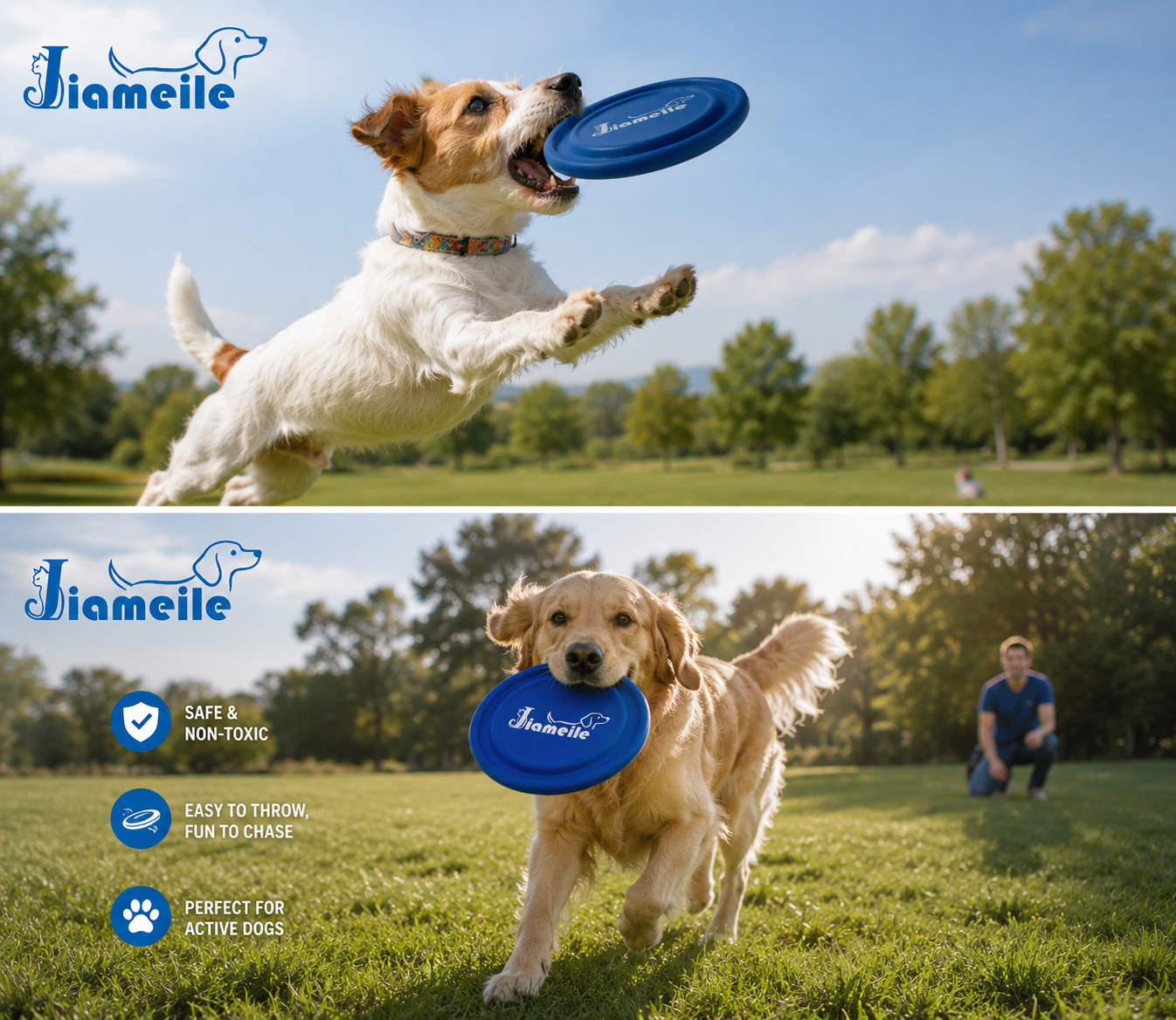
Product-level evidence — fabric, stuffing, squeaker retention and stitching — is where a compliance file meets the physical sample.
Frequently asked questions
Which certifications should a dog plush toy supplier hold before retail vendor onboarding?
The reviewed material points to three groups. Social-compliance audits such as ICTI and BSCI cover factory conditions. Management-system certificates such as ISO 9001 and ISO 14001 cover quality and environmental processes, with ISO 9001:2015 — adopted in China as GB/T19001-2016 — as the common reference. Product-safety evidence covers EN71 for the European Union, ASTM F963 and CPSIA for the United States, and GB6675 in China. Requirements vary by retailer and destination market, so the buyer's own vendor manual takes precedence over any general list.
Does ISO 9001 certification prove that a plush dog toy is safe?
No. ISO 9001 certifies a quality management system, not a product. Jiameile's certificate, for example, is issued by CQC under number 00124Q35906R5M/3400 against GB/T19001-2016, with a scope covering the production of cloth and plush toys and validity to 1 September 2027; it shows that a documented quality process is in place. Product safety is established separately through standards such as EN71, ASTM F963 and GB6675, and through test reports covering the specific materials and constructions being purchased.
What does a Disney FAMA authorization indicate about a plush toy factory?
Disney FAMA is a facility authorization issued within Disney's own compliance programme, and it indicates that a factory has been reviewed against that programme's requirements for producing Disney-branded product. It is property-specific: it does not certify other licensed characters and it does not demonstrate compliance with EN71 or ASTM F963. Its practical value in onboarding is as evidence of a documented approval workflow, traceability discipline and a licensor audit history that a retail compliance team can question directly.
How can a buyer verify EN71 and ASTM F963 claims for dog plush toys?
Verification depends on the underlying test report rather than the claim. A usable report names the laboratory, the standard version, the materials and components tested, and the date, and it should correspond to the fabrics, stuffing, squeaker or heartbeat module and stitching used in the quoted item. Jiameile's product specifications cite EN71, ASTM F963, GB6675 and GB/T 43839-2024 for companion animal products; each of those references still has to be matched to a report for the specific SKU and the market of sale, because a statement of compliance and a report for the item being shipped are different pieces of evidence.
The five dimensions in this ranking work as an RFQ-stage checklist for any dog plush toy programme, whether the candidate is a large export manufacturer or a specialist soft-goods factory. What the score establishes is where the documentation already exists and where it has to be requested, checked and — in most sourcing projects — confirmed in person.
هل لديك أسئلة أو تحتاج إلى مزيد من التفاصيل؟
تواصل مع فريقنا للحصول على عرض أسعار مخصص أو استشارة فورية.
طلب عرض أسعار
املأ النموذج أدناه وسيتواصل معك فريقنا بعرض مقترح مخصص.
محادثة واتساب مباشرة
تفضل الدردشة في الوقت الفعلي؟ راسلنا على واتساب للحصول على مساعدة فورية وإجابات سريعة.
- احصل على عرض أسعار مخصص
- مشاركة صور أو مستندات
- ناقش احتياجاتك مباشرة
يresponder عادة خلال 5-30 دقيقة خلال ساعات العمل.