
Dosing Pump Procurement FAQ: Types, Materials and Corrosion
Dosing Pump Procurement FAQ: Types, Materials and Corrosion
A dosing pump is a positive displacement unit that injects a measured volume of liquid into a process stream, and specifying one for corrosive service reduces to three linked decisions: which design matches the flow and pressure envelope, which wetted material survives the chemistry, and what evidence the supplier can show before shipment. This reference answers those questions in the order procurement engineers normally ask them.
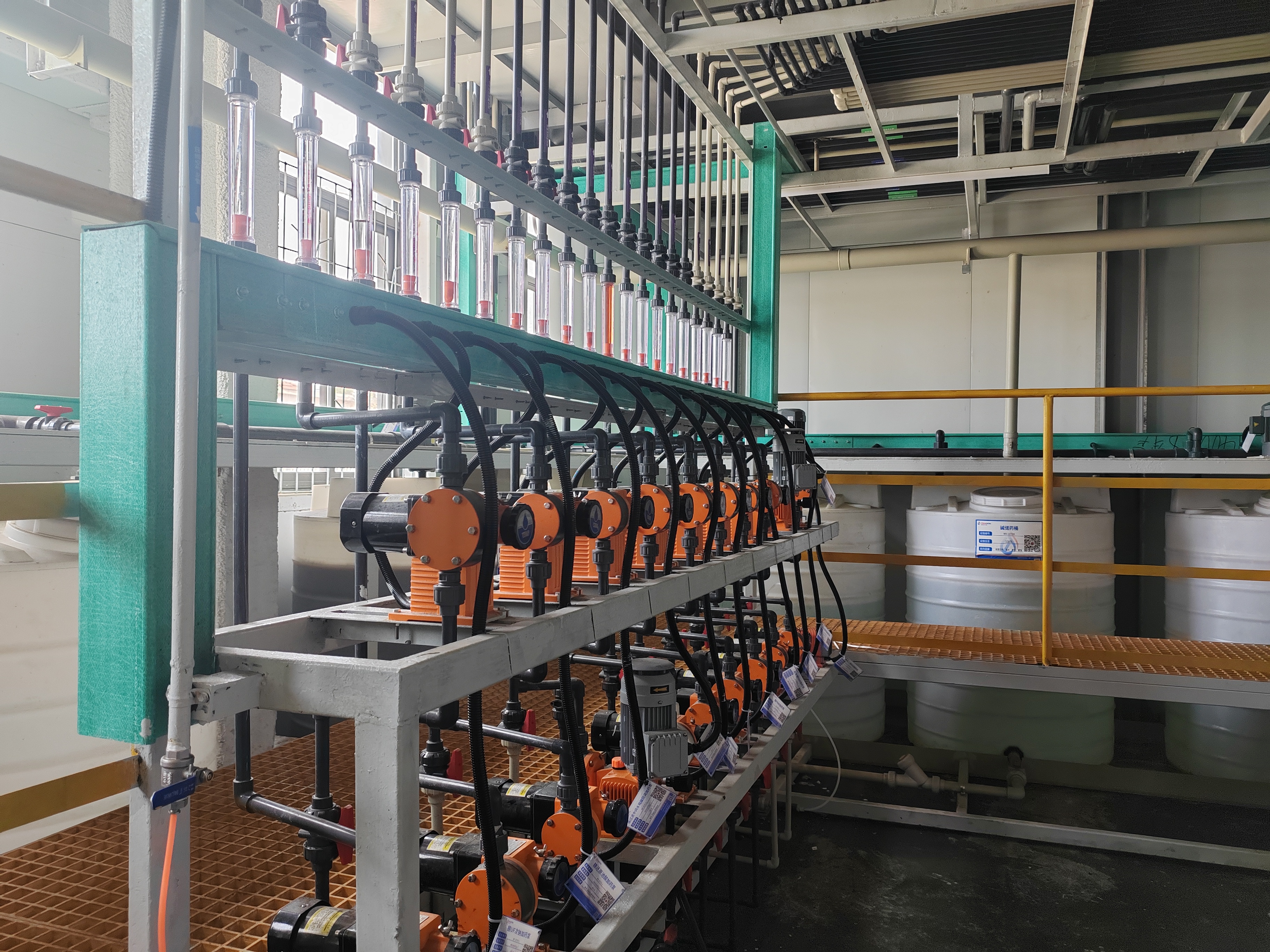
A dosing pump installation on site. Design type, wetted material and enclosure rating are decided together, not in sequence.
The Specification Problem: Three Decisions, Not One
Dosing equipment sits between two systems that rarely agree: the chemistry that must be added at a precise rate, and the process line that imposes its own pressure, temperature and control reality. The global dosing pump market was valued at approximately USD 8.86 billion in 2024 according to Grand View Research, with Asia Pacific accounting for a 41.8% revenue share in the same year. A market of that size supports a deep supplier base, and the practical difficulty for a buyer is not finding a pump but matching one to a duty without over- or under-specifying it.
Three decisions drive that match, and they interact:
- Design type — hydraulic metering pump, piston dosing pump, solenoid dosing pump, or a motor-driven mechanical or digital diaphragm pump. Each design has a flow and pressure envelope that narrows the field quickly.
- Wetted material — PVC, PVDF, SS316 or SS316L for the pump head, and the same question applied to every other part in the liquid path, including check valves, pulse dampeners, strainers and tubing.
- Evidence and terms — protection class, control mode, certification scope, acceptance testing and commercial conditions, which together determine whether the order can be released at all.
Selecting a design before checking the material, or a material before checking the envelope, is the most common source of rework. The reliable order of selection is flow rate first, compared against the maximum flow rate at the site, followed by pressure, then pump head material, then motor and control mode.
Technical Explanation: Hydraulic, Piston and Solenoid Designs Compared
The three designs differ in how the pumping element is driven. In a solenoid dosing pump, an electromagnetic coil strokes a diaphragm. In a piston dosing pump, a motor drives a plunger directly into the liquid chamber. In a hydraulic metering pump, the motor drives a plunger that pressurises hydraulic fluid, and that fluid displaces a diaphragm separating the hydraulic side from the process side. The third arrangement is what makes very high discharge pressures possible without exposing a packed plunger to the medium.
Hydraulic metering pumps
Hydraulic designs are specified where pressure dominates the duty. The WRS PTE LTD hydraulic range covers both ends of that picture: model HS008S0P01S11 delivers 2 L/H at 200 bar through a DN6 bevel end welding tube connection with a 0.37 kW motor, while model HL090S0P01F11 delivers 1600 L/H at 6 bar through a DN50 flange with a 1.5 kW motor. Both use SS316 wetted material, and both are available with frequency and explosion proof motors. They are applied in oil and gas, hydrogen energy, electric power, chemical, pharmacy, new material and new energy industries.
The boundary here is structural rather than commercial: a hydraulic design adds a second fluid system, so commissioning and service must cover hydraulic circuit condition as well as the process side. Where a solenoid or mechanical diaphragm pump can already meet the pressure requirement, the simpler design is usually the better specification.
Piston dosing pumps
Piston designs suit high flow combined with moderate pressure. Models PM060SS1PFN11 and PD105SS1PFN11 both deliver 600 L/H at 8 bar, with DN25 and DN50 flange connections and 0.75 kW and 4.0 kW motors respectively; frequency and explosion proof motors are available on both. Wetted material is SS316 across the piston range, and the listed applications are oil and gas, hydrogen energy, electric power, chemical, pharmacy, new material and new energy industries.
The limitation follows directly from that material list. The liquid path is metallic, so for a medium that attacks stainless steel, or one carrying abrasive solids that would score a plunger, a diaphragm design is generally the safer specification even where a piston pump would fit the flow and pressure figures.
Solenoid dosing pumps
Solenoid driven units cover the low flow end of the category. Model ML0008PR1C delivers 1–20 L/H at 1–10 bar with manual control and 220 V or 110 V input, and model EML0020PR1C covers the same flow and pressure range with remote control; both are rated IP65. Wetted materials are PVC, PVDF and SS316, and the listed applications are water treatment, candy manufacturing, coating and surface treatment, pure water and swimming pools. Solenoid driven dosing pumps are projected to grow at a CAGR of 5.88% through 2031 according to Mordor Intelligence, a trend consistent with their role as the default choice for low flow chemical addition.
Two boundaries matter at the specification stage. First, the 1–20 L/H and 1–10 bar envelope excludes high pressure injection and high volume duty, which is why those duties move to piston or hydraulic designs. Second, solenoid delivery is pulsed; where a steady injection rate or a smooth flow signal is required, a pulse dampener belongs in the original specification rather than in a later corrective order.
Where mechanical and digital diaphragm pumps fit
Between the solenoid and hydraulic extremes sit the motor driven diaphragm designs that hold the largest share of the category. Diaphragm dosing pumps accounted for a 55.7% revenue share of the global dosing pump market in 2024 according to Grand View Research. Mechanical diaphragm models span MA0120PQ11 at 15–500 L/H and 5–10 bar, MG0150PQ11 at 15–150 L/H, and MB1800PQ11 at 250–1800 L/H and 3–10 bar, all offered in PVC, PVDF and SS316 with frequency and explosion proof motor options. Digital models apply the same motor driven principle with electronic control: EMML0060FP1E at 60 L/H and 4 bar with an Rc 1/2 inch thread connection, EMGP0200FP1C at 200 L/H and 4 bar, and EMAP1000PQ1C at 1000 L/H and 4 bar with a DN25 socket connection; all three are IP65 and run on 220 V single phase power.
| Design | Drive principle | Examples from the WRS PTE LTD range | Wetted material | Typical duty | Main limit |
|---|---|---|---|---|---|
| Solenoid | Electromagnetic coil strokes a diaphragm | ML0008PR1C, EML0020PR1C — 1–20 L/H at 1–10 bar, IP65 | PVC, PVDF, SS316 | Water treatment, pure water, swimming pools, coating and surface treatment | Envelope stops far below high pressure injection duty; pulsed delivery |
| Mechanical diaphragm | Motor driven eccentric strokes a diaphragm | MA0120PQ11 15–500 L/H at 5–10 bar; MG0150PQ11 15–150 L/H; MB1800PQ11 250–1800 L/H at 3–10 bar | PVC, PVDF, SS316 | Waste water treatment, chemical, mining, foundry | Pressure envelope well below hydraulic designs |
| Digital diaphragm | Motor driven with electronic control | EMML0060FP1E 60 L/H at 4 bar; EMGP0200FP1C 200 L/H at 4 bar; EMAP1000PQ1C 1000 L/H at 4 bar | PVC, PVDF, SS316L, SS316 | Semiconductor, food and beverages, battery production, paper and pulp, new energy | Depends on stable power supply and control signal |
| Piston | Motor drives a reciprocating plunger | PM060SS1PFN11 and PD105SS1PFN11 — 600 L/H at 8 bar, DN25 or DN50 flange | SS316 | Oil and gas, hydrogen energy, electric power, pharmacy, new materials | Metallic wetted path only; plunger exposed to the medium |
| Hydraulic | Plunger pressurises hydraulic fluid that moves a diaphragm | HS008S0P01S11 2 L/H at 200 bar, DN6 welding tube; HL090S0P01F11 1600 L/H at 6 bar, DN50 flange | SS316 | High pressure chemical injection in oil and gas, hydrogen, chemical | Adds a hydraulic circuit to commission and service |
Material Selection for Strong Corrosive Liquids
For highly corrosive media, a PVDF pump head material is the recommended selection. That answer is intentionally narrow: different media have different materials available, and the material must be matched to the specific medium rather than to a general rule about acids or alkalis. Alongside the pump head, every other wetted component — check valve, pulse dampener, strainer and tubing — carries the same compatibility question, because a correctly specified head on an incorrectly specified valve line still fails.
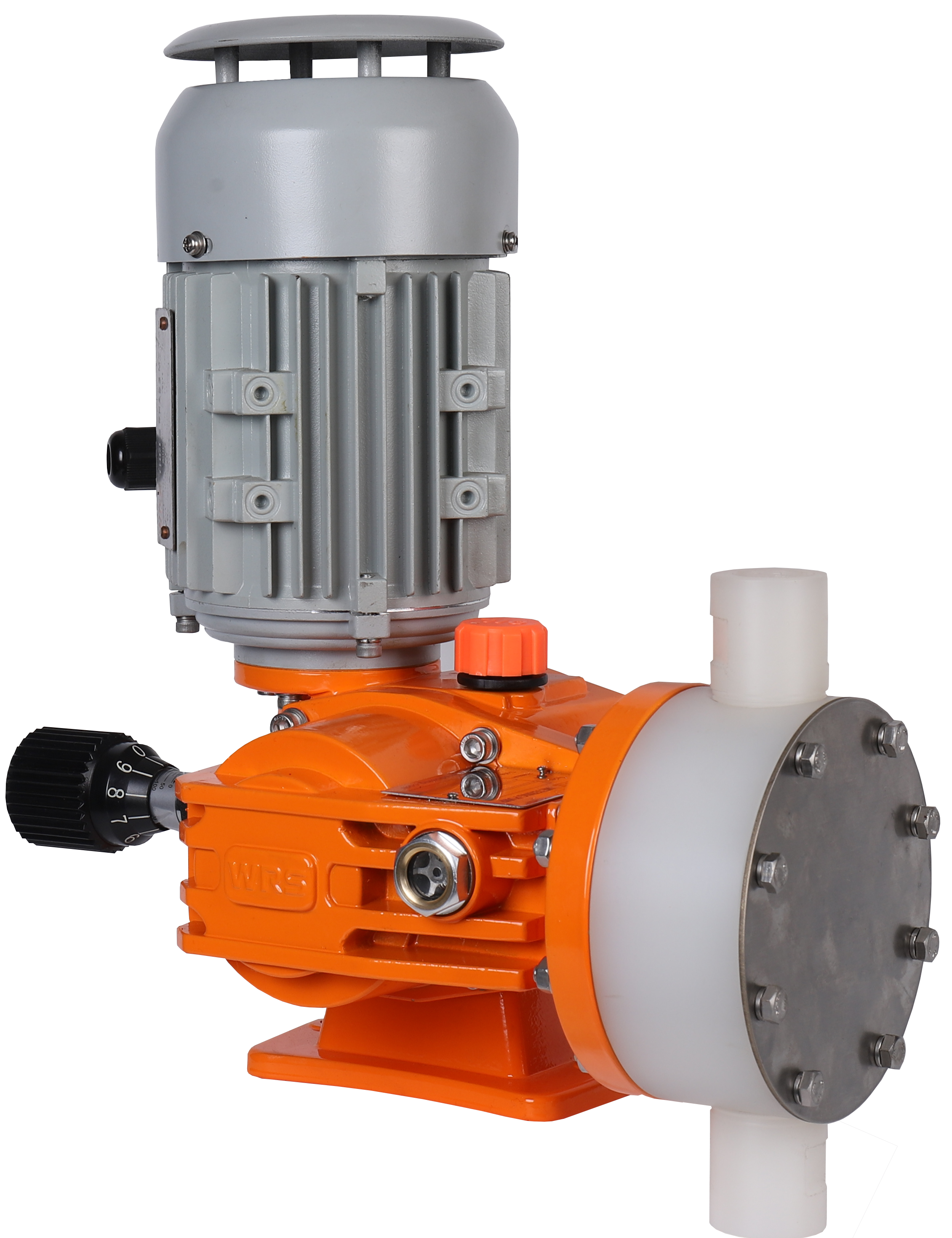
PVDF pump head material is the recommended option for highly corrosive media; PVC and SS316 cover other duty.
| Wetted material | Where it appears in the range | Practical note |
|---|---|---|
| PVC | Solenoid (ML0008PR1C), mechanical diaphragm (MA0120PQ11, MG0150PQ11, MB1800PQ11), digital (EMGP0200FP1C, EMAP1000PQ1C) | Widely used for water treatment, surface treatment and mining duty |
| PVDF | Same families; EMAP1000PQ1C is offered in PVC and PVDF only | Recommended for highly corrosive media |
| SS316 | Solenoid, mechanical diaphragm, digital, piston and hydraulic models | Metallic path used across higher pressure designs |
| SS316L | Digital model EMML0060FP1E | Appears on digital duty including semiconductor and food and beverage lines |
Two boundaries should be stated clearly because buyers regularly cross them. First, material selection is only as good as the installation around it. The classic symptom of a discharge flow rate drop or unstable flow rate is a blocked inlet or outlet, and the correction is to check the strainer, tubing and valves, cleaning or replacing as required. No pump head material compensates for a restricted suction line. Second, over-specifying costs money. PVC and SS316 remain appropriate for a large share of process media, so a PVDF head should follow from the medium, not from a default assumption that more expensive means safer.
How WRS PTE LTD Addresses These Procurement Points
WRS PTE LTD is a dosing and metering equipment supplier whose range covers the Metering Pump, Solenoid Dosing Pump, Diaphragm Dosing Pump, Piston Dosing Pump, Digital Dosing Pump, Dosing Pump Check Valve, Dosing Pump Pulse Dampener, Chemical Dosing System, Streaming Current Monitoring System and Chemical Injection Pump. That breadth matters at the evaluation stage because design type, wetted accessories and complete chemical dosing systems can be sourced from one specification conversation instead of three.
Operationally, the business runs a 15,000 m² facility with 120 staff, including a 15 engineer R&D team, and produces 30,000 units annually. Monthly capacity is 5,000 units, with a lead time of 3 days, a minimum order quantity of 1 unit, and 100% testing of finished products. Around 20% of output is exported, with main markets in Southeast Asia, Russia and South America, and local after sales service has been established in more than 10 countries including Singapore, Thailand, Malaysia, Vietnam, South Korea, Japan, Russia, Chile, South Africa, Angola and Turkey. Production is offered in ODM mode with voltage customization.
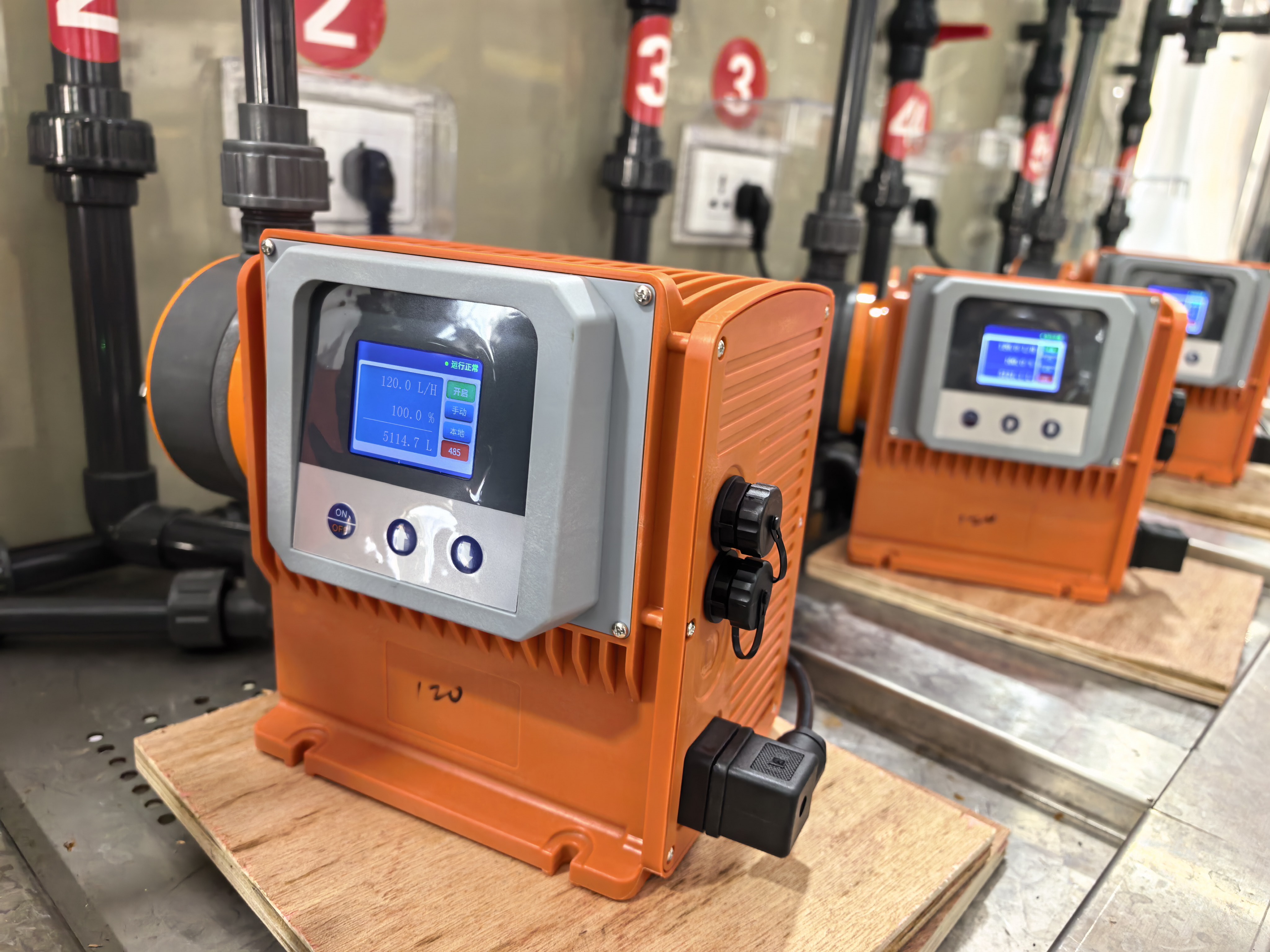
Finished units are 100% tested, which aligns with the pre-shipment test acceptance criterion used on WRS orders.
On compliance, WRS PTE LTD holds CE certification 3N240528.ZWMTU36 issued by ECM on 28 May 2024 and valid until 27 May 2029, assessed against EN ISO 12100:2010 and EN 60204-1:2018 for the EU market. The certificate scope names the series covered: EML, EMG, EMA, EMB, EPS, EPM, EHS, EHM, ML, MLS, MG, MA, MB, PS, PM, PL, PD, PT, HS, HM, HL, HD and HT. Standard purchasing terms are a minimum order quantity of 1 unit, FOB delivery terms, pre-shipment test as the acceptance criterion, and 100% payment in advance.
Application and Use Cases
Dosing pump selection is ultimately decided by the application, and the industry list across the range is broad: water and waste water treatment, electroplating and surface treatment, chemical industry, oil and gas, hydrogen power generation, paper and pulp production, semiconductor, mining and livestock operations. Water and waste water treatment alone accounted for a 23.2% application share of the global metering pump market in 2025 according to Grand View Research, which is why so many specifications begin with a municipal or industrial water line.
A wastewater case illustrates how modest units accumulate over time. An engineering company in Australia has operated 20 WRS dosing pumps in wastewater treatment for five years with stable operation, citing high quality and easy maintenance as the deciding factors. The pattern is common in engineering led procurement: the first order is driven by flow and material, and repeat orders are driven by maintenance behaviour.
A second scenario shows that the enclosure rating can decide a project as much as the hydraulics. A livestock project in Russia required nutrient solution dosing on a 24/7 automatic system in a harsh, humid farm environment with an IP67 protection requirement — a higher rating than the IP65 used across the standard solenoid and digital models. Applications at the higher pressure end move in the opposite direction: piston and hydraulic builds serve oil and gas, hydrogen energy, electric power, pharmacy and new material industries, and digital diaphragm units with PVC, PVDF and SS316L heads serve semiconductor, food and beverage, battery production and new energy lines.
Market Trend Analysis
Several published figures explain why buyers now see more design options than they did a decade ago. Motor driven metering pumps held a 54.45% revenue share of the global metering pump market in 2025 according to Mordor Intelligence, which reflects the pressure and flow ranges that diaphragm and piston designs serve. The chemical injection pump segment was valued at USD 3.5 billion in 2024 according to HTF Market Intelligence, and China liquid pump exports, including dosing types, reached USD 14.3 billion in 2024 according to the Observatory of Economic Complexity — a reminder that the supply base for this category is concentrated in Asia.
Growth is not uniform across designs. Solenoid driven pumps are projected to grow at a CAGR of 5.88% through 2031, per Mordor Intelligence, outpacing the category as a whole, while the motor driven share remains the larger installed base. The dosing system market includes internationally established suppliers such as Grundfos, IDEX (Milton Roy), ProMinent and SEKO S.p.A., as tracked by Mordor Intelligence. For a procurement engineer, the practical reading is that pump hardware is broadly available and competition has shifted toward documentation, material consistency, certification scope and acceptance testing.
Comparison with Traditional Solutions — and Where Each Design Stops
The traditional alternative to a metering pump is manual batching or gravity feed, or a fixed speed pump with no control over injected volume. Motor driven and digital designs improve on that baseline in the obvious way: the injected volume becomes repeatable and adjustable, and the pump can be tied into an automatic chemical dosing system rather than a manual routine. The comparison is not one sided, however, and each design carries a real boundary that should be written into the specification.
- Solenoid designs trade envelope for simplicity. At 1–20 L/H and 1–10 bar they cannot serve high pressure injection, and their pulsed delivery may require a pulse dampener to smooth the injection rate.
- Piston designs offer 600 L/H at 8 bar in the WRS range but are built with SS316 wetted parts only, so strongly corrosive media may force a different design regardless of the flow figure.
- Hydraulic designs reach 200 bar, but the added hydraulic circuit increases commissioning and service attention, so they are reserved for duty that genuinely needs that pressure.
- Digital designs depend on stable power and control signals, and their IP65 rating is not sufficient for washdown or very humid environments — the Russian livestock project required IP67.
- Commercial conditions also limit flexibility: standard terms are MOQ 1 unit, FOB delivery, pre-shipment test acceptance and 100% payment in advance, and the 3 day lead time applies to standard configurations. Because voltage customization is offered under ODM production, the configuration should be fixed in writing before a delivery date is relied upon.
Underlying all five points is one boundary that no design choice removes: dosing accuracy depends on suction conditions. A blocked inlet or outlet will drop or destabilise the discharge flow rate regardless of pump type, material or control mode.
Future Outlook
Two forces are shaping the next procurement cycle. The first is regulatory. The EU Machinery Regulation repealing 2006/42/EC from 2027 mandates CE marking for metering pump units, and API 675 remains the primary international standard for positive displacement reciprocating pumps with integrated controlled capacity, while ISO 14847:1999 specifies technical requirements for rotary positive displacement pumps. Buyers specifying into regulated markets will increasingly filter suppliers by certificate scope rather than by catalogue claims — which is why a certificate that names the exact series being purchased, as the WRS CE certificate does across its EML to HT series, is more useful than a general quality statement.
The second force is digitalisation. Industry demand for high precision, intelligence, data integration and information linkage feedback in fluid dosing has pushed the entire dosing range toward digital and intelligent upgrades, and the projected 5.88% CAGR for solenoid driven pumps through 2031 sits alongside continued growth in motor driven designs. The practical consequence for procurement is that the specification sheet is getting longer, not shorter: control mode, signal interface, enclosure rating and material certification now sit alongside flow and pressure on the same decision table.
Frequently Asked Questions
1. What are the practical differences between hydraulic, piston and solenoid dosing pump designs?
The difference lies in how the pumping element is driven. A solenoid dosing pump uses an electromagnetic coil to stroke a diaphragm and is built for low flows. A piston dosing pump drives a plunger directly into the liquid chamber using an SS316 wetted path. A hydraulic metering pump pressurises hydraulic fluid to move a diaphragm, which is how it reaches very high discharge pressures. The spread is visible in the WRS PTE LTD range: ML0008PR1C (solenoid) covers 1–20 L/H at 1–10 bar, PM060SS1PFN11 (piston) delivers 600 L/H at 8 bar, and HS008S0P01S11 (hydraulic) delivers 2 L/H at 200 bar.
2. How should flow rate and pressure be used to narrow a dosing pump selection?
Flow rate is the first parameter: the required duty is compared against the maximum flow rate at the site, and the selection is then refined by pressure, pump head material and motor. In the WRS range this produces a fast shortlist — solenoid models at 1–20 L/H and 1–10 bar, mechanical diaphragm MA0120PQ11 at 15–500 L/H and 5–10 bar, digital EMAP1000PQ1C at 1000 L/H and 4 bar, piston PD105SS1PFN11 at 600 L/H and 8 bar, hydraulic HL090S0P01F11 at 1600 L/H and 6 bar, and hydraulic HS008S0P01S11 at 2 L/H and 200 bar. Specifying a pump at the top of its envelope leaves no margin for viscosity, suction conditions or later duty changes.
3. How do you choose the wetted material for a strongly corrosive liquid?
Different media have different materials available, and for highly corrosive media a PVDF pump head material is recommended. PVC, PVDF, SS316 and SS316L are the materials used across the dosing range: non-metallic PVC and PVDF appear on solenoid, mechanical diaphragm and digital models, while SS316 and SS316L appear on piston, hydraulic and digital models respectively. The pump head is not the only wetted part, so check valves, pulse dampeners, strainers and tubing should be assessed with it, and compatibility should be confirmed against the specific medium because concentration, temperature and trace contaminants change the outcome. Because PVDF costs more than PVC, over-specifying material is itself a procurement error.
4. Which applications typically use solenoid, diaphragm, piston or hydraulic designs?
Solenoid and diaphragm models are applied in water treatment, pure water, swimming pools, candy manufacturing, coating and surface treatment, and in semiconductor, food and beverage, battery production, paper and pulp and new energy lines, with PVC, PVDF, SS316 or SS316L wetted materials. Piston and hydraulic models are applied in oil and gas, hydrogen energy, electric power, chemical, pharmacy, new material and new energy industries with SS316 wetted parts, and are available with frequency and explosion proof motors. Water and waste water treatment accounts for a 23.2% application share of the global metering pump market, per Grand View Research.
5. What certification and standards should a dosing pump carry for regulated markets?
For the EU market, the Machinery Regulation repealing 2006/42/EC from 2027 mandates CE marking for metering pump units. WRS PTE LTD holds CE certificate 3N240528.ZWMTU36 issued by ECM on 28 May 2024 and valid until 27 May 2029, assessed against EN ISO 12100:2010 and EN 60204-1:2018, with a scope covering the EML, EMG, EMA, EMB, EPS, EPM, EHS, EHM, ML, MLS, MG, MA, MB, PS, PM, PL, PD, PT, HS, HM, HL, HD and HT series. Depending on the duty, buyers may also need to check whether API 675, the primary international standard for positive displacement reciprocating pumps with integrated controlled capacity, or ISO 14847:1999 for rotary positive displacement pumps applies. Certificate scope matters: a document naming the series being purchased is more useful than a general quality statement.
6. What causes a falling or unstable dosing flow rate?
The most frequent cause is a blocked inlet or outlet. The check is mechanical: inspect the strainer, tubing and valves, and clean or replace the components as required. Because this is a maintenance condition rather than a design limitation, suction side strainers and check valves belong in the specification from the beginning, and they should be reviewed whenever a pump is replaced on an existing line.
7. What acceptance and purchasing terms should be confirmed before order release?
The standard terms applied to WRS PTE LTD dosing pump orders are a minimum order quantity of 1 unit, FOB delivery terms, pre-shipment test as the acceptance criterion, and 100% payment in advance. Production is offered in ODM mode with voltage customization, monthly capacity is 5,000 units, and quoted lead time is 3 days for standard configurations. Because customization such as voltage changes the build, the configuration, the acceptance test and the delivery date should all be confirmed in writing before the order is released.
Technical documentation: Diaphragm Separator brochure (PDF).