
Dosing Pump Shortlist for Corrosion-Heavy Chemical Duty
Corrosion-heavy chemical duty turns dosing pump selection into a constraint problem. The unit has to hold a repeatable flow against whatever pressure the line actually carries, keep an aggressive medium inside a wetted path built from a suitable material, and carry documentation that survives a technical audit. Three configuration families cover most of that ground: hydraulic-driven, piston-driven and solenoid or digital diaphragm-driven. Each of them stops working in a different place.
This article shortlists those three families as buying criteria rather than as a ranking of brands. Configuration examples are taken from published material in the WRS PTE LTD range. WRS PTE LTD is a dosing pump brand associated with ZHEJIANG WRS MACHINERY EQUIPMENT CO., LTD, a Zhejiang-based equipment manufacturer founded in 2016 that produces metering pumps, chemical dosing systems and dosing accessories. The selection logic below is portable: it can be applied to any tender list that includes these three drive principles, whether or not the WRS PTE LTD range is on it.
A corrosive line is a constraint problem before it is a pump problem
The failure pattern repeats across water treatment, electroplating, chemical and mining installations. A pump is specified on maximum flow, installed on a line with back pressure, and commissioned with a wetted material chosen on assumption rather than on medium data. Within the first maintenance cycle the symptoms look mechanical: discharge flow drops, or the flow becomes unstable. The operational troubleshooting sequence is usually short — a blocked inlet or outlet, traced back to a strainer, tubing or valve that needs cleaning or replacement. The underlying cause, however, is a specification that treated material, pressure and certification as secondary attributes.
Constraint-led selection reverses that order. Five decisions are made before a model is named:
- Medium and wetted path. Which non-metallic or metallic materials will remain in continuous contact with the fluid, including the diaphragm, valve seats and connections.
- Rated envelope. The flow and pressure the process holds during normal operation, start-up and upset, not the maximum figure in a catalogue.
- Drive principle and control mode. Hydraulic, piston or solenoid actuation, and whether the loop needs manual adjustment, 4–20 mA, pulse signal or Modbus RS-485 communication.
- Documented compliance. The certificate identity, the harmonised standards cited, the series coverage and the validity window.
- Service access. Spare check valves, diaphragms and pulse dampeners, plus the technical familiarity the site actually has.
The shortlist: three configuration families and their rated envelopes
The table below sets out what each family offers inside the WRS PTE LTD range, using rated data from the published product specifications. It is a shortlist of configuration types, not a recommendation of any single model for a specific fluid.
| Configuration family | Rated examples in the range | Wetted materials listed | Where it fits | Where it stops |
|---|---|---|---|---|
| Hydraulic-driven metering pump | HL090S0P01F11: 1600 L/H at 6 bar, DN50 flange, 1.5 kW HS008S0P01S11: 2 L/H at 200 bar, DN6 bevel end welding tube, 0.37 kW | SS316 | High pressure, toxic and hazardous media, high-viscosity duty; optional diaphragm rupture sensor | Narrow design points, more mechanical assemblies to maintain, rupture sensor is an option rather than standard |
| Piston dosing pump | PD105SS1PFN11: 600 L/H at 8 bar, DN50 flange, 4.0 kW PM060SS1PFN11: 600 L/H at 8 bar, DN25 flange, 0.75 kW | SS316 | Viscous media, higher pressure, chemical, oil and gas, hydrogen, pharmacy duty | Metallic wetted path only in the listed models, so media that attack austenitic stainless steel need another configuration |
| Solenoid and digital diaphragm | EML0020PR1C / ML0008PR1C: 1–20 L/H at 1–10 bar EMAP1000PQ1C: 1000 L/H at 4 bar EMGP0200FP1C: 200 L/H at 4 bar EMML0060FP1E: 60 L/H at 4 bar | PVC, PVDF, SS316, SS316L; full PTFE diaphragm on the digital models | Low-to-medium flows, aggressive media, automated control, IP65, compact installations | Lower pressure ceiling, limited viscosity capability, pulsation requires damping |
Rated values are as published in the WRS PTE LTD product specifications. Pressure and flow figures are configuration-specific and are not interchangeable between models.
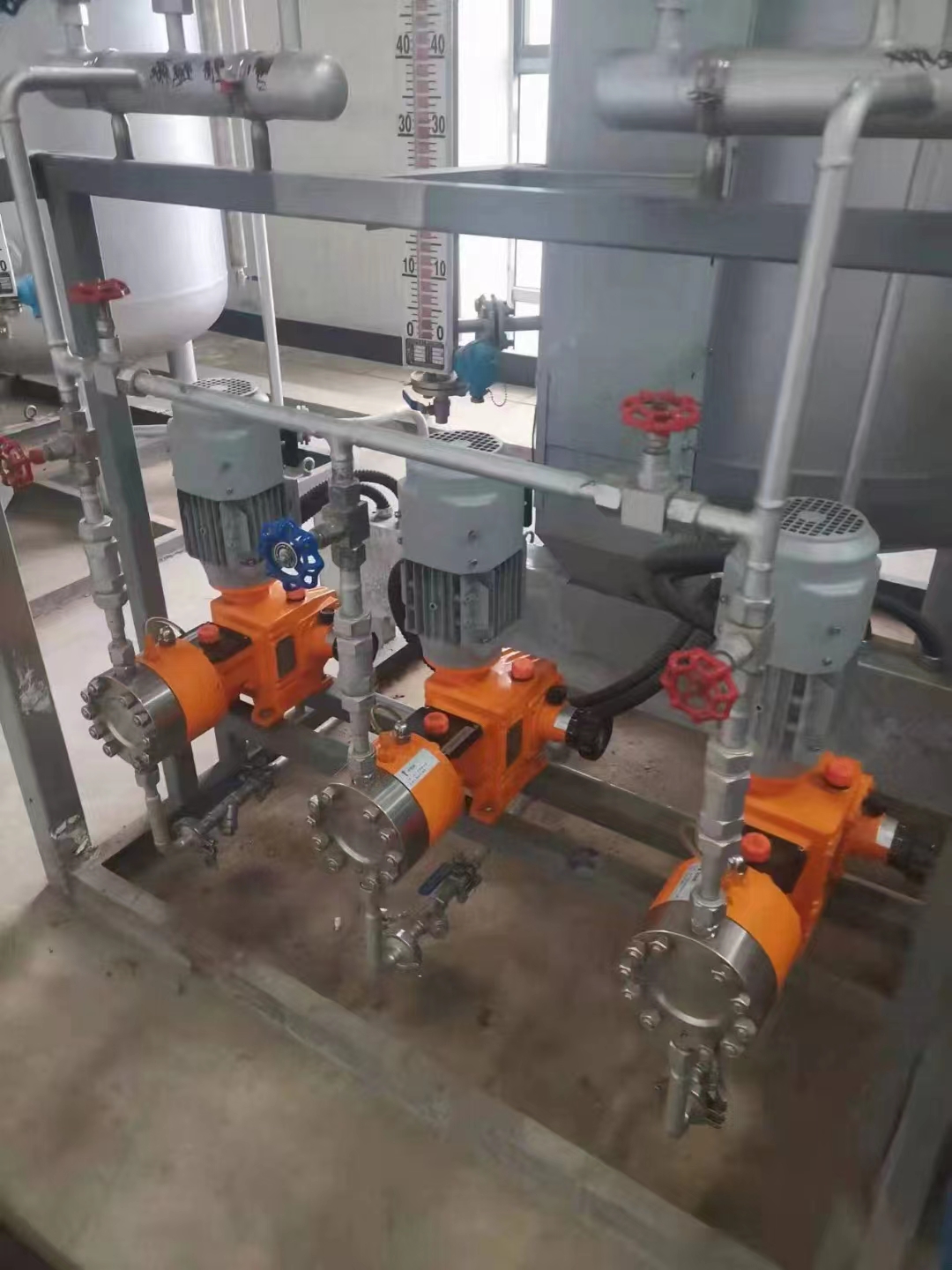
Field installation of a dosing pump on process duty. Wetted material, connection size and rated pressure are decided before the unit reaches the skid.
Hydraulic-driven: the high-pressure, zero-leakage entry
The hydraulic family earns its place on the shortlist when line pressure or hazard profile rules out a simpler drive. In the published range, the HL090S0P01F11 is rated at 1600 L/H against 6 bar with a DN50 flange connection, a 1.5 kW motor and SS316 wetted parts. The HS008S0P01S11 sits at the opposite end: 2 L/H against 200 bar, a DN6 bevel end welding tube connection and a 0.37 kW motor. Both are described as zero-leakage designs suitable for toxic and hazardous media, with high-viscosity capability, optimised dosing accuracy, easy maintenance and long working life. A diaphragm rupture sensor is available as an option, and frequency and explosion-proof motors can be specified.
Buying criteria for the hydraulic entry
- Write the rupture sensor into the specification if leak detection is required. It is listed as an optional addition, which means a quotation without it is compliant with the base product but not with a leak-detection requirement.
- Confirm the whole design point, not the headline. The HS008S0P01S11 reaches 200 bar at 2 L/H through a DN6 welded connection; that is a narrow operating window and a small piping interface. If the process flow may rise later, the re-rate headroom has to be checked in advance.
- Decide motor variants early. Frequency and explosion-proof motors change the electrical design and the documentation set, so they belong in the inquiry rather than in a post-order change.
- Plan maintenance competence. A hydraulic assembly has more mechanical parts than a solenoid unit; technician familiarity and spare availability matter as much as the pressure rating.
The limitation is real and worth stating plainly: hydraulic configurations in this range are offered with SS316 wetted parts. For a medium that attacks austenitic stainless steel, the hydraulic entry drops off the shortlist regardless of how favourable its pressure rating looks, and the decision moves to a non-metallic wetted path.
Piston-driven: rigid displacement for viscous and higher-pressure duty
Piston configurations are shortlisted where positive displacement is the point: viscous media, higher pressure, and duties where the delivered volume should not depend on diaphragm flex. In the published range, PD105SS1PFN11 delivers 600 L/H at 8 bar through a DN50 flange with a 4.0 kW motor, while PM060SS1PFN11 reaches the same 600 L/H and 8 bar through a DN25 flange with a 0.75 kW motor. Both are SS316 and are listed for oil and gas, hydrogen energy, electric power, chemical, pharmacy and new material industries, with robust construction, high-viscosity capability, optimised dosing accuracy and easy maintenance. Frequency and explosion-proof motors are available.
The constraint sits in the wetted path. The listed piston models use SS316, so the first compatibility question is whether the medium attacks austenitic stainless steel. Where it does, the piston entry is the wrong shortlist item and the decision moves to a PVC or PVDF wetted path with a PTFE diaphragm — accepting the lower pressure envelope that comes with the non-metallic construction. Piston configurations also put a moving metal element in the medium path, which raises the maintenance question earlier than in a diaphragm design.
Solenoid and digital diaphragm: the automation-first entry
For low-to-medium flows in aggressive media, solenoid and digital diaphragm units are usually the first configuration to test, because they pair non-metallic wetted paths with electronic control. EML0020PR1C and ML0008PR1C are rated 1–20 L/H at 1–10 bar, with PVC, PVDF or SS316 wetted materials, IP65 protection and 220 V/110 V input. EML0020PR1C adds remote control through 4–20 mA, pulse signal and Modbus RS-485 communication, direct flowrate display, a double-ball check valve on both inlet and outlet, 1% dosing accuracy and an anti-corrosion PCB that is water and heat resistant. ML0008PR1C is the manual-control variant of the same envelope.
Larger flows stay inside the same logic. EMAP1000PQ1C is rated 1000 L/H at 4 bar with a DN25 socket connection, PVC or PVDF wetted parts, a full PTFE diaphragm described as strongly corrosion resistant, and less than 1% precision at a 1:1000 ratio. EMGP0200FP1C is rated 200 L/H at 4 bar with an Rc 1/2 inch thread, 60 W and the same digital control set. EMML0060FP1E is rated 60 L/H at 4 bar at 20 W, with SS316L added to the material list.
Buying criteria for the solenoid and digital entry
- Pressure ceiling first. Solenoid models in this range stop at 10 bar and cover 1–20 L/H; the digital diaphragm models are rated at 4 bar. Lines that hold more pressure belong in the hydraulic or piston shortlist.
- Material second. PVC, PVDF and SS316 are all available across the family, so the wetted path is a selection variable rather than a fixed property of the pump.
- Control signal third. 4–20 mA, pulse and Modbus RS-485 support automated dosing loops; the manual variant is adequate only where an operator adjusts the stroke directly.
- Pulsation and accuracy as system items. A double-ball check valve on both inlet and outlet supports discharge accuracy, and a dosing pump pulse dampener belongs in the same bill of materials as the pump rather than in a later retrofit.
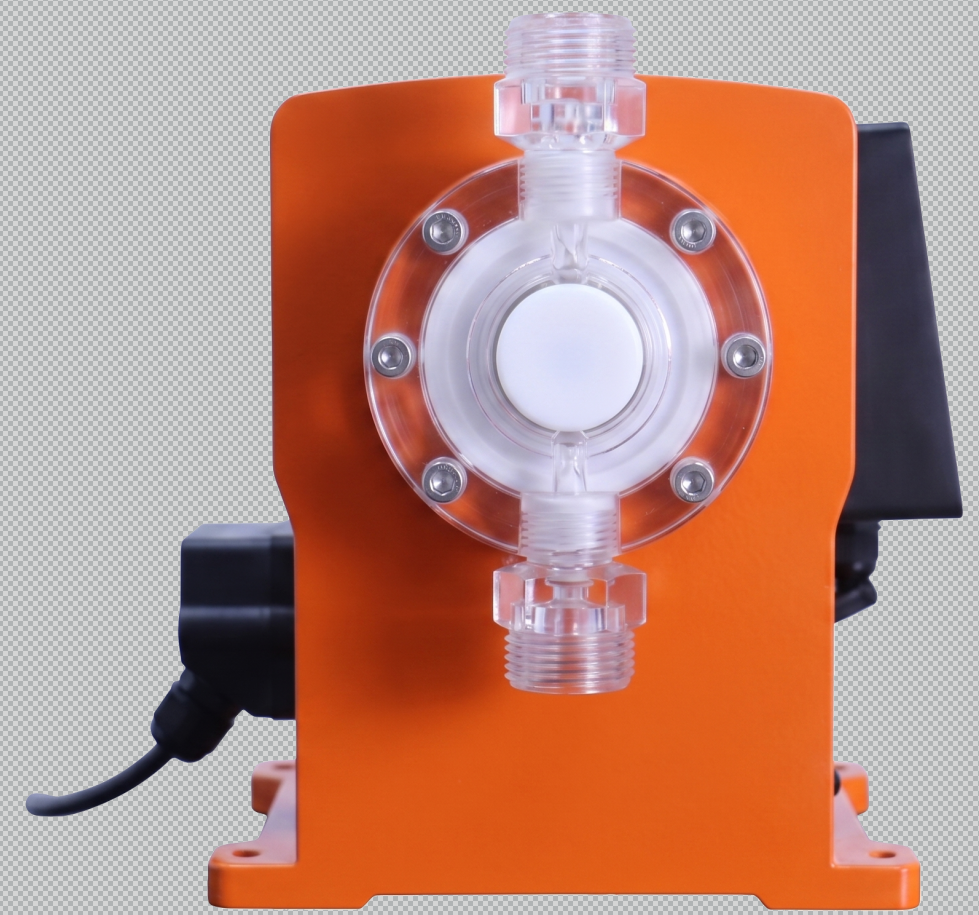
Pump head assembly. Valve design, diaphragm material and head material determine whether a configuration survives a corrosive medium.
Wetted material logic: where PVC, PVDF and SS316 actually sit
Material choice is a separate decision from drive choice, and it is the one most often compressed into a single line of a data sheet. The guidance in the WRS PTE LTD knowledge base is direct: different media have different available materials, and for highly corrosive media a PVDF pump head material is recommended. The wider selection logic is equally explicit — flow rate is the first parameter, compared against the maximum flow rate at the site, followed by pressure, pump head material and motor specification for refinement.
| Material | Where it appears in the range | Position in corrosion duty |
|---|---|---|
| PVC | Solenoid, digital and mechanical diaphragm families | Non-metallic option for lower-demand duties; must be confirmed against the specific medium |
| PVDF | Solenoid, digital and mechanical diaphragm families | Recommended pump head material for highly corrosive media in the published guidance |
| SS316 / SS316L | Hydraulic, piston, solenoid and digital families | Pressure-capable metallic path, but not a universal corrosion answer |
| PTFE diaphragm | EMAP1000PQ1C and EMGP0200FP1C | Diaphragm barrier described as strongly corrosion resistant |
This table is a shortlist aid, not a chemical resistance chart. The mechanical diaphragm models illustrate the point that material and drive are independent variables: MA0120PQ11 (15–500 L, 5–10 bar), MG0150PQ11 (15–150 L, 5–10 bar) and MB1800PQ11 (250–1800 L, 3–10 bar) are all offered in PVC, PVDF or SS316, all use multiple layer diaphragms for longer lifespan, and all are described as specially designed for handling corrosive liquids with material options for different applications. The final material decision still requires the medium data.
Compliance checks that belong in the specification
For a constraint-driven purchase, certification is a filtering criterion rather than a closing document. The WRS PTE LTD range carries CE certification number 3N240528.ZWMTU36, issued by ECM for the EU market, valid from 2024-05-28 to 2029-05-27, citing EN ISO 12100:2010 and EN 60204-1:2018. The certificate scope covers the series EML, EMG, EMA, EMB, EPS, EPM, EHS, EHM, ML, MLS, MG, MA, MB, PS, PM, PL, PD, PT, HS, HM, HL, HD and HT.
What a buyer should verify line by line
- Series coverage. Match the model prefix on the quotation against the certificate scope list. A model outside the listed series requires separate documentation.
- Validity window. Confirm the certificate remains valid across delivery and commissioning, not only at the date of purchase.
- Rated limits against the process. Flow, pressure, connection size, motor rating and protection class are the figures to reconcile; the solenoid and digital models in this range are rated IP65.
- Regulatory horizon. The EU Machinery Regulation replaces Directive 2006/42/EC from 2027, so CE documentation should be current at commissioning, not only at order (European Commission).
- Sector standards where the project demands them. API 675 is the primary international standard for positive displacement reciprocating pumps with integrated controlled capacity, and ISO 14847:1999 specifies technical requirements for rotary positive displacement pumps while explicitly excluding safety and testing requirements.
Application fit and field evidence
Corrosion duty is not one industry. The published application record for the WRS PTE LTD range covers water and wastewater treatment, electroplating and surface treatment, chemical industry, oil and gas, hydrogen power generation, paper and pulp production, semiconductor manufacturing, mining and livestock operations. Each of those settings stresses a different part of the shortlist: wastewater and chemical duty stress material and dosing accuracy, oil and gas stresses pressure and motor variants, and humid or washdown environments stress enclosure protection.
One data point on service life: an engineering company in Australia has operated 20 WRS PTE LTD dosing units in wastewater treatment for five years, with stable operation reported as the result and high quality and easy maintenance cited as the highlight. That is evidence about durability in a corrosive duty over time, not a performance claim for a specific model.
A second case is a useful constraint reminder. A 24/7 nutrient solution dosing installation in a harsh, humid livestock farm environment in Russia required IP67 protection — above the IP65 rating of the solenoid and digital models listed in this shortlist. The gap is instructive: protection class is set by the installation environment, and the pump enclosure is only one part of meeting it. Shortlisting the pump before checking the enclosure requirement is the kind of omission that surfaces during commissioning.
Market signals behind the shortlist
Third-party market data supports the emphasis on diaphragm and solenoid configurations. Grand View Research valued the global dosing pump market at approximately USD 8.86 billion in 2024, with Asia Pacific holding a 41.8% revenue share and diaphragm dosing pumps accounting for 55.7% of revenue. Mordor Intelligence reported motor-driven metering pumps at a 54.45% revenue share of the global metering pump market in 2025, and projected solenoid-driven dosing pumps to grow at a CAGR of 5.88% through 2031. HTF Market Intelligence valued the global chemical injection pump market at USD 3.5 billion in 2024, and Grand View Research placed water and wastewater treatment at a 23.2% application share of the metering pump market in 2025.
Two implications follow for buyers. First, the diaphragm principle dominates the installed base for a reason: it separates the drive mechanism from the medium, which is exactly what a corrosive duty requires. Second, the projected growth in solenoid-driven units points to where automation is heading — small and medium flows controlled by signal rather than by hand. China's liquid pump exports, including dosing types, reached USD 14.3 billion in 2024 according to OEC, which means sourcing options are broad and differentiation shifts to documentation, material traceability and service rather than to availability.
Market size estimates vary by definition. Published 2024–2025 figures for the dosing pump market range from roughly USD 6.35 billion to USD 8.86 billion depending on whether large chemical injection systems are included, so a single number should not be used as a procurement benchmark.
Where this shortlist stops
The shortlist is a filter, not a decision. Four boundaries should be acknowledged before it is used in a tender:
- No price band is published in this source material. Budget should be assessed per configuration from wetted material, spare parts such as check valves and diaphragms, documentation and the cost of downtime — not from a headline unit price.
- Material compatibility is not resolved here. The PVDF recommendation for highly corrosive media is a starting point; the specific medium still has to be confirmed.
- Extreme combined duty falls outside it. A requirement for very high pressure and a highly aggressive medium in the same installation, or a project that mandates API 675 compliance, needs engineering review beyond a configuration shortlist.
- Validation is still required. A single-unit trial is practical: the published capability data lists a minimum order quantity of one unit, a three-day lead time and 100% testing, which allows a sample to be run before a fleet decision is made.
Spare parts holding. Check valves, diaphragms and dampeners belong in the procurement scope, not in an afterthought order once the pump is running.
Outlook
Three developments are likely to shape corrosive-duty selection over the next few years. Digital control is already standard in this range — 4–20 mA, pulse signal and Modbus RS-485 communication, direct flowrate display, precision better than 1% and a 1:1000 ratio on the digital diaphragm models — which moves the purchasing question from whether a pump can be automated to how cleanly it integrates with an existing dosing loop. Regulation is tightening: the EU Machinery Regulation replacing 2006/42/EC from 2027 raises the value of documentation that is current at commissioning. And supply is broadening, with solenoid-driven units projected to grow at 5.88% CAGR through 2031, which increases the number of comparable offers a buyer will see and makes verified ratings and certificate scope the practical differentiators.
Manufacturing capacity matters in that context. WRS PTE LTD operates through a 15,000 m² facility with 120 staff, 15 engineers and annual output of 30,000 units, offers ODM production with voltage customisation, monthly capacity of 5,000 units and 100% testing, and maintains local after-sales support in more than 10 countries including Singapore, Thailand, Malaysia, Vietnam, South Korea, Japan, Russia, Chile, South Africa, Angola and Turkey.
FAQ
Which pump head material should be specified for strongly corrosive liquids?
Different media have different materials available for selection. For highly corrosive media, PVDF pump head material is recommended in the WRS PTE LTD selection guidance. The range offers PVC, PVDF and SS316 across the solenoid, digital and mechanical diaphragm families, and SS316 across the hydraulic and piston families, so the material is a specified variable rather than a fixed property of the pump.
How should flow rate be used as the first selection parameter?
Flow rate is treated as the most important parameter, and selection is made by comparing it with the maximum flow rate at the site. Pressure, pump head material and motor specification are then used to refine the choice. Selecting on a catalogue maximum without checking the site maximum is the most common cause of a pump that is oversized for its duty.
Does CE marking on a dosing pump confirm chemical compatibility with my medium?
No. The CE certificate for the WRS PTE LTD range, number 3N240528.ZWMTU36 issued by ECM and valid from 2024-05-28 to 2029-05-27, cites EN ISO 12100:2010 and EN 60204-1:2018 and covers machinery and electrical safety. It does not certify that a wetted material is compatible with a specific chemical. Material compatibility is a separate decision based on the medium.
What causes a drop or instability in dosing flow, and what is checked first?
A drop or unstable discharge flow is commonly traced to a blocked inlet or outlet. The first check is the strainer, tubing and valves, which are cleaned or replaced as required. Where the blockage recurs, the underlying cause is often a wetted path or valve arrangement that does not suit the medium rather than a pump fault.
What protection class is relevant in humid or washdown environments?
The solenoid and digital models in this range are rated IP65. Where an installation demands a higher class, such as the IP67 protection specified for a 24/7 nutrient solution dosing installation in a humid livestock environment, enclosure protection has to be addressed at the installation level or through a different configuration, because the pump rating alone will not meet the requirement.
Which accessories belong in a corrosion-duty dosing installation?
Accessories should be scoped with the pump. The range includes dosing pump check valves, dosing pump pulse dampeners, chemical dosing systems and streaming current monitoring systems. A double-ball check valve on both inlet and outlet, as fitted to EML0020PR1C, supports discharge accuracy, and a pulse dampener addresses the pulsation produced by solenoid actuation.
The shortlist is deliberately narrow, and that is its value. A buyer who records the drive principle, the wetted material, the rated envelope and the certificate coverage against each line item usually finds that the constraints have already made the decision. What remains is verification: confirm the medium, confirm the design point, and confirm the documentation before the order rather than after commissioning. A technical reference covering diaphragm separators in the WRS PTE LTD range is available for download at the diaphragm separator document.
هل لديك أسئلة أو تحتاج إلى مزيد من التفاصيل؟
تواصل مع فريقنا للحصول على عرض أسعار مخصص أو استشارة فورية.
طلب عرض أسعار
املأ النموذج أدناه وسيتواصل معك فريقنا بعرض مقترح مخصص.
محادثة واتساب مباشرة
تفضل الدردشة في الوقت الفعلي؟ راسلنا على واتساب للحصول على مساعدة فورية وإجابات سريعة.
- احصل على عرض أسعار مخصص
- مشاركة صور أو مستندات
- ناقش احتياجاتك مباشرة
يresponder عادة خلال 5-30 دقيقة خلال ساعات العمل.