
Dough Mixer vs. Planetary Mixer: An Independent Buyer's Comparison for 2026
Mixer is one of the least standardized words in small-appliance procurement. A buyer searching for a dough mixer and a buyer searching for a planetary mixer are frequently looking at the same machine, described through two different naming systems: one based on what the machine produces, the other on how the tool moves.
That overlap is a procurement problem rather than a semantic one. It changes how specifications are written, how quotations are compared, and how easily a buyer ends up with a machine that is correctly named but wrongly configured.
DSP (Yiwu DSP Electric Appliance Co., Ltd.) is a Yiwu-based manufacturer and exporter of small home appliances, listing a 20,000 m2 production site, 130 employees, 30 engineers and an annual output of 5,000,000 units. Its published catalogue makes the naming overlap visible: the model KM3057 appears under the product name Dough Mixer and, in the same specification sheet, is classified by type as a Planetary Mixer. Alongside it, DSP lists the stand mixers KM3031 and KM3058 as planetary types, and the hand mixers KM2064, KM2091 and KM2143 as Food Mixer / Kitchen Mixer.
This comparison treats both categories the way a buyer in 2026 has to: by mixing action, capacity and duty cycle, attachment suitability, and compliance scope.
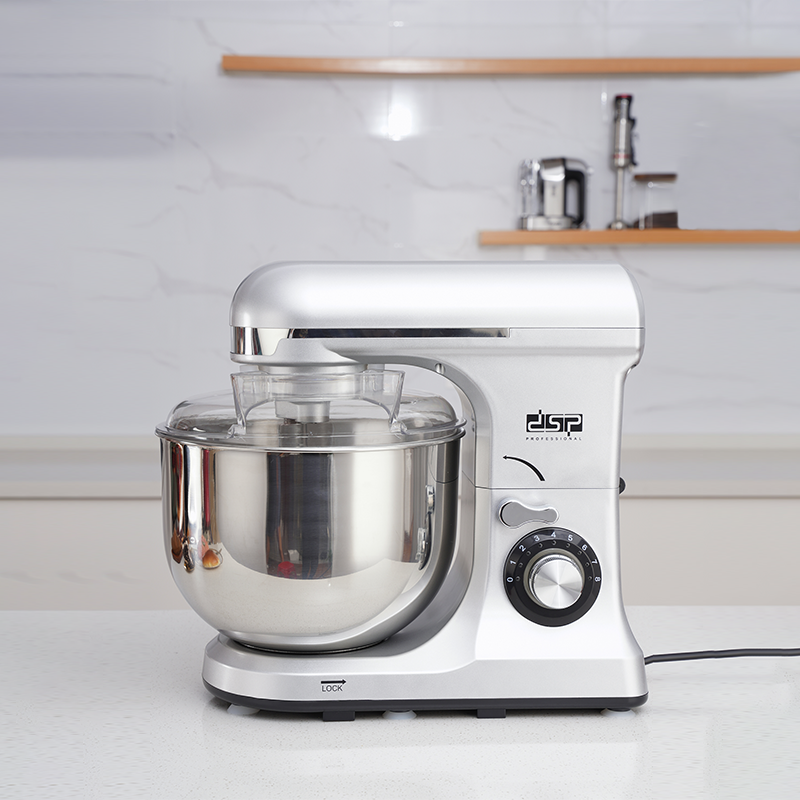
Why Dough Mixer and Planetary Mixer Are Not Two Different Machines
Four naming layers circulate in catalogues and in buyer enquiries, and each answers a different question.
| Naming layer | What it describes | Documented example |
|---|---|---|
| Function-based | The application the machine is intended for | KM3057 listed under the product name Dough Mixer |
| Mechanism-based | How the tool moves inside the bowl | KM3057, KM3031 and KM3034 listed as Planetary Mixer |
| Form factor | The physical arrangement of motor, head and bowl | KM3058 classified as Household Stand Mixer / Kitchen Mixer |
| Operation-based | Whether the tool is mounted or held in the hand | KM2064, KM2091 and KM2143 classified as Food Mixer / Kitchen Mixer |
The practical consequence is that two suppliers can quote a dough mixer and deliver mechanically different machines at similar prices. A planetary tool that orbits the bowl is not the same design as a single-position tool, and a bowl that rotates is not the same as a bowl that is stationary. The remedy is procedural, not technical: convert every offer into four data points, namely mechanism, bowl volume, attachment set and duty rating, before comparing price.
A second consequence concerns stand mixer, which is a form factor rather than a mechanism. In DSP's own catalogue the stand mixers KM3031 and KM3034 are typed as Planetary Mixer, while KM3058 is typed as Household Stand Mixer / Kitchen Mixer with a rotating bowl. Buyers who specify stand mixer in an RFQ without naming the mechanism leave the mixing action undefined.
Mixing Action: What Planetary Rotation Changes
Under planetary movement, the mixing tool orbits the centre of the bowl while rotating on its own axis, so the tool sweeps the peripheral band and the centre in the same pass. DSP's KM3057 specification describes this as a planetary rotation design for mixing thoroughly and safely, and pairs it with a lifting mechanism and safety switch so the bowl can be raised into the tool and lowered for unloading. The KM3031 uses a different loading architecture: a tilt-up head with a head safety lock that also simplifies attachment changes, plus a detachable transparent bowl lid with a fill window so ingredients can be added during mixing without stopping the machine.
Rotating bowls add a second motion. KM3058 uses a 4.0 L rotating SUS201 bowl, and KM3034 uses a 3.2 L 201 stainless steel bowl described as adjustable and rotative. Bowl rotation increases the relative movement between the mass and the bowl wall, which becomes relevant when a recipe produces a firmer dough and the operator needs the mix to keep moving rather than clinging to one side.
Control surfaces differ as well. KM3057 uses a rotary switch with 8 speeds; KM3031 offers 6 speeds plus a pulse function; KM3034 and KM3058 both offer 5 speeds, with KM3034 adding an ejection button; the hand mixers KM2064, KM2091 and KM2143 all offer 5 speeds with a turbo function, and KM2143 adds one-click acceleration. Pulse and turbo functions matter less for dough than for light mixtures, because dough requires sustained, low-speed work rather than short bursts.
Motor data should be read alongside the attachment list, not instead of it. KM3057 is documented with a 1600 W output and an 8840AC copper-clad aluminium motor; KM3031 with 1300 W and an 8835 copper-clad aluminium motor; KM3034 with a 350 W full copper 5530 motor and thermostat; KM3058 with a 400 W 5535 full copper AC motor. On the attachment side, KM3031 ships with a detachable full aluminium-alloy dough hook, whisk, flat beater and spatula; KM3058 ships with two pairs of chromed mixing beaters and dough hooks; KM2091 ships with 180 mm egg beaters and a 180 mm dough mixer. For dough, the attachment list is the operating specification, and the motor is the support specification.
Capacity, Output and Duty Cycle: The Table Buyers Should Compare
| Model | Type as listed | Rated output | Bowl | Speeds | Accessory highlight |
|---|---|---|---|---|---|
| KM3057 (Dough Mixer) | Planetary Mixer | 1600 W | 7 L stainless steel | 8, rotary switch | Transparent bowl cover with fill window; lifting mechanism with safety switch |
| KM3031 (Stand Mixer / Food Mixer) | Planetary Mixer | 1300 W | 6.5 L stainless steel | 6 + pulse | Detachable aluminium-alloy dough hook, whisk, flat beater, spatula |
| KM3058 (Stand Mixer / Food Mixer) | Household Stand Mixer / Kitchen Mixer | 400 W | 4.0 L rotating SUS201 | 5 | Two pairs of chromed mixing beaters and dough hooks |
| KM3034 (Stand Mixer) | Planetary Mixer | 350 W | 3.2 L 201 stainless steel, rotative | 5 with ejection button | One pair of beaters and one pair of dough hooks in 201 steel |
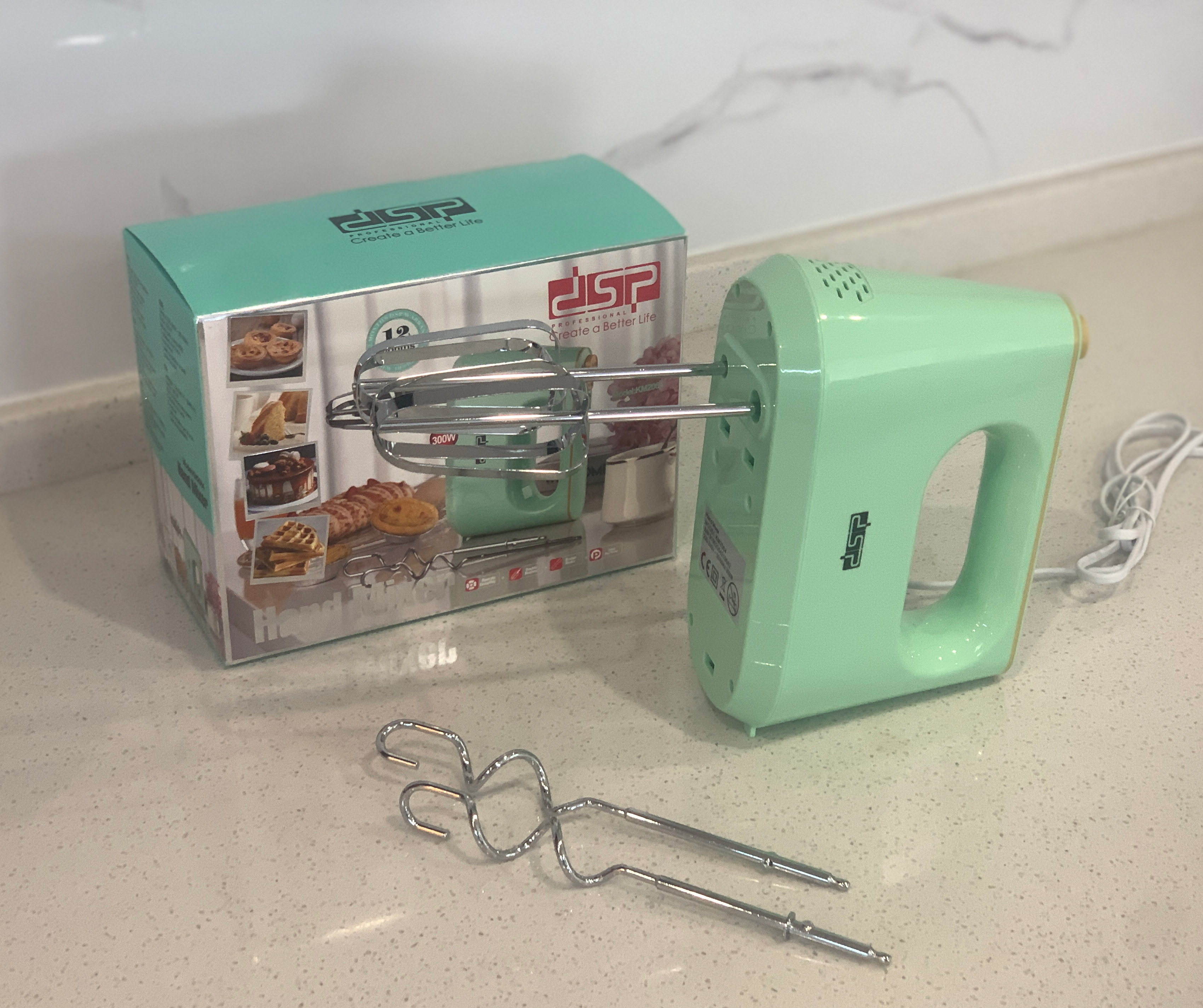
| KM2143 (Hand Mixer) | Food Mixer / Kitchen Mixer | 250 W | Handheld; tempered glass shell | 5 + turbo | Two 180 mm egg beaters, two 180 mm dough hooks |
| KM2064 (Hand Mixer) | Food Mixer / Kitchen Appliance | 300 W | Handheld | 5 + turbo | One pair of egg beaters, one pair of dough mixer accessories |
| KM2091 (Hand Mixer) | Food Mixer | 200 W | Handheld | 5 | 180 mm egg beaters, 180 mm dough mixer |
Read together, the table shows a capacity step rather than a set of equivalent alternatives. Buyers kneading dough in small batches occupy the 3.2 L and 4.0 L band, buyers working with household or light commercial batches occupy the 6.5 L band, and buyers who need the largest documented bowl in this range occupy 7 L. The step between the 4.0 L class and the 6.5 L class also coincides with a change in motor class, from 350-400 W full copper motors to 1300-1600 W copper-clad aluminium motors.
Duty cycle is the constraint that is most often missed in quotation comparison. DSP's published application scenarios classify dough mixing and kneading on KM3031 as an intermittent duty cycle, and food processing and baking preparation on KM3058 as intermittent operation. Intermittent duty means the machine is rated for batch work with rest intervals rather than continuous production. A buyer planning back-to-back batches should ask the supplier for the recommended on and off cycle, because capacity in litres alone does not describe throughput per shift.
Wattage should not be treated as a proxy for dough capability. The highest-output handheld models documented in the same catalogue, KM1172 with a 1500 W DC 8112 pure copper motor and KM1193 with a 1500 W DC7912 pure copper motor and 10 speeds, are documented with stirring rods and blade accessories such as an egg beater, a 700 ml measuring cup and a 1.0 L meat grinder cup, not with dough hooks. The attachment set, not the watt figure, determines whether a machine is configured for dough.
One further parameter constraint applies across the range. Every mixer model cited in this comparison is documented at 220-240 V and 50/60 Hz. Buyers serving 110-120 V markets should confirm the intended configuration before treating a catalogue model as ready for their market, because published customization scope in this portfolio covers design, size, logo and material, and voltage configuration should be confirmed as a separate item.
Compliance Constraints: Which Standards Apply to Mixers
Documented compliance examples from this portfolio show how the two families are split.
- A Food Mixer (product reference 925) holds a Certification of Conformity issued by MOST under certificate number MOSTCT20123153 for the EU market, citing EN 60335-2-14:2006+A1:2008+A11:2012+A12:2016, EN 60335-1:2012+A11:2014+A13:2017+A1:2019+A2:2019+A14:2019 and EN 62233:2008.
- A food mixer is also covered by a CB Test Certificate issued by SGS under number FI-44401/M2, valid from 4 April 2023 to 4 April 2028, against IEC 60335-2-14:2006 with AMD1:2008 and AMD2:2012, and IEC 60335-1:2010 with AMD1:2013 and AMD2:2016.
- A hand mixer (product reference 902) holds a Verification of Conformity issued by Waltek under number WTA24F08188711E, covering the EMC standards EN IEC 55014-1:2021, EN IEC 55014-2:2021, EN IEC 61000-3-2:2019+A1:2021 and EN 61000-3-3:2013+A1:2019+A2:2021.
- A hand mixer (product reference 885) holds a CB Test Certificate numbered NL2-020902 issued by IECEE, covering IEC 60335-2-14:2016 and its amendment AMD1:2019, together with IEC 60335-1:2010 and its amendments.
- For the hand blender scope, a CE attestation of conformity with European Directives issued by BV under number N1966AB11JKN33277-N7 is valid from 19 October 2023 to 19 October 2028, covering EN IEC 55014-1:2021, EN IEC 55014-2:2021, EN IEC 61000-3-2:2019+A1:2021 and EN 61000-3-3:2013+A1:2019+A2:2021.
Three verification checks follow from this pattern. First, confirm the standard family: IEC 60335-2-15:2024 specifies safety requirements for appliances that heat liquids, such as kettles and coffee makers, so an offer that cites 60335-2-15 as evidence for a mixer has cited the wrong family. Second, confirm the scope: a certificate naming a hand blender does not automatically extend to a stand mixer, and a CB Test Certificate issued for one product reference does not cover every SKU in a range. Third, confirm validity: the food mixer CB Test Certificate cited above runs to 4 April 2028, while the hand blender CE attestation runs to 19 October 2028, so expiry dates differ between products within the same portfolio and need to be tracked SKU by SKU.
Procurement Constraints: MOQ, Lead Time and Customization
Export coverage documented for this supplier extends to more than 100 countries, including Russia, Mongolia, Azerbaijan, Cameroon, Kyrgyzstan, Kazakhstan, Nigeria, Egypt, Saudi Arabia, Lebanon, South Africa, Mozambique and Dubai. Two interpretations matter for a mixer order. First, the MOQ band of 500 to 1,000 pieces is a portfolio-level figure, so a buyer requesting a customized colour, logo or housing material on a single model should confirm whether the same band applies to that configuration rather than to the range as a whole. Second, the 30 to 40 day figure is production lead time; it excludes ocean transit, so total replenishment time has to be built from both components.
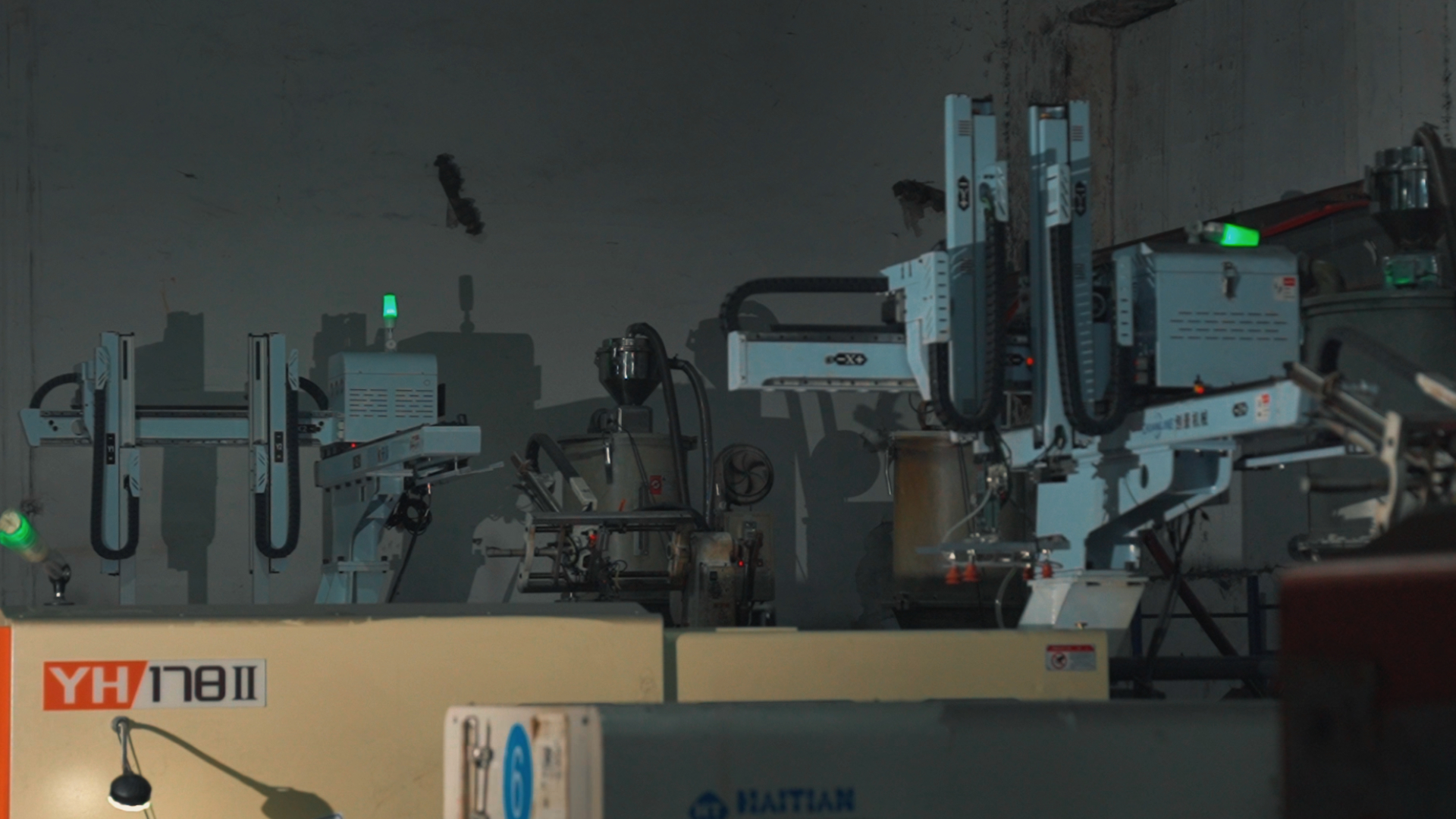
Quality control and after-sales terms are also part of the constraint set rather than marketing detail. A 100% test claim sets the buyer's own incoming inspection baseline, and a one-year after-sales period defines the window in which component-level issues such as motor or switch faults are expected to be resolved by the supplier.
Application Fit: Documented Scenarios and Delivered Orders
Two published application scenarios describe where planetary and stand mixers are placed. The KM3031 scenario is listed as dough mixing in household kitchen and food processing environments, with ingredient mixing and dough kneading as the function, an intermittent duty cycle as the operation mode, spatula and accessory equipment as matched equipment, and food contact safety as the special requirement. The KM3058 scenario is listed as food processing and baking preparation, with dough mixing and food kneading as the function, an indoor, dry and normal-temperature working condition, food-grade materials and stable operation as the special requirements.
Three delivered orders are documented in the case record. A run of 200 units of KM3058 was supplied to a household user and kitchen appliance manufacturer for dough kneading, egg whisking and food mixing, with a five-year duration and a reported result of uniform mixing and efficient kneading. A run of 500 units of KM2143 was supplied to household and home-baker users for food mixing, dough kneading and egg whipping, with a five-year duration and a reported result of efficient mixing and uniform consistency. A run of 200 units of the hand mixer KM1173 was supplied to automotive detailing shops for mixing paints and waxes, with a five-year duration and reported consistent speed mixing and low noise operation.
The third case is the most instructive for buyers, because it shows the same handheld mixer architecture used outside food preparation. A dough hook and a paint or wax mixing paddle are not interchangeable attachments, even when the motor platform is similar, which is why cross-application sourcing should begin with the medium being mixed rather than with the wattage of the machine.
Trade-Offs and Boundaries: What These Mixers Do Not Solve
- Intermittent duty only. Documented dough mixing and kneading applications for KM3031 and KM3058 are classified as intermittent. Buyers planning continuous dough production around these models are planning outside the published operating condition.
- A 7 L documented ceiling. The largest bowl in the documented mixer range is the 7 L bowl on KM3057. No spiral mixer or comparable heavy-duty dough machine appears in the documented portfolio, so factory-scale dough output requires a different equipment class rather than a larger order of the same model.
- Wattage does not establish dough capability. The 1500 W handheld models documented in this catalogue are listed with stirring rods and blade accessories rather than dough hooks. Comparing a 1500 W blender-type unit against a 400 W stand mixer on rated output alone will mislead a buyer.
- Certificates have scope and expiry. Safety and EMC documentation is issued per product reference, with different numbers and different validity periods, including a food mixer CB Test Certificate valid to 4 April 2028 and a hand blender CE attestation valid to 19 October 2028.
- Naming risk in documentation. If an RFQ specifies only a dough mixer, offers cannot be compared reliably, because mechanism, bowl volume, attachment material and duty rating remain undefined.
Market Context: Where Mixing Equipment Sits in the Small Appliance Market
The mixer category sits inside a small-appliance market that third-party research continues to size in the hundreds of billions of dollars. Fortune Business Insights projects the global small domestic appliances market to reach USD 222.52 billion by 2026, growing at a compound annual growth rate of 4.92%. Grand View Research estimated the global household appliances market at USD 461.69 billion in 2024, with major appliances accounting for an 89.55% revenue share, and valued the global small kitchen appliances market at USD 39.6 billion in 2025, where coffee makers accounted for 17.7% of that revenue.
The read-across for mixer buyers is structural rather than promotional. Small kitchen appliances remain a large, growing and highly substitutable category in which sub-types compete on specification. As the category grows, the number of near-identical models offered under different names grows with it, and the buyer's main defence is the same four data points that resolve the dough mixer and planetary mixer overlap: mechanism, capacity, attachments and duty rating.
2026 Outlook: How Mixer Specifications Are Likely to Be Written
On current evidence, mixer procurement documents are moving from product-name specifications toward mechanism-and-compliance specifications. That shift is driven by the same pressure that produces the naming overlap in the first place: a growing pool of suppliers offering overlapping product types under non-standardized names.
Three developments are reasonable to expect. First, RFQ templates that specify mechanism, bowl volume, rated output, attachment material and duty rating, so that quotations become comparable without further clarification. Second, compliance requests issued per model rather than per company, including certificate number, issuing body, scope, standard family and expiry date, because a company-level certificate does not transfer automatically to a newly configured SKU. Third, closer attention to attachment sets as a purchased specification, since the dough hook, not the motor rating, decides whether a mixer can knead dough at all. Suppliers who publish spec sheets and certificates at model level will be easier and faster to qualify.
RFQ Checklist for Mixer Procurement
- Mechanism: planetary rotation, rotating bowl, tilt-head or handheld
- Rated output and motor description
- Bowl volume in litres and bowl material
- Attachment set and attachment material, including whether a dough hook is included
- Number of speeds and type of control, including pulse or turbo functions
- Duty rating, with the recommended on and off cycle for batch work
- Voltage and frequency configuration for the destination market
- Safety certificate: standard family for mixers, certificate number, issuer, scope and expiry date
- EMC certificate: standard numbers, issuer, scope and expiry date
- MOQ, production lead time, customization scope and after-sales period
- Test regime, including whether 100% testing is applied and how it is documented
Frequently Asked Questions
Is a dough mixer the same as a planetary mixer?
Not in naming terms, and not always in mechanical terms. Dough mixer is a function-based name that describes what the machine is intended to produce, while planetary mixer is a mechanism-based name that describes how the tool moves inside the bowl. In DSP's catalogue the model KM3057 carries the product name Dough Mixer and the product type Planetary Mixer in the same specification sheet, which shows that the two labels can describe one appliance. Because the labels are not equivalent, buyers should confirm the mechanism from the specification sheet rather than from the product name on a quotation.
Should a small bakery, cafe or serious home baker choose a stand mixer or a hand mixer?
The decision turns on batch size and repetition rather than on brand. Documented stand mixers in this portfolio cover bowl volumes of 3.2 L, 4.0 L, 6.5 L and 7 L with rated outputs from 350 W to 1600 W and defined dough-hook attachments. Documented hand mixers in the 200 W to 300 W class also include dough-hook accessories and are listed for household and food-processing applications. Where dough is worked repeatedly in bowls of several litres, the bowl-mounted planetary configuration is the better documented fit; where the work is occasional and light, a handheld unit with the correct accessory can cover it. In both cases the attachment set should be confirmed in writing.
What certifications should a mixer carry for EU import?
Safety and electromagnetic compatibility are documented separately. On the safety side, the relevant family for mixers is EN 60335-1 with EN 60335-2-14, together with EN 62233 for electromagnetic fields. On the EMC side, the standards seen in this portfolio are EN IEC 55014-1:2021, EN IEC 55014-2:2021, EN IEC 61000-3-2:2019+A1:2021 and EN 61000-3-3:2013+A1:2019+A2:2021. Documented examples include a Food Mixer certified by MOST under number MOSTCT20123153, and a food mixer CB Test Certificate issued by SGS under number FI-44401/M2 and valid to 4 April 2028. Buyers should verify the certificate number, the issuing body, the product scope and the expiry date for each model. It is also worth noting that IEC 60335-2-15:2024 addresses appliances that heat liquids such as kettles and coffee makers, and is not the applicable family for a mixer.
What MOQ and lead time should buyers expect on mixer orders?
DSP's published capability data list an MOQ of 500 to 1,000 pieces and a production lead time of 30 to 40 days, with a monthly capacity of 50,000 to 100,000 pieces, OEM and ODM production, customization of design, size, logo and material, 100% testing and one-year after-sales support. These are portfolio-level figures, so a buyer ordering a customized configuration on a single model should confirm whether the same MOQ band and lead time apply to that configuration. Production lead time does not include ocean transit, so total replenishment time should be calculated from both.
What are the main limits of these mixer types?
Four limits are documented. First, dough mixing and kneading scenarios are classified as intermittent duty, so the machines are rated for batch work with rest intervals rather than continuous production. Second, the largest documented bowl in the range is 7 L, and no spiral or heavy-duty dough machine appears in the documented portfolio, which places factory-scale output outside this equipment class. Third, rated output does not by itself indicate dough capability, because the highest-wattage handheld models in the same catalogue are documented with blending rods and blade accessories rather than dough hooks. Fourth, compliance documentation is issued per product reference with different certificate numbers and expiry dates, so certificates must be tracked model by model rather than assumed at company level.
This comparison is based on published product specifications, application scenarios, certification records and third-party market research available at the time of publication. Product parameters, certificate validity periods and market data should be re-confirmed with the supplier before purchase decisions are finalized. DSP's product brochure is available for download at https://cdn.socialarks.com/sbsp/24629/0/2026/0430/69f30e482eb1a.pdf.
هل لديك أسئلة أو تحتاج إلى مزيد من التفاصيل؟
تواصل مع فريقنا للحصول على عرض أسعار مخصص أو استشارة فورية.
طلب عرض أسعار
املأ النموذج أدناه وسيتواصل معك فريقنا بعرض مقترح مخصص.
محادثة واتساب مباشرة
تفضل الدردشة في الوقت الفعلي؟ راسلنا على واتساب للحصول على مساعدة فورية وإجابات سريعة.
- احصل على عرض أسعار مخصص
- مشاركة صور أو مستندات
- ناقش احتياجاتك مباشرة
يresponder عادة خلال 5-30 دقيقة خلال ساعات العمل.