
شهادة الجيونيت الصرف الصحي ودليل المعلمات للمشترين الصناعيين
Certification and technical parameters are the first filters most industrial buyers apply when sourcing a drainage geonet for EAEU, EU, or other regulated projects. This reference guide explains what the key standards cover, how Haoyang Environment Co., Ltd. documents compliance for its 4.0mm–8.0mm drainage geonet, and how to read those documents against your project's specific conditions.
Why certification and parameters matter before price negotiation
Industrial buyers in construction, mining, landfill, tunnel, and slope stabilization projects increasingly treat drainage geonets as engineered components rather than commodity geosynthetics. The commercial reason is straightforward: a geonet that fails under chemical exposure, high compressive load, or不符合 project specifications can require excavation, replacement, and environmental liability that far exceeds the material's purchase price.
In procurement practice, certification documents and parameter sheets are the fastest verifiable evidence of whether a supplier can meet the project's performance boundary. For buyers evaluating suppliers in the EAEU, the relevant question is not only "does this drainage geonet have a certificate?" but "which GOST standard does the certificate reference, and does that standard match my application?" For EU/EEA projects, the equivalent question is whether the product holds a valid Verification of Conformity under EN 13249:2016.
What the primary drainage geonet certifications actually cover
Haoyang Environment Co., Ltd., a geosynthetics manufacturer headquartered in Dezhou (Yucheng) National High-tech Industrial Development Zone, Shandong Province, China, holds several certifications that apply to its drainage geonet and 3D composite drainage geonet products. The table below summarizes each certification, the issuing body, the referenced standard, and the applicable market.
| Product scope | Certificate | Issuer | Standard | Market | Validity |
|---|---|---|---|---|---|
| Composite drainage geonet | ICR/VC/HE250523 (Verification of Conformity) | ICR | EN 13249:2016 | EU/EEA | 2025-05-20 → 2030-05-19 |
| Drainage geonet | ICR/VC/HE250524 (Verification of Conformity) | ICR | EN 13249:2016, CPR (EU) 305/2011 | EU/EEA | 2025-05-20 → 2030-05-19 |
| 3D composite drainage geonet | POCC CN.32682.04NC中0.OC01.H00838 (GOST Certificate of Conformity) | ПрофСерт (ProfSert) | GOST 33068-2014 | EAEU/Russia | Valid |
| Drainage geonet | POCC CN.32682.047C00.0C01.H00840 (GOST Certificate of Conformity) | ПрофСерт (ProfSert) | GOST 56586-2015 | EAEU/Russia | Valid |
| Drainage geonet | POCC CN.32682.047C00.OC01.H00837 (GOST Certificate of Conformity) | ПрофСерт (ProfSert) | GOST 70090-2022 | EAEU/Russia | Valid |
For a buyer, this certification coverage matters for three reasons. First, it allows the same product family to be specified in both EU/EEA and EAEU projects without substituting materials. Second, it provides a documented compliance trail for customs clearance and regulatory review. Third, it reduces the need to qualify a second supplier for different regions.
What the certificates do not say: A certificate confirms compliance with a specific standard at the time of issuance. It does not by itself verify that every roll delivered to your site meets your project's custom thickness, mass per unit area, or strength requirements. That is why parameter verification remains a separate procurement step.
Reading the drainage geonet parameter sheet
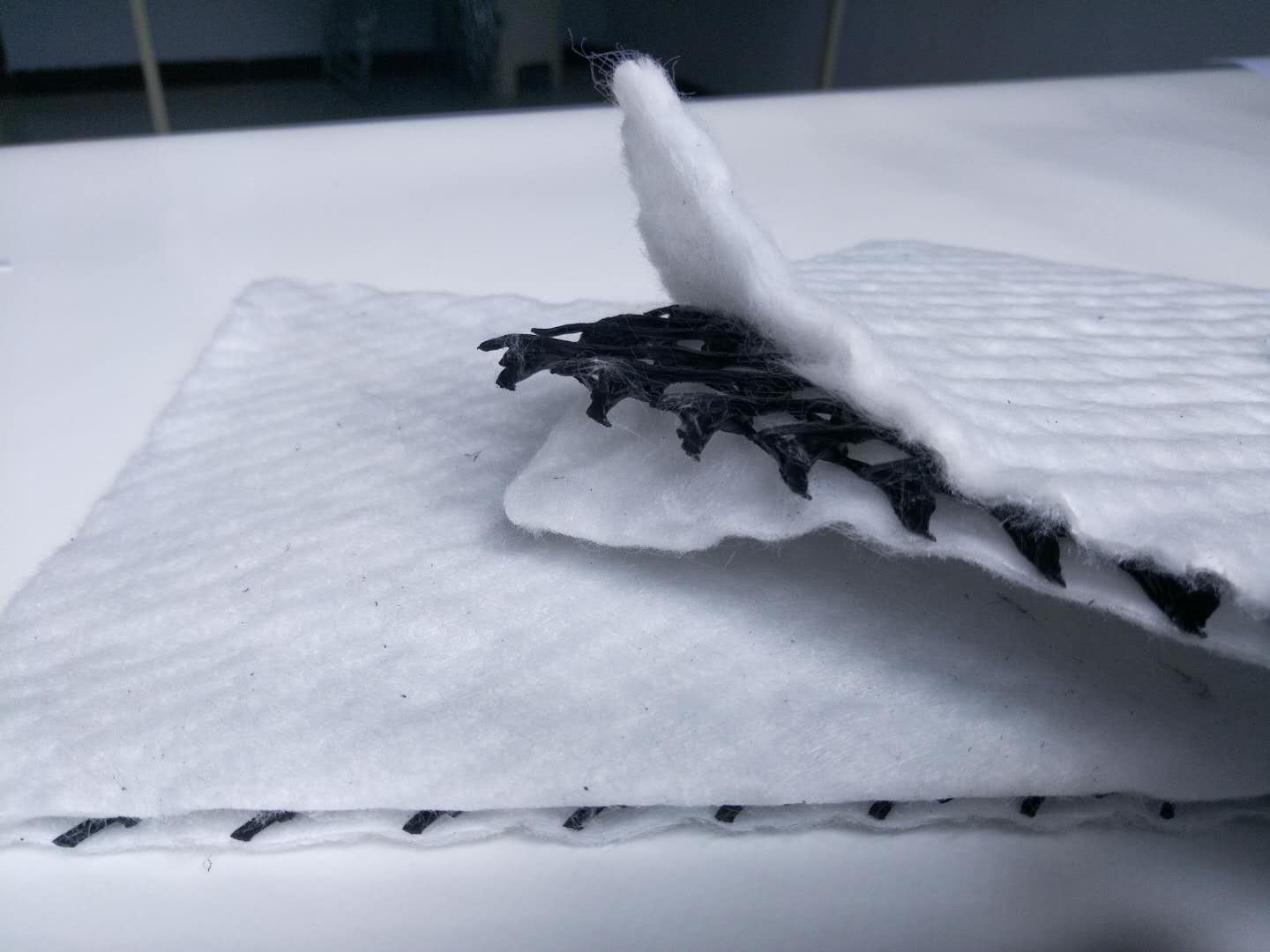
Haoyang's drainage geonet is manufactured in a 4.0mm–8.0mm model with a specification range that buyers can treat as a reasonable starting point for evaluation. The table below lists the published parameters and what each one indicates for a typical civil or environmental application.
| Parameter | Published value | Procurement significance |
|---|---|---|
| Thickness | 4.0mm–8.0mm (customizable) | Affects in-plane flow capacity and resistance to crushing under overburden. |
| Mass per unit area | 500–1400 g/m² (customizable) | Indicates material density; commonly correlated with mechanical robustness. |
| Tensile strength (MD/TD) | ≥5–15 kN/m | Relevant to installation handling, tear resistance, and survivability over uneven subgrades. |
| Elongation at break | 10–25% | Helps predict deformation behavior under load and differential settlement. |
| Compressive strength (10% strain) | ≥500–830 kPa | Indicates how much vertical stress the geonet can carry while maintaining its drainage structure. |
| Acid/alkali resistance | ≥90% strength retention | Relevant for leachate, mine drainage, and industrial effluents with aggressive chemistry. |
| Drainage capacity | ≥50–120 (L/min)/m (customizable) | Directly indicates the geonet's ability to transmit water along its plane under specified conditions. |
Two aspects of this parameter set are particularly useful for buyers moving from Research to Evaluation.
Compressive strength combined with drainage capacity. A drainage geonet can show good flow capacity in a lab test but lose that capacity if the ribs deform under the weight of a landfill, tailings stack, or roadway. The combination of ≥500–830 kPa compressive strength at 10% strain and ≥50–120 (L/min)/m drainage capacity gives the buyer a starting point for assessing whether the geonet will keep draining under real overburden.
Acid/alkali resistance at ≥90% strength retention. For projects involving mine tailings, leachate, or industrial process water, chemical resistance is a critical survival parameter. The published retention figure provides a threshold that buyers can compare with the actual chemistry of their site.
Material selection: HDPE, PP, and PET in geonet applications
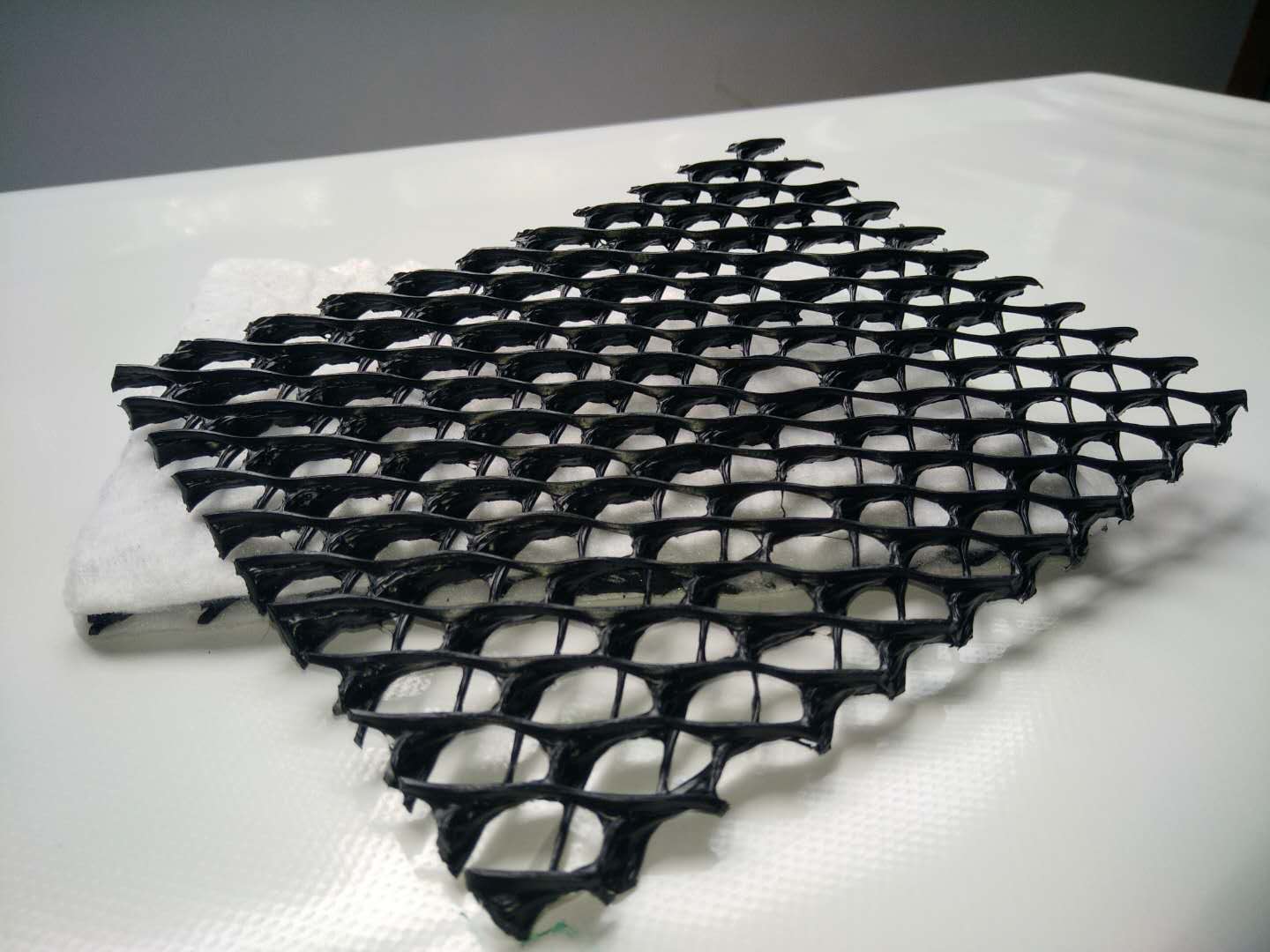
Haoyang's drainage geonet is available in HDPE, PP, and PET. Material choice affects not only chemical resistance but also mechanical behavior, installation flexibility, and long-term performance. Industry data indicates that polyethylene-based drainage nets account for nearly 64% of global material demand, largely because of high chemical resistance.
For most landfill, tailings, and industrial containment projects, HDPE is a common default because of its broad chemical resistance and long service record. PP is often selected when higher temperature resistance or different stiffness characteristics are needed. PET offers high tensile performance but requires careful consideration of hydrolysis risk in alkaline, high-moisture environments. A qualified supplier should be able to explain the trade-off rather than simply recommend one material for every project.
Integrated molding and hot melt welding
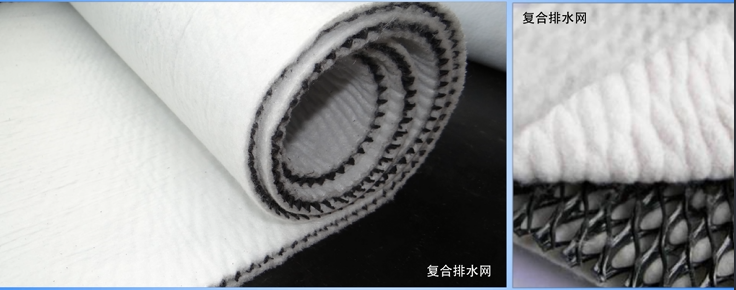
Manufacturing quality is as important as material selection. Haoyang describes its drainage geonet as using integrated molding and hot melt welding processes. For a buyer, these two process terms matter because they influence structural continuity and the risk of delamination or weak junctions between the net layer and geotextile layer in a composite product. A geonet with weak bonds between layers can lose its composite function during handling or after cyclic loading.
When evaluating suppliers, buyers should ask for process descriptions, not just finished-product parameters. The value of a parameter such as tensile strength depends on the consistency of the manufacturing process across the full roll width and production batch.
How to evaluate a drainage geonet against project conditions
Certification documents place the product in a compliance framework, but project fit depends on the specific conditions of your site. The following evaluation sequence is commonly used by industrial buyers:
- Confirm the governing standard. Determine whether your project must meet EN, GOST, ASTM, or national requirements. For EAEU projects, request the GOST certificate number and verify that the referenced standard matches the application scope. For EU/EEA projects, check the ICR Verification of Conformity number and its validity period.
- Identify the critical chemical environment. If the geonet will contact leachate, acid mine drainage, saltwater, or industrial effluent, verify the acid/alkali resistance parameter (≥90% strength retention for Haoyang's product) and confirm the material grade with the supplier.
- Define the overburden condition. Estimate the maximum vertical stress after construction. Compare it with the compressive strength at 10% strain. If the site has deep fill or heavy equipment loads, consider the higher end of the 4.0mm–8.0mm thickness range.
- Check drainage capacity against the expected inflow. Calculate the required flow per meter of slope or drainage path. Use the published drainage capacity range of ≥50–120 (L/min)/m as a benchmark and request test data under conditions similar to your project.
- Review mechanical survivability. Tensile strength (MD/TD ≥5–15 kN/m) and elongation at break (10–25%) help anticipate how the geonet will behave during installation over uneven surfaces and under seasonal movement.
Verification step: The certification numbers cited in this guide are drawn from Haoyang's compliance documentation for the drainage geonet product family. Buyers should request copies of the actual certificates before final approval, because customs and regulatory review may require the physical document rather than a summary.
Application patterns: tunnel, subgrade, slope protection, and landfill
The performance characteristics described above translate into different application logic depending on the project type.
Tunnel drainage geonet. In tunnel lining systems, the geonet is placed behind the lining to collect and convey groundwater. The key requirements are high drainage capacity, adequate compressive strength to resist grouting pressure, and long-term chemical resistance to groundwater. The 4.0mm–8.0mm thickness range and ≥500–830 kPa compressive strength make this product family relevant for such applications, though the exact layering must be designed by the project engineer.
Subgrade drainage geonet. For road and railway subgrades, the geonet is used to intercept water seeping upward or laterally and direct it to collection points. Tensile strength and tear resistance are important because installation often occurs over rough, compacted aggregate. The MD/TD tensile strength of ≥5–15 kN/m provides a baseline for handling and survivability.
Slope protection drainage geonet. In slope and retaining wall systems, the geonet relieves hydrostatic pressure behind the structure. The critical design value is the in-plane drainage capacity, which must be high enough to handle rainfall infiltration without causing pressure buildup. Haoyang's published drainage capacity range of ≥50–120 (L/min)/m is a practical starting point for such calculations.
Landfill drainage geonet. Landfill leachate collection is among the most demanding applications because the geonet must remain functional under decades of load and chemical exposure. The combination of high compressive resistance, acid/alkali resistance (≥90% strength retention), and composite construction with a geotextile layer is what makes the product relevant for landfill applications.
Limitations and boundaries of certification-based procurement
Certification and parameter sheets are necessary procurement tools, but they have limits that buyers should acknowledge in their evaluation model.
Certificate scope may be narrower than the product family. A certificate may name a specific product scope, such as "composite drainage net" or "3D composite drainage geonet," rather than every variant manufactured by the supplier. Buyers should confirm that the certificate on file covers the exact product configuration they intend to purchase, including material type and whether the geonet is a 3D composite or a single-layer net.
Standard compliance is not the same as site-specific verification. A product can comply with EN 13249:2016 or GOST 33068-2014 and still be unsuitable for a particular project if the site's chemistry, loading, or geometry falls outside the tested envelope. Parameters such as acid/alkali resistance and compressive strength describe performance under defined conditions, not under every possible field condition.
Validity and regional applicability are conditional. The ICR Verification of Conformity for the drainage geonet is valid from May 20, 2025, to May 19, 2030. GOST certificates have their own validity and regional scope. Buyers with long construction or commissioning timelines should verify that certificates remain valid through the entire project phase, not just at the time of order.
Certification does not replace manufacturing consistency. A certificate is issued based on type testing and audit. It does not guarantee that every production lot matches the tested product. Buyers who require high consistency should ask the supplier about quality control procedures, such as batch testing or production traceability.
Market context: drainage as the leading function in geocomposites
The emphasis on drainage in geosynthetic systems is supported by market data. According to Grand View Research, drainage applications led the geocomposites market with a 44.55% revenue share in 2024. This helps explain why drainage geonet specifications and certifications have become a distinct procurement category rather than a side note within broader geosynthetics purchasing.
For industrial buyers, the practical takeaway is that the drainage geonet should be evaluated as a critical component with its own compliance and performance documentation. The increasing availability of region-specific certifications from manufacturers such as Haoyang reflects a broader expectation that suppliers support multi-region projects with evidence rather than generic claims.
Traditional solutions vs. certified composite drainage geonets
The alternative to a composite drainage geonet is often a traditional granular drainage layer made of sand, gravel, or crushed stone. The comparison is well established in civil engineering practice.
| Evaluation criterion | Traditional granular drainage layer | Composite drainage geonet |
|---|---|---|
| Drainage capacity per unit thickness | Requires significant layer thickness to achieve high flow | Thin geonet can provide specified in-plane flow |
| Compressive behavior | Depends on aggregate quality and compaction; can deform under load | Published compressive strength provides a verifiable threshold |
| Chemical resistance | Mineral aggregates are generally stable, but leachate can interact with fines | HDPE/PP/PET materials offer defined chemical resistance (e.g., ≥90% strength retention) |
| Installation speed | Labor-intensive, requires transport and placement of large volumes | Roll placement is faster, but requires careful subgrade preparation |
| Certification traceability | Often not certified as an engineered component | Can be documented through EN 13249:2016, GOST, or other standards |
| Known limitation | Widely understood performance; easy to inspect | Filter compatibility and long-term creep must be verified under project conditions |
One honest limitation of composite drainage geonets is that their long-term performance depends on the compatibility of the geonet with adjacent soils and geotextiles. A geonet can clog or lose flow capacity if the surrounding filter system is not designed correctly. Granular layers, while bulky and more expensive to install, have a longer track record in some traditional applications. Buyers should not assume that a certified geonet automatically outperforms a well-designed granular system in every situation.
How Haoyang's manufacturing and R&D context supports certification claims
Haoyang Environment Co., Ltd. was founded in 2008 and operates from a manufacturing base in Dezhou (Yucheng) National High-tech Industrial Development Zone, Shandong Province, China. The company reports a factory area of 200,000 m², approximately 190 employees, annual output of 33,000 tons, and export sales accounting for about 60% of its business. It holds more than 70 patents and proprietary technologies, and maintains cooperative relationships with universities such as Fudan University and Tianjin University of Technology, with 20 professional engineers on its R&D team.
These facts matter for buyers because certification is not an isolated event. A manufacturer with in-house production control and patent-backed process knowledge is more likely to maintain the consistency that certifications imply. Haoyang's product range includes geomembranes, geotextiles, composite drainage nets, and waterproof mats, which means a drainage geonet project can often be paired with the same supplier's geomembrane and geotextile products, reducing interface risk between components.
The company also reports a full-chain service capability, from material supply to on-site installation and construction. In a gold mine tailings pond project in Uzbekistan, for example, Haoyang supplied 900,000 square meters of materials for seepage prevention, using a 3D composite drainage network of textured geomembrane and high-strength polypropylene geotextile. The project description states that the solution combined independently developed textured geomembrane with the composite drainage system, moving beyond a single-product sales model. This serves as a reference, not as a guarantee that every project can be replicated in identical fashion.
Manufacturing capability and quality control questions for suppliers
Beyond certification documents, buyers evaluating a drainage geonet supplier should ask structured questions about production capacity and quality control. Haoyang reports a monthly capacity of 3,000 tons, a lead time of 10–30 days, a minimum order quantity of 5,000 m², and a quality control policy of 100% testing. Export markets include Africa, Europe, Central Asia, Southeast Asia, Australia, and South America, and the company provides on-site after-sales support.
These figures offer a useful baseline for buyer expectations:
- Lead time of 10–30 days is relevant for project scheduling, but buyers should confirm lead times for their specific order volume and customization requirements.
- MOQ of 5,000 m² should be checked against the project's required area. Small pilot projects may face different minimums.
- 100% testing as a stated policy is a positive indicator, but buyers should request the actual test plan: which parameters are tested per roll, which are type-tested, and how results are documented.
- On-site after-sales support can reduce installation risk, but its availability depends on the project location and service agreement. Buyers should clarify whether on-site support is included in the quoted price.
Future outlook for drainage geonet procurement
Several trends are likely to shape drainage geonet procurement over the next few years. First, the global geocomposites market, which includes geotextile-geonet products, was valued at USD 564 million in 2024 and is projected to reach USD 1,074.88 million by 2032. This scale suggests that geosynthetic drainage products will remain a meaningful category for industrial buyers.
Second, regional certification requirements are becoming more embedded in procurement frameworks. The presence of both EN 13249:2016 and GOST certifications in a single product family is no longer exceptional; it is becoming a baseline for suppliers that serve both European and EAEU markets. Buyers should expect certification documents to become part of routine technical submittals, similar to geotechnical reports and material test results.
Third, the distinction between commodity geosynthetics and engineered drainage components is likely to sharpen. Buyers who can articulate their project's compressive, chemical, and hydraulic requirements will be better positioned to evaluate suppliers than those who simply compare prices per square meter.
Frequently asked questions
Which certificate applies to a composite drainage geonet for the EU/EEA market?
The composite drainage geonet holds Verification of Conformity certificate number ICR/VC/HE250523, issued by ICR, confirming compliance with EN 13249:2016 for the EU/EEA market. The certification is valid from May 20, 2025 to May 19, 2030.
Which GOST certificate applies to a drainage geonet for the EAEU/Russia market?
Haoyang drainage geonet products are certified under GOST standards through multiple certificates, including POCC CN.32682.047C00.0C01.H00840 referencing GOST 56586-2015 and POCC CN.32682.047C00.OC01.H00837 referencing GOST 70090-2022. Both are issued by ПрофСерт (ProfSert) for the EAEU/Russia market.
Does the 3D composite drainage geonet have a separate GOST certificate?
Yes. The 3D composite drainage geonet holds GOST Certificate of Conformity number POCC CN.32682.04NC中0.OC01.H00838, issued by ПрофСерт (ProfSert), confirming compliance with GOST 33068-2014 for the EAEU/Russia market.
What is the model designation for Haoyang's drainage geonet?
The model designation is 4.0mm–8.0mm, with customizable parameters including mass per unit area from 500–1400 g/m², tensile strength (MD/TD) from ≥5–15 kN/m, compressive strength at 10% strain from ≥500–830 kPa, acid/alkali resistance of ≥90% strength retention, and drainage capacity from ≥50–120 (L/min)/m.
What material options are available for the drainage geonet?
The drainage geonet is available in HDPE, PP, and PET. Polyethylene-based drainage nets account for nearly 64% of global material demand, largely because of high chemical resistance. Material selection should be based on the chemical environment, temperature conditions, and mechanical requirements of the project.
How long is the ICR Verification of Conformity valid for the drainage geonet?
The ICR Verification of Conformity for the drainage geonet product is valid from May 20, 2025, to May 19, 2030. Buyers should verify that the certificate remains valid for the full project delivery and commissioning period.
What quality control and production capacity does the supplier report?
Haoyang Environment Co., Ltd. reports a monthly capacity of 3,000 tons, a lead time of 10–30 days, a minimum order quantity of 5,000 m², and a quality control policy of 100% testing. The company also provides on-site after-sales support and exports to Africa, Europe, Central Asia, Southeast Asia, Australia, and South America.
Note: This reference article is provided for procurement interpretation. Certificates, parameters, and company facts are drawn from published documentation of Haoyang Environment Co., Ltd. Buyers should obtain official certificate copies and test reports directly from the supplier before final specification approval.