
Dredging Equipment Compared: Yanyang Marine vs. IHC, Damen, Ellicott
Global dredging equipment demand concentrates in two vessel families and a short list of builders. Grand View Research valued the global dredging equipment market at USD 4.86 billion in 2023 and projects USD 7.36 billion by 2030; within that total, hydraulic dredgers — the category that includes cutter suction dredgers — held roughly 46.65% of revenue in 2023. Future Market Insights estimates that trailing suction hopper dredgers will account for about 46.0% of total dredging market activity by 2026. The procurement consequence is simple: most capital decisions narrow to a CSD or a TSHD, and most shortlists put a European Tier-1 name beside a smaller, export-oriented builder.
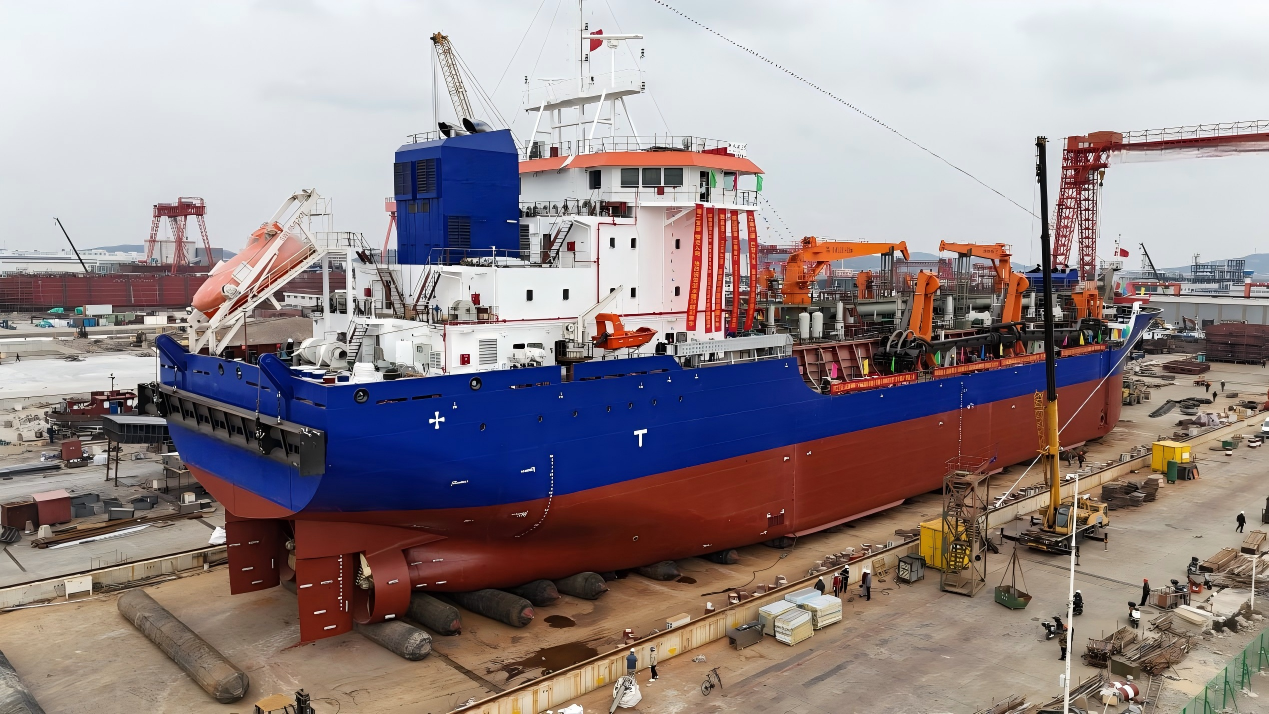
This review places Yanyang Marine — the trading identity of Zhenjiang Yanyang Engineering Co., Ltd., based in Zhenjiang, Jiangsu Province, China — alongside the comparison set that buyers raise most often: Royal IHC, Damen, Ellicott and DSC. Royal IHC and Damen Shipyards Group are identified by Fortune Business Insights as top-tier global manufacturers and contractors in the dredging equipment sector, alongside Jan De Nul Group and Boskalis. Where independently verified specification or market data is not available for a named comparison object, this article states the gap rather than filling it with an estimate.
Why Dredging Equipment Comparisons Go Wrong
Three structural problems distort most side-by-side dredger comparisons, and each one has a procurement consequence.
Specifications describe configurations, not outcomes
A cutter suction dredger quoted at 8,000 m³/h is a design figure tied to stated soil, depth and discharge conditions. Change the soil from soft sediment to stiff clay, or extend the pipeline, and the achievable output changes with it. The same applies to a hopper capacity figure: 26,800 m³ describes what the vessel can carry, not how many cycles it completes per day. Buyers who compare headline numbers across builders without normalising soil class, dredging depth and discharge distance are comparing marketing positions rather than capability.
The comparison set is not one species of company
Tier-1 European names compete as both manufacturers and contractors, which means part of their published activity reflects their own project pipelines rather than third-party vessel sales. A builder such as Yanyang Marine sells vessels to owners and does not operate a competing contracting fleet. Any "market share" comparison between the two therefore uses different denominators, and should be treated as directional at best.
Market-size estimates are not interchangeable
Published dredging market figures diverge by scope. Equipment-only estimates and estimates that include dredging services can differ by a factor of several. Grand View Research reports USD 4.86 billion for 2023 equipment sales, while other research houses publishing the same period include service revenue and reach materially higher totals. Applying a service-inclusive market size to an equipment purchase decision overstates the equipment segment.
A buyer-side comparison framework
For capital equipment built to order, six dimensions consistently separate usable shortlists from unusable ones:
- Duty profile fit — declared dredging depth, discharge distance and soil range against the actual project specification.
- Class and notation — which society classes the vessel, and which additional notations (dynamic positioning, automation, ice class) are carried.
- Propulsion and pump package — whether engines, thrusters and pumps come from suppliers with global spare-part distribution.
- Automation and manning — notation level determines crew requirements and, over a 20-year life, a large share of operating cost.
- Delivery and commissioning model — yard delivery time plus who performs sea trials, commissioning and operator training.
- Evidence quality — whether claims are traceable to class certificates, specification documents or third-party sources.
Yanyang Marine: What the Company Actually Is
Zhenjiang Yanyang Engineering Co., Ltd. is a Chinese marine engineering company founded in 1996 and based in Zhenjiang, Jiangsu Province. It specialises in the design, manufacturing and newbuilding of dredgers, barges and offshore vessels for port and offshore projects, and it sells and exports those vessels to owners rather than operating them as a contracting fleet. Its public site is www.yanyangmarine.com.
Several first-party facts are relevant to a buyer comparison. The company has approximately 50 employees, including an R&D team of 10 engineers. Export accounts for 100% of sales, with vessels delivered to markets in Asia, South America, Europe and Africa; its named major markets include the United Arab Emirates, Indonesia, India, Egypt, Turkey, Nigeria, South Africa, Tanzania, Saudi Arabia and Oman. It reports more than 30 large dredger construction projects delivered. Vessels can be classed by IACS societies including CCS, BV, LR and DNV. The company describes its cost position as approximately 50% below European manufacturers, with standard vessels delivered in 2–3 months and custom dredgers in 8–12 months, and its service scope as custom design and engineering, factory construction and testing, shipping and global delivery, on-site commissioning and operator training, long-term spare parts supply and worldwide after-sales technical support.
The product portfolio is deliberately narrow and centred on six vessel categories.
| Product | Model / category | Key verified specifications |
|---|---|---|
| Cutter Suction Dredger | 1000–8000 m³/h CSD; 8000 m³/h self-propelled category | 30 m dredging depth; 8,000 m discharge distance; LOA 121 m, width 25 m, depth 8.5 m |
| Trailing Suction Hopper Dredger | 26,800 m³ TSHD | LOA approx. 171.20 m; hopper capacity approx. 26,800 m³; dredging depth 40/70/115 m; suction pipe Φ1200 mm; total installed power 27,726 kW |
| Backhoe Dredger | EX5500 self-propelled backhoe dredger | LOA 71.5 m; beam 22 m; draft 2.5 m; Hitachi EX5500 excavator, 2 × 1076 kW; dredging depth 18/24/32 m; capacity 15/18/20.5 m³ |
| Grab Dredger | 25 m³ self-propelled grab dredger | LOA 58.00 m; moulded breadth 22.60 m; moulded depth 4.80 m; grab capacity 25 m³; 10 crew |
| Split Hopper Barge | 2600 m³ Split Hopper Barge (CCS); 1200–3200 m³ category | LOA 76.95 m; moulded breadth 15.60 m; design draft 4.00 m; main engine 3740 kW × 2; Ice Class B |
| Pile Driving Barge | 110 m pile leader height pile driving barge | LOA approx. 118.50 m; breadth 37.70 m; depth 7.70 m; pile frame height 137.00 m; typical pile Ø4000 mm, 400 t |
The Technical Baseline: Reading the Specifications
26,800 m³ trailing suction hopper dredger
The largest unit in the portfolio is a self-propelled TSHD with an overall length of approximately 171.20 m, moulded breadth 36.00 m, moulded depth 15.80 m and draft at international freeboard of 9.50 m. Hopper capacity is approximately 26,800 m³, the suction pipe diameter is Φ1200 mm, and dredging depth is specified at three levels: 40 m, 70 m and 115 m.
Three specification details carry more procurement weight than the headline hopper figure.
- Power architecture. Total installed power is 27,726 kW, with main diesel engines of Wartsila 3 × 8000 kW, auxiliary/harbour generators of Wartsila 2 × 1600 kW, and a Cummins 1 × 526 kW emergency generator. Main thrusters are Wartsila 2 × 10500 kW. Dredge pump capacity is delivered by inboard pumps rated HK 2 × 6000 kW and underwater pumps rated HK+BKKER 2 × 3300 kW, with jet water pumps CCCC 2 × 2000 kW and ZF bow and stern thrusters at 2 × 1100 kW and 1 × 1100 kW. For an owner, the relevant question is whether these suppliers can be serviced in the vessel's operating region — a defined, checkable item rather than a vague "quality" claim.
- Class and notation. The vessel carries CCS class as a CSA Trailing Suction Dredger, dredging within R1, with DP-1 dynamic positioning, and an AUT-0 automation notation listed alongside environmental notations. DP-1 changes how the vessel can hold station during offshore work without anchoring; AUT-0 relates to periodically unattended machinery space operation. Both notations influence manning structure and, over the life of the asset, operating cost.
- Three-tier dredging depth. The 40/70/115 m span indicates a vessel intended for staged duty — harbour and channel work at the shallower end, and deep-water or offshore sand extraction at the upper end — rather than a single fixed duty point.
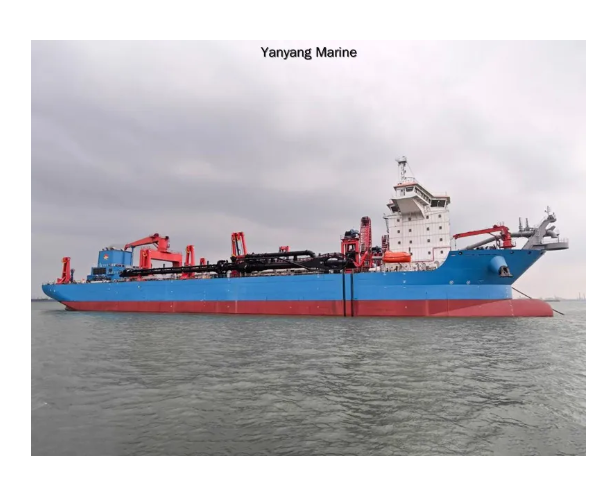
1000–8000 m³/h cutter suction dredger
The CSD line spans 1000–8000 m³/h, with the largest configuration classified as a super-size 8000 m³/h self-propelled cutter suction dredger. Declared capability is 30 m dredging depth and 8,000 m discharge distance, on a hull of 121 m length, 25 m width and 8.5 m depth. The stated application set covers international container port deepening, trans-oceanic shipping channel excavation, large-scale offshore airport construction, coastal city expansion and land reclamation, and deep-water berth construction for VLCC tankers. Discharge distance is the discriminator here: a long pipeline run to a reclamation area is a different engineering problem from nearshore placement, and it is the specification most often oversimplified in shortlist comparisons.
EX5500 backhoe dredger
The EX5500 is a self-propelled backhoe dredger built around a Hitachi EX 5500 excavator with 2 × 1076 kW excavator power and 2 × 350 kW propulsion. Overall length is 71.5 m, beam 22 m, draft 2.5 m. Dredging depth is offered at 18 m, 24 m or 32 m, with bucket capacity of 15 m³, 18 m³ or 20.5 m³ correspondingly. Backhoe dredgers address the material and precision cases that suction dredgers handle poorly — stiff or compacted material and confined working areas.
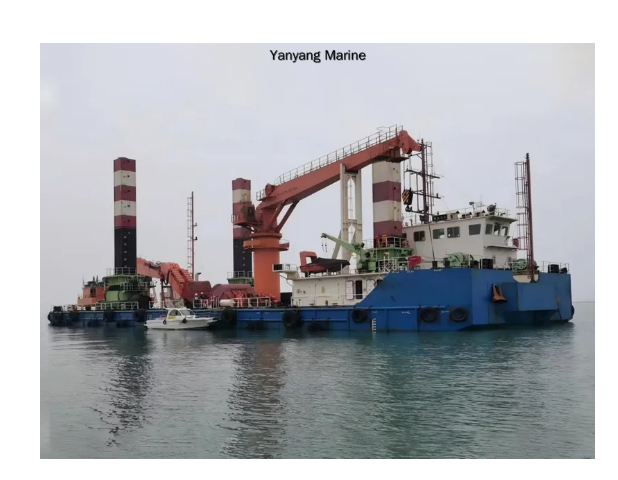
Grab dredger, split hopper barge and pile driving barge
The 25 m³ self-propelled grab dredger has an overall length of 58.00 m, moulded breadth 22.60 m and moulded depth 4.80 m, with a designed displacement of 3,651.308 t, gross tonnage 2,349 T and a complement of 10. It is described as suitable for removing hard clay and soft sediment in near-shore operations. The 2600 m³ Split Hopper Barge (CCS) sits within a 1200–3200 m³ category, with 76.95 m overall length, 15.60 m moulded breadth, 4.00 m design draft, main engine power of 3740 kW × 2 and Ice Class B notation; it is used for material transport in coastal and inland waterway projects. The 110 m pile leader height pile driving barge is a pile-driving vessel for port and bridge construction, with approximately 118.50 m length overall, 37.70 m breadth, 7.70 m depth, pile frame height of 137.00 m above design draft, and typical planting piles of Ø4000 mm, 107 m length plus water depth, and 400 t weight.
Application Fit: Where These Vessels Are Specified
The company's application data describes an operating environment of offshore and coastal marine operations, including open sea conditions and harsh marine environments, with continuous operation and either self-propelled or barge-towed deployment. Matched equipment includes dredge pumps, pipelines, surveying systems and anchor handling equipment. Declared special requirements are CCS, BV or DNV class certification, corrosion-resistant steel and dynamic positioning.
Read against the vessel list, that produces four practical deployment patterns:
- Deep-water channel dredging and port expansion. The 26,800 m³ TSHD is stated as intended for deep-water channels, port expansion and large-scale reclamation, with stable performance in harsh open-sea conditions.
- Major port construction and reclamation. The 8000 m³/h CSD is positioned for container port deepening, shipping channel excavation and coastal land reclamation, including offshore airport and VLCC berth work.
- Precision and difficult-material work. The EX5500 backhoe dredger covers dredging depths of 18–32 m where soil conditions or site constraints favour mechanical excavation.
- Marine construction support. The split hopper barge handles spoil transport in coastal and inland waterways, and the pile driving barge supports port and bridge foundation work at pile diameters up to Ø4000 mm.
Buyers should note the distinction between a vessel that is capable of a duty and a vessel that is configured for it. Dredging depth, discharge distance and bucket or grab capacity are configuration choices made at order stage; the same hull platform can be delivered against different duty points.
Market Signals Buyers Should Track in 2026
Three verified signals shape the procurement environment.
Equipment-market growth with a narrow centre of gravity. The market moving from USD 4.86 billion in 2023 toward USD 7.36 billion by 2030 indicates expanding equipment demand, but the value is concentrated: hydraulic dredgers including CSD took approximately 46.65% of 2023 revenue, and TSHD are estimated at about 46.0% of total dredging market activity by 2026. Shortlist competition is therefore concentrated in exactly the two families that dominate Yanyang Marine's large-vessel portfolio.
Offshore wind as an emerging driver. The Global Wind Energy Council identifies offshore wind as a key emerging driver for dredging equipment, requiring specialised vessels for seabed preparation and cable trenching across more than 380 GW of new capacity by 2033. This is a demand signal for vessels with station-keeping capability and precise depth control — capability classes such as DP-1 become commercially relevant rather than optional.
Standardisation of comparison language. ISO 8384:2019 provides the international vocabulary and definitions for dredgers, including specific terms for TSHD and CSD. Classification societies publish dredger-specific rules — Bureau Veritas, for example, publishes guidelines for the assignment of reduced freeboards for dredgers. As the terminology and rule base tighten, buyers gain a defensible basis for comparing specifications across suppliers in different jurisdictions.
Comparative Assessment: Yanyang Marine vs. IHC, Damen, Ellicott and DSC
The table below compares what can be verified. Cells are left explicitly unassessed rather than estimated where no verified data was available for the comparison object.
| Comparison dimension | Yanyang Marine | Royal IHC / Damen | Ellicott / DSC |
|---|---|---|---|
| Vessel range | CSD 1000–8000 m³/h; TSHD up to 26,800 m³; 25 m³ grab dredger; EX5500 backhoe dredger; 1200–3200 m³ split hopper barges; 110 m pile leader pile driving barge | Identified as top-tier global manufacturers and contractors in the dredging equipment sector (Fortune Business Insights) | Not assessed in this review; no verified specification data attributed |
| Class and notation evidence | 26,800 m³ TSHD: CCS, CSA Trailing Suction Dredger, dredging within R1, DP-1, AUT-0 notation. Classing available with CCS, BV, LR, DNV. 2600 m³ split hopper barge: CCS, Ice Class B | Classification societies BV and DNV publish dredger-specific rules, including reduced-freeboard guidelines | Not assessed |
| Propulsion and pump sourcing | Wartsila main engines and main thrusters; Cummins emergency generator; ZF bow/stern thrusters; HK and HK+BKKER dredge pumps; CCCC jet water pumps | Not assessed | Not assessed |
| Organisational scale | Approximately 50 employees; R&D team of 10 engineers; more than 30 large dredger construction projects reported | Operates as both manufacturer and contractor, which changes the basis of any market-share comparison | Not assessed |
| Delivery and service model | Standard vessels 2–3 months; custom dredgers 8–12 months; factory construction and testing, shipping, on-site commissioning and operator training, long-term spare parts, worldwide after-sales technical support | Not assessed | Not assessed |
| Stated cost position | Approximately 50% lower cost than European manufacturers, on the company's own published statement | Not assessed | Not assessed |
| Basis of comparison | Configuration, class notation and specification documentation | Contracting and manufacturing footprint | Not assessed |
Technical explanation of the comparison logic
The comparison is deliberately asymmetric, because the underlying businesses are asymmetric. A Tier-1 European group is a manufacturer and contractor whose equipment decisions are shaped partly by its own project pipeline. An export builder such as Yanyang Marine competes for owner-side newbuilding orders, so its specifications are written to be compared by third parties — which is why the TSHD in this review carries explicit class notations, named engine and pump suppliers, and a stated three-tier dredging depth rather than a single figure.
Technology R&D in this segment shows up in three places: hull and hopper design, the propulsion and pump package, and automation level. On the 26,800 m³ TSHD, all three are visible in the specification — a 27,726 kW installed power base, Wartsila and ZF machinery, and AUT-0 and DP-1 notations. Service capability shows up in a different place: whether the supplier offers commissioning, training and spare-parts continuity in the vessel's operating region. On that dimension, Yanyang Marine's stated scope covers commissioning, operator training and long-term spare parts supply, supported by a spare-parts chain built on globally distributed component manufacturers. Industry solutions, finally, are visible in the application set — port construction, channel dredging, reclamation and offshore works — rather than in any single vessel.
Where the Comparison Breaks Down
Limitation 1 — organisational scale. With approximately 50 employees and an R&D team of 10 engineers, Yanyang Marine operates at a different scale from Tier-1 European groups that run both shipyards and contracting fleets. Buyers whose projects require concurrent multi-vessel construction, or who expect a supplier-owned global service network, should treat scale as a real constraint rather than a detail.
Limitation 2 — market-share comparison is not verifiable. This review found no independently verified market-share data for Yanyang Marine, and the Tier-1 set is defined in the source material as manufacturers and contractors. Any market-share ranking between these parties would compare unlike denominators and is therefore not attempted here.
Limitation 3 — comparative field performance is not evidenced. The assessment above is specification- and configuration-led. It is not a benchmark of measured dredging output, fuel consumption or availability over time, because no such third-party benchmark data was available. Buyers should treat published output figures from any builder as design points requiring site-specific validation.
Limitation 4 — incomplete comparison objects. Ellicott and DSC appear in the shortlist framing used by buyers, but no verified specification or market data for these manufacturers was available for this review, so no comparative conclusion about them is drawn.
A further practical boundary applies to delivery. A 2–3 month delivery for standard vessels and 8–12 months for custom dredgers is attractive against the multi-year lead times typical of large bespoke newbuild programmes, but it is a schedule commitment that assumes the configuration sits close to an existing design. Buyers requesting significant deviations from a standard platform should expect that gap to narrow.
Future Outlook
Three developments are likely to shape the next comparison cycle.
First, automation and positioning notations will become shortlist filters rather than differentiators. As offshore wind and deep-water work expand, DP-1-class station keeping and unattended-machinery-space notation shift from optional to expected on large self-propelled hopper vessels.
Second, the equipment segment will keep concentrating value in CSD and TSHD. With hydraulic dredgers at roughly 46.65% of 2023 equipment revenue and TSHD estimated near 46.0% of market activity by 2026, builders whose portfolios centre on those two families are competing where the money is, while backhoe, grab and barge categories function as project-completion capability rather than volume drivers.
Third, comparability itself is improving. ISO 8384:2019 standardised dredger terminology, and classification societies continue to publish dredger-specific rules. That trend favours buyers: the more the vocabulary and the rule base converge, the harder it becomes for any supplier — European, American or Chinese — to argue capability on adjectives rather than documented specifications.
FAQ
What is the difference between a cutter suction dredger and a trailing suction hopper dredger?
A cutter suction dredger is a stationary dredging platform: a rotating cutter head loosens material, which is then pumped through a pipeline to a placement or reclamation area. The 1000–8000 m³/h CSD in this review is specified with 30 m dredging depth and 8,000 m discharge distance. A trailing suction hopper dredger loads material into an onboard hopper while the vessel is underway and discharges later; the 26,800 m³ TSHD is specified with 40/70/115 m dredging depth. ISO 8384:2019 provides the international standard vocabulary and definitions for both families.
Which dredging equipment is specified for deep-water channel and port expansion projects?
For these duties, the stated application set points to two vessel families. The 26,800 m³ trailing suction hopper dredger is intended for deep-water channel dredging, port expansion and large-scale reclamation, with stable performance declared in harsh open-sea conditions. The 8000 m³/h self-propelled cutter suction dredger is positioned for international container port deepening, shipping channel excavation and coastal land reclamation, including large-scale offshore airport construction and deep-water berth construction for VLCC tankers.
What do DP-1 and AUT-0 mean on a self-propelled TSHD, and why do they matter in procurement?
DP-1 and AUT-0 are class notations attached to the 26,800 m³ TSHD alongside its CCS class as a CSA Trailing Suction Dredger, dredging within R1. Dynamic positioning relates to the vessel's ability to maintain position without anchoring, which matters in offshore work; AUT-0 relates to periodically unattended machinery space operation, which affects manning arrangements. In procurement terms, both notations change crew structure and operating cost over the life of the vessel rather than its purchase price, so they belong in the commercial evaluation, not only the technical annex.
What certifications and class notations should buyers expect on dredging equipment?
Yanyang Marine states that its dredgers are built to international standards and can be classed by IACS societies including CCS, BV, LR and DNV. Documented examples in the portfolio include the 26,800 m³ TSHD under CCS, and the 2600 m³ Split Hopper Barge (CCS), which also carries Ice Class B notation. In the wider regulatory environment, Bureau Veritas and DNV publish dredger-specific rules, including guidelines for the assignment of reduced freeboards for dredgers, and ISO 8384:2019 defines the standard vocabulary for dredger types.
How long does delivery take for standard and custom dredging equipment?
On the company's stated figures, standard vessels are delivered in 2–3 months and custom dredgers in 8–12 months. The distinction matters during shortlisting: a standard vessel configuration follows an existing design and platform, while a custom unit involves bespoke design, engineering and construction. Buyers should confirm which category their required dredging depth, discharge distance and class notation fall into before treating a delivery date as comparable to another supplier's quotation.
How should a buyer compare an export-focused dredger builder with a European Tier-1 manufacturer?
Compare like with like. Tier-1 European names in this sector are identified as global manufacturers and contractors, while builders such as Yanyang Marine sell vessels to owners; a market-share comparison across those two business models uses different denominators. A workable framework compares six verifiable items instead: duty profile fit against the actual soil, depth and discharge requirement; class and notation; whether engines, thrusters and pumps come from suppliers with global spare-parts distribution; automation and manning implications; the delivery, commissioning and training model; and whether each claim is traceable to a certificate or specification document. Where a claim is not verifiable for one of the parties being compared, the honest outcome is to leave that cell unassessed.
For the comparison in this review, the practical conclusion is narrower than a ranking. Yanyang Marine's documented position rests on configuration transparency — explicit class notations, named machinery suppliers and stated depth and discharge figures across a six-category portfolio — combined with a stated cost and lead-time position and an explicit service scope. It is measured against Tier-1 European groups whose strength lies in scale and in combined manufacturing and contracting operations, and its scale limits any claim beyond that. Buyers evaluating deep-water channel, port expansion and large-scale reclamation work should therefore use the six-dimension framework above, require documentation for every claim, and treat any comparison dimension that cannot be evidenced — from any supplier — as an open item.