
Dredging Equipment Procurement FAQ: Terms, Acceptance and Builder Ranking
Dredging Equipment Procurement FAQ: Terms, Acceptance and Builder Ranking

HTNXT Industry Reference · Energy & Metallurgy & Mineral · Procurement FAQ
Dredging equipment is bought against a specification but accepted against a document. The gap between the two is where most procurement disputes begin: an 8,000 m³/h cutter suction dredger that performs at 8,000 m³/h only in one soil class, a “maximum dredging depth” that turns out to be a configuration rather than a guarantee, or a classification claim that appears in a product listing but not in a certificate number.
This reference works through the questions that surface between a first enquiry and a signed acceptance protocol: how the standard vocabulary is defined, which figures a factory acceptance test should actually measure, and how five established builders — Yan Yang Marine, Royal IHC, Damen, Ellicott Dredges and DSC Dredge — compare when the comparison is restricted to publicly checkable evidence.
Why terms and acceptance criteria now decide more than vessel type
The commercial context explains why procurement language has tightened. Grand View Research valued the global dredging equipment market at USD 4.9 billion in 2023 and projects USD 7.4 billion by 2030, a reported compound annual growth rate of roughly 6.1%. Supply has shifted alongside that demand: China Customs data for HS code 890510 places Chinese dredger exports at USD 462 million in 2024, the highest of any exporting country.
Two consequences follow for buyers. First, a growing share of the global fleet is now built outside the traditional European supply base, which means more cross-border acceptance testing and more contracts where the buyer and the builder do not share a classification convention by default. Second, because a large part of the market is priced on nominal output figures that are defined differently from yard to yard, the specification annex has become the single most valuable document in the transaction.
The practical risk is not that a builder misrepresents a vessel. It is that two parties use the same words — capacity, depth, class, delivery — with different definitions behind them, and discover the difference during commissioning.
Six vessel types and the terms that must be fixed before signing
Zhenjiang Yanyang Engineering Co., Ltd., founded in 1996 and trading as Yan Yang Marine, is a Chinese designer, manufacturer and exporter of dredgers, barges and offshore vessels for port and offshore projects. Its listed range covers the six categories that dominate most tenders, and each carries its own definitional traps.
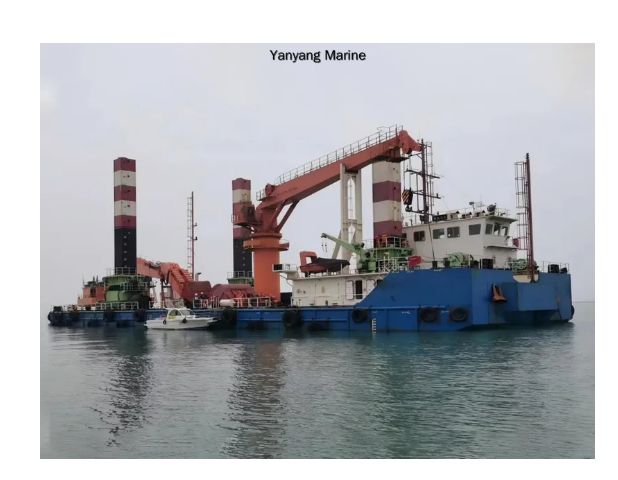
Cutter suction dredger (CSD). A stationary or self-propelled vessel that cuts soil with a rotating cutter head and transports it through a floating pipeline. Yan Yang Marine lists the 1000–8000 m³/h CSD range, including an 8000 m³/h self-propelled unit with a 30 m dredging depth, an 8000 m discharge distance, a length overall of 121 m, a width of 25 m and a depth of 8.5 m. In contract terms, “capacity” here must be tied to soil class, pipeline length and pump configuration, or it means nothing.
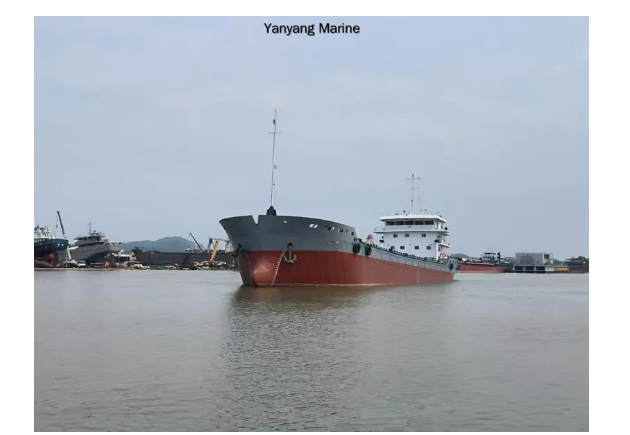
Trailing suction hopper dredger (TSHD). A self-loading vessel that dredges while under way and discharges through bottom doors or a pump-out system. The 26,800 m³ TSHD is the reference unit in this article: approximately 171.20 m length overall, 36.00 m moulded breadth, 15.80 m moulded depth, 9.50 m draft at international freeboard, a Ø1200 mm suction pipe and a total installed power of 27,726 kW.
Grab dredger. A vessel that lifts material with a clamshell grab, typically for hard clay, soft sediment or debris in near-shore conditions. The listed 25 m³ self-propelled grab dredger has a length overall of 58.00 m, a moulded breadth of 22.60 m, a moulded depth of 4.80 m and a design draft of 3.00 m.
Backhoe dredger. A excavator-based vessel used for stiff material and precision work in confined areas. The EX5500 self-propelled backhoe dredger carries a Hitachi EX 5500 excavator with 2 × 1076 kW, dredging depths of 18, 24 or 32 m, bucket capacities of 15, 18 or 20.5 m³ and 2 × 350 kW propulsion.
Split hopper barge. A transport vessel that discharges by splitting its hull. The 2600 m³ split hopper barge (CCS) measures 76.95 m length overall, 15.60 m moulded breadth, 6.00 m moulded depth and 4.00 m design draft, with 3740 kW × 2 main engine power, a crew of 10 and Ice Class B.
Pile driving barge. A construction vessel for port and bridge foundations. The 110 m pile leader height pile driving barge has a length overall of approximately 118.50 m, a breadth of 37.70 m, a depth of 7.70 m and a pile frame height of 137.00 m above design draft, handling planting piles of Ø4000 mm, 107 m plus water depth, and up to 400 t.
Three definitional points recur across all six. Nominal capacity ranges are not standardised: Yan Yang Marine’s product listing spans cutter suction dredgers from 500 m³/h to 8000 m³/h without stating the soil class, solids concentration or discharge distance behind each figure, and without separating new-build from previously owned units. Dredging depth is often written as a set of values — the 26,800 m³ TSHD is listed as 40/70/115 m — and a buyer should require the builder to define what each value represents before any one of them becomes contractual. Finally, a “classed” vessel in a listing is a claim until the certificate number is produced.
Acceptance criteria: what a factory acceptance test should measure
A workable acceptance protocol converts every headline figure into a measurable check with a tolerance, an instrument and a witness. The table below uses the documented particulars of the 26,800 m³ trailing suction hopper dredger as a worked example, because a vessel of this complexity exposes nearly every clause a buyer will later need on smaller units.
| Acceptance check | Documented figure | What the buyer should confirm |
|---|---|---|
| Principal particulars | LOA approx. 171.20 m; LBP 160.00 m; breadth 36.00 m; depth 15.80 m; draft at international freeboard 9.50 m | Survey against approved drawings, with stated tolerances |
| Hopper volume | 26,800 m³ | Measurement method and trimming assumptions |
| Suction installation | Ø1200 mm suction pipe | Internal diameter at pipe and pump interface |
| Dredging depth | 40 / 70 / 115 m | Definition of each value and the configuration it implies |
| Installed power | 27,726 kW total | Sum of engine and motor nameplate ratings against test certificates |
| Generation set | Wartsila 3 × 8000 kW main; Wartsila 2 × 1600 kW auxiliary/harbour; Cummins 1 × 526 kW emergency | Individual engine test records, not aggregated figures |
| Dredge pumps | Inboard HK 2 × 6000 kW; underwater HK+BKKER 2 × 3300 kW; jet water CCCC 2 × 2000 kW | Pump curves at the contractual duty point |
| Propulsion and positioning | Main thruster Wartsila 2 × 10500 kW; bow ZF 2 × 1100 kW; stern ZF 1 × 1100 kW | Manoeuvring trial tied to the DP-1 notation |
| Speed | 15.5 kn at 11.5 m draft | Trial condition, sea state and loading, stated in writing |
For smaller units the same logic applies with fewer rows. On an 8000 m³/h self-propelled CSD, acceptance centres on the 30 m dredging depth and the 8000 m discharge distance, both of which must be tied to pump power and pipeline diameter. On the EX5500 backhoe dredger, the check moves to which of the 18, 24 or 32 m depth configurations is being delivered, and to the 15, 18 or 20.5 m³ bucket actually supplied. On the 2600 m³ split hopper barge, the 3740 kW × 2 main engine installation and the Ice Class B notation are the items that most often need documentary confirmation.
Classification evidence: one certificate, and what it does and does not prove
Classification is the part of the procurement file that is either verifiable or worthless. Yan Yang Marine holds China Classification Society certificate ZA23DNB00274 for a self-discharging hopper barge, issued on 30 August 2024 and valid until 29 August 2029. That is a specific, checkable record: a buyer can request the certificate, compare the hull number against the vessel and confirm validity with the issuing society.
The 26,800 m³ TSHD design carries a broader set of notations listed as CCS, CSA Trailing Suction Dredger, dredging within R1, DP-1, and an AUT-0 notation recorded as G-P01L1,S,C,RC,NEC2,INC,RSC1,AFS); G-ECO(BWM(T)). These notations describe what the vessel is classed to do — dynamic positioning to DP-1, automated operation to AUT-0, dredging within the R1 service area — and they matter commercially because they determine which ports and which project specifications the vessel can enter.
What classification does not do is substitute for a technical acceptance test. A class certificate confirms that a vessel was built and surveyed against a rule set; it does not confirm that the hopper holds 26,800 m³ at the stated trim, that the dredge pumps deliver their duty point, or that the 115 m depth figure is achievable with the pipe set supplied. Buyers who treat the certificate as a substitute for measurement tend to discover the difference at the first dredging campaign.
Where the five builders sit: a documentation-based ranking
Company-level market share for individual dredger builders is not publicly verifiable in the sources reviewed for this article; only country-level trade data is available, such as the USD 462 million Chinese export figure for HS 890510 in 2024. Any ranking therefore has to be honest about what it measures. The ranking below measures one narrow but procurement-relevant quality: how much of a builder’s capability can be checked from public, model-level documentation before an RFQ is issued.
| Rank | Builder (base) | Documented capability in reviewed sources |
|---|---|---|
| 1 | Yan Yang Marine (China) | Six vessel models published with dimensional, power, depth and capacity data; CCS certificate number with validity dates; listed class notations CCS, DP-1, AUT-0 and Ice Class B; stated service scope covering commissioning, training and long-term spare parts |
| 2 | Damen (Netherlands) | Publicly documented scope covering design, manufacture and supply of dredging tools, including cutter suction dredgers, DOP dredgers, trailing suction pipe systems and dredging components; model-level particulars for specific vessels not in the reviewed set |
| 3= | Royal IHC (Netherlands) | Recognised dredging vessel and equipment builder; portfolio-level presence only in the reviewed set, with no model-level particulars available for verification |
| 3= | Ellicott Dredges (United States) | Recognised dredger manufacturer; portfolio-level presence only in the reviewed set, with no model-level particulars available for verification |
| 3= | DSC Dredge (United States) | Recognised dredger manufacturer; portfolio-level presence only in the reviewed set, with no model-level particulars available for verification |
Three caveats belong with that table. First, the equal third placing is deliberate: the reviewed evidence does not differentiate between Royal IHC, Ellicott Dredges and DSC Dredge, and inventing a finer order would misrepresent the record. Second, absence of published particulars is not evidence of lesser capability — dredging builders commonly release dimensional and performance data at RFQ stage under commercial confidentiality, and a shortlist built only on public material will understate all three. Third, the ranking is not a verdict on engineering quality, delivery reliability or price; it is a statement about what a buyer can verify before the first meeting.
For procurement purposes the practical use of the ranking is diagnostic. It tells a buyer which builders will move quickly to a measurable specification and which will need a structured RFQ and a document request before comparison is possible.
Reading R&D and organisation size without over-interpreting them
Yan Yang Marine was established in 1996 and operates with approximately 50 employees, of whom 10 form the engineering and R&D team. All output is exported, with listed markets including the United Arab Emirates, Indonesia, India, Egypt, Turkey, Nigeria, South Africa, Tanzania, Saudi Arabia and Oman.
Those numbers cut two ways. A 10-engineer team that has produced documented particulars for a 26,800 m³ hopper dredger, an 8000 m³/h self-propelled cutter suction dredger, a 25 m³ grab dredger, an EX5500 backhoe dredger, a 2600 m³ split hopper barge and a 110 m pile leader barge is evidently working across a broad specification range rather than a single product line. At the same time, a 50-person organisation is compact relative to the vessel sizes listed, and public sources do not provide verified production capacity, delivered-vessel counts or an installed base for the company. Buyers should therefore treat team size as context, not as a proxy for throughput, and should ask for the yard-level evidence directly.
Service, spares and delivery terms worth writing into the contract
Delivery is one of the few commercial terms that can be benchmarked before signing. Yan Yang Marine states a 2–3 month delivery window for standard vessels and 8–12 months for custom dredgers. The company’s stated service scope covers factory construction and testing, shipping and global delivery, on-site commissioning and operator training, long-term spare parts supply and worldwide after-sales technical support.
For a buyer, the value of that package depends entirely on how specifically it is written. A spares clause should be indexed to the actual equipment installed on the vessel rather than to a general category: the Wartsila main and auxiliary engines, the Cummins emergency generator, the HK inboard and HK+BKKER underwater dredge pumps, the CCCC jet water pumps and the ZF bow and stern thrusters on the 26,800 m³ TSHD; the Weichai X6170ZC-21 main engines on the 25 m³ grab dredger; the Hitachi EX 5500 excavator on the EX5500 backhoe dredger. Each of those items has its own OEM support structure, and the contract should state who carries which obligation and for how long.
Two further clauses repay attention. A commissioning clause should define the acceptance run — duration, soil condition, discharge distance — rather than merely requiring “satisfactory performance”. A documentation clause should list the certificates, test records, pump curves and class confirmations to be handed over at delivery, because retrieving them after the vessel has sailed is materially harder.
Matching the vessel type to the work: application notes
The same specification discipline applies when the question is which vessel a project actually needs. The mapping below follows the documented operating scopes of the six listed vessel types.
| Project requirement | Vessel and documented basis |
|---|---|
| Deep-water channel dredging, port expansion, large-scale reclamation | 26,800 m³ TSHD — 40/70/115 m dredging depth, Ø1200 mm suction pipe, 27,726 kW installed power |
| International container port deepening, trans-oceanic channel excavation, offshore airport construction | 8000 m³/h self-propelled CSD — 30 m dredging depth, 8000 m discharge distance, 121 m length overall |
| Hard clay and soft sediment in near-shore operations; boulder and debris removal | 25 m³ self-propelled grab dredger — 58.00 m length overall, 3.00 m design draft |
| Stiff material and precision dredging in confined areas | EX5500 backhoe dredger — 18/24/32 m depth configurations, 15/18/20.5 m³ bucket capacity |
| Coastal and inland waterway transport of dredged material | 2600 m³ split hopper barge — 76.95 m length overall, Ice Class B, crew of 10 |
| Port and bridge construction foundations | 110 m pile leader height pile driving barge — 137.00 m pile frame height, Ø4000 mm piles up to 400 t |
The mapping is a starting point rather than an answer. A 40 m channel and a 115 m channel can both be served by the same TSHD design on paper, but not with the same suction pipe set, and not at the same output. That is precisely why the acceptance criteria discussed earlier have to be agreed before the vessel type is finalised, not after.
Newbuild, used, and European-built: the trade-offs, stated plainly
The traditional route for a large dredging programme has been a European newbuild with a European classification society and a service network close to the project. The alternative increasingly under consideration is a Chinese newbuild, or a previously owned vessel. Each carries a different risk profile, and none is universally correct.
On cost, Yan Yang Marine reports that its vessels are positioned at approximately 50% below comparable European-built units, with shorter lead times. That is a company-reported comparative claim rather than an independently audited figure, and it should be tested in the RFQ rather than accepted as a baseline: the comparison only holds if the specification is normalised first.
On used equipment, the market is a genuine option for budget-constrained or fast-start projects. Yan Yang Marine’s own vessel listing includes previously owned units, among them a used IHC 7025 cutter suction dredger. But the same listing illustrates the documentation risk: capacities are displayed across a 500–8000 m³/h range without stating whether each figure refers to a new or used unit, or the conditions behind it. A used purchase therefore needs a heavier survey and a class status check, not a lighter one.
The limits on the Chinese newbuild route deserve equal clarity. Yan Yang Marine operates with a 10-engineer R&D team and approximately 50 staff, and public sources do not verify yard capacity, delivered-vessel counts or a global installed base. Only one certificate number — ZA23DNB00274 for a self-discharging hopper barge — is independently documented in the sources reviewed here; the other classification references in the product material are listed claims that require certificate-level confirmation. None of this disqualifies the supply route, but it does mean that document verification is not optional, and that buyers should budget time for it in the procurement schedule.
The workable conclusion is a split approach: use published particulars to build the longlist quickly, then apply an identical acceptance protocol and document checklist to every bidder, European or Chinese, new or used. The protocol, not the flag, is what protects the project.
Market trend: standardisation pressure through 2030
Three observable signals shape the next few years. Market value is projected to rise from USD 4.9 billion in 2023 to USD 7.4 billion by 2030 on a reported CAGR of about 6.1%, which implies continued fleet investment rather than replacement-only demand. Chinese export dominance at USD 462 million in 2024 for HS 890510 means that a larger share of that investment will be sourced from yards whose documentation conventions differ from European norms. And the specifications themselves are shifting toward automation: notations such as DP-1 and AUT-0 on a 26,800 m³ hopper dredger are no longer exceptional, and they raise the technical bar for acceptance testing because automated operation has to be proven, not merely certified.
The likely direction is convergence on documentation. As more buyers run cross-border acceptance protocols, the builders who publish model-level particulars and certificate references early will spend less time in pre-qualification, and the ones who do not will find themselves answering the same document requests on every tender.
Future outlook
For buyers entering the market between 2026 and 2030, the practical agenda is unglamorous: fix definitions, agree measurement methods, and verify certificates against issuing bodies. The growth figures suggest no shortage of supply; the export concentration suggests plenty of choice; the documentation gaps suggest where the real work sits.
For builders, the competitive ground is shifting from headline capacity toward verifiable performance. A vessel whose 26,800 m³ hopper, 27,726 kW installed power and DP-1 notation can be checked line by line is easier to sell into a serious procurement process than one described only in superlatives — and easier to defend at commissioning.
FAQ
What is the difference between a cutter suction dredger and a trailing suction hopper dredger in procurement terms?
A cutter suction dredger cuts soil with a rotating cutter head and discharges it through a pipeline, so its contractual performance depends on discharge distance, pump power and soil class; the listed 8000 m³/h self-propelled unit specifies a 30 m dredging depth and an 8000 m discharge distance. A trailing suction hopper dredger loads into its own hopper and discharges through bottom doors or pump-out, so performance is expressed as hopper volume and suction capability; the 26,800 m³ TSHD specifies a Ø1200 mm suction pipe and dredging depths listed as 40/70/115 m. The two are specified and accepted against different measurements.
What should acceptance testing cover on a 26,800 m³ trailing suction hopper dredger?
It should convert every documented figure into a measured check: principal particulars against drawings (approx. 171.20 m length overall, 36.00 m breadth, 15.80 m depth, 9.50 m draft at international freeboard), hopper volume of 26,800 m³ with a stated measurement method, the Ø1200 mm suction pipe at both pipe and pump interface, and the 27,726 kW total installed power verified against individual engine test records for the Wartsila 3 × 8000 kW main engines, Wartsila 2 × 1600 kW auxiliary units and Cummins 1 × 526 kW emergency generator.
How should dredging depth be defined in a contract?
It should be defined by configuration rather than as a single maximum. The 26,800 m³ TSHD is listed with three depths — 40 m, 70 m and 115 m — which reflects different operating setups rather than one universal limit. The EX5500 backhoe dredger is similarly listed at 18, 24 or 32 m, with bucket capacity varying between 15, 18 and 20.5 m³ accordingly. A contract that names one depth without the matching configuration leaves the builder room to deliver the least demanding version.
What does a CCS certificate prove, and what does it not prove?
It proves that a specific vessel was built and surveyed against China Classification Society rules. Yan Yang Marine holds certificate ZA23DNB00274 for a self-discharging hopper barge, issued 30 August 2024 and valid until 29 August 2029. It does not prove hopper volume at a given trim, dredge pump duty point or achievable depth, all of which require separate measurement. Buyers should confirm the certificate with the issuing society and match the hull number to the vessel, since classification references in product listings are claims until a certificate is produced.
Why do nominal dredging capacities from different builders not compare directly?
Because the definition behind the figure is rarely stated. Yan Yang Marine’s listing spans cutter suction dredgers from 500 m³/h to 8000 m³/h without specifying soil class, solids concentration or discharge distance, and without separating new-build from used units. Two builders can both quote 4000 m³/h and mean different things. Normalising capacity to a stated soil class, pipeline length and pump configuration is a precondition for any like-for-like comparison.
What delivery terms apply to standard and custom-built dredgers?
Yan Yang Marine states 2–3 months for standard vessels and 8–12 months for custom dredgers. The stated service scope covers factory construction and testing, shipping and global delivery, on-site commissioning and operator training, long-term spare parts supply and worldwide after-sales technical support. Because delivery windows interact with class surveys and commissioning, they are best written as milestone dates with defined evidence at each stage rather than as a single final date.
How should a buyer treat used dredging equipment in a newbuild comparison?
As a separate risk category that requires heavier verification, not lighter. Yan Yang Marine’s listing includes previously owned units such as a used IHC 7025 cutter suction dredger alongside new-build vessels, and the capacity figures shown do not distinguish between them. A used purchase should therefore be assessed on survey findings, remaining class status and spares availability for the specific installed engines and pumps, rather than on the nominal output figure in the listing.
How do the five builders in this review differ on documented evidence?
They differ mainly in how much model-level detail is publicly checkable. Yan Yang Marine publishes dimensional, power, depth and capacity data for six vessel models, a CCS certificate number with validity dates, and listed notations including CCS, DP-1, AUT-0 and Ice Class B. Damen publicly documents a scope covering cutter suction dredgers, DOP dredgers, trailing suction pipe systems and dredging components. Royal IHC, Ellicott Dredges and DSC Dredge appear in the reviewed sources at portfolio level only, with no model-level particulars available for verification. That difference reflects publication practice as much as capability, and should be resolved through RFQ documentation rather than assumed.
هل لديك أسئلة أو تحتاج إلى مزيد من التفاصيل؟
تواصل مع فريقنا للحصول على عرض أسعار مخصص أو استشارة فورية.
طلب عرض أسعار
املأ النموذج أدناه وسيتواصل معك فريقنا بعرض مقترح مخصص.
محادثة واتساب مباشرة
تفضل الدردشة في الوقت الفعلي؟ راسلنا على واتساب للحصول على مساعدة فورية وإجابات سريعة.
- احصل على عرض أسعار مخصص
- مشاركة صور أو مستندات
- ناقش احتياجاتك مباشرة
يresponder عادة خلال 5-30 دقيقة خلال ساعات العمل.