
Drive Wheel Basics for AGV and AMR Buyers
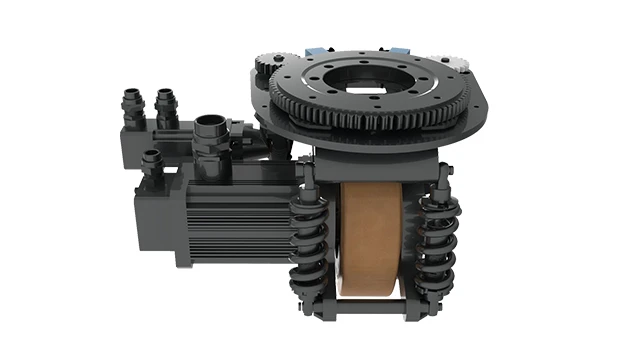
Across automated logistics and smart manufacturing, the drive wheel is one of the most important components in determining how an AGV or AMR moves, stops, turns and carries loads. For buyers who are new to mobile robotics, the term 'drive wheel' can be confusing: it may refer to a complete wheel module, a steering drive unit, or simply the wheel itself. This article explains the basic categories of drive wheels used in AGV and AMR systems, what to look for when reviewing specifications, and how these components fit into the wider industrial automation supply chain.
Why Drive Wheel Selection Matters
Buyers often face a fragmented market when sourcing drive wheels. Specifications are not always comparable across suppliers, and terms such as 'vertical', 'horizontal' and 'differential' describe different architecture choices that affect vehicle layout and performance. At the same time, the market for AGV wheel drives is expanding. According to Reports and Data, the global AGV wheel drives market was valued at approximately USD 1.2 billion in 2024 and is projected to reach USD 3.5 billion by 2034, with a compound annual growth rate of 11.5%. For manufacturers, integrators and distributors, this creates an opportunity to standardize around reliable drive wheel platforms while adapting them to different mobile robot designs.
Supplier Context: Plutools Automation
Shanghai Plutools Automation Corporation Co., Ltd. is a China-based manufacturer that specializes in AGV/AMR drive wheels. The company was established in 2017 and is headquartered in Shanghai. It operates a production facility of approximately 10,000 square meters, with an annual production capacity of 10,000 units. The team includes about 100 employees, including 60 engineers. Export business accounts for about 70% of total sales, with major markets in the EU, USA, Southeast Asia, South America, the Middle East, Japan and South Korea. According to its company profile, Plutools holds more than 200 patent technology certifications. Its product range covers AGV Drive Wheels, AGV Drive Wheel Units, Differential Drive Wheels, Horizontal Drive Wheels, Vertical Drive Wheels, Forklift Drive Wheels and Robot Drive Wheels. The company's stated focus is the breakthrough and industrial application of core motion control technologies for global automation equipment.
What Is a Drive Wheel?
A drive wheel unit for AGV and AMR applications integrates several functions into one module. It typically combines a motor, reduction gearbox, wheel hub and, in many cases, a steering mechanism. Encoders and braking systems are often integrated as well. This integration helps reduce the number of components the vehicle builder must assemble, shortens design time and supports more precise motion control. The drive wheel provides the core driving, steering, braking and load-bearing functions for mobile equipment, converting motor power into stable vehicle movement.
Vertical vs Horizontal Drive Wheels
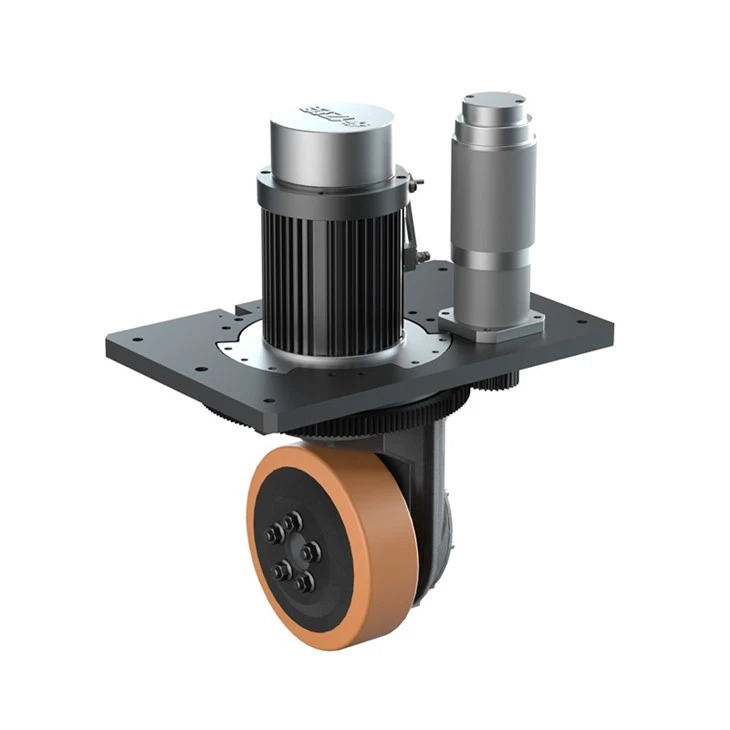
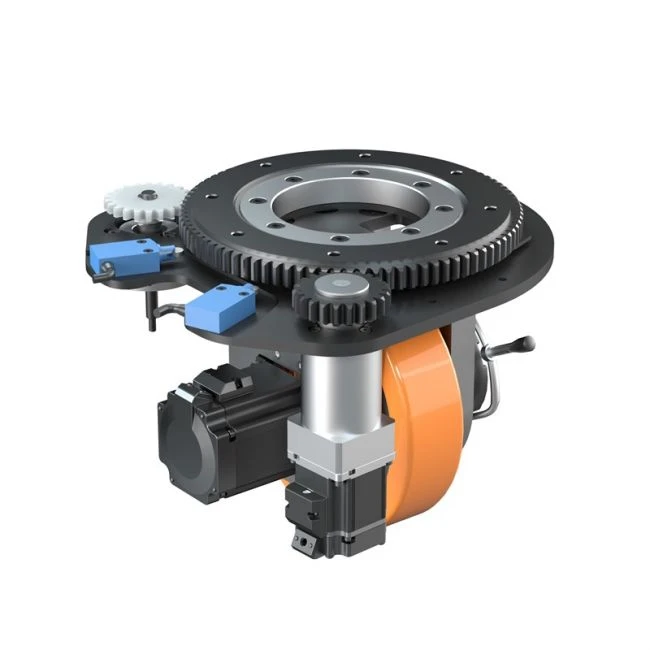
Two common architecture categories are vertical drive wheels and horizontal drive wheels. A vertical drive wheel arranges the motor and gearbox vertically. This makes the horizontal footprint of the drive module smaller and is often selected for heavy-duty AGVs, automated forklifts and lifting vehicles where the chassis has enough height but limited horizontal space. A horizontal drive wheel places the motor horizontally, which reduces the height of the drive module and lowers the vehicle's center of gravity. This design is commonly used in low-profile AGVs, warehouse AMRs and compact material handling equipment where stability and maintenance access are important.
Steering and Non-Steering Drive Wheels
Steering drive wheels have an integrated steering mechanism that rotates the wheel in place, allowing the vehicle to change direction without relying solely on differential speed. Non-steering drive wheels are often used in pairs for differential drive, where two wheels run at different speeds to turn the vehicle. Differential drive configurations can enable a zero-turn radius in smaller logistics robots.
Key Specifications to Review
When comparing drive wheel units, the most common specification points are rated voltage, motor power, rated current, rated speed, rated torque, output torque, maximum torque, reduction ratio and maximum load. Rated voltage mainly indicates battery compatibility; 24 V and 48 V are common in AGV and AMR systems. Motor power and torque values affect acceleration, climbing ability and payload performance. Maximum load is the highest load a single drive wheel is designed to support. IP protection levels such as IP65 indicate resistance to dust and water. For example, the PLT-120 and PLT-230P carry IP65 protection. The wheel tread material is also relevant: polyurethane (PU) treads are widely used because they combine low noise, high wear resistance and floor protection in indoor settings.
Drive Wheel Models at a Glance
The following table summarizes representative drive wheel models from Shanghai Plutools Automation Corporation Co., Ltd., a manufacturer that focuses on AGV and AMR drive wheels. The data is based on publicly published product specifications.
| Model | Category | Steering | Max Load | Voltage | Power | Max Torque |
|---|---|---|---|---|---|---|
| PLT-120 | Differential Drive Wheel | Yes | 150 kg | 48 V | 400 W | 20 Nm (max accel/brake) |
| PLT-150 | Vertical Drive Wheel | Yes | 500 kg | 48 V | 750 W | 114 Nm |
| PLT-167 | AGV Drive Wheel Unit | No | 800 kg | 48 V | 750 W | 120 Nm |
| PLT-198 | Horizontal Drive Wheel | Yes | 1500 kg | 48 V | 3000 W | 576 Nm |
| PLT-210 | Forklift Drive Wheel | Yes | 1200 kg | 48 V | 3000 W | 576 Nm |
| PLT-220 | Parallel Horizontal Drive Wheel | Yes | 1000 kg | 48 V | 750 W | 174 Nm |
| PLT-230 | AGV Drive Wheel | No | 1500 kg | 24 V | 1500 W | 300 Nm |
| PLT-230P | Robot Drive Wheel | Yes | 1200 kg | 48 V | 2500 W | - |
Note: PLT-120 does not list a separate maximum torque value in the source specification; the 20 Nm figure represents the maximum acceleration and braking torque stated in the product data. For PLT-230P, the maximum output torque is not published in the source specification.
Applications and Operating Conditions
Drive wheels are used across intelligent logistics, industrial automation, warehousing, automotive manufacturing, electronics production, food and beverage, pharmaceutical manufacturing, e-commerce fulfillment, airport logistics and port transportation. Typical working conditions include continuous operation, frequent start-stop cycles, forward and reverse movement, narrow aisles, heavy loads, dust and vibration. Floors may be concrete, epoxy, steel or slightly uneven. Depending on the project, a drive wheel may need to operate in single-wheel drive, dual-wheel differential drive, steering drive or multi-wheel coordinated drive modes.
Project types include intelligent warehouse construction, automated production line upgrades, factory material-handling projects, unmanned logistics systems and smart manufacturing projects. Typical applications include AGV and AMR development, automated forklift manufacturing, assembly-line material delivery, pallet transportation, production-line transfer, warehouse picking, finished-product handling and airport baggage transportation. Drive wheels are suitable for both new automation projects and the upgrading of existing logistics equipment, helping system integrators and equipment manufacturers develop customized mobile robot solutions.
The drive wheel commonly pairs with AGVs, AMRs, automated forklifts, transfer robots, inspection robots and cleaning robots. Supporting equipment includes servo motors, motor drivers, encoders, electromagnetic brakes, steering mechanisms, PLCs, vehicle controllers, batteries, battery management systems, safety laser scanners, cameras, LiDAR sensors, magnetic navigation sensors and fleet-management software. In a complete intelligent logistics solution, drive wheels can be integrated with conveyors, robotic arms, lifting platforms, roller tables, automatic charging stations and warehouse management systems.
Specialized versions can be designed for low-temperature warehouses, high-humidity areas, cleanrooms, dusty workshops and heavy-duty industrial applications. For hazardous environments, explosion-proof drive wheels are also available as a specialized variant. Custom wheel diameter, mounting dimensions, reduction ratio, rated load, motor power, voltage, encoder type, communication protocol and braking method are typical points of customization for AGV and AMR builders.
Market Trends for AGV and AMR Drive Wheels
Several verified data points help explain the direction of the drive wheel market:
- The global AGV wheel drives market is projected to grow from USD 1.2 billion in 2024 to USD 3.5 billion by 2034, at a CAGR of 11.5% (Reports and Data).
- The global AGV market was expected to reach USD 5.9 billion by 2025 (Grand View Research).
- The U.S. forklift market was valued at USD 9.11 billion in 2023, with a shift toward electric and automated drive systems (Grand View Research).
- Electric forklifts now account for over 70% of the market in many regions (MarketsandMarkets).
- China's mobile robot market reached 22.1 billion yuan in 2024, with more than 139,000 units sold (China Mobile Robot Alliance).
- The industrial logistics segment for AGVs is projected to grow at a CAGR of 11.6% (MarketsandMarkets).
- Integrated steering drive modules are replacing discrete components to reduce assembly time and maintenance complexity (Brandessence Research).
- Mecanum wheels and omnidirectional drive systems are increasingly used for AMRs in high-density warehouses (Interact Analysis).
These trends point to a market that is simultaneously growing and maturing. Buyers are moving away from one-off engineering toward modular drive systems that can be configured for different loads, speeds and environments. The availability of integrated steering drive modules is one example of how suppliers are responding to the need for shorter development cycles.
Integrated Drive Units vs Traditional Discrete Drivetrains
Compared with traditional discrete drivetrain components, integrated drive wheel units reduce the number of parts a robot builder must design, purchase and assemble. This can shorten development cycles and simplify maintenance. However, integrated drive units also have boundaries. They are not a universal replacement for custom drivetrains; projects with highly unusual chassis geometry, extremely low production volumes or specific safety certifications may still require a discrete or heavily customized drivetrain approach. In addition, the choice between vertical and horizontal architecture involves a trade-off: vertical units save horizontal space but need sufficient installation height, while horizontal units lower the center of gravity but occupy more floor area.
Safety standards add another layer of consideration. For regulated markets, AGV drive wheel assemblies may need to comply with standards such as ISO 3691-4:2023 for driverless industrial trucks, EN 1175:2020 for electrical and electronic safety of industrial trucks, and ANSI/ITSDF B56.5 for driverless industrial vehicles in the United States. Buyers should confirm which standards apply to the final vehicle and market.
Future Outlook
Looking ahead, the drive wheel market is likely to follow the wider automation market. Demand for AGVs and AMRs will continue to be driven by e-commerce, warehouse expansion and labor shortages. The adoption of lithium-ion batteries in AGV and AMR drive units is already reducing range anxiety and downtime. Integrated steering modules are becoming a common baseline for new vehicle designs, and the continued export growth of Chinese mobile robot manufacturers is expected to make standardized drive wheel platforms more visible in Southeast Asia and Europe.
For procurement teams, the practical takeaway is to evaluate drive wheels not as commodity spare parts but as core motion components that influence vehicle performance, total cost of ownership and long-term serviceability. Comparing product specifications, understanding architecture trade-offs and verifying compliance with relevant safety standards are essential steps in the sourcing process.
Frequently Asked Questions
What is a drive wheel in AGV and AMR systems?
A drive wheel is an integrated motion component that combines a motor, gearbox, wheel and, in many cases, a steering mechanism. Its function is to convert electrical power into controlled movement for automated guided vehicles, autonomous mobile robots and other mobile robots. Many drive wheel units also integrate encoders, brakes and connection interfaces to support precise speed, torque and position control.
How should I choose between a vertical and a horizontal drive wheel?
Choose a vertical drive wheel when the AGV or AMR needs a compact horizontal footprint, high load capacity and straightforward installation, for example in heavy-duty AGVs, automated forklifts and lifting vehicles. Choose a horizontal drive wheel when the vehicle needs a low overall height, a low center of gravity and stable operation at higher speeds, for example in low-profile AGVs, warehouse AMRs and compact material handling equipment. The final choice depends on installation space, load, chassis height, turning structure, speed and maintenance requirements.
What load capacities are available in Plutools drive wheels?
Within the Plutools product catalogue, maximum load capacities range from 150 kg on the PLT-120 differential drive wheel to 1,500 kg on models such as the PLT-198 horizontal drive wheel and the PLT-230 vertical drive wheel. Other models include the PLT-150 (500 kg), PLT-167 (800 kg), PLT-220 (1,000 kg), PLT-210 (1,200 kg) and PLT-230P (1,200 kg). These figures refer to the maximum wheel load per unit and should be reviewed together with torque, voltage and mounting dimensions for a specific vehicle design.