
Drive Wheel Buyer Framework: Acceptance Criteria for Vertical, Horizontal & Differential Units
Drive Wheel Buyer Framework: Acceptance Criteria for Vertical, Horizontal & Differential Units
A drive wheel unit is an integrated assembly that combines an electric motor, a reduction gearbox, a wheel, and — in steering configurations — a steering mechanism. It is mounted on automated guided vehicles (AGVs), autonomous mobile robots (AMRs), and industrial trucks to convert electrical power into controlled floor traction. Because the unit sits between the payload and the floor, it fixes three vehicle properties that are expensive to change later: how much mass the platform can move, how precisely it can position itself, and how well it tolerates its operating environment.
The category has shifted from a component purchase to a program decision. Third-party research values the global AGV wheel drives market at approximately USD 1.2 billion in 2024 and projects USD 3.5 billion by 2034, an 11.5% CAGR driven largely by logistics and warehouse automation (Reports and Data). China's mobile robot market reached 22.1 billion yuan in 2024 on more than 139,000 units sold (China Mobile Robot Alliance). At that volume, drive wheel acceptance criteria stop being a one-off engineering judgement and become a repeatable procurement process.
This article converts the terms that appear in drive wheel quotations — load capacity, rated voltage and current, torque, reduction ratio, protection level, material, tread, and custom load and speed options — into eight acceptance checkpoints, then applies them across vertical, horizontal, differential, forklift-class, and AGV steering units. Plutools drive wheel models are used throughout as worked examples of how each checkpoint resolves.
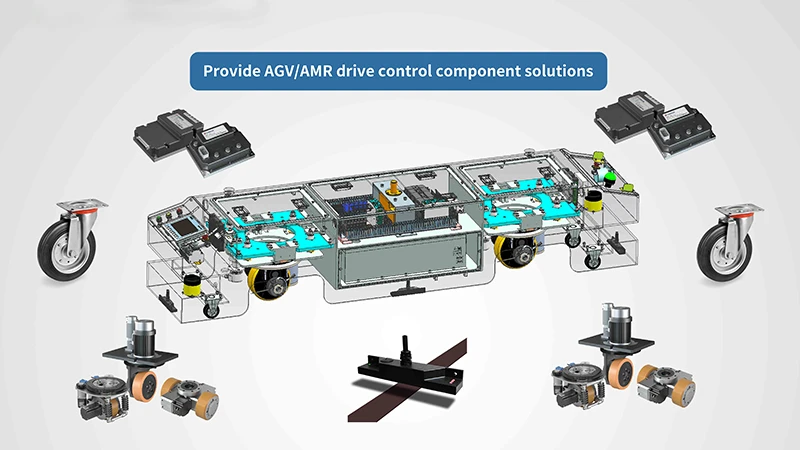
Drive wheel architectures map onto distinct AGV, AMR, and industrial truck layouts, and the mount interface is fixed at specification stage. Image: Plutools.
Why acceptance criteria moved earlier in the buying process
The traditional AGV drivetrain was assembled from separate parts: a motor, a gearbox, a wheel hub, and a steering actuator, each sourced independently and integrated by the vehicle builder. Industry analysis now points to integrated steering drive modules replacing discrete components specifically to reduce manufacturer assembly time and maintenance complexity (Brandessence Research). When the drive wheel arrives as a single tested module, the buyer's question changes from "which motor?" to "which complete unit passes our acceptance tests?"
Three demand signals reinforce that shift. Electric forklifts now command more than 70% market share in many regions as replacements for combustion models (MarketsandMarkets). The industrial logistics segment of the AGV market is projected to grow fastest, at an 11.6% CAGR (MarketsandMarkets). And omnidirectional solutions such as mecanum wheels and comparable drive systems are increasingly used in AMRs operating in high-density warehouses (Interact Analysis). More drive wheel units per vehicle, running more demanding duty cycles, raises the cost of a specification error.
The four drive wheel architectures buyers actually configure
Before checkpoints, terminology. Most drive wheel quotations fall into four architectures, and the architecture determines which checkpoints dominate the evaluation.
Vertical drive wheel units
A vertical drive wheel mounts with the motor and gearbox axis oriented vertically relative to the floor. It typically produces a compact mounting footprint and a short load path into the chassis. Three Plutools units illustrate the range. The PLT-230 AGV Drive Wheel is a vertical unit without steering, rated 24 V, 1500 W, 76 A, 2590 RPM, with 5.5 Nm rated torque, a 30:1 gear ratio, 108 Nm output torque, 300 Nm maximum torque, and 1500 kg maximum load. The PLT-150 Vertical Drive Wheel adds steering, rated 48 V, 750 W, 20 A, 3000 RPM, with 2.4 Nm rated torque, a 22.5:1 ratio, 108 Nm output torque, 114 Nm maximum torque, and 500 kg maximum load. The PLT-230P Robot Drive Wheel adds shock absorption, rated 2500 W at 48 V and 62 A, 3000 RPM, a 30:1 ratio, 1200 kg load, and IP65 protection.
Horizontal and parallel horizontal drive wheel units
Horizontal units orient the motor axis parallel to the floor and dominate heavier material handling. The PLT-167 AGV Drive Wheel Unit is a horizontal unit without steering, rated 48 V, 750 W, 18 A, 3000 RPM, with 2.4 Nm rated torque, a 21:1 reduction ratio, 40 Nm output torque, 120 Nm maximum torque, and 800 kg maximum load. The PLT-220 Parallel Horizontal Drive Wheel with steering is rated 48 V, 750 W, 18 A, 3000 RPM, with 2.4 Nm rated torque, a 28:1 ratio, 58 Nm output torque, 174 Nm maximum torque, and 1000 kg maximum load.
At the heavy end, the PLT-210 Forklift Drive Wheel is a parallel horizontal unit with steering rated 48 V, 3000 W, 68 A, 3000 RPM, with 9.55 Nm rated torque, a 32:1 reduction ratio, 260 Nm output torque, 576 Nm maximum torque, and 1200 kg maximum load. The PLT-198 Horizontal Drive Wheel is a planetary horizontal unit with steering that shares the same electrical set and 32:1 ratio, with a 1500 kg maximum load.
Differential drive wheel units
A differential drive wheel unit is used in pairs, with left and right wheels driven independently so that the vehicle steers by controlling the speed difference between them. The PLT-120 Differential Drive Wheel is specified at 400 W, 48 V, 11.2 A, 3000 rpm rated speed, 1.28 Nm rated torque, IP65 protection, a drive wheel load of 150 kg, and a total drive wheel weight of 5±2 kg. It offers two transmission ratio options, 9 and 20, with rated output torque of 10 Nm and 21 Nm and maximum acceleration and braking torque of 20 Nm and 42 Nm. Carbon steel is the specified construction material. Differential pairs are the geometry that enables a zero-turn radius, which is why they are widely used in smaller logistics robots (Mobile Robot Guide).
Steering drive wheel assemblies
Steering variants — the PLT-150, PLT-220, PLT-210, and PLT-198 — integrate the steering function into the drive wheel assembly rather than adding a separate actuator. For buyers, this changes the acceptance test: steering behaviour, steering position feedback, and the mounting interface become part of the same purchase specification as traction performance, and they must be validated together rather than as separate line items.
Step 1 — Load capacity: define the measurement point first
Maximum load is the first number buyers compare and the last one properly defined. Across the referenced Plutools range the published figures are 150 kg drive wheel load on the PLT-120, 500 kg on the PLT-150, 800 kg on the PLT-167, 1000 kg on the PLT-220, 1200 kg on the PLT-210 and PLT-230P, and 1500 kg on the PLT-198 and PLT-230.
Before those numbers are used in a comparison, an acceptance criterion should answer three questions. First, is the figure declared per drive wheel, per unit, or per complete vehicle? The PLT-120 states a drive wheel load, which is a narrower definition than a vehicle payload figure. Second, is the rating static or dynamic, and does it already include a safety factor? Third, what share of total vehicle weight does the drive wheel carry under the worst-case load position — a cantilevered mast or an off-centre pallet can push one wheel far beyond its share of the nominal payload. A framework that answers these questions before comparing suppliers avoids the common failure of selecting a unit that matches the payload number but not the load path.
Step 2 — Rated voltage and current: matching the electrical envelope
48 V is the dominant platform voltage across the referenced range: the PLT-120, PLT-150, PLT-167, PLT-220, PLT-210, PLT-198, and PLT-230P are all rated at 48 V, while the PLT-230 AGV Drive Wheel is rated at 24 V. Rated current ranges from 11.2 A on the PLT-120 differential unit to 68 A on the 3000 W horizontal units and 76 A on the PLT-230.
Voltage consistency across a range has a practical purchasing consequence: a mixed fleet can share battery and charging architecture when units are rated at the same voltage. Current is the checkpoint that drives connector rating, cable cross-section, fuse selection, and controller headroom. Two units can both be rated 48 V and still require different wiring — 18 A for the PLT-167 or PLT-220, 20 A for the PLT-150, 62 A for the PLT-230P, and 68 A for the PLT-198 and PLT-210. Current should therefore be captured in the acceptance record as an electrical design input, not as a comparison footnote.
Step 3 — Torque: three numbers with three different jobs
Drive wheel datasheets carry at least three torque figures, and they are not interchangeable. Rated torque describes continuous-duty operation at the motor. Output torque describes what the reduction gearbox delivers at the wheel. Maximum torque describes the peak the unit can absorb during acceleration, braking, or an obstruction. A buyer who compares only one of the three is comparing incomplete units.
A concrete example makes the distinction visible. The PLT-198 Horizontal Drive Wheel and the PLT-210 Forklift Drive Wheel are both rated 9.55 Nm at the input, gear-reduced 32:1, with 260 Nm output torque and 576 Nm maximum torque. The lighter PLT-220 steering unit delivers 2.4 Nm rated torque through a 28:1 reduction, producing 58 Nm output torque and 174 Nm maximum torque. The PLT-120 differential unit publishes a rated torque of 1.28 Nm alongside rated output torque of 10 Nm and 21 Nm for its two ratio options, plus maximum acceleration and braking torque of 20 Nm and 42 Nm.
The acceleration and braking figure matters most in duty cycles with frequent start-stop. It determines whether the unit can follow the commanded motion profile without entering overload protection, and it is the value an acceptance test should cite for high-cycle AGV applications. Where a datasheet does not publish all three values — as with the PLT-230P Robot Drive Wheel, which specifies 2500 W, 48 V, 62 A, 3000 RPM, a 30:1 gear ratio, 1200 kg load, and IP65 protection — the gap should be raised with the supplier rather than filled by assumption.
Step 4 — Reduction ratio and rated speed
Reduction ratios in the referenced range span 21:1 on the PLT-167, 22.5:1 on the PLT-150, 28:1 on the PLT-220, 30:1 on the PLT-230 and PLT-230P, and 32:1 on the PLT-210 and PLT-198, with the PLT-120 differential unit offering two options at 9:1 and 20:1. Rated speed is 3000 RPM on most units and 2590 RPM on the PLT-230.
Ratio and speed together define the trade-off the buyer is actually making. A higher ratio multiplies torque at the wheel but reduces achievable ground speed for a given motor speed; a lower ratio favours travel speed over gradeability. Because the ratio is fixed at order, it should be validated against the vehicle's required top speed and maximum gradient before the specification is frozen, not after the first prototype runs.
Step 5 — Protection level: what IP65 does and does not cover
IP65 protection is specified for two units in the referenced range: the PLT-120 Differential Drive Wheel and the PLT-230P Robot Drive Wheel. Several other units, including the PLT-167 AGV Drive Wheel Unit and the PLT-150 Vertical Drive Wheel, do not carry a stated IP rating in their published specification.
That gap is a genuine boundary rather than an oversight, and it changes how the checkpoint should be applied. An IP rating describes resistance to dust and water ingress; it does not describe chemical resistance, washdown frequency, cleaning agents, or ambient temperature limits. Buyers working in food processing, cold storage, or humid production areas should treat protection level as an explicit, written acceptance criterion, and should not assume that a drive wheel suited to a dry warehouse will tolerate the same conditions as an IP65 model.
Step 6 — Material and tread
The referenced Plutools drive wheel units are specified with carbon steel construction, which covers the structural and load-bearing side of the assembly. Tread compound is a separate checkpoint that determines traction, floor protection, and wear behaviour.
In industrial truck applications, polyurethane (PU) treads are commonly used because they combine higher load capacity with floor protection in indoor settings (Mordor Intelligence). For a buyer, the acceptance question is not simply "which compound?" but which combination of traction requirement, floor type, cleaning regime, and expected service life the unit is being bought to satisfy — because tread is one of the few drive wheel attributes that can be adjusted at specification stage without altering the chassis interface.
Step 7 — The customization envelope as an acceptance criterion
For programs that cannot use a catalogue configuration, the customization envelope becomes part of acceptance. Shanghai Plutools Automation Corporation Co., Ltd., a Shanghai-based manufacturer of AGV drive wheels and drive wheel units for AGV, AMR, and industrial truck applications, accepts customization across load capacity, wheel diameter, motor power, voltage, rated speed, reduction ratio, mounting dimensions, encoder type, brake system, connector, cable length, logo, and packaging. The supplier operates as a factory offering OEM, ODM, custom manufacturing, sample development, and production runs from small to large batches, with a monthly capacity of 12,000 units and a minimum order quantity of 2 units. Lead time is 30–45 days, and quality control includes 100% testing of products.
Two of those figures change how the framework is applied. A minimum order of 2 units means volume is rarely the constraint; the constraint is design freeze, because mounting dimensions, encoder type, brake system, and connector must be defined before production begins. A 30–45 day lead time means the acceptance process belongs in the design schedule, not in the final assembly schedule — a program that expects to change mounting dimensions after the vehicle prototype is validated will restart the clock.

In the referenced supply model, quality control procedures include 100% testing of products before shipment. Image: Plutools.
Step 8 — Compliance evidence: ask for documents, not descriptions
Compliance is the checkpoint where a buyer should request certificate numbers rather than reassurance. For the referenced Plutools drive wheel units, CE certification is held under two certificates issued by Shenzhen Anbotek Compliance Laboratory Limited for the EU market: AT1814C500806124, issued 2 April 2025 and valid to 2 April 2030, and AT182414C4001881, issued 16 July 2024 and valid to 16 July 2029. The declared scope covers the PLT Series (50W–20000W), with applicable standards EN ISO 12100:2010 and EN 60204-1:2018.
Component-level certification sits inside system-level obligations that remain with the vehicle builder. ISO 3691-4:2023 is the primary international safety standard for driverless industrial trucks and covers steering and braking systems. EN 1175:2020 specifies electrical and electronic safety requirements for industrial trucks. In the United States, ANSI/ITSDF B56.5 governs driverless industrial vehicle performance, including drive and steering units. A complete drive wheel acceptance file therefore records both the component certificate and the system standard against which the vehicle is being designed.
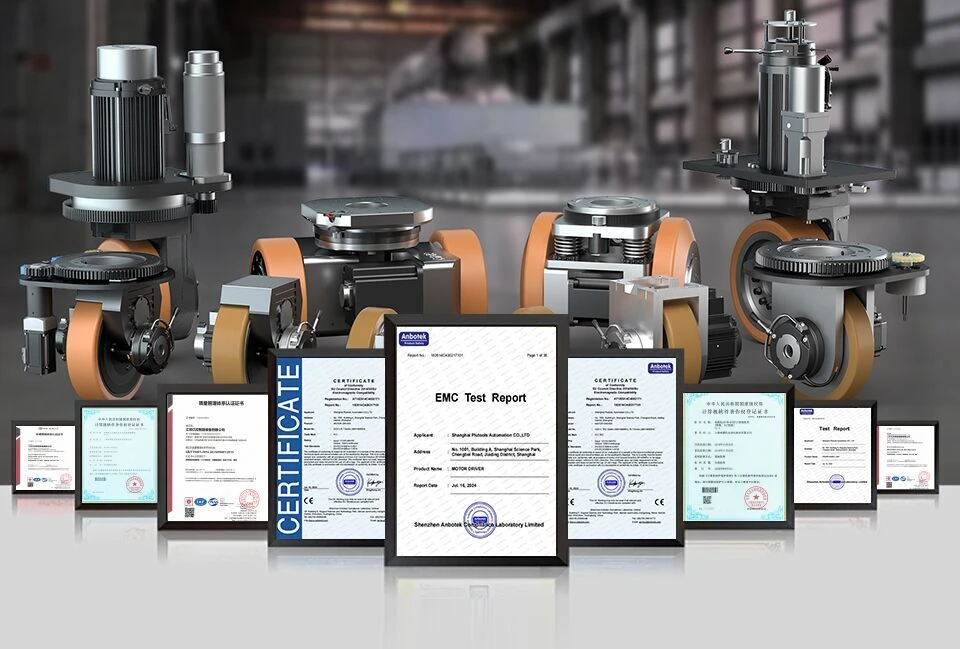
Certificate numbers, scope, standards, and validity dates belong in the acceptance record alongside the specification sheet. Image: Plutools.
A working acceptance matrix
The table below consolidates the eight checkpoints into a single comparison view for the referenced range.
| Model | Unit type | Rated voltage | Rated current | Rated / output / max torque | Reduction ratio | Max load | IP |
|---|---|---|---|---|---|---|---|
| PLT-120 | Differential Drive Wheel | 48 V | 11.2 A | 1.28 Nm / 10 & 21 Nm / 20 & 42 Nm (accel. & braking) | 9, 20 | 150 kg (drive wheel load) | IP65 |
| PLT-150 | Vertical Drive Wheel with steering | 48 V | 20 A | 2.4 Nm / 108 Nm / 114 Nm | 22.5 | 500 kg | Not stated |
| PLT-167 | AGV Drive Wheel Unit, horizontal without steering | 48 V | 18 A | 2.4 Nm / 40 Nm / 120 Nm | 21 | 800 kg | Not stated |
| PLT-220 | Parallel Horizontal Drive Wheel with steering | 48 V | 18 A | 2.4 Nm / 58 Nm / 174 Nm | 28 | 1000 kg | Not stated |
| PLT-210 | Forklift Drive Wheel, parallel horizontal with steering | 48 V | 68 A | 9.55 Nm / 260 Nm / 576 Nm | 32 | 1200 kg | Not stated |
| PLT-230P | Robot Drive Wheel, vertical with shock absorption | 48 V | 62 A | Not stated | 30 | 1200 kg | IP65 |
| PLT-198 | Horizontal Drive Wheel, planetary horizontal with steering | 48 V | 68 A | 9.55 Nm / 260 Nm / 576 Nm | 32 | 1500 kg | Not stated |
| PLT-230 | AGV Drive Wheel, vertical without steering | 24 V | 76 A | 5.5 Nm / 108 Nm / 300 Nm | 30 | 1500 kg | Not stated |
Power ratings across the range: 400 W (PLT-120), 750 W (PLT-150, PLT-167, PLT-220), 1500 W (PLT-230), 2500 W (PLT-230P), and 3000 W (PLT-210, PLT-198). All units listed are specified with carbon steel construction, and all are rated for manufacturing industry applications.
Mapping drive wheel units to application profiles
The matrix is only useful once it is read against a required task profile. Five common profiles map onto the referenced range as follows.
- Light differential-steer AMR platforms: the PLT-120 pairs two 150 kg drive wheel loads with IP65 protection, a 5±2 kg unit weight, and 9:1 or 20:1 ratio options — a configuration suited to compact robots that turn in place.
- Mid-load AGVs without steering: the PLT-167 covers 800 kg at 48 V and 18 A, and the PLT-150 covers 500 kg where a steering vertical unit fits the chassis better.
- Steering AGVs in the 1000 kg class: the PLT-220 delivers 1000 kg with 58 Nm output torque through a 28:1 ratio.
- Forklift-class and heavy material handling: the PLT-210 supports 1200 kg and the PLT-198 supports 1500 kg, both at 260 Nm output torque and 576 Nm maximum torque through a 32:1 ratio at 48 V, 3000 W.
- Heavy vertical-mount platforms: the PLT-230 delivers 1500 kg at 24 V, and the PLT-230P adds shock absorption with IP65 protection at 1200 kg.
A documented deployment illustrates how these profiles behave in practice. An AGV manufacturer and industrial automation system integrator in Brazil took delivery of 200 units for an ultra-heavy-duty AGV with multiple navigation modes, using Plutools drive wheel units to provide drive, differential steering, and precise motion control. Over a two-year period, the reported result was stable operation under heavy-load conditions, accurate route tracking, flexible steering, and reliable material transportation, with high load capacity, high output torque, precise differential control, navigation compatibility, and customised system integration identified as the deciding factors. For buyers, the relevance is not the case itself but the profile it represents: differential steering plus heavy load plus multiple navigation modes is exactly the combination that makes torque documentation and protection level non-negotiable checkpoints.
Market trends that are rewriting the acceptance checklist
Several verifiable trends explain why the framework above is becoming standard practice rather than an optional refinement.
- Category growth: the global AGV wheel drives market is valued at approximately USD 1.2 billion in 2024 and projected to reach USD 3.5 billion by 2034, with an 11.5% CAGR driven by logistics and warehouse automation (Reports and Data).
- Regional concentration: Asia Pacific accounted for a 37.6% revenue share of the global AGV market in 2025 (Grand View Research), and China recorded 22.1 billion yuan in mobile robot market scale in 2024 on more than 139,000 units sold (China Mobile Robot Alliance).
- Export orientation: China's mobile robot export volumes have increased, with leading providers targeting Southeast Asia and Europe (China Mobile Robot Alliance) — which raises the number of programs that must satisfy more than one compliance regime.
- Electrification of material handling: electric forklifts now hold over 70% market share in many regions (MarketsandMarkets), and the U.S. forklift market alone was valued at USD 9.11 billion in 2023 with a shift toward electric and automated drive systems (Grand View Research).
- Fastest-growing segment: industrial logistics is projected to grow at an 11.6% CAGR within the AGV market (MarketsandMarkets).
- Power architecture: lithium-ion battery technology now powers the majority of new AGV/AMR drive units, reducing range anxiety and downtime (Fortune Business Insights).
- Omnidirectional demand: mecanum wheels and comparable omnidirectional drive systems are increasingly used for AMRs in high-density warehouses (Interact Analysis).
- Module consolidation: integrated steering drive modules are replacing discrete components to reduce assembly time and maintenance complexity (Brandessence Research).
Market sizing itself shows why scope discipline matters. Estimates of the total AGV market differ by definition — Grand View Research places it at USD 5.9 billion by 2025, Fortune Business Insights at USD 5.52 billion, and Interact Analysis at USD 6.4 billion when AMRs are included. That divergence is a useful reminder that a market figure should always be read together with its scope, in the same way that a drive wheel load figure should be read together with its measurement point.
Integrated drive wheel units versus traditional in-house drivetrains — and where the fit stops
Comparing an integrated drive wheel unit with a traditional in-house drivetrain is a comparison of where engineering effort sits, not of which approach is superior. In the traditional model, the builder sources a motor, gearbox, hub, and steering actuator separately and owns the tolerance stack, the integration risk, and the split warranty. In the integrated model, assembly time and maintenance complexity are reduced (Brandessence Research), and the builder owns the mounting interface and the controls integration instead.
That trade has real boundaries, and buyers should test them explicitly:
- Lead time. The referenced lead time for the Plutools range is 30–45 days. A program that needs units immediately is not a fit for a customized integrated unit.
- Design freeze. Mounting dimensions, encoder type, brake system, connector, and cable length are customizable but must be defined before production. Changing them after validation restarts the cycle.
- Load ceiling. The PLT-120 is rated at a 150 kg drive wheel load and the PLT-150 at 500 kg maximum load. Platforms above the published classes require either the horizontal 1200–1500 kg units or a customization path.
- Protection is not universal. IP65 is published for the PLT-120 and PLT-230P; other units in the referenced range do not carry a stated IP rating. Applications requiring sealed units must specify accordingly and verify in writing.
- Service model. An integrated unit concentrates motor, gearbox, and wheel into a single service item, so field repair is typically replacement rather than partial rebuild. That changes spare-part planning and should be factored into total cost analysis.
- Certification scope. The referenced CE certificates cover the PLT Series (50W–20000W) for the EU market under EN ISO 12100:2010 and EN 60204-1:2018. Buyers requiring approvals for other regions must verify those separately rather than assuming coverage.
Future outlook
Three directions look likely to harden drive wheel acceptance criteria further. The first is standardisation. With ISO 3691-4:2023 addressing steering and braking systems on driverless industrial trucks, and EN 1175:2020 governing electrical safety for industrial trucks, buyers are increasingly asking suppliers to document test evidence rather than rated figures alone — which favours manufacturing processes built on 100% testing.
The second is module consolidation. If integrated steering drive modules keep displacing discrete components, the drive wheel will absorb more of the specification that used to be spread across four part numbers, and the acceptance matrix will grow to match. That shift also concentrates responsibility: the supplier's documentation quality becomes as decisive as the unit's torque curve.
The third is electrical and protection consistency. With 48 V appearing across most of the referenced range and IP65 already specified on selected units, fleet-level specifications are likely to treat both as defaults rather than options. For buyers, the practical implication is to build the acceptance file now, while the number of drive wheel variants per program is still small enough to compare by hand.
Frequently asked questions
- What is the difference between a vertical and a horizontal drive wheel?
- The difference is the orientation of the motor and gearbox axis relative to the floor, and how the assembly mounts on the chassis. A vertical drive wheel such as the PLT-230 AGV Drive Wheel or the PLT-150 Vertical Drive Wheel mounts with the motor axis vertical, which typically produces a compact footprint. A horizontal drive wheel such as the PLT-167 AGV Drive Wheel Unit or the PLT-198 Horizontal Drive Wheel orients the motor axis parallel to the floor. The choice affects chassis height, mounting footprint, steering integration, and how the load path transfers into the vehicle frame.
- How should load capacity be read on a drive wheel datasheet?
- First establish the measurement point. The PLT-120 Differential Drive Wheel is specified with a drive wheel load of 150 kg, which is a narrower definition than a vehicle payload figure. Other units in the same range are published as maximum load: 500 kg for the PLT-150, 800 kg for the PLT-167, 1000 kg for the PLT-220, 1200 kg for the PLT-210 and PLT-230P, and 1500 kg for the PLT-198 and PLT-230. Buyers should confirm whether each figure is per wheel, per unit, or per vehicle, whether it is static or dynamic, and what proportion of the vehicle load the drive wheel carries in the worst-case position.
- Which torque value matters — rated, output, or maximum?
- All three, because they describe different conditions. Rated torque is the continuous-duty figure at the motor; output torque is what the gearbox delivers at the wheel after reduction; maximum torque is the peak the unit can absorb during acceleration, braking, or obstruction. The PLT-198 Horizontal Drive Wheel and PLT-210 Forklift Drive Wheel are rated 9.55 Nm, reduced 32:1, with 260 Nm output torque and 576 Nm maximum torque. The PLT-220 delivers 2.4 Nm rated, 58 Nm output, and 174 Nm maximum through a 28:1 ratio. The PLT-120 publishes 1.28 Nm rated torque, 10 Nm and 21 Nm rated output torque for its two ratios, and 20 Nm and 42 Nm maximum acceleration and braking torque.
- Is IP65 required for an AGV drive wheel?
- It depends on the operating environment rather than on the vehicle class. IP65 protection is specified for the PLT-120 Differential Drive Wheel and the PLT-230P Robot Drive Wheel. Other units in the referenced range, including the PLT-167 AGV Drive Wheel Unit and the PLT-150 Vertical Drive Wheel, do not carry a stated IP rating in their published specification. Where dust, splash, washdown, or cleaning agents are present, protection level should be written into the acceptance criteria. An IP rating defines ingress protection only; it does not describe chemical resistance or ambient temperature limits.
- Which drive wheel configuration suits forklift-class material handling?
- Horizontal units with integrated steering and a high reduction ratio. The PLT-210 Forklift Drive Wheel is a parallel horizontal unit with steering rated 48 V, 3000 W, 68 A, 3000 RPM, with 9.55 Nm rated torque, a 32:1 reduction ratio, 260 Nm output torque, 576 Nm maximum torque, and 1200 kg maximum load. The PLT-198 Horizontal Drive Wheel is a planetary horizontal unit with steering that shares the same electrical set and reduction ratio with a 1500 kg maximum load. The higher load figure is the differentiator when the application approaches the heavier end of material handling.
- What can be customized on an AGV or AMR drive wheel unit?
- Shanghai Plutools Automation Corporation Co., Ltd. accepts customization across load capacity, wheel diameter, motor power, voltage, rated speed, reduction ratio, mounting dimensions, encoder type, brake system, connector, cable length, logo, and packaging. The supplier operates as a factory offering OEM, ODM, custom manufacturing, sample development, and production runs from small to large batches, with a monthly capacity of 12,000 units, a minimum order quantity of 2 units, and a lead time of 30–45 days. Quality control includes 100% testing of products.
- How can a buyer verify CE compliance for a drive wheel unit?
- Request the certificate number, issuing authority, declared scope, applicable standards, and validity dates, then confirm each against the product being ordered. For the referenced Plutools range, CE certification is held under certificate AT1814C500806124, issued 2 April 2025 and valid to 2 April 2030, and certificate AT182414C4001881, issued 16 July 2024 and valid to 16 July 2029, both issued by Shenzhen Anbotek Compliance Laboratory Limited for the EU market and covering the PLT Series (50W–20000W) under EN ISO 12100:2010 and EN 60204-1:2018. System-level obligations such as ISO 3691-4:2023, EN 1175:2020, and ANSI/ITSDF B56.5 remain with the vehicle builder.
For buyers who want the underlying model data behind this framework, the PLT drive wheel selection handbook covering the referenced range and mounting information is available as a downloadable reference: PLT drive wheel selection handbook. Additional product information is published at plutools.com.