
Drive Wheel Procurement FAQ: Terms, Acceptance, PLT-198 and Axis Choice
Drive wheel procurement in AGV, AMR and automated forklift programs rarely fails because the unit is wrong on paper. It fails because the purchase order, the acceptance gate and the chassis geometry were never written down to the same level of detail.
This FAQ addresses the three questions that decide whether a drive wheel order executes cleanly: what purchasing terms and acceptance criteria should actually contain, which figures from a unit such as PLT-198 belong in an RFQ, and how a buyer should choose between a vertical and a horizontal drive wheel when the chassis is already drawn.

Drive wheel acceptance is a production-floor event: what is measured before shipment defines what the buyer can later claim.
Shanghai Plutools Automation Corporation Co., Ltd. is a Shanghai-headquartered manufacturer founded in 2017, focused on AGV/AMR mobile robots and core motion control technology, with AGV Drive Wheel as its main product line. Its declared commercial and technical terms are used below as a worked example of how a procurement file should be read, not as a substitute for project-specific validation.
Why drive wheel questions surface at execution, not selection
Most programs shortlist a drive wheel on two numbers — load and voltage — and then discover during the purchase order that neither number settles the contract. Load ratings rarely state whether they are static or dynamic. Voltage says nothing about current, and current is what sizes the controller, cabling and fusing. Torque is often quoted without saying whether the figure is motor-side or wheel-side, continuous or peak.
The category is also expanding, which brings less experienced buyers into the specification process. Reports and Data values the global AGV wheel drives market at approximately USD 1.2 billion in 2024 and projects USD 3.5 billion by 2034, an 11.5% CAGR. MarketsandMarkets expects the industrial logistics segment specifically to grow at a CAGR of 11.6%. More orders are being written by teams specifying a drive unit for the first time — and that is exactly where terms and acceptance language decide outcomes.
The opportunity is straightforward: a drive wheel contract that fixes four things — commercial terms, an acceptance checklist, the duty condition attached to each torque and current figure, and the axis orientation the chassis can physically accept — removes most of the rework that occurs between prototype and pilot build.
Purchasing terms that belong in the drive wheel RFQ
Commercial terms are not paperwork. Each one sets a project constraint that is expensive to renegotiate later. The declared position for Plutools drive wheels illustrates how specific this can be made at the quotation stage.
| Term | Declared position | What the buyer should confirm |
|---|---|---|
| Minimum order quantity | 2 units | Whether a prototype build or single-vehicle pilot can be ordered without committing to batch volume. |
| Delivery terms | FOB Shanghai | Freight, insurance, duties and inland transport sit with the buyer; landed cost must be modelled separately from unit price. |
| Payment terms | 50/50 | Which milestone releases the balance — in particular whether it falls before or after the pre-shipment test is signed off. |
| Acceptance criteria | Pre-shipment test | What is measured, to what tolerance, and what record is delivered with the unit. |
The fourth row is the one that most often goes undefined. A minimum order of two units is low enough to support a single test vehicle; FOB Shanghai places the logistics burden on the buyer and should be reflected in total cost of ownership rather than compared against a delivered price elsewhere. The 50/50 split is only protective if the second instalment is anchored to an accepted test record rather than to a shipment date.
Acceptance criteria: turning 'pre-shipment test' into a checklist
'Pre-shipment test' is a label, not a specification. Two suppliers can both offer it and mean entirely different things. The buyer's job is to convert the label into a written checklist before the purchase order is issued, so that acceptance is a measurement rather than an opinion.
| Check | What to record | Why it matters |
|---|---|---|
| Nameplate versus quotation | Model, maximum load, reduction ratio, torque figures, rated speed, rated current | Prevents delivery of a unit that matches a drawing but not the commercial offer. |
| Duty condition of torque figures | Which value is motor-side rated, which is wheel-side output, and whether any peak value is time-limited | On PLT-198, 576 Nm maximum torque and 260 Nm output torque only become comparable once their duty is stated. |
| No-load run at rated speed | Vibration, abnormal noise, temperature rise, direction of rotation | The cheapest early indicator of assembly quality; PLT-198 declares a rated speed of 3000 RPM. |
| Current draw | Measured value against the declared rated current | PLT-198 declares 68 A rated current; the differential drive wheel declares 48 V at 11.2 A. Controller, cable and fuse sizing follow from this number. |
| Ingress protection | Visible IP marking where declared | The differential drive wheel declares IP65, which covers dust ingress and water jets; it does not describe the tread-to-floor interface. |
| Materials | Tread compound and body material | The differential drive wheel declares a PU tread and a carbon steel body; tread compound drives floor protection and wear behaviour. |
| Mass | Weighed unit mass | The differential drive wheel declares 5±2 kg; vehicle payload and counterweight calculations depend on it. |
| Documentation pack | Test record, rating label photo, wiring information, revision of the drawing supplied | Feeds the vehicle-level compliance file and makes repeat orders reproducible. |
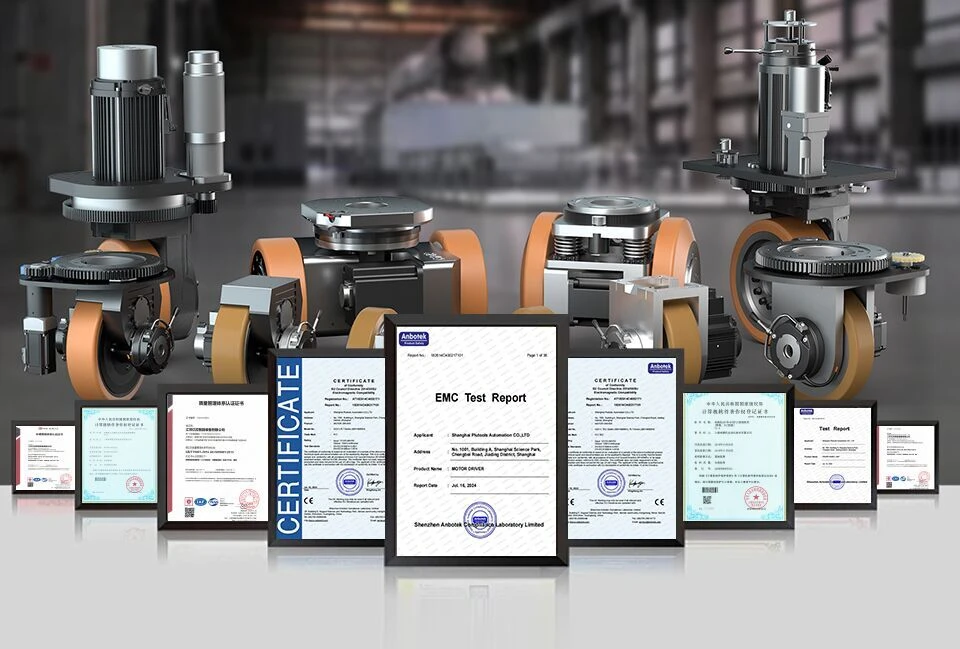
Acceptance documentation should travel with the unit: a test record is only useful if it is traceable to a specific serial number.
PLT-198: reading seven declared figures in an RFQ
PLT-198 declares a maximum load of 1500 kg, a reduction ratio of 32, a maximum torque of 576 Nm, an output torque of 260 Nm, a rated torque of 9.55 Nm, a rated speed of 3000 RPM and a rated current of 68 A. Each figure answers a different question, and each is only binding once its condition is written down.
Maximum load: 1500 kg
A maximum load figure is a ceiling, not a target. Buyers should ask whether 1500 kg is static or dynamic, at what speed it applies, on what floor condition, and whether it includes the chassis and payload together or payload alone. A unit accepted against an unclear load definition will still be 'compliant' when it underperforms on the vehicle.
Maximum torque and output torque: 576 Nm versus 260 Nm
Two different torque numbers on the same datasheet are not a contradiction; they are a headroom statement. The 576 Nm maximum describes what the unit can deliver under a peak condition, while the 260 Nm output figure describes the wheel-side output the buyer can normally design around. The RFQ should require the supplier to state how long the maximum can be sustained and whether it is thermally or electrically limited.
Rated torque and reduction ratio: 9.55 Nm and 32
The 9.55 Nm rated torque is a motor-side figure, and the ratio of 32 is the gear stage that converts motor-side values into wheel-side values. The ratio is also a consistency check: motor-side rated torque multiplied by the ratio should be reconcilable with the declared output torque. Where the arithmetic and the declared output diverge, the supplier should explain the difference in writing — gearing efficiency, duty definition or a different reference point. This kind of reconciliation is routine in RFQ review and is far cheaper than discovering the discrepancy during commissioning.
Rated speed: 3000 RPM
Speed at the motor shaft becomes speed at the wheel through the same ratio. As a first-order check, 3000 RPM divided by 32 gives roughly 94 RPM at the wheel; the vehicle's required travel speed then follows from wheel diameter. Buyers should confirm whether 3000 RPM is a rated or a maximum figure, because the two produce very different continuous-duty behaviour.
Rated current: 68 A
Current is the figure that constrains everything around the wheel — controller rating, cable cross-section, fusing and DC bus capacity. It should be quoted with its voltage and duty, and it should appear in the acceptance record as a measured value, not only as a datasheet number.
What PLT-198 does not answer
No datasheet resolves duty cycle, floor friction, gradeability or thermal behaviour under continuous operation. Those are vehicle-level questions, and they belong in an on-vehicle validation plan rather than in the pre-shipment test.
Vertical versus horizontal: a layout decision with cost and safety consequences
The choice between a vertical drive wheel and a horizontal drive wheel is primarily about installation geometry and its effect on vehicle layout, stability and maintenance — not about which unit drives better. The two orientations solve different chassis problems.
| Criterion | Vertical drive wheel | Horizontal drive wheel |
|---|---|---|
| Orientation | Motor and gearbox arranged vertically | Motor arranged horizontally |
| Effect on vehicle dimensions | Reduces the horizontal footprint of the drive unit | Reduces the height of the drive module |
| Stability | Safe when structure, load distribution and installation strength are properly designed; requires particular attention on tall or heavy vehicles | Lower centre of gravity, better anti-tipping behaviour and greater stability at higher travel speeds and during frequent turning |
| Installation | Relatively simple installation structure, but requires available installation height | May require more complex mounting and chassis design |
| Cost profile | May offer lower overall integration cost | May carry a higher initial cost, offset by reduced structural height and improved stability |
| Typical applications | Heavy-duty AGVs, automated forklifts, lifting vehicles, and chassis with limited horizontal space | Low-profile AGVs, warehouse AMRs, latent lifting robots and compact material-handling equipment |
| Maintenance access | Depends on the surrounding chassis design | Generally easier access for maintenance |
The practical decision rule follows from the table. Where the vehicle carries heavy loads, the chassis has sufficient installation height, and horizontal space is tight, a vertical drive wheel is generally the recommended choice. Where overall vehicle height is constrained and a low centre of gravity, stable high-speed travel and accessible maintenance matter more, a horizontal drive wheel is the better fit. The final choice should be made against installation space, load capacity, chassis height, turning structure, operating speed and maintenance requirements together — not against any single one of them.
When a differential drive wheel is the correct class
Differential drive wheels serve a different weight class from a heavy vertical unit, and mixing the two in one bill of materials is a common early error. The differential configuration declares IP65 ingress protection, 48 V at 11.2 A, a 150 kg load, a 5±2 kg unit mass, a polyurethane (PU) tread and a carbon steel body, with load and speed customizable.
That profile fits low-profile AMRs, warehouse robots and compact material-handling equipment, where the drive module height and unit mass matter as much as load. Polyurethane is widely used for forklift and industrial wheel tires because it combines load capacity with floor protection in indoor settings, which is why it appears in this class of unit rather than as a cost shortcut. Differential layouts also support zero-turn radius, a characteristic widely used in smaller logistics robots. The load difference is the decisive one: 1500 kg on PLT-198 against 150 kg on the differential unit is an order of magnitude, and 68 A against 11.2 A shows the same separation on the electrical side.
Market context behind the procurement question
Regional weight matters when specifying a drive unit. Asia Pacific held a 37.6% revenue share of the global AGV market in 2025, and the China mobile robot market reached 22.1 billion yuan in 2024 across more than 139,000 units sold — a supply base that buyers outside the region increasingly source from. Electric forklifts now command over 70% market share in many regions as a replacement for combustion models, which pushes more material-handling procurement into electrically driven configurations. Integrated steering drive modules are also replacing discrete components, reducing assembly time and maintenance complexity, while omnidirectional and mecanum drive systems gain ground in high-density warehouse AMRs. The direction is consistent: the drive unit is becoming a documented module with its own acceptance file rather than a component bought on a drawing.
Where a price-led purchase falls short — and where this checklist stops
Traditional drive wheel purchasing compares unit prices against a two-dimensional drawing and treats acceptance as 'it runs when installed'. It is fast, and it works when the application matches the default configuration. The documented approach described here is slower to set up, but it produces something the other approach cannot: a record that can be referenced when a second vehicle, a second production batch or a second site is added.
It also has real limits that buyers should not overlook.
- Pre-shipment testing is a unit-level gate, not a duty-cycle validation. Floor friction, gradeability and thermal behaviour under continuous operation still have to be proven on the vehicle. A unit that passes acceptance can still be the wrong unit for the application.
- Written figures bind only what is written. A supplier can deliver a fully compliant unit with an unstated duty condition. Torque and current values are only useful when the RFQ forces the condition into the document.
- Layout choices carry structural cost. A vertical drive wheel assumes available installation height. Where the chassis cannot provide it, the horizontal alternative adds mounting complexity and may raise initial cost — a trade-off that should be decided before the chassis drawing is frozen, not after.
- Class mismatch cannot be documented away. A 1500 kg heavy-duty unit is not a drop-in replacement for a 150 kg differential unit. Matching load class first avoids a full re-specification later.
What procurement terms reveal about a long-term supply relationship
For buyers planning repeat builds, the documents that matter most are the ones that survive the first order: revision control on drawings, notification of engineering changes, and continuity of spare parts across production batches. Supplier scale is one indicator of whether those processes exist. Shanghai Plutools Automation Corporation Co., Ltd. is a national high-tech enterprise with more than 22 years of industry R&D and production experience, a 60-engineer R&D team and over 200 patent technology certifications. Its manufacturing facility covers 10,000 square meters, employs approximately 100 staff and has an annual production capacity of 10,000 units, with exports accounting for 70% of sales across the EU, USA, Southeast Asia, South America, the Middle East, Japan and South Korea.
For a procurement file, those facts translate into specific contract clauses rather than general reassurance: who signs off drawing revisions, how much notice precedes a change affecting an approved unit, and how long a given configuration remains orderable. Buyers running multi-site rollouts should write those three answers into the agreement at the first order, because they are far harder to negotiate at the fifth.
Future outlook
Acceptance criteria are likely to become more standards-referenced and less supplier-defined. ISO 3691-4:2023 is the primary international safety standard for driverless industrial trucks and covers steering and braking systems; EN 1175:2020 specifies electrical and electronic safety requirements for industrial trucks; ANSI/ITSDF B56.5 governs driverless industrial vehicles in the United States. These are vehicle-level standards, and drive wheel acceptance criteria are typically derived from them rather than written independently. As integrated drive and steering modules continue to replace discrete components, the practical difference between suppliers will narrow on hardware and widen on documentation: who can supply a traceable test record, a stable revision history and a configuration that remains available two years after the first order.
FAQ
What are the purchasing terms and acceptance criteria for Plutools drive wheels?
Minimum order quantity is 2 units. Delivery terms are FOB Shanghai. Acceptance criteria are pre-shipment test. Payment terms are 50/50. Buyers should confirm in writing what the pre-shipment test measures and which record accompanies the unit, since the term itself does not define the measurement.
How should I choose between a vertical drive wheel and a horizontal drive wheel?
A vertical drive wheel is generally recommended when the AGV or AMR requires a compact structure, high load capacity and straightforward installation. Its motor and gearbox are arranged vertically, which reduces the horizontal footprint of the drive unit, and it suits heavy-duty AGVs, automated forklifts, lifting vehicles and equipment with limited chassis space. A horizontal drive wheel is more suitable when the vehicle requires a lower overall height, a low centre of gravity and stable operation at higher speeds; its motor is arranged horizontally, which reduces the height of the drive module and improves vehicle stability, and it is commonly used in low-profile AGVs, warehouse AMRs, latent lifting robots and compact material-handling equipment. The final choice should rest on installation space, load capacity, chassis height, turning structure, operating speed and maintenance requirements.
Which PLT-198 figures should appear in an RFQ?
Maximum load 1500 kg, reduction ratio 32, maximum torque 576 Nm, output torque 260 Nm, rated torque 9.55 Nm, rated speed 3000 RPM and rated current 68 A. Each figure should be quoted together with its duty condition, and the buyer should ask which values are motor-side and which are wheel-side.
How does PLT-198 differ from the differential drive wheel configuration?
PLT-198 declares a 1500 kg maximum load and a 68 A rated current. The differential drive wheel declares a 150 kg load, 48 V at 11.2 A, IP65 ingress protection, a 5±2 kg unit mass, a PU tread and a carbon steel body, with load and speed customizable. They belong to different vehicle classes and are not interchangeable within one bill of materials.
What should be recorded at pre-shipment test?
At minimum: nameplate data against the quotation, the duty condition of each torque figure, no-load running behaviour at rated speed, measured current against the declared rated current, the visible IP marking where declared, tread and body materials, weighed unit mass, and the documentation pack including the drawing revision that was manufactured against.
Can load and speed be customized?
The differential drive wheel configuration declares customizable load and speed. For PLT-198, any customization should be confirmed against the project's specific load and speed requirement before the order is placed, because the declared figures apply to the standard configuration.
Do international standards apply to drive wheel acceptance?
ISO 3691-4:2023 covers steering and braking systems of driverless industrial trucks, EN 1175:2020 specifies electrical and electronic safety requirements for industrial trucks, and ANSI/ITSDF B56.5 governs driverless industrial vehicles in the United States. These are vehicle-level standards, and drive wheel acceptance criteria are usually derived from them.
For buyers who need the full configuration range in one document, the PLT drive wheel selection manual (PDF) is available for download.
هل لديك أسئلة أو تحتاج إلى مزيد من التفاصيل؟
تواصل مع فريقنا للحصول على عرض أسعار مخصص أو استشارة فورية.
طلب عرض أسعار
املأ النموذج أدناه وسيتواصل معك فريقنا بعرض مقترح مخصص.
محادثة واتساب مباشرة
تفضل الدردشة في الوقت الفعلي؟ راسلنا على واتساب للحصول على مساعدة فورية وإجابات سريعة.
- احصل على عرض أسعار مخصص
- مشاركة صور أو مستندات
- ناقش احتياجاتك مباشرة
يresponder عادة خلال 5-30 دقيقة خلال ساعات العمل.