
Drive Wheel Scenario Fit: Forklift vs AGV vs AMR Duty Cycles
Drive Wheel Scenario Fit: Forklift vs AGV vs AMR Duty Cycles
A drive wheel is usually shortlisted on two numbers — rated load and maximum torque — and then judged in service by a third that rarely sits in the same table: duty cycle. A forklift-class vehicle that moves 1,200 kg, accelerates, brakes, steers inside a narrow aisle and repeats that sequence hundreds of times per shift asks something different of a wheel assembly than a 150 kg autonomous mobile robot (AMR) that travels almost continuously at moderate speed across an epoxy floor. Fitting the unit to the duty cycle, rather than to the largest figure on the datasheet, is what keeps a chassis predictable after commissioning.
This scenario-fit comparison maps three drive wheel configurations from Shanghai Plutools Automation Corporation Co., Ltd. — Plutools, an AGV and AMR drive wheel manufacturer based in Jiading District, Shanghai — to the duty envelopes their published specifications describe. The three units are the PLT-210 forklift drive wheel, a parallel horizontal drive wheel with integrated steering rated to 1,200 kg and 576 Nm maximum torque; the PLT-198 horizontal drive wheel, a planetary unit with steering rated to 1,500 kg with a 32:1 reduction ratio; and the PLT-120 differential drive wheel, a 400 W, IP65 unit rated to 150 kg of drive-wheel load. Product names below follow the manufacturer's own catalogue listings.
Why the duty cycle decides before the specification does
Published application guidance for drive wheels describes a demanding and fairly consistent operating picture: indoor factories, automated warehouses, production workshops, logistics centres and semi-outdoor industrial areas; continuous operation with frequent starting and stopping; forward and reverse movement; narrow aisles; heavy loads; dust, vibration and temperature variation. Floors may be concrete, epoxy, steel or slightly uneven. A specification table cannot express that mixture, but four questions can.
- How much mass must the driven wheel move, and how is it distributed? A load rating applies to a wheel, not automatically to a vehicle; the number of driven and load-bearing wheels changes the platform-level figure.
- How often does velocity change? Stop-start intralogistics work loads the assembly differently from long, near-constant travel.
- How much steering happens under load? A steering-equipped unit and a differential pair resolve direction in different mechanical ways.
- What does the floor and atmosphere do to the unit? Dust, humidity, cleaning routines and temperature are separate from torque, yet they decide whether a given enclosure is usable.
Those four answers point to a configuration before they point to a model. The sections below apply them to the three units in order of increasing vehicle mass.
Three configurations, three duty envelopes
The three units are not scaled versions of one design. Two are horizontal drive wheels with integrated steering; the third is a differential unit built around a much smaller motor. Reading them side by side makes the differences visible.
| Parameter | PLT-210 | PLT-198 | PLT-120 |
|---|---|---|---|
| Configuration | Parallel horizontal drive wheel with steering | Planetary horizontal drive wheel with steering | Differential drive wheel |
| Rated voltage | 48 V | 48 V | 48 V |
| Motor power | 3,000 W | 3,000 W | 400 W |
| Rated current | 68 A | 68 A | 11.2 A |
| Rated speed | 3,000 rpm | 3,000 rpm | 3,000 rpm |
| Rated motor torque | 9.55 Nm | 9.55 Nm | 1.28 Nm |
| Reduction ratio | 32 | 32 | 9.20 |
| Output torque | 260 Nm | 260 Nm | 10.21 Nm rated |
| Maximum torque | 576 Nm | 576 Nm | 20.42 Nm acceleration and braking |
| Rated load | 1,200 kg | 1,500 kg | 150 kg drive-wheel load |
| IP protection | Not stated in product data | Not stated in product data | IP65 |
| Drive wheel weight | Not stated in product data | Not stated in product data | 5 ± 2 kg |
Source: Plutools published product specifications. Figures are reproduced as listed; the supplier should be asked to confirm the basis of each rating for a specific vehicle design.
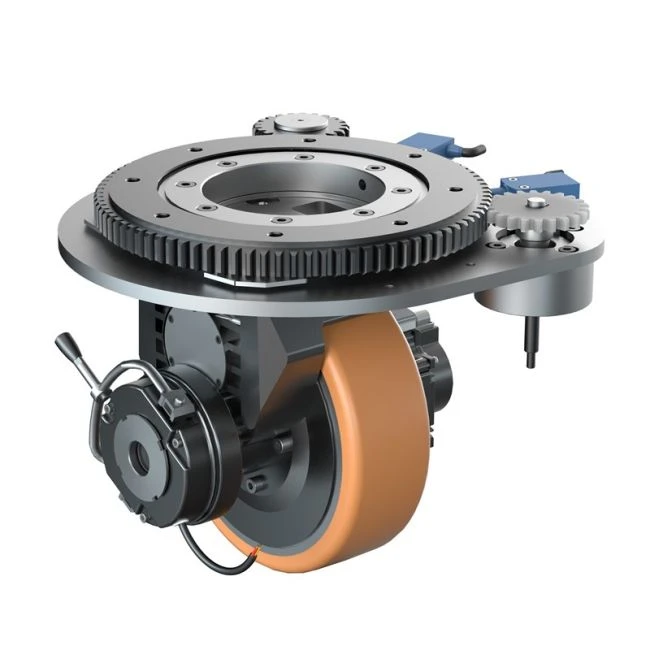
PLT-210 forklift drive wheel: parallel horizontal structure with integrated steering, rated to 1,200 kg with 576 Nm maximum torque.
Forklift-class duty: where the PLT-210 fits
The PLT-210 is listed in the Plutools catalogue as the forklift drive wheel, and its specification profile matches that role: a 48 V, 3,000 W motor drawing 68 A at 3,000 rpm, a 32:1 reduction, 260 Nm of output torque and a 576 Nm maximum, wrapped in a parallel horizontal housing with integrated steering and rated to 1,200 kg.
The steering function is the part that reshapes the chassis. In a steering drive unit, the assembly both drives and changes heading, so the vehicle can turn without relying on a separate differential pair to rotate the chassis. That matters in the narrow-aisle, frequent-direction-change operating pattern described in the application guidance for material handling equipment. For a designer, the practical consequence is layout: the steering envelope, mounting interface and cable routing have to be reserved in the chassis early, not retrofitted after the deck height is fixed.
Load and torque should be read as two separate qualifications. The 1,200 kg figure describes how much the unit is rated to carry; the 576 Nm figure describes the peak torque it can deliver. A project that selects on torque alone can end up with a unit whose structural rating is correct but whose duty profile is wrong — or the reverse. The relevant question is not which number is larger but whether the vehicle's heaviest configuration, worst-case acceleration and most frequent manoeuvre all sit inside the same envelope.
High-load horizontal duty: what the PLT-198 changes
The PLT-198 shares almost every electrical figure with the PLT-210 — 48 V, 3,000 W, 68 A, 3,000 rpm, 9.55 Nm rated motor torque, a 32:1 reduction, 260 Nm output torque and 576 Nm maximum torque — yet it is rated to 1,500 kg rather than 1,200 kg. The difference sits in the gearbox architecture: the PLT-210 uses a parallel horizontal structure, the PLT-198 a planetary horizontal structure, both with integrated steering.
That comparison is one of the more useful signals in the data set. Identical torque and different load ratings show that the load figure is a structural and bearing specification as much as a torque specification. A buyer who screens on torque alone will see no difference between these two units at all, and will lose the 300 kg of headroom that may be the entire reason to choose one over the other. The 1,500 kg rating places the PLT-198 in the heaviest material-handling duty within this set — the case where a forklift-class platform, a laden pallet truck or a heavy transfer chassis would push past the PLT-210's 1,200 kg envelope.
Because the electrical interface is nominally the same, a vehicle family can in principle use one unit for its standard model and the other for its heavy variant without redesigning the 48 V drive architecture. That is an inference about interface compatibility, not a validated result: mounting dimensions, shaft and flange details and the steering interface must be confirmed against the actual drawings before a common platform is assumed.
AGV and AMR duty: the PLT-120 inside the 150 kg envelope
The PLT-120 is a different class of unit. It is a differential drive wheel with a 400 W, 48 V motor drawing 11.2 A at 3,000 rpm, a 9.20 transmission ratio, 1.28 Nm rated motor torque, 10.21 Nm rated output torque and 20.42 Nm of maximum acceleration and braking torque. It weighs 5 ± 2 kg and carries an IP65 rating. Its drive-wheel load is 150 kg.
Those numbers describe the light, high-cycle end of intralogistics: parts-kitting AMRs, small transfer robots, inspection and cleaning platforms, and the lighter AGV formats used in electronics, pharmaceutical and e-commerce environments. The low unit weight and integrated structure are relevant to deck height and to the effort of integrating a drive module into a compact chassis; the differential layout is the conventional way to achieve tight turning within a small footprint.
The 150 kg figure deserves particular care. It is a drive-wheel load rating, and the published application guidance describes single-wheel drive, dual-wheel differential drive, steering drive and multi-wheel coordinated drive modes. A platform's usable payload therefore depends on how many driven and load-bearing wheels share the mass and on how that mass shifts during acceleration and braking. Treating 150 kg as a whole-vehicle capacity is a common reading error; the distribution calculation should be confirmed with the supplier against the actual layout.
A scenario-fit matrix for project teams
The matrix below translates the duty-cycle questions into configuration choices. Each row is a conditional fit, not a recommendation for a specific customer project; the final selection still depends on the vehicle calculation.
| Scenario class | Dominant stress | Configuration to evaluate | What to verify first |
|---|---|---|---|
| Forklift-class vehicle steering under load in narrow aisles | Repeated stop-start, steering torque, structural load | PLT-210 (1,200 kg, steering, 576 Nm max) | Worst-case laden mass and peak acceleration demand |
| Heavy transfer platform above the 1,200 kg envelope | Sustained structural load plus steering | PLT-198 (1,500 kg, planetary, 32:1) | Mounting and bearing rating for the heaviest configuration |
| Light AMR kitting and small-format transfer | High cycle count, tight turning, low unit mass | PLT-120 (150 kg per wheel, differential) | Load distribution across driven and load-bearing wheels |
| Dust, humidity or routine washdown in the route | Ingress, cleaning chemistry, condensation | PLT-120 (IP65 stated) | Whether the protection level matches the actual exposure |
| Semi-outdoor or temperature-variable industrial bay | Thermal cycling, uneven floor, vibration | Any of the three, after environmental confirmation | Documented operating range and floor condition |
Steering architecture against aisle width and chassis layout
Two of the three units integrate steering; the third does not. That single structural difference drives the chassis conversation.
A steering drive wheel combines propulsion and heading change in one assembly. For narrow-aisle work and for vehicles that must reposition frequently while carrying a load, this reduces the mechanical choreography the chassis has to perform to change direction. The cost appears in the chassis envelope: the steering sweep requires clearance, and the mounting structure must handle the reaction forces that steering under load introduces.
A differential drive wheel achieves direction change by speed difference between left and right units, which keeps each unit simple and the deck low, and suits the compact platforms on which the PLT-120 is specified. Its limitation is the opposite of its advantage: turning behaviour depends on the pair, so the wheelbase and the position of the non-driven castors become part of the steering calculation rather than a separate detail.
Neither arrangement is better in the abstract. What matters is whether the aisle geometry, the load path and the deck-height constraint are all satisfiable by the arrangement being considered — and that check should happen before the drivetrain architecture is frozen, because it is expensive to change afterwards.
Environment: IP65, PU tread and the gaps in the data
Only the PLT-120 states an IP rating in the product data: IP65. On the IEC 60529 scale that is normally read as dust-tight construction plus protection against directed water jets; it is not an immersion rating, and it says nothing on its own about chemical resistance to particular cleaning agents. For an AMR moving between a production hall, a washdown area and a chilled store, the buyer needs the exposure defined before the rating is judged sufficient.
The specifications reviewed here do not list an IP rating for the PLT-210 or the PLT-198. That is a gap in the published data, not evidence that the units are unprotected — the two statements are not the same, and treating an unlisted rating as a failure would be as careless as assuming a high one. Projects with dust, humidity or cleaning routines should ask for the enclosure information directly rather than infer it.
All three units list a PU wheel tread, described by the manufacturer as low noise and high wear resistance, and a carbon steel construction. The application guidance adds that low-temperature warehouses, high-humidity areas, cleanrooms, dusty workshops and heavy-duty industrial applications may require specially adapted versions. Floor finish interacts with tread behaviour as well: concrete, epoxy, steel and slightly uneven surfaces are all named as real operating conditions, so a tread that performs on a smooth epoxy aisle should not be assumed to perform identically on a worn concrete slab or a steel plate transition.
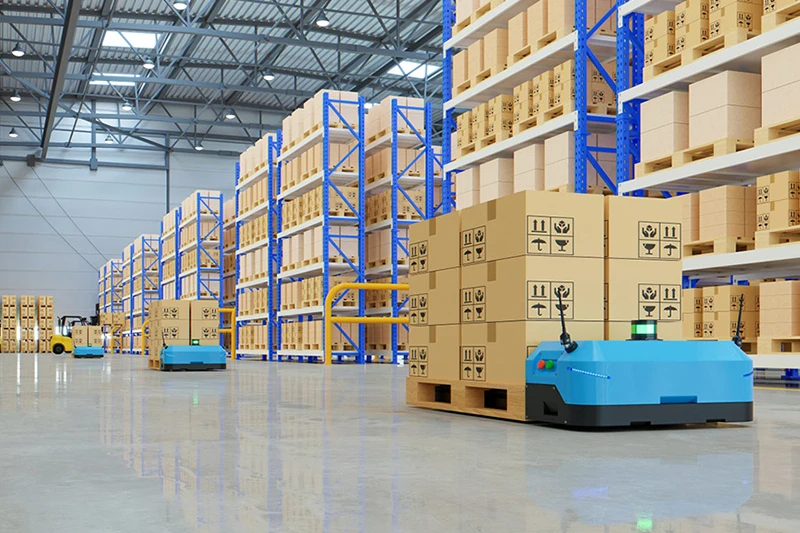
Duty cycle, not headline load, separates forklift-class, AGV and AMR drive wheel requirements in material handling operations.
Why scenario fit is becoming a procurement question
Market data supports the direction of travel without settling any individual specification decision. TrendX Insights projects the global automated guided vehicle market growing from USD 4.45 billion in 2025 to USD 12.44 billion by 2034, a compound annual growth rate of 12.1% over 2026–2034, according to the report published in September 2026. Separately, Plutools' own selection guide cites a global AGV wheel drive market of approximately USD 1.2 billion in 2024, projected to reach USD 3.5 billion by 2034.
Those two figures use different scopes — complete vehicles versus wheel drives — and should not be added, compared directly or treated as interchangeable. Their shared implication is narrower and more useful: the number of distinct vehicle programmes is expanding, and each programme brings its own duty profile. A 150 kg AMR fleet and a 1,500 kg transfer platform are not variations of one requirement; they are different engineering problems that happen to draw on the same component category.
The regulatory layer reinforces the point. Published AMR design guidance from SEER Robotics states that compliance work typically involves functional safety at Performance Level d, Category 3 (PLd Cat. 3) or SIL2, with ANSI/RIA R15.08 and ISO 3691-4 named as the relevant frameworks. That guidance is a summary, not a substitute for the standards themselves: exact editions, jurisdictional applicability and the division of safety responsibility between wheel supplier and vehicle builder must be confirmed with the standards bodies and the integrator before any conformity statement is made. It does mean, however, that a drive unit's control and braking interfaces now belong in the procurement conversation alongside load and torque.
Where each unit stops: fit boundaries
A specification is only useful when its boundary is stated with it. The boundaries below follow directly from the published figures.
| Unit | Documented fit | Boundary to check |
|---|---|---|
| PLT-210 | Forklift-class steering duty up to 1,200 kg, 576 Nm maximum torque | No IP rating listed; a laden configuration above 1,200 kg falls outside the stated rating |
| PLT-198 | Heavy horizontal duty up to 1,500 kg with steering, 32:1 reduction | No IP rating listed; parallel versus planetary mounting differences must be confirmed on drawings |
| PLT-120 | Differential AGV and AMR duty at 150 kg drive-wheel load, IP65 | 150 kg is per wheel, not per vehicle; IP65 does not describe immersion or chemical resistance |
One further boundary applies to all three: the reviewed data contains no comparative durability testing, no measured duty-cycle endurance figures and no verified field-failure rates. Any statement about relative service life would therefore be unsupported. The fit argument here rests on configuration, load, torque, ratio and ingress — not on longevity claims.
Verification steps before specification sign-off
For a procurement or engineering team moving from shortlist to release, the following checks close the gap between a datasheet and a project.
- State the duty cycle in the RFQ, not just the load. Describe acceleration and braking frequency, steering frequency under load, route length, floor types and cleaning routine. A 1,200 kg platform that manoeuvres constantly is a different case from one that runs long straight legs.
- Ask which torque figure applies to continuous sizing. The data lists both output torque and maximum torque; confirm which value the supplier intends for continuous operation and which is a peak value, so the acceleration calculation does not rest on the wrong number.
- Confirm the load basis. For the PLT-120 in particular, verify whether 150 kg describes a single wheel under the specified mounting and whether the multi-wheel distribution in the actual chassis has been reviewed.
- Request the enclosure and material documentation where the environment demands it. IP65 is stated for the PLT-120; the PLT-210 and PLT-198 require direct confirmation for dusty, humid or washdown routes.
- Match the customization scope to the chassis. Plutools lists customization of load capacity, wheel diameter, motor power, voltage, rated speed, reduction ratio, mounting dimensions, encoder type, brake system, connector, cable length, logo and packaging — the interface items on that list are the ones that decide whether a standard unit drops into an existing design.
- Confirm commercial and quality terms in writing. The published supply terms list a minimum order of 2 units, a lead time of 30–45 days and 100% testing, with a stated monthly capacity; each of these should be re-confirmed for the specific configuration and order volume.
- Separate safety responsibility explicitly. Where ANSI/RIA R15.08, ISO 3691-4 or PLd Cat. 3 / SIL2 requirements apply, record who supplies the safety architecture, which standard edition is referenced and what evidence accompanies it.
The organizational context behind those checks is visible in Plutools' published company profile: a 10,000 m² production facility, more than 100 employees, a 60-engineer R&D team, more than 200 patent technology certifications and an export share of roughly 70% across the EU, USA, Southeast Asia, South America, the Middle East, Japan and South Korea. Those are company-reported figures describing scale and market reach; they are not evidence of performance on any specific duty cycle, and they do not replace a project-level validation.
The scenario decides, the specification confirms
Forklift, AGV and AMR duty cycles are often discussed as if they sit on one continuum of increasing sophistication. In component terms they sit on different axes. The forklift-class case is governed by structural load and steering under load; the heavy horizontal case by the load ceiling and gearbox architecture; the AGV and AMR case by cycle count, compactness and ingress protection. The PLT-210, PLT-198 and PLT-120 each answer one of those axes clearly and leave the other two to units outside their stated envelope.
The practical rule for a project team is to write the duty cycle down before opening the specification table, then use the table only to confirm or reject a configuration the duty cycle already pointed to. That sequence keeps load, torque, ratio, steering and ingress in one conversation — and it makes the boundary conditions, not the headline numbers, the deciding evidence.
FAQ
What is the practical difference between a forklift drive wheel and an AGV drive wheel?
A forklift drive wheel is specified around structural load and steering under load. The PLT-210, listed as a forklift drive wheel, is rated to 1,200 kg with 576 Nm maximum torque and integrates steering in a parallel horizontal housing. An AGV drive wheel in this set, the PLT-120, is a differential unit rated to 150 kg of drive-wheel load with a 400 W motor and IP65 protection. The difference is the duty envelope rather than the component category: the forklift unit carries more mass and steers while loaded, while the AGV unit prioritises compact integration and ingress protection at a lower load.
How do I choose between the PLT-210 and the PLT-198 when both list 576 Nm maximum torque?
Choose on load rating and gearbox architecture, not on torque. The two units share 48 V, 3,000 W, 68 A, 3,000 rpm, 9.55 Nm rated motor torque, a 32:1 reduction, 260 Nm output torque and 576 Nm maximum torque. The PLT-210 is rated to 1,200 kg in a parallel horizontal structure; the PLT-198 is rated to 1,500 kg in a planetary horizontal structure, both with steering. If the heaviest configuration exceeds 1,200 kg, the PLT-198 is the unit whose stated rating covers it; mounting and bearing details should then be confirmed against the drawings.
Does an IP65 rating make the PLT-120 suitable for washdown areas?
IP65 is normally read as dust-tight construction plus protection against directed water jets, and it is not an immersion rating. Whether it is sufficient for a given washdown routine depends on the water pressure, nozzle proximity, cleaning chemistry and drainage in that area, none of which the rating itself defines. The PLT-210 and PLT-198 do not list an IP rating in the reviewed product data, so an unlisted rating should be treated as an open question for the supplier rather than as either a pass or a failure.
Can a 150 kg differential drive wheel support a heavier platform?
The 150 kg figure on the PLT-120 is a drive-wheel load rating, not a vehicle payload rating. Published application guidance describes single-wheel drive, dual-wheel differential drive, steering drive and multi-wheel coordinated drive modes, so the platform-level capacity depends on how many driven and load-bearing wheels share the mass and how that mass transfers during acceleration and braking. A heavier platform is therefore a distribution question that must be calculated and confirmed with the supplier for the actual chassis layout.
What information should a buyer give a drive wheel supplier at the RFQ stage?
At minimum: the heaviest laden mass and how it distributes across wheels; acceleration and braking frequency; how often the vehicle steers while loaded; route length and floor types, including concrete, epoxy, steel or uneven transitions; dust, humidity, cleaning and temperature conditions; the electrical architecture, including 48 V compatibility; and the mounting envelope available in the chassis. Adding the applicable safety framework — for example ANSI/RIA R15.08 or ISO 3691-4 requirements — allows the supplier to state which interfaces it covers and which remain with the vehicle builder.
The Plutools 2026 drive wheel selection manual, covering the PLT series and its configuration options, is available as a public download: Plutools drive wheel selection manual (PDF).
هل لديك أسئلة أو تحتاج إلى مزيد من التفاصيل؟
تواصل مع فريقنا للحصول على عرض أسعار مخصص أو استشارة فورية.
طلب عرض أسعار
املأ النموذج أدناه وسيتواصل معك فريقنا بعرض مقترح مخصص.
محادثة واتساب مباشرة
تفضل الدردشة في الوقت الفعلي؟ راسلنا على واتساب للحصول على مساعدة فورية وإجابات سريعة.
- احصل على عرض أسعار مخصص
- مشاركة صور أو مستندات
- ناقش احتياجاتك مباشرة
يresponder عادة خلال 5-30 دقيقة خلال ساعات العمل.