
Drive Wheel Shortlist: PLT-120, PLT-198, PLT-210 for AGV, Forklift, AMR
Drive Wheel Shortlist: PLT-120, PLT-198, PLT-210 for AGV, Forklift, AMR
A drive wheel shortlist is useful only when it separates build types before it ranks numbers. For AGV, forklift and AMR programs, three Plutools drive wheels cover the structural configurations behind most chassis layouts: PLT-120, a differential drive wheel rated for 150 kg AGV and AMR use with IP65 protection and 48 V operation; PLT-198, a forklift drive wheel built around parallel horizontal steering with a load rating of up to 1500 kg; and PLT-210, a parallel horizontal drive wheel with steering, a 1200 kg load rating, a 3000 W motor and 576 Nm maximum torque.
The sequence below runs from configuration to load to torque, because those three layers answer different questions: whether the unit can be mounted in the chassis at all, whether it can carry the rated mass through the intended duty cycle, and whether it can deliver the acceleration or grade performance the vehicle needs. It then sets out the customization variables that move load and speed, followed by the purchasing terms and acceptance evidence worth settling before a purchase order.
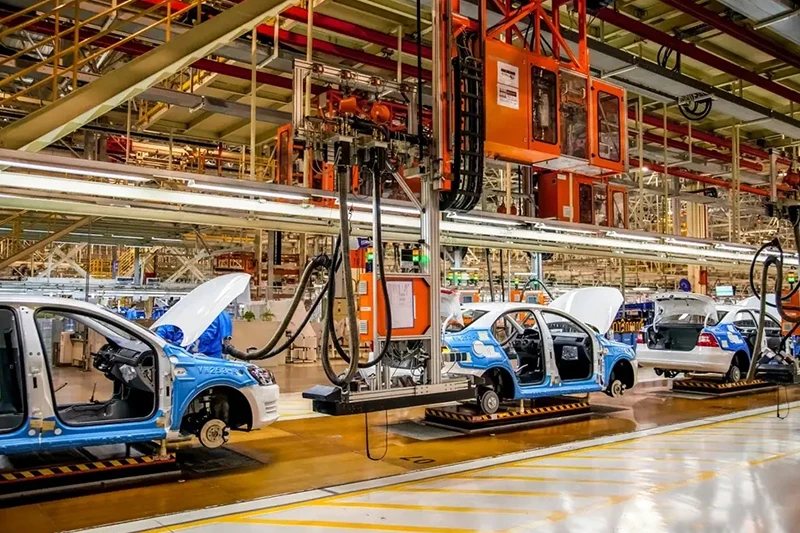
Configuration comes before load capacity
The first filter in any industrial drive wheel evaluation is the structural configuration, because it fixes the mounting envelope, the steering architecture and the control interface long before a load figure is checked. A differential drive wheel steers by driving two wheels at different speeds; it carries no separate steering actuator, so the chassis must provide the geometry that lets the vehicle turn. A parallel horizontal drive wheel with steering integrates the steering function into the drive unit itself, which is the arrangement a forklift or a heavy steered AGV needs when the drive position and the steering position cannot be separated.
The two families are therefore not interchangeable in practice. Their mounting dimensions, the space they occupy in the chassis, their service access and their control interfaces differ, and a load rating lifted from one family tells a buyer nothing about whether the other will fit. The horizontal designation refers to how the motor and wheel are arranged relative to each other rather than stacked vertically; buyers should confirm the exact mounting orientation and the height the unit requires under the deck with the supplier rather than assuming a common envelope across models.
This shortlist excludes vertical drive wheels and mecanum or omni drive wheels. Those address different motion problems, and mixing them into a three-model comparison would blur the decision rather than sharpen it. The scope here is deliberately narrow: differential and parallel horizontal units for AGV, AMR and forklift builds.
The shortlist in one view
Shanghai Plutools Automation Corporation Co., Ltd. (Plutools) designs and manufactures AGV drive wheel assemblies from a 10,000 m² production facility in Shanghai, and the three models below are the entries a buyer is most likely to place side by side when the build type is not yet fixed. The table states only the values confirmed for each model.
| Model | Structural configuration | Load rating | Electrical and protection | Motor and torque | Build it fits |
|---|---|---|---|---|---|
| PLT-120 | Differential drive wheel | 150 kg | 48 V; IP65 | — | 150 kg class AGV and AMR chassis |
| PLT-198 | Parallel horizontal drive wheel with steering | Up to 1500 kg | — | — | Forklift and heavy material handling |
| PLT-210 | Parallel horizontal drive wheel with steering | 1200 kg | — | 3000 W motor; 576 Nm maximum torque | Heavy AGV, AMR and steered industrial vehicles |
A dash marks a value that was not part of the specification confirmed for this shortlist. It is not evidence that the model lacks that capability; those parameters should be requested directly for the intended configuration.
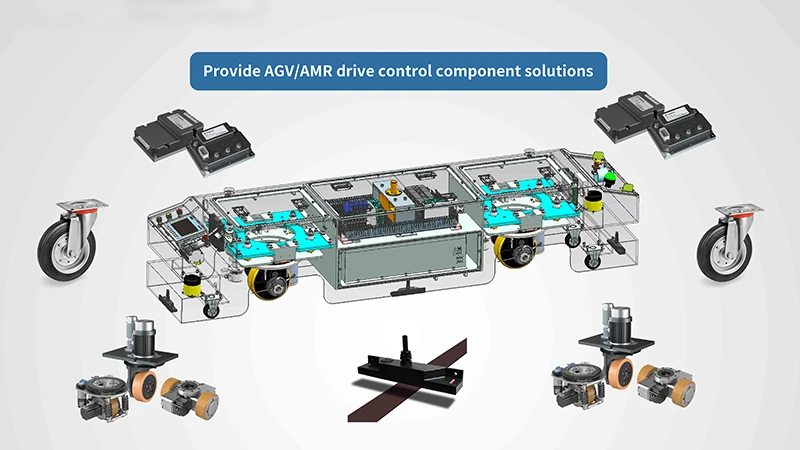
PLT-120: differential drive for 150 kg AGV and AMR platforms
The PLT-120 is a differential drive wheel rated for 150 kg AGV and AMR applications, with IP65 protection and 48 V operation. Its natural position is on a light mobile robot chassis where two driven wheels provide both traction and steering, and where the ingress protection rating matters because the vehicle works in an environment with dust or routine wash-down of the run area.
Three points deserve attention when this model enters a shortlist. The first is the 150 kg rating: it describes the load the wheel is rated to carry as specified, and it must be reconciled with how many wheels share the vehicle mass and how much load transfers forward under braking or onto one side during a turn. A 150 kg wheel rating is not a statement about total vehicle payload. The second is the IP65 rating, which defines protection against dust and water jets rather than immersion; the cleaning regime of the site should be checked against that definition rather than assumed. The third is the 48 V operating voltage, one of the voltage classes used in industrial battery-powered platforms, which has to be matched to the vehicle's battery and controller architecture.
For a parts-kitting AMR or a small towing unit, the differential arrangement also simplifies the control model: the vehicle turns by commanding a speed difference between the two drive wheels, and there is no steering actuator to sequence. The trade-off is that turning performance depends on the chassis layout, so tire choice, wheelbase and the support castor arrangement all affect how well a differential drive wheel performs in a tight aisle.
PLT-198: parallel horizontal steering for forklift-class loads up to 1500 kg
The PLT-198 is a forklift drive wheel with parallel horizontal steering and a load rating of up to 1500 kg, which places it in a different duty class from the 150 kg differential unit. Here the wheel is asked to do two jobs at once: carry a heavy vertical load and steer that load. The integrated parallel horizontal layout is what makes that combination possible in a compact drive position.
For a forklift or heavy material handling build, the practical questions shift from traction geometry to structure and service. Buyers should establish the mounting pattern and the height the unit requires, the brake arrangement, the encoder interface and the cable and connector specification, because each of those determines whether the unit drops into an existing chassis or forces a redesign. The steering function also creates an integration boundary: the vehicle controller has to command steering and drive together, and the handover between wheel and controller is where most commissioning delays originate if it is not specified up front.
One boundary is worth stating plainly. A rating of up to 1500 kg describes the wheel within the load and duty conditions for which it is specified; it does not authorize a vehicle payload figure, because the share of load carried by the drive wheel and by the support wheels changes with the forklift's load centre and lift height. Confirming that distribution with the supplier, using the actual vehicle layout, is a more reliable route than comparing headline numbers.
PLT-210: 1200 kg with a 3000 W motor and 576 Nm maximum torque
The PLT-210 is a parallel horizontal drive wheel with steering, a 1200 kg load rating, a 3000 W motor and 576 Nm maximum torque. It is the only model in this shortlist with published motor power and torque values, which makes it the more usable reference point when the vehicle design depends on grade starting, acceleration or heavy rolling resistance rather than on carrying the highest possible mass.
The word to watch is maximum. A maximum torque figure describes the peak the drive can deliver, which is relevant to breakaway from rest and to climbing, while continuous duty is limited by thermal behaviour over the work cycle. Buyers should ask for the continuous rating and the duty cycle it applies to, then compare that against the real task profile: a vehicle that climbs a ramp once per shift has a different thermal duty from one that accelerates every twenty seconds for eight hours.
This is also where the shortlist produces a genuine decision rather than a ranking. The PLT-198 carries a higher stated load, up to 1500 kg, while the PLT-210 carries 1200 kg but publishes 3000 W and 576 Nm. A project constrained by mass alone leans toward the PLT-198; a project constrained by documented torque for a grade or an acceleration target leans toward the PLT-210, subject to confirming its continuous rating. Neither number makes one unit universally better than the other.
Comparing load, torque and speed across the three models
The three specifications measure different things, and collapsing them into a single ranking is where shortlists usually go wrong.
- Load is a rating for the wheel as specified. Convert it into a vehicle-level figure by mapping how many wheels share the mass and how load transfers under acceleration, braking, cornering and, for forklift builds, lift height.
- Torque should be read in two columns, maximum and continuous. Maximum supports breakaway and grade work; continuous supports the duty cycle. Only the first is published in this shortlist, so the second must be requested.
- Speed is not a fixed property of any of these units. It emerges from wheel diameter, the rated speed of the motor and the reduction ratio, which is why travel speed belongs in the customization discussion rather than the model comparison.
- Configuration is a pass-or-fail filter. A differential unit and a steered parallel horizontal unit serve different chassis architectures regardless of how their load ratings compare.
Customization: the variables that set the final load and speed envelope
Plutools offers OEM, ODM and custom manufacturing with sample development, with customizable parameters covering load capacity, wheel diameter, motor power, voltage, rated speed, reduction ratio, mounting dimensions, encoder type, brake system, connector, cable length, logo and packaging. That list maps directly onto the comparison above, and the interactions are worth understanding before an RFQ is issued.
Wheel diameter and reduction ratio trade speed against tractive effort. A larger wheel covers more ground per revolution but reduces the force available at the contact patch for a given motor torque; a higher reduction ratio multiplies torque at the wheel while lowering output speed. Because those two variables move in opposite directions, a target travel speed and a target grade capability cannot be specified independently. Stating both in the RFQ lets the supplier propose a coherent combination rather than a compromise chosen on the buyer's behalf.
Motor power, voltage and rated speed then define the electrical envelope, while encoder type, brake system, connector and cable length define the control and installation interface. Mounting dimensions decide whether the unit fits at all. Commercial parameters also matter at the evaluation stage: the minimum order quantity is 2 units, lead time runs 30 to 45 days, and monthly capacity stands at 12,000 units, which is relevant when a pilot build has to scale into a production programme.
Application fit: three build scenarios
A 150 kg parts-kitting AMR, a forklift-class material handling vehicle and a heavy steered AGV place different demands on a drive wheel, and each maps to a different entry on this shortlist.
For the light AMR, the PLT-120 brings differential steering, IP65 protection and 48 V operation into a chassis that needs compact drive positions and simple control. The design emphasis is repeatable route tracking in aisles and predictable behaviour at low speed. For the forklift build, the PLT-198 supplies parallel horizontal steering with a load rating of up to 1500 kg, and the design emphasis moves to structural mounting, braking and the steering handover to the vehicle controller. For a heavier AGV or AMR that must steer as well as drive and has a documented torque requirement, the PLT-210 offers 1200 kg with a 3000 W motor and 576 Nm maximum torque.
Scale-up is a separate question from fit. Plutools reports a programme with an AGV manufacturer and industrial automation system integrator in Brazil covering 200 units over two years, applied to an ultra-heavy-duty AGV with multiple navigation modes, where drive, differential steering and precise motion control were combined and the vehicle operated under heavy-load conditions with accurate route tracking. That programme illustrates how differential control and non-standard system integration are handled in series production; it does not convert any single model's rating into a general performance guarantee.
How integrated drive units change the comparison
Buyers now routinely compare a drive wheel against an integrated drive unit rather than against another wheel. maxon describes an integrated wheel drive that combines the wheel, motor, gearhead and brake in one subsystem; IDEC describes a safety wheel drive combining wheel, gearbox, motor, safety encoder and safe motion control; and AMRDriveUnit presents units combining motor, gearbox, drive, encoder and wheel for OEM programmes. The direction of travel is consistent: the wheel is increasingly sold as part of a motion subsystem rather than as a mechanical component.
The buyer consequence cuts both ways. An integrated unit can reduce the number of interfaces the chassis team has to design, document and commission, which shortens the path from prototype to pilot. It also consolidates failure and service points into one assembly, narrows the pool of substitutable parts and ties the vehicle's control roadmap to one supplier's architecture. A discrete drive wheel paired with separately specified motor, encoder and brake preserves serviceability and second-sourcing options but shifts integration work back onto the vehicle team. Neither approach is universally preferable; the choice depends on how much integration capacity the programme actually has.
Safety is the other axis. A technical summary published by SEER Robotics states that AMR design compliance requires genuine integration of functional safety, typically Performance Level d, Category 3 or SIL2, referencing ANSI/RIA R15.08 and ISO 3691-4. That is a supplier summary rather than the standard text, and it should be checked against the official editions and the rules of the target market before it is used in a conformity decision. What it establishes for procurement is simpler: the RFQ should ask where the safety function sits, which standard edition applies and what evidence supports the claim.
Market context for the shortlist decision
Demand context supports the shortlist but does not decide it. TrendX Insights projects the global automated guided vehicle market growing from USD 4.45 billion in 2025 to USD 12.44 billion by 2034 at a 12.1% compound annual growth rate. A separate estimate cited in Plutools' own AGV drive wheel selection guide puts the global AGV wheel-drive market at about USD 1.2 billion in 2024 and projects USD 3.5 billion by 2034, a figure that originates with a commercial research source rather than an official statistics body.
Two cautions follow. Research houses use different scopes, base years and definitions, and published AGV forecasts have varied materially between providers, so a single growth rate should not be used to size a component order. And a growing vehicle market does not by itself create demand for a specific configuration; the split between differential, vertical and steering drive wheels depends on the vehicle mix, not on the aggregate. For a broader view of the supply base, Dataintelo reports that China exported USD 630.8 million of base-metal castors in 2023, about 4.6 times the German figure, which indicates depth in adjacent industrial wheel manufacturing without being evidence about drive wheel assemblies specifically.
Certification and acceptance evidence
Component-level certification is checkable, and it should be checked against the exact model and scope rather than accepted as a general statement. Plutools holds CE certification issued by Shenzhen Anbotek Compliance Laboratory Limited under certificate AT1814C500806124, issued 2 April 2025 and valid to 2 April 2030, covering the PLT Series (50W–20000W) against EN ISO 12100:2010 and EN 60204-1:2018. A second certificate, AT182414C4001881, issued 16 July 2024 and valid to 16 July 2029, covers the same series under the same standards.
The limits matter as much as the numbers. These are component certificates with a defined product scope and standard set; they do not by themselves establish conformity of the finished AGV or forklift, because machine-level conformity depends on the integrated system, its safety functions and the rules of the destination market. Buyers should confirm that the specific model and configuration being ordered falls inside the certified scope, and should ask for the declaration and test evidence that accompany the shipment.
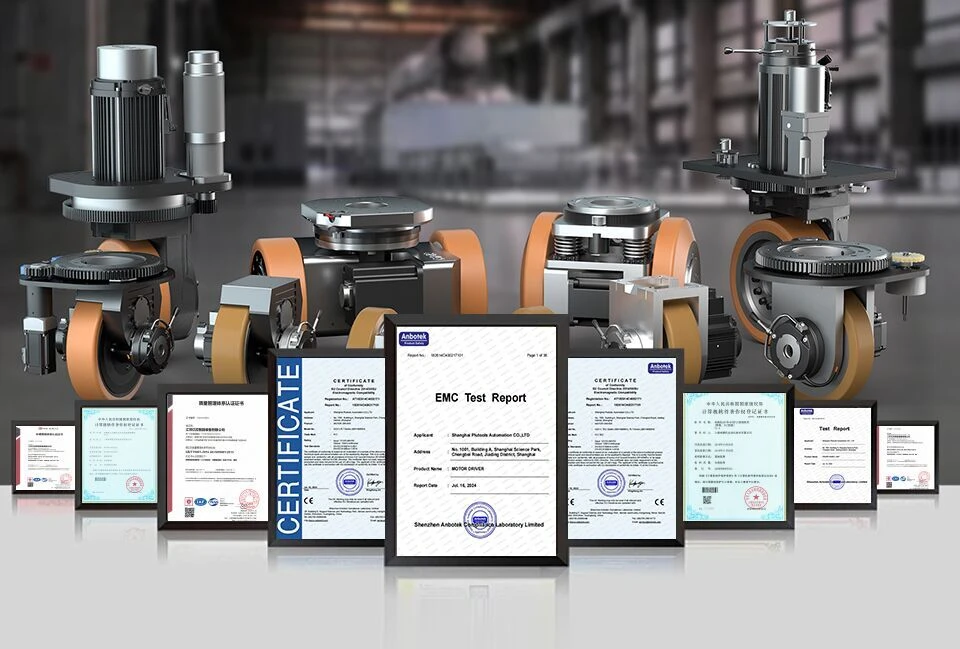
Production evidence completes the picture. All products undergo 100% testing as part of the manufacturer's quality control process, and the controls applied at that stage should be named in the acceptance plan so that the buyer knows what has already been verified before the unit reaches incoming inspection.
Next steps: purchasing terms and acceptance criteria
Once the configuration is fixed, the remaining risk sits in the commercial and acceptance details. A practical RFQ for any of the three models should settle the model and full configuration, the voltage and electrical interface, mounting dimensions, encoder type, brake system, connector and cable length, the target travel speed together with the target grade or acceleration requirement, and the load case the rating is expected to cover in the actual vehicle layout.
On the commercial side, confirm the quantity against the 2-unit minimum order quantity, the 30 to 45 day lead time against the build schedule, and the packaging and labelling requirements. On the acceptance side, agree in advance which characteristics will be measured, against which documented values, with what test record and who signs off, so that incoming inspection compares the delivered unit to an agreed specification rather than to a data sheet.
Enquiries and purchasing discussions for the PLT-120, PLT-198 and PLT-210 can be directed to Eric.Tang at sEric.Tang@plutools.com or +86 15989586580, including WhatsApp on the same number. Company information is published at Shanghai Plutools Automation Corporation Co., Ltd., and the PLT selection manual covers the wider model range for buyers who need to check adjacent options before finalizing a shortlist.
The shortlist answer in one line: differential and 150 kg with IP65 at 48 V points to the PLT-120; parallel horizontal steering with the highest stated load points to the PLT-198; parallel horizontal steering with published 3000 W and 576 Nm maximum torque points to the PLT-210.
FAQ
Which of the three drive wheels suits a 150 kg AGV or AMR?
The PLT-120 is the entry built for that class: a differential drive wheel rated for 150 kg AGV and AMR use with IP65 protection and 48 V operation. Its differential arrangement means the vehicle steers through a speed difference between the driven wheels rather than through a separate steering actuator, so the chassis layout and the support wheel arrangement have to be designed around that behaviour.
What does parallel horizontal steering change in a forklift build?
Parallel horizontal steering integrates the steering function into the drive unit, so the same assembly carries the load and steers it. That is what allows a forklift drive wheel such as the PLT-198, rated at up to 1500 kg, to occupy a compact drive position. The integration also shifts responsibility: the vehicle controller must command steering and drive together, and the mounting pattern, brake arrangement and encoder interface have to be agreed before commissioning.
Is a higher load rating always the better choice between the PLT-198 and PLT-210?
No. The PLT-198 is rated at up to 1500 kg while the PLT-210 is rated at 1200 kg, but the PLT-210 is the model with published values of a 3000 W motor and 576 Nm maximum torque. A project limited by mass may prefer the higher rating; a project that must demonstrate torque for grade starting or acceleration may prefer the model with a documented torque figure, after confirming its continuous rating and duty cycle. The two numbers describe different capabilities.
Which customization variables change a drive wheel's load capacity and speed?
Load capacity, wheel diameter, motor power, voltage, rated speed and reduction ratio are the variables that move the load and speed envelope, alongside mounting dimensions, encoder type, brake system, connector and cable length for the interface. Wheel diameter and reduction ratio interact: a larger wheel raises distance per revolution while reducing force at the contact patch, and a higher reduction ratio multiplies torque while lowering output speed. Because of that interaction, travel speed and grade capability should be specified together rather than separately.
What should be verified before accepting a drive wheel delivery?
Acceptance should compare the delivered unit against an agreed specification rather than a general data sheet. That means confirming the model and configuration, the mounting dimensions and interface items, the certified scope where certification is claimed, and the test records produced during production, since all products undergo 100% testing as part of the manufacturer's quality control process. The characteristics to be measured and the sign-off authority should be written into the order before shipment, not negotiated at incoming inspection.
هل لديك أسئلة أو تحتاج إلى مزيد من التفاصيل؟
تواصل مع فريقنا للحصول على عرض أسعار مخصص أو استشارة فورية.
طلب عرض أسعار
املأ النموذج أدناه وسيتواصل معك فريقنا بعرض مقترح مخصص.
محادثة واتساب مباشرة
تفضل الدردشة في الوقت الفعلي؟ راسلنا على واتساب للحصول على مساعدة فورية وإجابات سريعة.
- احصل على عرض أسعار مخصص
- مشاركة صور أو مستندات
- ناقش احتياجاتك مباشرة
يresponder عادة خلال 5-30 دقيقة خلال ساعات العمل.