
Drive Wheel Specs & CE Certification for AGV Projects
Drive wheel selection in AGV and AMR projects is fundamentally a constraint-matching exercise. The drive unit must satisfy electrical parameters, torque and load requirements, installation geometry and regulatory compliance before it can be considered viable. For engineers and procurement teams moving from research into evaluation, the priority is not just identifying a drive wheel supplier, but verifying that the specification sheet, certification coverage and customization boundaries actually correspond to the vehicle design. This article provides a parameter-level guide to AGV drive wheels, with a focus on the verification steps that reduce project risk.
Why Drive Wheel Verification Matters in AGV Procurement
The demand for AGV drive wheels is expanding alongside the automation of logistics and industrial material handling. The global AGV wheel drives market was valued at approximately USD 1.2 billion in 2024 and is projected to reach USD 3.5 billion by 2034, reflecting a CAGR of 11.5%, according to Reports and Data. This growth is driven by warehouse automation, the electrification of industrial vehicles and the rising adoption of autonomous mobile robots.
Market growth also creates a sourcing risk: specification sheets may list impressive numbers, yet the actual drive wheel may not meet the application's duty cycle, mounting constraints or export compliance requirements. In practice, drive wheel issues in AGV projects are rarely caused by a single dramatic defect. More often, they arise from mismatched voltage, underestimated maximum torque, incorrect reduction ratio, insufficient IP protection or missing certification for the destination market.
Verification, therefore, needs to happen at four levels:
- Electrical parameters: rated voltage, current, power and motor speed
- Mechanical output: rated torque, max torque, reduction ratio and load capacity
- Physical integration: mounting dimensions, wheel diameter, steering configuration and chassis height
- Regulatory compliance: CE certificates and applicable safety standards for the target market
The Parameter Checklist: What to Verify Before Selection
A drive wheel specification is meaningful only when its parameters are checked against the actual AGV duty cycle. Max torque matters during acceleration and climbing; rated torque matters during continuous operation; max load defines the structural capacity; and rated voltage must match the vehicle battery system.
Take the PLT-230 model as an example. It operates at 24 V, delivers 1500 W, draws a rated current of 76 A, runs at 2590 RPM and offers a rated torque of 5.5 Nm with a gear ratio of 30:1. Its output torque is 108 Nm, max torque reaches 300 Nm, and max load is 1500 kg. This makes it a vertical drive wheel without steering, suited for heavy-duty AGV platforms that rely on differential steering from two independent drive units.
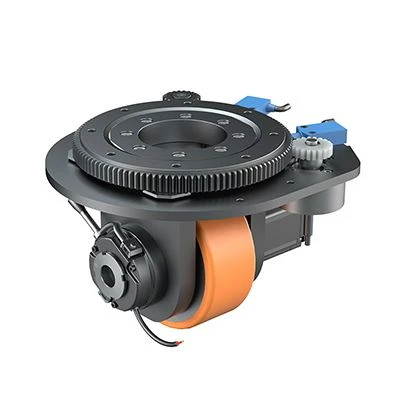
PLT-210 parallel horizontal drive wheel with steering, rated at 48 V, 3000 W and 1200 kg max load.
The following table summarizes the core parameters of the Plutools drive wheel range. It is intended as a starting point for matching a model to a vehicle architecture.
| Model | Type | Rated Voltage | Power | Rated Speed | Output Torque | Max Torque | Max Load |
|---|---|---|---|---|---|---|---|
| PLT-230 | Vertical Drive Wheel without Steering | 24 V | 1500 W | 2590 RPM | 108 Nm | 300 Nm | 1500 kg |
| PLT-150 | Vertical Drive Wheel with Steering | 48 V | 750 W | 3000 RPM | 108 Nm | 114 Nm | 500 kg |
| PLT-230P | Vertical Drive Wheel with Shock Absorption | 48 V | 2500 W | 3000 RPM | — | — | 1200 kg |
| PLT-167 | Horizontal Drive Wheel without Steering | 48 V | 750 W | 3000 RPM | 40 Nm | 120 Nm | 800 kg |
| PLT-120 | Differential Drive Wheel | 48 V | 400 W | 3000 RPM | 10/21 Nm | 20/42 Nm | 150 kg |
| PLT-210 | Forklift Drive Wheel (Parallel Horizontal, with Steering) | 48 V | 3000 W | 3000 RPM | 260 Nm | 576 Nm | 1200 kg |
| PLT-198 | Horizontal Drive Wheel (Planetary, with Steering) | 48 V | 3000 W | 3000 RPM | 260 Nm | 576 Nm | 1500 kg |
| PLT-220 | Parallel Horizontal Drive Wheel with Steering | 48 V | 750 W | 3000 RPM | 58 Nm | 174 Nm | 1000 kg |
Note that model selection is not based on a single parameter. A 1500 kg max load does not automatically mean the wheel can support a 1500 kg vehicle under all dynamic conditions. The steering type, tire material, duty cycle and floor conditions all affect real-world performance. Verified manufacturers usually state both rated torque and max torque explicitly, which helps buyers distinguish between continuous output and short-term peak output.
Vertical vs. Horizontal Drive Wheel: The First Architecture Decision
One of the first decisions in AGV drive design is whether the drive unit should use a vertical or horizontal motor arrangement.
A vertical drive wheel positions the motor and gearbox vertically, which reduces the horizontal footprint of the drive unit. This makes it suitable for heavy-duty AGVs, automated forklifts, lifting vehicles and equipment with limited chassis space. Because the vertical arrangement can accommodate a larger gearbox within a compact horizontal footprint, it is often chosen for high-load applications.
A horizontal drive wheel keeps the motor horizontally oriented, which lowers the overall height of the drive module and lowers the center of gravity. This configuration improves vehicle stability at higher speeds and during frequent turning, and it is commonly used in low-profile AGVs, warehouse AMRs, latent lifting robots and compact material-handling equipment.
The final choice depends on installation space, load capacity, chassis height, turning structure, operating speed and maintenance requirements. For compact heavy-load designs, vertical drive wheels are generally recommended. For low-profile vehicles requiring stability and easier maintenance access, horizontal drive wheels are the more suitable option.
Steering integration is a separate decision from motor orientation. Drive wheels can be supplied with or without integrated steering. For example, PLT-230 is a vertical drive wheel without steering, while PLT-150 is a vertical drive wheel with steering. PLT-167 is a horizontal drive wheel without steering, while PLT-198 and PLT-220 are horizontal configurations with steering. Specifying the correct combination of orientation and steering function is critical to the vehicle's kinematics.
A Drive Wheel Portfolio Built for Constraint Matching
Shanghai Plutools Automation Corporation Co., Ltd. is a Shanghai-based manufacturer focused on AGV/AMR drive systems. Founded in 2017, the company operates a 10,000 m² production facility with a team of more than 100 employees, including 60 engineers, and reports an annual output of 10,000 drive wheel units. Plutools has obtained more than 200 patent technology certifications and holds designations including Specialized and Innovative Enterprise and National Small Giant Enterprise. Approximately 70% of its output is exported to the EU, USA, Southeast Asia, South America, the Middle East, Japan and South Korea.
Within the drive wheel product family, the portfolio covers several structural configurations:
- Vertical drive wheels without steering, such as PLT-230
- Vertical drive wheels with steering, such as PLT-150
- Vertical drive wheels with shock absorption, such as PLT-230P
- Horizontal drive wheels without steering, such as PLT-167
- Parallel horizontal drive wheels with steering, such as PLT-210, PLT-198 and PLT-220
- Differential drive wheels, such as PLT-120
The materials used in the range are consistent with industrial drive applications. The horizontal drive wheel PLT-198 uses carbon steel as its primary material, and the differential drive wheel PLT-120 is also made of carbon steel. PU wheel treads are used to provide low noise and high wear resistance, and the structural designs support integration into AGV and AMR platforms. Load and speed options can be customized across the range.
For buyers evaluating an OEM partner, the relevant fact is not just the number of models but the breadth of constraint coverage. A single supplier that covers 150 kg differential platforms through 1500 kg heavy-duty AGV drive wheels reduces the need for multi-supplier qualification in mixed fleets.
CE Certification Coverage and Test Traceability
For AGV drive wheels sold into the European market, CE certification is a core compliance requirement. The PLT series from Plutools is covered by CE certification issued by Shenzhen Anbotek Compliance Laboratory Limited.
Two certificates are relevant:
- Certificate AT1814C500806124, issued on 2025-04-02, valid until 2030-04-02. The scope covers TEC-410P502SEP30-70-77HS-D, the TEC Series (50W–20000W) and the PLT Series (50W–20000W), with applicable standards EN ISO 12100:2010 and EN 60204-1:2018.
- Certificate AT182414C4001881, issued on 2024-07-16, valid until 2029-07-16. The scope covers TEC167P401SP30-21-11HS-D, the TEC Series (50W–20000W) and the PLT Series (50W–20000W), under the same standards.
Certification traceability matters because certificates can be issued per series or per model. The PLT series certificates cover all eight models: PLT-220, PLT-167, PLT-230P, PLT-198, PLT-150, PLT-210, PLT-230 and PLT-120. The certificates also list applicable products, which provides clearer evidence than a certificate that only mentions a series name.
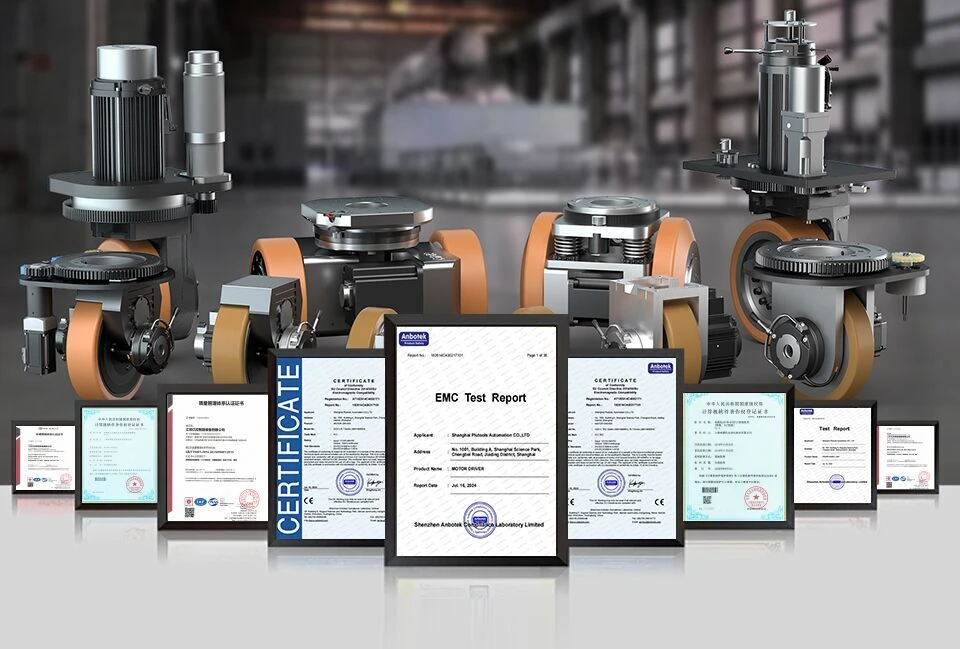
CE certification for the PLT series covers drive wheel models from PLT-120 to PLT-230P.
Beyond CE, buyers exporting to the US should verify alignment with ANSI/ITSDF B56.5, the American safety standard for driverless industrial vehicles, which governs the performance of drive and steering units. ISO 3691-4:2023 serves as the primary international safety standard for driverless industrial trucks and covers steering and braking systems. EN 1175:2020 specifies electrical and electronic safety requirements for industrial trucks and is applicable to drive wheel assemblies in European markets.
Additionally, the PLT-120 differential drive wheel carries an IP65 protection level, and the PLT-230P robot drive wheel also specifies IP65. IP ratings are particularly relevant for applications with dust exposure or occasional water contact, such as semi-outdoor logistics areas and food and beverage production environments.
Application Fit and a Verified Heavy-Duty Case
The application range for these drive wheels spans intelligent logistics, industrial automation, warehousing, automotive manufacturing, electronics manufacturing, food and beverage production, pharmaceutical manufacturing, e-commerce fulfillment centers, airport logistics and port transportation. Typical working conditions include continuous operation, frequent starting and stopping, forward and reverse movement, narrow aisles, heavy loads, dust, vibration and temperature changes. Floor surfaces can include concrete, epoxy, steel or slightly uneven floors.
For special environments, drive wheels can be designed for low-temperature warehouses, high-humidity areas, cleanrooms, dusty workshops and heavy-duty industrial applications.
A documented case from the Plutools portfolio involves a Brazil-based AGV manufacturer and industrial automation system integrator. The customer sourced 200 drive wheel units for an ultra-heavy-duty AGV with multiple navigation modes. The drive units had to provide drive, differential steering and precise motion control. Over a two-year period, the wheels delivered stable operation under heavy-load conditions, accurate route tracking, flexible steering and reliable material transportation. The key highlighted attributes were high load capacity, high output torque, precise differential control, multiple navigation compatibility and customized system integration.
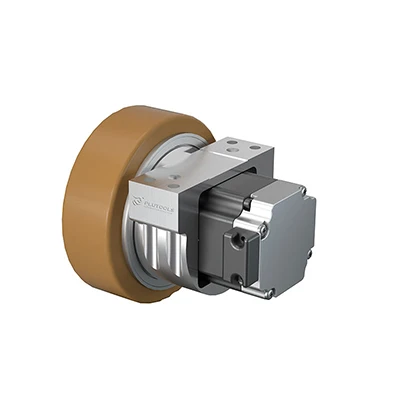
PLT-120 differential drive wheel, rated at 400 W, 48 V, with IP65 protection and a 150 kg drive wheel load.
Market Trends Influencing Drive Wheel Demand
Several market trends are shaping demand for AGV drive wheels.
First, the shift toward electric industrial vehicles is accelerating. Electric forklifts now command over 70% market share in many regions as a replacement for combustion models, according to MarketsandMarkets. This increases the importance of electric drive components, including drive wheels with matched voltage, torque and control characteristics.
Second, lithium-ion battery technology now powers the majority of new AGV/AMR drive units, reducing range anxiety and downtime. For drive wheel suppliers, this means the vehicle battery voltage, commonly 24 V or 48 V, must be matched precisely, and the drive unit should be compatible with the charging and power management architecture of the vehicle.
Third, integrated steering drive modules are replacing discrete components. According to Brandessence Research, this shift reduces manufacturer assembly time and maintenance complexity. The Plutools portfolio reflects this trend: models with integrated steering, such as PLT-150, PLT-198, PLT-210 and PLT-220, combine motor, gearbox, wheel and steering function in a single unit.
Fourth, the China mobile robot market reached 22.1 billion RMB in 2024, with more than 139,000 units sold, according to CMRA. China's export volume of mobile robots is also increasing, with leading providers targeting Southeast Asia and Europe. For global buyers, this means Chinese drive wheel manufacturers are increasingly serving international markets with export-oriented compliance documentation.
Integrated Drive Wheel vs. Traditional Drive Architecture
Understanding the difference between integrated drive wheel units and traditional discrete drive architectures helps frame the sourcing decision.
In a traditional arrangement, the motor, gearbox, wheel, brake, encoder and steering mechanism are sourced separately and integrated by the vehicle manufacturer. This approach provides flexibility but increases assembly time, inventory complexity and the risk of interface mismatches.
An integrated drive wheel combines these components into one unit. The benefits include a smaller installation footprint, reduced vehicle assembly work, better motion accuracy and simpler maintenance. For AGV manufacturers producing at scale, the integrated approach reduces procurement complexity across multiple components.
However, there are boundaries to the integrated approach. For vehicles with highly specialized suspension systems, ultra-low chassis profiles or non-standard mounting envelopes, a standard integrated unit may not fit without modification. In these cases, a traditional discrete design or a customized drive wheel may be more appropriate. This is why custom manufacturing capabilities matter: drive wheels may need to be adapted in load capacity, wheel diameter, motor power, voltage, rated speed, reduction ratio, mounting dimensions, encoder type, brake system, connector, cable length, logo and packaging.
Plutools operates with production modes that include OEM, ODM, custom manufacturing, sample development and production runs from small to large batches. Monthly capacity is 12,000 units, lead time is 30–45 days, MOQ is 2 units and quality control includes 100% testing. These operational facts are relevant for buyers moving from evaluation into small-batch pilot runs or large fleet rollouts.
Known Boundaries: Where Buyers Should Adjust Expectations
Every drive wheel has an application envelope, and it is important to state these boundaries clearly.
Load capacity is one boundary. The PLT-230 has a max load of 1500 kg, but this is a structural limit, not a recommendation for continuous operation at full load. Dynamic factors, such as acceleration, braking and floor unevenness, affect the actual permissible load.
Duty cycle is another boundary. Drive wheels support continuous or intermittent operation depending on vehicle task requirements. In multi-shift environments with 24/7 operation, the selected drive wheel must be sized with adequate margin for heat dissipation and component wear.
Floor and environmental conditions also define boundaries. Concrete, epoxy, steel and slightly uneven floors impose different stress profiles. Low-temperature warehouses, high-humidity areas, cleanrooms and dusty workshops require different tire compounds, sealing levels and material choices. Buyers should specify the working condition when requesting a drive wheel quotation, not just the vehicle weight.
Future Outlook
The AGV drive wheel market is expected to follow the broader trajectory of industrial automation. With a projected CAGR of 11.5% through 2034, suppliers that can combine parameter accuracy, certification documentation and customization capability will be better positioned in the procurement process.
The direction of product development is also visible in current specification sheets. Higher torque density, IP-rated protection, integrated steering, shock-absorbing vertical drives and modular customization are already present in standard product ranges. The next phase of buyer evaluation will likely place even more emphasis on the traceability of factory tests, the validity period of certificates and the supplier's ability to support multi-market exports.
For manufacturers of AGVs, AMRs, automated forklifts and mobile robots, the practical path is to treat drive wheels as a specification-critical subsystem rather than a commodity component, and to evaluate suppliers against a documented parameter and compliance checklist.
FAQ
How should I choose between a vertical drive wheel and a horizontal drive wheel?
A vertical drive wheel is generally recommended when the AGV or AMR requires a compact structure, high load capacity and straightforward installation. Its motor and gearbox are arranged vertically, helping reduce the horizontal footprint of the drive unit. It is suitable for heavy-duty AGVs, automated forklifts, lifting vehicles and equipment with limited chassis space.
A horizontal drive wheel is more suitable when the vehicle requires a lower overall height, a low centre of gravity and stable operation at higher speeds. Its motor is arranged horizontally, which helps reduce the height of the drive module and improves vehicle stability. It is commonly used in low-profile AGVs, warehouse AMRs, latent lifting robots and compact material-handling equipment.
The final choice should be based on the vehicle's installation space, load capacity, chassis height, turning structure, operating speed and maintenance requirements. Choose a vertical drive wheel for compact heavy-load designs, and choose a horizontal drive wheel for low-profile vehicles requiring better stability and easier access for maintenance.
Which CE certificates cover the Plutools drive wheel series?
Two CE certificates cover the PLT series. Certificate AT1814C500806124 was issued on 2025-04-02 and is valid until 2030-04-02. Certificate AT182414C4001881 was issued on 2024-07-16 and is valid until 2029-07-16. Both were issued by Shenzhen Anbotek Compliance Laboratory Limited and are based on EN ISO 12100:2010 and EN 60204-1:2018. The certified scope includes the TEC Series (50W–20000W) and the PLT Series (50W–20000W), covering models PLT-220, PLT-167, PLT-230P, PLT-198, PLT-150, PLT-210, PLT-230 and PLT-120.
What are the key parameters to verify when sourcing an AGV drive wheel?
The critical set of parameters includes rated voltage, motor power, rated current, rated speed, rated torque, reduction ratio, output torque, max torque and max load. Buyers should also verify the steering configuration, whether the unit includes steering, the IP protection level, the tire material and the mounting dimensions. The choice should be based on the vehicle battery voltage, the required continuous and peak torque, the chassis footprint and the operating environment.
What customization options are available for drive wheels?
Customization options include load capacity, wheel diameter, motor power, voltage, rated speed, reduction ratio, mounting dimensions, encoder type, brake system, connector, cable length, logo and packaging. Production modes include OEM, ODM, custom manufacturing, sample development and small-to-large batch production. This level of customization supports both pilot projects and fleet-scale rollouts.
Reference document: PLT Selection Manual (PDF) — publicly accessible specification reference for the PLT drive wheel series.