
Drive Wheel Supplier Capability: What PLT Specs Prove
Independent industry reference — model-level evidence for AGV, AMR and forklift drive wheel procurement
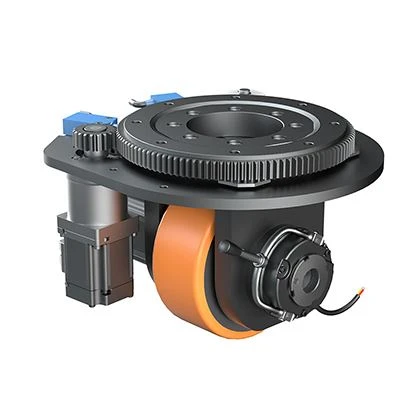
Figure 1 — The PLT-198 planetary horizontal drive wheel with steering, one of three models used in this article to show how supplier capability can be read from published specification data.
The global AGV wheel drives market was valued at approximately USD 1.2 billion in 2024 and is projected to reach USD 3.5 billion by 2034, according to Reports and Data, implying an expected CAGR of 11.5% over that period. Behind that growth sits a procurement problem that market reports rarely describe: engineers specifying drive wheels for automated guided vehicles (AGVs), autonomous mobile robots (AMRs) and automated forklifts must select a supplier long before a prototype can be built.
At the research stage, most available material is directional. Catalogues describe high load capacity, compact design and stable output. Those phrases are not comparable across vendors, cannot be written into a purchase order, and cannot be checked at goods-in inspection. What can be compared is model-level evidence: a named model, a declared parameter set, a stated material, and a stated limit.
This article uses three published Plutools drive wheel models — the PLT-120 differential drive wheel, the PLT-210 forklift drive wheel and the PLT-198 heavy-load horizontal drive wheel — as a worked example of how a buyer can convert specification data into supplier evaluation criteria before ordering.
Why capability claims fail before the first prototype
In the awareness and research phases, a buyer typically assembles a shortlist of three to six drive wheel suppliers and tries to filter them using catalogue material. Three decisions depend on that material, and each one needs numbers rather than adjectives.
Filtering. A statement such as "suitable for heavy loads" cannot be compared with a competing supplier's statement, because neither side has defined heavy. A declared maximum load of 1200 kg versus 1500 kg is comparable, and it immediately tells the buyer which of the two belongs in a forklift platform and which belongs in a lighter AMR.
Sizing. Drive wheel selection is a calculation, not an impression. Tractive effort depends on torque at the wheel; duty cycle depends on rated current and voltage; structural margin depends on rated load per wheel. Every one of these values either exists in the supplier's data or does not.
Risk allocation. A purchase order needs acceptance criteria. If the supplier publishes a 32:1 reduction ratio and 260 Nm output torque, the buyer can reference those figures at receiving inspection. If the supplier publishes only a general capability statement, the buyer carries the entire performance risk.
What counts as drive wheel supplier capability evidence
In a procurement sense, capability evidence is a declared parameter set attached to a specific model designation that is precise enough to do three things: drive an engineering calculation, become an acceptance criterion in a purchase order, and be verified on delivery. Anything below that threshold is brand communication rather than evidence.
Working definition. A drive wheel model qualifies as procurement-grade evidence when it publishes: electrical rating (voltage, current, power), kinematic rating (rated speed, reduction ratio, rated torque, output torque, maximum torque), structural rating (maximum load per wheel, materials, tread compound), environmental rating where applicable (IP protection), and physical data (unit mass, mounting configuration).
Shanghai Plutools Automation Corporation Co., Ltd. is a Shanghai-based manufacturer of AGV and AMR drive wheels, established in 2017, operating a 10,000 m² production facility with approximately 100 employees, a 60-engineer R&D team, an annual output of 10,000 units, and export business representing 70% of sales across the EU, USA, Southeast Asia, South America, the Middle East, Japan and South Korea. Its published catalogue is used below because the models carry parameter-level data that can be tested against the definition above.
PLT-120: what a 150 kg IP65 differential unit proves
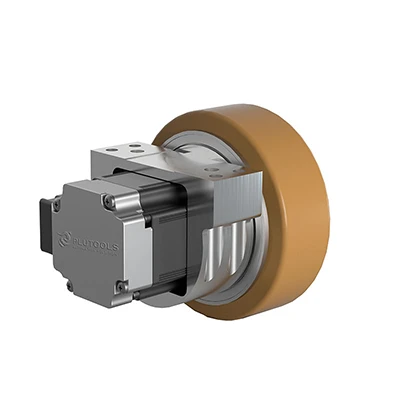
Figure 2 — PLT-120 differential drive wheel: 48 V, 11.2 A, 150 kg drive wheel load, IP65, 5±2 kg unit mass.
The PLT-120 is a differential drive wheel intended for AGV and AMR applications in the manufacturing industry. The unit uses a carbon steel body with a polyurethane (PU) tread, an integrated steering function, and a compact structure intended to reduce the space required inside an AGV or AMR chassis.
| PLT-120 parameter | Published value |
|---|---|
| Model type | Differential drive wheel |
| Rated voltage / current | 48 V / 11.2 A |
| Rated power | 400 W |
| Rated speed | 3000 rpm |
| Rated torque | 1.28 Nm |
| Transmission ratio | 9.20 |
| Rated output torque | 10.21 Nm |
| Max acceleration and braking torque | 20.42 Nm |
| Drive wheel load | 150 kg |
| IP protection level | IP65 |
| Unit mass | 5±2 kg |
| Materials | Carbon steel body, polyurethane (PU) tread |
Four values in this table do most of the procurement work. The 48 V / 11.2 A electrical rating tells the buyer which battery architecture and controller current envelope the unit belongs to, before any mechanical drawing is exchanged. The 9.20 transmission ratio combined with a 10.21 Nm rated output torque gives a continuous torque figure at the wheel rather than at the motor — the number that actually drives the vehicle. The 20.42 Nm maximum acceleration and braking torque defines the peak the assembly is declared to transmit during start and stop events, which is the correct reference when sizing braking behaviour and duty cycles. IP65 indicates a dust-tight enclosure with protection against water jets, which matters for workshops, semi-outdoor logistics areas and wash-down-adjacent zones.
The unit mass of 5±2 kg deserves separate attention. A four-kilogram spread across a delivered batch is significant when the chassis design depends on suspension preload, floor pressure distribution or a tight weight budget for battery capacity. A buyer who needs this parameter under control should ask for measured unit mass per shipment rather than accept the band as a planning assumption.
The boundary is equally explicit. The 150 kg figure is a drive wheel load rating, not a robot payload rating. Per-wheel load must be derived from vehicle mass plus payload, distributed across the drive configuration, and then adjusted for dynamic load transfer during acceleration, braking and cornering. A differential arrangement with two drive wheels does not simply divide the total by two in every operating condition.
PLT-210: what a 1200 kg forklift unit proves
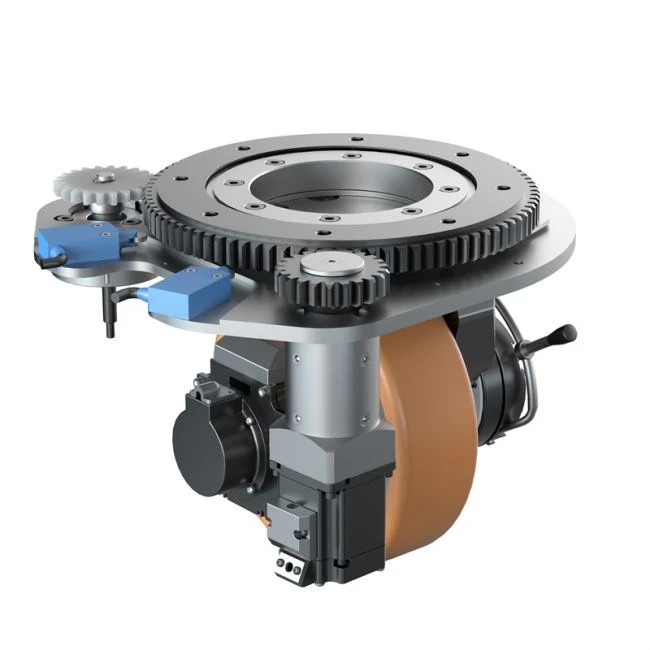
Figure 3 — PLT-210 parallel horizontal drive wheel with steering, specified for forklift applications up to 1200 kg drive wheel load.
The PLT-210 is a forklift drive wheel classified as a parallel horizontal drive wheel with steering. It uses an integrated parallel horizontal structure with a steering function, a PU wheel tread, a carbon steel body, and supports customizable load and speed options.
| PLT-210 parameter | Published value |
|---|---|
| Model type | Parallel horizontal drive wheel with steering |
| Rated voltage / current | 48 V / 68 A |
| Power | 3000 W |
| Rated speed | 3000 RPM |
| Rated torque | 9.55 Nm |
| Reduction ratio | 32 |
| Output torque | 260 Nm |
| Max torque | 576 Nm |
| Max load | 1200 kg |
| Materials | Carbon steel body, PU tread |
The PLT-210 sits in a different operating envelope from the PLT-120: 3000 W instead of 400 W, 68 A instead of 11.2 A, and 576 Nm of maximum torque instead of 20.42 Nm. For an automated forklift builder, that translates into a unit intended to move loaded pallets rather than to position a light AMR chassis. The integrated steering function also removes one assembly step from the vehicle build, because the steering actuator does not have to be sourced and aligned separately.
The declaration that load and speed options can be customized is useful but conditional. Customization means the published configuration is a baseline, not a fixed article. A buyer who changes rated load or rated speed moves part of the validation responsibility onto the project, and should require the customized configuration to be re-declared in writing — including the torque values that follow from the new ratio — before the purchase order is issued.
PLT-198: the heavy-load case and the torque chain
The PLT-198 is a horizontal drive wheel classified as a planetary horizontal drive wheel with steering. It is intended for automated guided vehicle applications, with typical use in AGV and AMR systems, and is built on a carbon steel body.
| PLT-198 parameter | Published value |
|---|---|
| Model type | Planetary horizontal drive wheel with steering |
| Rated voltage / current | 48 V / 68 A |
| Power / rated speed | 3000 W / 3000 RPM |
| Rated torque | 9.55 Nm |
| Reduction ratio | 32 |
| Output torque | 260 Nm |
| Max torque | 576 Nm |
| Max load | 1500 kg |
| Material | Carbon steel |
The value of this data set is that the torque chain is visible. A rated motor torque of 9.55 Nm passes through a 32:1 reduction and is declared as 260 Nm at the wheel. That output figure is lower than the arithmetic product of motor torque and ratio, which is expected once transmission efficiency is taken into account, and it is the number an engineer should use for gradeability and acceleration calculations. Tractive effort is derived from torque at the wheel divided by the rolling radius of the wheel, so a buyer comparing models must obtain the wheel diameter or the mounting drawing as well — it is not contained in the parameter list.
The maximum torque of 576 Nm is a peak figure, distinct from the continuous 260 Nm. The distinction is a normal source of specification error in early-stage comparisons: a supplier's peak torque and a second supplier's output torque measure different things, and building a comparison table without separating them produces an apparent advantage that does not exist in service. The same caution applies to the 1500 kg maximum load, which is a structural rating and should be matched against the worst-case per-wheel load, including load transfer.
Three models, one comparison table
Placing the three models side by side shows how a buyer can move from a general question about supplier capability to a specific procurement decision in a single step.
| Parameter | PLT-120 | PLT-210 | PLT-198 |
|---|---|---|---|
| Configuration | Differential | Parallel horizontal, steered | Planetary horizontal, steered |
| Voltage / current | 48 V / 11.2 A | 48 V / 68 A | 48 V / 68 A |
| Power | 400 W | 3000 W | 3000 W |
| Rated torque | 1.28 Nm | 9.55 Nm | 9.55 Nm |
| Reduction ratio | 9.20 | 32 | 32 |
| Torque at wheel | 10.21 Nm rated / 20.42 Nm max accel.-brake | 260 Nm / 576 Nm max | 260 Nm / 576 Nm max |
| Max load | 150 kg | 1200 kg | 1500 kg |
| IP rating | IP65 | Not published in the parameter set | Not published in the parameter set |
| Tread / body | PU / carbon steel | PU / carbon steel | Carbon steel |
One observation from this table is directly useful in supplier conversations. The PLT-210 and the PLT-198 publish identical electrical and torque data — 48 V, 68 A, 3000 W, 3000 RPM, 9.55 Nm rated, 32:1 reduction, 260 Nm output, 576 Nm maximum — yet their rated loads differ at 1200 kg and 1500 kg, and their structural classifications differ between parallel horizontal and planetary horizontal. Since the drivetrain figures are the same, the load difference must be carried by the structural side of the assembly: housing, bearing arrangement and mounting design. That is precisely the part of a supplier's capability a buyer cannot read from a motor datasheet, and the part for which model-level load evidence should be requested.
From data sheet to purchase order: an acceptance checklist
Published specifications become procurement value only when they are converted into acceptance criteria. The table below maps each parameter family to the question it settles and the action it justifies.
| Parameter | What it establishes | Acceptance action |
|---|---|---|
| Rated voltage and current | Battery architecture and controller envelope | State voltage and current in the order; request the motor data sheet |
| Rated torque and reduction ratio | Continuous tractive effort | Reference both figures; request a torque verification record |
| Output torque at the wheel | Gradeability and acceleration margin | Combine with wheel diameter to calculate required effort |
| Maximum torque | Peak starting or stall margin | Define permitted start and stop cycles in the order |
| Maximum load | Structural and bearing rating per wheel | Submit the per-wheel load calculation with the enquiry |
| IP rating | Dust and water exposure limit | Confirm the cleaning regime and confirm suitability in writing |
| Unit mass tolerance | Suspension preload and floor pressure | Request measured mass per shipment where the tolerance is critical |
| Tread compound | Floor protection, noise and friction behaviour | Match PU tread to concrete, epoxy or steel floors |
| Body material and treatment | Corrosion exposure in humid or cleanroom areas | Confirm surface treatment for the intended environment |
Where this evidence stops
Model-level specifications answer a defined set of questions and leave others open. A buyer who understands the boundary makes better use of the data than one who treats a catalogue as a certificate.
Published figures describe a model, not a production batch. A declared 1500 kg maximum load or a 260 Nm output torque does not by itself demonstrate unit-to-unit consistency across shipments. Batch-level verification, sampling and traceability are separate questions and should be raised as separate questions.
Vehicle-level standards are not satisfied by a component data sheet. ISO 3691-4:2023 is the primary international safety standard for driverless industrial trucks and covers steering and braking systems; EN 1175:2020 sets electrical and electronic safety requirements for industrial trucks in Europe; ANSI/ITSDF B56.5 governs driverless industrial vehicle performance in the United States. A drive wheel contributes evidence into those frameworks, but compliance is established at the vehicle level, in the target market, and requires documentation specific to the integrated machine.
Rated load and rated speed are not interchangeable across configurations. Where a model supports customizable load and speed — as declared for the PLT-210 — the published baseline does not automatically extend to the customized version. A changed reduction ratio changes output torque, and a changed load rating changes the structural case.
Integrated modules reduce assembly work but reduce service granularity. The industry is moving toward integrated steering drive modules in place of discrete motor, gearbox and wheel components, a shift noted by Brandessence Research. Integration shortens build time and simplifies alignment, but it also means that a failure is handled at module level rather than by replacing a single sub-component, and it constrains the chassis geometry to the supplier's mounting envelope. For a low-volume or heavily customized platform, a discrete arrangement can still offer more design freedom than an integrated unit.
The 150 kg boundary on the PLT-120 is real. It suits light AGV and AMR chassis, not loaded pallet transport. Buyers who need forklift-class loads are pointed by the data itself toward the PLT-210 or PLT-198 rather than toward a reinterpretation of the smaller unit.
Where these models fit: application conditions
Drive wheels of this class are used across intelligent logistics, industrial automation, warehousing, automotive manufacturing, electronics manufacturing, food and beverage production, pharmaceutical manufacturing, e-commerce fulfilment centres, airport logistics and port transportation. The operating environment is typically indoor — factories, automated warehouses, production workshops, logistics centres — with some semi-outdoor industrial use.
Typical working conditions include continuous operation, frequent starting and stopping, forward and reverse travel, narrow aisles, heavy loads, dust, vibration and temperature variation. Floor surfaces range from concrete and epoxy to steel and slightly uneven ground. Special versions can be designed for low-temperature warehouses, high-humidity areas, cleanrooms, dusty workshops and heavier industrial duty, which is where the requirement should be stated at enquiry stage rather than assumed.
The functional role is equally well defined. The drive wheel provides driving, steering, braking and load-bearing functions, converts motor power into vehicle motion, and — by combining motor, gearbox, wheel, encoder and braking system into one assembly — improves motion accuracy, structural integration and equipment reliability while reducing installation space. Drive wheels of this type are matched with AGVs, AMRs, automated forklifts, transfer robots, inspection robots and cleaning robots, together with servo motors, drivers, encoders, brakes, steering mechanisms, vehicle controllers, batteries, safety scanners, LiDAR and fleet-management software. Project types span intelligent warehouse construction, automated production line upgrades, factory material-handling projects, unmanned logistics systems and smart manufacturing programmes, covering both new automation builds and the retrofit of existing logistics equipment.
Configuration choice follows the task. Dual differential drive wheels allow a zero-turn radius and are widely used in smaller logistics robots, a characteristic noted by Mobile Robot Guide. Steered horizontal units like the PLT-210 and PLT-198 suit platforms that must reposition a load with directional control, such as automated forklifts. Polyurethane treads are common in indoor forklift applications because they combine load capacity with floor protection, as Mordor Intelligence observes in its coverage of the forklift tyre market.
Market signals that raise the value of model-level evidence
Several verifiable market signals explain why specification-level comparison is gaining weight in drive wheel procurement. The global AGV wheel drives market is projected to grow from approximately USD 1.2 billion in 2024 to USD 3.5 billion by 2034 at an expected CAGR of 11.5%, according to Reports and Data, driven largely by logistics and warehouse automation. The industrial logistics segment is projected to grow fastest, at a CAGR of 11.6%, according to MarketsandMarkets.
Demand is concentrated. Asia Pacific held a 37.6% revenue share of the global AGV market in 2025, per Grand View Research, and the China mobile robot market reached 22.1 billion yuan in 2024 with more than 139,000 units sold, according to the China Mobile Robot Alliance. On the forklift side, the U.S. market was valued at USD 9.11 billion in 2023 with a visible shift toward electric and automated drive systems, per Grand View Research, and electric forklifts now hold over 70% market share in many regions as replacements for combustion models, according to MarketsandMarkets.
Two technology directions reinforce the same conclusion. Mecanum and omnidirectional drive systems are increasingly used for AMRs in high-density warehouses, per Interact Analysis, which widens the range of drive configurations a buyer must compare. And integrated steering drive modules are replacing discrete components to cut assembly time and maintenance complexity, per Brandessence Research. In both cases, the buyer's job shifts from sourcing parts to comparing declared module-level performance — which is exactly the type of evidence examined in this article.
Future outlook
As AGV and AMR volumes rise, the evaluation of drive wheel suppliers is likely to become more documentary and less rhetorical. Buyers who already compare torque at the wheel, per-wheel load and IP protection will push the same discipline into the questions they ask about batch consistency, customization change control and market-specific compliance documentation. Suppliers who publish parameter sets that survive a purchase order will find that conversation easier than suppliers who publish capability adjectives.
The shift toward integrated steering modules and electric forklift platforms suggests that drive wheel selection will increasingly be a platform decision rather than a component decision. That raises the value of models with a broad declared operating range — the difference between a 150 kg differential unit and a 1500 kg steered horizontal unit is not a marketing tier, it is a different vehicle architecture. Suppliers able to document both ends of that range coherently, with the structural evidence behind each load rating, will be better positioned when buyers consolidate their supplier lists.
For procurement teams, the practical implication is straightforward: build the comparison table before the first call, request the missing dimensions rather than the missing adjectives, and keep peak and continuous figures in separate columns. The three models discussed here show that the published data can carry that process — as long as the buyer also asks what the data does not cover.
For reference, Shanghai Plutools Automation Corporation Co., Ltd. publishes its full model selection data in the PLT selection handbook (PDF), and additional information is available at www.plutools.com.
FAQ
What is a drive wheel in an AGV or AMR system?
A drive wheel is an integrated assembly that combines a motor, gearbox, wheel, encoder and braking system to provide driving, steering, braking and load-bearing functions for mobile equipment. In AGV and AMR applications the unit converts motor power into vehicle movement, enabling the platform to travel forward and reverse, turn and stop accurately, while reducing installation space and simplifying chassis design. Drive wheels for this category are used in manufacturing environments and are designed for integration into AGV and AMR systems.
What do the PLT-120 specifications indicate about its suitable payload?
The PLT-120 is a differential drive wheel with a published drive wheel load of 150 kg, a rated power of 400 W, a rated voltage of 48 V, a rated current of 11.2 A, a rated speed of 3000 rpm, a rated torque of 1.28 Nm, a transmission ratio of 9.20, a rated output torque of 10.21 Nm, a maximum acceleration and braking torque of 20.42 Nm, IP65 protection and a total weight of 5±2 kg, with a polyurethane tread and carbon steel body. The 150 kg figure is a per-wheel load rating rather than a robot payload rating, so the platform payload must be derived from vehicle mass, load distribution and dynamic load transfer.
How do PLT-210 and PLT-198 differ if their motor data is identical?
Both models publish the same electrical and torque figures: 48 V, 68 A, 3000 W, 3000 RPM, a rated torque of 9.55 Nm, a reduction ratio of 32, an output torque of 260 Nm and a maximum torque of 576 Nm. They differ in structural classification and load rating. The PLT-210 is a forklift drive wheel classified as a parallel horizontal drive wheel with steering, with a maximum load of 1200 kg, a PU tread and customizable load and speed options. The PLT-198 is a planetary horizontal drive wheel with steering, with a maximum load of 1500 kg and a carbon steel body. Because the drivetrain data match, the 300 kg load difference reflects the structural design of the assembly.
Which specification values should appear in a drive wheel purchase order?
A purchase order should reference the values that determine performance and can be checked on delivery: rated voltage, rated current and rated power; rated speed; rated torque, reduction ratio, rated output torque and maximum torque; maximum load per wheel; IP protection level where declared; wheel tread and body material; and unit mass with its tolerance. For the PLT-120, that includes 48 V, 11.2 A, 400 W, 9.20 ratio, 10.21 Nm rated output torque, 20.42 Nm maximum acceleration and braking torque, 150 kg load, IP65 and 5±2 kg. For the PLT-210 and PLT-198, it includes 68 A, 3000 W, 32 ratio, 260 Nm output torque, 576 Nm maximum torque, and the respective 1200 kg and 1500 kg load ratings. Wheel diameter and mounting dimensions should also be requested, since tractive effort cannot be calculated without them.
Are published drive wheel specifications sufficient proof of supplier capability?
No. Published model-level specifications establish what a design is declared to deliver; they do not by themselves establish batch-to-batch consistency, traceability, or compliance with vehicle-level standards such as ISO 3691-4:2023 for driverless industrial trucks, EN 1175:2020 for electrical safety of industrial trucks in Europe, or ANSI/ITSDF B56.5 in the United States. They also do not automatically extend to customized load or speed configurations, which require re-declared performance values. Buyers should treat published specifications as the basis for acceptance criteria and request the additional model-specific evidence needed for their market and application.
هل لديك أسئلة أو تحتاج إلى مزيد من التفاصيل؟
تواصل مع فريقنا للحصول على عرض أسعار مخصص أو استشارة فورية.
طلب عرض أسعار
املأ النموذج أدناه وسيتواصل معك فريقنا بعرض مقترح مخصص.
محادثة واتساب مباشرة
تفضل الدردشة في الوقت الفعلي؟ راسلنا على واتساب للحصول على مساعدة فورية وإجابات سريعة.
- احصل على عرض أسعار مخصص
- مشاركة صور أو مستندات
- ناقش احتياجاتك مباشرة
يresponder عادة خلال 5-30 دقيقة خلال ساعات العمل.