
Drum Motor Configuration: Materials, Ratings, Protection
For conveyor OEMs and integrators, the drum motor is rarely a one-line specification. Housing material, gear material, motor phase, and ingress protection determine whether the drive survives its environment — and a supplier's ability to deliver those variants is itself a selection criterion. This article breaks down the main configuration decisions, maps them to common conveyor applications, and reviews how manufacturers such as SEAPARKS structure their drum motor portfolio.
Why conveyor drive selection is a specification problem
A belt conveyor's drive must match a duty envelope: belt speed, belt pull, operating hours, ambient temperature, moisture, dust, and cleaning regime. In a conventional drive train, the motor and gearbox can be specified independently and adjusted on site. A drum motor changes that logic. The motor, gearbox, and pulley are contained in one rotating shell, so the configuration is fixed at the factory rather than assembled in the field.
That makes specification discipline more important. A dry packaging line may run well with a carbon steel housing, a single-phase asynchronous motor, and IP66 protection. A food processing line washed down with high-pressure hot water needs a 304 stainless steel shell and an IP69K-rated drive. The underlying motor technology can be the same; the configuration is not. For buyers, the practical question is whether a supplier can deliver the right variant without turning a standard product into a special one.
The configuration dimensions that define a drum motor
Four variables carry most of the specification weight: housing material, gear material, motor type and phase, and protection class. Each is documented in the manufacturer's model data, and each maps to a distinct set of operating conditions.
Housing material
Carbon steel is the cost-effective default for general industrial conveyors and is offered across SEAPARKS' light-duty and heavy-duty series. 304 stainless steel is used where corrosion resistance and cleanability are required; it is the standard housing on the hygienic F-series and is also available as an alternative on light-duty and heavy-duty models. Where cleaning agents are more aggressive, 316 stainless steel is available as an option on the hygienic series. The selection should be driven by the washdown chemistry and moisture level of the facility, not by the conveyor's load alone.
Gear material
The gear train determines torque transmission and service life inside the drum. SEAPARKS specifies alloy steel gears across most of its portfolio, including light-duty, hygienic, and heavy-duty series; the heavy-duty models are documented with high-alloy steel precision-ground gears. A subset of light-duty models — TM80M and TM113M — uses polymer gears, matched to lower power ratings (up to 0.11 kW and 0.18 kW respectively).
Motor type and phase
Drum motors are available as asynchronous and synchronous machines, in single-phase, three-phase, and DC variants. In SEAPARKS' naming, TM-prefixed models use asynchronous motors and DM-prefixed models use synchronous motors. Single-phase asynchronous units, such as the TM80A (0.034–0.11 kW) and TM113A (0.12–0.23 kW), suit facilities without three-phase supply. Three-phase versions span the light-duty, hygienic, and heavy-duty ranges. DC synchronous versions appear on smaller models such as the DM80A and DM80F, and three-phase synchronous motors start from the 113 mm diameter class, for example the DM113A and DM138A.
Protection class
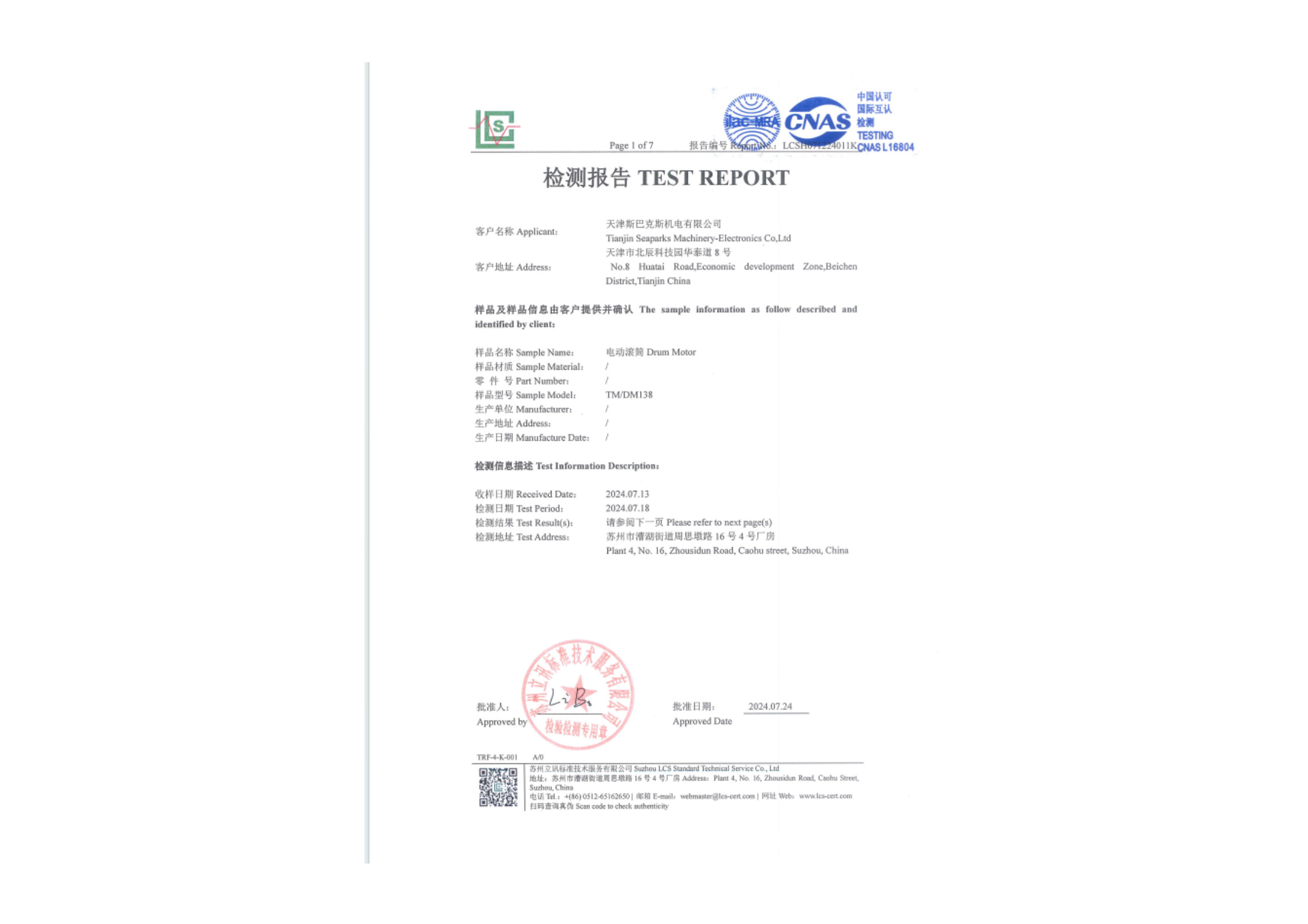
Ingress protection ratings define how well the drum resists dust and water. IP66 indicates dust-tight construction with protection against powerful water jets; IP67 adds temporary immersion. IP69 is referenced on SEAPARKS' light-duty series, covering protection against high-pressure water jet cleaning. For hygienic applications, the F-series carries IP69K, the rating used for equipment that must withstand high-temperature, high-pressure washdown. SEAPARKS' IP69K rating is supported by test report LCSH071224011K, issued by Suzhou Luxun Standard Technical Service Co., Ltd., a CNAS-accredited laboratory, citing ISO 20653:2023 for the test.
How SEAPARKS structures its portfolio
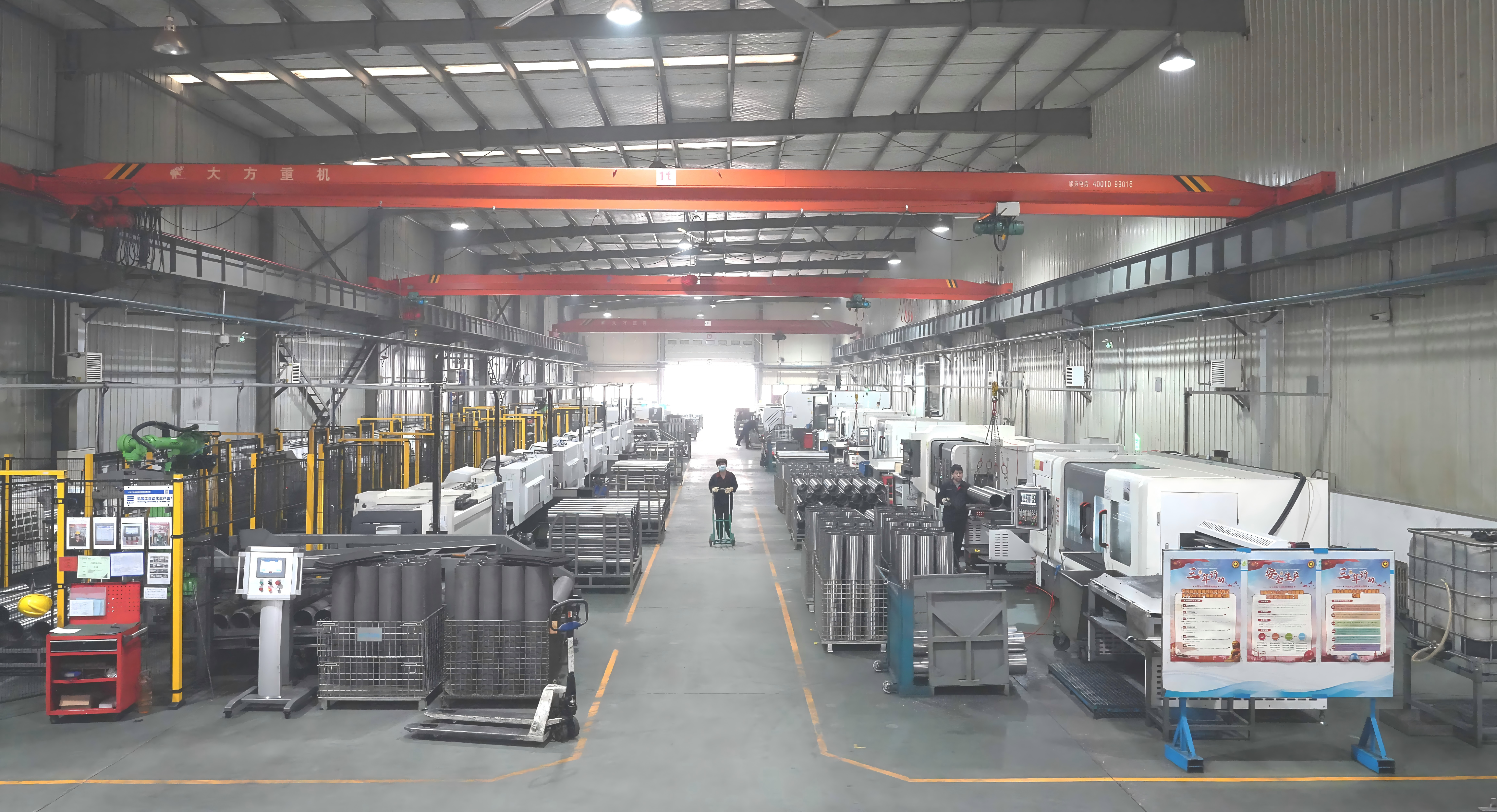
Tianjin Seaparks Machinery-Electronics Co., Ltd. (SEAPARKS) is a drum motor manufacturer founded in 2002 in Tianjin, China. The company reports a plant area of 50,000 square meters, roughly 360 employees, an R&D team of 40 engineers, and an annual output capacity of 300,000 motorized conveyor drums. According to its company profile, more than one million SEAPARKS drum motors are currently operating worldwide, exported to more than 50 countries. The company also holds ISO 9001 quality management, ISO 14001 environmental management, and ISO 45001 occupational health and safety certifications.
The product structure is organized by duty class. The DXZ series covers oil-free drum motors for belt conveyors; the DMA/F/H and TMA/F/H series cover synchronous and asynchronous oil-immersed drum motors; and the AM200 and TP series are pallet drum motors for roller conveyors. Unpowered conveyor rollers complete the range. The table below summarizes how the portfolio maps to configuration options.
| Duty class | Series | Diameter | Motor types | Housing | Protection |
|---|---|---|---|---|---|
| Light Duty | TM80A, DM80A, TM80M, TM113A, DM113A, TM113M, TM138A, DM138A | Ø80–Ø138 mm | Single/three-phase asynchronous; three-phase/DC synchronous | Carbon steel or 304 stainless steel | IP66/IP67/IP69 |
| Hygienic | TM80F, DM80F, TM113F, DM113F, TM138F, DM138F, TM165F, DM165F, TM216F, DM216F | Ø80–Ø216 mm | Three-phase asynchronous; three-phase/DC synchronous | 304 stainless steel (316 optional) | IP69K |
| Heavy Duty | DM100H, DM138H, TM138H, DM165H, TM165H, TM174H, DM216H, TM216H, TM270H, TM320H | Ø100–Ø320 mm | Three-phase asynchronous; three-phase synchronous | Carbon steel or 304 stainless steel | Confirm per configuration |
Within each class, the model data shows the operating window. The three-phase TM113A, for example, is rated 0.12–0.55 kW with a maximum belt pull of 1469 N and nominal belt speeds from 0.09 to 1.4 m/s. The synchronous DM113A achieves a higher belt pull (2053 N) over a slower speed window (0.14–0.68 m/s). The hygienic DM165F is rated 1.1–3 kW with 5229 N maximum belt pull, while the heavy-duty TM320H covers 1.5–7.5 kW with 6600 N maximum belt pull. These figures illustrate why suppliers publish torque and belt pull bands rather than a single rating: the internal gear ratio tailors the drum to the application.
| Model | Motor type | Power range | Max belt pull | Belt speed range |
|---|---|---|---|---|
| TM113A (three-phase) | Asynchronous | 0.12–0.55 kW | 1469 N | 0.09–1.4 m/s |
| DM113A (three-phase) | Synchronous | 0.12–0.55 kW | 2053 N | 0.14–0.68 m/s |
| TM165F | Asynchronous | 0.25–2.2 kW | 4147 N | 0.1–2.0 m/s |
| DM165F | Synchronous | 1.1–3 kW | 5229 N | 0.42–2.09 m/s |
| TM320H | Asynchronous | 1.5–7.5 kW | 6600 N | 0.63–3.2 m/s |
Protection ratings for the heavy-duty H-series are documented separately for each model configuration; buyers should confirm the rating for the selected variant.
Mapping configurations to application scenarios
The value of configuration flexibility is easiest to see in application terms. SEAPARKS' model data links each series to the industries it is designed for.
Security screening, X-ray inspection, and airport baggage handling. The light-duty A-series is listed for security screening conveyors at airports and railway stations, airport baggage handling systems, packaging conveyors, belt scale conveyors, and general belt conveyors. The Ø80–Ø138 mm diameters fit the enclosed frames of screening machines, and the single-phase options are useful in installations where three-phase supply is not guaranteed.
Food processing, meat processing, and pharmaceutical production. The hygienic F-series is listed for medium-duty belt conveyors, meat processing conveyors, food processing conveyors, packaging conveyors, belt sorting conveyors, assembly lines, and agricultural product belt conveyors. The 304 stainless steel shell (316 optional) and IP69K rating are the defining capabilities for washdown environments.
Logistics, warehouse, and e-commerce conveying. The heavy-duty H-series is listed for express logistics, warehouse logistics, e-commerce logistics, automated warehousing, airport logistics, manufacturing logistics, automotive manufacturing, packaging, automated sorting systems, and conveyor automation. The larger diameters and higher belt pull — up to 6600 N on the TM320H — support continuous operation in sorting hubs.
For a buyer, the practical takeaway is that the same supplier can cover multiple conveyor populations — security screening, food processing, and parcel sortation — with one drive principle and different configurations. That reduces the number of vendors in the supply chain and simplifies spare-part strategy.
Market trends supporting configurable drum motors
The drum motor market is growing on the back of logistics automation and food processing demand. Custom Market Insights valued the global drum motor market at approximately USD 2.13 billion in 2025. Dataintelo projects Asia Pacific to hold a 38.2% revenue share by 2025, making it the fastest-growing region, with industrial growth in China and India as a stated driver. The same source reports that AC motors account for a dominant 52.3% of the drum motor revenue share.
Two technical trends support the shift toward more configuration variants. First, hygiene standards are tightening: IP69K is the highest ingress protection rating under IEC 60529 and is required for hygienic drum motors to withstand high-pressure (up to 1450 psi) and high-temperature (80°C) washdowns, according to IBT Industrial Solutions. Second, efficiency is becoming a buyer criterion: energy-efficient drum motors can achieve overall efficiency of up to 82–83%, reducing lifetime cost compared with traditional geared motors, per data published by Rulmeca and Interroll.
Both trends point in the same direction. Food and pharmaceutical buyers are standardizing on stainless steel and IP69K configurations. Logistics buyers are favoring efficient three-phase drives in larger diameters. The market is effectively rewarding suppliers whose portfolios offer configuration depth rather than a single mass-produced variant.
Drum motors versus conventional gearmotor drives
The drum motor's advantage over a conventional motor-and-gearbox assembly is structural. Housing the motor and gearing inside the drum eliminates external couplings, chains, and guards; the sealed shell prevents lubricant leakage and product contamination; and the smooth surface is easier to clean. In hygienic lines, those differences are decisive. In logistics conveyors, the compact drive reduces installation height and snagging risk.
The comparison is not one-sided. Drum motors are generally replaced as complete units: because the motor and gearbox are integrated, a failure typically means removing the drum and mounting a replacement, whereas a conventional gearmotor can often be repaired at component level. High-power applications are another boundary — SEAPARKS' largest heavy-duty drum motor, the TM320H, reaches 7.5 kW, and designs requiring substantially more power still tend to use conventional geared drives. Thermal behavior also differs: the motor is enclosed inside the shell and relies on the drum surface and, in oil-immersed designs, the oil charge for cooling, so the duty cycle must be checked against the manufacturer's ratings rather than assumed.
Future outlook
Several forces point to continued growth in configurable drum motors. Warehouse and e-commerce automation is expanding most quickly in Asia Pacific, the region with the highest projected revenue share. Food safety regimes in mature markets are pushing hygienic drum design toward IP69K and stainless steel as a baseline. Energy efficiency requirements favor the drum motor's integrated, low-loss design over external gearboxes.
For buyers, the practical implication is in the specification stage. Suppliers that document their configuration options — housing materials, gear materials, phase variants, protection classes, and test reports — make the evaluation process faster and more reliable. As the market grows, that documentation is likely to become a standard part of drum motor procurement.
FAQ
Which drum motor housing material should I choose: carbon steel or stainless steel?
For general industrial conveyors, carbon steel is available across SEAPARKS' light-duty and heavy-duty series and provides a cost-effective combination of strength and durability. Where corrosion resistance, cleanability, or washdown is required, 304 stainless steel is the standard housing on the hygienic F-series and is also offered as an option on other series. If the cleaning chemistry is aggressive, 316 stainless steel can be specified on the hygienic series. The decision should follow the facility's moisture level and cleaning agents.
What is the difference between single-phase and three-phase drum motors?
Single-phase asynchronous drum motors — such as the TM80A and TM113A variants — are designed for light-duty applications where only single-phase supply is available. Three-phase versions are offered across SEAPARKS' light-duty, hygienic, and heavy-duty series and are the more common choice in industrial conveyor systems. Within the same model family, single-phase and three-phase units often have different power and pull ratings; for example, the single-phase TM113A is rated 0.12–0.23 kW while the three-phase TM113A is rated 0.12–0.55 kW.
What does IP69K mean for a drum motor?
IP69K is the ingress protection rating used for equipment that must withstand high-pressure, high-temperature washdown. SEAPARKS' hygienic F-series drum motors carry IP69K, documented in test report LCSH071224011K issued by Suzhou Luxun Standard Technical Service Co., Ltd., a CNAS-accredited laboratory, under ISO 20653:2023. In practice, it means the drum is protected against dust and the hot high-pressure water jets used in food and pharmaceutical cleaning.
How are belt speed and belt pull specified for a drum motor?
Each drum motor model covers a range of power, torque, belt pull, and belt speed rather than a single operating point. The three-phase TM113A, for instance, offers 0.12–0.55 kW, up to 1469 N belt pull, and 0.09–1.4 m/s belt speed. The hygienic DM165F offers 1.1–3 kW, up to 5229 N, and 0.42–2.09 m/s. The internal gear ratio is selected to achieve the required speed and pull, so buyers should specify belt speed and load rather than only power.
What certifications should a drum motor have for EU and North American projects?
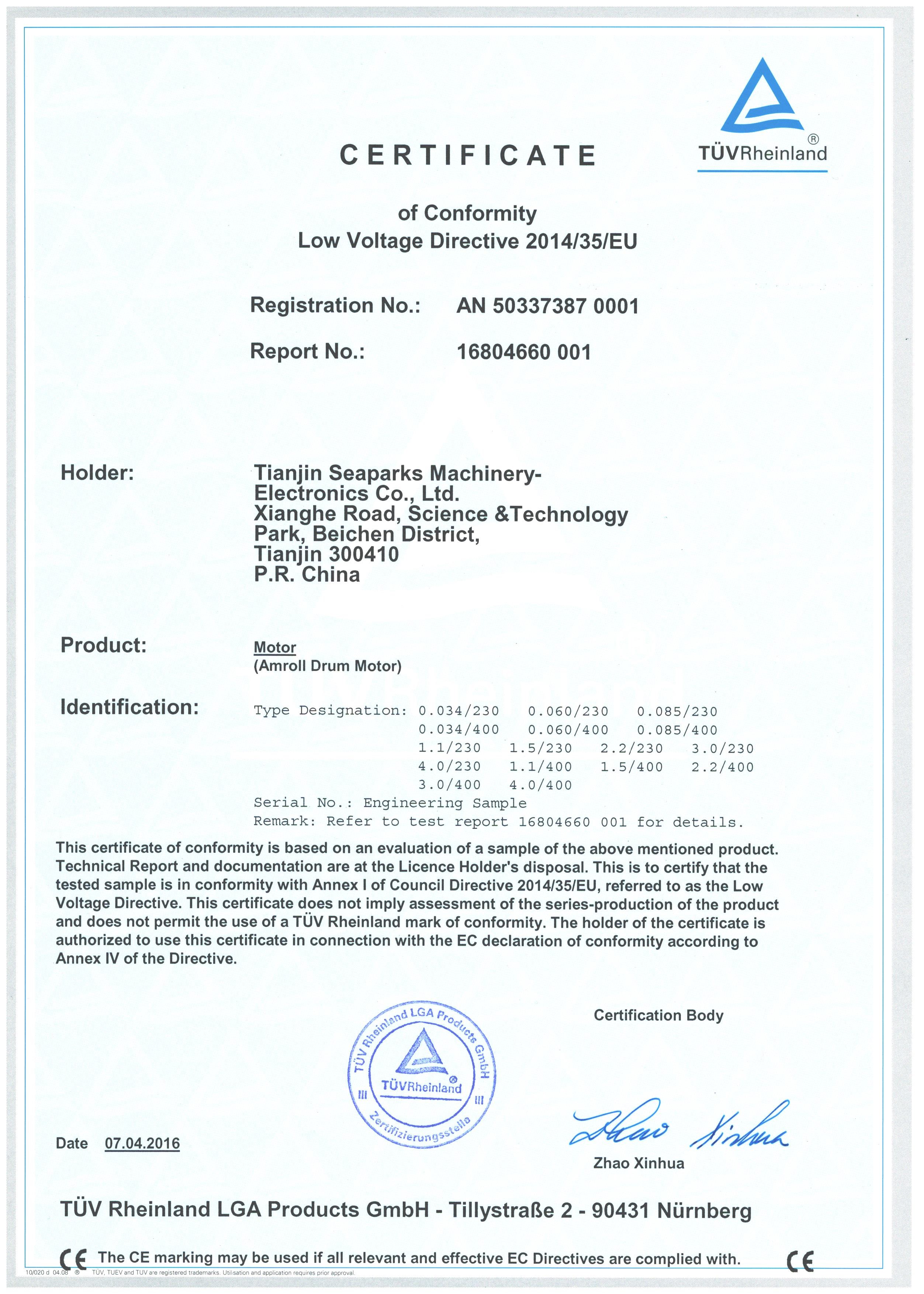
For the EU, drum motors must bear CE marking, which for SEAPARKS is documented through TÜV Rheinland certificates under the Low Voltage Directive 2014/35/EU (certificates AN 50337407 0001 and AN 50337387 0001) and the EMC Directive 2014/30/EU (certificate AE 50461043 0001). For North America, the company holds TÜV Rheinland UL certificates (CU7219001101, CU7219001102, CU7219000901) referencing UL 1004-1 and CSA C22.2 No.100-04. RoHS compliance is verified under 2011/65/EU via an SGS test report.
What are the ordering terms for low-volume drum motor procurement?
SEAPARKS lists a minimum order quantity of 1 unit, with FOB/CIF delivery terms and pre-shipment inspection. Payment for new customers is 100% advance. These terms make single-unit evaluation and prototyping feasible before full-scale procurement.